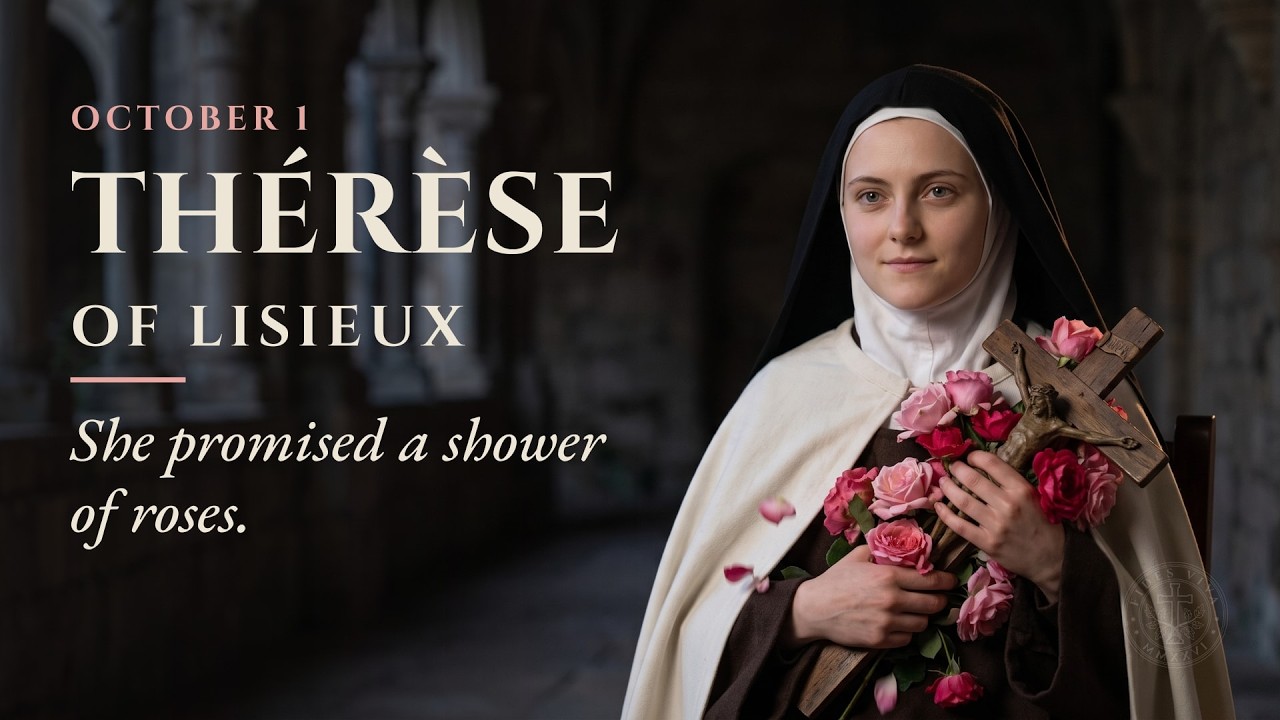
In the infirmary of a convent in Lisieux, a twenty-four-year-old Carmelite, sick with tuberculosis, takes a rose and pulls its petals off, one by one, over her crucifix. She asks that not a single petal be lost.
This is Thérèse of the Child Jesus, whom half the world calls the Little Flower: the saint of the roses. In those months she had promised that, after her death, she would go on doing good on earth, and that her help would fall like a shower of roses.
What few people know is that, even as she made that promise, heaven had turned to fog for her. She could no longer feel it, and she confided as much to one of her sisters. Even so, she kept declaring her faith and praying for those who did not believe.
How do you promise a shower of roses from inside a night like that? What did she say as she died? And what did they find thirteen years later, when they opened her tomb?
A Mother Lost and a Smile
That Carmelite had begun life in Alençon, a town in Normandy, in the France of the Third Republic. Outside the churches, atheism was enjoying its golden age. Inside, many Catholics prayed with a stern piety that spoke more of God's justice than of his mercy.
In the Martin home, death knew the way in. Of Louis and Zélie's nine children, four died young. Five girls remained: Marie, Pauline, Léonie, Céline and the youngest, Thérèse, born in January 1873.
Zélie fell ill with cancer and died at the end of August 1877. Thérèse was four and a half. She watched her mother receive the Extreme Unction, the sacrament of the dying, now called the Anointing of the Sick. The five sisters stood in a row, oldest to youngest, and their father was sobbing.
Then he lifted her into his arms: "Come and kiss your poor little mother one last time." Without a word, the little girl put her lips to her mother's forehead.
She did not cry much. She watched and listened in silence. Once she found herself alone in front of the coffin lid, and she stood looking at it for a long time. She was so small that she had to tip her head back to see all of it.
On the day of the funeral, the five girls looked at one another sadly. Louise, the maid, said: "Poor little things, you have no mother anymore!" Céline threw herself into Marie's arms: "Well then, you'll be Mama." Thérèse turned to Pauline and flung herself into her arms: "Well, for me, Pauline will be Mama!"
With that death, the most painful period of Thérèse's life began.
In November, Louis took his daughters to Lisieux, to a house with a garden called Les Buissonnets, near the family of their uncle Isidore Guérin.
In 1882, Pauline left too. She entered the Carmel of Lisieux, a convent of nuns devoted to prayer who never leave its walls. Toward the end of that year, Thérèse fell seriously ill. She had severe headaches and bouts of sickness, and she saw things that were not there. The family arranged a novena of Masses to Our Lady of Victories: nine consecutive days of supplication.
One Sunday in May 1883, Pentecost Sunday, Marie stepped out into the garden for a moment. From her bed, the child began to call, almost in a whisper: "Mama… Mama…" Marie came straight back. Thérèse saw her come in but could not manage to say she recognized her, and she kept calling, louder and louder.
Marie knelt by the bed with Léonie and Céline. The three of them turned toward the statue of Our Lady in the room. Marie was praying "with the fervor of a mother begging for her daughter's life." With no help left on earth, the little girl turned to her Mother in heaven as well.
"All of a sudden the Blessed Virgin seemed beautiful to me, so beautiful that I had never seen anything so lovely… but what went right to the depths of my soul was the ravishing smile of the Blessed Virgin."
Two big tears ran silently down her cheeks, "tears of pure joy." And she thought: "The Blessed Virgin has smiled at me, how happy I am… but I will never tell anyone."
She lowered her eyes and saw Marie gazing at her with love. The child was cured.
A year later would come the day she had longed for most: her First Communion, when she would receive Jesus in the Eucharist for the first time. That same day, behind the grille of the Carmel, Pauline would make her vows forever.
Shoes by the Fireplace and a Condemned Man
In the chapel of the Benedictine abbey where she went to school, the child received Jesus for the first time.
It was the first kiss of Jesus to her soul, a kiss of love. She felt loved, and she answered him: "I love you, I give myself to you forever."
That morning there were no requests and no struggles. She and Jesus had known each other for a long time, and that day "it was no longer a look, but a fusion." Her joy was so great that she burst into tears, and her companions could not understand why.
The girl who cried for joy also cried over almost everything. On Christmas Eve 1886, the family came home to Les Buissonnets after Midnight Mass. By an old custom, Thérèse's shoes stood waiting by the fireplace, filled with presents. She was thirteen, and at home they still treated her as the little one.
That night her father was tired. When he saw the shoes, he said words that pierced her heart: "Well, at last, thank goodness this is the last year!"
She went upstairs to take off her hat. Céline saw tears shining in her eyes: "Oh, Thérèse, don't go down, it would hurt you too much to look at your shoes now!"
But this time Thérèse was no longer the same: Jesus had changed her heart.
She held back her tears. She hurried downstairs. She picked up the shoes and set them in front of her father. One by one she took out the presents, "looking happy, like a queen." He burst out laughing. Céline thought she was dreaming.
That night she recovered the strength of soul she had lost at four and a half, when her mother died. She called it her complete conversion. From then on, she added, no battle defeated her: she had set out on "a giant's race."
That new strength soon looked for someone to serve. One Sunday in July 1887, at the end of Mass in Saint-Pierre Cathedral, a holy card of the Crucified Christ was sticking out of her missal. Before that image she sensed what her mission was: to save souls.
That summer the newspapers were full of Henri Pranzini, sentenced to death for a triple murder. He refused any religious help. The teenager began to pray for him and to offer God, for his salvation, all that Jesus had suffered for everyone.
She asked Céline to have a Mass offered for her intentions, without daring to say it was for "Pranzini, the great criminal." Céline coaxed it out of her and, far from laughing at her, joined her.
Thérèse told God she was sure he would forgive the man even if he never went to confession. She asked only for "a sign" of repentance, for her own comfort. Their father had forbidden them to read the newspapers, but she did not think she was disobeying if she read what concerned Pranzini.
He was guillotined in Paris on August 31, 1887. The next day, she opened La Croix, the Catholic newspaper, and read:
"Pranzini had not gone to confession; he had climbed onto the scaffold and was about to put his head into the grim opening when, suddenly, he turns, takes hold of a crucifix the priest was holding out to him, and kisses its sacred wounds three times."
Her tears gave her away, and she had to hide. She would call that man her "first child."
It would not be the last time a crucifix stood at the center of her story.
If her prayer could reach a condemned man, Thérèse now knew where she wanted to pray from: behind the walls of the Carmel of Lisieux, where Pauline and, more recently, Marie were living. She was fourteen.
Forbidden to Speak to the Pope
The first door she knocked on was her father's. A few months earlier, at the end of May 1887, she had asked his permission to enter the Carmel, and Louis Martin had given it.
The other doors did not open so quickly. Her uncle, Isidore Guérin, refused at first and did not give in until October. The ecclesiastical superior of the Carmel, the priest responsible for that community, was opposed: the girl was too young.
That left the bishop. A few days later she traveled with her father to Bayeux. Before going in to see him, she put her long hair up in a bun to look older. The bishop postponed his answer.
In November, Louis, Céline and Thérèse joined a diocesan pilgrimage to Rome. They passed through Loreto. At the end of the journey, an audience with Leo XIII was waiting for them.
On November 20, the pilgrims filed past the Pope one by one. They knelt, kissed his foot and his hand, and received his blessing. Beside Leo XIII stood Father Révérony, vicar general of Bayeux, the priest who acted in the bishop's name. Word soon came from Father Révérony: it was forbidden to speak to the Pope.
She turned to Céline. And her sister said just one word to her: "Speak!"
At the Pope's feet, instead of kissing his hand, she folded her hands. Her eyes were full of tears: "Most Holy Father, I have a great favor to ask of you."
The old man bent his head until it almost touched her face.
"Most Holy Father, in honor of your jubilee, allow me to enter the Carmel at fifteen."
"I don't quite understand," said the Pope. The vicar explained to him that the superiors were considering the matter. "Well then, my child, do what the superiors tell you."
She rested her hands on the Pope's knees: "Oh, Most Holy Father, if you said yes, everyone would agree!"
Leo XIII looked at her steadily: "Come, come… You will enter if God wills it."
Thérèse wanted to keep talking. Two Noble Guards took her by the arms and, with the vicar's help, pulled her away from the Pope's feet by force.
"If God wills it." That was all she took home from Rome.
The bishop's permission came later. On April 9, 1888, at fifteen, she walked through the door of the Carmel of Lisieux. She had knocked on every door she could find, and this one opened when it no longer depended on her.
She was entering the Teresian Carmel, the religious family of another Teresa: Saint Teresa of Jesus, the great saint of Ávila. Her writings would nourish this young woman.
Inside, she faced a schedule that began at a quarter to five in the morning and a cloister with no heating. Within a few months, the hardest news about her father would reach her from outside.
Behind the Grille: the Holy Face
The grille of the Carmel separated two worlds. Behind it, the rule of enclosure held: once inside, a sister never left the monastery again.
Thérèse was a postulant, the young woman who asks to enter and does not yet wear the habit. She sewed in the linen room and swept. Of those beginnings she left a plain summary: "more thorns than roses."
In January 1889 she received the Carmelite habit. A month later the news came. Her father "would drink the most bitter, the most humiliating of all cups." A serious illness meant that he had to be admitted to an institution in Caen, where he would spend three years. She could not go out to see him.
"Words cannot express our anguish."
And yet, looking back, she called those three years "the dearest, the most fruitful of our whole life." And she added: "I would not give them up for all the ecstasies and revelations of the saints."
Dryness, a prayer that brought no sweetness at all, was her daily bread. She spent long stretches contemplating the Holy Face, the humiliated face of Christ in his Passion. She always carried the Gospel with her and read Saint John of the Cross, the Carmelite who was her true teacher. Her religious name joined the two ends of Jesus' life: Thérèse of the Child Jesus and of the Holy Face. The prayers she wrote to the Holy Face of Christ are still prayed.
At seventeen, in September 1890, she made her profession, the vows that bound her to the Order forever, and a few days later she received the black veil. In her cell she carved a few words: "Jesus is my only love."
A year later, during a retreat, the priest who preached it launched her "full sail upon the waves of confidence and love."
In the summer of 1894 her father died. Weeks later, Céline too walked through the door of the Carmel, and she brought her camera with her. Thanks to her, we know her sister's face today.
That autumn, with her father gone and Céline at her side, Thérèse kept running into the same wall: she wanted to be a saint, and every day she saw herself further from the saints.
The Elevator
She put it in an image: "When I compare myself with the saints, I have always found that there is the same difference between them and me as between a mountain whose summit is lost in the sky and the obscure grain of sand trodden underfoot by passers-by."
She did not lose heart. She reasoned that God cannot inspire desires that are impossible. Growing bigger was beyond her; she would have to accept herself as she was, imperfections and all. But she wanted to find another way to get there: "a little way that is very straight, very short, a totally new little way."
She lived in an age of inventions. In the homes of the rich, no one had to climb the stairs anymore: an elevator had replaced them. She wanted an elevator too, because she was too little to climb the rough stairway of perfection. She looked for it in Scripture and found these words: "Whoever is a little one, let him come to me." And another passage in which God promises to comfort like a mother who caresses her child and rocks it on her knees.
"The elevator that is to lift me up to heaven is your arms, O Jesus! For that I do not need to grow up; on the contrary, I must stay little, and become ever more so."
On June 9, 1895, the feast of the Most Holy Trinity, she took the next step. She offered herself to Merciful Love: she gave herself entirely, holding nothing back, to the love of God that bends down to what is small. In the prayer she wrote that day, she left this line: "In the evening of this life, I shall appear before you with empty hands."
Many still pray it today, in her own words.
Pauline, prioress since 1893 under the name Mother Agnes of Jesus, had entrusted her with helping to form the novices. She also asked her to write down her childhood memories, and Thérèse filled school notebooks with them until she handed them over in January 1896.
Later on, not long before her death, a novice told her that one day they would find her body incorrupt. Her answer came quickly: "Not that marvel! It would take me off my little way of humility."
Every evening, ten minutes before six, Sister Saint Peter shook her hourglass. It meant: "Let's go!" She was old and infirm, and someone had to take her to the refectory. Move the bench just so, never hurry, hold her by the belt.
One wrong step: "Oh, my God, you're going too fast, I'm going to break something!" A slower step: "I knew you were too young to lead me."
In the refectory, Thérèse rolled up her sleeves for her. Because those hands could barely manage the bread, she cut it for her. And before leaving, she gave her "my most beautiful smile."
One winter evening, in the frozen cloister, she heard distant music and imagined a glittering drawing room. She would not have traded those ten minutes of service for a thousand years of parties.
There was another sister who, in Thérèse's words, had "the knack of displeasing me in everything." Charity, she told herself, lies not in feelings but in deeds. She prayed for her every time they met and did every service she could for her. When she felt like answering her sharply, she gave her "my friendliest smile." Sometimes, when the struggle was too much, she fled "like a deserter."
One day at recreation, the sister asked her, quite delighted: "What is it that draws you to me so much? Every time you look at me, I see you smile."
What drew Thérèse was "Jesus hidden in the depths of her soul."
In March 1896 she asked to work in the linen room alongside Sister Marie of Saint Joseph, whom the community considered difficult. "If you only knew how much we have to forgive her," Thérèse would tell them.
What she was learning about love, that it does not depend on what one feels, she would soon need in order to believe.
A few weeks later came Holy Week of 1896. Thérèse had kept the whole of Lent with a strict fast, and she said she had never felt so strong.
Holy Thursday: the Tunnel
On the night of Holy Thursday she kept watch before the Altar of Repose, the altar where the Eucharist is kept that night after the Mass that recalls the Lord's Last Supper. She stayed there until midnight. Then she went back to her cell.
Her head had barely touched the pillow when she felt "something like a stream rising, rising, boiling up to my lips." She did not know what it was. She thought she might be about to die, and her soul filled with joy. The lamp was out. She decided to wait until morning to be sure of her "happiness."
When she woke, she went to the window. She had not been mistaken: it was blood.
This is how she understood it: "I was inwardly convinced that Jesus, on the anniversary of his death, wanted me to hear a first call. It was like a sweet, distant murmur announcing the Bridegroom's arrival." The Bridegroom: that was her name for Christ.
That morning she told the prioress. She added that she was not suffering at all and asked not to be given any special treatment. She spent Good Friday keeping every austerity of the Carmel. The next night, the same sign came.
She had coughed up blood for the first time. It was the first sign of tuberculosis, which at the time caused one in every seven deaths in Europe. In 1897 it would take around one person a week in Lisieux.
That same Easter, another trial began. Until then her faith had been so alive that she could not believe unbelievers existed: she thought they were speaking against what they really thought. "In the joyful days of Eastertide, Jesus made me feel that there really are souls who have no faith."
God allowed her soul "to be invaded by the thickest darkness." The thought of heaven, once so sweet to her, became "a cause of struggle and torment."
"You have to have traveled through that dark tunnel to understand its darkness."
It was like being born in a country wrapped in thick fog, never having seen the sun, and knowing, all the same, that your true homeland is somewhere else.
She kept making acts of faith. She prayed for those who did not believe. She sang what she wanted to believe. She herself joined that darkness to the unbelief of her time. And the trial would stay with her until her death.
That same year, with her body wounded and the sky covered in fog, Thérèse felt a longing for every vocation at once. In the Carmel she had already been asked to pray for a young man who was preparing to become a priest.
In the Heart of the Church
His name was Maurice Bellière. In October 1895, Mother Agnes had entrusted him to her as a spiritual brother: a seminarian whom Thérèse would support with her prayer and her letters.
In May 1896 she was given a second brother: Father Adolphe Roulland, a young priest of the Paris Foreign Missions Society who was leaving for China. Thérèse asked Father Roulland for a lock of his hair. A "relic," she told him, in advance.
During her retreat in September, her longing for every vocation weighed on her: she wanted to be an apostle, a missionary, a martyr, all at once, and she did not know how to bring it all together. She opened the First Letter of Saint Paul to the Corinthians. She read about the members of the body of Christ, each with its own role. She did not recognize herself in any of them.
She kept reading. The Apostle urged his readers to desire the greatest gifts and promised to show them a still better way. And he explained that without love, those gifts are nothing.
"I understood that if the Church had a body made up of different members, it did not lack the most necessary, the most noble of them all: I understood that the Church had a heart, and that this heart was burning with love."
She understood, too, that if that love were ever to go out, the apostles would stop proclaiming the Gospel and the martyrs would refuse to shed their blood.
"O Jesus, my love!… my vocation, at last I have found it: my vocation is love!… In the heart of the Church, my Mother, I will be love… and so I will be everything."
She corrected herself at once. It was not a delirious joy. It was "the calm and serene peace of the sailor who sees the lighthouse that will guide him into port."
A few days later she summed it up in a letter to her sister Marie: "Trust, and nothing but trust, can lead us to Love."
But the fog was still there. In October, during the retreat for the whole community, she confided her doubts to the priest who was preaching it. He advised her to carry the Creed over her heart.
She obeyed. She copied it out in her own blood and kept it on her.
In November a request arrived from far away. The Carmel of Saigon needed reinforcements, and in Lisieux they thought of her.
The community made a novena to Théophane Vénard, a young missionary martyred in Tonkin in 1861, whom Thérèse loved dearly. They asked for a sign.
During the novena, Thérèse began coughing again: "the sheath is not as strong as the sword."
She would not go to Saigon. In January 1897, in her own Carmel, one of the sisters came to tell her about a dream.
The Black Door and a Promise
It was Sister Thérèse of Saint Augustine. On January 8 she heard creaking sounds, and that night she dreamed of Thérèse's father, who had died years before. In the dream, "Mr. Martin is asking for Sister Thérèse of the Child Jesus." At first she dismissed the impression as superstition.
The next day she told Thérèse, who was glad: her death was near.
Later, on one of the community's free days, when the sisters were allowed to talk with one another, Sister Thérèse of Saint Augustine told her the whole dream. She had seen a very black door, draped with red and gold gauze.
Thérèse listened. And she confided what was happening in her soul.
"I do not believe in eternal life; it seems to me that after this mortal life there is nothing more."
Thérèse told her that the black door was an image of what was happening in her soul. There, all she had left was love.
The same Thérèse who had inscribed "Jesus is my only love" on the wall of her cell now felt nothing on the other side.
That same January, in a letter, she wrote: "if there is a heaven, it is for me."
On March 19, the feast of Saint Joseph, she told her sister Marie what she was asking of the saint: "the grace of spending my heaven doing good on earth." In May, at Marie's request, she wrote a poem to the Virgin, "Why I Love You, Mary," which is still sung today.
Her body was paying the price. On May 23, the doctor applied more than five hundred cauterizations to her side: small burns that were used back then as a remedy. Afterward Thérèse went up to her cell and lay down on her pallet, the straw mattress Carmelites slept on. The doctor prescribed morphine.
In June, out of obedience to the prioress of the time, Mother Marie de Gonzague, she began filling her last notebook. And in those weeks she said the words that would make her known across half the world: her work after death, she announced, "will be like a shower of roses."
She made the promise of the roses in the depth of her night, when she could no longer feel heaven.
To Maurice Bellière, her spiritual brother, she wrote: "I am not dying; I am entering into life."
On July 8 they brought her down to the infirmary. In the room there was an image of the Virgin. She would never leave it again.
September 1897
In the infirmary, the little one who had learned to let herself be carried could no longer take a single step. Beside the bed sat Pauline, Mother Agnes, the sister she had chosen as her mother when she was a child. Day after day, she wrote down in a notebook what Thérèse said.
On September 6 they brought her a relic of Théophane Vénard, the young martyr of Tonkin. She wept for joy.
Within a few days she grew much worse: her feet swelled, and on the 14th they estimated she had no more than fifteen days to live.
That same day she held a rose in her hands. She pulled off its petals one by one over her crucifix, and with each petal she caressed the wounds. She asked that not one be lost: later on, they would serve "to bring joy."
On the 20th she called herself "a skeleton." She said she groaned and begged for mercy without ceasing. And she denied that she was patient.
By the 22nd her voice was almost gone. Even so, she said: "What a grace it is to have faith!" Without faith, she admitted, she would have taken her own life.
Two days later she said: "My soul, in spite of its darkness, is in an astonishing peace." The doctor remarked that her face was not altered and that she had "the look of an angel."
In those weeks she had said: "it is very easy to write beautiful things about suffering… you have to be in it." And the day after speaking of her peace, she declared that what she had written about suffering was true. On the 28th she listened to the office of Saint Michael, the archangel.
On the morning of the 29th the death rattle began, the hoarse breathing of the final agony. The community knelt to say the prayers for the dying. At midday, Thérèse asked: "Mother, is this the agony?… I shall never know how to die."
That night, after Matins, the night prayer, she said: "Yes, my God, I want it all."
On the morning of the 30th, she joined her hands. She was looking at the image of the Virgin. "It is pure agony, without any mixture of consolation."
In the afternoon she was struggling for breath. Then, through the window, came the singing of birds: robins and other little birds, very loud, very close, for a long while. That singing pierced Mother Agnes to the heart.
Céline put a small piece of ice to Thérèse's lips. Thérèse took it with a smile. It was a smile "like a last farewell," and Mother Agnes never forgot it.
At six o'clock the Angelus rang, the prayer that recalls the angel's message to Mary. Thérèse looked for a long time at the image of the Virgin.
A little after seven, the prioress had sent the community away. Thérèse asked: "Mother, isn't this the agony yet?… Am I not going to die?"
The prioress answered: "Yes, my poor little one, it is the agony, but perhaps God wants to prolong it for a few hours."
Thérèse replied: "Well then… go on!… go on!… Oh, I would not want to suffer for a shorter time…"
She looked at her crucifix. And she said the last words she would ever say:
"Oh, I love Him!… My God… I love you!"
She sank gently back. The prioress rang the infirmary bell: "Open all the doors." The sisters came in and knelt down.
They saw Thérèse's face regain the color it had when she was well, and her eyes remain fixed on high, shining with peace and joy. It lasted "the space of a Creed." Then she breathed her last.
It was twenty past seven in the evening on September 30, 1897. She was twenty-four years old.
She was gripping her crucifix so tightly that they had to pull it from her hands to prepare her body for burial.
They buried her in the Carmelites' plot in the cemetery of Lisieux. Outside her family and her convent, no one knew who she was.
Shower of Roses
The following year, her name began to travel beyond Lisieux. Her notebooks were printed under the title *Story of a Soul*, in a run of two thousand copies. Her sisters presented them as if everything had been addressed to a single person, polished the style and left out some passages.
Even so, the book passed from hand to hand. Then letters began to arrive at the Carmel. They came from people everywhere who said they had received a grace after asking her for it. It was the shower she had promised from within her night.
In less than thirty years, the sisters recorded some eight thousand accounts. These were not miracles recognized by the Church: they were graces the faithful told of with gratitude.
Thirteen years after her death, on a September morning in 1910, they opened her grave. They dug down three and a half meters and brought up the coffin, badly decayed. Those standing by the grave said that the palm placed there in 1897 came up green and fresh, and that two of the workmen noticed a strong scent of violets.
Of her, only bones remained. It was what she had wanted: no marvel to lead her off her Little Way. The bishop forbade anyone to take away a single fragment, and more than five hundred people came to venerate her remains.
In 1914, Pius X signed the introduction of her cause, the process that examines whether someone can be declared a saint. Then war broke out. Many French soldiers prayed to her, and so many of their pleas arrived that the tribunal was excused from investigating her reputation for holiness.
In March 1923, her remains returned to the Carmel. They rest in the Chapel of the Châsse: a statue of Thérèse lying in death holds her ribs, and beneath it, in a gilded silver reliquary given by devotees from Brazil, lie the rest of her bones. There they are still venerated today.
To beatify her, the Church had healings examined by doctors. One was that of Father Charles Anne, a priest of Lisieux sick with galloping pulmonary tuberculosis: the same disease that had taken her. In 1923, Pius XI beatified her in Saint Peter's, and in 1925, with two more approved healings, he declared her a saint.
There remained the wound of Saigon. Could the nun who never set sail because her cough came back be a missionary without leaving the enclosure? In December 1927, Pius XI proclaimed her patroness of the missions, alongside Saint Francis Xavier, the Jesuit missionary. From the day she crossed the threshold of the Carmel at fifteen, Thérèse had never once left it.
One thing was still missing: her voice as she had written it, without the corrections of 1898, and a sentence from one of her letters that someone had scraped away.
If There Is a Heaven
That voice had to wait more than half a century. Mother Agnes, her Pauline, lived until 1951. Pius XII had asked that the original texts not be brought to light until after Mother Agnes's death. In 1956, the notebooks were at last published just as Thérèse had written them, page by page.
That voice, now free of any retouching, reached Rome on October 19, 1997. In Saint Peter's Square, John Paul II proclaimed her a Doctor of the Church. With that title, the Church recognizes a teaching as a sure guide for all the faithful. Thérèse never studied theology. She learned from the Gospel she always carried with her, and her writings contain more than a thousand quotations from the Bible. She who had wanted to stay little now stood among the teachers of the faith.
Her memorial is celebrated on October 1, and every year at the end of September her reliquary is carried through Lisieux, from the Carmel to the Basilica and on to the Cathedral. Since 1994, her relics have traveled to nearly seventy countries, and throughout the Church people still pray her Offering and her poems are still sung.
The sentence that was scraped away was the one from January 1897: "if there is a heaven, it is for me." It had been copied for her cause for canonization. Afterward, someone erased it from the paper. The copy kept it, and today it can be read again.
She wrote it at a time when she could no longer feel heaven. And the whole of her trust fits within that sentence.
Saint Thérèse of the Child Jesus and of the Holy Face, you who knew you were too little to climb alone and let yourself be carried in the arms of Jesus, and who in the darkest night kept telling him "I love you," obtain for us that trust which does not need to feel in order to believe, and teach us to love in the little things of every day. Pray for us. Amen.