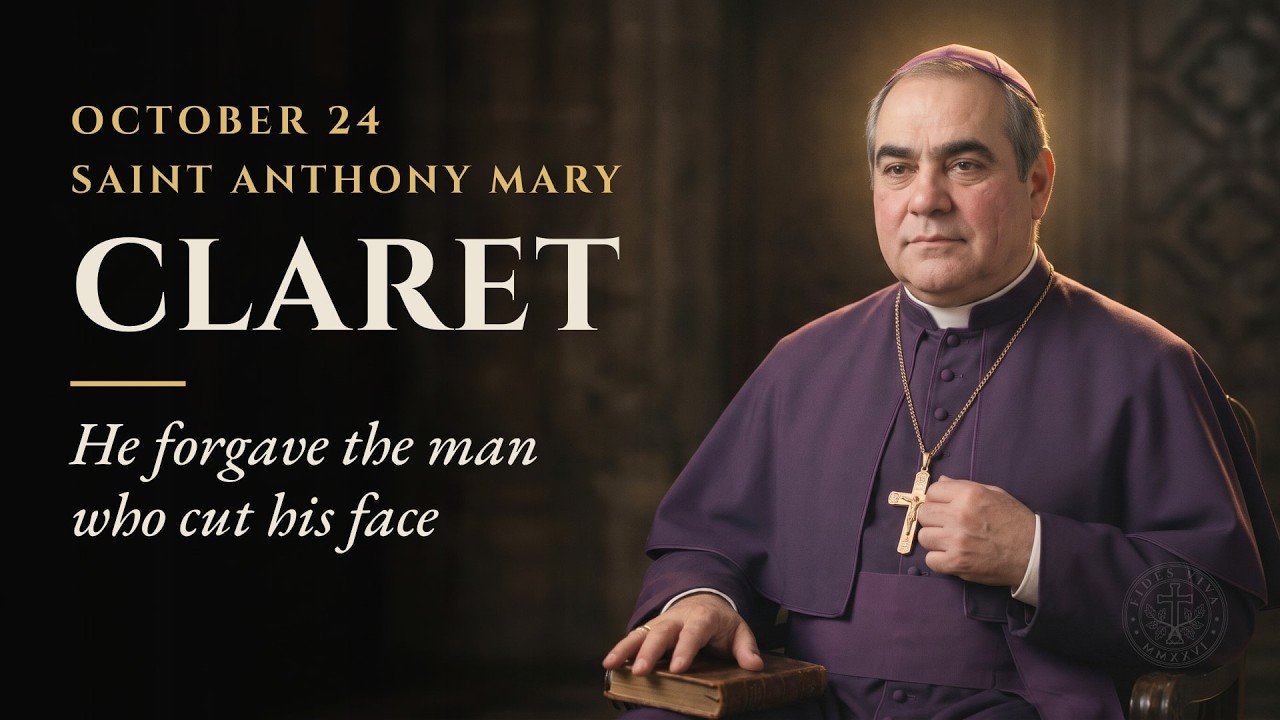
For days he had been saying from the pulpit that he wanted to seal what he preached with his own blood. One February night in 1856, the Archbishop of Santiago de Cuba, Anthony Mary Claret, was walking down the Calle Mayor, the main street of Holguín. People greeted him on both sides, and a sacristan lit his way with a lantern.
A man leaned toward him as if to kiss his ring. Instead, he pulled out a razor and slashed his face open from the ear to the chin.
The archbishop pointed to an apothecary's shop nearby and said "Let's go in here, where we'll have the remedies close at hand." Inside, he was the one who had to give the doctors courage. That night, what he felt was joy.
That man had begun his life in Catalonia, amid the clatter of the looms.
More Machines Than Saints
In the late 1820s, the future archbishop was not thinking about giving his blood for anyone. He was thinking about threads. In a factory in Barcelona, a city filling up with workshops and new machines, a young man from Sallent would spread out on the table the fabric samples that arrived from Paris and London. He took them apart until he understood how they were made, and then he drew the loom that could reproduce them.
He had arrived at seventeen, studied drawing at the school of the Lonja, and dressed with elegance, perhaps too much. He was so skilled that he even corrected the foreman, the man who ran the factory.
A few years earlier, in his father's workshop in Sallent, that same boy used to lead the rosary among the looms, and the workers answered without stopping their work. As a child he had told a visitor to his school that he wanted to be a priest.
Now, in Barcelona, some gentlemen proposed to his father that they set up a factory of their own with young Anthony. And Anthony, who until then had always obeyed his father, this time said no. He felt a revulsion inside that he could not explain. Even so, manufacturing had taken hold of him completely, like a fever. At Mass he had "more machines in his head than there were saints on the altar."
It was at Mass that something broke. One morning, while the priest went on at the altar, a question Jesus asks in the Gospel came into his mind. What good is it to gain the whole world, if in the end you lose your soul? The words were an arrow that wounded his heart.
He went looking for help at the house of Saint Philip Neri, where a community of priests lived. A brother of the house took him to one of the fathers, and the advice was simple. He should study Latin, the language a man then had to know to become a priest.
In those same years, life shook him three times. One day, on the beach behind the Barceloneta, a wave dragged him out to sea. He called on Mary, and found himself back on the shore.
Another time, a lady tried to seduce him, and he broke free of her arms, struggling with all his strength. He told no one, so as not to damage her honor.
The third blow came from a companion with whom he shared lottery tickets. The man stole receipts, money, clothes and books from him, and ended up sentenced to two years in prison with hard labor. What hurt Anthony was less what he had lost than the shame, and he hardly dared go out into the street. And so, through one bitterness after another, God kept drawing him away from the life Anthony called Babylon, the way a child is weaned from its mother's breast.
Disillusioned with the world, Anthony went to speak with his father and told him he wanted to become a Carthusian, one of those monks who live in silence, each in his own cell. Juan Claret had hoped to have him as a partner in the factory. He felt great sorrow, and answered him "I don't want to take your vocation away from you... All the same, may God's will be done."
With his Latin barely begun and the Charterhouse fixed in his heart, Anthony left Sallent for Vic one rainy afternoon.
The Storm at Montealegre
He reached Vic after nightfall on September 29, 1829, soaked to the bone. He still wanted to be a Carthusian. The bishop welcomed him warmly. There he made a general confession, going back over his whole life before Father Pedro Bach, of the Oratory of Vic, who from then on was his director.
On his study desk, Anthony set a large holy card of Saint Bruno, the founder of the Carthusians. When his first year of studies ended, his director arranged for him to enter the Charterhouse of Montealegre, near Barcelona, and Anthony set out.
On the way, a storm caught him. He ran until he was out of breath, and in the middle of the downpour he said to himself "Perhaps God doesn't want you to go to the Charterhouse!" He did not have the courage to go on, and he went back to Vic. In time he understood that his calling to be a monk had been meant only for a season.
One winter, in his second year of philosophy, he took to his bed with a bad cold. In the middle of the morning, a very strong temptation against purity came over him. He called on Mary, on his guardian angel and on his saints, traced the cross on his forehead and tried to think of something else. Nothing worked.
As he turned over in bed, he saw her. Mary was there, very beautiful, in a crimson dress and a blue mantle, with a crown of roses. Anthony heard her say to him "Anthony, this crown will be yours if you overcome," and she placed the crown on him. On his right he saw saints praying for him, and on his left, demons drawing back.
He insisted that he was neither asleep nor dizzy. The temptation left him, leaving a great joy behind, and for years he suffered no more temptations of that kind.
He went on studying in Vic, and on June 13, 1835, the feast of Saint Anthony, his patron, he was ordained a priest. Eight days later he sang his first Mass in Sallent, and there he stayed, serving the parish of his hometown. He preached, taught the catechism and heard confessions from early in the morning. Every day he visited the sick, from the moment he brought them Viaticum, the Communion given to the dying, until they died or recovered.
But as he read the Bible, it seemed to him that a voice was saying to him, in person, the very words he was reading. In the pages of the prophets, God told him that He had chosen him and not cast him off, and that He was sending him to bring the good news to the poor. God also set before him the watchman, the one who keeps watch from the heights to warn his people.
So he decided to leave the parish and go to Rome, to offer himself as a missionary to the Pope's office that sent missionaries throughout the world. His superior put obstacles in his way, and so did the town. The people of Sallent showed him how much they loved him just as he was getting ready to leave.
With no passport and no money, the parish priest of Sallent set off on foot toward the Pyrenees.
A Leg That Would Not Walk
In 1839, since Barcelona had refused him a passport, he was making his way to Rome on foot, across the mountains of a Catalonia at war. Near the Font del Picasó, a man shouted "Halt!" and aimed a musket at him. He belonged to a band of ten armed men. Their leader questioned him, and the parish priest of Sallent answered every question with composure.
While they were talking, the prisoners the band had with them escaped. The men set off toward Puigcerdà with him at the rear, and Anthony took the chance to turn off toward France. The man who had stopped him came up close and whispered "Don't tell anyone." Anthony answered "Go with God, all of you."
In Marseille he boarded a steamer bound for Italy and paid for the cheapest place, out on the foredeck, open to the weather. He slept on a coil of rope, with his head resting against a cannon. One night a storm caught him, and he stayed drenched until dawn. The bread and cheese he ate were salty with seawater. An English passenger, a Catholic, gave him a few duros, silver coins. Anthony shared them out among some exiled Spanish monks and a fellow Spaniard who had been robbed along the way, and he left the ship with nothing.
In Rome he could not find the cardinal who was supposed to send him to the missions. While he waited, he made a retreat of Spiritual Exercises, whole days of silence and prayer, and there he was invited to join the Society of Jesus. By November 2 he was living in their novitiate, the house where the Jesuits train those who are just beginning. Overnight, he found himself a Jesuit.
He learned to give retreats, to preach and to hear confessions. Since he could not yet go out to work, he prayed, and he wrote a prayer to Mary placing himself in her hands as an instrument for the conversion of sinners. In that prayer he told Our Lady "I will not keep silent, even if I knew they would tear me to pieces."
Four months later, such a fierce pain struck his right leg that he could not walk. The superior of all the Jesuits, Father General Jan Roothaan, spoke to him without hesitation. "It is God's will that you go to Spain soon, do not be afraid, take heart." Later Roothaan wrote to him that God had brought him into the Society not so that he would stay in it, but so that he would learn how to win souls.
Back in Catalonia, in 1840 he was put in charge of the parish of Viladrau, a village in the Montseny mountains plundered again and again by the war. The doctors had left. So he became the village's doctor of body and soul, working from medical books and what he knew of plants, and never charging anything. None of the sick he visited died, and people began coming to him from other villages. When there were too many, he simply made the sign of the cross over them, and people said they were healed. He put it down to the faith of the sick.
But he also went out to preach in other villages, and those who fell ill while he was away did die. When he came back, the families met him with the words Martha spoke to Jesus at her brother's tomb, that if he had been there, this death would not have happened. He could not raise anyone from the dead, and those tears grieved him deeply.
So he asked his superior to release him from Viladrau and from any parish at all, so that he would be free to preach wherever he was sent. He left in January 1841, and the village was very sorry to see him go.
Free of any parish now, with his bundle in his hand, he began to travel across Catalonia on foot.
The Bundle
He walked five hours in the morning and five in the afternoon, in snow or in sun, and he wore the same cloak in winter as in summer. Tied up in a kerchief he carried his breviary, the book of prayers a priest prays every day, a shirt and a pair of stockings. So as not to get lost, he carried a map of Catalonia backed with linen. Money he neither carried nor accepted. One day he put his hand in his pocket, thought he felt a coin, and took fright. It was a medal someone had given him long before, and he felt as if he had come back from death to life.
Rome had given him the title of apostolic missionary, which authorized him to preach missions. Even so, he never preached in any parish without an explicit order from his bishop. Each parish mission meant several days of sermons, confessions and prayer in one town, and before going up into the pulpit he prayed the rosary with the people. His aim, he said, was "that God be known, loved and served by all."
That urgency went back a long way. In Sallent, at five years old, the boy would lie in bed awake, thinking about eternity. He imagined enormous distances, added more to them, and never reached the end. Forever, forever, he kept telling himself, and it filled him with pity to think of those who would have to suffer without end. As a grown man he compared himself to someone who sees a house burning at night and runs through the streets shouting "Fire!"
Sometimes a scrap of paper was enough. In a large city, a child kissed his hand and asked him for a holy card. The next day, after Mass, a tall, heavy man with a long mustache, his face muffled in his cape, asked him to hear his confession. In the sacristy he broke down in tears. The child had left the holy card on the table at home, the man had read it out of curiosity, and every word pierced him like a dart. He was fifty years old, had not been to confession since he was a boy, and had once commanded very wicked men. Then he asked "Father, can there be forgiveness for me?" Claret answered "Yes, sir, yes, take heart, have confidence."
In Barcelona, with two companions, he founded a religious publishing house to print booklets and leaflets so cheap that anyone could own them. At the front of nearly all of them he placed his prayer to Our Lady. The young man once wounded by a line of the Gospel, as if by an arrow, now offered himself to Mary with that very image. He told her "I am like an arrow placed in your mighty hand."
But the harvest came at a price. The government even sought to arrest him, because, as a general in Cuba told him years later, it feared the crowds that followed him. During the first half of every mission, all kinds of lies went around about him, like the story that he had stolen a donkey. During the second half, everyone called him a saint. And at the end, when the praise was loudest, a sadness came over him that he could not explain. He understood it as ballast, the weight a ship carries so the wind will not capsize it, and in his case the wind was vanity.
For fifteen years he examined himself on humility twice a day, at noon and at night. After all that time, he admitted "and I am still not humble." He had good stretches, and others so bitter that life itself wearied him. Then he would think and speak only of heaven, and that gave him back his courage.
In the diocese of Tarragona almost everyone loved him, but a few wanted him dead, and the archbishop knew it. Claret asked the archbishop to decide where to send him, and told him that even if two rows of assassins with daggers lay in wait along the road, he would keep going.
"Lucrum mori," he would say in Latin, to die is gain. He longed for the day when his own blood would seal what he taught.
In 1847 a new war closed the roads of Catalonia, and his bishop placed him under the orders of the Bishop of the Canary Islands.
El Padrito
In Catalonia, even his name had become a weapon. During the war of the matiners, the armed bands that had risen against the government, some newspapers went so far as to say that the rebels would do nothing without consulting "Mosén Claret," as priests were then addressed in Catalonia. It was a way of implicating him. So the Bishop of the Canary Islands took him away to the islands.
On Gran Canaria the churches could not hold the people, so Claret preached in the town squares. So that no one would be left without confession, he organized the confessions in groups of eight. In every town they welcomed him with joy and saw him off with tears.
On Lanzarote he traveled with a priest so stout that he could not manage the roads, and to spare him the walk the two of them rode together on a camel. When they reached one village, someone refused to listen to Claret. That could not be the missionary from Gran Canaria, the man said, because that one always went on foot.
When he left the islands, they offered him a new cloak. He turned it down and took the old one with him, with five rips the crowds had torn in it. In the Canary Islands they called him "el Padrito," "the little Father," a name full of affection. In 1951 Pius XII declared him co-patron of the Diocese of the Canary Islands, alongside Our Lady of the Pine.
With that cloak on his back he returned to Vic, and there he proposed to his bishop that he gather other priests to preach missions together. On July 16, 1849, the feast of Our Lady of Mount Carmel, in a small cell of the seminary, he began a congregation with five priests, a family of missionaries who would live under one rule. He named it the Congregation of Missionary Sons of the Immaculate Heart of Mary. He considered himself the least of them all.
Claret described each of his missionaries in these words, "A Son of the Immaculate Heart of Mary is a man who burns with charity and sets on fire everything in his path." Such a man, he went on, rejoices in privations and delights in slander.
But that family was not yet a month old when, on August 11, as Claret came down from the pulpit, the Bishop of Vic, Luciano Casadevall, placed in his hand an appointment from the Crown. It named him Archbishop of Santiago de Cuba. Claret was left stunned, as if dead.
He said no. He felt unworthy, and he did not want to leave the publishing house or the congregation, both of them just born. He turned down the urging of the nuncio, the Pope's representative in Madrid, and of the minister as well. So they turned to the bishop, whom he obeyed in everything, and the bishop ordered him to accept.
That command shook him. He did not dare say yes, but he wanted to obey. He asked for a few days of prayer and asked four priests he trusted to commend the matter to God and tell him what to do. Among them was Father Pedro Bach, his director ever since the night he arrived in Vic soaked to the bone. On the last day they deliberated and gave him their answer. It was God's will.
On October 4, he accepted.
And the same bishop who had ordered him to accept consecrated him a year later in the cathedral of Vic. It was October 6, the feast of Our Lady of the Rosary and of Saint Bruno, the saint on the holy card that had stood on his desk as a seminarian.
A bishop now, and still a missionary, at the end of December he sailed from Barcelona for Cuba, and over nearly two months at sea he preached a mission to those traveling with him.
The Earth That Shakes
On February 16, 1851, the new archbishop set foot in Santiago de Cuba. Before him lay an enormous diocese he had never asked for.
A few days later he went to pray before Our Lady of Charity of El Cobre. Her chapel, four leagues from the city, was filled with the offerings the faithful left there in thanksgiving.
In El Cobre, the town of that shrine, he preached a mission, and during it he married nearly four hundred couples who had been living together without being married. The civil law of the time required a permit for white people to marry Black or mixed-race people, so, to avoid any mistake, every day he asked the town's commandant whether any of them faced a racial impediment. One day a man from Cádiz came forward who was living with a woman of mixed race. They had nine children, and he wanted to marry so he could raise them properly. The archbishop's secretary told him to come back.
That same night the commandant wrote to the town's parish priest, accusing the archbishop of marrying "people of different classes." Claret rebuked the commandant for an accusation he considered slanderous, and the officer denied having reported anything to his superiors. But the commanding general, the highest military authority in the region, acting on bad advice, opened one of the most furious investigations against the archbishop. It was his first trouble in Cuba. In the end the authorities agreed to allow exceptions, provided the missionaries reported them to the governor beforehand.
That trouble did not stop the missions. The following year he was preaching in Manzanillo when, without knowing how, he let slip that great earthquakes were coming.
On August 20, 1852, at ten in the morning, he was in Bayamo when he felt the first one.
And in Santiago, his own cathedral city, the ground kept on shaking. The cathedral was left cracked and the archbishop's palace in ruins. Horses stood frozen in the streets, the sick came out of the hospitals, and people cried out "Mercy!" Mass was celebrated in plank chapels put up in the squares, and to one of them, on the tree-lined promenade, came the processions in which the people begged God to have pity.
In the afternoons the archbishop preached a mission of penance, and he compared God to a mother who shakes the bed of a sleepy child to wake him and, if that is not enough, punishes him bodily. That was how he understood those tremors, and he warned that if they did not turn back to God, the plague would come. Some took it badly and grumbled against him.
A month later the cholera came. On one street, every resident died in less than two days. The archbishop and his priests were always among the sick, caring for them body and soul. Of those priests, only one died.
He was the parish priest of El Cobre, Our Lady's town. He was already sick in bed when they came to fetch him for a dying man, and he answered "I know that if I go, I will die... but since there is no other priest here, off I go."
He went, came back, lay down, and died.
The pastoral visitation, the bishop's journey through every town of his diocese, went on, on horseback and on foot. Three times he covered most of that vast territory this way. The fourth time, in early February 1856, it brought him to Holguín.
As a Christian, as a Priest
Holguín was just one more of the towns in that diocese Claret had accepted out of obedience. On February 1, 1856, the archbishop preached there for an hour and a half on the Presentation of Jesus in the Temple, the day Mary and Joseph brought the Child to offer him to God.
At half past eight that night he set out along the Calle Mayor with four priests, his page, and a sacristan lighting the way with a lantern. He walked with his head bowed and his handkerchief at his mouth. A man stepped forward, made as if to kiss his ring, and pulled out a razor. He was going for the throat. Because his head was bowed and the handkerchief was in the way, the blade never reached the throat, but it laid his left cheek open to the bone, from ear to chin, and caught his right arm as well.
In the apothecary's shop next door, in front of the horrified doctors, the wounded man stayed calm, and he was the one telling them what to do. He fainted for a moment and was brought round with vinegar. The doctors reckoned he had lost more than four pounds of blood.
They carried him to his lodging on a litter made of poles. Lying in bed, he felt something he could not explain, the pleasure, the joy and gladness of having at last shed his blood for Jesus and for Mary. That joy reached everyone who came to see him, and it stayed with him as long as the wounds remained open.
He also saw that the devil had helped the man strike the blow. Even so, he remembered that he was a minister of Christ, and he prayed for his attacker with the words of Jesus on the cross.
And he said, "My Father, forgive him, for he does not know what he is doing."
Later a fistula opened in his cheek, a small channel through which his saliva leaked out. He entrusted himself to the Virgin, and it closed all at once. In the scar on his arm he saw an image of Our Lady of Sorrows take shape, the Virgin at the foot of the cross, and over the years it slowly faded.
There remained the man who had cut his face open. He was a Canary Islander from Tenerife, Antonio Pérez, as the archbishop himself identified him. A year earlier, at the request of Pérez's relatives, Claret had gotten him released from prison.
Before the judge, the wounded man declared that he forgave him "as a Christian, as a Priest, and as an Archbishop."
The judge sentenced the attacker to death. The archbishop asked for clemency, that is, for the sentence to be pardoned. He made the request to the captain general, the highest authority on the island, who had traveled all the way there to see the wounded man. He also offered to pay for Pérez's passage back home. The man escaped the garrote, the method of execution used at the time, and served ten years in a prison with hard labor in Africa.
On the way back, someone set fire to the estate where they thought he would spend the night. Santiago welcomed him like a man it had already given up for dead. He came back disfigured, the scar running across his face, and for months his speech came out thick and clumsy.
A year later, an order from the Crown took him out of Cuba.
The Caged Bird
In Cuba he had been attacked in the open street. In Madrid no one raised a hand against him. In June 1857 he was named confessor to Queen Isabella II, the priest who heard her confession and guided her life of faith. It also fell to him to teach the faith to the little Infanta Isabella, a princess of the royal house.
At the palace they respected him, and the queen truly valued him. He knew it, and even so, living at court was a constant martyrdom for him. He explained it with a simple image.
"I am like a caged bird that keeps going from bar to bar to see if it can escape."
He even said he would almost have welcomed a revolution, as long as it got him thrown out. He asked the queen for only one favor, to let him withdraw, and that was the one favor he was never granted.
One day the king and queen took him by surprise and conferred on him the Cross of Charles III, one of the kingdom's high honors. In front of everyone he said nothing. Afterward, alone with the queen, he told her it had caused him great sorrow, and from then on he wore it only on the most formal state occasions. He would not accept gifts either. He wanted to be able to say, on the day he left, that he did not have so much as a pin from the queen.
He stayed, because he understood that this was God's will, and every day he offered that confinement to God once more.
His day began at three in the morning, winter and summer, and he prayed as he dressed. Before his meditation he prayed the Trisagion, a prayer of praise to the Most Holy Trinity. Before his midday meal he made the Stations of the Cross, the prayer that follows Jesus step by step on the way to the cross, and at night he prayed the whole rosary. The table was another battle. He never touched meat, fish or wine, though he liked them, and he called his own body a bad little donkey, a stubborn beast that got the better of him more than once.
What cost him most was the hour of audiences, from eleven to twelve. The waiting room filled with people who came to ask him for a government post or a favor at the palace, and he would not grant them. However many reasons he gave them, they were not convinced. Before going out to them, he asked for the grace not to lose his temper. As one person left and the next came in, he raised his eyes to an image of Mary. He sent many away with a little help or a book, and so they left less disheartened.
In those years José Xifré, one of the five companions from that cell in Vic and by then superior of the congregation, ordered him to write the story of his life. He wrote it only out of obedience, knowing he would have to tell things he would rather have kept to himself. That is how his Autobiography came to be. In it he left the prayer he resolved to repeat without ceasing, the one known today as his Apostolic Prayer. It begins like this. "O my God and my Father, grant that I may know You and make You known, that I may love You and make You loved."
In those same pages he set down something he had lived through shortly before, one summer at La Granja, the royal palace near Segovia. On August 26, 1861, at seven in the evening, he was praying in the Church of the Rosary. There he received a grace that would stay with him for the rest of his life. Christ present in the Eucharist, in the consecrated host he received at Communion, remained within his breast from one Communion to the next, day and night. With that grace came a charge, to pray and to stand against the evils that threatened Spain.
Before the Blessed Sacrament, which is Jesus present in the Eucharist, something happened to him that he described in these words, "Before the Blessed Sacrament I feel a faith so alive that I cannot explain it." When the time came to leave, he had to tear himself away.
Months later he thought of removing that grace from what he had written. He said that the Virgin told him not to remove it, and that at Mass Jesus confirmed the grace to him.
Outside the palace, that respect had another face, and in 1864 papers attacking him began to come off the presses.
Anthony, Withdraw
In Madrid, newspapers, pamphlets and doctored photographs were circulating against him. Caricatures of him were on sale everywhere. There were even indecent booklets printed under the titles of two of his books, El Ramillete and La Llave de oro, The Little Bouquet and The Golden Key, so that people would believe he had written them. Behind all this were political factions that had failed to use him to reach the queen. Now they painted him as a corrupt man hungry for power.
At times his nature rebelled. Then he would look at Christ, see how far he was from suffering what Christ had suffered for him, and grow calm. His friends urged him to defend himself. He told them that the best defense was to pay no attention and to pray for those who attacked him. That year he wrote The Consolation of a Slandered Soul.
On March 21, 1865, the man who had drawn those caricatures knelt at his confessional. He had been converted. His drawings had been many, vicious and slanderous. Now the caricaturist was on the other side of the grille, asking for forgiveness.
But that summer the ordeal came from someone Claret loved, the queen, who made her confession to him. In Italy a new kingdom had been born, the Kingdom of Italy, and it had gradually taken over almost all the lands the Pope governed. Spain was getting ready to recognize it. Pius IX had already written to the queen that he would always advise her against it. Claret had warned her, and twice he had threatened to leave her side. She had promised him that she would stop being queen before she took that step. On July 15 the government approved the recognition, and the queen wept.
Two days later, at La Granja, Claret was praying before the Christ of Forgiveness, an image of Jesus venerated there. He heard a voice that he attributed to Jesus, and it said to him, "Anthony, withdraw." And he left for Catalonia.
The queen wrote him a letter begging him to "make this one more sacrifice for your daughter in confession." He asked the nuncio, the Pope's representative, to consult Rome. The answer came back from there that he should do whatever God inspired him to do.
Not knowing what to do, Claret placed the decision in the hands of the missionaries of his congregation. On August 23, in Vic, José Xifré, the superior general, met with the four consultors, the priests who helped him govern the congregation. The five of them entrusted the decision to God and voted. Three said he should not return to court. Two said he should. Claret said it in these words, "Adhering to the majority of the votes, I have resolved not to go." He stayed in Vic giving retreats, days of recollection and prayer.
In November he went to Rome. Pius IX received him twice and asked him to remain at the queen's side.
In December he went back to Madrid, because the nuncio ordered him to. The bird was returning to its cage out of obedience.
With Him You Will Die
The revolution Claret had almost wished for came in September 1868 and toppled Isabella II. The door of the cage opened at last, but it opened onto exile. Her confessor crossed the border with the queen and stayed with the court in Pau, in France.
There, news reached him from La Selva del Camp that one of his missionaries had been murdered, the first of the congregation to die a martyr. On October 7 he wrote Xifré a letter that began with these words, "Let us give thanks to God." To him, that death was like the first fruit of the harvest, and he said so in the letter, "the Lord and his Most Holy Mother have now deigned to accept the firstfruits of the martyrs." He also reminded him that storms do not last forever.
But the storm went on. On October 18 the government suppressed his congregation. Xifré, under threat of death, was living in hiding, and Claret approved of it.
Later he followed the court to Paris. In the spring of 1869 he left it and traveled to Rome, where some Mercedarian friars took him in. In a letter to a priest friend he confided, "It seems to me that I have now fulfilled my mission."
Yet he still had something left to say. In December the First Vatican Council opened, the great assembly of bishops from all over the world called by the Pope, and he was among them.
At the end of May 1870, hearing things in the council hall that outraged him, he felt the blood rush to his head. He suffered a mild apoplectic attack, a small stroke. Saliva dribbled from the side of his mouth where the Holguín scar ran, and his tongue kept stumbling. On May 31 he asked to speak all the same. The question under debate was the infallibility of the Pope, that is, that when the Pope solemnly defines a truth of faith for the whole Church, he cannot be mistaken. Claret spoke in favor. As proof of what he believed he offered his sufferings, above all the wound that had laid open his face in Cuba, and he declared himself ready to shed all his blood for that truth.
That summer the Council was suspended. On July 23 he arrived, ill, in Prades, a town in the south of France where his exiled missionaries were living. There he was warned that people wanted to arrest him and bring him to trial in Spain. He had to flee like a criminal.
One hot August afternoon he reached the Abbey of Fontfroide, near Narbonne, a monastery of Cistercian monks built in stone in the twelfth and thirteenth centuries. The prior welcomed him and gave him a room in the guesthouse.
Every day Claret came down very early to celebrate Mass, after a long time of preparation, and then he made a visit to the Blessed Sacrament. Sometimes he followed the monks' Mass from a plain seat in the choir, the part of the church where they sing.
In early October a stroke paralyzed his right side, and he never got up again. He received the last sacraments. Into Xifré's hands he made his profession, the promise by which he gave himself forever as one more of the Sons of the Heart of Mary, the family he himself had founded.
At his side was Father Jaime Clotet, one of the five priests from that cell in Vic. The sick man often kissed the crucifix and asked Clotet to suggest aspirations, one-line prayers, so that he could repeat them with him. On October 23, seeing him kiss the cross, Clotet addressed him with the title given to an archbishop.
"Your Excellency wishes to die with Jesus Christ, and with Him you will die."
Gravely ill by then, Claret answered him in a clear voice.
"Say that, say it, with Him you will die."
His agony was long, but peaceful. The next morning the monks were praying on their knees in the room, and Clotet and another missionary stood beside the bed. At a quarter to nine on the morning of October 24, 1870, Anthony Mary Claret died, at the age of sixty-two.
Clotet did not know how to describe that calm to Xifré, and in his letter he told him, "Now I see clearly that the death of the just is not death but sleep." He had known Claret for more than twenty years, and he had never seen him as beautiful as he was that morning.
The missionary who had walked so many roads now lay in the hands of the monks, in a foreign land, far from Vic.
The Carpenter's Box
Three days later, after the funeral, the monks buried him in their small cemetery, in a tomb cut into the rock. On the gravestone was carved an ancient saying attributed to a pope, "I have loved justice and hated iniquity, therefore I die in exile."
There he rested, far from his homeland, for more than a quarter of a century. In 1897 his remains returned to Vic.
That same year, in Lérida, a fifteen-year-old girl fell ill with smallpox. She was in danger of death, and she asked Claret to intercede for her before God. The next morning she woke up cured. Years later, Rome examined that cure and recognized it as a miracle, along with the healing of a sister of the Filipense congregation who was cured instantly of a serious ulcer while praying with her sisters.
With those two miracles, in February 1934, Pius XI declared him Blessed, the step by which the Church recognizes that someone is with God and allows them to be venerated.
But not even in death was he left in peace. On July 20, 1936, with the Claretians' house in Vic in danger of being stormed, Father Bertrans cut the seals of the reliquary casket and, with two other priests, took out the body. A carpenter from the town had made a box at the priest's request. With the body inside, the carpenter carried it out of the religious house and hid it in his own home.
That is how the body of a man whom Rome declared a saint on May 7, 1950, was saved. Before that, Rome had recognized as a miracle, among others, the cure from cancer of a religious sister in Santiago de Cuba, the very city where he had been archbishop. Every October 24, the day of his death, the whole Church asks God in his memory for the charity and patience with which God strengthened him to proclaim the Gospel.
Today his body rests in Vic, in the crypt of the church his religious family built, in a tomb by the sculptor Domènec Fita. It is the city he reached soaked to the bone one rainy night, at twenty-one, and where he founded his congregation in a cell. The weaver from Sallent who only wanted to preach on foot was taken to Rome, to Cuba, to the palace and into exile. In the end, other hands brought him back home.
Saint Anthony Mary Claret, weaver of Sallent and missionary on foot, you let God lead you where you would not have chosen to go. In Holguín you forgave the man who wounded you, as a Christian, as a priest and as an archbishop. Obtain for us a heart that obeys without fear and knows how to forgive. Stay close to the sick, to the slandered and to those who live far from home, as you lived in exile. As you asked each day, may we know God and make him known, love him and make him loved. Pray for us. Amen.