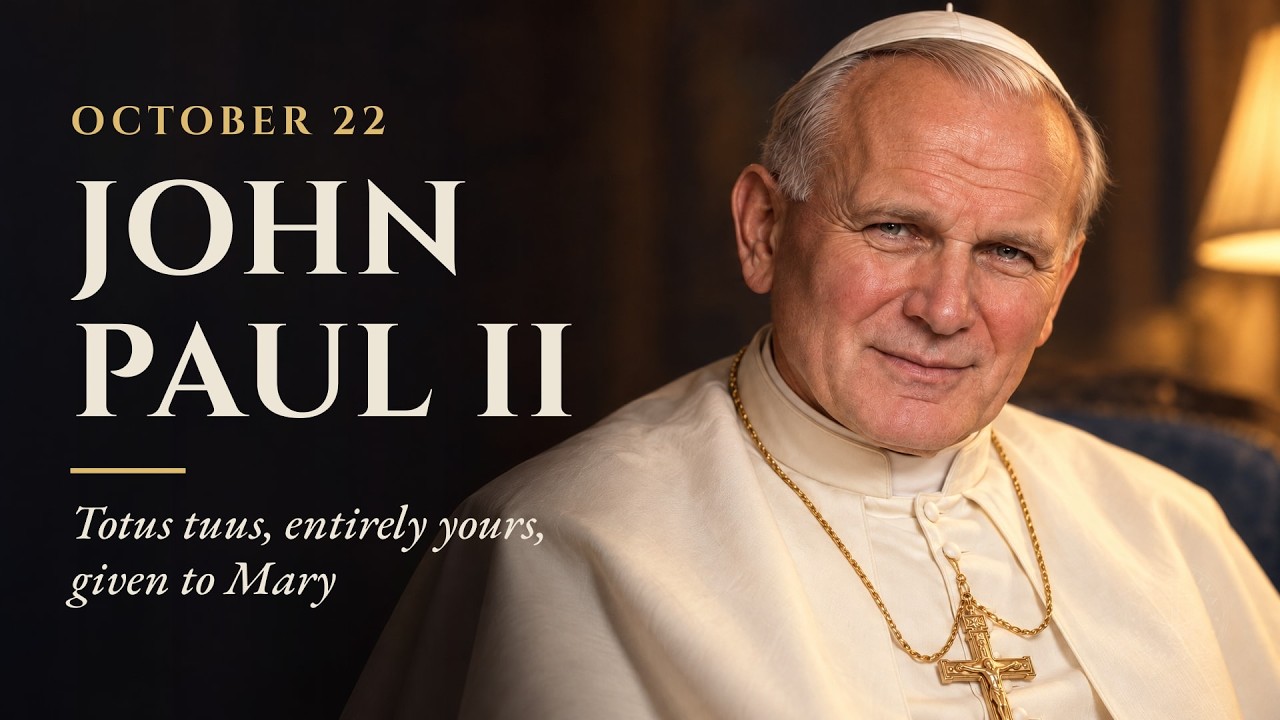
Karol Wojtyła is twenty years old, and his hands are white with stone dust. He works in a quarry in Kraków because, under the Nazi occupation, a laborer's job is what keeps him from being deported to forced labor in Germany. One day a charge goes off, and the stones kill a fellow worker. The old blaster he assists sometimes turns to him and says, "Karol, you ought to be a priest." The young man keeps on working. One winter day he comes home from work, and his father is no longer alive. He has no family left.
In October 1978, that same man, now John Paul II, stands before a packed Saint Peter's Square and asks the world to let go of its fear and let Christ in.
Quarry Dust
Every morning that autumn of 1940, the twenty-year-old laborer walks the half hour from the Dębniki neighborhood to the Zakrzówek quarry. He should be sitting in the lecture halls of the Jagiellonian University, but the Germans have shut it down after deporting its professors. Now this job is his only protection, because anyone without one can end up on a train to Germany.
At the quarry, the Polish foremen try to spare the students the hardest tasks. They make him the assistant of the old blaster who sets the dynamite charges that split the rock. The old man likes the young man's voice, and now and then he tells him that his place is at the altar, where he would sing well. It is in this quarry that the charge goes off and kills that fellow worker. Karol is deeply shaken, and out of those months among the rocks will come a poem he calls "The Quarry."
But winter brings another blow. On February 18, 1941, coming home from work, he finds his father dead, and that day stays in his memory with perfect clarity. His father was the last of his family left to him. Olga, his sister, had died before he was born. His mother, Emilia, died when he was barely nine, before he had made his First Communion, and soon afterward he also lost Edmund, his brother, a doctor. Losing his father felt like being uprooted from the soil he had grown up in.
The family of his friend Juliusz Kydryński, who works beside him at the quarry, surrounds him with care and affection. And in the empty apartment, the nights of long ago come back to him.
After his wife's death, his father, a military man of austere habits, lived in constant prayer. Some nights the boy would wake up and see him on his knees, just as he knelt in church. They never talked about vocation. That example became for him a kind of seminary at home, the first he ever had.
A year after he starts at the quarry, Karol is moved to the water purification plant at the Solvay factory. His fellow workers know he is a student, and on the night shift they let him read while they keep watch for him. In time he will celebrate the funerals of many of those workers and baptize their children. He called that factory his true seminary, though a secret one.
His former teacher from Wadowice and the teacher's wife now move into that apartment in Dębniki, where he is the only Wojtyła left, and with them comes a theater that has to be kept hidden.
Why Not Me?
The apartment where Karol had been left alone now fills with hushed voices. Mieczysław Kotlarczyk, the teacher of Polish who had first drawn him into the theater back in Wadowice, lives there with his wife. By day he works on the streetcars, and Karol works at the factory. At nightfall they prepare together what they call a theater of the living word, with almost no scenery, only the poem spoken aloud before a few trusted guests. If the occupation authorities find them out, the punishment could be a concentration camp.
Karol's love of the stage went back to his high school years. In Wadowice, his religion teacher had asked him to welcome the archbishop of Kraków, Adam Stefan Sapieha, who was visiting the parish. After the speech, the archbishop wanted to know what the young man would study. They told him Polish language and literature, and Sapieha remarked, "A pity it isn't theology." What fascinated Karol were books and the stage.
But in the neighborhood's Salesian parish, where the occupiers have taken away nearly all the priests and brothers, it is a tailor, Jan Tyranowski, who gathers the young men into Living Rosary groups. He used to say that his trade made the inner life easier. It is he who places in Karol's hands Saint John of the Cross and Saint Teresa of Ávila, two Spanish mystics of the sixteenth century.
Then a doubt takes hold of Karol. Could too great a love for Mary draw him away from Christ? He finds the answer in a book by Saint Louis-Marie Grignion de Montfort, and he closes it convinced that Mary, far from leading anyone away from Christ, draws closer to him all who live her mystery.
Totus tuus, "totally yours," are the two Latin words he takes from a formula in that book. His devotion to Our Lady went back to his childhood. At about ten he had received the scapular of Our Lady of Mount Carmel, a small piece of cloth worn over the chest as a sign of belonging to Mary, and as an old man he was still wearing it.
Meanwhile, in the middle of the war, an inner light grows clearer and clearer within him. Karol puts it in simple words, "The Lord wants me to be a priest." One day he sees it with complete clarity, like an illumination within him, and with it come joy, certainty and an immense peace.
At the same time, he thinks of his classmates from Wadowice, several of them Jewish, who have died at the front, in the camps or in the deportations. If so many are losing their lives, he asks himself, "why not me?" And he concludes that he is not still alive by chance.
The theater has left its mark on him, but he now understands that it is not his vocation. In letting it go, he draws strength from the example of Brother Albert Chmielowski, a Kraków painter who lost a leg fighting for Poland in the uprising of 1863 and gave up his art to live among the poor in a city shelter.
In the autumn of 1942, he makes his decision. He knocks at the door of the Kraków seminary, which operates in hiding from the occupiers, and the rector receives him. Everything must remain absolutely secret, even from the people closest to him. He begins studying theology in a faculty that is also underground, without leaving his job at Solvay.
The seminary he has just joined has no building. On many mornings, its meeting place is the archbishop's private chapel.
Broken Glass
Jerzy Zachuta, another underground seminarian, serves some mornings alongside Karol at the archbishop's Mass, in his residence on Franciszkańska Street. That morning Karol serves at the altar without him and, when Mass is over, goes out to look for him.
At his friend's home, in the Ludwinów neighborhood, they give him the news. The night before, the Gestapo, the occupiers' secret police, came and took him away. Soon afterward, Zachuta's name appears on the list of Poles condemned to be shot.
The danger reaches the archbishop too. Since September 1944 the seminarians have been living in hiding in his own residence, and Archbishop Sapieha is exposing himself to severe reprisals. Earlier, he himself had settled another doubt that Karol was carrying. Drawn by the mystics the tailor Tyranowski had given him to read, the young man had thought of becoming a Carmelite, a friar in an order devoted to prayer. The archbishop settled the question in a few words, "First you must finish what you have begun." And so it was.
On the night of January 18, 1945, the Red Army reaches the outskirts of Kraków. The Germans retreat and blow up the Dębnicki Bridge, the one in the neighborhood where Karol had lived with his father. The blast shatters every window in the residence while the seminarians are praying in the chapel with the archbishop. The next morning they hurry to repair the damage.
On November 1, 1946, All Saints' Day, Sapieha ordains him a priest in that same chapel. Karol is the only one ordained that day, before a few relatives and friends.
They sing the Veni Creator, the hymn with which the Church calls upon the Holy Spirit, and then the Litany of the Saints, the long plea that calls on them all. All the while, Karol lies on the floor in the shape of a cross, until the archbishop lays his hands on him. That day he remembers Jerzy Zachuta, the friend who never came back to serve Mass, as a brother united by Christ to the mystery of his death.
Lying prostrate that day shaped forever the way he would be a priest. Half a century later, for that anniversary, he will tell of it in Gift and Mystery, the book in which he recounts his vocation.
The next day, All Souls' Day, he celebrates his first three Masses in the Crypt of Saint Leonard, beneath Wawel Cathedral, beside the tombs of Poland's kings. His godmother is there. Beside Karol at the altar stands Father Kazimierz Figlewicz, who had made him an altar server in Wadowice and who heard his confession in that same empty cathedral on September 1, 1939, the day the war broke out.
The archbishop had chosen the day of the ordination because the young priest had to leave right away for Rome to continue his studies.
Kissing the Ground
Rome gives him his studies, and also a way back. In late October 1947, the young priest is returning from Belgium, where he has spent the summer among Polish emigrants and miners, and he stops in Ars, a village in France. It is Sunday, the feast of Christ the King. He enters the old little church where Saint John Vianney, the holy Curé of Ars, once heard confessions, and he comes out convinced that in the confessional a priest fulfills an essential part of his mission.
In the summer of 1948, back in Poland, he receives his first assignment, a country parish. He takes a bus as far as Gdów, a farmer gives him a ride in his cart, and then he goes on foot by a shortcut through wheat fields in the middle of the harvest. As he steps onto the land of the parish of Niegowić, he kneels and kisses the ground, the gesture he learned from the Curé of Ars. In the church he stops first before the Blessed Sacrament, the consecrated bread kept in the tabernacle, and only afterward goes to introduce himself to the pastor.
The following year he is called to Kraków, to Saint Florian's parish, and there the air is different. The communist regime imposes on public life a militant atheism that fights against faith. Every Thursday, Father Wojtyła, the associate pastor, gathers university students and speaks to them about the existence of God and of the soul. In the summer of 1951, Archbishop Eugeniusz Baziak, who now governs the diocese, steers him toward study and teaching, and that takes away his time with people. Wojtyła sums it up simply, "It cost me." From then on he makes sure that books never make him forget he is a priest.
That same archbishop ordains him a bishop in 1958, in Wawel Cathedral. Now a bishop, Wojtyła travels to Rome for the Second Vatican Council, the great gathering of bishops from all over the world.
In November 1962, in the middle of the Council, he writes a letter in Latin to Padre Pio, the Capuchin friar of San Giovanni Rotondo, in southern Italy. He asks him to pray for a forty-year-old mother of four daughters who is about to undergo surgery for cancer.
According to the aide who read it to him, the friar said on hearing it, "One cannot say no to this." Eleven days later, the bishop writes him another letter, this time to thank him. The woman has been suddenly healed, before the operation. Padre Pio reads it and says only, "Thanks be to God."
The woman is Wanda Półtawska, Wojtyła's lifelong friend.
With the letter of thanks already sent from Rome, the bishop returns to Kraków, where some residents have spent years asking for what the regime denies them, a church.
The City Without God
The city is called Nowa Huta, and the regime has built it next to Kraków as a model socialist workers' city. Its plans include housing for the workers and not a single church. It is a city designed for living without God.
Its residents refuse to accept that. In 1959 the authorities withdrew the permit they already had for the church, but on the lot set aside for it stood a cross. On April 27, 1960, they turned out to defend it against those who came to remove it.
Bishop Wojtyła makes those people's cause his own. In 1964 Pope Paul VI names him Archbishop of Kraków, and the following year, after Wojtyła entrusts the neighborhood parish to a new pastor, the authorities grant the permit. The Pope then gives him a stone from the tomb of Saint Peter to serve as the church's cornerstone.
On October 14, 1967, Wojtyła, now a cardinal, digs the first clods of earth himself. Ten years of construction follow, and the authorities deliberately slow the work down.
While the walls rise slowly, Wojtyła often returns to Kalwaria Zebrzydowska, the great shrine of Our Lady in his diocese, where he had gone since he was a boy. He walks its paths alone and brings before God in prayer the troubles of the Church under communism.
On May 15, 1977, the city that was planned without God finally has its church. More than seventy thousand people surround it as the cardinal consecrates it under the name of Our Lady Queen of Poland. It is the church known as the Ark of the Lord. In his homily, Wojtyła tells the crowd, "We cannot live without God. And we want to live for God."
Inside, the tabernacle is shaped like the globe and holds a small piece of rock from the Moon, a gift from Paul VI. Nearby is an image of the Virgin made from shrapnel taken out of the wounds of Polish soldiers at Tobruk and Monte Cassino, two battles of the Second World War.
The following year, the cardinal of Kraków travels to Rome with the other cardinals for a conclave, the closed-door gathering in which they elect the Pope.
Wide Open
Beneath the frescoes of the Sistine Chapel, in October 1978, the cardinals are gathered to elect the successor of Peter. At one point during those days, another of the cardinals comes up to Wojtyła. He had been the rector of the college where Wojtyła lived as a young man, during his studies in Rome, and now he speaks to him quietly.
"Dominus adest et vocat te," the Lord is here and is calling you.
On October 16, Wojtyła is elected, at fifty-eight, and takes the name John Paul II. That same day, Cardinal Stefan Wyszyński, Primate of Poland, the bishop who guides the Church throughout his country, tells him, "The task of the new Pope will be to lead the Church into the third millennium."
Six days later, Saint Peter's Square fills for the Mass that begins his service. The new Pope recalls that Peter came to this city in obedience to his Lord. He explains that in the Church all power is service, and he asks Christ to let him be the servant of his servants. Then he invites everyone not to be afraid to welcome Christ, and he puts it this way.
"Be not afraid! Open, I say, open wide the doors for Christ!"
The man asking this is the same young man who broke stone at Zakrzówek so he would not be deported, the one who came home from work one day to find his father dead, the last of his family. Before the crowd, he asks that the borders of nations, economic and political systems and the fields of culture be opened to Christ, and he ends by saying that only Christ has the words of eternal life. Every October 22, the day of his memorial, the Church reads that homily again in its prayer for the day. On his coat of arms, the new Pope keeps what he already bore as a bishop, a gold cross, an M in the lower right recalling Mary beside her crucified Son, and his Totus tuus.
A week later, from his window at the hour of the Angelus, the short midday prayer to Our Lady, he confides to the faithful, "The Rosary is my favorite prayer."
That devotion to Our Lady goes with him far from Rome. His first journey takes him to Mexico, before Our Lady of Guadalupe, and there he prays a prayer of his own that begins like this.
"O Immaculate Virgin, Mother of the true God and Mother of the Church!"
Two days later he celebrates Mass at her shrine. He opens his homily with "Hail, Mary!" and says that the first steps of his pilgrimage have brought him to this very place. Over nearly twenty-seven years as Pope he will make more than a hundred journeys outside Italy and gather the young people of the world at the World Youth Days he himself began. But that first year, the journey that weighs most is the return home. On June 2, 1979, the eve of Pentecost, he celebrates Mass in Victory Square in Warsaw, in a Poland ruled by the communist regime. Before the crowd he says that Christ cannot be shut out of the history of man in any part of the globe, and that shutting him out is an act against man. He ends by asking the Holy Spirit to come down and renew the face of the earth, "the face of this land!"
Two and a half years after that Mass that began his service, on a Wednesday in May, his open white jeep moves slowly across Saint Peter's Square among the pilgrims.
Brother
On May 13, 1981, shortly after five in the afternoon, the man who asked everyone not to be afraid makes his usual round among the faithful before the general audience. Someone brings a little girl up to him. He holds her in his arms for a moment and hands her back to her parents.
A few moments later, shots ring out.
Wounded in the abdomen, the Pope collapses inside the vehicle. People cannot believe what they have just seen. Many burst into tears. Many others kneel right where they are and pray with the rosaries they had brought for him to bless. In the crowd, some remember that on another May 13, sixty-four years earlier, Our Lady appeared to a few young shepherd children in Fatima, a village in Portugal. The gunman is Ali Agca, a young man from Turkey.
The Pope is rushed to the Gemelli Polyclinic, a hospital in Rome, and there he spends six hours in surgery.
Sunday comes. Four days have passed, and the wound is still open. From his room, linked to the square, he prays the midday Marian prayer with the faithful, and his weak voice reaches the very place where he was shot. Before he finishes, he says these words.
"I pray for the brother who wounded me, whom I have sincerely forgiven."
The man who tried to kill him, he calls brother.
Yet the wound is slow to heal. On June 3, after twenty-two days in the hospital, the Pope returns to the Vatican. Four days later, in the Basilica of Saint Mary Major, a recording plays what he cannot come to say in person. It is an act of consecration he wrote himself, a prayer that places the world in Our Lady's hands. After the shooting he had also asked for the envelope holding the third part of the secret of Fatima, the part of the message of those shepherd children that the Church had kept unpublished. In July it is brought to him through the Secretariat of State.
By then he is back at the Gemelli, because on June 20 an infection forced him to return, and on August 5 he undergoes a second operation, one that proves decisive. Only in mid-August, three months after that afternoon in the square, does he finally leave the hospital.
One of the bullets had stayed behind in the white jeep.
The Bullet and the Crown
Exactly one year after the shooting, on May 13, 1982, the Pope goes on pilgrimage to Portugal. In Fatima, before the statue of Our Lady, he prays the same prayer that had been heard as a recording in Saint Mary Major the previous June, and with it he consecrates the whole world to her. As a young man he had placed himself in her hands with his motto,
Totus tuus, totally yours, and now he comes before her image with the life he held on to in the square.
When the Bishop of Leiria-Fatima visits Rome, the Pope gives him the bullet that stayed behind in the jeep, so that it can be kept at the shrine. What came next was the bishop's idea. That piece of metal, which could have killed him, ended up set in the crown of Our Lady.
There is still the man who fired that bullet. From his hospital bed, the Pope had called him brother, and it remained to be seen whether he would go and find him. On December 27, 1983, John Paul II walks into Rome's Rebibbia prison and meets Ali Agca, in full view of everyone.
As he leaves, the Pope says these words.
"We have met as men and as brothers, because we are all brothers."
Then he adds that everything that happens in life must confirm that brotherhood, which springs from the fact that God is our Father.
How had he come out of that afternoon alive? He gave the answer himself in 1994, on another May 13, from a room at the Gemelli, where he was once again a patient. In a meditation for the Italian bishops, he explained what happened in the square this way.
"It was a mother's hand that guided the bullet's path, and in his throes the Pope halted at the threshold of death."
It is his way of looking at that day, with the eyes of faith. The Mother to whom he had given himself as a young man, in the middle of the war, he now recognizes in his own wounded body.
Those words also reach Portugal, and the Carmelite convent in Coimbra. There lives Sister Lúcia, one of those shepherd children of Fatima, now a nun and very old. That envelope had held the third part of the secret, the vision the children had on July 13, 1917, which she wrote down in 1944 at her bishop's order. An angel with a flaming sword cries out three times, "Penance!" Then a bishop dressed in white climbs a mountain toward a large cross, with other bishops, priests and men and women religious. He passes through a large city half in ruins and prays for the dead he meets along the way. At the top, as he kneels at the foot of the cross, a group of soldiers fires on him and kills him. Two angels gather up the blood of the martyrs. In the spring of 2000, when she is asked whether that bishop is the Pope, Sister Lúcia answers yes at once. In the vision the bishop dies, and the Pope in the square lived on. For the Church, this shows that the future is not written in advance. And Sister Lúcia agrees completely with the words about a mother's hand.
Jesus, I Trust in You
The forgiveness he carried into Rebibbia was something he had already been practicing in silence, with strangers. On Good Friday of 1980, at midday, John Paul II goes down into Saint Peter's Basilica, steps into a confessional and sits down to listen to the faithful who come to ask forgiveness for their sins. It was the lesson he had taken as a young man from the little old church in Ars, and from that Good Friday on he returns to that confessional every year.
At the end of that same year he signs an encyclical, a letter addressed to the whole Church, on God the Father, the One who is rich in mercy. He gives it a Latin name,
Dives in misericordia. What its pages say, he lives every Good Friday in that wooden box, one person after another.
That mercy does not wait only for those who walk into a church. It also goes out to find those who are dying alone. In February 1986, on his journey to India, the Pope's first stop in Calcutta is Nirmal Hriday, the home where Mother Teresa and her sisters care for the dying. There the Pope calls it a place that bears witness to the primacy of love.
Mercy also needed a day on everyone's calendar. In the spring of 2000, John Paul II canonizes Saint Faustina Kowalska in Rome, a Polish nun whose diary holds the message of Divine Mercy. That day he decrees that throughout the Church the Second Sunday of Easter, the one after Easter Sunday, will from then on be called Divine Mercy Sunday.
The Pope wanted to bring that message to the land where he himself was born. On August 17, 2002, he returns to Kraków and dedicates the new Shrine of Divine Mercy in the neighborhood of Łagiewniki. Its cornerstone was brought from Mount Calvary, as a lasting reminder that sin can be forgiven. The Pope is now eighty-two years old. He repeats Saint Faustina's words about God's boundless mercy and, with her, professes that apart from that mercy there is no other source of hope for humanity. All of it fits into five words a child can say, and he says them before the crowd.
"Jesus, I trust in you."
Then he solemnly entrusts the whole world to Divine Mercy, so that Saint Faustina's message may reach every person on earth. To those listening, he makes this appeal.
"Be witnesses to mercy!"
He closes with a prayer of his own to God the merciful Father, entrusting to him the destiny of the world and of every human being. It was his last journey to Poland.
The House of the Father
Two and a half years after Łagiewniki, the trust he had asked of everyone has to hold firm in his own body. As far back as 1991, his doctor had seen in him the first signs of Parkinson's. In February 2005 he is admitted once again to Rome's Gemelli Polyclinic, the hospital that took him in after the shooting, because he cannot get enough air. They perform a tracheotomy, an opening in the throat so that he can breathe, and the doctors ask him not to speak for a few days.
When he woke up, as his spokesman later related, the Pope asked with gestures for a sheet of paper and wrote.
"But what have they done to me?"
Then he kept writing, using the two Latin words he had made his own as a young man, in the middle of the war, to give himself entirely to Mary.
"But I am still always totus tuus."
His body, though, no longer obeys him. On March 30 he comes to the window of his study, above Saint Peter's Square, and blesses the crowd without being able to say a word. It is the last time the square sees him.
The next day, shortly after eleven, he goes to the chapel for Mass and is seized by a violent chill. His fever soars. He falls into septic shock, an infection that spreads into the blood and makes the heart and circulation fail. He asks to stay in his room, and his wish is respected.
In the afternoon, his eyes half closed, he celebrates Mass at the foot of his bed with the priests who are with him. At the consecration, when the bread and wine become the Body and Blood of Christ, he weakly raises his right arm over them. The cardinal archbishop of Lviv gives him the Anointing of the Sick, the sacrament the Church offers to those who are gravely ill, and as evening falls the Pope receives Communion.
On Friday he wakes up conscious and serene. He celebrates Mass early. Then the fourteen Stations of the Cross, the way of Jesus to the cross, are read to him, and he makes the sign of the cross at each one. After that he asks them to read him Terce, one of the prayers of the day, and passages from Scripture.
Below, the square has filled with young people praying for him. Through his spokesman, Joaquín Navarro-Valls, the words the Pope said about them became known.
"I have looked for you. Now you have come to me. I thank you."
On Saturday, April 2, at around half past three in the afternoon, in a voice that can barely be heard, he speaks in Polish to those around him.
"Let me go to the house of the Father."
Shortly before seven he slips into a coma, and he does not wake again. In the dim light a small candle burns, as a Polish custom calls for. At eight, beside the bed, Stanisław Dziwisz, his secretary for almost forty years, begins the Mass of the feast of Divine Mercy. The hymns in the room mingle with those rising from the square.
At nine thirty-seven in the evening, John Paul II falls asleep in the Lord.
It is the eve of Divine Mercy Sunday, the very Sunday he himself had given to the whole Church. Beneath his window, the young people do not leave the square.
Santo Subito
Behind those young people, the world arrives. Within a few days, more than three million pilgrims file past his body, some after twenty-four hours in line. On April 8, in Saint Peter's Square, Cardinal Joseph Ratzinger, Dean of the College of Cardinals, presides at the funeral. From the crowd a cry in Italian rises again and again, "Santo subito!", a saint now. That same day he is buried in the Vatican Grottoes, beneath the basilica.
The square was asking for haste, and the Church listened without leaving its usual path. Ratzinger, elected Pope with the name Benedict XVI, makes just one exception. He does not wait the five years that usually pass after a death, a period meant to confirm that a reputation for holiness lasts and spreads. In Rome and in Kraków, testimonies are gathered from those who knew John Paul II, and theologians and cardinals study his life. At the end of 2009, Benedict XVI declares him Venerable, which means he recognizes that John Paul II lived the Christian virtues to a heroic degree.
What the Church looks at in that examination is his life with God, not whether every decision he made in governing was right. In 2020 the Holy See itself published a report on how Theodore McCarrick, an American bishop, had risen to cardinal despite accusations about his sexual conduct. It concludes that in 2000 John Paul II named him archbishop of Washington by his own personal decision, on the basis of inaccurate and incomplete information from three of the four American bishops he had consulted. By the time the report came out, a canonical process had already found McCarrick guilty and dismissed him from the priesthood.
To beatify him, the Church also asked for a sign, a healing due to his intercession. In France, Sister Marie Simon-Pierre worked as a nurse in a maternity hospital until Parkinson's, the same disease the Pope had carried for more than a decade, forced her to give it up. In June 2005, about two months after the Pope's death, she asks him for help, and the Parkinson's disappears completely. In January 2011, Benedict XVI signs the decree recognizing that healing as due to the intercession of John Paul II.
On May 1, 2011, Divine Mercy Sunday, Benedict XVI declares him Blessed, the step before sainthood, in the square before more than a million faithful. Never before had a pope beatified the man who came before him. During the ceremony, Sister Marie Simon-Pierre prays before a relic of the Pope.
For that beatification, John Paul II's coffin leaves the Grottoes and is moved to the Chapel of Saint Sebastian, next to Michelangelo's Pietà, where pilgrims from all over the world pray before him, beneath the altar.
That same Sunday, far from Rome, in Costa Rica, a woman the doctors had sent home to die stays awake so she can follow the beatification.
I Feel Fine
What had brought that woman to that night is told by Floribeth Mora herself, a mother of four, and by her husband, Edwin Arce. One morning in April 2011, Floribeth had woken up at home with a terrible headache and vomiting. At Calderón Guardia Hospital, in San José, the doctors found an aneurysm, a serious lesion in an artery of the brain, and told her that the spot they needed to close could not be reached. The two of them entrusted themselves to John Paul II, and the doctors advised taking her home for the end.
Edwin walked out of the hospital, sat down on the ground and wept, "My God, help me! Karol Wojtyla, John Paul II, don't leave me alone…!" He says that a voice then told him twice, "Don't be afraid, take her home." And he took her home, where the medication kept her asleep most of the day.
That is why, on the Sunday of the beatification, while her family goes to the stadium where the ceremony is being broadcast, she fights to stay awake and asks the Pope to help her. She does not want to die. She wants to be with her children and to meet the grandchildren who are on the way.
The next morning she sees John Paul II in a magazine, his hand in a gesture that seems to invite her to get up. She gets up, goes to the kitchen and says only this to her husband, "I feel fine." Her neurosurgeon later confirms that the aneurysm is gone.
That healing went through the Church's examination. The board of physicians for the cause, which only says whether a healing has a scientific explanation, found none, and then theologians and cardinals attributed it to the intercession of John Paul II. On April 27, 2014, once again Divine Mercy Sunday, Pope Francis canonizes him in the square together with John XXIII. In this way the Church holds him up to everyone as a model of Christian life and as an intercessor.
The young man who came home from work one day during the war and no longer had anyone learned on his knees not to be afraid. He learned it watching his father pray at night, and he lived it later, lying on the floor of the chapel where he was ordained and in a bed at the Gemelli, where he forgave with the wound still open. When he asked an entire square to open the doors to Christ, he was offering what he himself had put to the test, step by step, in his own life.
Sooner or later, each of us comes to a place like the ground where Edwin sat down and wept outside the hospital, and it is right there that we can learn to trust.
Saint John Paul II, you lost your loved ones young and learned in wartime to trust in God. Teach us not to be afraid. You called the man who wounded you brother. Obtain for us a heart able to forgive. Stay close to the sick, to those who mourn their dead and to those who feel alone, you who carried your cross before the eyes of all to the very end. Help us to open wide the doors to Christ and to say with you, "Jesus, I trust in you." Pray for us. Amen.