It is a Sunday in Caracas in 1919, and a friend who stops by to wish José Gregorio Hernández well finds him full of joy. The day before, at Versailles, the treaty ending the Great War was signed, and the doctor is celebrating that the world is at peace once more. Then, almost in a whisper, he confides something more. He has offered God his own life for that peace.
A little later he hurries out. In La Pastora, his neighborhood, a poor and very sick old woman is waiting for him, and on the way he stops at a pharmacy and buys, with his own money, what she cannot afford. That afternoon he never reaches the sick woman's house.
And this man of the streets, the doctor in the dark suit and hat, had once wanted to shut himself away forever in the silence of a monastery in Italy, where they gave him another name, Brother Marcelo.
A Silk Handkerchief
That hurry for a sick woman with no money was nothing new. It came from long years of seeing patients in Caracas, since the end of the nineteenth century, when he was already teaching at the university. To his door come those who can pay and those who cannot, and every one of them is seen.
At the bedside, José Gregorio stays on his feet, in an almost humble stance, his arms crossed over his chest, and listens to the patient's story. Then he asks for a silk handkerchief, spreads it over the skin and rests his ear on it. He takes the temperature with a thermometer, counts the pulse by his watch and writes the prescription standing up.
From those who have nothing to pay with he takes nothing, and often he also leaves in their hand the money for the medicines. Of his wealthy patients he asks something else, that they leave alms for the poorest. That is why Caracas begins to call him the doctor of the poor.
His day began long before, in the dark. He gets up to pray, hears Mass and receives Communion, every morning. At the university, in a climate of strong materialism, where only matter is held to be real, he makes the sign of the cross in front of his students before every class.
He learned that way of praying and of caring for the sick at home. In Isnotú, a small village in the Venezuelan Andes of Trujillo, his mother and his aunt used to take him to church and to visit the sick and lift their spirits. His mother dies in 1872, before the boy has turned eight, and from then on he is raised by his aunt María Luisa.
Years later, as a grown man, José Gregorio will say of his mother, "From the cradle she taught me virtue, made me grow in the knowledge of God and gave me holy charity as my guide."
He had been born in that same village, on an October 26, and that is the day the Church now celebrates him as a saint.
It is the same Church that, long after that house in Isnotú, will recognize a healing asked for in his name.
Four Microscopes
The boy who went with his mother into the homes of the sick does not stay long in Isnotú. His village schoolteacher sees the boy's promise and persuades his father to send him to the capital to study. At thirteen he leaves the mountains and arrives as a boarder at a school in Caracas.
There he grows into a cheerful young man. He loves parties and dancing, learns music and sews his own suits. He plans to study law, but his father, a merchant who knows well how eager his son is to help others, encourages him to become a doctor. In June 1888 the Central University awards him his degree as a Doctor of Medicine.
Degree in hand, he goes back to his home region, because he wants to heal among his own people. For seven months he rides on horseback along the old pack trails, the paths of the loaded mules, between Isnotú, Betijoque and the hamlets of the mountains. He goes from one sick person's house to the next. Between visits he tells every case to Santos Aníbal Dominici, his closest friend, a doctor like himself, who is in Caracas. He writes to him about a woman whose bleeding has finally stopped, about two cases of dysentery that still won't clear up, and about a patient with tuberculosis. He asks him for news and advice from the capital, because he knows his own limits. And he confides a plan to him, to save up enough money to go and study in Paris.
He never needs to save it. In 1889 the government sends him to Paris to learn what is not yet taught in Caracas, microbes and histology, the study of the body's tissues under the microscope. He works alongside the great histologist Mathias Duval, who writes in a letter that his student has mastered the techniques of the laboratory. Another of his teachers gives him the medal for the best student. In Paris he leaves behind the memory of his piety, and then he completes his training in Berlin.
While he is away, his father dies in Venezuela, the man who had steered him toward medicine. José Gregorio does not keep the inheritance and hands it over to his sister's children.
In 1891 he returns to Caracas, and in his luggage he brings four modern Zeiss microscopes, each with a single objective lens. With them he founds three professorships at the Central University, in histology, in experimental physiology, which studies how the living body works, and in bacteriology, the science of microbes. His students bend over those lenses, and so begins in Venezuela a medicine that is learned by testing things in the laboratory.
With What Sorrow
What his students learn in that laboratory earns him a name among the country's doctors, and in 1904 he is among the founders of the National Academy of Medicine. There, in front of his colleagues, his faith comes into the open. The question under debate is whether science should adopt evolution as doctrine, the idea that living species change into one another over time. José Gregorio states plainly that he is a creationist, in the sense that he believes God created life, and he holds that no academy should turn a hypothesis into doctrine, because that slows the progress of science. Even so, he can accept evolution, as long as it stays in harmony with the idea of a Creator God.
Facing him is Luis Razetti, a surgeon who defends evolution and does not share his faith. They argue hard, but the friendship between them does not break. Razetti will always speak up for José Gregorio's merits as a professor and as a scientist, and for his spotless conduct.
In this man, faith and medicine work together, and a saint puts him to the test. His devotion to Saint Teresa of Avila, the Spanish mystic, goes back so far that he could not say when it began. One day, one of his most beloved teachers publishes a study on hysteria, a disorder of the nerves. He states that the saint suffered from it and that her ecstasies, the moments when she was caught up in God, were hysterical fits. José Gregorio puts it this way.
"With what sorrow I read my teacher's article!"
He sets out to show, with the tools of his own profession, that there is no sign of hysteria in her. He looks for the real illness in what Teresa herself tells in the book of her life, and he reaches a doctor's conclusion. It was an acute illness of her youth, something like rheumatic fever, which inflames the joints and brings on fever. The essay he writes in her defense is left unfinished. In those pages he also explains why he loves her even more. It was she who spread devotion to Saint Joseph, to whom he is devoted.
That faith also has a rule. Since December 1899 he has belonged to the Franciscan Third Order, a way for laypeople to follow the rule of Saint Francis at home and at work. His students keep seeing him arrive at class in a dark suit.
In June 1906 he sends the minister a letter asking to retire from his professorship. With it he sends his newly published book, Elements of Bacteriology, the first on that science written in Venezuela. He is forty-one years old.
Like a Giant Tree
The following year, the doctor who already lives by a Franciscan rule wants to take one more step. He goes to see Juan Bautista Castro, the Archbishop of Caracas, who has guided him in the life of faith for many years, and tells him that he wants to give himself entirely to religious life. The archbishop hesitates, because he believes Venezuela still needs José Gregorio's science very much. Even so, he lets him try.
The desire runs deep. José Gregorio has always loved the cloister. Over the years, as he studies the Church's doctrine, her moral teaching and her history, that love grows like a giant tree until it shapes his whole life. What he is seeking has a name, the contemplative life, an entire existence given to prayer and to being with God. That is why he chooses the charterhouse, a monastery where the monks live in silence and solitude. It is the order that best suits his spirit.
But that step comes at a price. In June 1908, in Puerto Cabello, about to sail for Italy, he says goodbye to his brother César in a letter and admits what it costs him.
"Only by obeying the divine call have I been able to take this step, which for me is so hard."
He loves his family dearly, and parting from them hurts. Of all the sacrifices, the most painful is leaving his aunt María Luisa, the woman who raised him when his mother died. He asks everyone's forgiveness and hopes to see them again in heaven. He also leaves them a treasure, the letter in which the novice master, the monk who forms the newcomers, told him he had been accepted. To him that letter is a true relic, because a saint wrote it.
Behind him he leaves the lecture hall, the laboratory and the sick of Caracas. He has let go of his family and said goodbye to his homeland. On July 16 of that year he walks through the gate of the Charterhouse of Farneta, among cypress trees, near the city of Lucca, in Tuscany. He arrives so worn out that he weighs ninety-seven pounds, a little over forty kilos.
Brother Marcelo
Within the walls of Farneta, the life he has always longed for finally begins. In August he receives the habit of the Carthusians and, with it, a new name. From now on they call him Brother Marcelo.
At midnight comes the hour of Matins, the prayer the monks sing together while the world sleeps. By the nearby stream the frogs sing, the cypresses and myrtles rise as high as the tower, and the whole cloister falls silent.
In November, from his cell, he writes to his brother César. He assures him that his health is always very good, and tells him how he prays for them. Each day, in turn, he offers for one of his family his communion, the Masses, the Divine Office and the Office of the Blessed Virgin, his fasting and his vigil. The Divine Office is the Church's prayer spread across the hours of the day. In this way he goes on from his brothers and sisters to his in-laws and his nieces and nephews. In his order the monks live in solitude, in silence and at a distance from people, and that is why he writes so little. But that does not separate them, because they can meet whenever they wish within the Heart of Jesus. He signs with his new name, Brother Marcelo Hernández, Carthusian novice.
But his body does not respond. He lacks the strength for the cold, for the fasting and for the manual work the rule asks of every monk. And Latin, the language in which the entire Office is prayed, will not yield to him. Nine months go by, until one day the superior general of the order calls him in and speaks these words.
"My son, you can see now that we cannot accept you. Go back to your country and try to acquire what you lack."
José Gregorio blames no one but himself. As he sees it, he has suffered what happens to anyone who, blinded by presumption and propped up by vanity, attempts so high a flight. He praises only the superior's charity in bearing with him for nine months, when he saw how incapable he was. Those words are a verdict, but also a hope. And he obeys. So he passes through the terrible pain of entering the world again.
It is the first door that closes on the man who, ten years later, will hurry through the streets of La Pastora with medicines in his hand. In the spring of 1909, Brother Marcelo leaves the charterhouse and sails back to Venezuela.
A Light in the University
Obeying that command to go back to his country comes at a price, and he pays it on the dock. On April 21, 1909, the steamship Città di Torino sets José Gregorio ashore at La Guaira, the port of Caracas. He does not go up to the capital, because he dreads the mockery waiting for him, and he spends the night in a boarding house on Los Baños Street, in Maiquetía, by the sea.
From that room he writes to his brother César. He tells him that a month earlier the superior told him his vocation was not the contemplative life but the active one, and spoke to him of the Jesuits or of the priesthood. Now José Gregorio asks César to go and see the archbishop, because he wants to enter the seminary, the house where future priests are trained.
With the archbishop's consent, he goes up to Caracas without drawing attention and enters the seminary. On April 24 the Catholic press publishes the news, and the seminary fills with people. His family, his colleagues and his students come, and with them medical students. His patients come too, the sick who used to walk into his consulting room with no money and leave with their medicine paid for.
A question is already running through the city, and Luis Razetti, the surgeon who argued with him at the Academy without ever ceasing to be his friend, asks it in public. "Where is he more useful to society, in the laboratory or in the seminary?" No one has the right to criticize him, he adds, but his decision puts out a light in the university.
Then Juan Bautista Castro, the archbishop who let him try the charterhouse, advises him to return to the university, because the young need him. José Gregorio obeys once again. In September he is appointed professor of pathological anatomy, the study of diseased tissue, and he stands before his students once more.
Three years later, in October 1912, he sits down to tell it all in a letter to Santos Aníbal Dominici, the friend who used to receive his cases from the trails of Trujillo and who now lives far away, in Washington. He tells him about the terrible crisis he has been through, and about what he found at Farneta.
"There I saw holiness to a heroic degree, and I can assure you that once you have seen that sight, everything else on earth turns to mud."
Then he explains his return, and where he stands now.
"And here I am, obeying that command."
At the end he signs off as the friend who loves him most, almost his only friend, and leaves him a certainty for the distance between them.
"But if we do not take up our friendship again on earth, that is what we have heaven for."
At his lectern he keeps the hope he brought back from Farneta, the hope of one day gathering the strength he lacked and knocking at that door once more.
Much to My Contentment
The strength he lacked in the charterhouse he now seeks in Caracas, and a tradition tells that he sought it with his hands. After leaving the university, with almost no one knowing, he would step into a little church to pray for a while and then walk on to a small carpentry shop. There he would set aside his professor's clothes, put on work clothes and shape the wood, like someone hardening his body for an austere life.
In 1913 he tries again. He offers his resignation to the Academy of Medicine, which refuses it because the seat is for life, and he sails for Rome. He enters a college where the Jesuits train future priests from Spanish America. He studies Latin, the very Latin that defeated him at Farneta, and theology, without hurrying. In February 1914 he tells his brother César about it in a letter.
"I now find myself at the College, much to my contentment and liking."
Soon afterward pleurisy, an inflammation of the lining around the lungs, lays him low, and his stay in Rome ends after eight months. In April he is in Paris, and there a doctor examines what he has been coughing up and finds Koch's bacillus, the germ of tuberculosis.
From Paris he writes that going back to Caracas after giving everything up weighs heavily on him, and that he feels no one can understand him. He has always longed for the death that frees us from so many ills and brings us safely to heaven, and now he fears he will have to stay in the world for good. Even so, he asks that the Lord's will be done in everything.
With his sister Avelina, though, he allows himself a smile. This is what he writes to her from Paris.
"The doctor tells me, thinking he is giving me great news, that I am not going to die of this."
In early September he is back in Caracas. At some point in those years, Archbishop Juan Bautista Castro had given him a simple piece of advice for deciding what comes next. He should put his vocation in one pan of a scale and the needs of Venezuela in the other, and see which way the needle leans, the part of the scale called the pointer. And he had told him how to read it.
"Wherever the pointer leans, see the will of God there, and follow it."
The needle leans toward the sick and the students of his own country. From then on he devotes himself only to teaching and healing, in a Caracas where the university is closed.
The New York Portrait
The first need the scale sets before him is that of the young men left without classrooms. He asks permission to teach on his own, and at a school in Caracas, alongside one of his nephews, he gives free histology classes to anyone who wants to learn. And he carries his prayer into his own home.
In June 1915 he gathers the whole family at his house, between the street corners known as San Andrés and Desbarrancado. He wants to consecrate it to the Sacred Heart, that is, to place the home under the love of Jesus Christ, the love the Church contemplates in his heart. At about half past five in the afternoon, everyone kneels. A Capuchin friar says some prayers, the family recites the Creed aloud, and then the consecration is read, asking Jesus to visit that house "in the company of your sweet Mother."
In August of that year, Archbishop Juan Bautista Castro dies. He was the one who let him try the charterhouse, who brought him back to the classroom and who set the scale before him. He stood beside him at every door, the one that opened toward Italy and the ones that later closed.
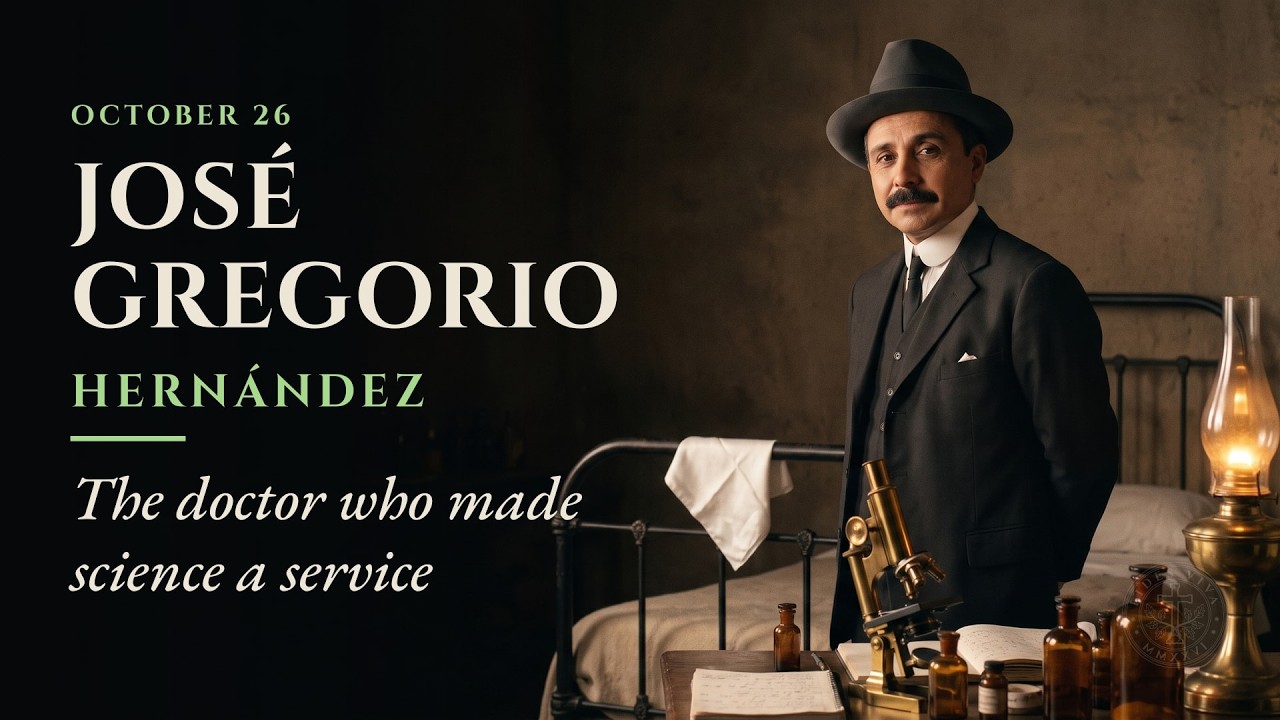
In 1917 he travels to New York and Madrid to study and to prepare the second edition of his bacteriology textbook. In New York he walks into a photography studio and has his portrait taken standing, in a dark three-piece suit, a white handkerchief in his pocket, his felt hat on and his hands behind his back. He sends a copy to his brother César, to feel a little less far from his family. That figure, standing so still, is the man so many families will later recognize on their holy cards.
To another nephew, the one studying medicine, he gives this advice as a reminder of what his studies are for.
"A good doctor is one who knows how to heal his patients, and that begins to be learned not in the laboratory, but in the hospital."
In October 1918 the Spanish flu reaches Venezuela. It falls on a population already worn down by malaria, tuberculosis, hunger and poor sanitation, and across the country the dead are counted in the tens of thousands. A national relief board is formed with the new archbishop, and it is run by Luis Razetti, José Gregorio's old colleague from the Academy. José Gregorio joins the emergency effort. For twenty-two days he uses a car with a driver to reach more of the sick, from one door to the next and from one bed to the next.
He and Razetti are said to have declared in public that what was killing so many people was poverty, more than the flu.
In December the epidemic dies down, and Dr. Hernández goes back to his classes and to the patients he has always cared for.
The World at Peace
The last of those classes falls on a Saturday, June 28, 1919, and at three in the afternoon he is in the classroom of the School of Medicine, on time. He explains the leprosy bacillus to his students, how it looks under the microscope, how it is stained and how it is grown, and at the end he tells them the topic of the next class. That same Saturday, across the ocean, the treaty that ends four years of fighting in Europe is signed at Versailles, the war he had watched England enter while he was in London in 1914.
The next day is Sunday. He rises before five and prays the Angelus, the prayer that recalls the angel's announcement to Mary. He goes to the church of the Divina Pastora, his neighborhood church, hears Mass and receives Communion.
Then he begins his rounds. He stops at the homes of his poor patients, at the orphans of Divine Providence and in the wards of Vargas Hospital. At noon he goes into the church of San Mauricio to make his visit to the Blessed Sacrament, a time of prayer before Jesus present in the Eucharist, and he prays the Angelus again.
At half past one a friend comes by with his good wishes and finds him radiant. The news from Versailles has already reached Caracas, and José Gregorio rejoices at it and exclaims.
"The Peace Treaty has been signed! The world at peace!"
Then he lowers his voice. He confides to his friend that he has given his own life to the Lord as an offering, so that the world may have peace.
A little later he says goodbye and hurries out, because a poor old woman in La Pastora is very ill and has no money for her medicines. He goes into a pharmacy, buys them for her and walks on toward the sick woman's house.
It is said that, once out in the street, he crossed in front of a stopped streetcar without seeing the car coming toward him, and that a neighbor saw it all from her window.
At the corner of Amadores he is struck by one of the few cars on the streets of Caracas. At the wheel is a good friend of his, a former student. A witness hears José Gregorio cry out.
"Most Holy Virgin!"
They carry him, close to death, to Vargas Hospital, the same hospital whose wards he walked that morning, and there a priest gives him the last rites, the anointing of the sick with which the Church accompanies the dying. José Gregorio dies almost at once, speaking the name of the Virgin.
In another ward of the hospital, they say, a religious sister recovering from surgery, Candelaria of Saint Joseph, now Blessed, begins to pray for him.
Luis Razetti, the colleague from the Academy who did not believe, comes to his friend's body. Standing before it, he says these words.
"This man was a saint."
The Doctor Is Ours
That same night, a death on a street corner becomes the mourning of an entire city. He lies in state in the Great Hall of the Central University, on a bier covered with flowers brought down from the Ávila, the mountain that rises over Caracas. Thousands of the city's people file slowly past the coffin, and the line never ends.
The next day, June 30, the city comes to a standstill. The funeral Mass is celebrated in the Cathedral, with the archbishop presiding. When it ends and the coffin comes out into the street, the people insist on carrying it themselves. A cry runs through the crowd.
"Dr. Hernández is ours."
They lift him onto their shoulders and set off. The procession leaves at four in the afternoon and crosses Caracas step by step. It reaches the General Cemetery of the South at nine at night.
As they lower him into the earth, Luis Razetti speaks at the graveside and says of his friend that he leaves behind not a single stain. The writer Rómulo Gallegos has also walked behind the coffin, and in his chronicle of that day he records that everyone felt "the desire to be good."
The authorities arrest and prosecute the friend who was at the wheel. Then the Hernández family writes to the judge. They ask for no punishment at all, because they are convinced it was an accident with no intent, and they accept what happened as God's will. After that letter, the prosecutor revises his call for a conviction, the driver is acquitted and the Superior Court upholds the acquittal.
The driver's name was Fernando Bustamante. His siblings used to say that he and the doctor were about to become compadres, the tie a baptism creates between two households, and that over the years he became devoted to José Gregorio. He lived until 1981.
From the night of the burial, the grave is never left alone. People come back with flowers, holy cards, thank-you plaques and medical prescriptions, and they light candle after candle, until one day those candles set the grave on fire.
When his remains are taken from there in 1975, some of those who saw him die are present. They are carried to the church of Our Lady of La Candelaria, in the center of Caracas, and they have rested there ever since.
A Girl from Apure
The candles the people light at that grave eventually reach the Church. Some thirty years after the burial, the Archdiocese of Caracas opens José Gregorio's cause, the long and careful examination the Church makes of a life before calling someone a saint. It calls those who knew him to testify. Among them is Santos Aníbal Dominici, the friend of the letters, who sits before the tribunal to tell what he saw.
Objections come too. A former vicar general, the priest who governed the diocese alongside the archbishop, sets them out in a letter that the nuncio, the pope's representative, sends to Rome. Rome asks for them to be examined, and a tribunal in Caracas hears seven witnesses. The tribunal concludes that this opposition was aimed at the priest's own archbishop, not at José Gregorio's virtues. In 1964 Rome declares that nothing stands in the way of going forward.
In 1986 Pope John Paul II declares him Venerable, the title by which the Church recognizes that someone lived the Christian virtues to a heroic degree. The next step requires a miracle, a healing that medicine cannot explain, asked of God through him. And for decades the cause waits for one.
One day in March 2017, that long wait crosses paths with a family from the plains of Apure. Yaxury Solórzano, a ten-year-old girl, is riding a motorcycle with her father when robbers block their way and open fire. The girl is wounded in the head.
They take her to a clinic in San Fernando de Apure, and the neurosurgeon comes out to say he is going to operate. Yaxury's mother says that at that moment Dr. José Gregorio Hernández came in and told her that he would operate on the girl, because God had sent him.
They operate, and the doctors expect serious lasting damage. Her mother, her sister and the anesthesiologist caring for her ask God for help through the Venerable José Gregorio.
Five days after the shooting, Yaxury suddenly gets better. Two weeks later she leaves the hospital in good health, with no neurological or cognitive impairment at all.
Years later, the doctors who study the case for the Church examine that healing and find no explanation for it. In 2020 the Church recognizes it as the miracle the cause had been waiting for, a healing asked for in his name.
On April 30, 2021, in Caracas, Pope Francis's representative presides at the Mass in which José Gregorio Hernández is proclaimed Blessed, the step that allows the Church to honor him publicly before declaring him a saint.
A Hat on a Microscope
Months before that Mass, the Church had had to open his casket at La Candelaria. The Venezuelan cardinal Baltazar Porras, who was present at the opening, comes out of the church that October of 2020 and says, "There are small bones, earth, and pieces of metal and wood that were possibly part of the earlier casket." That is what remains of the doctor, a handful of bones in the earth. From them will come his relics, small fragments of his own body that the Church keeps so that people may pray beside them.
Those fragments come into the hands of the Servants of Jesus, the sisters founded by Carmen Rendiles, a Venezuelan nun of the twentieth century. For a whole month they prepare more than one hundred sixty relics. As they work, they pray for an end to the pandemic, for medical workers, and for peace in Venezuela and in the world.
Forty reliquaries are made for the country's dioceses. The base is a microscope of Venezuelan iron. Above it rises a hat like the felt one the doctor wore in the New York photograph. At the top sits the relic, surrounded by pearls from Margarita, the Venezuelan island in the Caribbean. The pearls recall the Rosary. The bishops of Venezuela watch over devotion to the doctor. They remind the faithful that a relic is a sacramental, a blessed sign that helps people pray, not an amulet, and they reject the superstitious and spiritist uses some people make of his figure.
Many Venezuelans have had to leave their homeland, and the relics go with them, to parishes in Madrid, in the Canary Islands and in the communities they have formed in other countries.
In Florida, the parish of St. Katharine Drexel in Weston keeps a fragment of his own body, and Cardinal Porras brought relics to Venezuelans there and in Doral.
That devotion, which filled his grave in the General Cemetery of the South with candles, is what opens the way to the final step. On February 24, 2025, from the Gemelli hospital where he is a patient, Pope Francis approves the favorable votes of cardinals and bishops for the canonization of José Gregorio Hernández. The Church takes a special path for him, without the second miracle usually required, because devotion to him has endured and spread without interruption for a century.
On October 19, 2025, in Saint Peter's Square, Pope Leo XIV proclaims José Gregorio Hernández a saint, together with Carmen Rendiles and five others already declared Blessed. She and he are Venezuela's first two saints.
That same October, Cardinal Porras promises a relic of the new saint to the superior of the Charterhouse of Farneta.
The Cell at Farneta
The promise is kept in February 2026. A Venezuelan deacon, Jean Carlos González, travels from Assisi to Farneta with a fragment of the saint's bone and knocks at the door of the charterhouse. Through that same door, in 1909, a very thin novice walked out, unable to bear the cold or the fasting.
The monks let the deacon into the cell where Brother Marcelo lived, the name José Gregorio received when he took the habit. That day, the deacon says, they pray together for the whole Venezuelan people.
Then they place the relic beside those of their own brothers, the martyrs of 1944, Carthusians of that house who were shot by the Nazis for giving refuge to people being hunted. One of them was a Venezuelan. The monks welcome the doctor from Caracas with "a humble joy," and when they speak of him, they don't say José Gregorio. They say Brother Marcelo.
The deacon also says that the saint goes on interceding, above all for those who turn to him for their health.
And so he returns to that silence, the man who once wanted it forever, and whom a superior sent back to his country to acquire what he lacked. He obeyed. And what he lacked, he did not find within these walls. He found it in the consulting room where he charged the poor nothing, in the wards of Vargas Hospital and in the streets of La Pastora, in a dark suit and hat, with medicines in his hand, all the way to the corner of Amadores.
What closed door is turning us, too, back toward others?
Saint José Gregorio Hernández, doctor of the poor, you longed for the silence of the cloister. And you obeyed when God sent you back to the street. You paid out of your own pocket for the medicines others could not buy. Teach us to recognize God's will in the doors that close. Obtain for us the grace to practice works of charity after your example. Be with the sick who wait in a hospital or at home. Be with the doctors and nurses who care for them, and with all who mourn someone taken suddenly. Ask for the world the peace for which you offered your life. Saint José Gregorio Hernández, pray for us. Amen.