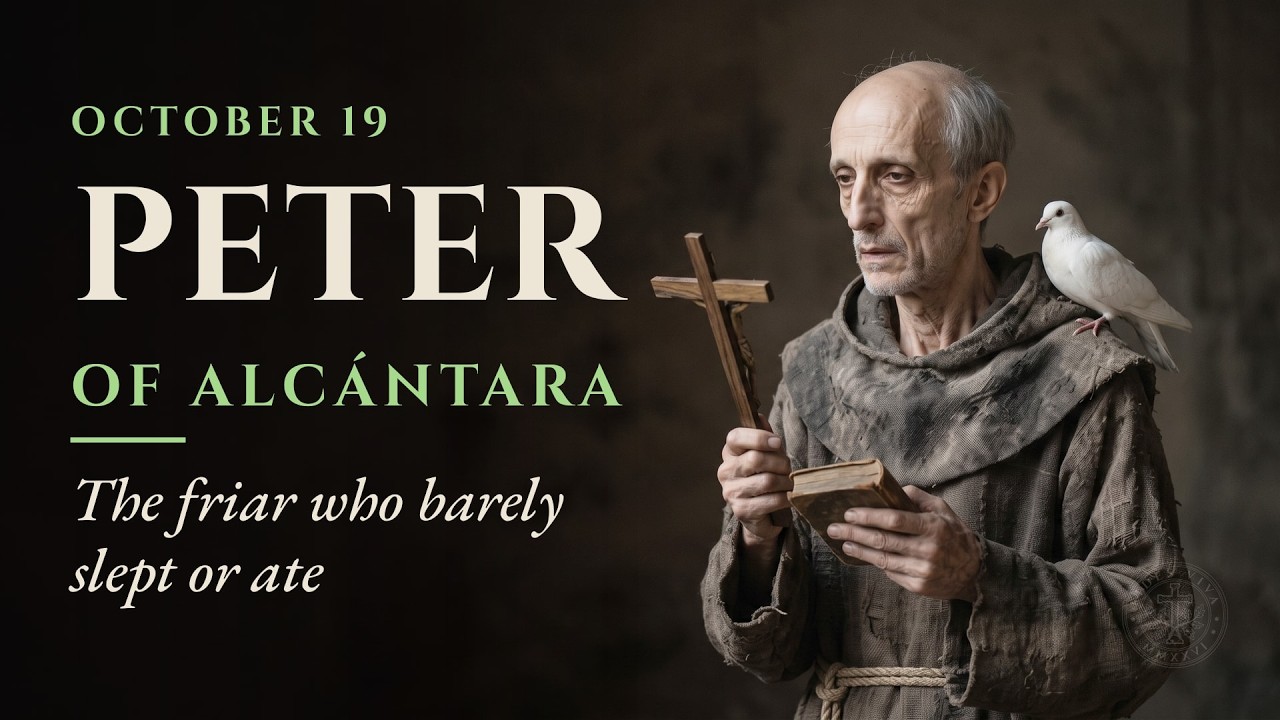
In Coria, all it took was someone calling out, "Friar Peter of Alcantara is coming down this street," and people stepped out to their doors and leaned from their windows. He went by barefoot, in a single narrow habit, his bald head always bare to the sky.
In Ávila, when he was already old, a nun looked at him closely. Saint Teresa of Ávila found him worn thin and silent, and she opened her soul to this man so dry on the outside. In those days almost no one trusted the way she prayed. He listened to her, and he understood her.
That friar had chosen the narrowest way for himself. And through that narrowness, everyone who knocked found a way in.
Known by Voice
The head that Coria came out to see had learned to bow in 1515, at Majaretes, a poor Franciscan friary in Extremadura. A boy of about sixteen arrived there, Juan de Sanabria, from a family of standing in Alcántara. He had studied at Salamanca. Ahead of him lay a career in learning and the good name of his family.
He left both behind. He received the habit from his uncle, who was the guardian, the superior of that friary. He was entering the Custody of the Holy Gospel, a small group of very poor friaries with its own superior, which many within the Order had fiercely opposed. The following year he made his vows, the promise that bound him to that life forever, and with them he also gave up the name Juan. From then on he was Peter.
Of what moved him to trade the lecture halls of Salamanca for that sackcloth, the poor, rough wool of the habit, not a single word remains, either his own or from those who knew him. What remains is the way he began to live.
He began with his eyes. For three years, in one house of his Order, he knew none of the friars except by their voices, because he never raised his eyes. When he had to go somewhere, he fell in behind the others and followed them.
Of everything he gave up for God in those early days, what cost him most was overcoming sleep, and to overcome it he spent the hours of the night on his knees or on his feet.
In that same narrow habit he walked the roads of Extremadura and Portugal for nearly thirty years. He was ordained a priest, and little by little his brothers entrusted him with the governing of the others. That poor custody had already become a province in 1519, under the name of Saint Gabriel, and Friar Peter came to be its provincial, the superior of all its friaries.
Without Office
In the autumn of 1554 the friars of Saint Gabriel met in chapter, the assembly that elected their superiors, in the same house at Majaretes where that boy had left his name behind. The chapter was presided over by the commissary general, the superior the Order sent over the provinces, and he arrived with a clear wish. He wanted them to elect Friar Peter as provincial. But the friars did not want that election, and neither did Friar Peter. Friar Juan de Espinosa was elected, and the man who had spent nearly his whole life as a friar caring for others was left without office, with no post to fill.
He claimed nothing. What he asked for next was something else, and he asked for it the way things are asked for in the Church. He obtained a papal rescript, a written permission from the Pope with the force of law, to live as a hermit with one companion, alone with God. He also asked his new provincial for leave, and Espinosa granted it.
He also had the protection of the bishop of Coria, who lived almost like one of the Discalced, the barefoot friars. So, with both his papers in order, around 1555 he went to a hermitage at Santa Cruz de Paniagua. It stood a crossbow shot from the village, as far as an arrow could fly, and very close to the house where the bishop went to rest.
A boy was living in that house at the time, the bishop's nephew, and he saw the hermit up close. The hermitage was a very small room. Its door opened onto a tiny garden plot, made for Friar Peter because he loved it, and they planted it with parsley so that it would always be green. To the left of the entrance was a corner so small that you had to bow your head to get in, and inside there was no room to lie down. That was where Friar Peter slept, with a stone for a pillow. On the other side, his companion had his own corner, a little larger.
But this solitary man did not live shut away. He very often came down from the hermitage to eat with the bishop and with the boy's whole family. He sat at the table barefoot, in his narrow habit, and in the grove nearby, among the water and the gardens, they talked of God. As evening fell he withdrew very early to his corner.
That was how nearly two years passed.
Simple Use
Meanwhile, in the lands around Coria, a gentleman from Ciudad Rodrigo and his wife, who loved Friar Peter dearly, had built a house and walled in a garden beside a spring. That house was not for them. In May 1557, at El Pedroso, Rodrigo de Chaves came before the local magistrate and a notary, on his own behalf and on behalf of his wife, Francisca. They were going to give that house to Friar Peter, with its walled garden and the land around it, in open woodland pasture beside the spring of El Palancar.
They gave it to him for the rest of his life and for whatever companions he chose to have, but only in simple use, so he could live there always without ever being its owner. They also gave him leave to make a chapel in one of the rooms and to say Mass there. That way Friar Peter could give himself entirely to prayer, which was what the Pope had given him permission to do.
That same month, work began there to turn the house into a tiny friary. When the builders saw the measurements, they begged him not to make the doors so low or so narrow, because no one would be able to get through without stooping and turning sideways. Friar Peter did not change a single measurement, and he gave them this answer. "The way to heaven is very narrow, and so we must make ourselves very narrow."
The doors were left low and narrow, and, as the neighbors told it later, he was the one who kept knocking his head on them.
Rodrigo de Chaves asked him many times to write something short and clear about prayer. The little book of prayer that bears Friar Peter's name begins by answering him, and says that without so much insistence its author would never have set about gathering in it the best of other works. He made it small in size and in price so that it would serve the poor, who cannot buy more expensive books, and clear so that simple people could understand it. He calls Rodrigo and Doña Francisca his dearly beloved children in the Lord.
What it invites the reader to meditate on, to ponder slowly before God, is the Life and Passion of Christ our Savior, in which, it says, all our good is found. And at the end of the prologue he places everything in the hands of Jesus Christ, for his honor and glory, because all that is good comes from him.
In the end, Rodrigo and Doña Francisca followed Friar Peter themselves. They took a house in El Pedroso and lived there for about two years, dressed in sackcloth like the friar, to be near him.
Come Here, My Children
Through the low door of El Palancar the poor, the children and the people of the area began to come and go, and sixty years later many of them swore to what they remembered. Lorenzo Pérez, a lawyer from Coria, was seventy years old when, in January 1616, he stood before the Church's judges, who were examining whether Friar Peter had been a saint, and swore to what he had seen as a boy. Seventeen other neighbors from Coria, Torrejoncillo and El Pedroso gave testimony along with him. Many of them could not sign their names. But nearly all of them said, on their own, what they had seen with their own eyes and what they had only heard others tell.
What Lorenzo had seen, many times, was Friar Peter crossing the streets of his town. People came out to look at him because he was, as Lorenzo put it, an extraordinary figure. Since there was not yet a friary of his order in Coria, he stayed in the house of a married couple, the same couple who years later would become Lorenzo's own parents-in-law.
Inside that house, the one who saw him up close was the lady of the house. Many times she went into her guest's room and found him absorbed in prayer. And she used to say that if God did them any good, it was because they had had him in their home.
At El Palancar, the door that opened every day was the door of the porter's lodge, the friary gate where people from outside were looked after. The son of a man who worked at the friary often saw Friar Peter come out through it with a few bowls in his hands. He called the poor with great love, and said to them, "Come here, my children." He gave them the food himself, with his own hand, and then he comforted them and taught them.
Through another door, the door of his little cell, came the children. One of them, hardly more than a little boy, went with other boys to give him their reading lesson, reading aloud to him what they had learned. The boy would find the friar kneeling, or sitting on the cork mat, a slab of cork that was all there was in the cell, and not just once, but many times.
And there was another door, the door of a woman in El Pedroso who had two brothers among the Discalced, the barefoot friars. Her granddaughter, who swore to it at the age of seventy-six, once saw Friar Peter sitting there. His feet were bare, as always, and his toes were raw and sore.
The grandmother felt sorry for him, and begged him, "Father, for the love of God, let me put a few little rags on those toes of yours, they're in such a bad way." He would not allow it, and this is how he answered her.
"Sister, these are roses and flowers to me."
The neighbors swore that they never saw him sad or heard him complain of his pains, and that he was always cheerful.
What They Saw and What They Heard
Those same witnesses, so careful to keep what they had seen apart from what they had heard, also swore to two things they could not explain, a Mass in the open field during a storm and a river crossed without a boat. It was a feast day in El Pedroso, and so many people came that the church could not hold them. So Friar Peter said Mass out in the field. Among the crowd was a boy of about sixteen, who was past seventy when he swore to what happened that day.
A great windstorm rose up, and everyone feared some danger. But where Friar Peter was celebrating, no one felt the storm. The friar stayed at the altar, and he said his Mass through to the end in great calm.
Others, who had not been there and had heard it told, added more. The parish priest had been afraid for the Blessed Sacrament, the consecrated bread in which Catholics adore Christ present. Friar Peter told him not to be afraid, that the storm would not trouble them. And the candles on the altar did not go out.
That much a boy saw. As for the river, no witness ever claimed to have seen it.
Friar Peter was going from El Pedroso to Garrovillas, and since he had left his companion sick in Portezuelo, he was traveling alone. He came to the Tagus at the crossing of the Lubia ferry. The ferrymen did not take him across, and yet he found himself on the other bank, the very bank where they stood.
Friar Peter, not realizing he had already crossed, asked them to take him over to Garrovillas. They answered that he was already on the other side, that he should think about what he was asking, because he seemed to be out of his mind.
In Torrejoncillo and in El Pedroso everyone took it as certain, and one of the neighbors put it this way before the judges. "Even the children know it and tell it."
Fugitive and Apostate
Among his brothers of the province of Saint Gabriel, the very province he had once governed, people did not speak of him in the same way. In September of 1557, a few months after Friar Peter arrived at El Palancar, the friars of his province met in chapter, their elective assembly, at the friary of Monticelo del Hoyo, and one of the matters they took up was his. A document that had come from Rome hung over that assembly. That spring Pope Paul IV had signed a papal brief, a ruling for the whole Church, against fugitive and apostate friars. An apostate was a friar who left his order without permission.
The man presiding over the chapter applied that brief. Because of what had happened with Friar Peter, he took away the voice and the vote of the provincial, Friar Juan de Espinosa, the same man who had given Friar Peter leave to go to the hermitage. And the assembly treated Friar Peter as a fugitive and an apostate.
And yet Friar Peter had the Pope's permission, fully in order, to live as a hermit with one companion, along with the leave of his provincial. The papers that had taken him to Santa Cruz and then to El Palancar were of no use to him before his own brothers. Some of them disliked that withdrawn life he led on his own.
The provincials who came later abandoned him. Friar Peter responded by looking for another door, and he looked for it within the law. At the end of 1557 he moved his little friary of El Palancar into the Custody of Saint Simon, a small group of friaries under the Conventuals, the other great branch of the Franciscans. Old privileges granted by the popes allowed him to do this without asking Rome for new permission. Along that road he carried his reform forward from El Palancar, a life of barefoot friars, poor and given over to prayer.
That opposition from his brothers did not close the door to those who sought his counsel. In 1558, in the palace of the bishop of Coria, the same bishop who had sheltered him at the hermitage of Santa Cruz, a young man in a hurry came looking for him. Luis de Rojas, another of the bishop's nephews, was about twenty-five and let Friar Peter guide him in prayer. He had just learned that he was to inherit the Marquisate of Poza, and he wanted to leave at once for Valladolid to take possession. His mother and his relatives urged him on.
Friar Peter told him not to go. When the young man paid no attention, the friar took him aside, into another room, alone. He reminded Luis how many times, in prayer, the young man had fervently asked to suffer for the love of God. Luis answered that he still wanted the same thing. Then the friar began naming humiliations and contempt from the young man's own family, and to every one of them the young man said yes.
At last he told him the hardest thing. Luis could find himself, for a few hours, with his soul lost and blind against God, and for that be imprisoned, sentenced and made to wear the sambenito, the tunic the Inquisition put on the condemned.
Luis answered, "May God hold me in his hand, so that I never offend him."
Friar Peter did not hold him back. He sent him off with these words, "Now go with God, and bear it with patience."
Luis left the palace and took the road to Valladolid.
The Little Book
In Valladolid, what Friar Peter had foretold in that room in Coria came to pass. An uncle of Luis, himself a friar, was caught up in the city's Protestant circle, and he drew the young man in with him. Luis was denounced, and he confessed that he had been a heretic for twenty-four hours and repented. He was sentenced to permanent exile from the court and to the loss of his honors as a knight.
In the summer of 1559, confined in a monastery in the city, he told two Franciscans through his tears, word for word, what Friar Peter had said to him before letting him go.
The suspicion reached Coria too. In July of that same year a decree from the inquisitor of Llerena, the Inquisition's judge for that region, was read out in the city. It ordered that forbidden books be handed over to the cathedral schoolmaster, one of the canons of the cathedral. A local man declared more than once that he had handed in the little book of Friar Peter of Alcantara.
It was the small, cheap book the friar had made for the poor. It was not on that year's list of forbidden books. But it was a book of prayer in the people's own language, the kind the Inquisition distrusted in those days, and in part it summarized another book, by a Dominican friar, which was forbidden.
In November the schoolmaster went further and denounced the bishop of Coria to the inquisitor. In his denunciation he spoke of a league and company of Theatines, his name for a group that, he claimed, set itself apart from the rest of the faithful. Among the names he put in it were Luis de Rojas, Friar Peter of Alcantara and Rodrigo de Chaves, the benefactor of El Palancar. He also accused the bishop of sheltering a well-known apostate, against the Pope's brief, the very one under which Friar Peter's brothers had treated him as a fugitive.
Meanwhile, Friar Peter had not stopped. Ever since the friar who led the Custody of Saint Simon had died, it was Friar Peter who in practice guided it. That spring the superior of the Conventuals, the branch his custody now answered to, had confirmed him in that office, and Friar Peter had traveled outside Spain to an assembly of that branch. In October he had gathered the friars of his custody at the hermitage of San Isidro de Loriana, a little house for five or six friars in the lands of Ávila. And in spite of the denunciation, he remained at the head of his custody.
He Understood Me from Experience
The suspicion Friar Peter knew so well was weighing on a nun in Ávila as well. It was a lady of the city, a friend to both of them, who brought Friar Peter and Teresa of Ávila face to face in August of 1560. Teresa was a Carmelite nun of the monastery of the Incarnation, and she was forty-five years old. Some of what she experienced in prayer her confessor put down to the devil, and other good people of the town thought the same.
Sitting before that barefoot friar, she told him about her life and her way of praying as clearly as she knew how. He had spent his whole life in prayer, following the poor Christ along the narrowest way.
Teresa puts it like this. "I saw that he understood me from experience." And that was all she needed. "He gave me light in everything."
When Friar Peter learned what she had been through, he was filled with deep compassion. He told her that few sufferings on earth are as great as the one she had endured, opposition that comes from good people. The man who spoke to her this way had been treated by his own brothers in the province as a runaway friar.
In the book of her life, Teresa calls him a holy man of great spirit, and she paints him just as she saw him that summer. To her he seemed very old, though he was only around sixty. And he was so worn away that he seemed made of nothing but tree roots.
For all that, he was very kind and easy to approach. He said little unless someone asked him, but then it was a pleasure to hear him, she says, because he had a very fine mind.
That conversation left her deeply consoled and happy, certain that what she experienced in prayer came from God.
From then on he enjoyed talking with her, and he confided in her about his own life and his affairs. The man who as a young friar never lifted his eyes, not even to recognize his brothers, had in that nun someone to speak with about God with an open heart.
Contenting the Body
In those conversations in Ávila, the friar of few words told Teresa little by little how he slept, how he ate and how he got through the cold nights. For some forty of his years of penance he had never slept more than an hour and a half in any one night and day. He slept sitting up, his head resting on a small piece of wood fixed into the wall. He could not lie down, because his cell measured four and a half old Spanish feet, a little over a meter.
He had never put up his hood, however hot the sun or heavy the rain, and he had never worn anything on his feet. Against his skin he wore a single sackcloth habit, as narrow as he could bear, and over it a short cloak of the same cloth.
On nights of bitter cold he had his own way of keeping warm. He would take off his cloak and open the door and the little window of his cell. Then he would put the cloak back on and close them, and so, after so much cold, that bit of covering contented the body.
Eating once every three days was ordinary for him. When Teresa was astonished, he asked her why she found it strange, since it was quite possible for anyone who grew used to it. A companion of Friar Peter told her that the friar sometimes went eight days without a bite of food. Teresa put it down to his raptures, those times of prayer when God filled him so completely that he was carried out of himself. She herself saw him like that once.
To Teresa, all of it seemed a strength of spirit that only God could give.
But in those years the one who needed help was her. Teresa wanted to found a small house of nuns, Saint Joseph's. She did not know whether to do it with a fixed income, money that would guarantee their bread, or in poverty, living on whatever they were given. They had been writing to each other since 1560.
In April of 1562 Friar Peter sent her a letter that settled her on founding in poverty. Teresa had reservations about other points of doctrine in that same letter, but on poverty she followed the advice of the friar who owned nothing of his own.
The bishop of Ávila still had to accept the foundation under his authority. Friar Peter went to see him to plead on her behalf. And in the end the bishop accepted the house under his authority.
Laetatus sum
Teresa and Friar Peter saw each other for the last time in August of 1562. That autumn Friar Peter lay ill in Arenas, where he had begun a foundation in 1561. A friend, the town's doctor, took him into his home.
There he received Extreme Unction, the sacrament with which the Church anoints the gravely ill and places them in God's hands. His end was like his life, and to the very last moment he went on preaching to his friars and giving them counsel.
It was the eighteenth of October. When he saw that the end had come, in that body Teresa had seen as if made of tree roots, he began to say in Latin the psalm that sings of the joy of going to the house of the Lord.
«Laetatus sum in his quae dicta sunt mihi.»
I rejoiced when they said to me, "Let us go to the house of the Lord."
And so, on his knees, he died.
All his life he had chosen the lowest doors. Through the last one he passed with the joy of the psalm on his lips.
Teresa was in Ávila, far from Arenas.
At the hour he died, she saw him before her, and Friar Peter told her that he was going to his rest.
She did not believe he had died, and she told a few people about it.
Eight days later the news reached Ávila that he had died, or that he had begun to live forever, as she preferred to put it. To Teresa it seemed that the world was no longer fit to bear so much perfection.
From then on she saw him many times, in very great glory. The first time, he told her that blessed was the penance that had won him so great a reward.
Afterward it was the Lord who spoke to her. He told her that nothing asked of him in Friar Peter's name would go unheard.
Teresa kept on talking to the old man who had so loved talking with her. She entrusted many things to him, and she saw them granted.
The Holy Fig Tree
The people of El Palancar sought what Teresa entrusted to him in Ávila, and they sought it in the friary garden, in the shade of a fig tree. The local people told how that tree had come to be. Friar Peter used to carry a dry staff of fig wood, his walking staff, and one day he drove it into the soil of the garden. The dead stick put out branches and bore figs.
In 1616 the fig tree still stood there, enormous, and everyone called it the holy fig tree. Its figs were carried all over the district against fevers and other ills, and the children would come up to the friars to ask for the holy figs. That is what the people of El Pedroso and Torrejoncillo swore that winter, as something that belonged to their own land.
Those figs reached Coria too, at the convent of the Conception. There a nun who had never known Friar Peter asked for them out of devotion and gave them to the sick who came asking. Some came back afterward to thank her.
Then she was the one who fell ill. The doctors said she had consumption, the lung disease that in those days wasted away so many. One day in August someone brought her three figs, and she answered in surprise. «Jesus, my lady, figs in August for a woman with consumption!»
She ate them. She was left free and well, and the fever never came back. At thirty-six, unable to sign her name, she swore to it at the grille of the parlor, the room where the nuns spoke with people from outside.
Those sworn statements traveled to Rome with many others. The Church beatified him in 1622, a first step, and in 1669 the Pope canonized him, which means he declared Friar Peter a saint for the whole Church. His memorial is celebrated on the nineteenth of October each year in the Franciscan family. Brazil's first emperor had borne the name Pedro de Alcântara since his baptism, because of the devotion the royal house of Portugal had for the saint, and in 1826 he asked that Friar Peter be made patron saint of his country, its holy protector. The Pope granted it.
His remains are venerated today in a friary in Arenas, the town where he died, which is now called Arenas de San Pedro.
In that same friary there is a copy of his cell from El Palancar. Those who come lean in to look at that hollow where a man could not lie down, just as the people of Coria leaned out to watch him pass.
For Christ, Friar Peter had chosen so narrow a life, and into it fit the poor at the friary gate, the people of El Pedroso, and Teresa, in Ávila, who needed to be understood.
Saint Peter of Alcantara, you lived barefoot and poor for love of Christ crucified. At the gate of El Palancar you called the poor your children. In Ávila you understood Teresa when no one else understood her. Teach us to pray simply, looking upon the life and Passion of Jesus. Give us a heart that uses without possessing, and a door open to whoever knocks. Be with the sick and with those who suffer pain in their bodies, the pain you bore without complaint. Comfort those who suffer the opposition of good people, and those who feel alone. And when our hour comes, may we say with joy that we are going to the house of the Lord. Pray for us. Amen.