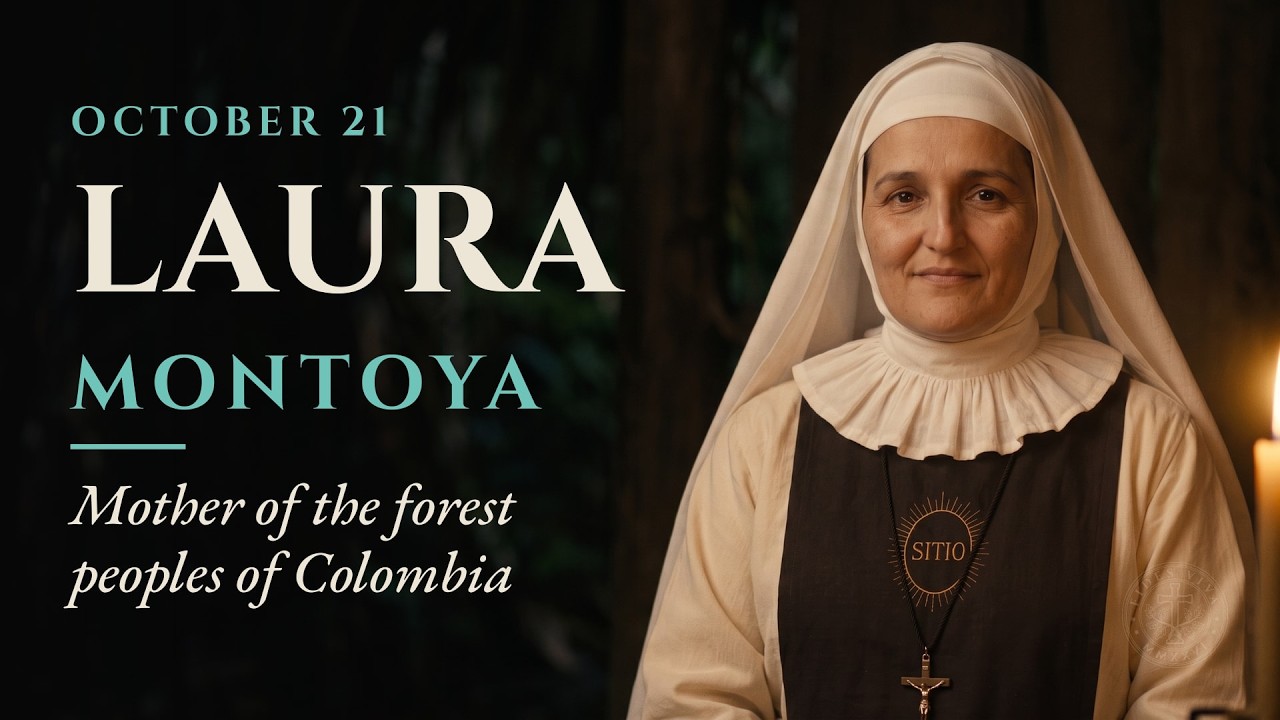
“You, what for coming here?” The question comes, in halting Spanish, from Juan de Jesús, an Indigenous Katío man of Dabeiba, in the forests of Antioquia. He is asking Laura Montoya, a teacher from Medellín who has just arrived with her elderly mother and a few companions. She answers that she has come to teach the law of God. He wants to know if the government sent her. Laura answers “No, government not send. God, yes, send.” Then the Katío asks her to tell him where she found God. “Where you find God?” She says “In Medellín.” Juan de Jesús does not soften. He insists that “Indian is no soul” and that she has to go back to her own land. The teacher answers “Indian also has soul.”
That woman had not found God in Medellín. She had known him long before, as a fatherless little girl, beside an anthill.
One Block from the House
The ants march in a line to a tree, strip its leaves and carry them back to the anthill, one block from the house and in plain sight of it, in the mountains of Antioquia. Behind them goes Laura, a girl of seven or eight, in the early 1880s. Her father was murdered in Jericó in December 1876, in the middle of a civil war, when she was two. Her mother, Dolores Upegui, was left a widow with three children, and her father's enemies seized the family's property. Laura has been through an orphanage, the home of some aunts and uncles and her grandfather's farm in Amalfi, and among her own relatives she has learned what it means to beg for affection.
That morning, the one she will call the most beautiful of her life, she follows the ants to the tree and comes back with them. She watches how they greet one another, how they set down their load and vanish into the mouth of the anthill. Now and then she takes a leaf from one and carries it to the entrance herself, sometimes tricking them, sometimes stroking them.
Suddenly she is struck, as if by lightning. She knows there is a God. She knows it with a knowledge so deep and so loving that, many years and many books later, she will still know no more about God than she knew then.
She does not know how much time passes, and she cannot speak. At last she slips away from the house so no one will hear her, and she weeps and cries out at the top of her voice, as if she needed it to breathe, out of pure joy. She looks at the anthill again and feels God in it with a tenderness she has never known. She lifts her eyes to the sky, calls out to him, and weeps because she cannot see him. She will always call that morning the blow of the anthill. From then on Laura is no longer alone, because she knows how to seek God, and her mother's absences begin to hurt a little less.
Those absences had begun earlier. When Laura was six, poverty forced Dolores to send one of her children to their father's father in Medellín. She thought of Carmelita, the eldest, but the girl was frightened and clung to her mother. Then Laura offered to go in her place. The bitterest ghosts of orphanhood fell upon her and her heart broke, but she gave a resolute yes, and that yes showed her mother what had to be done. Dolores calmed Carmelita, who would stay with her, and then went over to Laura and gave her the bitterest of caresses. In Medellín no one showed her any affection, and her relatives made fun of her. A few months later, the mother and her three children were together again on the estate of Dolores's father.
That same mother taught her something harder. Every day she had her children pray for a man named Clímaco Uribe. The children grew fond of him, and Laura thought he was family. One day, when she was a little older, she asked where this man lived. Dolores answered “That is the man who killed your father.” And she asked her to go on loving him, because we must love our enemies, who bring us closer to God. It was what Jesus asked of his own, and Laura learned it at home, from her mother's lips.
More than a century later, a doctor from Antioquia, at the edge of death, would entrust himself to that little girl.
Like a Cannonball
Knowing there is a God does not yet teach her how to pray at Mass. Kneeling beside her mother, the girl looks at the Host and feels nothing. Her mother weeps a great deal, above all at the elevation, when the priest lifts the Host up before everyone. Laura becomes convinced that she will never learn to hear Mass well, because she does not know how to cry.
When she is about ten, one morning while she is doing chores at home beside a wooden bench, a fierce longing to receive Communion rises in her. So she makes a spiritual communion, which means receiving Christ through desire, without the Host. She is left as if electrified, unaware of anything happening around her. She feels a pain and a love she has never known, as if the Holy Eucharist were piercing her soul through and through, and she is bathed in tears without realizing it. She will call it the blow of the bench. Years later she will say of that name, “What a strange name… but God and I understand each other.”
Among her relatives, Laura is still begging for affection. At about twelve she is unjustly sent away from an uncle's house, and from that closed door comes a decision, which she herself will describe in these words.
“From then on I resolved to be a saint, and a great saint, and soon.”
By about fifteen she is reading spiritual books, above all Sacred Scripture, and her reading leads her into silent prayer. She dreams of Carmel, the cloistered monastery where Carmelite nuns live to pray. She wants to go to God like a cannonball.
But the cloister will have to wait. When she is about sixteen her grandfather dies and Laura comes to Medellín. She lives in the asylum, the hospital for the mentally ill where her aunt works, and ends up running it. To earn her living she enters the Normal de Institutoras, the school that trains women teachers, on a scholarship, and in 1893 she graduates with her teaching diploma.
She teaches first in Fredonia and, a year later, in Santo Domingo. There, in front of the children, she teaches not so much the catechism as devotion.
Until she returns to Medellín. Her cousin Leonor Echavarría has founded the Colegio de la Inmaculada, a school for girls, and in 1897 Laura is appointed its vice-principal. The young woman who dreamed of a cloistered cell now spends her days among desks, blackboards and pupils. When Leonor dies young, all of it will pass into Laura's hands. Meanwhile, it is Leonor who entrusts her with some boarders whom no one can bring to confession.
Eight Pupils
The girls come from another school, one with a rather free spirit, and at the Inmaculada they now face the annual retreat, days set apart for prayer that end with confession. But as soon as they hear confession mentioned, they recoil in utter revulsion and say they would rather leave the school.
The teachers do not force them, but together they begin a crusade of prayer and wait. One day, in secret, eight of those girls come to Laura and tell her what they have kept hidden for years, that they have always made bad confessions and have left out their sins because they do not dare to say them.
Laura bursts into tears. And they, who love her dearly, weep with her.
She does not leave them alone with that burden. She asks the school's confessor for permission to listen to them, hears them out and gives them back their trust in God, and then arranges for a priest friend who does not know them to hear their confessions. When the day comes, they confess bathed in tears, and Laura sees it as a true conversion.
That same night, while the boarders study, Laura lies down under the toldillo, the mosquito net that covers her bed. Then a voice reaches her that does not come in through the ears of her body. For her, hearing it means understanding. And she understands that it is the devil speaking, and that he calls her a newcomer and an intruder.
"I will have my revenge on this upstart."
An animal comes in, something like a dog or a wolf, with a mule's hooves and black, tightly twisted horns. The beast threatens to tempt Laura's brother and to bring the school down with a slander. Laura raises her crucifix, but at once it seems to her that this does the beast too much honor. So she grabs it by the horns, cold, so very cold, grinds it against the floor and tells it that it will do nothing more than God allows, because she has God on her side.
The girls in the next room see nothing. Laura sprinkles holy water in her brother's room and in the maid's, and says not a word to anyone. Only a year later does she tell Carmelita, the sister who as a little girl had clung to their mother.
The threat does not fade from her mind. Some time later, Laura tells the confessor, who is also the director of the school, what she expects. The school will fall because of a slander against her.
The priest answers her in four words.
"I don't believe that."
Spiritual Daughter
The slander the confessor refused to believe reaches Medellín in print, in the form of a novel. Eva Castro, a former pupil of Laura's, has already set the date of her wedding, and only days before, she postpones it. She says she wants to become a Carmelite nun.
Her brother, the doctor and writer Alfonso Castro, publishes a novel in the city called "Spiritual Daughter." In it, an unmarried teacher persuades her pupils not to marry, and one of them gives up her wedding. Medellín reads the story, puts it together with what has happened in the Castro home, and recognizes Laura in that teacher.
But a letter reaches Laura's hands from people who know what really happened. It is signed by Teodosio Ramírez, and the name of Ana Jaramillo also appears at the bottom. They write to her, "We know that you worked hard with the young lady in question so that she would not act with such nervous rashness." They also remind her that she herself begged Eva, with great tact, not to cause a scandal.
Another voice rises from the classrooms. One of Laura's pupils says that the teacher spoke well to them of religious life, and that she also respected Christian marriage and prepared them for it. The young woman puts it this way.
"As for me, she never once scolded me over the suitors who came along… She was a true mother."
Laura does not defend herself alone. Before speaking out in public, she goes to see Monsignor Víctor Escobar, the vicar capitular, who governs the diocese while Medellín has no archbishop. Only then does she sit down to write. The parents of her pupils pay for the printing, and in 1906 many copies of the "Open Letter to Doctor Alfonso Castro" come off the press. It is Laura's first book, a printed defense that passes from hand to hand throughout the city.
Even so, the novel weighs more than the letter. At the Colegio de la Inmaculada, the school of the eight girls who wept with her, the parents begin to arrive. They come one after another, collect their daughters and take them away. The desks empty. What Laura feared that night, and the confessor did not believe, has come true.
The school closes for lack of pupils.
My Wound
In the empty classroom, a question Laura thought was settled comes back to her. What does God want her for? She had dreamed of Carmel. She asked to enter the Company of Mary, an order devoted to educating women, and they did not accept her. She also knows that marriage is not her path.
Then her thoughts turn toward the Indigenous peoples.
They are the Indigenous people of Guapá, whom she had met years before in Jardín, a town in southwestern Antioquia. A priest who was her friend, Father Ezequiel Pérez, had asked her to found a school there, and she said no until she learned that the people of Guapá lived nearby. She accepted, taught them the faith and prepared them for baptism. She returned to Medellín sure of her calling, but unable to see where to begin. So she waited, gently tied to the post of a hope, and stayed in the classroom to earn her bread until God's hour struck.
In Marinilla, a town in eastern Antioquia, that waiting breaks open in 1907. In her day, people who did not know the faith were called "infidels." Laura described it this way.
"I saw myself in God, and it was as though he wrapped me in his fatherhood, making me, in the most intense way, the mother of the infidels."
She feels them as children taking shape within her, children she has never seen and who hurt her like real children. An open wound, the kind that never stops hurting. That is what she calls them.
"From then on I called them my wound."
Beside forests full of people whom God loves, the cell of Carmel now seems far too cold to her.
But when she speaks of it in Medellín, almost no one follows her. Only her pupils are enthusiastic. Her spiritual directors listen in bewilderment, and some call her mad and remind her of other missionary expeditions that failed. She has her reasons. If the Indigenous people flee from missionaries because they feel threatened, a few women will seem less dangerous to them and can open the way for the priests.
The city does not see it that way. For society and the civil authorities, such a task is not fitting for a woman, and from the archbishop's circle a rumor goes around that the teacher is spreading liberal ideas. She proposes her work to several religious communities. None of them says yes.
So she resolves to go into the wilds and show that such work is compatible with being a woman.
She already sees herself in a clearing surrounded by very dense forests, with other companions in simple peasant dresses, living in huts or under tents, some setting out through the forest while the others pray and work at the house.
Sooner Dead Than Turned Back
That decision soon runs into an order. One of her spiritual directors hears her out and answers her bluntly.
"I seriously forbid you to continue with this undertaking of the Indians, or even to think about them. It is not feasible, nor is it for your sex, and it bears every sign of nothing but great madness."
The woman who already saw herself in a forest clearing has the door shut on her, and she is asked not even to look at it again. Laura obeys. The prohibition does not crush her. For the moment she rests, sure that God will accept the sacrifice of obedience and will find other means or other people to carry God's name to the Indigenous peoples.
With that door shut, Laura turns to another Mother. Kneeling before an image of the Virgin, the girl who grew up without a father speaks to the Mother of Jesus with all the trust of a daughter.
"Mother, I am not an orphan, because I have You, and You are more than a Mother. But the poor Indians are orphans, and they tear my soul apart! Will You not be their Mother?"
She promises to carry Mary's name among them and to serve the Virgin even as a wheel on the cart that carries Mary to their hearts. She comes out of that prayer so full of trust that she no longer even thinks about the Chocó, another forest region.
And a door opens. In Santa Fe de Antioquia, Bishop Maximiliano Crespo listens to the teacher's plan and answers her with these words. "Well, I welcome this work with my soul, my life and my heart." He promises to support her always and, if the diocese runs short of money, to pay out of his own pocket.
With the bishop's support, in May 1914 an expedition leaves Medellín, and the city watches it with curiosity and admiration. Missionaries, muleteers and mules. Laura goes with a few companions, and a priest travels with them. They carry no weapons. They carry Christ on a crucifix, and they go entrusted to the Virgin.
Among them, on one of the mules, rides Dolores Upegui, Laura's mother, now elderly. The woman who once gave Laura, then a girl of six, the bitterest of caresses now climbs beside her along the mule track, a mountain path cut for pack animals.
Some people urge them to turn back. Laura answers them with a single sentence.
"Sooner dead than turned back!"
True to that watchword, days later they reach the end of the road at Dabeiba, between mountain and forest, the land of the Emberá Katío. From the very first day they face the terrain and the distrust of the Katío leaders. That same year the Congregation of the Missionary Sisters of Mary Immaculate and Saint Catherine of Siena is born there, the sisters people will come to call, after their foundress, the "Lauritas."
That same week, a Katío man comes back to the newcomers' house with a question.
Indian Also Has Soul
Juan de Jesús, the Katío man of Dabeiba, comes in without long greetings and goes straight to what he wants to know.
"Me want for ask, you, what for coming here?"
"To teach the Indians the law of God," Mother Laura answers.
He wants to know who is behind this woman. "That you alone, or other one sent? Government sent?"
"No, government not sent. God, yes, sent."
"Where you find God?" the Katío asks. And she answers "In Medellín."
The Indigenous man does not learn, says Juan de Jesús, but the "libre," which is what they call the white man, does learn, because he has a soul. "Indian also has soul," she answers him. The man does not give way. "You not know, Indian is not soul. You must go back again your land, because Indian not like you."
She argues no further. She tells him she is staying so that they will have somewhere to come and visit, somewhere to eat lunch and somewhere to hear the graphophone, a hand-cranked machine with a large horn that plays recorded music. And she sets it playing. Juan de Jesús jumps back.
"You have people put inside that board… We much afraid!"
He keeps insisting that she go back to her land, until lunch arrives. Then he sits down, eats heartily and, between one spoonful and the next, gives his verdict. "This way is good, is good." With the plate empty, the visit is over.
That distrust does not surprise Mother Laura. It seems quite natural to her, as she sees in the Katío the story of their past, so hard and so sad.
Winning over this people will take patience, and the foundress has set herself a rule that she will later put into words herself.
"From the beginning I resolved not to give the sisters any mouthful I had not already swallowed myself."
So when, in August 1914, the time comes for the first visit to the little Katío houses, at first she goes alone, and she makes the first expedition with only one sister at her side. To the Katío, who keep the memory of the cruelties of the Conquest, the arrival of these women may look like the prelude to the final destruction of their people. Telling them that the women have come to seek their souls would only alarm them more. This is how Mother Laura will later put it, speaking of herself and her sisters.
"That is why we had to bear, with the greatest kindness, the harsh distrust of the poor people we loved so much."
When the Katío come to the house, the sisters give up their seats to them and put food in their hands.
The first thing they see as they come in is a picture of Mary. They learn her name before God's, and in front of that image they are taught everything else. They repeat a short prayer that sprang from Mother Laura's soul the first time she stood before someone who did not know Christ.
"Mary, my Mother, save me!"
For many of them, the first word they ever spoke in Spanish was "María!"
What none of those little houses has is a place to keep the Eucharist.
They Have Nature
The girl who came to know God beside an anthill now has to teach her sisters to pray without a church. The missionaries sleep in bohíos, Indigenous huts with palm-thatched roofs that here have no walls, and they travel the mountains by mule. Those little houses have no tabernacle, the place that keeps the presence of Jesus in the Eucharist, and Mother Laura feels "a deep sadness." While she looks for a way to get one, an idea comes to her, and she gives it to her sisters in a single sentence.
"They have no tabernacle, but they have nature!"
God is to be sought in creation just as he is sought before the tabernacle, "for although his presence is different, he is there in both places." They offer up that lack as a "Baptistine sacrifice." Like Saint John the Baptist, who stepped aside so that Jesus might increase, they go without his presence "so as to seek that Jesus may grow in the souls that do not know him." Mother Laura invites them to praise God each morning with the song of the birds, "not by instinct, but by reason and love." Over the years that teaching becomes a book, Mystical Voices of Nature, in which the foundress asks each missionary to make "a tabernacle of the world around her."
But the forest also brings danger. In Murrí, one morning as she prays "full of God," she seems to see many snakes and wild animals of that land come before the Lord, "as if in procession." She rejoices that they have come to place themselves at the command of their Lord, and she asks him to bless them according to their nature. Then she tells the Lord, "not with the mouth," that these animals are "an impassable bulwark," a wall no one can cross, between the sisters and the people there. After a while the answer comes, and she tells it like this.
"I knew with certainty that God was ordering the wild beasts to do us no harm, and that they would receive no harm from us either."
She gives her consent to that pact and is left certain that they will be able to live there without those animals ever touching them.
The distrust that hurts her most does not come from the forest. One day they are given a house on one condition, that no Indigenous person may enter it. She laments it.
"Oh my God, what I felt! So there is room for the mothers and not for the children?"
Another day a gentleman reproaches her for not changing the language and dress of the Katío. She answers him, "with a little seriousness," that the Katío love their language as anyone loves their own, and that in their dress they keep their traditional greatness. She admits that she too had once believed they wore little because they had no clothes, "but what lessons and rude awakenings I had!" To those who want to tear all of that from them by force, she answers with the history of the Americas.
"They were not wild beasts when the white race came to America. It was irrational treatment that turned them into wild beasts… Only our Lord knows how to change hearts, and he taught us the way to do it, through love and sacrifice."
Many criticize her because, done this way, it all goes very slowly.
At that same pace she later sets out with her missionaries for San Pedro de Uré, another forest even deeper in, and there she serves for almost a year.
With the Constitutions in Hand
When she comes back from San Pedro de Uré, Mother Laura finds that the questions no longer come from the Katío. Now it is men of her own Church who are questioning her. Urabá, the region where Dabeiba lies, is now an apostolic prefecture, a mission territory that Rome has entrusted to the Carmelites. At its head is a Carmelite, José Joaquín Arteaga, its first prefect. He governs the mission in Rome's name, and that is why he can make decisions about the sisters who work there.
Arteaga reviews the congregation and wants to impose on it the rule of the Discalced Carmelite nuns, a different form of religious life, cloistered behind convent walls. The sisters, who sleep in bohíos and ride up into the forest by mule, say no.
The refusal does not go unanswered. Arteaga appoints a Carmelite friar as the sisters' chaplain, the priest who says Mass for them and hears their confessions. According to Mother Laura, on one occasion the friar says this.
"I have come solely to finish off Mother Laura and her work. That work is a disgrace to us and must not exist."
The friar also hears the confessions of the novices, the young women preparing to become sisters, and in the confessional he plants in them distrust of the foundress. The house splits apart.
Arteaga then writes to the nuncio, Monsignor Roberto Vicentini, the Pope's representative in Colombia, whose judgment will decide the matter. Mother Laura has to travel to Bogotá. In his office, the nuncio holds the constitutions, the written rules of the congregation, and reads her the charges against Mother Laura, one after another. She performs duties reserved for priests. She rebels against the sacramental life, the life of Mass and confession. She governs without a council. She publishes letters in the newspapers out of vanity. She makes dangerous expeditions out of a craving for prominence.
She answers that the only true charge is the one about the dangerous expeditions, and that God has approved them with wonders and miracles.
The nuncio asks her to explain.
So she tells him about Dabeiba. For months a plague of locusts had ravaged the region, and hunger and sickness had followed it, and then it was the Indigenous people themselves who asked the missionaries to pray. The sisters prayed, the plague stopped from one moment to the next, and afterward many freely asked for baptism.
In Bogotá, after hearing her whole defense, Vicentini changes his attitude and sets the accusations aside.
Twenty Postulants
The nuncio heard her out, but in Urabá the envy and suspicion carry on, and because of them the missionaries have to leave Dabeiba, the land where the work was born and where Juan de Jesús, the Katío man of that first week, stayed for lunch.
The deepest trial comes later, and it reaches the youngest. This is how Mother Laura experienced those years of dealing with the bishop of Santa Rosa de Osos, Miguel Ángel Builes, in whose diocese the sisters have their novitiate, the house where new sisters are formed. The bishop opposes her missions and says of them "I will destroy them, I will not leave a single one! I will make them disappear!"
He keeps three sisters in the seminary kitchen and does not let them out even for their retreat. He maintains that the congregation has been rotten from the start, founded on the pride of its superior. And he orders the Blessed Sacrament removed from the novitiate.
In response, Mother Laura gathers the first twenty postulants, young women who have just asked to enter, and leaves with them for the diocese of Santa Fe de Antioquia. There she opens a new house of formation, supported by the bishop who succeeded Crespo, the man who had welcomed the work. Mother Laura was never short of priests who opposed her, and of those persecutions she says this.
"God permits them, so that my affection for the clergy may be completely supernatural."
In those years her spiritual director, Father Esteban Le Doussal, walks beside her. He asks her to write her life, and she takes up the pen out of obedience. She fills notebooks addressed to a "father" and gives them the title "History of the Mercies of God in a Soul."
Others keep speaking ill of the work. Among the Lauritas, people tell what happened to one of those critics, Father Rubén Palacio, a priest from Yarumal who had never met Mother Laura. He hears his bishop speak very badly of her at a gathering of the clergy and begins to criticize her in front of his parishioners. One night, after a whole day spent speaking ill of the missionaries, he is smoking a cigarette in his room with the light on. A solemn sister walks in, in a white habit, a blue scapular and a white veil, with a crucifix and a camándula, which is the rosary. She looks at him and goes out toward the street. Behind her come group after group of sisters dressed just like her, until he is frightened. The cigarette has burned down far enough to scorch his mouth.
In the morning, the people of his household tell him that this is how Mother Laura's missionaries dress. He decides never again to speak ill of them, because if there were going to be so many, they had to be the work of God.
A work that now spans several dioceses needs the word of Rome, and in 1930, in fragile health, Mother Laura sets sail to go and ask for it.
A Million Lives
In Rome, Mother Laura carries a single request for her daughters. She asks for the decree of praise, the first recognition Rome gives a congregation, the one that places it under the Holy See.
The answer is no.
She does not leave Rome without praying. In November, in Saint Peter's Basilica, she remains before Jesus in the Eucharist, in intense prayer, and then she lets her desires pour out. She had wished for three long lives, one for adoration, another for humiliations and another for the missions.
Now she offers the Lord those impossible desires. And as she offers them, a single life for the missions seems far too little. So she gives him something greater, the desire to have a million lives to spend in the missions, among those who still do not know Christ.
After that offering, she is left very sad. And she says to the Lord, again and again, an arrow prayer, a short prayer sent up like an arrow.
"Ah! How I die, seeing that I am nothing and that I love you!"
She returns to Colombia without the decree and goes on building the work among her sisters.
The Wooden Chair
The woman who wished for countless lives for the missions spends her last nine years unable to reach them. In Medellín, Mother Laura lives seated in a wooden wheelchair. The mountains she once climbed by mule are far away now, and she can no longer go to see the Katío. She still has her hand. With it she writes and governs her sisters from her desk, never giving up what they call her apostolate of the word and the pen.
Nor does she give up adoration. In October 1941 she is before the ciborium, the sacred vessel that holds the consecrated hosts, and she prays to Jesus in these words.
"Into your Sacred Ciborium I enter, Jesus, to leave there the kiss of my love as a tribute of adoration."
From April 1949, Mother Laura lives in a room of the convent at Belencito. Her bed can still be seen there, with the pictures of Saint Joseph, of Saint John Bosco and of a sleeping Child Jesus, and a large wooden cross. Her dying is long and painful. On October 21, 1949, she dies there, without having seen Rome approve her congregation.
The orphan who went from house to house leaves behind ninety houses in three countries and four hundred and sixty-seven sisters. The day of her death is now her feast in Colombia, with its own prayer in the Liturgy of the Hours, the prayer by which the Church makes every hour of the day holy.
Beneath the steps of the church at Belencito there is a crypt, and there they bury her. Beside her rests Dolores Upegui. She is the mother who followed her all the way to Dabeiba and ended up joining the congregation as one more of her sisters. Mother and daughter remain together.
Four years later, Rome grants Mother Laura's daughters the decree of praise she had gone to ask for in person.
My Advocate
Meanwhile, at Belencito, the door of Mother Laura's room is no longer closed. After her death, those who knew her come to the sisters and ask to go into that room. There they pray to God. In the end the sisters open the room to anyone who wishes to pray there.
In Colombia it is said that an eighty-seven-year-old woman prayed in that room, and that her healing was the one that opened the way to beatification.
In 2004, in Saint Peter's Square, Pope John Paul II proclaims her Blessed, the first public recognition of her holiness.
The following year, that doctor from Antioquia who was to entrust himself to the girl of the anthill, Carlos Eduardo Restrepo, is gravely ill and close to death. He entrusts himself to Blessed Laura and recovers in a way that science cannot explain. In December 2012, Pope Benedict XVI authorizes the decree that recognizes this healing as a miracle through the intercession of Mother Laura.
For the doctor, Mother Laura is the one who defends him before God, and he says so plainly.
"My saint, my advocate, is Mother Laura."
He says that she is with him every day and that, through her, God guides his hands with light.
In May 2013, in that same square, Pope Francis canonizes her and declares her a saint for the whole Church. Laura Montoya is, to this day, the only Colombian saint.
That Katío man of Dabeiba wanted to know where the newly arrived teacher had found God, and she told him it was in Medellín. Today, in Medellín, beside the bed and the wooden cross at Belencito, others come in to tell God what weighs on them. They come with the trust of the woman who told the Virgin she was no orphan because she had Mary as her Mother. The girl who learned beside an anthill that she was not alone has become a mother to those who come alone to her door.
Where has God found each one of us?
Lord, you sought out an orphan girl beside an anthill and gave her your companionship. You sent her into the forest as a mother to those who did not know you. Through the intercession of Saint Laura Montoya, teach us to seek you in little things and in all that you have made. Give us her courage to go out to meet those no one is waiting for. Give us her respect for every people and every language. Comfort the sick, the slandered and those who mourn someone they have lost. May all who feel orphaned find a mother in your Mother. Saint Laura Montoya, pray for us. Amen.