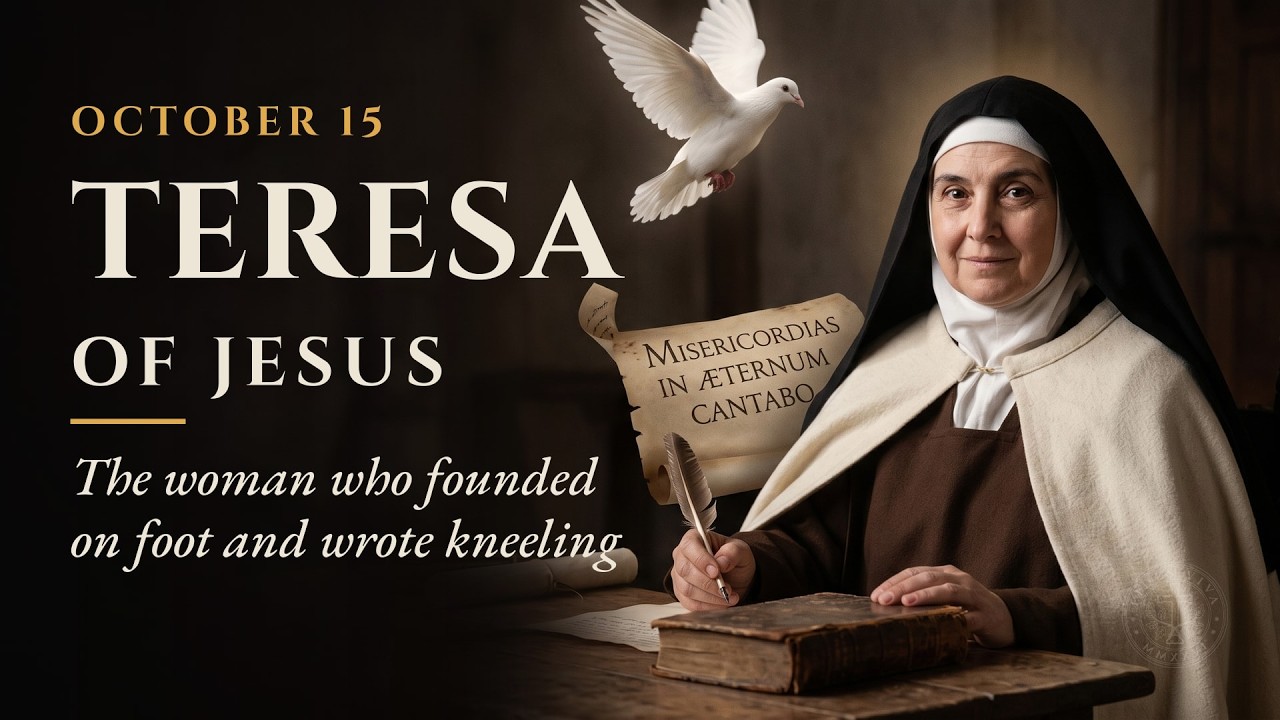
The hour of prayer arrives at the Monastery of the Incarnation in Ávila, and a nun named Teresa looks at the clock, wishing it were over. For years she will live torn between God and the world. Today that same nun is Saint Teresa of Jesus, Teresa of Ávila, the first woman Doctor of the Church. It was she who said that to pray is to share friendship with the One we know loves us. And she herself took years to trust that friend. She was buried without being embalmed. More than four centuries later, her tomb was opened once again to see what remained of her. And what they found was not what anyone would expect of a body so old.
Very Early in the Morning
She comes to that house on her own two feet. In Ávila, before dawn one November day in 1535, at twenty years old, she leaves her father's house without his permission. He has firmly refused to let her become a nun. She walks to the Carmelite Monastery of the Incarnation, outside the city walls, and there the prioress takes her in.
The house she chooses is a large one, home to nearly two hundred people. Its nuns go out into the city when there is need, and they receive visitors in the parlor, the room with a grille where they speak with people from outside. The following year, the same father who had refused signs the dowry, the gift a family makes to the monastery, and his daughter receives the habit.
It was not the first time she had left home for God. She was six or seven, reading the lives of the saints with Rodrigo, her favorite brother. Seeing what the women martyrs suffered, she thought they had bought heaven very cheaply. So the two of them agreed to go off to the land of the Moors to die as martyrs, begging for alms along the way, so that their heads would be cut off there. They set out, and they had to come back home.
Their martyrdom foiled, they became hermits in the garden. They built little hermitages out of pebbles, which quickly tumbled down. The girl looked for corners where she could pray alone, above all the Rosary, and she gave alms as best she could, and she could do very little. In those books she discovered that everything comes to an end and only God remains. She and Rodrigo said it to each other again and again, "forever, ever, ever."
Rodrigo, the brother from that runaway journey toward the land of the Moors, will one day go much farther. The same year Teresa enters the Incarnation, he sets sail from Seville for the Indies, and there, on the Río de la Plata, he dies, probably two years later. The two children who dreamed of giving their lives for God will never see each other again.
The house she left that dawn had already lost its mother. Doña Beatriz de Ahumada died when her daughter was thirteen. The girl then went to the hermitage of San Lázaro, stood before an image of Our Lady of Charity and asked her for what she no longer had. Many years later she told it this way. "I begged her to be my mother."
And so, that November dawn, she does not cross Ávila entirely alone.
The One They Expected Dead
Shortly after making her vows, in 1537, Teresa falls gravely ill and has to leave the Incarnation to seek a cure. She spends the winter in Hortigosa, at the home of her uncle Pedro. There she reads a book on prayer, the Third Spiritual Alphabet by Friar Francisco de Osuna. From that book she learns recollection, a way of praying in which the senses are gathered inward so that one can be alone with God. So prayer comes to her first as a book.
But the cure does not come. In Becedas she spends months undergoing treatments that do not heal her, and she returns to Ávila worse than when she left.
In August 1539, in her father's house, she falls unconscious and stays that way for almost four days. They give her up for dead. When she comes to, her tongue is torn to pieces from biting it. She cannot swallow even water. Her body is drawn up, curled into a ball, and she can move only one finger of her right hand. To move her, two women carry her in a sheet, each holding one end.
She stays like this until Easter. Then she asks to be taken back to her monastery. The nuns welcome her home, and she sums it up in one dry sentence. "They were expecting her dead, and they received her alive, but with her body worse than dead."
She spends more than eight months unable to move, and almost three years before she walks again. The first step is not a step. When at last she begins to crawl on her hands and knees, she praises God. The nuns marvel at her patience, and she counts it a gift from the Lord.
The doctors of this earth can offer her no more hope, so she decides to turn to the doctors of heaven. She does not want superstitious devotions. She takes Saint Joseph, the husband of the Virgin, as her protector. And she is sure who put her back on her feet. It was Saint Joseph.
From then on, she cannot remember asking him for anything he did not grant. And to anyone who has no one to teach them to pray, she leaves a piece of advice. "Whoever cannot find a master to teach them prayer, let them take this glorious Saint as their master, and they will not lose their way."
Back on her feet, she returns to the life of the house, to the visits and to the parlor.
The Clock
The hours at the grille slip by without her noticing. Teresa speaks well, people are fond of her, and the visitors keep coming back.
Those conversations are slowly drawing her away from God. One day, when she has only just met a certain person, Christ appears before her, very stern, making her understand how much this grieved him. She does not see him with the eyes of her face but with the eyes of the soul, and more clearly than if she saw him with the eyes of the body. She is left stunned. But as the days pass she convinces herself that she imagined it, and she goes back to the same conversation.
Another time, with that same person and in broad daylight, she and others who are there see something like a large toad coming toward them, far faster than toads move. She never forgot it. She took it as one more warning, and even so she did not give up those visits.
For about a year and a half she even gives up prayer. She sees herself as so wicked that she does not think herself worthy to keep company with God. She calls it false humility, and says it was the greatest temptation she ever had. Years earlier she had taught her father to pray, and he has come so far that he goes to the Incarnation to talk to her about God. And Teresa gives him her illnesses as her excuse for not praying.
At the end of December 1543 her father falls ill, and Teresa nurses him. She lets him see no sorrow at all, though inside her soul is breaking. His back hurts him badly. She suggests that he think of the Lord carrying the cross, and he complains no more.
He receives the anointing of the sick and asks his family to commend him to God and to remember that everything comes to an end. He spends three days barely conscious. On the day he dies he comes to himself and prays the Creed, the prayer in which a Christian professes his faith. He dies halfway through the Creed, praying it himself.
The man who did not want to see her become a nun leaves this world praying, as his daughter taught him, and at peace, like an angel.
In that grief, her father's confessor, a Dominican friar, takes her under his care. He has her receive Communion every two weeks and asks her not to abandon prayer. And so she returns to prayer, and never again gives it up, although she still does not turn away from those conversations in the parlor that were drawing her away from God.
It is not easy for her. There are days when all she waits for is the end of the hour, her eyes on the clock. But she does not get up. She holds on to prayer as to a strong pillar.
And in that struggle she discovers what prayer is. For her it is friendship, being alone with someone she knows loves her. She says so to Christ with the simplicity of someone speaking to a friend. "Oh, what a good friend you are, my Lord!"
She has lived like this for almost twenty years, her heart divided between God and the world, when one day she walks into the oratory of the house and finds an image that was not there before.
The Christ Covered in Wounds
The image had been brought in for a feast of the house, and now it is carried to the oratory to be kept there. It is Lent, and Teresa stands still before it. It is a Christ covered in wounds, so moving that when she looks at it she trembles all over, because she sees in it what he suffered for us.
She is thirty-nine years old and comes to this moment weary of herself. She longs for rest, and her bad habits will not let her have it. For years she has been resolving to change by her own strength. And again and again she falls back into the same ways.
Now she looks at those wounds and feels how poorly she has thanked him for them. And then she feels her heart breaking.
She throws herself down beside him, weeping a great deal, and begs him to strengthen her once and for all, so that she will not offend him again.
Other times she has wept and made promises. Now she no longer trusts herself and puts all her trust in God.
And from the floor she speaks to him.
She tells him she will not get up from there until he does what she asks.
And she stays there, on the floor. From then on she grows much better. God draws her out of what she calls so deadly a death.
In those same days she is given the Confessions of Saint Augustine, as though the Lord had arranged it. It is the book in which that saint of the early centuries tells how he returned to God. In a garden, Augustine had heard a voice calling him to change his life.
When Teresa reaches that page, the voice is no longer Augustine's alone. She feels that it is the Lord saying it to her. And for a long while she weeps, quite undone.
Soon afterward, in prayer, she is taken by surprise by something she had never known before, a presence of God so clear that she cannot doubt he is within her.
But this closeness does not reassure everyone. Some of her friends and confessors are afraid that the devil is deceiving her. In the Spain of that time, women who said they received favors from God were met with suspicion.
I Will Give You a Living Book
So several men of God hear her out. In the winter of 1557, Francis Borgia, a Valencian nobleman who has given up everything to become a Jesuit, passes through Ávila. Teresa tells him about her prayer and holds nothing back. And she leaves with his answer. What she experiences in prayer comes from God.
Then they take away what had kept her company most. Ever since she was a girl reading the lives of the saints with Rodrigo, books have been her path to God. In August 1559 the Inquisitor General, Fernando de Valdés, publishes the Index, the list of forbidden books. With it, many of the spiritual books in Spanish that she used to read disappear. She feels the loss deeply.
And in that loss the Lord tells her, "I will give you a living book."
A few days later, she says, her visions begin. On the feast of Saint Peter in 1560 she sees Christ, and he himself is that living book.
That same year, at the home of her friend Doña Guiomar de Ulloa, a widow of the city, she meets an old and very thin Franciscan. He is Friar Peter of Alcántara, a reformer of the Franciscans. Teresa opens her soul to him, and he sheds light on everything for her.
And during those months, at the Incarnation, she is sometimes given the grace of the dart, one of the scenes of her life that artists have depicted most often. At her left side she sees an angel. He is not large but small and very beautiful, his face aflame, and he seems to her to be one of those called cherubim.
In his hands the angel holds a long golden dart with a little fire at its tip. It seems to her that at times he plunges it into her heart, and that it reaches to her very depths.
When he draws it out, he leaves her on fire with a great love of God. The pain makes her moan. And the sweetness is so great that she does not want the pain to leave her.
It is not a pain of the body but of the soul, though the body shares in it too, and greatly.
A Star
One day, while she is at prayer, she suddenly finds herself plunged into hell, in the place the demons had prepared for her. Before her is an entrance like a very long, narrow alley, like a very low, dark oven. The ground is mud. At the far end there is a hollow in the wall, and she sees herself put into it.
She feels a fire in her soul and a despair, a total absence of hope, that weighs more than all the pains she had ever suffered in her body, even those of the four days when they gave her up for dead.
There is no light there, only darkness.
She comes out of it changed. She loses her fear of the sufferings of this life. What remains is an immense sorrow for the souls who are lost, and above all for the Lutherans. They are the Christians who, in her century, have broken away from Rome to follow Luther. To her they are still members of the Church through baptism, and what she feels for them is grief. From that sorrow comes her longing to live the Rule of Carmel, the way of life of her Order, as perfectly as she can. At the Incarnation that Rule is lived in a softened way, with outings into the city and visitors in the parlor.
One September night, Teresa and a few of her relatives are talking in her cell about the Desert Fathers, the first monks who left everything to pray in solitude. A young relative, María de Ocampo, suggests founding a small monastery and offers her inheritance. Doña Guiomar de Ulloa, her widowed friend, joins in. Teresa hesitates. She is content in her cell.
But one day, after she receives Communion, Christ commands her to strive for that house with all her strength. She is promised that the house will be built and will be called Saint Joseph's, that Saint Joseph will guard one door and the Virgin the other, and that Christ will walk among them. It will be a star giving off great light.
When Teresa hears this, she is filled with anguish, because she sees all she will have to suffer to do it, and the peace of her cell that she will have to leave behind.
The distress does not leave her. On the feast of the Assumption in 1561 she is praying in a Dominican church in Ávila, the same church where she had confessed so many sins, and she remembers them. Suddenly she sees herself being clothed in a garment very white and full of light. Our Lady is at her right and Saint Joseph at her left, and they are the ones putting it on her. She understands that she is now cleansed of her sins.
Our Lady takes her hands. She tells Teresa how glad she is that Teresa serves Saint Joseph, and assures her that the monastery will be built.
The house now has a name and two guardians. What it still lacks is money.
Hard Times
As soon as Ávila finds out, the gossip begins, the laughter, the people saying it is madness, and opposition comes from every side. The pressure reaches everyone who helps her. Doña Guiomar, her widowed friend, is refused absolution, God's forgiveness in confession, by her confessors for as long as she will not give up the plan. The provincial, the superior of the Carmelites in that region, had given his permission, and now he withdraws it. He says the house will have nothing to live on, and that the opposition is too great. Even Teresa's confessor orders her to say no more about it. And at the Incarnation, her own convent, they look on her so unkindly that some of the nuns ask for her to be locked up as punishment.
Teresa and Doña Guiomar then turn to Friar Pedro Ibáñez, a Dominican, the most learned man in the city. He asks them for eight days to study the plan, sure that he will talk them out of it. When the eight days are up, he is convinced that the work is truly for God. And he tells them to hurry and finish it.
But in Ávila people are already saying that this house is born of visions, that Teresa says Christ has commanded it. And in the Spain of that time, that was dangerous. Some friends warn her, very frightened, that she could be denounced to the Inquisition, the tribunal that judged those who strayed from the faith.
“This struck me as funny and made me laugh,” Teresa says. She knows very well what she carries within her. For the smallest ceremony of the Church, or for any truth of Scripture, she would be ready to die a thousand deaths. So she answers that, if there were any reason, she would go and find the Inquisition herself. Then she tells Ibáñez, with complete clarity, about her visions and her way of praying, so that he can see whether there is anything in them against Scripture.
Meanwhile, Teresa's sister secretly buys a small house, as if it were for herself. There is no money. “My Lord, how can you command me to do things that seem impossible?” Teresa says to Christ. One day she has nothing to pay the workmen who are repairing the house. Then Saint Joseph appears to her, the one she calls her true father and lord, and gives her to understand that the money will not be lacking. And she hires them without a single coin to her name.
The house seems far too small to her, and she thinks of buying another. But after receiving Communion she hears Christ say to her, “I have already told you to go in as best you can.” And the same voice adds, “How many times did I sleep out in the open for want of a place to go!” Teresa returns to the little house, fixes it up with what there is, and finds in it a complete monastery.
In the summer of 1562, the husband of Teresa's sister, the one who had bought the little house, falls ill. Teresa obtains permission to leave the Incarnation to care for him, and so, without arousing suspicion, she can see to the house. The foundation is made in great secrecy. On August 24, four young women take the habit in the little house. It is Saint Joseph's, the house Christ had promised her, with Saint Joseph and the Virgin guarding its doors. A poor Carmel, living in enclosure, where the nuns stay within its walls and never go out. And this time, unlike the pebble hermitages of her childhood, the walls do not fall down.
Right away Teresa has to go back to the Incarnation to answer to the provincial. He had withdrawn his permission, and the house has been founded with the permission of the bishop of Ávila, Don Álvaro de Mendoza. And the whole city rises up against the new house. The town council, which governs Ávila, gathers the leading citizens to close it down, and there it is defended by Friar Pedro Ibáñez, the learned Dominican, and by other priests. The house holds firm. The city will go on fighting it in the courts for more than a year, but the nuns do not leave.
And in the rough little house, four novices begin to live what she had dreamed of.
The Rough House
At the end of 1562 Teresa returns to Saint Joseph's, and this time she comes to stay. The house is poor and unfinished, with a few small hermitages in the garden. Now she wears a habit of rough brown wool, just like her novices. There she will live the five years she calls the most restful of her life.
Even in those quiet years, the devil does not leave her in peace. One day she sees beside her a small, dark, hideous figure, growling as if in despair. Teresa laughs and asks for holy water. Throwing the water over herself is of no use, but as soon as she throws it toward where he is, he is gone at once.
Years later, when the Church was examining her holiness, one of her nuns testified that Teresa never wanted to travel without holy water. They carried it in small gourds hung from their waists.
In those years, a priest tells her that for two and a half years he has been living in a grave sin he does not dare to confess. Teresa promises to pray for him and to have others pray too, and she writes to him through a third person. After the first letter, he goes to confession.
But the temptation will not let go of him, and he tells her it torments him like a hell. So Teresa asks God to let that temptation fall on her instead, and she spends a month of terrible torment until he is set free. Whenever the temptation presses on him again, he rereads Teresa's letters. She credits that change to the prayer of her sisters at Saint Joseph's.
It is for those few sisters that she now writes The Way of Perfection, a book that teaches them how to pray. In it she speaks of the Church torn in two by the Lutherans, and of her grief for it. She is deeply distressed, and she puts it this way. “As if I could do anything or were anything, I would weep before the Lord and beg him to remedy so great an evil.”
And in 1567 the superior of the whole Order knocks at the door of Saint Joseph's.
A Friar Who Wanted to Be a Carthusian
The visitor is the prior general of the Carmelites, the Italian John Baptist Rubeo. He sees the little house, talks with its foundress and, before going on his way, authorizes her to found more houses like it. A few months later he also gives her permission for two houses of friars.
The first new house opens in August in Medina del Campo, a town of merchants and great fairs. There Teresa looks for friars willing to live the Rule without any softening, as her nuns do. The first to offer himself is the prior of the Carmelite friary, Friar Antonio de Heredia. But more are needed.
One day a young Carmelite friar, twenty-five years old, arrives in Medina. His name is Friar John of Saint Matthias, he is studying in Salamanca, and he has come to celebrate his first Mass. Teresa talks with him. She is very pleased with him, and she learns that he is about to leave the Order to become a Carthusian. The Carthusians are monks who live in silence, each one alone in his cell.
They talk for weeks. She offers him another kind of solitude, a life of poverty within his own Order. He gives his word to join her, on one condition, that it not take long. He will become Saint John of the Cross.
And it does not take long. In November 1568, in Duruelo, a farmhouse lost in the countryside, Friar John opens the first house of Discalced, or barefoot, friars. That is what the men of the reform are called, those who live the Rule without any softening. Teresa is not there, because she is still out on the roads founding new Carmels one after another, and by the end of her life there will be seventeen.
A few years later she is ordered back to the Incarnation, the house she had left, but now as its prioress. And there the paths of the two cross once again. As confessor for those nuns she brings in Friar John, one of the Discalced, whom she considers a very holy man.
One day in November 1572, Teresa receives Communion from Friar John's hands, and with it the grace she calls spiritual marriage, the deepest union with Christ. Years later she will write that this union takes place in the most hidden part of the soul.
The Book Before the Inquisitors
Meanwhile, one of her foundations has gone wrong, the one in Pastrana. Years earlier, Doña Ana de Mendoza, the Princess of Éboli, a great lady of the court, had called Teresa to her town to found a Carmel there. When she is widowed, the princess herself enters that house as a nun. Her presence and her meddling make the nuns' life impossible, and in 1574 they abandon Pastrana.
The princess leaves the convent too. And in those months she denounces a book of Teresa's to the Inquisition, The Book of Her Life, the account she had written for her confessors, with her visions and the favors she received from God. She had finished it in 1565, at Saint Joseph's. In 1559 Teresa's books had been taken from her, and now it is one of her own that the Inquisition is going to read.
The following year, the bishop of Ávila, Don Álvaro de Mendoza, the man who had protected Saint Joseph's, hands the original manuscript, written in Teresa's own hand, to the Inquisition in Valladolid. From there it goes on to the tribunal in Madrid, where the Dominican Domingo Báñez examines it. In the summer of 1575 he signs his report, and it is favorable. In it he writes that this woman, even if she may be mistaken in something, is at least no deceiver.
Even so, the book is held back for years.
It will only be published after her death.
In 1575, while the manuscript waits in Madrid, Teresa arrives in Seville to make a new foundation. She comes ill, with a handful of nuns, and among them all they have a single blanca left, the smallest coin in Castile, and nothing but the clothes on their backs.
The new accusation comes from inside her own convent. At the end of that year, a novice who had left that Carmel denounces Teresa and her nuns to the Inquisition. In 1576 the inquisitors of Seville question her and some of the other nuns. Teresa answers as openly as she had in Ávila, when she told Friar Pedro Ibáñez everything. For an adviser to the tribunal she writes an account of her inner life.
Before she leaves Seville, Father Jerome Gracián, a young Discalced friar who is now her superior, and whom she has promised to obey, imposes a mortification on her, an exercise in humility. He himself said it was one of the hardest she ever had to bear. He tells her to sit for a portrait, orders her to obey the painter, and goes away.
The painter is Friar Juan de la Miseria, a Neapolitan friar not very skilled with the brush. He scolds her if she laughs or moves her face. He takes her face in his hands to turn it toward the light. That is how the only portrait made of her in her lifetime comes to be. Above Teresa's head he paints a dove, and beside her a ribbon bearing a verse from the psalms.
“Misericordias Domini in aeternum cantabo.” They are words from a psalm, and they mean that she will sing the mercies of the Lord forever. To one side he writes her age, sixty-one.
The story goes that, when she saw the finished canvas, she told the friar he had painted her ugly and bleary-eyed.
With that sixty-one-year-old face she leaves Seville for Castile, but not to make a new foundation. Her own Order has commanded her to confine herself to a convent.
A Castle in the Storm
And in the end, the command comes from the general, Rubeo. A few years earlier, he had written that she does more good for the Order than all the Carmelite friars in Spain. The general feels he has been disobeyed. In Andalusia, houses of Discalced friars have been opened without his permission but with that of an apostolic visitor, the envoy sent to inspect the Order.
In 1575 the general chapter, the great assembly of Carmelite superiors, meets in Piacenza, in Italy, and turns against the Discalced. From that assembly comes the command to keep her confined. A rumor even reaches her, a false one, that she has been excommunicated, cut off from the communion of the Church.
With her own Order against her, Gracián and a confessor tell her to write. In June 1577, in Toledo, she begins The Interior Castle, which is also called The Mansions. In it, the soul is a castle with seven mansions, seven dwelling places, one inside the other. It is also a silkworm that shuts itself up in its cocoon and comes out a butterfly. And at the end lies the union of the two spouses, the soul and Christ.
She finishes it in November, back at Saint Joseph's in Ávila. For her teaching, Because of what she teaches in it, Pope Paul VI will proclaim her, in 1970, the first woman Doctor of the Church.
A few days later, one December night, friars of the Order's older branch, opposed to the Discalced, seize Friar John of the Cross, the friar she had won over in Medina, and lock him in the prison of their convent in Toledo. The next day, from Ávila, Teresa writes to King Philip II in his defense.
And as if that were not enough, on Christmas Eve she falls in her own house of Saint Joseph's and dislocates her left arm. With her arm like that and her friend in prison, she gets through the whole winter. In May, a folk healer sets it back in place, and the pain is terrible.
In 1578 a new representative of the pope arrives in Spain, the nuncio Filippo Sega. He strips Gracián of his powers and places the Discalced, friars and nuns alike, under the superiors of the Order's older branch, the one that opposed the reform. It is said that he called her a restless gadabout of a woman, disobedient and obstinate, a woman who will not stay still and will not obey.
That year two pieces of news reach her. Friar John has managed to escape from the prison in Toledo. And in Rome, General Rubeo has died. Teresa mourns him, even though he was the one who ordered her confined.
In the end, the ones who take the side of the Discalced are the nuncio's own advisers, and in 1580 Pope Gregory XIII, through a papal brief, a letter from the pope with the force of law, grants them a province of their own, the right to govern themselves.
With that province in hand and her arm still aching, Teresa sets out on the road once more, heading north.
It Is Time
Her last road north begins with a farewell. At the end of 1581, in Ávila, she meets with Friar John of the Cross. It is the last time. They had known each other since Medina, fourteen years earlier, when he was still thinking of leaving to become a Carthusian.
In the depth of winter she reaches Burgos, her health worn out. The archbishop puts obstacles in her way for months, and only in April 1582 does she open her last Carmel there. In May, Gracián, who has traveled with her on the journey, says goodbye to her. That same month the Arlanzón, the city's river, rises, and the water floods the house.
In the summer she starts back. She wants to reach Ávila to see her niece make her vows. But Friar Antonio de Heredia, the first to offer himself for the reform back in Medina, orders her to change course for Alba de Tormes. She obeys and arrives very ill. A few days later she takes to her bed, never to get up again.
Between the pages of her breviary, the book of daily prayers, she keeps a short poem, “Let nothing disturb you, let nothing frighten you, all things pass, God does not change, patience obtains all things, whoever has God lacks nothing. God alone suffices.”
The woman who at the Incarnation listened to the clock, wishing the hour of prayer would end, no longer counts the minutes. Now she is waiting for another hour.
On October 3 they bring Viaticum to her cell, the last Communion given to someone who is about to die. Beside her bed are Anne of Saint Bartholomew, the sister who cares for her as her nurse, and the priest who gives her the last rites. As she receives Christ, Teresa exclaims, “It is time, my Spouse, for us to see each other.”
She goes through her final hours in peace. Those keeping watch hear her repeating psalms, giving thanks to God and hoping for salvation from Christ. She says she dies a daughter of the Church, and she asks forgiveness for her sins. Friar Antonio begs her not to die so soon, and she answers him. “Father, I am no longer needed.”
She dies around nine o'clock on the night of October 4, 1582.
That very night, Pope Gregory XIII's new calendar takes effect, bringing the dates back in line with the course of the sun, and Thursday, October 4, is followed by Friday, October 15. In a single night, ten days are skipped. On that Friday the 15th she is buried in Alba, and on that date the whole Church celebrates her feast every year.
They leave her in the house where she died.
But She Walked
The nuns of Alba keep watch over her tomb. In that Carmel it was remembered that her body, buried without embalming, stayed for decades just as it was on the first day.
Ávila and Alba came to dispute possession of it. In 1585 it was taken to Saint Joseph's in Ávila, and the following year it went back to Alba. Beside her tomb in Alba, people began to speak of favors obtained through her intercession. That reputation helped open the examination of her life in Salamanca, and in 1622 Pope Gregory XV proclaimed her a saint.
Today that body rests behind a grille, in a silver casket given to her by the king and queen of Spain in the eighteenth century. Reaching it takes ten keys.
In the summer of 2024, every one of them is used. First, the Carmelite nuns of the house, a Church tribunal and a few religious carry the reliquaries of her heart and her arm, which are also kept in Alba. They do it singing the Te Deum, the ancient hymn of thanksgiving. With them is Father Marco Chiesa, the friar in charge of the Discalced Carmelites' causes of sainthood. They remove the marble slab. Three keys open the grille, three the tomb and four the casket.
They pray before the body. After more than four centuries in the ground, that body should be nothing but bones by now. Teresa's is just as it was in 1914, the last time the casket had been opened. The skin is dry and has no color left, and even so the experts can make out Teresa's face almost clearly. This is the body that so many of the faithful call incorrupt.
And then there is her foot. Her body is not complete in Alba. As was done with the saints, some parts were shared out as relics, and a foot is kept in Rome. That foot was studied too, and Father Chiesa describes what they found in it, growths on the bone, calcium spurs that make walking almost impossible. And he adds, “But she walked.”
As a child she set out from Ávila for the land of the Moors, and she had to turn back. After her illness she learned to walk again, starting on her hands and knees. She traveled across Castile, La Mancha and Andalusia in carts and on mules. And the nun who spent almost twenty years watching the clock during prayer ended up walking with that friend until her last day, on feet that could barely hold her up.
What if the hour that feels so long to us were also the hour of a friend who is waiting?
Saint Teresa of Jesus, you who heard the clock in prayer and did not abandon it, teach us to be alone with the One we know loves us. You who learned to walk again on your hands and knees, stay close to the sick who cannot get up today. You who asked the Virgin to be your mother, comfort those who mourn their loved ones. Obtain for us your trust, so that nothing may disturb us and nothing frighten us. And at the end of the road, may we wait with you for the hour of seeing the Spouse. Pray for us. Amen.