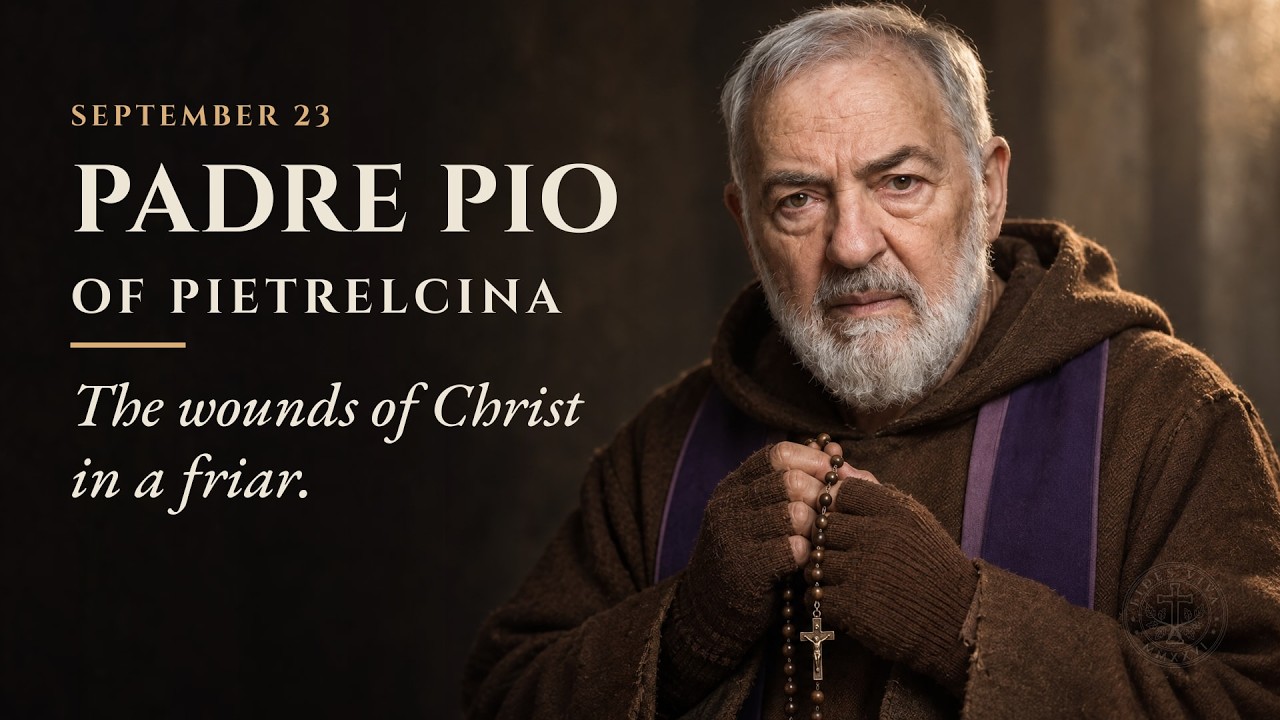
He almost always kept his hands covered. On them, and also on his feet and side, were wounds. To the envoy from Rome who came to question him, he himself told when they had appeared: one morning in 1918, after Mass had ended, while he was giving thanks to God. Yet the people who made their way up to his convent in southern Italy were looking above all for a priest. For more than fifty years, Saint Pio of Pietrelcina, Padre Pio, the Capuchin friar of San Giovanni Rotondo, celebrated the Eucharist and heard confessions hour after hour. He granted forgiveness in Christ’s name. In old age, he saw the doors open on a hospital born of his own effort, the Casa Sollievo della Sofferenza. Even today, it receives the sick, and the Holy See directly safeguards its continuity.
From Pietrelcina to the Gargano
At the end of the nineteenth century, the Samnium, the inland region around Benevento, made its living from the land. In Piana Romana, in Pietrelcina's countryside, the Forgione family cultivated small plots of their own. They were small landowners, people who depended on what each harvest yielded. There, in the spring of 1887, Grazio Forgione and Maria Giuseppa De Nunzio had a son. They baptized him the day after his birth, giving him the name Francesco.
The boy grew up among those fields and the work of the household. At that time, Friar Camillo, a Capuchin who collected alms for his convent, passed through the village. The Capuchins belong to the great family of Saint Francis of Assisi. They live on what they receive, wear a brown habit with a cord at the waist, and order their whole life around prayer, poverty, and obedience. The figure of that friar collecting alms remained forever linked to the beginnings of the boy’s vocation.
Entering the order first required an education, and that education cost money. The family made the sacrifice: Grazio emigrated across the ocean to pay for his son’s schooling.
On the feast of the Epiphany in 1903, at the age of fifteen, Francesco crossed the threshold of the Capuchin novitiate at Morcone. At the end of that same month, he put on the habit and left behind his baptismal name. From then on, he would be called Friar Pio.
The novitiate was a year of probation, with a strict schedule that left no room for comfort. During that time, his mother went to see him in Morcone. At the end of the year, the young man took his first vows. In January 1907, he made his solemn profession, giving himself to the order for life.
The years of study followed. In August 1910, he was ordained a priest in Benevento, and from then on he could celebrate Mass. But his body did not keep pace. His health had never been strong since his youth, and this prevented him from living in community, as a friar normally would. He returned to Pietrelcina, to his family home. He would spend almost six years there.
During those years at home and in illness, he wrote letters of spiritual direction. In one of them, dated on the feast of the Assumption in 1914, he spoke of Christ as the divine Guide. And he wrote:
“To reach our final end, it is necessary to follow the divine Guide, who wishes to lead the chosen soul only along the path He Himself traveled, that is, the path of self-denial and the cross.”
It was signed by a young and sick priest, writing from his parents’ village, far from the convent where he belonged.
In September 1916, his superiors assigned him to San Giovanni Rotondo, a town in the Gargano, the promontory of Apulia overlooking the Adriatic. The Capuchins had a small convent there, dedicated to Our Lady of Grace. Friar Pio was twenty-nine years old. He would never leave that place again, because he would live there until his death.
Illness had kept him at home, and now obedience was taking him to a remote mountain in the south. In that convent, what he had written about the cross would not remain merely words on the page of a letter.
In the Choir, After Mass
The year 1918 found Italy still at war. Mobilization reached the convents as well: many Capuchins were drafted to the front, and others fell ill. Then came the Spanish flu. In his letters, Friar Pio described what remained of the community at San Giovanni Rotondo: only three friars.
Three men to sustain the life of an entire religious house. They had to pray together at the appointed hours, celebrate Mass, and keep the church open for the people of the town. The epidemic did not stop at the convent door. It reached him, and it also reached people close to him, both in San Giovanni Rotondo and in Pietrelcina.
In that nearly empty convent, on the morning of September 20, the friar celebrated Mass. He was thirty-one years old. When it ended, he remained in the choir, the part of the church where friars gather to pray together. It was the time of thanksgiving: the quiet moment a priest gives to God after receiving Communion.
What happened in those minutes belongs to his own testimony. He recounted it three years later, when a bishop sent by the Holy See asked him to explain, point by point, how it had all begun. This was his answer:
“On September 20, 1918, after the celebration of Mass, while I was making the due thanksgiving in the Choir, I was suddenly seized by a trembling… I heard this voice: ‘I associate you with My Passion’… and I saw these signs from which blood was flowing. I did not have them before.”
A sudden trembling. A voice. And then, on his own body, wounds that bled and had not been there before.
In that same testimony, he said who had spoken to him. He had seen the Lord crucified. The marks were on his hands, his feet, and his side: the places of Jesus’ wounds on the cross.
His account follows a simple order. First the altar, then prayer, then the voice, and only at the end, the blood. The wounds come as the consequence of words, and those words speak of sharing: to associate someone is to make that person share in what is one’s own. What Christ was sharing with that friar was His Passion.
Years earlier, ill in his parents’ home, he had written that one reaches God by the path of self-denial and the cross. In the choir at San Giovanni Rotondo, that cross was marked on his flesh. It happened in a year of battlefronts and fever, in a house sustained by three friars, during the quietest time of the morning.
Wounds like these could not remain within the walls of a convent. Three years later, the silence of the choir would give way to precise questions and to the gaze of a Church that did not wish to rush to judgment.
Examination, Silence, and Obedience
On June 14, 1921, Carlo Raffaello Rossi arrived at the convent, an Italian bishop who would later become a cardinal. He had been sent by the Holy Office, the office of the Holy See charged with safeguarding the faith and examining matters that concerned it closely. He stayed for eight days.
He had not come to celebrate anything. He had come to ask questions. Seated before the friar, he put one hundred and forty-two questions to him, one after another, and listened to every answer. Friar Pio was thirty-four at the time, and he answered them all.
Then the visitor asked to see the wounds, and he examined them with his own eyes. He wrote down what lay before him. The wound in the side had taken the shape of a triangle. Those on the feet and side showed a gleam of changing reflections, like light falling on a damp surface.
When he had finished, he set down his judgment in writing:
“The stigmata in question are neither the work of the devil nor a gross deception, nor a fraud…”
Nor, he added, were they the effect of suggestion. It was the conclusion of a man who had looked and questioned for eight days. He was not proclaiming a miracle. He was closing, one by one, the doors to easy explanations.
Those pages also preserved a portrait of the man. Rossi noted that he celebrated Mass with extraordinary devotion. And he left one figure: each day, the friar spent between ten and twelve hours in the confessional.
Ten or twelve hours listening to others. While Rome studied his hands, he kept them busy granting absolution.
The examination did not bring the questions to an end. In 1931, the Holy See imposed restrictions on his ministry. He was forbidden to hear confessions and to celebrate Mass in public. The priest who spent his days receiving penitents saw the place where he waited for them empty.
He accepted the ruling. From 1933 onward, those faculties were gradually restored to him. It was a slow recovery, step by step, and each step returned him to the confessional.
Those were not his only difficult years. At other times in his life, he endured further investigations and further limits on his priestly ministry. There were also unjust accusations, and there was slander.
In the face of all this, he kept silent. He entrusted his cause to the judgment of God, to those who guided his soul, and to his own conscience. He received every restriction with humility, as one who obeys the Church he loves.
There is one kind of pain that can be seen, and another that has no witnesses. The wounds belonged to the first. Suspicion, silence, and waiting belonged to the second. In that hidden pain, the cross he had accepted to carry in following Christ continued to take shape.
What was said about him did not depend on him. What did depend on him was what he did whenever the door was opened to him: he returned to sit in the confessional.
And when those doors opened, the crowds did not come only to look at covered hands. They came to place their own conscience before him.
Time in the Confessional
They sought him in the church, in the sacristy, and in the corridors of the convent. Some asked to go to confession. Others wanted counsel for the journey of their souls, what the Church calls spiritual direction. Many simply came to his Mass. For more than fifty years, San Giovanni Rotondo was the place where people knew they could find him.
His day had a center, and that center was the altar. Mass was the high point of his day: the moment when, as a priest, he made present Christ’s sacrifice on the cross. The man who bore the wounds of the Passion on his body bent every morning over the very mystery that had marked him.
From the altar he went to the confessional, and there time was measured differently. It was no longer counted by the hours on a clock, but by the people kneeling one after another on the other side of the screen. Each one brought a life. Each one sought Christ’s forgiveness, which came through a friar’s voice.
For thousands, he was the friar of the wounds. For the person who sat before him, he was a confessor with a voice, with patience, and with a word meant for that person alone.
John Paul II would see this ministry as the distinctive mark of his apostolate. He also recalled that he sometimes treated pilgrims with an apparent sternness, and that those same pilgrims later returned to seek the sacrament’s forgiveness.
That accompaniment did not end when someone left the church. Gino Lenti, one of the many who came to him, went through a time of personal crisis and always remembered him. There was an exchange of letters with the friar. There were visits. His was not an encounter of a single afternoon, but a closeness that endured while the trial lasted.
That was his spiritual fatherhood: a written reply, a door opened again, a name not lost in the crowd.
He spoke of himself in very plain words.
“I want only to be a poor friar who prays.”
And he explained prayer with an image anyone could understand: “In books we seek God; in prayer we find him. Prayer is the key that opens the heart of God.”
The rosary was part of his daily prayer. The beads passed through covered hands, and those hands, so often examined, were the hands of a man at prayer.
That trust in prayer did not remain within the convent walls. From it came a work he himself founded: the Prayer Groups. They were gatherings of the faithful who came together to pray, with no other program than prayer offered with trust. They gradually spread beyond San Giovanni Rotondo, carrying to other places that same certainty that prayer opens the heart of God.
Around the confessional, another memory also took shape, one that the Capuchins and the faithful have treasured with affection. Many said that he read the consciences of his penitents with singular clarity. Others spoke of a fragrance they sensed near him, without knowing where it came from.
That memory accompanies his ministry, but does not take its place. What brought so many men and women back to God was the sacrament celebrated in faith, the Mass each morning, the hours of listening, and the rosary in his hands.
And around that everyday life of altar, confessional screen, and prayer, other stories grew—stories the people of the Gargano have continued to pass from mouth to mouth.
What Devotion Continued to Tell
One of them leads to the chapel of Sant'Anna. Carmelo Durante recalled a conversation about that chapel and understood it this way: the friar had been present there, in a place where his body was not. Devotion has a word for this, bilocation, meaning to be in two places at once. That is how it has remained in the memories of those who followed Padre Pio.
The war left another story. Father Damaso da Sant'Elia said that, during the Second World War, airmen on a bombing mission over the region made out in the sky the figure of a friar who kept them from dropping their bombs there, and that they recognized Padre Pio in that figure.
Other accounts speak of a struggle no one saw. Tarcisio de Cervinara passed on one of them: the friar’s spiritual battle with the tempter, that enemy who, in the Christian faith, seeks to turn a person away from God. In this memory, a life united to Christ’s cross also knew battle, and the battle was fought with the things of each day. He himself had called prayer “the best weapon we have.”
Another story bears a child’s name. Her name was Gemma, and her grandmother brought her to San Giovanni Rotondo. It is still told that her eyes recovered their sight through a grace the faithful attributed to the friar’s intercession. It is a memory of popular gratitude, distinct from the healings the Church would study much later with physicians and judges.
None of these accounts changed the pattern of his days. In the morning he celebrated Mass. Then he sat to listen to penitents. Between one task and the next, he prayed. What people saw at close hand was a priest who gave his time, his forgiveness, and his prayer in Christ’s name, and who needed no wonders to go on doing so the next day.
Very near the convent, moreover, there was a suffering no one had to recount, because it was plain for all to see. In those mountains, falling ill meant that many families were far from a doctor and a bed where the sick person could receive care. That pain had a home, a face, and a name.
The Cross Turned into Care
The hospital people had to go to was in Foggia, far from those heights. For the people of San Giovanni Rotondo, taking a sick person down there was a difficult journey. The hardship always weighed on the same households: those without the means to make the trip in time.
From that need came the idea of building a hospital in the town itself, for the local people. The friar took up the project and pressed it forward with all his strength. He wanted a place where the sick of the Gargano could receive care without having to travel far away.
Italy was emerging from the Second World War. Money was scarce, and so were materials. Raising a building of that size, in those years and in that place, required far more than goodwill.
Hands were needed, and hands came. Around the friar, a group of collaborators formed, ready to work for the project. Among those who joined was the writer Barbara Ward. Donations came as well, and each gift was added to the one before it like another stone in a wall that did not yet exist.
The work had to make its way through one material difficulty after another. Construction lasted several years, sustained by the offerings of the faithful.
Don Giuseppe Orlando, a priest who lived close to those beginnings, kept a precise memory. Padre Pio asked him to begin work on opening the access road to the future hospital.
Before the walls, before the wards and the beds, that was needed: a route by which materials could be brought up and, one day, the sick. That is how the work began on the ground, opening a way along the mountainside. One of the first things done for those who suffered was a road.
As the walls rose, the friar remained in his familiar place: the altar and the confessional. The work grew only steps away from where he listened each day to those who came with wounded souls. Two different labors advanced side by side, one of stone and the other of forgiveness.
The building received a name that says almost everything. It was not simply called a hospital. In Italian, Casa Sollievo della Sofferenza; in English, House for the Relief of Suffering. A house, the place where one is welcomed. And relief, the first thing sought by anyone who suffers.
On May 5, 1956, Casa Sollievo della Sofferenza opened its doors. The friar was sixty-eight years old. The work he had promoted was now dedicated to the purpose for which it had been founded: to relieve the pain and hardship of many families.
From then on, a sick person in those mountains could find near home a doctor, a bed, and someone to care for them. The long journey down to the plain was no longer the only way.
When he was still a young priest, that man had written that his path was the way of the cross. Since that day in the choir in 1918, he bore it in his body, and he had declared that Christ was uniting him to His Passion in this way. He never turned that wound into a spectacle, nor did he make suffering an ideal for others.
What he offered those who suffered was something else. Clean wards, nearby doctors, families who no longer had to choose between the journey and the wait. His union with Christ crucified, which in his life had been prayer, silence, and listening, now took its most concrete form of all: caring for the sick.
For decades, he had spent hours seated, almost motionless, tending wounds no one could see. Now, only a few steps from his convent, doors were opening for the wounds of the body.
The work continued to grow. But the friar’s final years would again bring limits, illness, and obedience.
The Final Years
Easter 1961 came to the convent after another visit. An ecclesiastical envoy named Maccari had spent time in San Giovanni Rotondo. After his stay, new measures arrived: they restricted Padre Pio’s public liturgical activity.
The elderly Capuchin was seventy-three years old. He had known restrictions thirty years earlier, and he responded to these as he had to the others: by accepting what was asked of him. The feast that celebrates Christ risen from the dead, the greatest of the Christian year, remained in the convent’s memory as a sad Easter.
His body had been frail since he was young. That frailty had kept him in his parents’ home after his ordination, and it had accompanied him throughout his life in the Gargano. In his final years, his health deteriorated quickly. The strength that had sustained whole days in the confessional began to fail him.
Even so, the altar remained the center of his days. There he continued to celebrate the sacrifice of Christ.
September 1968 came. That month marked fifty years since the morning in the choir. Padre Pio then celebrated his final Mass. He also gave a final blessing.
On September 23, 1968, he died in his convent. He was eighty-one years old. He had arrived in San Giovanni Rotondo sick and young, sent there almost out of necessity, and he never left.
The news spread, and people came. His funeral drew an extraordinary gathering. For half a century, they had sought him out for confession, for counsel, to hear him celebrate Mass. Now they came to bid him farewell.
On February 20, 1971, Paul VI received the superiors of the Capuchins. He spoke of that friar from the Gargano and explained why he had gathered such great renown. His answer was this:
“Because he celebrated Mass humbly, heard confessions from morning until night, and was... a visible representative of the wounds of Our Lord. He was a man of prayer and suffering.”
A Pope thus summed up, in a few sentences, what so many had seen at close hand for fifty years.
His reputation for holiness did not fade with his death. It continued to grow, and the Church prepared to examine again, this time, an entire life. In time, two healings attributed to his intercession would undergo the canonical examination that would lead to his recognition as a saint.
Prayer, Charity, and a Living Work
The first healing had the face of a woman from Salerno, Consiglia De Martino. She herself testified to what she had lived through. She spoke of her illness, of the prayer through which she entrusted herself to Padre Pio, and of her recovery.
Her testimony was the beginning of the examination. In the Archdiocese of Salerno, a process was opened with witnesses and statements. Then the doctors consulted by the Holy See studied the case carefully. In December 1998, the Church recognized that healing as a miracle obtained through the friar’s intercession.
On May 2, 1999, John Paul II declared him Blessed in Saint Peter's Square. With that step, the Church permits his public veneration, though still within a limited sphere. The Pope set his feast day on September 23, the day he had died in his convent.
The second healing brought the examination back to San Giovanni Rotondo. A boy named Matteo Pio Colella lived there. In January 2000, he fell ill with meningitis. His mother later described how it had begun and the days in the hospital, where her son fell into a coma.
Matteo recovered. As an adult, he himself spoke of those days. He said that during the coma he had experienced peace and communication.
The Archdiocese of Manfredonia-Vieste examined his healing between June and October 2000. Doctors studied it, and the Church recognized it. On February 26, 2002, the decree was signed that opened the way to canonization, the solemn declaration that someone is with God and may be venerated as a saint throughout the whole Church.
On June 16, 2002, Saint Peter's Square filled with pilgrims. From the façade of the basilica, the image of the friar looked out over the colonnade. John Paul II, eighty-two years old and already bent by illness, inscribed him among the saints.
In his homily, the Pope recalled something very personal:
“I too, in my youth, had the privilege of benefiting from his availability to penitents.”
The man who proclaimed Padre Pio a saint had been, many years before, one of those penitents.
John Paul II read that life as an ever-deeper search for identification with Christ crucified. He pointed to the confessional as the distinctive mark of his apostolate. He recalled the Prayer Groups and the Casa Sollievo della Sofferenza. And he summed up Padre Pio's teaching in two words: prayer and charity.
That charity still has beds, corridors, and night shifts. The Casa Sollievo della Sofferenza continues to care for the sick on the slopes of the Gargano, and like every human work, it has known difficulties. In May 2026, Pope Leo XIV established a commission to direct and oversee it. At the end of August, he received it at Castel Gandolfo to study its economic situation and how to renew the hospital, preserving the spirit in which its founder had desired it.
The work that was born to care for the sick also needs someone to care for it. Like the people it serves, it depends on hands to sustain it.
Padre Pio spent his life between the altar, the confessional, and the bedside of those who suffered. He obeyed when doors were closed to him and continued to serve when they opened. His cross, lived beside that of Christ, became forgiveness for those who knelt before him and relief for those who came sick to his home.
That poor friar of the Gargano still serves today whenever a sick person finds, under his name, someone to care for them.
Saint Pio of Pietrelcina, you who served Christ in prayer, at the altar, and in the care of those who suffered, intercede for the sick, for those who accompany them, and for those who seek God’s forgiveness. Saint Pio of Pietrelcina, pray for us. Amen.