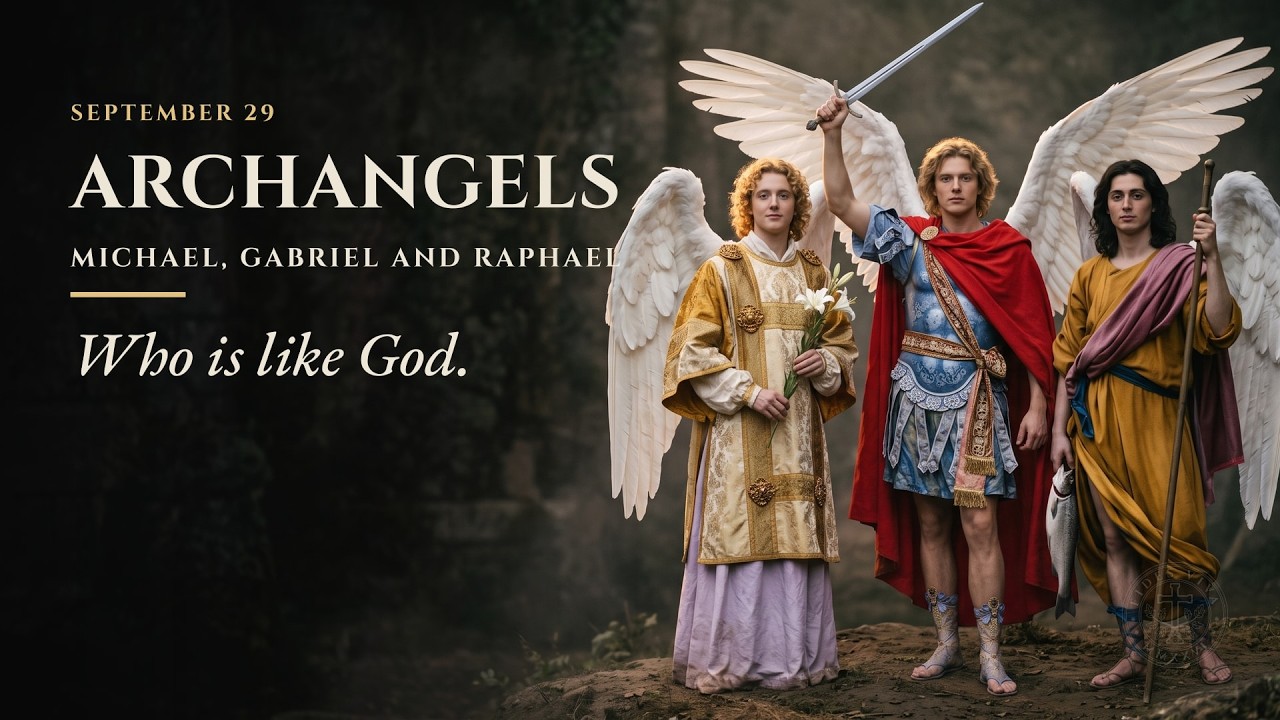
Every September 29, the Church celebrates the archangels Michael, Gabriel and Raphael in a single feast: the only angels Scripture calls by name. All three names end in “El,” a Hebrew word that means God: they speak of Him before they speak of themselves.
One stands before the devil and does not curse him. “May the Lord rebuke you!” he says.
Another is sent to Nazareth, to a young woman, Mary, who will be the mother of the Son of the Most High.
The third walks beside a young man, Tobias, who does not know who is walking with him.
Every day, many people say a prayer to Saint Michael, and the story goes that it came from a vision that left a Pope frozen in place. Is that really how it happened? And which prayer does the Church offer to everyone?
And that companion, sent to heal a blind father and a young woman who had lost seven husbands — when did he finally say who he was?
Names in a Land of Exile
The story of these names begins in a city under siege: Jerusalem, some six hundred years before Christ. Around it stands the army of Nebuchadnezzar, king of Babylon. The king orders young men of royal blood and noble families to be chosen to serve in his palace. Among them goes a young man named Daniel. They all leave behind their land, their homes and the Temple of their God. In exile, Daniel will hear two of the three names: Gabriel and Michael.
The third name comes from another exile, even older: that of the Israelites whom the king of Assyria carried off to Nineveh. There lives an old man, Tobit, the father of Tobias, that young man on the road. One day, his door will open to his son's companion.
In those two stories of exile, the three archangels appear by name. But what is an angel? The Church teaches, as a truth of faith, that angels exist. They are spirits with intelligence and will: they have no bodies, and they do not die. They serve God and carry His messages. And at the center of their world is Christ: they accompany Him from the moment He becomes man until He ascends into heaven.
That is why the Church honors them for what they are: servants of God, always turned toward Him. And in devotion she asks one concrete thing: not to give angels names that Scripture does not give them. Lists with other names circulate, but only three appear in Scripture: Michael, Gabriel and Raphael.
Let us go back to that road. One of the young men turns to look at his city. It is Daniel. And into his story comes the first of the three: Michael.
Michael: A Question Before the Dragon
The years go by, and Daniel is still in Babylon. One day he begins three weeks of mourning: he tastes no meat or wine, and he humbles himself before his God to understand what will become of his people. Without knowing it, he is not alone. Then a messenger of God brings him the answer: “Do not fear, Daniel.” He tells him that an enemy, “the prince of Persia,” blocked his way for twenty-one days, until Michael came to help him. And he leaves him a promise for the darkest days: “At that time there shall arise Michael, the great prince, guardian of your people.”
That is how Michael enters the Bible: as the protector of a small people facing empires. Even his name is a question: Michael means “Who is like God?” And that question already holds its answer: no one is equal to God.
A short letter in the New Testament, the Letter of Jude, holds another scene. Michael contends with the devil over the body of Moses, the one who brought Israel out of Egypt.
Michael has God's enemy right in front of him. And even so, he does not dare to judge him on his own. He leaves judgment in the Lord's hands and says only: “May the Lord rebuke you!”
The archangel does not answer with an insult. He answers by naming God. But the Bible brings them face to face once more.
It will be in its last book, the Book of Revelation, which opens heaven like a vast stage. A sign appears: a Woman clothed with the sun, in whom the Church sees the Virgin Mary. Right away another sign appears: “a huge red dragon, with seven heads and ten horns.” The Dragon stands before her, ready to devour her child the moment he is born. But the child is caught up to God, to His throne.
Then war breaks out in heaven.
Michael and his angels fight against the Dragon. The Dragon fights back, and his angels with him. And the Dragon falls. He is the ancient serpent, the devil, thrown down to the earth along with his angels.
Then a loud voice is heard in heaven. It proclaims salvation, because “the accuser of our brothers” has been cast out. And the voice also tells how the brothers have conquered him. They have conquered him by the blood of the Lamb.
The Lamb is Christ, who gave His life on the cross.
The victory is not won by the sword. It comes through that blood.
Scripture shows Michael in heaven and at the side of his people. On earth, it was whole peoples who sought out places associated with him. Many centuries later, on a mountain in southern Italy, a lost bull is found kneeling at the mouth of a cave.
Where the Peoples Sought Him
The bull's owner, a wealthy man who had been searching for it, draws his bow and shoots an arrow at it. The arrow never reaches the animal. It turns in midair and strikes him in the foot.
That is how it has been told for centuries in Monte Sant'Angelo, the town built on that mountain of the Gargano, and its pilgrims place the story in the year 490. The matter reaches Lorenzo Maiorano, bishop of Siponto, the nearby town on the coast. The bishop orders three days of prayer and penance.
On the third day, the archangel appears to him and tells him who he is: “I am the archangel Michael, and I stand always in the presence of God.” The cave, he adds, is consecrated to him. There sins will be forgiven. There whatever is asked in prayer will be granted.
In another appearance, the archangel announces to the bishop a victory for Siponto. Tradition places it on May 8, and on that day the Gargano still remembers the apparition.
Later, the bishops of Apulia climb up in procession to dedicate the cave to God. When they enter, they find a primitive altar already standing.
The legend adds something more: the archangel is said to have left his footprint in the rock. That rock is now enclosed at the Altare delle Impronte, the Altar of the Footprints. It is not a relic. Angels have no bodies, and nothing of them can be kept in a reliquary. What the grotto offers is the memory of a place where people have prayed for centuries.
In Byzantine times, the Gargano honored Michael above all in two ways. He was the one who presents the souls of the dead before the throne of God. And he was the one who heals. Water dripped from the rock, the “stilla,” and the stories credited it with cures. The idea that Saint Michael carries souls to God lives in that ancient devotion; it does not come from the Bible.
In 1507 a white marble statue came to the grotto, attributed to the sculptor Andrea Sansovino. Michael appears as a smiling adolescent, with curly hair and the breastplate of a Roman soldier. Beneath his feet writhes a monster with an ape's face, a goat's thigh, a lion's claws and a serpent's tail. That is how the sculptor imagined it, not Scripture. The sword is still raised high.
In Rome, the sword tells a different story. On top of Castel Sant'Angelo, beside the Tiber, an angel slides it into its sheath, and there people have said for centuries that the archangel freed the city from the plague.
Normandy, in northern France, has its own legend. In the year 708, the archangel is said to have appeared three times in dreams to Bishop Aubert, asking him for a sanctuary on an islet called Mont-Tombe. That islet is today Mont-Saint-Michel.
The abbey is still a sanctuary: since 2001, a monastic community has kept its tradition alive there.
The Franciscans, the friars of Saint Francis of Assisi, remember another mountain, La Verna, in Tuscany. Toward the end of his life, Francis began there, on the feast of the Assumption of Our Lady, a Lent: some forty days of prayer in honor of God, of Our Lady and of Saint Michael. During those days he saw Christ crucified in the form of a seraph, and he received in his body the stigmata, the wounds of Jesus in his hands, his feet and his side. He came down from the mountain on the archangel's feast day.
That Lent did not end with him. Today many of the faithful pray it in Brazil and in France, from August 15 to September 29.
Across the ocean, in Tlaxcala, in Mexico, stands the sanctuary of San Miguel del Milagro. The people there remember that it all began on April 25, 1631, during the procession of Saint Mark. A young Indigenous man, Diego Lázaro de San Francisco, then had an inner vision of Saint Michael. The archangel told him of a spring of healing water, hidden beneath a crag.
Diego kept silent, because he was afraid. And he fell ill.
When he was already near death, he saw a ray of light and the archangel, who led him to the ravine. There the archangel touched the ground with his staff, and Diego was healed. His family could not move the rocks that covered the spot. A young man of extraordinary appearance moved them aside.
But Diego kept silent, because he was afraid. Six months later, during Mass, pain went through him, and the archangel appeared to him a third time, with a rebuke. This time Diego did not keep silent. He took water from the spring to the bishop. The bishop promised to investigate and had the water shared among the sick. Those who drank it were healed.
In front of the sanctuary church, the well of that water is still there.
At the end of the nineteenth century, a Pope asked the whole Church to close every Mass by calling on Saint Michael. Around that prayer grew a story that many still repeat.
A Pope's Prayer
Here is the story as it is told, handed down as the memory of witnesses. On October 13, 1884, as Mass ends, the elderly Leo XIII stands motionless for about ten minutes. His face shows terror and astonishment. Afterward he withdraws and writes a prayer to Saint Michael. He sends it to the bishops. Later, he is said to have spoken of seeing legions of demons, and the archangel stepping in.
The question is whether that prayer was truly born of that vision.
The prayer has a date of its own. In 1886, Leo XIII added an invocation to Saint Michael to the prayers said at the end of Mass throughout the whole Church. Its opening words came from a verse already sung with the Alleluia at the Masses of the archangel.
In 1934, a scholar of the liturgy wrote against that story, which was beginning to spread by word of mouth. And the dates do not fit: the story has the prayer born that very day in 1884, yet the invocation was not introduced at the end of Mass until two years later.
There is also another memory, passed on secondhand decades later. An elderly cardinal, whose name was not remembered, is said to have claimed that the Pope added the invocation against the threat of Freemasonry, moved by a revelation. It is hearsay. The prayer dates from 1886; of the 1884 vision, all that remains is a disputed story.
That short invocation is the prayer the Church offers to everyone. A 1964 instruction, as part of the liturgical reform, removed it from the end of Mass. Thirty years later, in 1994, during the Regina Caeli, the prayer to Our Lady for the Easter season, John Paul II urged the faithful not to forget it and to pray it. It goes like this: “Saint Michael the Archangel, defend us in battle. Be our defense against the wickedness and snares of the devil. May God rebuke him, we humbly pray. And do thou, O Prince of the heavenly hosts, by the power of God, cast into hell Satan and all the evil spirits who prowl about the world seeking the ruin of souls. Amen.”
There is also a long formula in circulation, offered as “powerful.” It includes the exorcism published by order of Leo XIII, a rite reserved to priests with their bishop's permission, and the faithful should not use that part. The Church keeps magic and superstition out of devotion: no formula works by itself. What everyone can pray is the short invocation to Saint Michael and the petition Jesus taught in the Our Father: “deliver us from evil.”
On July 5, 2013, in the Vatican Gardens, Pope Francis unveiled a monument to Saint Michael. In that same place he consecrated Vatican City State to Saint Michael and Saint Joseph. Benedict XVI was present.
That name, which was a question, “Who is like God?”, received an answer that day from the lips of Francis.
“Saint Michael triumphs because it is God who acts in him.”
The Book of Daniel does not name Michael alone. Another messenger appears there too, one who does not fight: Gabriel.
Gabriel: The Doubt and the Yes
His name means “strength of God.” In the Book of Daniel, that strength works through words. Faced with a vision the prophet cannot decipher, Gabriel gives him its meaning. At another moment, he announces events that are still to come.
Many centuries later, in 1951, Pope Pius XII declared Gabriel the patron of telecommunications. He is also the patron of Vatican Radio. God's messenger became linked to the trades that carry the human voice across distances.
But the two announcements of his that the Church remembers most take place in the opening pages of the Gospel of Luke.
In the Temple in Jerusalem, a priest named Zechariah offers incense on the altar. The smoke rises slowly in the half-light. And to the right of the altar, someone is standing.
It is an angel. He tells Zechariah that his wife, Elizabeth, will bear him a son, and that the child will be named John: the one who will one day be known as the Baptist.
Zechariah does not believe it is possible. He is old, and his wife is also well on in years. He asks how such a thing could happen. The answer does not argue with his reasons. It gives him a name.
“I am Gabriel, who stand before God. I was sent to speak to you and to announce to you this good news.”
In the Gargano, the memory of the pilgrims placed similar words on Michael's lips. Here, the Gospel speaks them. The messenger comes from the presence of God and brings his news from there. But Zechariah has not believed, and the angel tells him he will be “speechless and unable to talk until the day these things take place.”
The same messenger is later sent to Nazareth, a small village in Galilee. He goes to a young woman, “a virgin betrothed to a man named Joseph, of the house of David.” The virgin's name is Mary.
Gabriel greets her: “Hail, full of grace!”
Then he announces: “You will conceive in your womb and bear a son, and you shall name him Jesus. He will be great and will be called Son of the Most High.” He explains that the Holy Spirit will come upon her.
The old priest doubted in the holiest place of worship. She, in a village house, listens.
Benedict XVI put it simply: “Gabriel is the messenger of God's Incarnation.” Through him, God asks a young woman for her “yes.” He does not impose it: he waits for the answer of a free woman.
And Mary gives it: “Behold, I am the handmaid of the Lord. May it be done to me according to your word.”
The Son of God becomes man.
The angel's words did not stay in that house. Gabriel's greeting opens the Hail Mary. Each time someone prays it, they repeat the greeting a messenger of God addressed to Mary. And the Angelus, the prayer that recalls the Incarnation, begins with his announcement: “The Angel of the Lord declared unto Mary.”
Gabriel announced two births: the birth of John and the birth of Jesus. That is why many turn to him with their most personal hopes. To anyone looking for a way to pray with Saint Gabriel, the Church does not offer a new formula. It hands back the angel's own words, spoken in Nazareth and prayed every day since.
Gabriel's two announcements take place in the Temple and in a house. The third name appears on a road that begins in Nineveh, where an old deportee has been living blind for years.
The Companion on the Road
That old man is Tobit. The Book of Tobit, which the Church recognizes as the Word of God, shows him through what he does. Among the captives of Nineveh, he gives alms to the poor. He pays his tithes, the share of his goods that the Law of Moses set apart for God. And he buries the dead whom others leave abandoned outside the walls of Nineveh.
That faithfulness costs him dearly. He loses what he had. And one day, after an act of charity, he loses his sight as well.
The man who looked after others now depends on others to take a single step.
Far away, in the ancient land of Media, lives a young woman named Sarah. She has been married seven times. And seven times her husband has died on the wedding night, struck down by a demon the book calls Asmodeus.
Sarah thought about hanging herself. She did not do it, and the reason the book gives is her father. She did not want that old man to go down to the grave overwhelmed with grief.
Two houses, far apart. An old man who can no longer see and a young woman who no longer hopes for anything. Both of them pray. And their prayers reach the Lord.
God sends someone to heal them both. Neither Tobit nor Sarah knows yet who it is.
Tobit thinks of his son. Tobit had once left some money in the care of a friend, in a distant land. He asks Tobias to go and bring it back.
The young man has never made that journey. Following his father's advice, he looks for someone to guide him. And the first person he finds is a traveler who knows that country well and agrees to go with him.
To Tobias, he is a stranger who knows the way. That is enough to set out.
One evening they stop beside the Tigris. Tobias goes down to the water. And suddenly a large fish leaps at him.
The young man is frightened. His companion encourages him. So Tobias grabs the fish and hauls it onto the bank.
Following his companion's directions, he takes out its heart, its liver and its gall, and keeps them. None of it seems to matter yet.
As they near their destination, the companion advises him to stay with some relatives. Sarah lives in that house, and she is Tobias's cousin. By the Law of Moses, she was set aside to be his wife.
Tobias meets her. And they marry.
Night falls, the same night that seven times ended in mourning. On his companion's advice, Tobias places the heart and liver of the fish on the brazier of incense, the vessel where fragrances were burned.
The demon flees all the way to Egypt, and the companion goes after him and leaves him there, bound hand and foot. Then the bride and groom rise and pray together. “Blessed are you, O God of our fathers,” Tobias begins, and he ends by asking: “Call down your mercy on me and on her, and allow us to live together to a happy old age.” And the two of them answer: “Amen, amen.”
This time, the wedding night takes no one.
They return to Nineveh. Tobias goes to his father with what is left of the fish from the Tigris. He spreads the gall on his father's eyes.
And Tobit sees.
The family wants to pay Tobias's companion. They owe him the journey, the wedding, the restored sight. But he takes them aside.
He tells them that, when they prayed, he was the one who presented their prayers before the Lord. And that he had been sent by God.
Then he says his name.
“I am Raphael, one of the seven angels who enter and serve before the Glory of the Lord.”
A young man had left home with a stranger who knew the way. He came back knowing he had walked beside a messenger sent by God.
The prayers of a blind man and of a woman without hope had not vanished into thin air. Someone who stands before the glory of the Lord had carried them to God. And he had come back with the answer, on foot, along the same roads they walked.
Raphael means “medicine of God.” He had been sent to heal them both: Tobit, so that he might once again behold the light of God, and Sarah, to free her from the demon and give her to Tobias as his wife. From the very beginning, his name said where the healing came from. For anyone looking for a way to pray with Saint Raphael for someone who is sick, for a marriage or for a child setting off on a journey, the book leaves a model: the prayer of Tobit and of Sarah, which Raphael himself presented before the Lord.
The book closes with the family at home. But Tobias's companion did not stay within its pages. Centuries later, on the roads of the Middle Ages, he was still walking with other young people as they left home.
Medicine of God in Córdoba
Tobias's companion went with them on a small painted panel, with two figures on it: Tobias and the archangel.
As early as the eleventh century, Christians in the West were already venerating Saint Raphael. Over time, popular devotion made him the patron of travelers and of doctors. Both come from the same pages: a road traveled together and eyes that see again.
One city made that medicine its own. In Córdoba, at the end of the thirteenth century, the plague arrives.
The people of Córdoba have handed down what happened next from generation to generation, as a story from their own home. Through Friar Simón de Sousa, the archangel asks for his image to be placed at the top of one of the city's towers. The bishop does so. And the contagion stops.
Centuries later, some bones are found in the parish of San Pedro. In 1578, a priest of the city, Andrés de las Roelas, is visited several times by the archangel. And the archangel reveals to him that those remains belong to the martyrs of Córdoba, the Christians who died there for their faith.
On May 7, the archangel swears an oath to him:
“I swear to you by Jesus Christ Crucified that I am Raphael, Angel, whom God has placed as Guardian of this City.”
Roelas confided it to another priest, Juan del Pino. And Juan del Pino kept it for twenty-five years. In 1603, the authorities of the diocese approved the account.
Roelas's house is today the Church of the Oath, and every October 24 Córdoba celebrates its Guardian with a feast of its own.
In 1651 the plague returned. When it ended, the city raised a statue of Saint Raphael on the Roman Bridge, in thanksgiving.
Today Córdoba also has its triunfos, tall columns crowned by the archangel. Its painters portrayed him with a fish in his hand. The fish from the Tigris, the one that leapt at a frightened young man, has ended up on the canvases of an entire city.
Every city keeps its own archangel. But on September 29 the whole Church gathers all three into a single day.
One Day for All Three
The date of the feast comes from a place six miles from Rome, on the Via Salaria, where a basilica was dedicated to Saint Michael. The Martyrology, the book in which the Church of Rome keeps the official memory of its saints, celebrates the three archangels on the day of that dedication, September 29. The building no longer exists; its day lives on, and in the Latin Church veneration of Michael became almost universal.
For centuries, the three archangels were celebrated on different dates. In 1969, the reform of the liturgy brought them together on that same day. October 2 was left for the Guardian Angels, whom the Church recognizes at the side of every person, from the beginning of life until death.
September 29 dawns. Those who began Saint Michael's Lent on the day of the Assumption of Our Lady reach the end of their journey of prayer this morning.
In churches, as the Eucharistic Prayer over the bread and wine begins, the people sing the Sanctus, the threefold "Holy" with which the Mass joins the song of the angels. During that song, the voice of earth and the voice of heaven say the same thing.
Then, when the consecration comes, the center of the feast is no longer the archangels. It is Christ, whom they serve.
The Church does not only sing with the angels. In the Roman Canon, the great prayer of the Roman Mass, it asks for their help. And when it says farewell to one of its dead, it prays in these words: "May the angels lead you into paradise."
In Monte Sant'Angelo, on that same day, the sword leaves the archangel's hand. It is the sword of the marble statue, the one the archangel has held high over the monster for more than five centuries. They carry it in solemn procession through the streets of the town.
It is not a relic. It is the sword of a work of art, which devotion brings out into the light of day.
In Rome, the angel on the castle keeps his sword in its sheath. Here, it passes through the streets among the people.
The fight against evil has an end, but it still touches our lives: in the struggle we do not win alone, in the news we do not know how to receive, in a hospital corridor, in a child leaving home.
For those hours, the Church gives us three names: Michael, "Who is like God?"; Gabriel, "strength of God"; Raphael, "medicine of God." All three speak of Him before they speak of themselves. And the victory that sword recalls was never the angel's: from the beginning, it belongs to God.
Lord God, you sent your archangels as messengers of your love: Michael, who before evil left judgment in your hands and whose name asks, "Who is like God?"; Gabriel, who brought Mary the announcement of your Son; and Raphael, who walked beside Tobias and presented before you the prayers of those who suffered. Through their intercession, deliver us from evil, open our hearts to your Word, and walk with those who are on the road, with the sick, and with those who can no longer see a way out. Through Jesus Christ, our Lord.
Saint Michael, Prince of the heavenly hosts; Saint Gabriel, messenger of the Incarnation; Saint Raphael, patron of travelers; holy archangels, pray for us.
Amen.