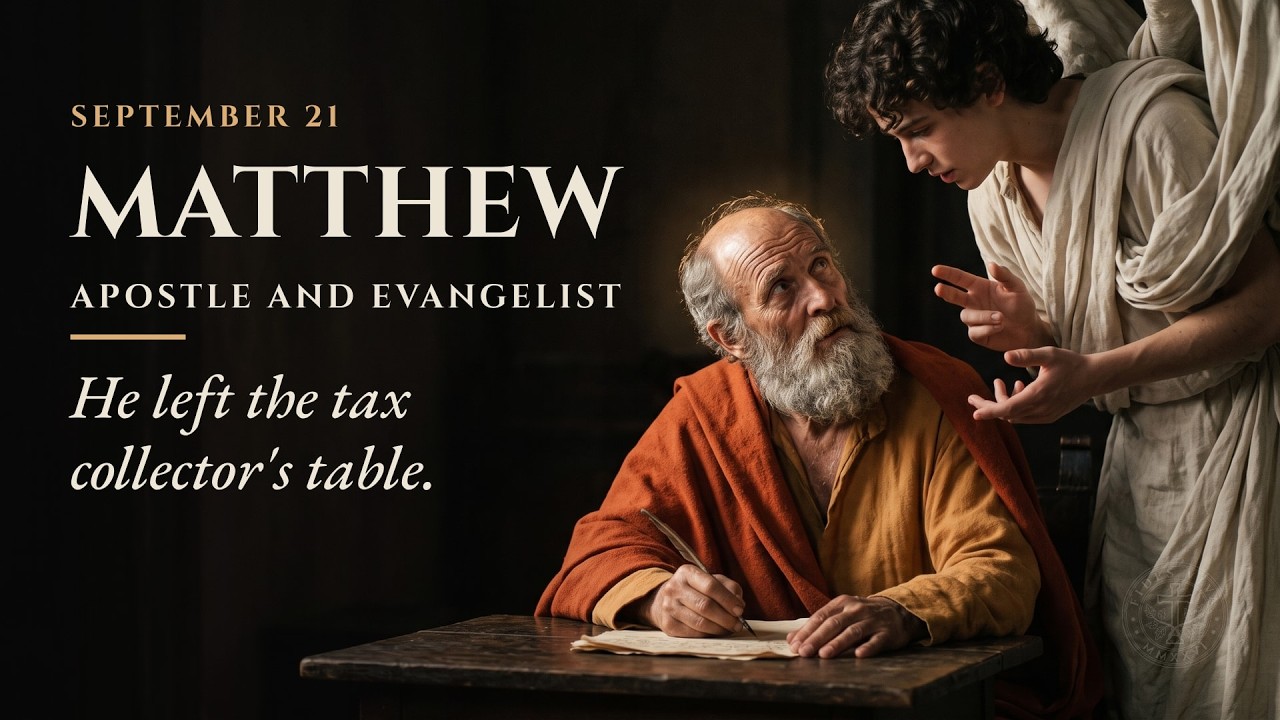
A man counts coins under a canvas awning. He separates them by metal: bronze on one side, silver on the other. He marks a figure in wax, erases it with his thumb, adds again. In front of the table a merchant waits with his donkey. Everyone looks away.
Then someone stops on the other side of the table.
And the hand goes still.
It is a customs post on the shore of a lake, in the north, in the land of a small king who rules because Rome allows it. The man collects tolls on every sack of grain, every bolt of linen, every traveler who passes on the road. He lives better than almost everyone around him. And his neighbors cross the street when they see him coming. To them he is a tax collector: one who sold out, who handles pagan money, who counts for nothing as a witness in court.
That same evening his house fills with people. His old colleagues from the trade, the other marked men of the town, reclining around the lamps, eating with the one who stopped at the table. And from the doorway, men in proper mantles murmur.
Not a single word of his was ever spoken aloud. Not a speech. Not a prayer. What remained was something else: the book that opens the New Testament.
To stand up from a table like that, with the accounts open and the money still on the board. What could make a man let it all go for a single word?
The Table That Divides
Dawn breaks over Lake Genesaret. The boats return with the night's catch, and linen nets spread to dry on the dark pebbles. This is Galilee, and Galilee is not a Roman province: it is ruled by Herod Antipas, a tetrarch who reigns as long as the emperor allows. Along the road that borders the water—the Via Maris—caravans pass from the coast toward Damascus, and with them travels the same rumor: the Messiah is near, God will remember his people. In the villages, the tribute is paid with clenched teeth.
Of the boy who one day would sit to collect that tribute, nothing was left behind. Not the year he was born, not his mother's name, not the house where he learned to count. Two of his own names survived, and only one that belonged to his father. The first Christians remembered him as Levi, son of Alphaeus, and also as Matthew; and the Church has always seen one man behind the two names. Everything else is silence: a Jewish boy of Galilee, with an undyed linen tunic, lost among the other boys on the shore.
When he appears, he is already a grown man, and he is sitting. It is the year 28, or close to it: no one marked down the exact date, though he marked down everything else. His post is in Capernaum, beside the road, under a canvas awning stretched over four posts. A low table. A bronze balance with two pans. Piles of coins sorted by metal: the prutot of bronze from Antipas; the silver denarii of the emperor; the tetradrachms of Tyre, with which the Temple tax is paid. Wax tablets, a scroll of records. On one side, a guard recruited from the region watches the line of merchants and their loaded donkeys.
He is thirty-five years old, perhaps forty. Olive skin, less weathered than the fishermen's: he works in the shade. Hair almost black, wavy, combed with oil and drawn back behind his ears; the beard full, dark, trimmed with care. He wears a fine linen tunic, a shade of saffron that his neighbors cannot afford, and from his leather belt hangs a purse. Every merchant leaves his coins on the table and pulls his hand back quickly, as if the board burned.
He is a tax collector: he collects tolls and customs duties for Antipas's administration. The official rate is one thing; what he collects beyond that stays in the tax collector's house. His people hold him for two things at once. For being unclean, because he deals every day with foreigners and pagan money. And for being a thief, because everyone knows how a tax collector grows rich. The teachers of the Law put him in the same breath as bandits, and his testimony carries no weight in court. Unclean and thief in the same breath. No one disputes his rate; no one wants his company.
And yet the table protects him. He has a house of stone, he has food to eat, and tomorrow the road will bring more caravans. The table feeds him and isolates him at the same time.
What could break a routine that everyone else has already decided for him?
A sack, a toll, a mark in the wax. And between two accounts, a voice speaks in front of the table.
The Call That Changes Everything
The one who has stopped brings no merchandise. He carries no donkey, no bundle, no purse to weigh. He comes down the road from the town, with a group of men behind him, and someone in the line might recognize him: it is Jesus, the one from Nazareth, the Galilean teacher people talk about in Capernaum, and whose house of welcome—Simon the fisherman's house—is just a few steps from here. If the man at the table had ever heard of him, if he had seen him pass by, no one wrote it down. The Gospels remember one thing only: that Jesus saw him.
He saw him. Sitting there, with the accounts open and his hands on the money. The tax collector was used to being looked at: sideways, in haste, people calculating the man before they approached. This look was different. It did not consult the record. It did not calculate how much he had kept or how many he had squeezed. Centuries later, a monk from the north would sum it up in a few words: he saw him with mercy and chose him. And on that shore, the line of merchants fell silent.
Then he spoke. One word, the span of a breath.
"Follow me."
Nothing more. No reproach for the money. No condition: first give it back, first fix your life, first prove something. No question about what he had done until that morning. An order that sounds like an invitation, spoken in passing, in the middle of work, in front of all those who despised him.
And the man stood up.
The Gospel that bears his name tells it with the same economy with which he had noted figures: "Follow me. And he rose and followed him." Not a verb too many. It does not say he hesitated. It does not say he asked for time to close the box or warn the guard. He rose. The stylus stayed pressed in the wax, the sum half-finished. The coins, in their piles of bronze and silver, went on gleaming on the board with no one behind it. The balance remained with one pan still tilted. And under the awning, an empty seat that until a moment before had been the safest place in his life.
The Gospel of Luke adds to the same scene a word that weighs: "And he left everything, and rose and followed him." Everything. A fisherman who lets go of his net knows the boat is still on the shore and he can come back for it. A tax collector who leaves his table does not find it waiting for him: someone else will sit in it tomorrow. He leaves the revenue, the house that revenue fed, the only way he knew how to have a place in a town that wanted him gone. He leaves also, and perhaps this cost more, being someone: feared, hated, but someone.
There is no sleepless night, no conversation with anyone: the conversion is told as a gesture, standing up. A door he had given up for closed swings open all at once, and the hard part is not understanding the word that opens it. It is standing.
He walks behind Jesus, his fine tunic among the crude wool mantles of the fishermen. The neighbors who always stepped out of his way this time stand still, watching.
What does a man do with the afternoon still ahead of him? With the money left on the table, the house still his, the colleagues who tomorrow will still sit behind their balances? The word he heard by the lake is going to echo that same night inside the black stone walls of his house. Because the first thing the man who left everything does is open his door.
The Table of the Banquet and Mercy
That night every lamp in his house is lit at once. Clay oil lamps in the niches of the wall, good oil, yellow light on the black stone of Capernaum. Cushions spread over mats; on low tables, flatbread still warm, fish from the lake, olives, jars of wine mixed with water. The host has not had time to change his life: he wears the same fine tunic from the morning, though now without the work belt or the purse hanging at his side. What has changed is the guest list.
Because the ones who arrive are his own. Other tax collectors, men like him, who run the toll stations and tariffs and live off the margin they take from the people. These are the men Capernaum avoids in the marketplace and will not admit as witnesses in any dispute. With them come those the Gospel simply calls sinners: people with whom an observant man would not share bread or shadow. And in the middle of them all, reclining on cushions in the manner of banquets in those days, with his elbow on the table and his feet drawn up, Jesus. The Gospels use that verb, recline: it is not a courtesy visit. It is a long supper.
The man who has just left his table does not turn away from those who sat at tables like it. He does not flee them, does not erase them, does not give them a speech. He invites them. The first thing he does with his house, now that it no longer serves to store money, is fill it with the only people who in years had not refused him a greeting. Leaving a dark place usually tempts a man to renounce those who stayed inside. Here the opposite happens: the first consequence of the word heard by the lake is that his colleagues in trade sit down to eat with the one who spoke it.
Outside, in the doorway, other people watch. They do not enter: entering a tax collector's house defiles, and eating with him defiles more. They are scribes, men who know the Law word by word, and Pharisees, men who strive to live it down to the smallest detail. Sharing bread was, in that Galilee, declaring yourself on the other's side; and it costs them to understand what a teacher of Israel is doing on that side. They ask the disciples, with a question that is more a reproach: why does their teacher eat with tax collectors and sinners.
The answer does not come from a disciple. It comes from Jesus, from inside, and he speaks it with the words of a prophet that everyone in the doorway knows by heart, Hosea:
"I desire mercy, and not sacrifice; for I came not to call the righteous, but sinners."
No one answers. The phrase hangs in the warm air of the room, between the lamps, and falls on those inside like something they did not expect to hear from a teacher. They were not there despite what they were, but had been sought out precisely for that. It is not that the Law does not matter: Jesus quotes Scripture to explain himself. It is that the God of that Law asks, before all else, mercy. And that night he has set it on the table of a tax collector.
The host listens, reclining among his former colleagues in trade, with his own bread in front of him. He says nothing; in the Gospels he is never heard to speak. But many years later, when he sits down to write what he remembers of Jesus, that same phrase from Hosea will sound again in his text, in the mouth of the same teacher. Whoever reads it afterward cannot help but think of this banquet.
This is where the question is born, the one that will walk with him the rest of his life. He had already started over, that very morning. But can you start over without denying where you come from? How do you walk behind a teacher carrying the name with which an entire people had marked you? The banquet ends; the lamps go out one by one; the guests go back tomorrow to their balances. And he leaves his house behind Jesus, toward a small group the teacher is about to choose, one by one, by name.
The Name That Remains
There are twelve of them. Around the year 29, somewhere in Galilee, Jesus gathers them and sets them apart from the rest of those who follow him: a small group, with a name of its own, to be with him and to be sent out afterward. The Twelve, the Church will call them from then on. Several are fishermen, men of net and boat; there is a pair of brothers; there is someone about whom barely anything more is known than his name. And among them, the man from the table.
The four lists in the New Testament name him. But only one adds something to his name. When he himself, many years later, sits down to write his Gospel and reaches the list of his companions, he will not call himself Matthew alone. He will write: "Thomas and Matthew the tax collector." Mark and Luke place him before Thomas and do not mention his trade. He puts himself last, and gives himself the epithet. The only one who preserves the word with which an entire people had marked him is the one who carried it. Those who read those lines afterward understood it as humility: he does not erase the old name, he signs it.
The life that begins has little to do with the one before. Dirt roads between villages, nights in the open or in borrowed houses, food when there is any. The fine tunic stays in Capernaum; now it is undyed wool, worn at the edges, tied with a cord. And on that cord, nothing. Jesus sends his followers with no gold, no silver, no purse, and the man who once managed tolls walks without a single coin. He sleeps beside men who before would have changed their path to avoid him. Now they share bread and dust, and Peter, the fisherman whose house stood just a few steps from his table, is his brother.
From the following year, the year 30, the Gospels record nothing particular about him. The accounts of the Passion do not mention him: he lives, like the others, through the Friday and Saturday when everything seemed to end, with his name appearing in no line. And then, when the Risen One calls his followers to a mountain in Galilee, he is one of the Eleven who climb it. There, in the land where he was called, he hears the order that opens the world:
"Go therefore and make disciples of all nations."
All nations. For a man who spent his life collecting from foreigners at the edge of a tetrarchy, those words must have sounded in a particular way. What was his trade, dealing with gentiles and reckoning in several currencies, was now the map of a mission.
They return to Jerusalem, to an upper room—the same one, it has always been remembered, where that last supper took place. There the Eleven wait with Mary, the mother of Jesus, and with some of his brothers, persevering in prayer. The Acts of the Apostles gives the list again, and there he is: Matthew, without the epithet, among those who await the promised Spirit. Days later Pentecost comes, and the Church walks out into the street.
Those who came after remembered that he stayed first among his own, preaching in Judea and its surroundings, to Jews like himself, before setting out toward other peoples. Of those years nothing more survives. In the Gospels he does not speak a single word. And yet he carries within him something that none of the others carry the same way: the exact memory of having been looked at differently, sitting behind a table, and of everything he heard from the day he stood up.
What does a man of accounts do when there are no more accounts to keep? He has his hands left, and the habit of writing things down. He has a memory that others, growing ever more distant from Galilee, begin to ask of him. And a memory like that, sooner or later, asks to be written down.
The Pen and the Memory
A clay lamp with a short wick. A tablet resting on his knees. A papyrus scroll filling line by line, column after column. The hand holding the reed pen has fingers darkened by ink made from soot, and on the inner side of the middle finger, an old callus that comes from neither nets nor a plow. It is the callus of someone who spent years recording figures that belonged to others. Now he records something else.
The ancient Church's memory holds that the first Gospel came from that hand. Where and when exactly, no one wrote it down. The most widely shared view places it between the years 50 and 70, in the region of Antioch, in Syria. There Jews who believed in Jesus lived alongside gentiles newly arrived at the faith. By then he would have been fifty, sixty years old. His hair had turned gray at the temples and thin at the crown; his beard, streaked with white. He squints to see the line. And he writes as he always has: with order.
Because the first thing that stands out about his book is the order. It opens with a list of names, a genealogy: generation after generation from Abraham to Jesus, passing through King David. A man of records who opens with a record. Then he gathers the teaching of Jesus into five great discourses, as if arranging columns: the Sermon on the Mount, with the Beatitudes and the Lord's Prayer that the Church prays every day in that form, his form; the sending out of the disciples; the parables of the Kingdom. Then the life of the community; and the end of time. And again and again, the same refrain: this happened so that what the prophet had said would be fulfilled. His Gospel is a bridge. On one side, the promises made to Israel; on the other, the Messiah who fulfills them. That is why it is the book that opens the New Testament.
From the first page he names Jesus with a word from the prophet Isaiah: "And his name shall be called Emmanuel," which means "God with us." And in the middle of the book he keeps a phrase that only he preserves, one that the man at the toll table might have heard with different ears than the rest. "Come to me, all who labor and are heavy laden, and I will give you rest."
The hand that separated bronze from silver now separates sayings from deeds. The call did not take away his trade; it changed his master. What he learned under the awning—to write with exactness, to lose no figure, to know what tongue each person spoke—becomes now the most lasting service a man can render to the memory of Jesus Christ.
How do we know it was him? Through a chain of voices. Around the year 120, in Hierapolis, a city in Asia Minor, a bishop named Papias was gathering what those who had listened to the disciples of the Lord had to say. From him comes the oldest news we have: "Matthew arranged the oracles in Hebrew speech, and each one interpreted them as he was able." The oracles: the words of the Lord. Around the year 180, in Lyon, Irenaeus repeats it with more detail: "Matthew published among the Hebrews, in their own language, a written form of the Gospel, while Peter and Paul were preaching in Rome." And in the year 392, from Bethlehem, Jerome—the man who translated the entire Bible into Latin—says the same thing again: Matthew, and an original in Hebrew.
And here a question remains open. The text the Church reads today is in Greek, and it does not look like a translation. For centuries people have debated whether there was a first writing in the language of the Jews that was later lost. Whether "Hebrew speech" meant the Aramaic that Matthew spoke in Capernaum. Or whether the Gospel we have was born already in Greek, built on Mark and on a collection of sayings of Jesus. None of those answers erases what the ancient Church affirmed without a single voice against it: behind this book stands the apostle who was a tax collector. His memory, his order, his way of seeing.
Of how he lived in those years only one piece of news survives, passed down in Alexandria at the end of the second century: "He nourished himself on seeds, dried fruits, and vegetables, without meat." Nothing more. The man who managed the money of a tetrarch ended up living on what fits in the palm of a hand.
And the scroll comes to an end. The last line of his Gospel is not his own: it is Jesus, on the mountain in Galilee, before the Eleven. "And behold, I am with you always, to the close of the age." After that, the author disappears. There is no signature, no farewell, no word about himself except for that nickname in the list. He tells what he saw and keeps silent about what he was.
What remains of a life when the name withdraws from the story and only the work stays behind? In his case, what remains is the book with which the New Testament begins, read aloud in the liturgy for twenty centuries. What remains is the prayer the Church prays every day in his words. And what remains is the question of what he did after he traced the last letter, rolled up the papyrus, and blew out the lamp.
The scroll began to travel. Copied by hand, from community to community, it reached places where no one had ever seen Lake Genesaret. And the man too set out on the road, toward lands where the map of his life disappears from sight, and where the Church's memory says that the last consequence of that "Follow me" was waiting for him.
To the Ends of the Earth: Mission and Martyrdom
An old man walks under a sun that is not the sun of Galilee. His hair, white and long to his neck, shows beneath a cloth that shields him from the light; his beard reaches to his chest, white as well. His tunic has lost its color, his sandals bear several patches. Against his chest, wrapped in cloth, a scroll. It is the only thing he has not let go.
Where he went, no one wrote it down. By the fourth century, when Christians wanted to trace his path, the answers did not agree. Some said Ethiopia. Others, Persia. Still others, the land of the Parthians, east of the Empire; and there were those who spoke of Macedonia, or simply of Syria. An older account said something different: that he first proclaimed Jesus Christ among the Jews, and when he departed for other peoples, he left his Gospel written behind so that the Word would remain where he could no longer remain himself. Of his end, even less is known. One ancient voice counted him among the apostles who did not die by violence; another, the one the West embraced, counts him as a martyr. The Church kept his book. His itinerary slipped from her hands.
Centuries later, a longer and more detailed story began to be told about his end. It took shape around 1260 in a book of saints' lives that all of Europe read in the Middle Ages, the Golden Legend, drawing on older accounts that already circulated under his name. And that story chooses Ethiopia.
It places him in a city called Nadaber. There two magicians, Zaroes and Arfaxat, held the people in terror with two dragons; the old man tames them in the name of Christ, and the court begins to listen to him. Then the son of King Egippus dies. And the old man brings him back to life. The king believes, the court believes, and a princess of that court, Iphigenia, gives her virginity to Jesus Christ. The apostle consecrates her, and the young woman receives the veil.
Egippus dies. Hirtacus takes the throne, and Hirtacus wants Iphigenia as his wife. He asks the apostle to bless the union. And the man who rose from the table without protest says now, without protest, that he will not: the young woman is already promised, and not to a king.
The king sends an assassin. He finds him at the altar, celebrating. There the sword reaches him. The old man falls forward, his arm still outstretched over the table.
That image wears borrowed clothes. The stone altar, the chalice, the vestments of the one who celebrates are those of the liturgy of centuries later, not those of a Jew of the first century. But the image stayed, because it says something true about him. The man at the table of coins, the host at the table of the banquet, dies at the third table of his life, the altar, and dies for the same reason he lived: because he would not sell what belonged to Jesus Christ. That is why, in the art that came after, he carries in one hand the book and in the other a sword, or a halberd, and sometimes the palm given to the martyrs.
And here the life closes, but the body does not vanish. With the death of an apostle begins the journey of his bones: who kept them, who sought them, who carried them across the sea. Because the earth where that white-bearded old man rests today is not in Ethiopia or Persia. It is in the south of Italy, by the sea, in a city that has called him its own for more than a thousand years.
Relics, Art, and the City That Calls Him Its Own
A wooden chest enters Salerno on the shoulders of armed men. It is the spring of 954. In front walks Gisulf, prince of the city, with the long drooping mustache of the Lombards and a sword at his side; behind him, the whole town. The memory of Salerno preserves it this way: the remains had come from Velia, on the Cilento coast, a little to the south, where an even older account said they had been found in the year 165. How they crossed the sea from Ethiopia, or from Persia, to that shore—no one wrote it down in time. The city did not question the path: it received the bones beneath the altar of an ancient church, Saint Mary of the Angels. That same May 6th—the people of Salerno repeat it from then on—the body began to yield a clear liquid. They called it the manna, and they said they saw it return each year, on the same date, for centuries.
More than a century later the Normans arrive. Robert Guiscard takes Salerno and raises a cathedral over that church. In March of 1081, before him and the archbishop Alfano, the relics descend into the new crypt. And in July of 1084 it is consecrated by a pope who had not come to consecrate anything at all: Gregory VII, driven from Rome, sheltered in the city, who will die there the next year and be buried in the same temple. From then on the reforming pope and the tax collector from Capernaum share a roof.
Today the crypt is reached by a staircase, and the light changes. It is a low, wide space, lined with colored marbles fitted into one another, with vaults covered in gilded stucco and dozens of paintings: scenes from the Gospel he wrote, and favors the city attributes to him—like the storm that, so they say here, scattered an enemy fleet. It took this appearance in the early seventeenth century, when Domenico Fontana and his son remade the entire space around a single point. The center. There, two meters below the floor, lies the tomb. Above it, an altar with a large baldachin; around it, a balustrade and four great brass candlesticks. And above the sepulcher, since 1605, a bronze statue by Michelangelo Naccherino with two faces: of Matthew, back to back, one turned toward the city and the other toward the sea. It is a Matthew in classical robes, imagined, not the Galilean Jew of the first century. But the gesture is exact. The man who spent years watching those who came down the road keeps watch now over both entrances to Salerno.
And Salerno answers. Each September 20th, as night falls, the rite of gathering the manna is celebrated over the sepulcher, beside the small cell where the box that receives it is kept. The next day, at six in the evening, the city takes to the street. Six images are carried on shoulders: Saint Joseph, Saint Gregory VII, Saint Anthony, Saint Fortunatus and Saint Gaius, and closing the procession, borne by porters dressed in red, the apostle. At one point in the route they turn him toward the sea, and he blesses the water. He stops before City Hall and before the barracks of the Guardia di Finanza, those who today collect the taxes and hold him as their patron. In the days before, his relic visits the city hospital, as one visits the sick. At midnight fireworks burst from a barge facing the sea, and the procession—presided this year by Monsignor Filippo Iannone—returns down toward the shore.
But the image the whole world held onto is not in Salerno. It is in Rome, in a side chapel of Saint Louis of the French. Between 1599 and 1600 Caravaggio painted there the Calling and the Martyrdom of the apostle, and in 1602 he added, above the altar, the evangelist writing with an angel who dictates to him. These are not reconstructions: the men are dressed as they were in the painter's Rome, with feathers and doublets, in a dark room. And yet, in the Calling, what happened happens again. A ray of light crosses the room on a diagonal, a hand points, and at the table of coins a man lifts his head not knowing if it is he who is called. Eight hundred years before, the monks of Ireland had painted him in the Book of Kells among gold and spirals, with the winged man at his side, because his Gospel begins with the human family of Jesus Christ. Each century painted him in its own way. All recognized him by the same thing: the book, and the table.
Below, the statue keeps watching the city and the sea. Those who come down to see it—pilgrims, accountants, customs officers in uniform, people of Salerno who have come since childhood—pass by a man whom his own people would not seat at a table. Why, twenty centuries later, does an entire city still walk behind the man from the tax collector's table?
The answer is not in the bronze. It is in Capernaum, at the table from which he rose.
The Table Where Everything Begins Again
Dawn breaks over the lake. Under the awning, the table sits as it was left: the balance still, the coins in two piles, a figure half-written in wax. The merchants who arrive that morning on the road find the booth with no one behind it, and a trail of dust leading away toward the town.
Three tables fit in one life. The table of coins, where they watched him with suspicion. The table in his house, soon after, with bread broken among former colleagues and Jesus reclining in the middle. And the one that the more distant memory of him settled at the end: an altar in a foreign land, and a sword. At all three, someone watched him from outside: with contempt, with scandal, with a weapon in hand.
What can make someone leave the safety of his table and his past with a single word? His life answers without a speech. There was no reasoning, no promise, no set term. There was someone who passed and looked at him without consulting the record. Centuries later, a monk from the north of England summed it up in two Latin words that a pope would carry on his shield:
"miserando atque eligendo"—"He saw him with mercy and chose him, and said to him: Follow me."
We too carry an open account on some table of our own: the desk where the work can come undone one morning with a call, the hallway of a hospital, the message we still have not answered. What would we do if, in the middle of that sum, someone called us by our name without asking for an explanation?
He rose and never spoke again in all the Gospel: he left his voice to be the book the Church still reads every three years and prays each day in the Lord's Prayer, down to the last line he heard from the risen Jesus on a mountain in Galilee: "And behold, I am with you always, to the close of the age."
In Salerno, the bronze watches the city and the sea. In Rome, a hand points in the darkness. But everything returns to the shore of the lake, to a sum no one finished. That morning, in Capernaum, mercy sat down at the table of a tax collector, and it has not risen from any table since.
Saint Matthew, apostle and evangelist, called from the table of taxes to the table of the Lord, pray for us.