Luke the Evangelist traveled for years alongside Paul and told the story of those journeys in a book. But in that book he never writes his own name. He shows himself through a single word.
It happens at night in Troas, a port on the coast of Asia. Paul, the apostle who carried the Gospel from city to city, sees in a vision a man of Macedonia begging him to cross the sea and help his people. Until then, the one telling the story of the journeys has not appeared in them. In the very next sentence he steps inside the story and says we.
That word will carry Luke to the bank of a river in Macedonia, through fourteen nights of storm without a glimpse of the sky, to Paul's last prison, in Rome. And there, when the others have gone, it will be Paul, not Luke, who says who stayed by his side.
We Sought
That word is born on a journey that has run out of road. Around the year 51, Paul is crossing the interior of Asia Minor with Silas and with Timothy, a young man he has just brought into the group. They want to proclaim Christ in the Roman province called Asia, and the Holy Spirit prevents them. They turn north, and the Spirit will not let them through there either.
With two roads closed, they go down to the coast and reach Troas, a port open to the sea. Ahead of them there is no more land. What happens after the vision of the man of Macedonia is written by someone who is in the port with them. "We sought passage to Macedonia at once, concluding that God had called us to proclaim the good news to them."
He writes we sought, in the plural. The vision was Paul's, but the decision to cross the sea belongs to all of them.
That voice is Luke's. The Church's oldest memory makes him a son of Antioch, the great city of Syria, and a physician by profession. The liturgy of his feast adds that he was born into a pagan family, one that worshipped the old gods, and that he embraced the faith. How he came to believe, and who first spoke to him of Christ, no one ever handed down. What can be seen is that, the first time his voice is heard, he already speaks as someone God has called.
Since the first centuries, the Church has recognized this companion of Paul as the author of one of the four Gospels and of the book that tells of these journeys. He was not one of the Twelve Apostles, and he never met Jesus in person.
With the voyage decided, they set sail from Troas and run a straight course to the island of Samothrace. The next day they make land at Neapolis, and from there they go up to Philippi, a Roman colony and the leading city of that part of Macedonia. They stay there a few days.
One sabbath, the Jewish day of rest, they go out through the city gate to the riverbank, where they expected to find a place of prayer. They sit down and speak with the women gathered there. One of them, Lydia, deals in purple, the costly dye of luxury cloaks, and comes from the city of Thyatira. She already worshipped the God of Israel. She listens to Paul, and the Lord opens her heart.
Lydia is baptized with all her household. Then she begs them, if they truly consider her a believer in the Lord, to come and stay with her, and she insists so warmly that she will not let them say no. Among the guests in that house is Luke.
Paul and Us
One day, as they are going to the place of prayer, a girl starts following them, shouting. She is a slave with a spirit of divination, and her owners make a great deal of money from her fortune-telling. For days she trails after Paul and his companions, the group Luke still calls we, crying out in the street that these men are servants of the Most High God and that they proclaim the way of salvation.
Paul puts up with it until, annoyed, he turns around. He speaks to the spirit and commands it, in the name of Jesus Christ, to come out of the girl. The spirit leaves her that very moment.
With the spirit goes the profit, and her owners understand that at once. They seize Paul and Silas, only those two, and drag them before the magistrates of the colony, who walk escorted by guards carrying bundles of rods. They accuse them of being Jews who are stirring up the city with customs Romans cannot accept. The magistrates order them stripped and flogged, and have them thrown into the innermost cell, their feet fastened in the stocks, a wooden beam with holes that keeps a prisoner from moving.
At midnight, in the dark, Paul and Silas are praying and singing hymns to God. An earthquake shakes the prison and throws open the doors. The jailer thinks the prisoners have escaped and is about to take his own life, and Paul shouts to him not to harm himself, because they are all still there.
The jailer asks them what he must do to be saved. He washes their wounds, is baptized with his whole family, and sits them down at his table. The next day, Paul lets it be known that he and Silas are Roman citizens, and no one could flog a Roman without a trial. He demands that the magistrates come in person to bring them out. On their way out they stop at Lydia's house, encourage the new Christians, and leave the city.
Ever since Paul and Silas were dragged away, the one telling all this has stopped saying we. Perhaps Luke stayed on in Philippi to keep proclaiming the Gospel. That is what scholars suppose, because he himself does not say.
The voice that fell silent in Philippi is heard again in Philippi. Some years have gone by. When the feast of Unleavened Bread is over, the week of the Jewish Passover, Luke writes we once more, and he sets sail from there with Paul.
Within five days they reach Troas, the very port of that first call. On the first day of the week, Sunday, they gather in an upper room to break the bread, the Mass of those first Christians. The room is full of lamps. Paul, who is leaving the next day, speaks to the assembly and keeps on talking until midnight.
What happens next, Luke saw. A young man named Eutychus is sitting on the window ledge, and as Paul talks on, he drifts into sleep. Overcome by sleep, he falls from the third story. When they pick him up, he is dead.
Paul goes down, throws himself on him and takes him in his arms. Then he tells them all, "Do not be alarmed, for his life is in him." He goes back up, breaks the bread, eats, and goes on talking with them until daybreak. They take the young man home alive, and everyone is greatly comforted.
At first light, Paul sets out.
The Lord's Will Be Done
On this journey, Paul is in a hurry. He wants to be in Jerusalem for Pentecost, the great Jewish feast, so he does not stop at Ephesus. From the port of Miletus he sends for the elders of that Church, the men responsible for the community, and they come down to the coast.
Paul reminds them that he has served the Lord with humility and with many tears, and that he earned his bread with his own hands. Now he is going to Jerusalem as if bound by the Spirit, not knowing what awaits him there. From city to city, the Holy Spirit warns him of chains and hardships. He tells them they will not see him again, and he entrusts them to the Lord.
Before he finishes, he reminds them of what the Lord Jesus said, "It is more blessed to give than to receive." Luke hears those words in that port and writes them down, as he will write down other words of Jesus that the witnesses will pass on to him.
Then Paul kneels down and prays with all of them. They are all weeping. They embrace him and kiss him, grieving most of all because they will never see his face again. Then they walk with him to the ship.
The wind carries them swiftly from port to port, and then, on another ship, to Tyre, on the coast of Phoenicia. They spend a week there with the Christians of the city. Moved by the Spirit, the Christians there tell Paul not to go up to Jerusalem.
As the travelers leave, the whole community, women and children included, kneels down with them on the beach to pray.
In Caesarea the warning stops being only words. The group stays at the house of a local Christian, and they remain there many days. A prophet named Agabus comes down from Judea. He comes in, takes Paul's belt, and ties up his own feet and hands with it. He says the Holy Spirit declares that this is how the owner of this belt will be bound in Jerusalem, and handed over to the Gentiles.
Then all of them, the Christians of Caesarea and also those traveling with him, Luke among them, beg Paul in tears not to go up.
Paul looks at them and says, "What are you doing, weeping and breaking my heart?" He is ready to be bound, and ready to die in Jerusalem for the name of the Lord Jesus.
Since they cannot persuade him, they stop pleading and say the only thing left to say, "The Lord's will be done."
A few days later, their preparations made, they go up with him to Jerusalem.
In Jerusalem the Christians welcome them gladly. The next day, Paul goes with Luke and the others to see the leaders of that Church, all gathered in one house. He tells them what God has done among the Gentiles, and when they hear it they praise God. There, once again, Luke stops saying we.
A few days later, in the Temple, some Jews from Asia recognize Paul. They stir up the crowd and accuse him of bringing Gentiles into the sacred precinct. They drag him out and beat him, until the tribune, the commander of the Roman garrison, arrives with his soldiers. The tribune has him bound with two chains, just as Agabus had foretold with the belt, and orders him taken up into the fortress, while the crowd shouts for him to be killed.
At the top of the steps, Paul asks permission to speak. A great hush falls, and he speaks to them in Hebrew, still in chains.
Neither Sun nor Stars
Paul is still in chains. He spends two years as a prisoner in Caesarea, the city where Agabus had warned him with the belt, and in the end he asks to be judged by Caesar, the emperor of Rome. Around the year 60, in the port of that same city, Luke's voice, silent since Jerusalem, says we once more, and it is decided that they will sail for Italy. Luke goes aboard with Paul.
Paul and some other prisoners are in the custody of a centurion named Julius, a Roman officer in command of a hundred soldiers. Traveling alongside Luke is Aristarchus, a Macedonian from Thessalonica. At Sidon, the first stop, Julius treats Paul kindly and lets him go to see his friends.
From there the winds are against them. Farther on they transfer to a ship from Alexandria bound for Italy, and they struggle along to a place on Crete called Fair Havens. The Jewish fast, the Day of Atonement, is already past, the storms are beginning, and sailing has become dangerous. Paul warns that the voyage will bring harm to the cargo, to the ship, and to their lives as well. But that harbor is no place to spend the winter, and the centurion listens instead to the pilot and the owner of the ship. They decide to set out.
They have barely set sail when the Euraquilo, a violent wind from the northeast, comes down on them. The ship cannot head into it, and they let it drift. The sailors pass ropes under the hull to keep it from breaking apart. Then they throw part of the cargo overboard, and after that, with their own hands, the ship's tackle.
Days go by without a sight of the sun. Nights go by without stars. The storm does not let up. On board, Luke and his companions too lose all hope of being saved.
No one has eaten for a long time. Then Paul stands up in the middle of them all. He tells them that an angel of the God to whom he belongs and whom he serves has stood beside him. The angel has told him not to be afraid, that he must stand before Caesar, and that God has granted him the lives of all who sail with him.
And so the fourteenth night comes. The sailors take soundings with a sounding line, a rope with a weight to measure the depth, and find twenty fathoms, each fathom the span of outstretched arms. A little farther on, fifteen. Land is near. They drop four anchors from the stern and wait for daylight.
Then some of the sailors try to escape in the ship's boat. Paul sees it and warns the centurion and the soldiers that unless those men stay with the ship, no one can be saved. The soldiers cut the ropes and let the boat fall into the sea.
At dawn, Paul urges them all to eat. For fourteen days they have been waiting, having tasted almost nothing. He assures them that not a hair of anyone's head will be lost.
He takes bread. He gives thanks to God in front of them all. He breaks it, and begins to eat.
It is the gesture of that lamp-filled room in Troas, now on the deck of a lost ship. They all take heart and eat as well. There are two hundred seventy-six people on board.
When they have eaten their fill, they throw the ship's wheat into the sea to lighten it. When daylight comes they see a bay with a beach and try to bring the ship in there. But they run aground. The bow sticks fast, and the stern begins to break apart under the pounding of the waves.
The soldiers want to kill the prisoners so that none can escape. Julius the centurion stops them, because he wants to save Paul. Some swimming, others clinging to planks from the ship, they all reach land.
Not one of the two hundred seventy-six has been lost. The island is called Malta.
The Beloved Physician
Of those who came out of the sea alive, two stay with Paul all the way to Rome, Aristarchus the Macedonian, and Luke. In the capital of the empire, Paul waits two more years for his trial under guard, and Luke is often at his side.
From that confinement, Paul writes to distant communities, and as he ends each letter he lets the people around him send their greetings. There, at last, appears the name of the man who never said who he was in his own book.
To the Christians of Colossae, a city in Asia Minor, Paul sends greetings from Luke, the beloved physician, and from Demas, another of his companions.
Two words, physician and beloved, spoken in passing at the end of a letter. One tells what that companion did for a living. The other tells what he meant to the prisoner who wrote it.
Because of the first of those words, the Church today calls on Luke as the patron saint of doctors and of everyone who cares for the sick. In Brazil, on his feast day, Masses are celebrated for them.
Back in that confinement in Rome, another letter ends the same way. It is written to a single man, a friend of Paul's. Greetings come from Mark, Aristarchus, Demas and Luke, whom Paul calls his fellow workers, those who labor with him for the Gospel.
Luke is named close to Mark, the man whose name is on another of the four Gospels.
Four companions around one prisoner, and Paul names them one by one.
Only Luke Is with Me
In the letters from that first imprisonment, Demas sent greetings alongside Luke. Later, in the time of the emperor Nero, Paul is a prisoner in Rome once again, and this imprisonment is his last. From there he writes to Timothy, the young man who was walking with him when Luke's "we" first appeared in Troas.
Paul looks back over his life. He tells Timothy that he has fought the good fight and finished the race. Then he asks him to come quickly, and he tells him who has gone and who is still with him.
The list is short.
Demas has deserted Paul, in love with this present world. Crescens has gone off to Galatia. Titus has left for Dalmatia.
And then Paul writes a sentence that stands alone.
"Only Luke is with me."
The word that was born that night in Troas reaches all the way to this prison in Rome. For years the companion told the story without saying who he was, tucked inside a we that passed by the river, through the room full of lamps, into the house in Caesarea where everyone wept, and onto the drifting ship. In the end, it is Paul who speaks the name of the one who stayed.
So Paul's road comes to its end. He dies a martyr in Rome, in the same city where the apostle Peter is crucified.
From that last letter, the sentence about his companion remains. Even today, at the Mass on Luke's feast day, the Church reads it aloud again, with Demas, with Crescens, with Titus, and with the only one who stayed.
What Paul preached from city to city is not lost with him, and neither is what was told by those who saw Jesus with their own eyes, because the man who stayed at Paul's side has put it all in writing.
In Orderly Sequence
At the end of the second century, in Lyon, in Gaul, the bishop of the city, Irenaeus, sets the Gospels read by the Churches side by side and gives each one its origin. Of the third, he says that Luke, Paul's companion, set down in a book the Gospel that Paul preached.
That book begins like a letter. It is addressed to a man named Theophilus, and before telling him anything, it explains where everything he is about to read comes from.
Luke recalls that many had already set out to put in writing what happened, just as it was handed on by those who saw it from the beginning. And then he speaks of himself. "I too have decided, after investigating everything accurately anew, to write it down in an orderly sequence for you, most excellent Theophilus, so that you may realize the certainty of the teachings you have received."
Those pages hold scenes that no other Gospel has. The Good Samaritan. The prodigal son. The beggar Lazarus in the parable, lying at the rich man's door. The woman everyone points to as a sinner, who, once forgiven, washes the feet of Jesus. These are stories of the poor, of the wounded, and of people who come back. Later there will be a second book, the Acts of the Apostles, which names Theophilus once more, and in which, one day, the word we will appear.
That companion who never saw Jesus is also the one who tells what no one else tells about his Mother. The angel's announcement to Mary. Her journey to visit Elizabeth. Her song, in which God lifts up the lowly and fills the hungry with good things. The presentation of the Child in the Temple. And the anguish of Mary and Joseph when they lose the Child and search for him.
The heart the Lord opened in Lydia by the river returns in these pages as a mother's heart. Twice Luke lingers over the same gesture, and he puts it this way.
"And Mary kept all these things, reflecting on them in her heart."
Around Luke, a much-loved memory also grew. In the East it was told from very early times that the man who wrote those pages had also painted the face of the Mother of God, with the Child in her arms, on a wooden panel.
In the Italian city of Bologna, people tell their own story of that image of Our Lady. A hermit who had come from Constantinople climbed Guardia Hill with an image painted on cedar wood, which, they say, was the work of Luke. The image was left in the care of a woman of the city, who was determined to build a sanctuary for it on the summit.
Centuries later came a time of rain and hunger. The people of Bologna carried the image down into the city with great devotion. The bad weather stopped, the sun came out again, and they saw it as a sign that Our Lady had prayed for them.
Since then, every year, the Madonna di San Luca, Our Lady of Saint Luke, comes down from her hill in procession and stays for a week among her people. Because of that memory of Luke as the painter of Our Lady, artists honor him as their patron saint.
A Lead Coffin
Luke's book passes from one Church to another, and in all of them it is read. Of his own life, far less has come down. The Christians of the first centuries remembered his old age, and they did not all remember it the same way.
Some say that he never married, that he wrote his Gospel in Achaia, in Greece, and that he died at seventy-four, full of the Holy Spirit. Others say that he lived to eighty-four, in Thebes, a city in Greece, and some add that he died a martyr, though no one knows it for certain. From that memory comes the stone tomb, an ancient sarcophagus that the Christians of Greece venerate as his first resting place.
But his bones did not stay in Thebes. In the fourth century they were carried to Constantinople, the new capital of the Empire, together with those of the apostle Andrew, and laid in the Basilica of the Holy Apostles. At the end of that same century, Saint Jerome, one of the great teachers of the early Church, made a note of it.
At some point those bones traveled toward the West, and the next trace turns up underground. In the twelfth century, in the cemetery beside the church of Santa Giustina in Padua, in northern Italy, a lead coffin comes to light. According to the account of its finding, it bears engraved calves and a double cross on the outside, and the name of the Evangelist inside. By those signs it is recognized as the coffin of Luke.
More than a century later, the abbot of the monastery of Santa Giustina has a worthy home made for those remains, a marble shrine. Four angels hold it up, and its reliefs show the figure of Luke, angels with torches, and carved oxen. That shrine is still there today, in the basilica, where the faithful venerate him.
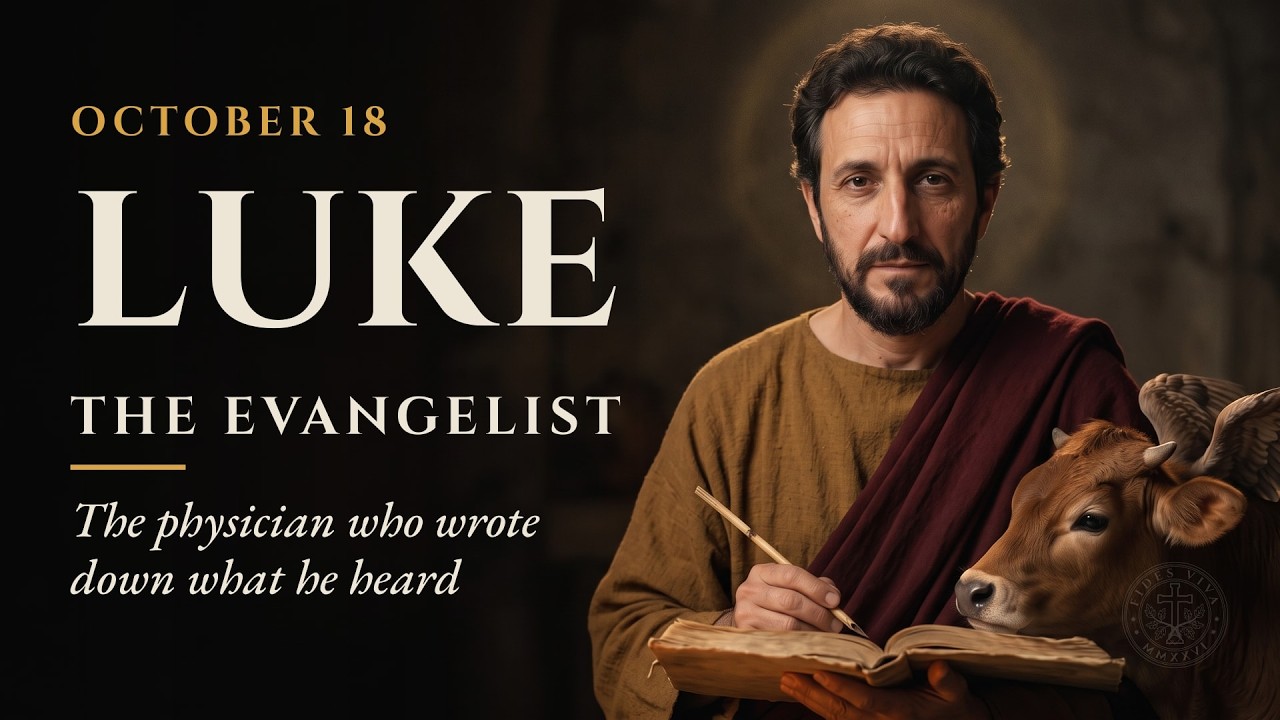
Those calves and oxen go back a long way. Irenaeus, that bishop of Lyon, had given Luke an animal, the calf offered in sacrifice in the Temple of Jerusalem, because his Gospel opens with a priest, Zechariah. That is where the ox comes from, the one that stands beside Luke in paintings and statues.
In 1354 a request reaches Padua from the emperor Charles IV, king of Bohemia. For the new Saint Vitus Cathedral in Prague, the city of his birth, he wants the prestige of a relic from the time of the apostles. Luke's skull leaves Padua and travels north.
The body stays in the marble shrine, without its head. For more than six centuries, head and body rest in two different countries, and in Thebes the stone tomb remains empty.
The Afternoon the Shrine Was Opened
Centuries later, the Orthodox bishop of Thebes wants to place a small relic of Luke in that empty tomb, as a gesture of friendship between his Church and the Church of Rome, and he writes to Padua to ask for it.
In Padua, the Catholic bishop of the city orders a canonical recognition of the relics, the official examination the Church makes of venerated remains, and calls in fourteen experts. They are led by a doctor who studies the human body after death.
On the afternoon of September 17, 1998, they lift the lid of the marble shrine, which had not been opened for almost five centuries. Inside is the old lead coffin, nearly six and a half feet long, still sealed, and in it lies a well-preserved skeleton without a head, that of a man who died in old age. Among the bones are some ancient coins, one of them from the year 299, and one of the experts sees in them a sign that, long ago, someone had opened the coffin and sealed it again.
The journey of the head had left a question still open, whether the skull in Prague and the body in Padua belonged to the same man. They bring the skull from Prague and set it beside the skeleton, and it fits the first vertebra of the neck. Head and body, separated in the time of the emperor Charles IV, are together once more.
The experts work for almost three years. The bones belong to a man about five foot four, with the arthritis that the years leave behind. Carbon-14 dating, which measures the age of bones, places them between the second half of the first century and the beginning of the fifth. The DNA inherited from the mother points to a Syrian origin rather than a Greek one, and Antioch, the city that ancient memory gave him as his homeland, was in Syria.
Inside the coffin there is also a small lead tablet, written in Latin and in Greek, a copy of an older inscription.
It reads “Ossa Lucae Evangelistae,” the bones of Luke the Evangelist.
In the end, the commission concludes that not a single element stands against this being the skeleton of Saint Luke the Evangelist.
The same tests reach as far as Rome. In the sixth century, the pope's ambassador in Constantinople had brought to Rome a head venerated as Luke's. Carbon-14 dating shows that it is centuries more recent than Luke. It cannot be his.
And the letter from Thebes receives its answer. In the year 2000, a rib from the skeleton in Padua travels to Greece, to the sarcophagus that may have been Luke's first tomb. It leaves a Catholic basilica and enters a tomb venerated by an Orthodox Church. Two Churches not yet united meet, for a moment, before the same saint.
One Heart and One Soul
The first thing Luke told about the Church in his second book takes place in Jerusalem. When Jesus has already been taken up to heaven, the eleven apostles return from the Mount of Olives and go up to the upper room of a house. There they persevere together in prayer, with some women and with Mary, the mother of Jesus.
Pentecost comes, the day the Holy Spirit descends upon them. After that, those who have been baptized persevere in the teaching of the apostles, in their shared life, in the prayers and in the breaking of the bread, the same gesture Paul will make years later, at night, in Troas. They break bread in their homes with gladness and simplicity of heart, and no one calls anything he has his own. All of it fits into the sentence with which Luke describes them, “The company of those who believed were of one heart and soul.”
That sentence is heard again every October 18, the feast day of Luke. At Mass that day, before the marble shrine in Padua or in any parish in the world, the priest extends his hands and addresses God with an ancient prayer, written in Latin. He recalls that God chose Luke to reveal, by his preaching and his writings, the mystery of God's love for the poor. Then he asks that those who already believe in God may persevere as one heart and one soul, and that all nations may see his salvation.
What Luke told of those homes in Jerusalem, the Church now asks for herself, in his very words. And the companion who, in the account of the journeys, let himself be heard only through the word we is named in full in the prayer of the whole Church.
Luke never wrote his name in his book, but he was there on the ship and, in the last prison, beside the one who suffered.
Saint Luke, beloved physician, you sought out the witnesses and set in order what Jesus did and taught. You stayed with Paul on the drifting ship and in his last prison, when the others had gone. Be with the sick today, with those who care for them and with those who have been left alone. Obtain for us a heart that keeps the Word as Mary kept it. And ask God that all who believe in his Son may become one heart and one soul. Pray for us. Amen.