Un muchacho flaco barre el suelo de un establo. Head down, mouth slightly open, as if listening to something no one else can hear. The air smells of damp straw and mule. Beyond the wall, friars are singing; he is not singing with them. Those who pass the door do not look at him.
Three times he has asked to enter a convent. Three times he has been told no.
He gets distracted. He cannot hold onto what they teach him. Things slip through his hands. The Capuchins kept him for eight months and took back his habit. That is why he is here: they have admitted him for one thing only—to care for the mule.
This convent was the first to close its door to him. Now it has opened the door to the stable. He is the last in the house, and he is not even of the house.
No one expects anything of him: not a lesson learned, not a sentence completed. Only that the mule be clean and the floor be swept.
And yet, in a few years, a tribunal in Naples will have him celebrate Mass in front of his judges. Rome will open a file with his name. Bishops and princes will cross Italy to see him.
What could anyone have seen in the boy with the mule? What happens when the last of all is chosen for something no one will know how to explain?
Born Outside: The Stable and the First Wound
Copertino, June 1603. The white sun of the Salento falls straight down on low stone houses whitewashed with lime and on the golden-stone castle. All around, olive groves as far as the eye can see, and an air that hums with cicadas. This is the Terra d'Otranto, the southernmost point of the Kingdom of Naples, governed from Madrid by Philip III through his viceroys. The feudal lords collect their dues, and behind them, the king's tax collectors. The Church that came out of Trent is raising sanctuaries along every road, and in the squares they preach about new saints. But when a carpenter cannot pay his debts, he loses his house, and no one preaches about that.
On the seventeenth of that month, the house of Felice Desa, the carpenter, is already in the hands of creditors. The seizure runs its course. Felice—wiry, black beard close-cropped, his back bent from the workbench—owes more than he can pay. Meanwhile, his wife, Franceschina Panaca, gives birth on straw in the shed attached to the house, among tools and animals. They call him Giuseppe Maria; in our tongue, Joseph Mary. He is born outside because there is no room for him inside. It is the first stable of his life.
Felice dies young. The debts do not: the creditors will still be claiming their money from the son years later. Franceschina is left alone with the child and with poverty. She is a sturdy woman, large-handed, hard to the point of harshness, and her faith does not soften with anything. She raises the small boy with what there is, which is almost nothing.
At seven years old, in 1610, they send him to school. It does not last long. Those who knew him as a child, decades later, and the friars who listened to his memories, all remembered it the same way: a sore opens on his right thigh, it becomes infected, it festers and will not close. For five years he stays away from his books, his leg bandaged, fever coming and going, limping when he manages to stand. In the village they notice something else: the mouth that hangs slightly open and the gaze that drifts away for hours. They give him a name: bocca aperta, the slack-jawed one. It will stay with him his whole life.
By night, beside the straw mattress, Franceschina plays the teacher. Instead of letters, she tells him the lives of saints. Above all, one: Francis of Assisi, the rich merchant's son who gave up everything, even his clothes, to follow Christ in poverty. The boy listens with his mouth open. There, with his leg bandaged, he begins to think about becoming a friar and a priest like Francis. Nothing is written down about that desire. No vision, no voice; only a sick child and a mother who tells stories.
In Copertino, few expected anything of that boy. To the neighbors he is the slack-jawed one who will never learn; to the creditors, the son of a debtor. And from that mattress, without finishing school, he already knows what he wants to be. He needs only one thing that five years of remedies have not brought: for his leg to heal.
Closed Doors: The Path of Rejections
It heals around 1618, when he is fifteen years old. The sore that five years of poultices could not close finally closes. Those who knew him remember it always the same way: the relief came from Our Lady of Grace, the one venerated in Galatone, a few hours' walk from Copertino. He is left with a sunken, dark scar on his right thigh. He is also left with a resolve that will not move from its place: he will be a friar of Saint Francis, to follow Christ in poverty.
At sixteen, in 1619, he knocks on the first door. It is the Grottella, the convent of the Conventual Franciscans just outside the village, among olive groves, beside the grotto of the Virgin. He has relatives among those friars. He thinks that will be enough. They ask what he knows. He reads with difficulty. He does not know Latin. He cannot hold onto a lesson from one day to the next. The answer is no.
He tries next with the Franciscan Observants, the stricter branch of the whole Franciscan family. The answer is the same.
There remain the Capuchins, the poorest branch of all: patched brown habit, long beard, bare feet, nothing to lose. In Martina Franca, on the stones of the Murgia, they accept him. Not as a choir friar, but as a lay brother—the one who serves in the kitchen and garden and does not study. They give him the habit. He has not yet turned eighteen and for the first time in his life he wears a religious garment.
It lasts eight months.
What he carries in his hands, he drops. He stands still in the middle of a task, mouth open, eyes elsewhere. The friars see a clumsy boy who cannot be trusted with anything, not even the smallest thing. And in a house where there is nothing, breaking what little there is weighs twice as much. They send him away. They ask for the habit back.
He folds it and returns it. He puts back on the mended shirt he arrived in. He walks out the door and heads south, toward Copertino, alone, under the white sun of the Salento.
To be rejected by those who have everything is one thing. To be rejected by those who have nothing is another. The Capuchins did not ask him for studies, or Latin, or memory; they asked him only to serve, and he could not even do that.
In Copertino, the same thing waits for him. Poverty. His mother. The creditors of his father, still claiming from the son what the carpenter did not pay. And the nickname that never left: bocca aperta.
Franceschina does not give up. The family story went that the woman, hard as stone, went back to the Grottella, to the relatives among the friars who had closed the door on him, and she insisted. She does not ask for the habit; she knows they will not give it. She asks for anything.
And at the Grottella there is one thing. In the convent stable lives a mule, and someone has to clean it, feed it, and sweep up after it. It is the work no one wants.
What does a boy of barely seventeen or eighteen do when even the house of the barefoot has told him no? This one accepts the mule.
The Door Below: The Lay Brother and the Habit
Around 1620 he enters the Grottella by way of the stable door. He is not a friar. He is what was then called an oblate—a layperson who offers himself to the convent, wears a short, patched habit, and does the work no friar does. They give him an apron of burlap, a wooden bucket, a broom of broom-shrub twigs. And the mule.
Every morning he leads her to the yard, feeds her, cleans her hooves, removes the manure and spreads fresh straw. removes fresh straw; his hands crack from cold water and the smell of the stable never leaves him. When he finishes, he scrubs, hauls water from the cloister well, cuts wood. No one asks him to study or questions what he knows. For the first time in his life, what he does not know does not matter.
He was born in a stable while the bailiffs emptied the house. Seventeen years later, another stable receives him. Between one and the other lies everything he has lived so far: the wound, the lost schooling, the three closed doors. And here, among the mule and the straw, something settles.
The friars begin to notice him. Not for what he does, but for how he does it. The clumsy boy who dropped things in Martina Franca carries and sweeps here without complaint, and when he finishes he does not go to rest. He stays in the church, in front of the image of the Virgin with the Child that gives the house its name, mouth slightly open, eyes upward. They find him there at odd hours, at dawn, before anyone else. He prays as he works: without noise, without asking anything for himself, with a steadiness that disarms.
Over time he will call himself Brother Ass. He will say it without wit and without bitterness: that is how he sees himself. He tends the mule and puts himself on its level—a beast of burden, useful for heavy work, that does not question the path. The boy who could not learn Latin had found another school: the school of the lowest place, of work that no one watches, of serving without needing anyone to explain anything to him.
The same men who once told him no now change their minds. Not because he has learned anything new. Because they have seen something that cannot be taught. They give him the habit and admit him to the novitiate, the year of testing before becoming a true friar. The burlap apron stays hanging in the stable.
In 1625 he makes his profession, at twenty-two years old, as a Conventual Franciscan friar. They cut his hair in the monastic tonsure—the crown shaved and a narrow ring of black hair left above the ears. He receives the full habit, gray-brown, with a pointed hood, and the white cord of three knots, one for each vow: poverty, chastity, obedience. On his knees before the superior, his hands in the superior's hands, he promises forever what the cord already holds tied. The community that rejected him at sixteen receives him as a brother at twenty-two.
He knows no more than before. He still cannot hold onto a lesson from one day to the next. The boy who spent years waiting for someone to want him in any place at all knows what a single word is worth: brother.
The door opened from below. What remains to be seen is how far someone who entered by it can go. Because being a friar is not the end of the road he wants. He wants to be a priest, to say Mass, to touch with these stable-worn hands the bread that becomes Christ. And for that there is an examination.
The Examination and Grace: From Incapacity to the Altar
Spring of 1628. In Poggiardo, a town in the Terra d'Otranto, the Bishop of Castro examines candidates for the priesthood from across the region. The Conventuals have brought theirs. Among them is a twenty-four-year-old, thin, with his mouth slightly open, who in almost eight years at the convent has not managed to hold onto a single text from one day to the next.
He knows what awaits him: a stern prelate, questions in theology and Scripture, the Latin that always slips away from him. The others review in the hallways; he does not review. He prays. His brothers have brought him knowing how the morning might end.
His brothers repeated for years how that morning went, and it has been told that way ever since. The bishop called the first candidates. They answered brilliantly, one after another—they were the best prepared. And then, satisfied, he approved all the rest. There were no more questions. Joseph entered the room without being examined and left approved.
He never told it as a stroke of luck. He gave the credit to the Virgin, the same one before whom he prayed in the Grottella from his days in the stable. The logic of that day said no. Another path opened, one no one had foreseen, and he walked through it without fully understanding how.
On March 18, 1628, he received ordination according to the rite of that century: the ordinands laid face down on the floor while the Litany of the Saints was sung, the bishop's hands laid on them in silence. Afterward, the oil on his palms—those palms hardened from hauling water and manure—the white cloth binding them, the chalice and paten in his hands. The boy who could not learn Latin was from that moment on a priest of Jesus Christ, forever.
Ten days later, on March 28, he celebrated his first Mass. Few witnesses. He wore the alb, the cincture, the stole crossed over his chest, and a damask chasuble over his gray habit. His hands trembled as he lifted the bread. No one would remember him for what he said that day; he barely knew how to say it. They would remember him for how he looked at what lay between his fingers.
From that examination without questions, something was born centuries later that he himself would never know: those who enter the test certain they cannot finish would one day call on him by name.
He returned to the Grottella a priest. He swept, he prayed, he heard the confessions of farmworkers coming down from the olive groves, he said Mass each morning before the Virgin with the Child. Two years like this, in peace—the last peace he would have. Around 1630, in that same church, something began to happen in him that neither his brothers nor he himself would ever be able to explain.
Seized: The Ecstasies and Unexpected Fame
It is a feast day morning and the church is full. Farmworkers from Copertino in clean shirts, women with linen headscarves, children sitting on the floor between the benches. The friars are singing in the choir. Those who were there would later place that day on the feast of Saint Francis, an October fourth, around 1630.
In the midst of the singing, a cry. Short, sharp, like someone struck from behind. It is him.
And then, silence.
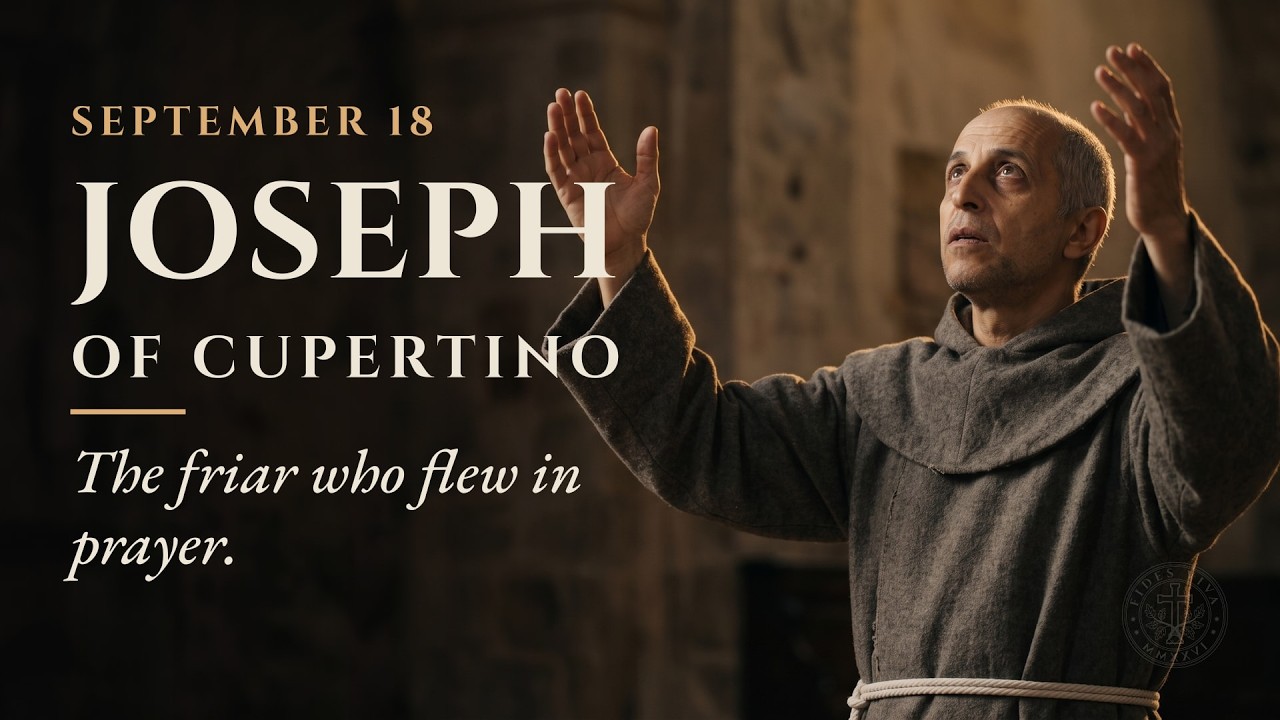
The friar was standing before the altar. Now he is not touching the ground. His arms open, his face turned toward the image of the Virgin with the Child, his body still in the air, above the heads of those who pray. His gray habit falls straight. The white cord hangs vertical, its three knots visible. One sandal is about to slip from his foot. No one moves. A woman puts her hand to her mouth. A child points with his finger and his mother lowers his arm without taking her eyes off what is above.
The friars fall silent. No one has taught them what to do in such a case. And then, without sound, he comes down. He returns to the floor like someone waking from sleep in the wrong place. He looks around, understands that something has happened. And he asks forgiveness.
"Excuse me for these spells of dizziness that come over me."
Dizziness. That is what he called it his whole life.
It was not a single time. In the years that followed, in that church and in that small cloister with its well, it happened again and again, and no one kept count. It took so little. Hearing the name of Jesus or Mary in a chant. A sacred image. A word of God spoken in passing. And most of all the Mass—any moment of the Mass. His brothers learned to recognize the sign: the short cry, and then the body that no longer responded.
Because that is what his brothers remembered afterward, one after another: that in the rapture the flesh did not feel. They drove pins into him. They held burning candles so close to his fingers that the flame touched them. Nothing. His eyes open, fixed on something, and he absent from his own body. They did not do it out of cruelty. They did it out of fear of deceiving themselves: they wanted to know if this was truth or theater. The answer was always the same: neither. The friar felt nothing of any of it.
And yet there was one thing that did reach him. Only one.
The voice of the superior.
It was enough for the guardian of the convent to call him by his name and order him to return. The body obeyed. The pins did not; the fire did not; a command did. There is the key to everything that would follow. The man whom nothing in the world could bring back to the ground came down at obedience. His brothers understood it soon: this was not his. If it were, he could have stopped it himself.
One day a brother asked him what was happening to him. He, who could barely explain himself, reached for the loudest comparison he knew: the arquebus, the long firearm of the Spanish soldiers who patrolled the Kingdom. "When in the arquebus the powder ignites and comes out with that thunder and noise, so the ecstatic heart catches fire with love of God." He did not speak of flying. He spoke of a charge that ignites and bursts. The love of Christ as powder in the chest: that is all he ever knew to say of himself.
He lived those years pressed close to the image in the Grottella. He called her "la mamma mia"—my mama—with the words of a small child. To her he gave credit for the healing of his leg, for the passing of his examination, for everything. He fasted until he was skin and bone. Under his habit he bore the marks of the discipline. His face turned sallow, his cheeks sank. And he went on sweeping, hearing the confessions of those coming down from the olive groves, saying Mass each morning with his hands shaking.
And the people began to come.
First from Copertino. then from the towns nearby, then from all across the Terra d'Otranto. Carts on the roads through the olive groves, families waiting since dawn, lords with their servants. The church filled each day, and they were not coming to pray to the Virgin. They came to see him. They waited for the cry as one waits for a performance to begin. He did not understand why they came. He asked to be taken for what he said he was. No one listened.
His brothers began to grow uneasy. A rural shrine turned into a place for the curious; an illiterate friar who rose into the air before crowds that could not tell the difference between devotion and spectacle. The boy with the open mouth was still the same. The world around him had changed.
The Church of that time, the Church after Trent, knew well the false saints. It had seen them deceive entire peoples with feigned holiness, and it had a tribunal to deal with them. What was happening in the Grottella was, at once, a grace and a problem of public order. And the problems of the Kingdom of Naples, sooner or later, were resolved in Naples.
In 1638 the summons came.
Suspicion and Judgment: Before the Holy Office
Naples was like nothing he had ever seen. Dark alleyways beneath iron balconies, vendors shouting, carts, churches of marble and gold at every corner. The capital of the Spanish viceroyalty, a teeming, noisy city. He entered it on foot, his habit thick with road dust and a linen satchel across his shoulder.
The tribunal of the Inquisition was waiting for him. The question was a single one: whether this friar was abusing the credulity of the people with ecstatic performances. A vicar of the tribunal questioned him over several sessions. Before him, a table with a green cloth, a crucifix, a scribe writing down every word. He answered as he knew how: in few words, without defending himself, his head bowed.
And then the judges wanted to see. They ordered him to celebrate Mass before them, in the church of the monastery of San Gregorio Armeno, between gilded screens and stuccoed walls. A borrowed temple, borrowed vestments, a chalice that was not his. And in the benches, men whose office was to distrust.
He said Mass. He finished. He withdrew to give thanks, as he did every morning of his life. And there, before those who were to judge him, his body left the ground.
It was recorded in the papers of the trial. It is not a pious memory: it entered the very dossier meant to judge him.
After that, no one knew what to do with him. The vicar closed the inquiry and sent the papers to Rome, to the Holy Office. While a decision was being made, they left him detained in the convent of San Lorenzo Maggiore. A wait without end in a cell not his own, in a city not his own.
Then came the order: to Rome. Another road, another satchel, another convent. They lodged him in the Santi Apostoli, the house of the Conventuals beside the Quirinal, in a city under construction, with scaffolding and travertine dust everywhere. The trial was presided over by Francesco Albizzi, one of the most feared jurists of the Holy Office.
On February 18, 1639, the sentence came. Acquitted. Completely. Neither false sanctity nor abuse of the people's credulity. The most severe tribunal in the Church found in him not a single lie.
But the same paper said something else. To remove him from the curiosity of the crowds, the tribunal decided he was not to return to the Grottella. Not as punishment: as a measure. And so, on the very sheet that declared him innocent, he lost his home.
He never saw Copertino again. Not the grotto with the image of la mamma mia, not the stable of the mule, not the olive grove, not his mother's house. He was thirty-five years old. He had twenty-four years left, and he would spend none of them there.
There is no record that he protested. There is no record that he asked for an explanation. He received the decree of obedience and kept it.
In that cell there was no one to appeal to.
There is a scene from those Roman months that his brothers always told the same way, the way family stories are told. Before leaving Rome he was brought before Pope Urban VIII, the pope of Bernini and the Barberini bees. He bent to kiss his foot, as was the custom. And he did not rise. He fell into ecstasy there, before the pontiff and his court. The pope, already old, did not make him rise. He said afterward that if the friar died before him, he himself could bear witness to what he had seen.
The tribunal had absolved him. The pope had seen him with his own eyes. And yet the order did not change: away. What Christ did in him was not in question; what the people did with him was. And he had to carry both things without opening his mouth.
He left Rome with nothing but what he wore, heading north. His destination was Assisi, the city of Saint Francis, the saint whose life his mother had told him about beside his bed when the sore kept him from school. In some way, he was returning to the beginning. But he returned without a home, without his own, without anyone who knew him. Fourteen years awaited him in that rose-colored stone. No one had told him that the hardest part would be what no one watching could see.
Solitude in Assisi: Dryness and Conversion
The lower basilica is always in shadow. A blue light slides across the frescoes of Giotto, the air smells of old incense and cold stone, and below, in the valley, the bells arrive muffled by mist. He lived here from 1639 to 1653. Fourteen winters in Umbria for a man raised under the white sun of the Terra d'Otranto.
The ecstasies followed him there. It took only the name of Jesus sung in the choir, an image of the Virgin on a side altar, and his body would leave him. The friars of the Sacred Convent learned quickly what those in the Grottella already knew. And the fame, which had traveled faster than he had, did not stop growing in those years. Prelates arrived, lords with servants, travelers who made a detour to see him. They kept him apart, far from the door and the visitors. When he was called, he came down. When he was ordered back up, he went back up.
But what no one saw was something else. In those years the light inside him went out. The same prayer that once tore him from the ground became dry as stone. He passed long stretches without a single moment of consolation. He prayed and felt nothing. He received Communion and felt nothing. He looked at the crucifix and found only silence. Temptations came, discouragement, the desolation of feeling nothing in the very house of Saint Francis. He wept often. His brothers remembered him this way: his face wet in the empty choir, his gaze lifted and his mouth slightly open, just like the boy of Copertino. But now with nothing to hear.
It is a solitude that many know without ever having left the ground: the solitude of going each day to the same round when that round no longer speaks. The solitude of caring for someone when love has dried up. The solitude of praying in a room, not knowing if anyone hears.
He continued. Every morning the Mass. Every hour, the choir. Every command, obeyed. No one promised him it would end.
In 1651 a different kind of traveler arrived in Assisi. John Frederick of Brunswick-Lüneburg, a Lutheran prince from northern Germany, twenty-seven years old, traveling through Italy. He had heard about the friar. He wanted to see him. And he attended his Mass.
What happened inside that man before Christ present on the altar, only he knew. But those who were in the church never separated the two things: what the duke saw at the altar and what he did afterward. Soon after that visit, John Frederick left the Lutheran faith and entered the Catholic Church. A prince with a sword and lace, converted by a friar who barely knew how to write. There was no sermon. There were no arguments. There was a small man before an altar, and another watching him.
So Assisi was this: fourteen years of ecstasies that others told about, and dryness that no one saw. What remains of a man like this when the miracle is taken away and only the night stays?
What remained was always the same. The morning Mass. The bench. Obedience. And that is what he carried with him when, in 1653, a letter from Rome pulled him out of Assisi in a single day, toward doors that would no longer be church doors, but the doors of a cell.
Disappearance: Pietrarubbia and Fossombrone
Pietrarubbia sits high, among rocks and chestnut trees, in the March of Ancona. A small Capuchin convent called San Lazzaro: walls of gray stone left unwhitewashed, cells made of boards, windows with iron grilles, terraced gardens and mist almost every morning. This is where they left him in 1653. He was fifty years old.
The order came from the Holy Office and gave no reasons. It was not a condemnation: no one accused him of anything. He would not leave his cell except to hear Mass. No visits, no one at the door. The man whom Naples and Rome had declared innocent was simply, quietly, put out of sight.
Among the Capuchins he was a stranger. They wore the brown habit and grew long beards; he was clean-shaven, with the gray Conventual habit mended with patches of different cloth. The same religious family that thirty-three years earlier had given back his habit in Martina Franca now gave him shelter by order of Rome. There is no record he said anything about it. He ate what they brought him, prayed the hours alone, heard Mass from his corner and returned to his cell.
But the silence did not depend on him. At Mass the body still left him at the name of Jesus or Mary, and the friars talked, and people from the valleys began to climb to Pietrarubbia as they had once climbed to the Grottella. Crowds again. Rome reacted again. They took him away in secret and brought him to the founding Capuchin convent at Fossombrone. No one heard from him in Pietrarubbia again.
Fossombrone was this until 1657. A cell of stone, a straw mattress, a small window high up. A wooden crucifix and a cord whip hanging from a nail. No visitors. His name spoken by no one. The friar half of Italy had talked about had, for the world, ceased to exist.
And from those years comes the hardest question of this whole life. For whom does a man live when there is no one left to watch?
He lived as if Christ himself were watching. He rose. He heard Mass. He prayed the hours. There is no record he asked for explanations, or asked when it would end, or reminded anyone that he had been absolved. He obeyed the Holy Office in Fossombrone with the same peace with which he had obeyed the superior calling him down from the air.
In 1656 someone, at last, looked. Pope Alexander VII, the one of Bernini's colonnade, decided to restore him to his brother friars and end the confinement in the Capuchin hermitages. They assigned him a house in the same March: the Convent of San Francesco in Osimo. And in 1657 the door of Fossombrone opened for him to leave, not for another to enter. He went as he had come, without sound, in his mended habit and empty hands, toward a house that this time would truly be his own.
The Last Place: Osimo and Death in Peace
On July 9, 1657, he crosses the threshold of the Convent of San Francesco, Osimo. A town in the March of Ancona, perched high on its hill, with a stone church from the thirteenth century and a bell tower visible from the valley. In the cloister, friars wear the same gray habit he wears, their faces clean-shaven, the cord of three knots around their waists. For the first time in four years no one looks at him like a stranger. He is fifty-four years old and his hair is nearly white.
They give him three small rooms on the first floor, with a window looking onto the square, and an oratory attached to them, where he celebrates the Eucharist each day. That is his whole world for the next six years: an altar, a hallway to the refectory. After the Grottella, after Naples, after Rome, after Assisi and two hermitages, the man so many had wanted to see fits at last into the size of a cell.
The raptures did not leave him. At the name of Jesus he still went still, his gaze lifted high, his mouth slightly open, like the boy from Copertino. But now it happened in an oratory three paces across, before one brother or none. His brothers remembered him as cheerful and simple, with a laugh that sounded like a child's; tender with the poor who came to the convent door and with the children in the square.
On August 10, 1663, he fell ill. Fever, and a weakness he never rose from again. They put him to bed on the straw mattress in the first room, his linen shirt and habit thrown over him. The friars took turns at his side. Five weeks like this. His skin turned the color of wax; his hands, once large and calloused from farmwork, trembled on the blanket. They brought him the Viaticum, the Body of Christ for the final journey, and anointed him with the oil of the sick. Sixty years old. Nearly all of them spent in obedience.
On September 18, 1663, his brothers heard him call on the Virgin. A verse from an ancient hymn to the Mother of God, spoken in a low voice.
Monstra te esse Matrem: Show that you are Mother.
Of la mamma mia—the one who, as he believed, had healed him as a boy in Galatone and had carried him through the examination—he asked now for the last thing. And he died. Those in the room remembered his face: at peace, smiling, like someone who had fallen asleep in the middle of a sentence.
There was no cry and no rising. The man who had lifted from the ground before crowds and inquisitors, and who—his early biographers said—had once risen before a pope, now lay on a straw mattress. A wooden crucifix between his hands, and the light coming in, quiet, through the window of the square. He died at home, among his own, just as he had asked at sixteen, at the door of the Grottella.
The three rooms are still there, with their furnishings, and the oratory too. What remains to be told is what a life like this leaves behind, and why, nearly four centuries later, so many people still climb to Osimo to find the friar who never learned to study.
The Living Legacy: Devotion, Patronage, and Hope
Ninety years after that morning, on February 24, 1753, Pope Benedict XIV declared him blessed; fourteen years later, on July 16, 1767, Clement XIII inscribed his name among the saints in St. Peter's Basilica. The friars of Osimo then completely renovated their old stone church, and in 1771 placed his body beneath the high altar.
In 1963, three hundred years after his death, they opened a crypt below. There he rests today: a rectangular urn of gilded bronze with panels of crystal, his body laid out in the gray Franciscan habit, his hands over his chest and a crucifix between his fingers. The man who lifted from the ground now lies still beneath the glass. In 2013 the urn traveled again through Copertino, Bari, Naples, Rome, and Assisi, and returned to Osimo.
Each September, around the urn, notebooks appear. Bound theses, pages of notes, exam papers. Students from Italy and around the world leave there what they are not sure they will pass, beside the man who could not finish school. When the twentieth century put people in the air, devotion gave him another charge, with no ancient tradition behind it: pilots and passengers afraid of flying. And on the other side of the world, in California, a city bears his name.
A boy no one wanted, chosen for something no one could understand. His life answered without words: he tended a mule, obeyed each superior, let himself be absolved and hidden away, and died calling Mary Mother. To Christ, who pulled him from the ground, there is no record that he ever asked to leave the last place.
We too know the night before the test when we are sure we will fail, the morning when we are the clumsiest in the room. What do we do with that place at the bottom?
He stayed there. And from there he was lifted.
The notebook that a sick boy from Copertino could never fill is filled today, beside his urn, by thousands of hands.
Saint Joseph of Cupertino, patron of students, consoler of the humble, and hope of those who do not believe they are capable, pray for us.