A boy of fourteen walks down a white dirt road with his younger brother at his side. Their wooden clogs are dusty. The smaller one is going to the city to study. The older one is only meant to stay a few days; sheep and fieldwork wait for him at home.
They arrive at a house of rose-colored brick. Both step inside.
And the older one never comes back.
There was no voice from heaven, no dream in the night. There was a brother he could not bear to leave alone, and a house he entered and, once inside, could not leave. His family waited for him at harvest time. He stayed.
The one who stayed to keep his brother company would eventually cross the entire world—farther than anyone in that house could have imagined. Years later he would shave his forehead and braid his hair down his back, the way men did in an empire not his own. He would learn to speak a language that had never been heard in his Quercy valley. And he would die at thirty-eight, bound to a wooden beam in the shape of a cross, on a hillside on the other side of the world.
With no blood on his hands. Without raising his voice. Betrayed for money.
What can be born from a choice made only to keep a brother from being alone?
The Unexpected Door
It is January, and the limestone plateau of the Quercy lies white with frost. In a stone house in Le Puech, a village in the commune of Montgesty, a child has just been born. Outside, France in 1802 is still struggling to breathe. Only a few years before, church bells had fallen silent by decree, priests had hidden or fled into exile, and churches had served as grain stores. Now they are opening again, slowly, with bare altars and seminaries nearly empty. None of that weighs too heavily in this valley. Here there are sheep, bread, and cold.
The child is born on January 6th, the Epiphany, and they register him with the name Jean-Gabriel. John Gabriel. He is the first of eight children born to Pierre Perboyre and Marie Rigal, farmers with land of their own—people with broad hands and few words.
This is how they remembered him at home: from the age of six, he kept a small flock on the hillsides of stone. He walked behind the sheep with a hazel stick, his face and hands burned by the sun, his nails broken. In winter, when the fields rested, he came down to the village school with a blue-covered book under his arm. He was not a boy given to outbursts. He was quiet and exact, the kind who does well what is in front of him, and never speaks of it. One detail from those years: the bread and cheese from his bundle often ended up in the hands of some poor person on the road, and he would come home having eaten nothing. No prodigy, no sign. Just a shepherd boy in wooden clogs.
And that is how things might have stayed, if not for an uncle.
Jacques Perboyre is a priest of the Congregation of the Mission, the religious community founded by Saint Vincent de Paul to serve the poor and form the clergy; its members are called Vincentians, or Lazarists. He has survived the years when being a priest could cost you your life. Now, in 1816, he has just opened a minor seminary in Montauban—a school where farm boys can begin their studies for the priesthood. Louis, the younger brother of John Gabriel, is going to enter it. Someone has to take him there. The older one, now fourteen, goes along.
He enters to see his brother sleep peacefully that first night among strangers. And in that brick building, among wooden benches and a chapel lit by tallow candles, something happens that no one has foreseen. He asks to stay.
No one kept the words he used. There is no letter, no witness who remembers a tear or a tremor in his voice. Only the fact, plain and clear: the brother who was supposed to go back to the farm does not go back. He stays to learn Latin and to pray each day beside the small boy he had brought by the hand. It happened in a house built to form priests of Jesus Christ in a country that had almost forgotten it had them.
To accompany someone to a door does not guarantee your return: sometimes the one who stays is not the one you expected. A gesture of brotherly love, with no other intention than not to leave a child alone, opens a path that neither of them has yet chosen.
What moves a person to stay where no one expected them to be? In the courtyard of Montauban there is no answer, only a boy in a new black cassock looking at a dawn he had not planned to see. What that gesture will cost him, and how far it will take him, no one yet knows. Not even he.
Forming to Disappear
Four winters later, the same young man is on his knees on the cold stone of that chapel. It is December 28th, 1820, the Feast of the Holy Innocents, and he is pronouncing his vows in the Congregation of the Mission: the four vows by which a Vincentian commits himself forever to poverty, chastity, obedience, and stability in the mission among the poor. Nothing in the ceremony draws attention. A wooden altar, some tallow candles, the quiet voice of someone who has learned not to make a sound.
But there is already in him something that looks far. From this moment on, he longs for the missions: to go where no one has heard the name of Jesus Christ and where speaking it can cost a life. He tells his superiors this with the same discretion as always. They note it. And they leave him waiting.
A year later, in 1821, they send him to Paris to continue his studies. The road passes near his home, and his superior grants him what any son would wish: a few days in Le Puech, with his mother and father. He is nineteen and has not set foot on the farm for five years.
He says no.
His reason fits in a single sentence, and that sentence was repeated in the Congregation for generations: "Saint Vincent went to see his family only once, and he regretted it." No reproach to his own family, no theory about detachment. Only a young man who has decided to take seriously, down to the last detail, the man whose rule he has embraced.
In Paris, on September 23rd, 1826, he lies face down on the stone floor of a chapel while the litanies of ordination are sung. Then silence, the bishop's hands on his head, then the hands of the other priests, one after another. His palms are anointed with oil and a chalice is placed in his hands. At twenty-four, he is a priest of Jesus Christ. Those long hands that had known farm work, refined now by ten years of books, will break the bread of the altar each morning for as many years as remain to him, in France and in China.
Those who lived with him kept a saying of his: "I am never happier than when I have offered the Holy Sacrifice." After Mass he would stay another half hour in thanksgiving, with no one asking him to. From that, and not from books, came the conviction that would stay with him always: that a priest must be another Christ. And he wanted to be one entirely.
But China will have to wait. He is sent to teach theology at the seminary of Saint-Flour, in the mountains of Auvergne. Later, as superior of the minor seminary of Saint-Pons, among adolescents like the boy he had been. And in Paris, as subdirector of the internal seminary on the rue de Sèvres, the house where young Vincentians take their first steps. Nine years, from 1826 to 1835, in the classrooms, hallways, and chapels of France.
It is not what he asked for. He does it well. His students remember him as patient and precise, hard on himself and gentle with them. Each time he asks again for the mission, the answer is the same, and his own body gives it: a cough, fevers, sleepless nights. Superiors do not send a man across the world who may not survive the journey. So he teaches. He grades papers. He listens to novices. He waits.
There is a fidelity that has no witnesses: the fidelity of doing well, year after year, what you did not choose. What moves someone, with the easy door always at hand, to choose again and again the narrow door, the one no one sees a man cross?
Meanwhile, Louis, the small boy he had led by the hand to Montauban, has followed the same path: the black cassock, the vows, the Congregation. And he has obtained what is denied again and again to his older brother. He boards a ship for China. Weeks later, in 1831, a sealed letter reaches the hands of John Gabriel.
The Brother's Place
He breaks the seal. A few lines are enough. Louis has died at sea, at twenty-four, somewhere on the route to Asia. There is no grave to visit, no place on the map where a finger could come to rest. The boy he had led down the white road of Quercy never reached the land he had set out for.
No one wrote down what the older brother felt that afternoon. Only what he did afterward. He went to his superiors and asked for one thing: the place that Louis had left empty in the mission to China. He did not ask for it as one asks for a posting. He asked for a dead man's post.
Anyone who has lost a brother knows that grief looks for somewhere to rest. He chose to follow the journey that death had cut short.
The superiors hesitate. The man before them is the same as always: he coughs, he falls ill, he passes nights without sleep. But the request is not the same anymore. Four more years pass—more classrooms, more novices, more fevers. And in 1835 comes at last the word he has waited for since the day of his vows: yes.
Le Havre. Cold wind, low sky, the creak of rope. Among the mission's cargo—vestments, books, a small traveling case for Mass—stands a priest of thirty-three with his black cassock under a traveling coat. Missionaries who board for China in those years do not plan a return. They say goodbye forever: to the language, to the faces, to the earth where they learned to pray.
Months at sea. Along the way he writes letters to his own people and to his community brothers about the meaning of what he is doing. He writes with the same small, precise hand that once corrected Latin. And the prayer his community brothers preserved from him says better than anything what he carries inside: "Oh, my divine Savior, by your omnipotence and your infinite mercy, transform me, and change me entirely into you." He does not ask for strength, or success, or to return. He asks to cease being himself so that Christ may live.
On August 29th, 1835, he sets foot on the island of Macao. The heat wraps around him like a wet cloth. Bells of Portuguese churches, junks with square sails, a language he does not understand on every corner. The black cassock, so natural in Paris, here weighs heavy and draws attention. Macao is a threshold: a European island pressed against an empire where professing Jesus Christ is forbidden by law, and where a foreign priest is, by law, a criminal.
Before the year is out, he crosses to the mainland, heading for the province of Ho-Nan, deep in the interior. The sea falls behind him. Ahead lies a vast plain that will ask of him not only his life. It will ask first for his face, his clothes, his name.
Becoming Small in Foreign Soil
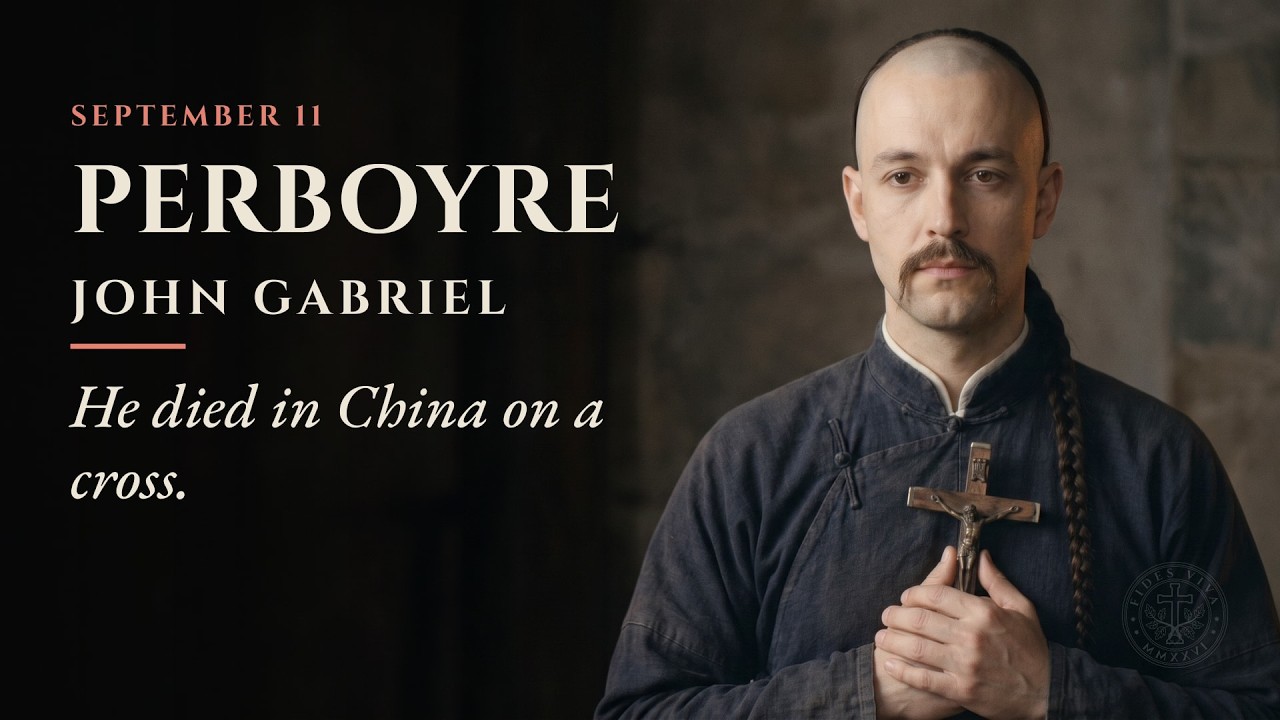
The first thing to fall is his hair. A razor clears his forehead and temples, as the empire's law demands of every man, and what remains is gathered in a braid down his back. The black cassock is folded and put away. In its place, a changshan—the long blue cotton tunic that men wear in this country—a crossed jacket with knotted buttons, and cloth shoes. No one who passes him on a road should guess where he comes from.
Then his name falls away. In the way of the country, Jean-Gabriel Perboyre becomes Tong Wenxue. By that name the Christians of Ho-Nan will know him; house by house, road by road.
Nanyang, 1836. A plain of yellow earth, ox carts, villages of adobe. Here begins what is slowest: the language. The man who taught theology in French and Latin sits like a child before a Chinese catechist who repeats the tones to him. The same syllable, spoken with the voice high or low, changes its meaning. He copies characters until his hand aches. He learns to name the Lord Jesus in that tongue, to ask, to comfort.
He has barely begun when a grave illness strikes him down. High fevers, weeks without the strength to rise. The priest who grew ill every winter in France is now thousands of miles from any doctor who speaks his language. The Christians who take him in care for him. His mission in Ho-Nan nearly ended there, on a straw mat, before it had truly started.
It did not end. He rose, thin, with skin drawn tight over his cheekbones, and went back to the book of characters.
Three years he walks the communities of the province. They are Christians without a church: they gather in private houses, behind a curtain, with an altar that fits in a traveling case. He arrives at night, on foot or by boat, with a paper lantern. He hears confessions for hours. He baptizes the children with water from a small vessel, with no font, no temple. He says Mass in a low voice, with someone watching at the door. Then he stays another half hour on his knees before the altar, as he did in Paris. "Never am I more content than when I have offered the Holy Sacrifice": this is how his brothers in the Congregation remembered him. In Ho-Nan, each Mass can cost him his freedom. The words do not change.
From outside, nothing sets him apart from any other peasant of the plain. This is the stripping away he sought without naming it: not to plant France in China, but to disappear into the people he has come to serve. His whole life fit into a single phrase that stayed with him: "No good is done to souls except through prayer."
But the stripping away has an inner room where no one enters. In those years he knows well whose shadow walks before him. In 1820, another priest of his own Congregation, Francis Regis Clet, had died a martyr in Wuchang, in the neighboring province, after thirty years of hidden mission. John Gabriel reveres his memory and truly desires the same grace.
Those who walked with him afterward remembered it this way: there was a night, or many nights, when that desire became agony. The body's fear and the soul's longing fighting in a room of earth. And in the midst of that struggle he saw Jesus crucified. He left no account of what was said. Only the agony remained, the cross, and a desire that did not fade.
That prayer of his survives in his papers. May I be transformed in you. In Ho-Nan those words are no longer the longing of a seminarian. They have a face, and that face is nailed to a cross.
In January of 1838 he is sent to Hou-Pé, the province of Hubei, to the mountain districts. Hills of terraced rice paddies, low mists, stone paths between houses with curved tile roofs. A year and a half of brief and fruitful apostolate: confessions, baptisms, communities that wait for him at night with a covered lantern. His feet harden on the roads. His braid fills with dust.
How does a phrase written in a notebook become an entire life laid on the table? From the outside, no one knows. What you see is a thin man, with a braid, climbing a hill in Hubei before dawn to say Mass in secret. What you do not see is how many nights like that one in Ho-Nan have prepared this step.
The quiet does not last long. On the roads people speak of the foreigner who goes from house to house. Christianity remains forbidden by imperial edict, and the European ships that press the coast make any stranger suspect. Someone has begun to ask questions. In September of 1839, the shadow that has walked before him for years stops, and waits for him.
Fidelity Under Chains
He has the face of someone known in the community. A catechumen: someone who has asked for baptism, who sits among the Christians to hear the doctrine. He knows what house the father Tong sleeps in and which path he takes before dawn. That man goes to the authorities and sells the hiding place. In return he receives a sum of silver. The records did not keep the amount; the memory of the Christians would later round it to thirty coins.
The soldiers come at night. They seize him without struggle. They take the blue changshan and dress him in a prisoner's rags. They put a wooden cangue around his neck—a stock so wide he cannot lie down or bring his hands to his mouth—and chain his wrists. And the road begins: from tribunal to tribunal, from the village to the district, from the district to the prefecture, from the prefecture to the capital of the province. Each mandarin—each official of the emperor with power to judge—questions him and sends him to the next.
Nine months in prison. More than twenty appearances.
Wuchang. A walled city on the bank of the Yangtze, the same place where twenty years before Clet had died. The interrogations follow a pattern that repeats. They kneel him on chains, hour after hour, until his knees open. They ask who he is, where he comes from, who hides him, where the other priests are, what houses the Christians gather in. When he is silent, they beat him. Bamboo rods on his back and thighs. Leather straps. Blows that split his lips. They take him to the courtyard with the cangue so the city can see him. The guards who held him said his body was one single wound.
What he did is told in few words, because there was little. Answer what touched his faith. Stay silent about everything else.
Not a single house, not a village, not the path he climbed before dawn with the lantern covered. The Christians who had sheltered him under their roof stayed nameless to the tribunals, because the chained foreigner would not open his mouth. What he kept silent about in those courtyards is as much his own as what he confessed: it is the last way left to him to care for his people.
And when the question touches something else—whether he is a Christian, whether he preaches the forbidden religion, whether he worships Jesus Christ—he answers that he is. Without raising his voice. Without speeches. Yes.
The Christians who saw him kneeling before the tribunal recounted this scene afterward. A mandarin, tired already of a prisoner who will not break, finds a way out. He orders a crucifix placed on the floor between them. And he offers him a bargain.
"Trample your God and I give you back your freedom."
One foot. A gesture of a second, and the door opens. The wounds, the cangue, the months of courtyard and chain: all of it ends with a step.
He looks at the crucifix on the stones. And he asks:
"Oh, how could I do such a wrong to my Savior?"
There is no defiance in it, no cry: it is a question, spoken with bewilderment, as one who does not understand what he is being asked. My Savior. The same word that begins his prayer always: O my divine Savior. He wrote it in France, he prayed it on the crossing, he repeated it in a room of earth in Ho-Nan. Now he says it on his knees, with broken lips, before a man who can give him back his life.
And he does not step.
This man was not a man of strong will. He was a timid seminary professor, ill every winter, whom his superiors kept from the mission for years because they did not believe his body could bear it. That body is what now, without strength, holds firm against what neither hunger nor bamboo nor fear could bend. He held that refusal before more than twenty tribunals, in the same tone. And an open question remains that cannot be answered from outside: what sustains someone who has no strength left and keeps choosing the same thing.
The tribunal of Wuchang condemns him to death. But in the empire a sentence like that is not final without the emperor's seal, and papers travel slowly. Weeks pass. Months pass. In the cell, the wait is the last trial: to know what is coming and not know when.
And one day in 1840 the imperial edict arrives at last. The sentence is confirmed. What began with a door opening in Montauban has now a certain end: September eleventh. Where does a gift of self like this end? Outside the walls there is a hill.
The Cross in Wuchang
The sky over the Yangtze breaks gray at dawn. The guards open the cell and remove the cangue from his neck for the last time. They do not give back his clothes. He comes out as he is: the shirt stained, the trousers soiled, nothing more.
In the courtyard seven men wait. Condemned for common crimes, people the city wants rid of on the same day. They bind them in a line. The foreigner takes a place among them, with no distinction: this is what the tribunal ordered, that he die mixed with the worst. And this is how he had asked to live since he shaved his forehead in Ho-Nan: as one more among his people.
They cross the city on foot. Dirt streets, shop shutters opening, people who pause for a moment and move on. Just a year before he walked paths like these, at night, with the lantern covered, to reach a house where they waited for him. Now they lead him in daylight, in sight of all, and there is no house at the end.
The city gate falls behind. The road begins to climb.
It is a mound of red earth on the outskirts, treeless, the place of executions. At the top they have set rough wooden beams. One of them is shaped like a cross.
They bind him to that beam. His arms open across the crossbar, held with rope. His neck against the upright. There are no nails. The penalty is the rope. The cross-shaped gallows is only the custom of the place, to keep the prisoner still while the executioner works.
The executioner passes the rope. He draws it tight.
A man of thirty-eight, far from the stone house where he was born, on the far side of the world, dies strangled by a rope, bound to a wooden cross, under a midday sky. His face tightens. Then it loosens and grows still.
Nothing more. An ordinary midday in Wuchang. Eight bodies on a hill. One of them had confessed Jesus Christ before more than twenty tribunals without raising his voice. One of them had asked, years before and in written words, to be changed entirely into his Savior. From the road below, the soldiers see only a foreigner tied to a beam. The few Christians who dare to look from a distance see something else, and there is no need to say it.
The bodies of the executed belong to no one. To claim one is to declare yourself complicit. And this is the body of a foreigner condemned for the forbidden religion.
A catechist claims it: a Chinese Christian, one of those who taught the doctrine in houses when the priest could not come. He wraps it simply, without ornament, and carries it to the mission cemetery. There, beside the grave of Clet, the old missionary who died the same way in 1820, he opens the earth and buries him. Two Frenchmen in black cassocks, made Chinese among the Chinese, rest one beside the other on the bank of the Yangtze.
The catechist had nothing to gain and everything to lose. He did it because the foreigner had become one of them even to the point of keeping their names silent under the bamboo, and now it was his turn to care for him.
Nothing remains on the hill to look at. Red earth, short grass, the walled city below: the mound becomes just a mound again. A missionary of thirty-eight, five of them in China and the last in prison, under a pile of earth with no name. What remains of a life given all the way to the end? Can a death like this be a seed?
What is sown in September works under the earth, where no one sees it. The life of John Gabriel does not end on that cross. It begins to bear fruit.
Seed for Many
The Christians of Hubei did not forget the hill. They kept, beside his grave, the memory of a light shaped like a cross over that place. So their devotion passed it on by word of mouth, and not the court records. They spoke of it without raising their voices, the way one speaks of something in the family.
The country took years to open its doors. When it did, John Gabriel's companions came back for him. They recovered his remains from the mission cemetery and carried them by sea, in the opposite direction from the journey he had made with his dead brother in his heart: from Wuchang to France, from France to Paris, to the house on the rue de Sèvres.
There he rests today. In the chapel where he prayed so many hours as a novice and as a formator, beneath a side altar, in a reliquary with a glass front. The recumbent figure wears the black cassock and white collar he left behind in Macao to dress as a Chinese man. Above the main altar, in its silver shrine, Saint Vincent de Paul, whose example was enough for him once to refuse to visit his family. Nearby, Clet, with whom he once shared a grave in Wuchang.
On November 10, 1889, in Rome, Leo XIII declared him blessed. Forty-nine years after the rope, his name was spoken aloud before the Church, and the image of his martyrdom—a man with a queue bound to a cross—spread across all of France.
One of those images arrived at the Carmel of Lisieux, in Normandy, where a young nun who would never leave her cloister kept it between the pages of her prayer book. Her name was Thérèse. She dreamed of missions she would never walk, and she prayed looking at a blessed who had walked them to the end. Those who studied her life afterward kept that small detail: the man who closed the door of Le Puech forever accompanies, through a holy card, the one who would one day become the patroness of the missions.
On June 2, 1996, in St. Peter's Square, John Paul II canonized him. He was the first canonized saint of China. The Pope said it this way: "Reproducing the Passion of Jesus with extraordinary likeness, he became like Him in death, even death on a cross." One hundred fifty-six years later, the whole Church spoke aloud what a few Christians of Hubei had seen from the road below.
And the echo did not stop in Rome. In 2020, when the name Wuhan traveled the world with the shadow of pandemic, there were those who remembered that two French missionaries had died there, and in Cahors, in Wuhan, and in the Polish city of Bolesławiec people prayed to Perboyre and Clet at the same time for the sick. Six years later, in a seminary in that same city, twenty-three bishops from nine Chinese provinces made a six-day retreat. In the land where there had once been a hill of executions there are now young men studying to be priests of their own people.
Five years of mission. Nine months in prison. A rope. What seemed to be lost under a nameless pile of earth is still alive on three continents. How does a life given this way, in silence and fidelity each day, stay alive? The figure in the black cassock does not answer. But the question returns, the way the gaze of the Christians of Hubei returned to the hill: what does that life say to us today?
When Desire and Destiny Meet
There is a prayer that answered before anyone else could. The Vincentian family keeps it as their own, born at some moment in his life as a priest, without knowing whom it would reach. It begins like this: "Oh, my divine Savior, by your omnipotence and your infinite mercy, change me and transform me entirely in you." It goes on asking that his hands be the hands of Jesus, his eyes the eyes of Jesus, his tongue the tongue of Jesus. And it arrives at the phrase from Saint Paul toward which the whole text moves: "I live, now not I, but Christ lives in me."
A martyr did not write it. He wrote it as a timid, sickly priest—the kind who does well what lies before him and expects no one to watch. He asks for one thing only, without a date and without conditions. He does not say how he wants to receive it.
The answer came in another language and on another continent. Betrayed for money. Taken from one judge to another. Beaten. Exposed in the street with a wooden collar at his neck. Bound to a wooden frame shaped like a cross, on the outskirts of a city, among common criminals. None of that appears On the page is "transformed entirely in you." History did the rest, word by word.
And he never pointed it out. In the months in prison he did not speak of fulfilling any prophecy or of resembling anyone. He answered what they asked him and kept silent about the names he had to protect. According to those Christians who saw him, he held the gaze when they put the crucifix at his feet. The likeness was something the others saw afterward: the Christians of Hubei from the road below, a pope in Rome a century and a half later. He had only asked, and left the rest in those same hands.
It all began at a door. A boy of fourteen who leads his younger brother to Montauban and, at the threshold, decides not to return to the farm. What can be born from a choice made only to keep another from being alone? From that choice came a teacher who showed dozens of young men how to set out. Then came a missionary who learned the language of a distant people to speak to them of Jesus Christ, and who shaved his forehead so he would no longer be a stranger. Then came a prisoner who chose silence so that others could live. Then came the first canonized saint of China. All of that fit in a gesture that, that morning in 1816, no one looked at twice.
We too cross doors like that, without noticing. We walk someone to a visit that was not ours to make, we say yes to a favor that seemed small, we stay an hour longer than we planned to stay. Which of those gestures from last week, so ordinary we have already forgotten them, is silently changing the course of what comes next?
John Gabriel did not know either. He only stayed. And then he kept staying: in the seminary, in the empty place of Louis, in the clothes and in the language of a people not his own, in a cell, on a hill.
Thirty-eight years. Of those, barely five in the land he loved. No book with his name, no foundation bearing it, no speech anyone remembers. Only a short prayer and a life that fulfilled it to the last letter. He asked to become another Christ, and on a hill in Wuchang his body took the shape of what he had asked for.
Saint John Gabriel Perboyre, martyr of Wuchang, apostle in a distant land, first canonized saint of China, pray for us.