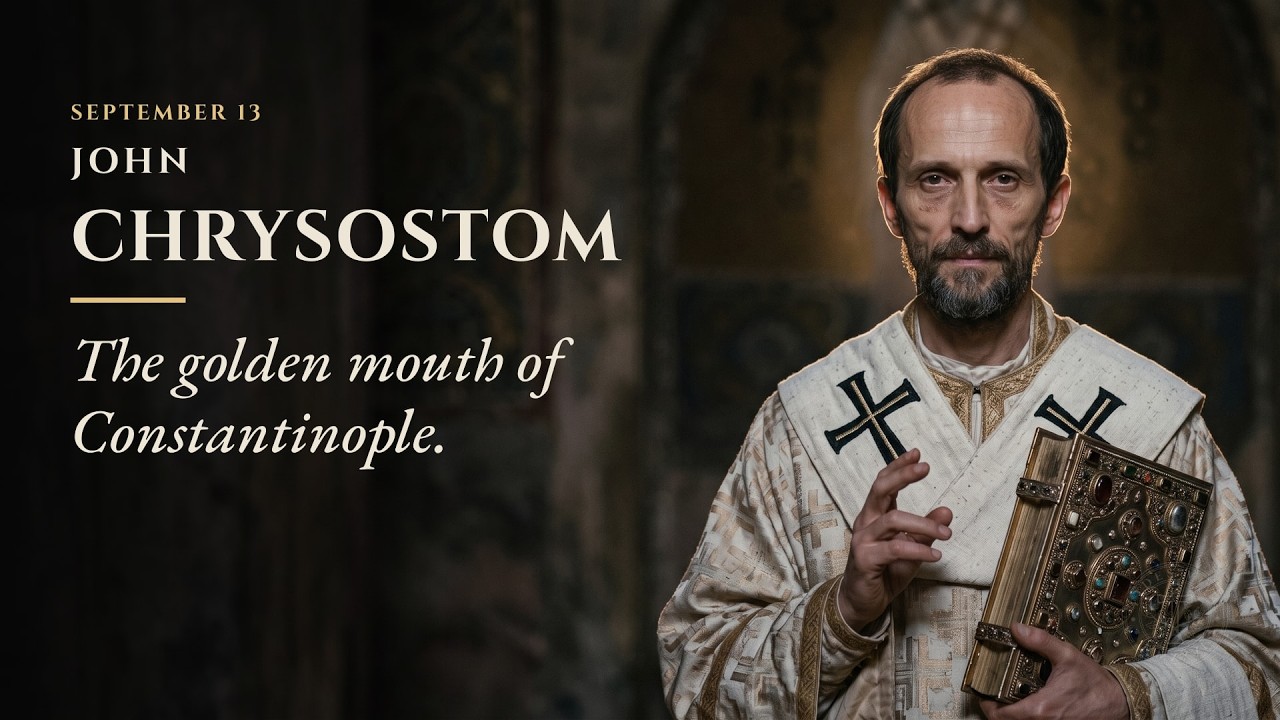
A man walks leaning on a cane. He is small, thin down to the bone, and each step costs him. Beside him march soldiers who do not look at him: they are only following an order. He has been on the road for weeks, sun and rain, fever. At the edge of a city, a stone chapel: the tomb of a forgotten martyr. There he stops. He cannot go on.
At dawn he asks for something.
A white tunic.
He puts it on like someone dressing for a feast. He receives Communion. And before he closes his eyes he says a single phrase: "Glory to God for all things."
That broken man had been bishop of the capital of the Empire. The year was 407. An order signed in the palace had torn him from his seat, and they were taking him to die as far away as possible.
Before that, his voice had filled basilicas. An entire city—half a million people terrified of an imperial punishment—had held itself together for weeks on his words. The empress herself had backed him at first. Until the word that comforted the poor began to speak of the gold in the palace.
Nearly nine hundred homilies survive. Twelve years preaching almost every day. A liturgy that, even today, every Sunday, carries his name.
How does a man like that move from a full basilica to this empty chapel, and what did the word he preached teach him, so that when he lost everything his last word was to give thanks?
Antioch: A Calling Between Two Worlds
A street of columns runs end to end through an enormous city. It is Antioch of Syria—present-day Antakya, in Turkey—half a million people on the bank of the Orontes River. Under the porticos, merchants cross paths with philosophers in cloaks and monks down from the mountain. The Empire has been Christian for only a few decades, and everything feels new. The temples of the old gods still stand open, the synagogue is full, and even the Christians are split in two, with rival bishops fighting over the same city. Into that boil of talk and argument a boy is born, around the year 349—the date most scholars accept, though some place it a few years earlier. His name was John.
His father, Secundus, an army officer, died when the boy was small. His mother, Anthusa, was left a widow at twenty. She never married again. She managed the household, protected her son's inheritance, and raised him herself in the faith of Jesus Christ. In that house without a father, the quiet strength that John would carry his whole life was forged.
At seventeen he sat in the classroom of Libanius, the most celebrated pagan orator of his age, a defender of the old gods and yet a friend to many Christians. There he learned how to move a crowd with his voice: the rhythm, the pause, the exact strike of a phrase. The boy with the high forehead and dark eyes was remembered as standing out among the students. A career in the courts awaited him: lawsuits, money, applause. His own circle tell us that when Libanius learned how long that widow had remained unmarried, he let out a cry of wonder at Christian women. And one old memory preserves his complaint, years later, when asked who should succeed him:
"He would have been my successor, if the Christians had not taken him from me."
Because the Christians did take him. Around the year 368, at nineteen, he walked down the steps into the baptistery pool and received baptism from the hands of Meletius, the bishop of Antioch. The water fell in silence. There was no lightning, no vision: there was a decision, slow and deliberate over many years, that came into the open that morning. The same word that was going to be sold in the courts from that day forward remained, from that day, in the service of Christ.
Meletius made him a lector—the one who reads Scripture aloud before the assembly. And in the school of Diodore of Tarsus he learned to read the Bible the way you read a letter: word for word, asking what the writer meant to say, and what it asks of the one who hears it.
He wanted to leave at once. The hermits in the mountains called to him like a magnet, and he had the urgency of nineteen. Then his mother called him to her side. He himself told the story years later, in his treatise On the Priesthood. She reminded him of her early widowhood and all she had held together for his sake. And she asked him one thing: not to leave her alone.
He stayed. Years. Reading in the assembly, studying, fasting at home, looking from the rooftop toward the southern mountains, where the hermits lived. It remained to be seen what that voice would teach him when at last he could follow it.
The Cave and the Body: Learning Limits
High on the limestone slopes south of Antioch, the wind smells nothing like the marketplace or incense—only stone and dry scrub. Among abandoned olive terraces, caves open low into the rock, and in some of them people live. Hermits. Men who had left the city to seek God in silence. Around the year 375, when he was about twenty-six and Anthusa was already dead, John climbed up to join them. He brought a codex of Scripture, a rush mat, a clay jar. Little else.
The first years he spent with other solitaries, learning the rhythm of vigils, fasting, silence. Then he wanted more. The last two he spent alone, in a narrow cave, with one oil lamp for company.
He barely slept. He kept vigil with Scripture in his hands, and when the light failed he went on praying into the rock's silence. He ate almost nothing. In winter, fine snow covered the mountain, and the cold seeped into the rock, into the mat, into his bones. He wanted his body to obey completely, to ask him for nothing, so that only Christ remained before him. And the body obeyed as long as it could.
Then it stopped obeying.
It started in his stomach. A dull pain that wouldn't leave, a cold that no cloak could drive off, a tremor in his hands that made the letters of the codex dance. His kidneys began to ache next. By twenty-nine he had damaged them for life—stomach and kidneys both—and he couldn't hold that life anymore. The total solitude with God was slipping through his fingers.
There is a defeat that those who have pushed their bodies too far know well—through work, through sport, through an ideal: the will stays whole and the legs won't move. No one forces it from outside. God didn't ask for a corpse. Holiness wasn't about breaking yourself.
Around 378 he came down from the mountain. Sick, wasted, clothes torn to rags and beard grown wild from years alone. He was returning to the city he had wanted to flee. But he carried something no classroom teaches: Scripture worked into his flesh, and the certainty that he needed nothing now. Not food, not comfort, not applause. Those years had ruined his health and given him a freedom no one could buy from him. That wound and that freedom would stay with him until the last road.
Antioch took him back, and Meletius, the bishop who had baptized him, put him to work. In 381 he ordained him deacon. It was one of the old man's last acts—that same year he left for Constantinople to preside over a council and never returned. John, in the white tunic and crossed stole of a deacon—the orarion—spent his days caring for the poor and widows, tending the sick. The man who had wanted to see no one now moved through the days among those who needed him most.
And he wrote. In those years he composed, among other works, a treatise that seminaries still read: On the Priesthood, shaped as a dialogue with his friend Basil. He wrote it as a man afraid, not one seeking to climb. Afraid of the burden, of responsibility for souls, of standing before the altar as he was. One sentence holds that fear:
"The priesthood is exercised on earth, but it belongs to the order of heavenly things."
The man who wrote that didn't want it for himself. He saw it as too large. And yet it was the very reason he couldn't refuse: if the priesthood belongs to heaven, you don't choose it as you choose a career; you receive it when the Church calls, and you pay with everything you are.
A man who couldn't eat with others, who shook with cold in summer, who had failed in the desert—what did he have left to give? What he had left was his voice. The mountain had taken his health and left his word sharp as never before. And the city below was waiting for someone to explain the Gospel to them.
The Pulpit of Antioch: The Word That Sustains
In the year 386, an old man in his seventies, with a thin, long white beard on his chest, laid hands on him. It was Flavian, bishop of Antioch since Meletius's death, whom he had succeeded. He ordained him priest, and with that ordination gave him something more than an altar: the ambo of the Great Church. From there John would speak to the city for twelve years. Almost every day.
He spoke about Scripture. Not ideas around Scripture—the text itself, verse by verse, like someone breaking bread. He took Genesis and explained it chapter by chapter; took the Gospel of Matthew, the Gospel of John, the letters of Paul, and opened them before artisans, merchants, slaves, matrons, soldiers. What he had learned from Diodore—to read first what the text says, in its plain sense, before hunting for symbols—became his way of preaching. And what he had learned from Libanius gave him the tools: the phrase that stays with you, the example drawn from the street, the question thrown to wake the listener who's drifting. Greek rhetoric put at the service of the word of Jesus Christ.
The people applauded, right there in the church, the way they did in the theater, because that's how it was done in those days. And he, from the ambo, would grow angry at the applause. He told them he didn't want applause, but changed lives; that leaving the basilica praising the preacher and going home exactly as you came was wasting the morning. For him the homily didn't end at the door. It ended at the table of each house, in how a slave was treated, in the coin given or refused to the beggar at the portico.
He didn't shy away from what was hard. He rebuked those who arrived at the same nave in silk and perfume where others had nothing to cover themselves with; those who ran to the hippodrome and missed the liturgy; those who swore false oaths as a habit. And in those early years he also delivered a series of harsh sermons, aimed at the Christians of Antioch who went to the feasts of the neighboring synagogue and mixed the two observances. They are pieces of the rhetoric of his century, with the sharpness that century allowed in a pulpit, and today they are read with care, within the Antiochene world that produced them. John didn't know how to speak any other way: what he believed was wrong he said aloud, from the ambo, in front of everyone.
In 387 that voice was tested. The court of Theodosius imposed a new tax on the city, and Antioch answered with a riot. The crowd ran through the streets, tore the statues of the emperor and his family from their pedestals, dragged them through the streets, smashed them. The riot passed. The fear stayed.
Because offending the image of the emperor was offending the emperor, and the punishment could be anything: executions, confiscations, the ruin of the whole city. Many fled to the countryside. Those who stayed waited to see soldiers arrive. And Bishop Flavian, in his seventies, set out on the long journey to Constantinople to ask Theodosius for mercy. Libanius too, the old pagan teacher, wrote speeches in his city's defense.
Antioch was left without its bishop, waiting for the sentence. And it was left with a priest.
John climbed to the ambo. He climbed again the next day, and the day after. While the city trembled, he preached day after day what is now known as the Homilies on the Statues. The basilica filled as it never had: people pressed between the columns, standing for hours, looking for something to hold on to. And he didn't promise them the emperor would forgive. He spoke about fear and death, and about which death truly deserved to be feared—not the one a tribunal could decree. He spoke about Christ, who also stood before a power that could kill him. He asked them to use those days of terror for what they didn't do on calm days: make peace, put away false oaths, look at the poor.
Antioch lived those weeks hanging from a voice. The voice of a small, sick man, who barely ate, and who every morning stood again before thousands to hold up the spirits of all of them.
The city held. When Flavian came back from the court at last, he found his people still standing. And he found the name of his priest on everyone's lips. That crisis was the first time it became clear what that word could do: not only teach, but hold up an entire city when everything else was failing.
When the danger passed, he went back to his work: Scripture each day. Around 388 and 390 he prepared the catechumens for baptism, walking them step by step through what they were going to receive. And he commented on the Gospel of Matthew, homily after homily, until he came to a passage that sums up everything he taught about the altar table and the table of the poor. It was the custom then to adorn churches: golden chalices, precious cloths, marble. John didn't forbid it. But one day he looked at the temple, then at the door, where beggars were waiting, and he said:
"Do you want to honor the body of Christ? Don't despise it naked; don't honor it here with silken robes and leave it outside shaking with cold."
And he added: "Christ doesn't need golden vessels. He needs golden souls."
The same Christ on the altar was the one shaking in the portico. Whoever received Communion and then walked past the hungry was leaving Christ incomplete.
Twelve years like this. A city educated in the Gospel verse by verse, a basilica full each morning, and a preacher's fame that began to leave Syria and arrive, by word of mouth, at the capital. The epithet by which the Church remembers him—Chrysostom, "golden mouth"—would be given only after his death. But the gold was already being heard.
And far from Antioch, in the halls of a palace where sees and careers were decided, someone began to ask about that priest. What happens when a voice made to console and to unsettle is called to the place where power decides? The rumor from the basilica of Antioch, little by little, was turning into a whisper in the court.
Constantinople: The Pastor and the Court
At the beginning of 398 an imperial escort removed John from Antioch without announcement, in a closed carriage. There was no farewell in the Great Church and no crowd at the porticos: the departure was prepared in silence, precisely so the city couldn't stop it. The man who had arranged it had a name and considerable power: Eutropius, the eunuch who ran the household of the young emperor Arcadius and, through it, much of the Eastern Empire. In Constantinople the bishop, Nectarius, had died, the see was empty, and Eutropius wanted the preacher of Antioch for it. John hadn't asked for it. They were bringing him.
On February 26, 398, he was consecrated bishop of the capital. They placed on his shoulders the omophorion, a band of white wool with dark crosses, the sign that then marked a bishop: no miter, no crosier—those would come centuries later. And the hands that consecrated him belonged to Theophilus, patriarch of Alexandria, a robust and shrewd man who had wanted another candidate for that see and who obeyed the court with his jaw clenched. Years before he had written about the weight of priesthood with genuine fear. Now that weight had the size of a capital.
Constantinople wasn't Antioch. It was a new capital, built for the emperor and dressed in marble and silk, where everything flowed through the palace: offices, revenues, sees, sentences. Arcadius, son of Theodosius, was young, pious, and weak; those who could get close to him governed in his place. First Eutropius, and then his own wife, the empress Aelia Eudoxia, a woman under thirty, daughter of a Frankish general, with enormous influence over her husband. In that city the bishop was one piece more on the board. It was expected that he would go along, that he would bless, that he would know when to be silent.
John did the opposite from the first month. He looked at the accounts of the episcopal palace and cut them. He abolished the banquets with which the bishop's house received the powerful. He ordered marble and ornaments meant to decorate the churches sold, and with that money he sustained hospitals and financed the daily distribution of food to the poor and widows on the Church's rolls. He demanded accounts from his clergy, priest by priest, and required that the bishop's house stop looking like a senator's house. He sent missionaries to the Goths, many of whom lived inside the capital itself, so they could hear the word of Jesus Christ in their own language. What he had preached in Antioch about the altar table and the table of the poor became the Church's daily spending here.
He ate alone, and little, because the stomach ruined in the cave wouldn't allow anything else. The court read it differently: they called arrogance what was a frailty he never knew how to explain. And from the ambo he was still the same: he spoke about luxury, about silken robes and jewels shown off in church while the poor waited at the door, with the same freedom he spoke about a craftsman's sin. Except now the empress was among those listening.
In 399 the city witnessed a scene no one forgot. Eutropius, the man who had brought him to Constantinople, fell from favor overnight: the court that had feared him abandoned him, and the crowd called for his head. The eunuch fled to the only place left to him. He ran to the Great Church and clung to the altar.
John stood between him and the crowd. He didn't hand him over. The next day, with the fugitive still clinging to the holy table, he climbed to the ambo. He preached about what gold, titles, and applause are worth when the fall comes, and as he spoke he pointed to the man trembling at his feet. He didn't humiliate him to please the crowd: he made him a lesson for all, beginning with those who had bowed to him the day before. And he asked mercy for him. The man who had made him bishop now depended on that bishop's protection, and he got it. The altar of Christ sheltered even those who didn't deserve it. That was the Gospel John explained, and that morning he lived it in front of the whole city.
Two years later, in 401, the reform left the capital. He was called to Asia Minor for conflicts among the churches of that province, and John traveled to Ephesus. There he judged several bishops accused of having bought their see with money—what the Church calls simony—and deposed them. He didn't stop at preaching against corruption: he removed the corrupt. It was an act of justice, and it was also a miscalculation, if he calculated anything. Each deposed bishop had friends, relatives, favors owed. And his absence from Constantinople stretched on for months. When he came back, there were people who had used the empty space to speak against him, in the palace and in the sacristies.
The enemies began to find each other. Within the city, clergy offended by his demands, the rich offended by his sermons, and an empress who felt herself pointed to every time the word vanity crossed the nave. Outside it, Theophilus of Alexandria, who had never fully accepted that Syrian in the see of the capital and who saw Constantinople as a rival to the ancient preeminence of his own church. Theophilus was patient, and he knew how to use others.
In 402 he used an old man of venerable standing. Epiphanius, bishop of Salamis, in Cyprus, near ninety years old and famous for his zeal against every heresy, came to Constantinople called by Theophilus to act against some Egyptian monks accused of doctrinal errors. And he refused to commune with John. It was a grave gesture: one of the most respected men in the East turned his back on the bishop of the capital. He died not long after, on the boat back to Cyprus. But the damage was done, and Theophilus was already preparing to come himself, with a retinue of Egyptian bishops.
John knew it, and he didn't change a word: he had never learned to say one thing in the pulpit and another in the palace. What price does a man pay who can't separate what he preaches from what he does, not even before the powerful? The city was about to see. The whispers of the court began to take written form, and in a villa on the Asian shore, in the shadow of an oak, someone was arranging benches for a trial.
The Synod and the Fall: When the Word Becomes Unwelcome
The benches filled in the summer of 403. The villa was called the Oak and stood on the Asian shore of the strait, across from Chalcedon, among gardens and ancient trees: close enough to the capital to see its walls from the water, far enough that the city couldn't enter. Theophilus of Alexandria presided. Around him sat the Egyptian bishops he had brought with him and the clergy and bishops that John had offended in five years of demands. There were scribes, wax tablets, and records. And there was a list.
The accusations were read one after another. That he had squandered the Church's goods: the marble sold for hospitals, now recast as squander. That he ate alone and received no one. That he had deposed bishops without authority. That he had spoken against the empress. Almost everything the city thanked him for appeared there with another name. From the far side of the water, the accused didn't come. They cited him several times, and each time he answered the same thing: he wouldn't accept as judges those who were his declared enemies. They judged him in his absence. They declared him deposed. The court, which had been waiting for that sentence, confirmed it without delay.
The soldiers came. They took him away at night to the harbor, to avoid the crowd, and put him on a ship toward the Asian coast, on the way to a first exile. The bishop of the capital crossed the strait under guard, the omophorion still on his shoulders.
The city found out at dawn, and it didn't stay quiet. The squares filled. Those who ate from the bishop's bread, the widows on his rolls, the sick from his hospitals, surrounded the Great Church shouting the name of the man who had given them everything. Then the earth shook at night, shaking the palace too. The memory of those close to him tells us that no one doubted what it meant: the people read the tremor as a sign from heaven, and in the palace there was fear that they might be right. Within days, the same court that had cast him out ordered him brought back. A boat returned him to shore, and the whole city came down to meet him. The small, bent bishop walked back into his church between a crowd that barely let him walk.
It looked like a victory. It wasn't. The sentence from the Oak was still written; the court had only set it aside. And from the ambo, John spoke exactly as before: about silk, about gold, about the poor at the door, knowing that every word would reach the palace. What had been a fire put out halfway reignited in a matter of months. His enemies didn't need another synod now. They only needed the emperor to sign again.
Easter came in 404. It was the night of the vigil, the holiest night of the Christian year. The catechumens had waited months, some years, to finally go down to the pool of the baptistery and be born to Christ in the water. The baptistery of the Great Church was full. Those about to be baptized wore white. The priests and deacons waited by the steps of the octagonal pool. Lamps burned. And in the middle of the rite, the soldiers entered.
They burst in with weapons in hand into the most innocent place in the Church. They shoved the priests. They beat back those waiting for the water. Men and women half-baptized fled into the dark streets, in white robes, the same night they should have been received as children. The city that had defended its bishop with an earthquake now saw the force of the palace inside the water of baptism. There was no way back now.
The weeks that followed he spent locked in the episcopal house, under watch, knowing that the final order would come. Among the words his faithful kept from those days is a homily, under his name, that says this:
"Many are the waves and great the tempest, but I do not fear shipwreck, because I stand upon the rock."
Upon the rock. Not upon the see, not upon the court, not upon the favor of a people that shouts one day and is silent the next. Upon Christ. A man who had left his body in a cave and who had never owned anything in a palace didn't have much more to lose.
On June 20, 404, the order came. He received it, said goodbye to a few of his own, and left the church by a side door, without warning the people, so that no one would die defending him. He no longer wore the white tunic or the omophorion: a heavy travel cloak, with a hood, over a brown tunic, and shoes that the road would soon destroy. He was fifty-five years old and looked like an old man. Outside, the soldiers waited.
Shortly after he left, the Great Church began to burn. Fire reached the Senate building next to it and devoured the wooden roof, the linen curtains, the benches. No one knew for certain how it started. What was clear was who the city turned against: the Johnites, as people began calling those who still remained faithful to the deposed bishop. They were questioned and persecuted. Olympias, the deaconess of senatorial family who had sustained with her fortune the bishop's dining halls and hospitals, was pursued and harassed for refusing to renounce him.
And he was already on the road east.
They had taken from him the see he never asked for, the fame that had carried him to it, and what little health the cave had left him. How does a faithful man respond when all three things are torn away at once? The answer didn't come in Constantinople. It came far away, in a valley of mountains that none of his people had ever seen. The dust of the road began to settle on the brown tunic. The exile had begun.
Cucuso: Consolation Amid Dispossession
The smoke couldn't find its way out. It clung to the low beams of a stone house in a village called Cucuso, in a high valley of Armenia Minor, between bare mountains where snow came early and took months to leave. That was where the journey that had begun at the side door of the Great Church ended. The bishop of the capital of the Empire lived now in a room with a straw mattress and a table for writing.
The winter of 404 was long. Fever didn't let go of him for weeks at a time; the stomach that the cave had ruined a quarter century before rejected almost all food, and the cold worked into his bones the way it had those nights in Syria, except now he hadn't chosen it. On top of that came the fear that gripped the valley: bands of Isaurians came down from the neighboring mountains to raid the villages and prowl the roads. More than one night the neighbors slept with their doors barred and their ears alert. A small man, bent, with a white beard and skeletal hands, listened to it all from his room and could do nothing.
And yet he wrote. From that table came more than two hundred letters in three years. Letters to the priests left without a bishop, to the widows on his rolls, to the friends defending him in the capital and paying the price for it. And seventeen letters to one woman alone: Olympias, the deaconess. She had sustained the Church's dining halls and hospitals with her fortune, and now they were making her pay. They had tried her for not renouncing him and had cut her off from her work; she grew sick, and sorrow sometimes overwhelmed her. The exile, still feverish, wrote to lift her up. He spoke to her of patience, of God's providence that governs even what seems lost, of Christ, for whom the two of them were paying that price. There is no complaint against his enemies in those letters, only concern for her health, her spirit, and those who still depended on her. The voice that in Antioch had sustained an entire city when it feared the emperor's punishment sustained now, from a frozen valley, a woman who had lost almost everything for being faithful to him.
In those same months he composed two treatises. One, on providence. The other carries a title that sums up his answer to everything they had done to him.
"No One Can Be Harmed Except by Himself."
They had taken his see, his fame, and his health, and he held that none of it was true harm. The only real harm, he wrote, is what one does to oneself: letting the injustice suffered turn to bitterness, letting go of trust, turning away from God. Enemies can take goods, cities, bodies. They cannot touch what a man will not surrender, nor steal what he no longer fears to lose. He had learned it in the cave, as a young man; now he signed it with his whole body.
And the Church did not leave him alone. His appeal crossed the sea to Rome. It was carried there, among others, by two trusted men: a priest named Germanus and a deacon he himself had ordained, John Cassian, a monk trained in the Egyptian desert who years later would found monasteries in Gaul. Pope Innocent, the bishop of Peter's see, received them. He heard the case and refused to recognize the deposition: for Rome, John was still the bishop of Constantinople. He wrote to sustain him, and sent an embassy to the East to demand a fair trial. The embassy was rejected: nothing changed in the court. But for the first time the cause of that small bishop stopped being a quarrel of the capital and became a matter for the whole Church. The West had taken his side.
Three winters passed in Cucuso. And the court was not satisfied. The letters that left that valley reached Antioch, Constantinople, Rome; the exile was still a bishop whom people listened to. In 407 a new order came: he was to move to Pityus, at the far eastern edge of the Euxine Sea—the Black Sea of today—one of the most remote and harsh corners the Empire could offer. The soldiers guarding him did not wait for him to recover.
He was fifty-eight years old. He gathered the tablets and the reed pen, threw the heavy hooded cloak over his white beard, and left the stone house between spears. No one in the capital knew that morning they were making him leave. One question remained that no letter had answered yet: where would a man find breath when all that was left to him was the road.
The staff struck stone. And the last journey began.
Comana: Glory to God for All Things
From Armenia northward, the route climbs and falls across a plateau with almost no shade. The soldiers marched at the pace of the order they carried, not at the pace of the man they carried with it. When the sun bore down, there was no tree to stop under; when rain came, the earth turned to mud and water seeped through his ruined shoes. Fever came back within days. His head burned, his stomach held nothing, and still they had to go on, because Pityus lay far and summer was ending.
In September of 407 his body said enough. They had reached Comana, a small city on the Pontic plateau, in lands of present-day Turkey. The fields were already reaped; a few cypress trees stood out against a sky threatening storm. On the outskirts there was a stone chapel, low, with a small apse and oil lamps burning inside. It held the tomb of a martyr named Basiliscus, a soldier who had died for Christ nearly a century before, in the persecutions that came before Constantine. His memory was kept, above all, in that region of Pontus. They let the bishop spend the night there.
Those who knew him kept what happened that night between those four walls. They say that in the dark, between sleep and waking, the martyr drew near. A young man, curly-haired and wearing a soldier's red cloak, with light in his face. And that he told him, plainly, that the next day they would be together.
The morning of September 14, he asked for a white tunic. He took off the brown road clothes, hardened by dust and rain, and dressed in white, as he had on the day of his baptism in Antioch, forty years before. He asked for communion. He received the Body of Christ, the one he had explained for so many years from the ambo and recognized in the poor at the door. Then he prayed. And he said, with the voice he had left, the words that sum it all up:
"Glory to God for all things."
He added an amen. He lay down beside the martyr's tomb, and died. He was fifty-eight years old.
There was no crowd. There was no Great Church, no ambo, no applause to reprove. There was a few soldiers with an order to carry out, a village priest, a lamp above the stone. The man who had held up with his voice an entire city of half a million people and had spoken to the emperor's court ended speaking for almost no one. And what he said was not a defense, not a reproach, not the names of those who had cast him out. It was thanksgiving.
For everything. For the cave that broke his stomach and for the pulpit. For Constantinople and for the Oak. For Olympias and for Theophilus. For the road that was killing him.
What comes out of the mouth is what was inside. And what was inside that wasted body was gratitude. In the chapel it hung in the air, and it hangs still across the centuries, a question that John did not answer with a sermon but with his last breath: what does it mean to give thanks when there is nothing left to lose.
The soldiers went on without him. They buried him beside Basiliscus, two men whom Christ had brought together in a tomb in the provinces. In the capital, his name was still missing from the public prayers. It seemed the exile had won.
The Return: Late Justice and Living Legacy
In the Great Church of Constantinople, rebuilt after the fire, there was a moment in every liturgy when a deacon read aloud a list of names. They were the dead bishops of the city, written on two wooden tablets joined together that were called diptychs, and the people prayed for them one by one. For years, that list was missing a name. John's. Whoever spoke it in public still ran a risk; his faithful, the Johnites, still gathered apart.
Between the years 417 and 428, on a date the city did not record with precision, the name came back to the tablets. No one announced it with trumpets. A deacon read it, the people responded, and the Church of the capital admitted quietly what the streets had known from the first day: that it had exiled its bishop for speaking plainly.
Thirty years after the death in Comana, in the year 438, a patriarch named Proclus, a man with a high forehead and a rounded beard whom the city regarded as a disciple of the exile, held the see. One day he preached about him. He spoke of the voice that had held Antioch and fed the poor of the capital, and of how that voice had died in a chapel in the provinces with an escort of soldiers. The people wept in the nave. And the emperor listened.
His name was Theodosius II, son of Arcadius and Eudoxia, who had signed the exile. He ordered the remains brought home.
On January 27, 438, the sarcophagus arrived by sea. The whole city waited for it: the harbor filled with people, and on the docks and in the streets so many torches burned that night looked like day. The same capital that had seen him leave under guard, and that had burned at his back, came out now to receive him as one receives a father. They carried him to the Church of the Holy Apostles, where emperors rested, and buried him there. In the very temple of the house that had cast him out.
That journey home was told for centuries, and as it traveled from Comana to the capital, the memory of the people added what the chronicle did not write. It was said that the sick who touched the sarcophagus as it passed were healed. And something more was said, in the readings repeated every January 27 in the churches of the East: that in Comana the stone would not move. That men pushed and the sarcophagus weighed like a mountain, until a letter came from the emperor asking forgiveness in the name of his parents. They placed it on the lid. And the stone became light.
Whatever happened in that field of Pontus, the image speaks a deeper truth: exile is not undone by an order, but by a pardon sought.
The centuries that followed were not all torches. In 1204, when Crusaders from the West sacked Constantinople, some of his relics were carried to Rome, and there they stayed, for eight hundred years, in St. Peter's Basilica. The man who had appealed to Pope Innocent from exile now rested beside the tomb of the apostle, but far from his people. And Christendom, which he had wanted united in communion, remained split in two.
The West, meanwhile, never stopped reading him. In the sixteenth century the Latin Church counted him among the four great Doctors of the East, along with Basil, Gregory Nazianzen, and Athanasius: teachers whose instruction holds for the whole Church. Pius X, at the beginning of the twentieth century, declared him patron of preachers. And in 1969, when Rome reviewed its calendar, the feast that had stood on January 27—the day of his return to Constantinople—moved to September 13, the eve of his death. The Churches of the East celebrate him on November 13, and on January 30, with Basil and Gregory, as patron of schools and Greek letters.
What remained was to close the wound of 1204. On November 27, 2004, in St. Peter's Basilica, John Paul II, now elderly and ill, handed to Patriarch Bartholomew I two crystal urns: inside them lay the relics of John Chrysostom and Gregory Nazianzen. That same afternoon the patriarch flew with them to Constantinople. They were waiting at the Phanar, in the Patriarchal Cathedral of St. George, and there they remain, beside the north wall of the nave, in crystal urns on golden stands. Sixteen hundred years after leaving under a soldiers' escort, the bishop returned to his city a second time. Now he came brought this time by the Church that had once defended him. Since then the Patriarchate celebrates that return every November 30. Three years later, in September 2007, as the sixteenth centenary of his death was observed, Benedict XVI devoted two consecutive catecheses to him before thousands of pilgrims.
On Mount Athos, in the monastery of Vatopedi, the monks show pilgrims a silver-gilt reliquary on a red cushion. Inside they venerate a skull they hold to be his, with the left ear, which they say is uncorrupted. Their piety preserves the explanation, born centuries later: that while the bishop was commenting on the letters of St. Paul, the apostle drew near and dictated to his ear. But it says, in its own way, what those who read his homilies know: that this man had listened to Scripture until it became his own.
And his voice still resonates. The liturgy that the Churches of the Byzantine rite, Catholic and Orthodox alike, celebrate almost every Sunday of the year has borne his name for centuries: the Divine Liturgy of Saint John Chrysostom. His homilies are still read in the Office of the Church; seminarians still study his treatise on the priesthood; and every September 13, in thousands of churches, someone hears again about gold vessels and golden souls, and about the naked Christ waiting outside. Schools, parishes, soup kitchens, and hospitals bear his name in East and West.
A deposed bishop, dead of exhaustion in a chapel almost no one knew, became one of the most read men in Christian history. The question remains why the Church, and with it so many people who do not even pray, keeps returning to the voice of one who lost everything rather than silence it. Perhaps the answer lies in that last phrase, spoken to almost no one in Pontus. It crossed the centuries as it crossed the strait that night of torches: whole, without complaint, giving thanks.
The Word and the Life: A Silent Invitation
A page lies open on a table, in the low light of late afternoon. It is one of his homilies, printed in a language he never heard spoken. Whoever reads it now does not see the stone ambo or the basilica full of standing people. They see only the words. And the words still burn a little.
At the beginning, before a tomb in the provinces, a question hung suspended: what turns a preacher's voice into a life so faithful that, having lost everything, the last thing that leaves him is thanks. John did not answer it with a phrase. He answered it with what he did. He preached that Christ waited naked at the door, and he sold the marble set aside to adorn the churches and clothed him with it. He spoke of the freedom of one who fears losing nothing, and he did not lower his voice when the silk of the court sat in the front row. He wrote about providence from a house full of smoke, with fever, to those who had lost their bishop for standing by him. And when he had nothing left—not see, not health, not road—he put on the white garment and gave thanks.
There it is: what the city could not forgive him for, and what the Church has not been able to forget. The mouth and the hands said the same thing.
That distance—the one he never let open—is the same one we cross each day, far from Antioch and Constantinople. We too speak: at the table, at work, in a message typed in haste, and we say what matters and what does not. Then the month closes with its accounts, and the hours are spent on what they are spent on. There it stands written, without rhetoric, what we truly believe. And sometimes, besides, life takes from us something we held for certain: a job that ends in three lines of email, a medical result spoken standing in a hallway. What word comes out first then, before we think it?
We know John's. He spoke it, as his own people remembered, with the voice he had left, in a chapel of Pontus, after he had received communion: "Glory to God for all things."
He did not make it up that morning. It came from a young man who left the forum for the water of baptism; from an ascetic who came down from the cave defeated and learned to live in a broken body; from a presbyter who held half a city in terror steady by explaining Scripture to them; from a bishop who chose the lists of widows over the banquets of the palace. Each renunciation took something from him, and in each one he discovered that what mattered most stayed whole. That is why in Comana nothing was taken from him that he had not already given.
Of all that this small man said in a lifetime of preaching, the memory of Christians kept first the last word: an act of thanks.
Saint John Chrysostom, Doctor of the Church, father of preachers, witness to charity and to thanksgiving, pray for us.