He has a fever. In the middle of it, he finds himself dragged before a tribunal. Someone asks him who he is.
"A Christian," he answers.
And from the Judge's seat comes the voice: "You lie; you are a Ciceronian, not a Christian."
Cicero, the great orator of ancient Rome, was the writer this man loved more than any other. His name was Jerome, and years later he told the story of that dream himself.
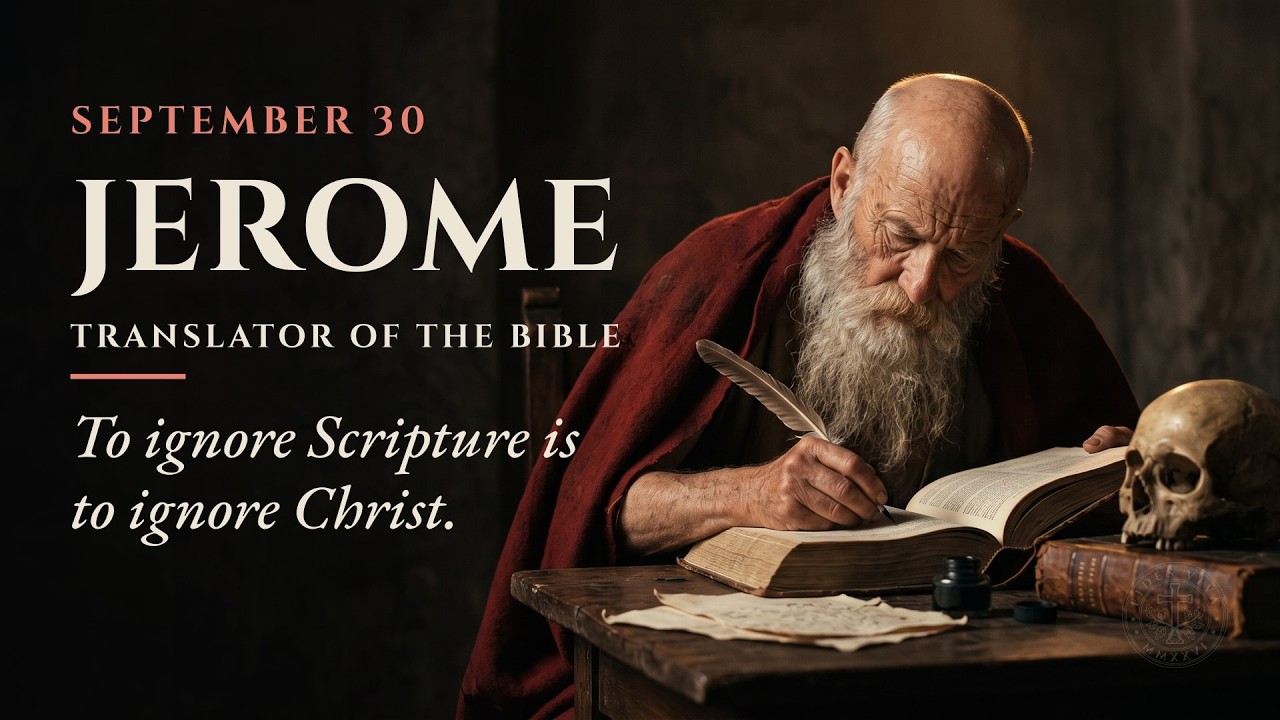
Today most people know him for other things. He is the saint who translated the Bible, the old man painters show with a lion at his feet. But in that fever, all he had was a verdict driven into his heart, and a whole lifetime ahead of him to answer it.
How did the man who preferred Cicero come to give the Church the Bible in her own language, beside the manger of Bethlehem? And where did that lion come from?
A Provincial Boy in Love with Cicero
Rome, in the middle of the fourth century. The capital of an empire that now calls itself Christian watches a boy from the provinces arrive. He comes from Stridon, on the border between Dalmatia and Pannonia, where he was born around the year three hundred and forty-five. His family is Christian and well-to-do, and they send him to Rome to study rhetoric, the art of speaking and writing well.
In the classrooms he discovers the Latin classics, and above all Cicero. The orator's scroll hardly ever leaves his hands. With great care and great effort, he slowly builds a library of his own.
He has the Bible within reach as well, but not the whole of it: Latin-speaking Christians read it in pieces, in partial translations made from the Greek. Next to Cicero, those pages sound rough to him, poor in style. And the great city offers him the life of the world too, with all its pleasures and its noise.
But on Sundays, Rome shows him something else. With other boys his age, he visits the tombs of the apostles and the martyrs and goes down into the catacombs: galleries dug underground, with the dead buried in the walls on either side. Down there, there is almost no light. And even in that darkness, as he would later remember, a line of Virgil, the poet of Rome, comes into his head: "Everywhere horror, and the very silence terrifies."
In that same Rome, already a young adult, he is baptized. Years later, writing to the pope, he would say that there he received "the garment of Christ." But his treasure is still on the shelves of his library. One day, a judge will throw that in his face.
His studies over, he travels north to Trier, an imperial city on the banks of the Moselle. There, for the first time, he meets something that has come from the East: men who leave everything to live alone in the desert, given over to prayer.
Back in Italy, in Aquileia, he joins a group of fervent Christians who share a common life. He would call them a "choir of the blessed," a company of happy men. Among them is Rufinus, the friend of his youth. They share the faith, and the desire to give themselves entirely to God.
When that choir breaks up, Jerome does what he had seen in Trier. For the sake of the Kingdom of heaven, as he himself would tell it, he leaves his home, his parents, his sister, his relatives and, hardest of all, the fine food he was used to.
There is only one thing he cannot bring himself to leave: the library he had gathered in Rome. He takes it with him on the road to the East. Around the year three hundred and seventy-four he passes through Antioch and keeps going, all the way to a desert in Syria.
The Desert of Chalcis: Tears at the Feet of Jesus
The desert is called Chalcis. It has deep valleys, rugged mountains and crags that the sun scorches from early morning. Jerome lives there as a hermit, a monk who lives alone, far from everything.
Years later he will tell a young woman in Rome about it, sparing himself nothing. Fasting has worn him down to the bone. The rough sackcloth he wears misshapes his limbs. His skin has turned dark from the sun and from neglect, and his face is pale and cold. And yet, in that scorched solitude, his imagination carries him back to the pleasures of Rome, among circles of dancing girls. His body is all but dead, but desire is still alive.
He weeps and groans every day. He throws himself at the feet of Jesus, washes them with his tears and dries them with his hair. He beats his breast for whole nights at a time, until, at the Lord's rebuke, calm returns.
He seeks out the deepest valleys and the harshest crags to pray. Those rocks are his oratory, his place of prayer. Sometimes, after many tears, he seems to find himself among the choirs of angels, and he sings for joy. He is not ashamed to confess his wretchedness.
Fasting is not enough to quiet his thoughts. So he looks for another remedy, and this too he will later tell in his own words: he asks a brother who had been a Jew before becoming a Christian to teach him Hebrew, the language in which most of the Old Testament was written.
The young man steeped in Cicero's eloquence goes back to learning his letters from the very beginning. He has to sound out harsh, guttural words. How often he despairs, how often he gives up and then, eager to learn, starts over. Much later he will thank God: from that seed sown in bitterness, he says, he now gathers sweet fruit.
But in those years in Syria, one thing has not changed: the books from Rome are still with him. He himself will confess what he used to do. He would fast so that he could read Cicero afterward. After nights of vigil and tears for his sins, he would pick up Plautus again, a writer of comedies. And when he opened the prophets of the Bible, their style struck him as crude and put him off.
"Because my blind eyes could not see the light," he will write, "I thought the fault lay not with my eyes, but with the sun."
Halfway through Lent, perhaps in the year three hundred and seventy-five, a fever falls on that weakened body and leaves him nothing but skin and bone. They give him up for dead. They are already preparing his funeral. His body is growing cold, and the warmth of life beats only in his chest.
Suddenly he feels himself caught up in the spirit and dragged before the Judge's tribunal: the tribunal from the beginning of this story. The light is so bright that he throws himself to the ground and dares not raise his eyes. They ask him who he is; he answers that he is a Christian, and hears that he is lying. But the Judge does not stop there. He adds a line from the Gospel: "Where your treasure is, there also will your heart be."
Then he orders him to be flogged. And worse than the blows is the burning of his conscience. He cries out: "Have mercy on me, Lord, have mercy on me." Those standing around the tribunal fall to their knees and beg the Judge to pardon his youth and give him time to repent.
Then Jerome swears an oath, calling on the name of God: "Lord, if I ever own secular books, or read them, I have denied you."
And he comes to. Those keeping watch over him see him open eyes so full of tears that even the doubters believe him. He insists it was no empty dream: his shoulders were black and blue, and he felt the blows long after he woke.
From then on, he writes, he read the books of God with greater passion than he had ever given to the books of men.
Rome Again: Pope Damasus's Commission
He leaves the desert with two things that have cost him dearly: an oath and a new language. In Antioch he is ordained a priest.
From the desert he had already written to Pope Damasus, the Bishop of Rome. With the Church in the East split into rival camps, he told him which side he stood on: "Whoever is joined to the Chair of Peter is mine." The Chair is the seat from which Peter and his successors guide the Church.
In the year three hundred and eighty-two, Jerome returns to Rome, and at last he stands before that pope, now an old man. Damasus takes him on as his secretary and adviser. And soon he entrusts him with something far greater than papal letters: a new Latin translation of the Bible. The very Bible that had sounded so crude to him as a student.
On the Aventine Hill, in the house of Marcella, a noble widow, a group of women from the great Roman families chooses him as their teacher of Scripture. Among them are Paula, also a widow, and her daughter Eustochium.
They are not content just to listen to him. They learn Greek and Hebrew. Paula and Eustochium come to read and sing the Psalms in the language in which they were written. The letters Jerome once spelled out in despair among the rocks of Syria now ring out, sung, in a house in Rome.
Eustochium decides to consecrate her virginity to God. And Jerome writes her a long letter about the life she has chosen. She is the young woman to whom he tells the story of the desert and the tribunal of the fever. In that same letter he teaches her how to pray: "If you pray, you are speaking with the Bridegroom; if you read, it is he who speaks to you." The Bridegroom is Christ.
While he teaches, he carries out the pope's commission. In the year three hundred and eighty-four he corrects the Latin text of the four Gospels and makes a first revision of the Psalter, the book of Psalms. The young man who found the Bible crude now spends his days weighing every one of its words. Here begins the work that, over the years, will become the Vulgate.
In the Aventine circle there is also Blaesilla, another of Paula's daughters. She has been widowed at twenty, and she decides to consecrate herself to God. A few months later, Jerome will have to write Paula a letter no one would ever want to write.
Slander in Rome and a Letter from the Ship
Blaesilla dies not long after consecrating herself to God. Jerome writes to Paula to console her, and he admits that he writes in tears: he calls himself Blaesilla's father in the spirit. But in the letter he also recalls what was heard at the funeral.
Paula had to be carried out of the procession in a faint. And murmurs were running through the crowd: fasting has killed the girl. Some went further: "How long before we drive these detestable monks out of Rome? Why don't we stone them, or throw them into the Tiber?"
That is why Jerome asks the mother for something harder than weeping together: to temper her grief. Grief without measure would give those people the opening they are looking for. And the man who guides these women in Scripture is the one everyone is watching.
While Damasus lives, the criticism has its limits. In December of the year three hundred and eighty-four, the old pope dies.
Then everything Jerome's pen had wounded comes into the open. For years he has criticized many people harshly, and now those words turn against him. Envy and misunderstanding do the rest. He himself would later say that everything about him was held against him: "One attacked the way I walked, or the way I laughed."
The gravest accusation targets his friendship with Paula. A man accuses him and then takes it back. But many who believed the man when he lied do not believe him when he recants. The life Jerome had in Rome becomes impossible, and he is pushed out.
August, three hundred and eighty-five. In the port of Ostia, at the mouth of the Tiber, a ship is about to sail. Jerome is already on board. He is writing in great haste to Asella, one of the women of the Aventine, who is staying behind in Rome.
He is overwhelmed with grief and tears. He reminds her that, before he met Paula, almost everyone in Rome thought him worthy to be a bishop. And he tells her that no other woman in the city had ever been able to tame him, only Paula, through her penance.
The man the city wanted as its bishop leaves it under accusation.
And yet the letter does not end in revenge. Jerome thanks God that he is counted worthy of the world's hatred. Then he asks Asella to pray for him, so that he may reach Jerusalem, the city where Christ died and rose again.
As the quay at Ostia falls away, so do the pope's secretary, the teacher of the Aventine and the bishop he might have been. What goes with him on that ship is gratitude.
That same year, at Portus, Rome's other harbor, Paula too boards a ship bound for the East.
Her children stay behind on the shore. Little Toxotius stretches out his hands to her from land. Rufina, her daughter, weeps. Paula lifts her eyes to heaven and overcomes a mother's love with her love for God.
Jerome is not on that shore. Years later he will describe the farewell gesture by gesture: the boy's hands, the daughter's tears, the mother's gaze lifted toward heaven.
In the East, their paths come together. And their pilgrimage leads them to a small town in Judea called Bethlehem.
Bethlehem: The Manger and a House for Pilgrims
In Bethlehem, Paula goes down into the grotto where Christ was born. Jerome is at her side.
The cave is small, made of rock. Paula looks at the manger and declares, in front of Jerome, that with the eyes of faith she can see the Child lying there. She sees the Magi. She sees the star. She sees the Virgin Mother and Joseph.
Then she bursts into tears. And through the tears, joy wells up in her. She too, she cries out, a sinner, has been found worthy to kiss the manger where the infant Lord wept, and to pray in this cave.
Paula kisses the manger.
Jerome had spent half his life among written words. In this cave, the Word of God became flesh and cried like a newborn.
He holds on to what he has heard. He will write it down much later, when Paula can no longer tell it herself.
From there they go on traveling through the Holy Land, as far as Egypt. But they come back to Bethlehem, and this time they come to stay. In the year three hundred and eighty-six, with Paula's wealth, they build a monastery for men, another for women, and a guesthouse for the pilgrims who come from everywhere to the places of Christ.
Jerome will explain why they wanted that house. They built it, he writes, "thinking that Mary and Joseph had found no place to stay."
The man who found no place left for him in Rome is now the one who opens the door.
Centuries later, painters will give him two things he never had. One is a cardinal's red mantle: with that scarlet they meant to say that he had served beside the pope, as a member of the clergy of Rome. But in his day that cardinal's scarlet did not yet exist.
The other is the lion. It came much later, with a legend from the Middle Ages: one day a lion with a wounded paw walks into the monastery at Bethlehem. Jerome has the wound treated, and the grateful animal stays on to live with the monks. The story had first been told of another monk, and over the centuries it passed to Jerome. Painters took it up gladly: a gentle beast beside the man of books.
What Postumianus, a traveler from Gaul who lived with him for a few months, saw in that house was no lion. He described it in a few lines: "He is wholly in reading, wholly in books; he rests neither by day nor by night; he is always reading or writing something."
The Bible from the Hebrew
This is the same man who, as a student, was captivated by a single sentence of Cicero. His passion for words is as strong as ever. What has changed is the book in front of him.
Around the year three hundred and ninety, he takes on the longest task of his life. The Old Testament that Latin-speaking Christians read had come from the Greek, from the ancient translation known as the Septuagint, the version of the Seventy. Jerome decides to go further back: to translate it straight from the Hebrew, that harsh language he had struggled so hard to learn in the desert.
It will take him about fifteen years, until four hundred and five.
He has at hand the great work of Origen, a Christian teacher from Alexandria, which set the Hebrew text in columns beside the Greek translations so they could be compared. Line by line, he looks from one column to another. He weighs every word. He goes back.
In those early years he takes a decisive step. He had once held the Greek translation to be inspired, and now he no longer does. For him, only the original is inspired.
His rules are simple and demanding. He respects even the order of the words, because in Scripture, he writes, that order "is a mystery." And when the Latin or Greek manuscripts disagree with one another, he goes back to the source: to the original Hebrew or Greek.
He does all of this in prayer. He asks God that his translation be made in the same spirit in which the books were written.
This is how, over the years, he answers the judge of that fever. The gift for the beautiful phrase that once drew him away from Scripture is now at its service. He no longer wants the text to sound like Cicero. He wants it to say what God meant to say.
At first, not everyone welcomed his translation. In Oea, a city on the African coast that is today Tripoli, a bishop has the Book of Jonah read in church in the new version. There is a passage everyone knows by heart: the plant God makes grow to give the prophet shade. They had always heard "gourd." Now they hear "ivy."
The uproar is so great that the bishop nearly loses his flock, and he has to correct the passage. Augustine, the great bishop of Hippo, tells Jerome about it in a letter. And Jerome answers him that the Hebrew does not say gourd: it names a shrub with large leaves that grows quickly and stands on its own.
In time, his version became the common heritage of the Church. It is the Vulgate, the Latin translation that came to be the text of the whole Church in the West. For centuries, in monasteries, cathedrals and parishes, Scripture was read in the words he had weighed in Rome and in Bethlehem.
More than a thousand years later, in the sixteenth century, the bishops gathered at the Council of Trent declared it "authentic": the Latin version the Church held to be reliable for public reading, preaching and teaching.
What drove those restless years before the columns of Hebrew and Greek, he himself put into words in his most often repeated saying:
"Ignorance of Scripture is ignorance of Christ."
But the same pen that served the Word also knew how to wound. Among those who ended up at odds with him was a friend from the days in Aquileia: Rufinus.
The Pen That Wounded, the Heart That Wept
Between the two old friends stood Origen, the man behind those columns of text. He had left behind immense works, and disputed ideas as well. Jerome had translated him and drawn on him in his own work. Rufinus, who admired Origen, asked Jerome to account for the way he had used him.
Jerome answered in haste, and with harsh words.
Writings went back and forth, and each reply set off the next. Around the year four hundred and one, the man of Bethlehem was still defending himself and attacking with his pen. Of that "choir of the blessed" in Aquileia, nothing was left between them but a bitter quarrel.
It was not the only wound his pen opened. In a book against another writer, he spoke of marriage in contemptuous terms, and even in his own day there were Christians who reproached him for it.
Pope Francis frankly acknowledged Jerome's excesses, a way of speaking that at times turned violent. And at the same time he recalled what this man was seeking deep down: the peace of Christ, with no enmity.
In January of the year four hundred and four, in the midst of those battles, Paula dies. The woman whose wealth had built the house for pilgrims is no longer in Bethlehem.
Jerome promises her daughter Eustochium a letter that will tell who her mother was. But when he takes up the pen, he cannot. His fingers stiffen, his hand drops, and his strength leaves him. He has to dictate it. It takes him two nights.
When he finishes, he himself warns that the style has come out rough, with no elegance or grace. That clumsiness, he says, bears witness to the grief of the one who writes. The young man who could not let go of Cicero no longer looks for the beautiful phrase: in those pages, grief is in command.
And that letter kept safe the little boy holding out his hands from the shore at Portus, and the tears of joy before the manger. What Paula said in the grotto has come down to us because the man at her side dictated it for her daughter.
It is the same hand that had wounded a friend. For Paula, that hand cannot even hold the pen.
On his table, the prophets are still waiting. The very ones that, beside Cicero, had seemed so crude to him when he was young.
Bethlehem in the Heart
He is at work on them when terrible news arrives from the West: Rome has been besieged and taken. It was the city of his youth and of his library, the city that had entrusted him with the Latin Bible and had watched him leave amid slander.
He writes it himself: "My voice sticks in my throat, and sobs break off my words as I dictate. The city that conquered the whole world has been conquered."
In that same letter he tells what happened to Marcella, the widow of the Aventine in whose house he had taught the Scriptures. He had been told that soldiers broke into her house and demanded gold. She is old by now, and she points to her poor dress: she has nothing hidden. They do not believe her, and they beat her. And she, at their feet, begs only for the young woman who lives with her. She dies a few days later, in that young woman's arms.
The work went on. He finished his commentary on Isaiah and then gave himself to Ezekiel. His last years belonged to Jeremiah.
But his pen still had one last battle in store. In his old age he had written against the followers of Pelagius, a monk who trusted so much in human strength that he left little room for the grace of God. In the year four hundred and sixteen, according to reports that reached Augustine, some of Pelagius's supporters attack the monasteries of Bethlehem. They beat monks and nuns, kill a deacon and set fire to the buildings. Jerome barely escapes, taking refuge in a well-defended tower.
Three years later Eustochium, Paula's daughter, dies. With her goes the last of the two women who had followed him from Rome to Bethlehem. He writes to Augustine himself that her illness and her death have caused him great suffering.
In that land he left behind a line that is almost a portrait of him: "Blessed is he who has Bethlehem in his heart, and in whose heart Christ is born every day."
The same pope who acknowledged his excesses used to tell a story about him, with the warning that it was apocryphal. In it, Jerome asks the Lord what he wants from him.
"You have not yet given me everything," he hears.
He lists all he has already given: this, and this, and this. And the Lord answers him: "One thing is missing: give me your sins, so that I may have the joy of forgiving them again."
On a thirtieth of September, around the year four hundred and twenty, Jerome dies in his cell, beside the Grotto of the Nativity. He dies a very old man, in the community he had founded. They bury him in a cave next to the grotto, near Paula and Eustochium.
The man who found no place in Rome takes leave of the world a few steps from where Mary and Joseph found no place either. It was there, where there was no room for them, that Christ had been born.
The city that watched him leave keeps what remains of him today. His relics are kept in Rome, in the Basilica of Saint Mary Major, one of the great churches dedicated to the Virgin.
At the end of the thirteenth century, Pope Boniface VIII ordered the whole Church to celebrate with special solemnity the feast of the four great teachers of the West: Ambrose, Augustine, Gregory and Jerome. He is a Doctor of the Church, a teacher of the faith whose teaching the Church recognizes as sure for everyone.
Every thirtieth of September, the whole Church keeps his memorial and remembers his living and tender love for Sacred Scripture.
That memorial is not kept only among books. In some places it has streets, music and people on their knees.
The faithful of Masaya, in Nicaragua, call him San Jerónimo Doctor, Saint Jerome the Doctor. Every year, from the twentieth of September to the seventh of October, the whole city celebrates him.
The promesantes, those who come to keep a promise to him, dance to the sound of the marimbas. They bring him ex-votos, offerings of thanks for a favor received, and they dress his image. Some enter the church on their knees and pray the rosary before the images. On the thirtieth, a torovenado comes out into the street, a folk dance that appears only on that day.
The hermit who bathed the feet of Jesus with his tears among the crags of Syria is welcomed today by a people on their knees.
In a dream, a judge refused to believe him when he said "Christian." He went on to live out that word with his whole life, page after page, until he died beside the manger of Bethlehem.
Lord Jesus Christ, who chose to be born in Bethlehem and to speak to us in your Word: you received the tears of Saint Jerome at your feet and turned his love of words into the service of your Scripture. Through his intercession, give us a heart that never tires of listening to you in the holy Book, that knows how to give you its sins as well, and that makes room for those who have no place of their own, so that you may be born in us every day. Saint Jerome, pray for us. Amen.