A child of three sits still in the middle of a house. Voices move around her—her brothers. The fire crackles. Someone tears bread. She does not move. Her eyes are fixed on a point in the wall where there is nothing.
And yet, there is a light there.
A light so vast that—she would write it herself, many years later—it made her soul tremble. No one else sees it. She understands that before anyone else does: what is shown to her is not shown to others, and she learns what children learn when they do not want to be different: to be quiet.
It is the Rhine in the twelfth century, a world of monasteries in red stone and men who speak in God's name. The youngest daughter of a small noble family is called Hildegard, and she will keep that secret for forty years.
Forty years. Until a woman of forty-two, bent at the back, with a wax tablet on her lap, hears an order she cannot go on refusing.
What comes from that tablet will not fit into one life. Three books of visions. Seventy-seven chants with music of her own. Books about herbs, stones, and remedies. Letters to popes and an emperor. And an old woman in black speaking in the cathedrals of the Rhine, at a time when almost no woman spoke.
All of it was already in the eyes of the child who watches the wall.
What happens to a gift when it stays hidden by fear for decades? And what does it take for silence, one day, to become a voice?
The Light No One Sees
Smoke rises straight from the kitchens over the vineyards of Bermersheim, and from hill to hill the monastery bells answer each other. The last years of the eleventh century run their course in the heart of the Holy Roman Empire. Abbots are lords of lands, and bishops are princes. Monks sing the hours before dawn. Barges move up and down the Rhine carrying pilgrims and merchants in flat-bottomed boats. The Church is coming out of a long reform, and across the region new cloisters of red sandstone are rising. In that world, public speech belongs to men. A woman prays, spins thread, obeys, and keeps silent.
Into that world, around the year 1098—the most likely date—a child is born in a house of stone and wood near Alzey. She is the tenth daughter of Hildebert and Mechthild, owners of some vineyards and grain fields, nothing more. They carry her to the baptismal font of the village church, as they do with all the children of the valley: three times into cold water, oil on the forehead, a white cloth at the end. From that morning she belongs to Christ.
She grows up frail: small, pale, with a body that always seems on the edge of failing. But what sets her apart from her brothers is not the body. It is in the eyes.
She is three years old when it happens for the first time. she herself would write it down, already an old woman, with a sobriety that admits no ornament: something left her shaking deep inside, though she did not know how to name it. It was not a dream. It was not a game. It was a clarity that came all at once, without anyone calling her, in the middle of an ordinary day.
And the light came back. It came other times, while the rest kept on with their work and no one lifted their head.
A child of three has no words for that. She does not even know what it is. She only knows that the others do not see it, and that what the others do not see brings fear or laughter. So she learns something that no one teaches her on purpose: to look inward and say nothing. To sit still when the light comes, and to lower her eyes when it goes.
Anyone who kept quiet as a child about something real that happened to them—out of fear it would be taken for a lie or for sickness—knows what that silence weighs. It weighs more the longer she carries it. And she carried it.
Here is the wound of her whole life, opened before she learned to read: a gift received without asking, and the fear of speaking it aloud. Something so large, and a mouth so small to hold it. Why would a child carry such a secret alone for so long?
Her parents, meanwhile, are thinking about the future of the tenth daughter. And that future has the shape of a door that closes.
The Recluse and the Stone Wall
The road climbs between beeches and oaks, along a narrow river called the Nahe. At the top, where the Nahe meets the Glan, there are walls of red sandstone and a church with a short tower: the monastery of Disibodenberg. They bring the child there, about eight years old, and not for a visit.
Her parents have offered her to God. It was the custom then to give a child to the cloister as one gives a tithe, and a sickly tenth daughter had no better dowry. At the monastery she is received not by a monk, but by a woman. Her name is Jutta of Sponheim, noble like the child, and she has chosen an uncommon way of life: that of a recluse. A recluse shuts herself in a cell attached to the wall of a church for life, with a single window open toward the altar, and from there she prays, fasts, and does not leave again.
What happened exactly that day, no one wrote down at the time. The memory of the place holds the date of November first, 1112, the feast of All Saints. That day brought a rite that chilled the blood: the monks sang the office for the dead over Jutta and the child. Holy water, candles, the smoke of incense. After that, the cell door was sealed. Whoever entered there died to the world to live beside Christ, one wall away from the altar where each morning the Eucharist was celebrated.
Inside, the cell was small, cold, dark. One window toward the church, a small opening outward to receive food. And two women: one who had chosen this, and another for whom it had been chosen.
Jutta taught her what she had: the entire Psalter, sung in Latin until it stayed in memory like the taste of bread. She taught her to rise at night for vigils, to pray the hours by the sound of the bell, to sew, to be silent. The monks' chant came through the wall, hour after hour, and the girl learned it without seeing them, the way you learn a river's sound by living at its edge.
Jutta was hard on herself: long fasts, a hair shirt under the wool, nights without sleep. The girl never imitated her in that; her own body already punished her enough. But in the dimness of that cell something happened that no one else had managed until then: the young woman confided her secret to Jutta. So they remembered it afterward in the monastery: she spoke of the light, and Jutta listened and kept it, the way you keep something fragile.
With time, when she came of age, the young woman cut her hair, received the black veil, and pronounced the vows of the Rule of Saint Benedict. Other girls from noble families came, drawn by the fame of the recluse. The cell ceased to be a cell: it became a small monastery of women, leaning against the side of the monks' monastery. So the years passed, two long decades, within the same wall. Outside, the red stone of Disibodenberg kept growing; inside, Hildegard kept seeing what no one else saw, and kept telling it to no one but her.
On December 22, 1136, three days before Christmas, Jutta of Sponheim died. She was not old; the austerity of years had worn her down before her time. The woman who had received her as a child, the only one she had told the truth to, was gone.
The women had to choose a new teacher—a magistra, the one who guides and governs the rest. They chose Hildegard. She was thirty-eight years old, her health broken, and accustomed to thinking of herself as the smallest among all.
The recluse who had learned to hide now had to stand at the front. And she did, with the same sobriety she brought to everything: she sang the hours, she governed the house, she kept her light.
For five more years she kept it. Until the light stopped waiting.
The Command to Write
It happened in 1141. She was forty-two years old, governed a small house of women, and was, as always, attentive to something no one else could see. But that time the light did not stay still.
She wrote it herself, years later, at the beginning of her first book: "A fiery light, of greatest brightness, coming from the open heaven, flooded my whole brain and burned my heart and my breast like a flame that does not burn, but warms." And within that flame, a voice. A command of seven words in Latin.
"Say and write what you see and hear."
She did not.
Someone who has kept silent for forty years does not learn to speak in an afternoon. She knew herself to be a woman, untaught, with no more Latin than what the psalms had given her. She called herself, in writing, a poor little female form. Who would believe a recluse of the Nahe if she said the sky was dictating to her? And what would happen to her if they did?
So she kept that too. And the body, which had punished her since childhood, turned on her with new violence. She fell ill, bedridden, without strength to rise from her mat, her eyes aching and her head on fire. She herself joined the two things together: the refusal and the sickness. Her body, for the rest of her life, would be a compass: it failed when she resisted and rose when she obeyed.
There was a monk at Disibodenberg named Volmar. He had taught her to read better, to write, to set in order a Latin learned by ear. He was her confessor. To him, at last, she told what she saw and what the voice asked of her. After Jutta, he was the second person in forty years.
Volmar believed her.
He did not tell her to be silent, or treat her as proud. He went to speak with Abbot Kuno, who governed the monastery, and the abbot gave permission for the magistra to write. That permission from an abbot in a provincial house opened, as we see it now, the door to all her written work.
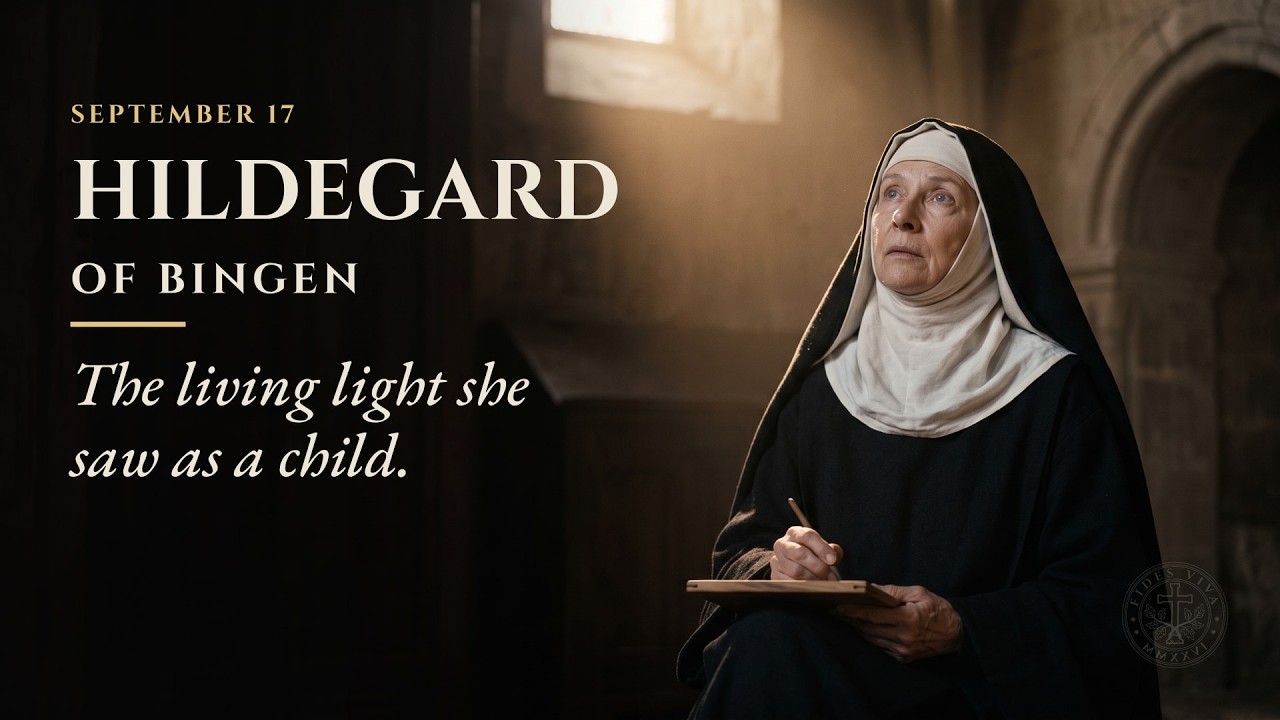
Then she took the wax tablet. A rectangle of wood with a coating of dark wax, a stylus of bone to scratch it: the notebook of that time. Her hand shook. She traced the first words, and strength came back.
To begin so late at something carried inside for years brings that same mixture: the fear still whole, and underneath the fear, an almost physical relief.
So the work of ten years took shape: she watched, awake, and scratched into the wax what the light showed her. Volmar, behind the partition, transferred it to parchment without touching the meaning, with Richardis of Stade helping with the tablets. From that came an enormous book—twenty-six visions: the mountain of God, the building of salvation, the Church of Jesus Christ as an immense woman, the end of times.
She titled it Scivias, which shortens an entire phrase: know the ways of the Lord.
But an abbot's permission was not quite enough. Around 1146 she wrote to the most listened-to voice in Christian Europe: Bernard, abbot of Clairvaux, the monk in white who in those same months was preaching the Second Crusade through France and the Empire. She set before him what she saw and asked him the only question that mattered: whether she should speak or be silent.
Bernard wrote back, and he gave her barely a few lines. His answer was brief, and it was encouragement. Nothing more, and nothing less. For a recluse who had spent a lifetime fearing ridicule, those lines from the most listened-to abbot of Christendom weighed like a stone wall.
What came after was bigger than she was.
Between November 1147 and February 1148, Pope Eugene III gathered a synod in Trier, the old Roman city on the Moselle. Eugene was also a Cistercian monk, a student of Bernard, and word reached him of what was being written in a cell on the Nahe. He asked to see the pages. And he ordered them read aloud.
In a nave filled with bishops and abbots, the visions of the poor little female form sounded before the successor of Peter. She was not there; she remained at Disibodenberg, with the tablet and the lamp. What was there was her word, alone.
The pope wrote to her afterward. She could go on writing what she received.
With that letter the scale of her life changed. The inner command had now an outer seal; the secret of the girl was a book a pope had heard. No one yet knew what a woman of fifty, with her health broken, would do when the Church told her to speak.
She found out soon. Because the light, as soon as it had permission to become word, began to ask for something harder to write: stone, water, walls, a place of her own to live.
The Founder and the Risk of Rupertsberg
The place had a name. Downriver, where the Nahe emptied into the Rhine across from the town of Bingen, a rocky hill rose that they called Rupertsberg. There, she said before the abbot and the monks, God wanted her women to be.
Kuno listened to the end. Then he said no.
He was not a bad man. He was defending his house. The women who had come to Disibodenberg brought dowries, lands, gifts from noble families. And since a pope had ordered her pages read aloud, the monastery on the Nahe had become a name people spoke. If she left, the money and the prestige would go with her.
She pressed. He refused again. And then the body spoke for her.
She fell ill a second time. But this time it was not fever or burning eyes. She went rigid. She could not rise from her mat, could not turn her head, could not lift a hand. Days. Weeks. The women kept vigil; the monks came to see her and left in silence. Kuno read that sickness as a warning against her: God was punishing her for wanting to leave. She read it the other way: God was holding her still because they would not let her obey.
Two readings of the same body laid out. And only one of them proved true.
Because when the abbot finally gave his consent to the move, the rigid woman rose. Strength came back, as it had come nine years before when she first scratched the wax. In the Nahe valley, no one debated the matter anymore.
Around 1150 they climbed the hill. There were about twenty women, with the magistra at their head, and what they found at the top was not a monastery. It was a slope of stone and scrub beaten by the wind off the river, with no walls raised, no cloister, no cells. And no water. On a hill between two rivers, the water lay below, not above; to drink and wash and cook, they had to descend the slope each day with pitchers.
She would not accept living that way. She had water channels built that would bring it up to the house: conduits of wood and stone, with the slope calculated right. It was a work of engineering on a site where others would have dug a well and called it done. The woman who saw the sky open knew also where a channel had to run.
And over the years the hill filled with pale stone. A church with two towers, a new cloister, dormitory, infirmary, a writing room with lecterns. Below, barges passed laden with wine and salt, and above, when the work fell silent, you heard singing.
They sang in a way that set people talking. A superior at Andernach, Tenxwind, had written to her already in those early years a courteous and pointed letter. She reproached her for admitting only noblewomen to Rupertsberg, and for having her women go to choir on the great feasts with their hair loose under silk veils, wearing crowns and rings, like brides. Hildegard answered without backing down. Her women were brides of Christ; and a bride, on her wedding day, adorns herself. The answer was copied and read far, and it is still read.
In 1151 she put the last word to the Scivias. Ten years between the first tablet and the last sheet of parchment. That same year she composed something uncommon for her time: an entire drama, sung through, the Ordo Virtutum, the Order of the Virtues. A soul goes out into the world, tires on the road, falls; the Devil claims her, and the Virtues—humility, chastity, obedience, mercy—seek her, lift her, send her back to the path. All of them sing, except the Devil: he shouts, argues, does not sing. For her, evil was exactly that: a voice without harmony.
It is very likely that drama sounded for the first time at the dedication of the new church, with the women in white singing the Virtues on a hill that three years before had been scrub. Faith there had become stone, water, and voice.
And then the voice she loved most went away.
Richardis of Stade had been at her side for ten years. She had held the tablets for the Scivias, been her eyes on days of sickness, the magistra's favored student. She was also noble, daughter of a Saxon marquess, sister to the archbishop of Bremen. And in 1151 her family secured her election as abbess of Bassum, a monastery far away, in northern Saxony.
Hildegard fought to keep her with an insistence unusual in her. She wrote to Archbishop Hartwig, the brother; she wrote to Rome. Hard letters, wounded letters, with a frankness that strikes us now in a woman who called herself a poor little female form. It did no good. Richardis left.
She died on October 29, 1152, in Bassum, a year after she went. It was said afterward, in the hill, that she had asked to return to Rupertsberg. Hildegard wrote to the archbishop again, this time asking for nothing: she had loved that soul, she said, and God had wanted her for himself. The founder who had bent an abbot and raised a monastery could not bend this, and she accepted it.
One last matter remained pending with Disibodenberg. The hill was hers, but not entirely: the dowries, the lands, and the legal dependence of the house still lay in the hands of the monks on the Nahe. In 1158, after years of negotiation, she obtained from them the deed that recognized Rupertsberg's freedom and returned its goods to it. The house of women ceased to be an annex. She was sixty.
That same year she began a new book, the Book of the Rewards of Life, where virtues and vices face each other, as in the drama, but in prose. The work accumulated: the Scivias, the songs, the drama, the letters, and now this.
A community that had climbed a slope without water, that had buried her most beloved daughter and had to fight for its own freedom, flourished. It sang. It wrote. And the woman who governed it, her health swinging between weeks of fire and weeks of bed, began to look beyond the river.
Because the permission a pope had given her did not say only to write. And at sixty, when other lives draw in, hers took to the road.
The Voice That Crossed the Rhine
The barge touches the bank and two women help her down. It takes effort. She leans on them and on her wooden staff across the pebbles, and when she is finally on her feet, the river wind tears a silvery-white strand loose from her head covering. Sixty years old. The pouch at her belt holds rolled parchments. She has come to preach.
In the twelfth century, a woman did not speak in a church. She did not teach the clergy. She did not stand in the sanctuary of a cathedral to tell canons what God thought of them. And yet that is what Hildegard did for thirteen years, between 1158 and 1171, in four journeys that took her along the Main, through Lorraine, down the lower Rhine, and into Swabia.
She did not invite herself. They called her. Bishops, abbots, chapters of canons asked her to come, and she came, by river boat where there was water and by mule where there was not. She preached in Mainz, the see that had jurisdiction over her. She followed the Main to Würzburg, to Bamberg, to the monastery of Ebrach. At Pentecost in 1160 she spoke in Trier, the city where a pope had ordered her pages read aloud twelve years before; now she was the one reading. From there she passed on to Metz.
Around 1163 she was in Cologne. The great city on the Rhine, with its port and its merchants, had a problem that troubled its clergy: the Cathars. They were preachers who taught that the material world was the work of evil, that the body was a prison and the Church a fraud. And they won over ordinary people with an austerity the priests themselves could not always show. She spoke against them: against their contempt for the body and for creation, which Christ had taken on when he became flesh. But she also spoke against the clergy whose lukewarm faith had let that weed grow. The canons of Cologne asked her afterward for a written copy of the sermon. She sent it to them.
The last journey took her to Swabia, far from her rivers: Zwiefalten, Maulbronn, Hirsau, Kirchheim. In Kirchheim she put the sermon in the mouth of the Church itself, as a wounded woman who grieves over her own children. She was seventy-three when she returned to Rupertsberg for the last time from a long road.
By what right did she speak? She herself explained it in her letters with an image that was not pride, but its opposite: "I am like a feather that has no weight at all and that the wind of God sustains and carries." Over time, her name became joined to a title that still follows her: the Sibyl of the Rhine, the one who sees what others do not.
The feather also reached the emperor. Frederick Barbarossa received her at his palace in Ingelheim, a few miles upriver, and they spoke. He was the most powerful man in Europe: forty years old, red beard, an empire that stretched from Burgundy to the cities of Italy. She was an old nun in black, without a jewel on her.
They wrote to each other afterward. And her letters were not courteous. From 1159 the Church had been split in two: Pope Alexander III, recognized as legitimate, and against him antipopes whom the emperor supported to bend him. Hildegard reproached him in writing, with a sharpness that would have cost a bishop his office. She warned him bluntly that his policy against the legitimate pope offended God, and that God saw him. And the emperor, instead of punishing her, signed in 1163 a document of imperial protection for Rupertsberg. The hill above the Rhine fell under the protection of the man its abbess had just scolded.
Between journeys, in the hill, she kept filling tablets. In 1163 she began the third and last of her great books of vision, the Book of Divine Works, and it took ten years to finish. It is the broadest of all. In its first vision appears an immense wheel, the entire universe as a circle of fire, water, air, and light, and in the exact center a human figure with arms open wide. Not an angel. A man. The creature at the heart of God's work.
And a voice speaking from that wheel says who it is: "I am the supreme and fiery force that kindles every living spark."
Everything she had loved since childhood was there together: the herbs and stones of her books of remedies, the humors of the body, the song, the light. A single force running through it all. She called it viriditas—the greenness, the sap of God in things. The body was not a prison, as the Cathars of Cologne said. It was the center of the design.
Rupertsberg had grown too small. More women were arriving than the hill could hold, and in 1165, at sixty-seven, she bought on the other bank of the river, in Eibingen, near Rüdesheim, a convent of Augustinian canons that had stood abandoned for some time. She repaired it. She filled it with women. And she remained abbess of both houses.
That meant crossing the Rhine. Twice a week, for years, the old woman descended the hill, boarded a barge, and crossed the wide cold river to the far bank to govern Eibingen, and returned. The water that had been scarce on the Rupertsberg slope was now the path between her two houses. Eight centuries later, her bones rest on that shore.
Everything came to the hill. Letters, the sick, mothers with children, nobles with guilt. And in 1169 came a woman from the region of Cologne called Sigewize, whom everyone held to be possessed. Her family had tried exorcisms, journeys, prayers. Nothing worked.
This is how the women of Rupertsberg remembered it afterward: the abbess did not touch her, did not shout, did not improvise. She prescribed a rite. Seven priests, standing for seven just men of Scripture—Abel, Noah, Abraham, Melchizedek, Jacob, Aaron—and the seventh for Christ himself. Prayer, fasting, holy water, in a precise order, like a recipe from her book of remedies applied to the soul. And at Holy Week that year Sigewize was free. Afterward she would not leave. She took the habit and stayed on the hill, among the women who had seen her arrive.
Whatever held her fast, the fame of Hildegard had moved from letters to the body of a woman healed.
In 1173 Volmar died.
Thirty-two years behind the partition. The monk who had taught her letters when she was a child locked away, the first to believe her, who had taught her Latin and transcribed, vision after vision, what she dictated to him, who had climbed the Rupertsberg slope with her and grown old at her side. She said it with a butcher's word, not a theologian's: she felt it as an amputation. They had cut away a part of the body with which she wrote.
Behind the partition lay an empty lectern. She was seventy-five, a book half finished, and hundreds of letters to answer.
It was then that a Flemish monk, Guibert of Gembloux, wrote to her from far away with a question no one had asked her so directly. He wanted to know how she saw. If in dreams. If in ecstasy, outside herself. If she lost consciousness. And in 1175, at seventy-seven, she answered him with the most precise description that exists of what had happened to her since she was three.
She saw awake. With eyes open. Without losing awareness, without falling, while she spoke or ate or walked. "The light I see is not spatial... and the one I see within that light I call the shadow of the living light." In that light, she said, she learned what she later wrote; and when the light withdrew, she returned to being an ignorant woman, like a child. Seventy-four years after the first time, the old woman had finally put a name to the secret of the house in Bermersheim.
Two years later, in 1177, Guibert left Flanders and settled at Rupertsberg. He took the empty lectern. She was seventy-nine, and her voice was still firm.
A whole life made of tablets, songs, walls, water channels, sermons, and letters to emperors. Everything she had hidden for forty years she had spoken in the next forty, and the whole Church had heard it. One test remained that had not yet come. A pope had listened to her, an emperor had listened, a cathedral full of people had listened. What would that voice do the day someone from outside ordered it to be silent?
The Silence and the Last Light
The answer came in 1178, and it came by way of a grave.
A nobleman from the region had died and been buried in the cemetery at Rupertsberg, in consecrated ground, with the community's prayers. His name has not survived. What is known is that years before he had been excommunicated, and someone in Mainz remembered. The canons of the chapter wrote to the abbess: that man could not lie among Christians. He had to be dug up.
She said no.
Not from whim or defiance. She held, and she held it in writing, that the man had died reconciled with Christ and with the Church; that he had confessed, that he had received the sacraments before he died. To dig him up would be to treat as an enemy someone whom God had already forgiven. And so that no one would come and do it behind her back, she went to the cemetery herself and erased every trace of the grave, until no one could say where the body lay.
Mainz answered with the harshest penalty that could fall on a monastery without closing it. The interdict. The word sounds ancient, but what it meant was very concrete: at Rupertsberg the Eucharist would not be celebrated. The women would not receive communion. And they would not sing. The hours of the office, which since Hildegard's childhood had marked every day of her life, were to be recited now without music. Spoken only, in a church where no singing voice came down anymore.
And so the months passed.
She had composed seventy-seven songs for that choir, and an entire drama for her women to sing. Now the church on the hill woke in silence, the antiphonaries closed on their lecterns. The women entered, sat, moved their lips. The psalter she had learned as a child, letter by letter, beside Jutta, was recited like someone reading a list.
The silence, once again, was not absence: it weighed in every corner of the house.
She did not resign herself. At eighty, very bent, she dictated a letter to the prelates of Mainz. It is one of the most beautiful pages that came from that hill, and it barely speaks of the dead nobleman. It speaks of song. She reminds them that the prophets composed psalms and accompanied them with instruments so that the creature, wounded by sin, might recover something of the harmony lost in Eden. Music, she says, is a remnant of paradise held in the human throat. And she warns them, with her usual frankness, that those who impose silence on the praise of God on earth run the risk of not hearing the praise of the angels in heaven. An old woman under punishment reminding her judges whom they were silencing.
In March of 1179 the interdict was lifted. The choir sang again.
She had six months left.
She faded slowly. The breathing grew short, the hands no longer held the stylus, and the women took turns at her bedside. On the morning of September 17, 1179, on the hill she had raised stone by stone, Hildegard died. She was eighty-one. She had lived forty years in silence and forty speaking, and the last months singing again.
They shrouded her in her black habit, the veil in place, the white hair short and hidden as she had worn it all her life. They buried her in the church at Rupertsberg, with the office for the dead sung: the same office with which, the house remembered, one bid farewell to the world upon entering a recluse's cell.
There is something more that Rupertsberg told, generation after generation. That same dawn, while the body lay inside, the sky above the monastery caught fire. Two enormous arcs of light crossed over the plateau, and at the point where they crossed, a reddish cross blazed.
The women came out to the courtyard. People from the valley lifted their eyes from the banks.
From three years old she had seen a light that no one else saw, and she had to explain it in letters, defend it before a pope, describe it to a curious monk so they would believe her. The morning she died, the hill says, the light was over her house, and that time it was not only she who saw it.
The song had come back to the choir. The woman who had composed it was no longer there to hear it. What remains of a life like that, when the song returns and the light goes dark? Her books remained, her melodies, two monasteries full of women, hundreds of letters kept in coffers. And there remained a question that the hill could not answer yet: what would the Church do with the voice of a nun who had called herself the poor little female form.
Eight Centuries of Memory
Half a century after her death, in 1233, some commissioners sat down in Mainz to listen to witnesses. Pope Gregory IX had sent them. Six years earlier he had opened a process to declare her a saint. Before the table came people from the valley, nuns, clergy, peasants who had climbed to the hill with a sick person and come down with them healed. They counted thirty and more cures at her tomb.
It was not enough. The commissioners found the accounts badly dated, the witnesses imprecise, the names incomplete. The file traveled to Rome with gaps, and the process faded without a sentence. The woman who had written to popes and emperors was left without the paper that would declare her holy.
The people of the Rhine did not wait. They kept calling her a saint, praying to her, climbing to her grave on the hill. The calendars of the region inscribed her name on September 17 as if Rome had spoken. A century later, in 1326, Pope John XXII would have confirmed that devotion. So it has been repeated through the generations, though the document has never surfaced and historians still argue about it.
Then came the fire. In 1632, in the thick of the Thirty Years' War, the memory of the place recalls that Swedish troops razed Rupertsberg. The church with two towers, the cloister, the water channels she had ordered built: all of it lay in ruins above the meeting of the Nahe and the Rhine. The women fled with what they could save, and what they saved were her bones. In 1641 they carried them across the river to Eibingen, to the second house she had founded, the one she visited twice a week by boat. They rest there still.
The name stayed in the holy cards, in the prayers of families in the Rheingau, in a village feast. Until in 1857 the people of Eibingen carried her out in procession for the first time through their streets. In memory of that first procession they raised a limestone sculpture in the south corner of the church. They have repeated it every September 17 since then.
And the twentieth century, so harsh with so many things, was strangely generous with her. In 1905 a new Abbey of Saint Hildegard rose above the vineyards, heir to Rupertsberg and Eibingen, and Benedictine nuns in black habit came to live in it again. In 1929 her bones received a new reliquary: gilded copper on a heart of oak, in the shape of a small building. At the top, spheres recall the lights seen in the sky the morning she died. A fire later damaged the pilgrimage church, which rose again with new stained glass; the reliquary returned to the sanctuary.
Between 1927 and 1933 the nuns of Eibingen did something more patient still. They copied by hand, miniature by miniature, the manuscript of the Scivias that had been painted in Rupertsberg in the abbess's own time. The woman with the tablet, the tongues of fire, Volmar behind the partition: all of it reproduced in brush, with gold and blue. In 1945, in the bombing of Dresden, the original manuscript disappeared. It has never been seen again. The oldest image of Hildegard writing survives today only in the copy those nuns painted in silence, not knowing what they were saving.
Rome was still missing. And Rome came, eight centuries late, in a single year. On May 10, 2012, Benedict XVI extended her cult to the whole Church by what is called equivalent canonization: to recognize as a saint, without opening a new process, someone the Christian people have venerated without interruption for centuries. It was the most exact way to say that the people of the Rhine had been right from the start. On October 7 of that same year, in Saint Peter's, he proclaimed her Doctor of the Universal Church. It is the title reserved for saints whose teaching the whole Church recognizes as a sure guide for faith. The apostolic letter spoke of her holiness of life and the originality of her teaching. She became the fourth woman in twenty centuries to hold that title. The child who had kept silent for fear of not being believed was now, with the seal of Peter, a teacher of the faith.
Today, every September 17, her reliquary walks the streets of Eibingen among the vineyards, with pilgrims come from every corner of the world. Some fifty Benedictine nuns sing in the abbey the antiphons she composed for their choir.
Caritas abundat in omnia: Charity abounds in all things. Her melodies are recorded and played in concert halls where no one prays. Her descriptions of plants and stones are read in universities; scholars study the language she invented.
Why does that voice keep sounding, eight centuries later, in the singing and prayer of the Church? Perhaps because she never spoke on her own initiative. She spoke because the light she called living—the light of Christ—commanded it, and she kept silent forty years before she dared. And the question a three-year-old girl could not answer in a house of stone stays open still: what do we do with a light we have been given.
Echoes of a Small Voice
A tablet of wax on the knees. A bone stylus stopped halfway through a line. Through the small window the morning light comes in and settles on the wax, still, like one who waits. For forty years that tablet lay empty, and the light kept coming through every day.
What happens when someone hides what they have been given, out of fear and the feeling of being too small? A woman, sick from resisting, answered it one day, taking the stylus and tracing the first word. From that one mark came three books of visions, some seventy-seven songs, a monastery built on a hill without water. And sermons in cathedrals where almost no woman spoke a word. She believed that light came from Christ, and obedience was how she said it. The silence of a child became the voice of a teacher.
We keep things hidden too. A word we know is true and do not speak in the Monday meeting. Something good we think too small to bother anyone with. How long do we hold it?
She held it for forty years. And after that, she never fell silent again.
In Eibingen, among the vineyards, a gilded copper reliquary rests in the sanctuary, shaped like a small house. Inside lie the bones of the girl who sat still watching a light. Outside, the nuns of the abbey keep singing the hours, and on her feast they sing the melodies she composed so their choir would not forget paradise. The poor little female form, as she called herself, left her voice in the hands of others, and that voice has not stopped sounding.
Saint Hildegard of Bingen, Doctor of the Universal Church, mother of singers and guide of the seekers of light, pray for us.