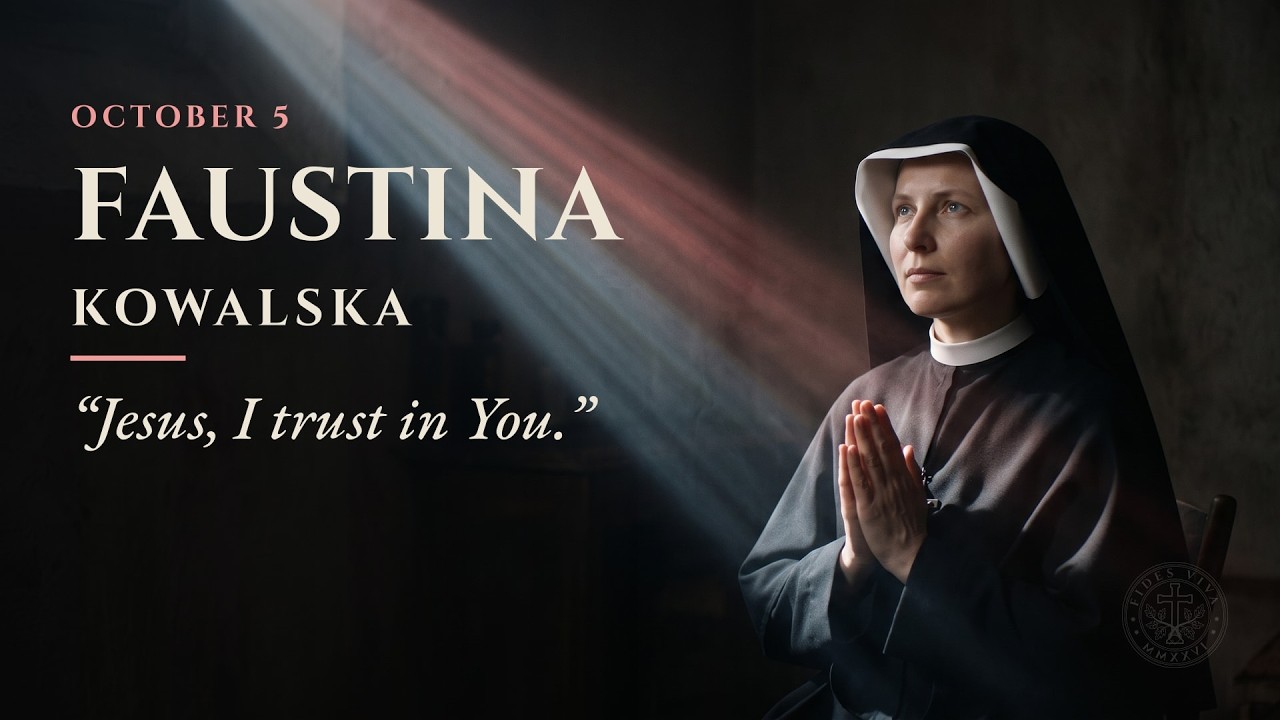
As night falls on a winter Sunday, in a convent cell in Płock, in Poland, a young nun who sells bread in a shop sees Jesus dressed in white. Two rays stream from His chest, one red and one pale. He asks her for an image, signed with a few short words.
That nun's name was Helena Kowalska. In the convent she was Sister Faustina. She didn't know how to paint. She'd had barely three years of school, and one of the sisters who trained her had judged her "not at all promising."
Today that image hangs in homes and parishes across half the world. Many pray the Chaplet that Jesus taught her, and the whole Church celebrates Divine Mercy Sunday, the feast she asked for. But first there was a priest who didn't believe her and had her mental health examined. There were notebooks she burned with her own hands. And there was a day when Rome forbade spreading that devotion in the form she had left it. That Divine Mercy Sunday would come, but she would not live to see it.
The words were these: Jesus, I trust in You.
Who was this young woman whom almost no one believed, and how did those few words reach the lips of millions?
The Angel Who Woke Her
It was night in a low, one-story house in Głogowiec, far from the roads, with a small chapel standing in front. A little girl got out of bed, knelt down and began to pray. It was Helena, the third of ten children born to poor farming parents. She had been born in 1905 in that village in central Poland, in a land still ruled by Russia.
Her mother, who couldn't read but was the one who taught her children the faith, found her on her knees and scolded her: "You'll go out of your mind, waking up like this and never sleeping." The girl answered: "Mama, it must be the angel waking me, so that I won't sleep but pray." In the mornings, it was her father who sang the Little Office of Our Lady. If her mother scolded him for waking the children, he would answer: "From the time they're little, they have to learn that God matters most."
That prayer in the night had a beginning. When she was seven, she was at Vespers in her parish church, the Church's evening prayer, with the Lord Jesus exposed in the monstrance on the altar. There, for the first time, she felt God's love filling her small heart. From then on, she knew she was called.
At nine she made her First Communion and walked home alone. A neighbor asked her why she wasn't walking with her friends. She answered: "I'm not walking alone; I'm walking with the Lord Jesus."
Her faith kept turning into deeds. Poor people would come to the village begging for bread, and once she put on her mother's old clothes and went from house to house dressed as a beggar. Whatever she gathered, she handed to the parish priest for them. She read the lives of the saints aloud from her father's small library. The next day, while tending the cattle, she would retell them to the other children: hermits who ate nothing but roots, berries and wild honey. She told them that when she grew up she would enter a convent. They laughed.
But poverty set the limit. A school came to Świnice, the village where the parish church stood, in 1917, when those lands were freed from Russian rule. For her it didn't last long: Helena had to give up her place to the younger children.
At sixteen she said goodbye to her family for the first time. She went into service in Aleksandrów, near the city of Łódź, in a house with a shop and a bakery and no running water. She hauled buckets, scrubbed floors and served the bakers their meals. One day she saw a great brightness there. She thought there was a fire and cried out, just as the bakers were sliding the bread into the oven. Nothing was burning.
Not long after, she went back to Głogowiec and asked permission to enter a convent. Her parents told her no. They didn't want that life for the best of their daughters, and their excuse was that there was no money for the dowry, what a candidate had to bring when she entered.
Helena went back into service, this time in Łódź, and the call went with her.
The Music of Venice Park
In the house in Łódź where she lived, there was a sick man tucked away in a hollow under the stairs. Helena brought food down to him. She cared for his soul too, and found him a priest.
At eighteen she asked her parents once more to let her enter a convent. The answer was the same: no. So she threw herself into the amusements of life. But the calls of grace didn't stop, and they had become "a great torment" to her. She tried to drown them out with distractions. That's why, when she was invited to a dance in Venice Park, she said yes.
The moment she began to dance, that July of 1924, she suddenly saw Jesus beside her. He had been tortured, stripped of His clothing, covered with wounds. He spoke to her:
"How long will you make Me suffer, how long will you deceive Me?"
She told her companions she had a headache, and she left. The nearest church was the Cathedral of Saint Stanislaus Kostka.
Inside, before the Blessed Sacrament, she lay prostrate on the floor with her arms outstretched like a cross. She asked the Lord to tell her what she should do. The answer came clearly, in her soul:
"Go at once to Warsaw; you will enter a convent there."
She didn't ask her parents' permission again. She gathered her things and set out for the capital.
In Warsaw she knew no one. She went to ask the pastor of Saint James's Church for help. The priest wrote a few lines on a card: he didn't know the girl, but he hoped she would find a place to serve. With that card he sent her to Ostrówek, to the home of a family who needed help with their children.
There they treated her like one of the family. The lady of the house often heard her laughter, hearty and cheerful, and her voice, because she sang all the time. One hymn kept coming back to her lips: "I will adore Jesus hidden in the Sacrament."
The lady thought of finding her a husband. But during the octave of Corpus Christi, the eight days that extend the feast of the Body of Christ, at Vespers one evening, God filled Helena's soul with an inner light. In simple words, she promised Jesus to stay chaste for the rest of her life. In that moment she made "a little cell" in her heart, and there she would always meet Him.
The pastor's card had found her work. She still had no convent. From Ostrówek she took the train to Warsaw again and again, to knock on convent doors.
"This Girl Isn't for Us"
In Warsaw, every convent where she knocked turned her away. At last she knocked at the house of a congregation on Żytnia Street. One of the sisters there, who years later would help train her in religious life, summed up her first impression bluntly: "A skinny, sickly, poor little thing, no expression at all, not the least bit promising."
The superior of the house, Mother Michael Moraczewska, wanted to see her for herself, so she went down to the parlor, the room where the sisters received visitors. She opened the door just a crack. The girl was sitting there and didn't see her. She looked a little unkempt. Mother Michael thought: "Oh, this girl isn't for us!"
She closed the door without a sound. She would send another sister to tell her no.
But she stopped. Out of love for her neighbor, she had to ask the girl at least a few questions. She went back in and talked with her. Up close, she was won over by the girl's smile, her face, her simplicity and her good sense, and soon she wanted to accept her.
Helena remembered one more step that morning. The superior sent her to ask the "Lord of the house," and she understood that she was meant to go to the chapel. There, before Jesus, she heard in her soul: "I accept you; you are in My Heart." She went back to the parlor and repeated it to the superior. The answer was: "If the Lord has accepted you, then I accept you too." Mother Michael's own memory kept only the door and the questions.
Her poverty was still in the way. Helena had no trousseau, the clothing and bare necessities each candidate had to bring with her when she entered. The congregation had been founded to take in young women who needed to rebuild their lives, and the house had no funds to provide one. They agreed that she would work for a while and bring in whatever she saved. The superior said goodbye and forgot all about it.
Months later, a young girl turned up at the porter's door with sixty zlotys for the sisters to keep for her, and said she was doing it on the superior's instructions. They wrote to Mother Michael, who by then was in Vilnius, and it took her a while to remember who they were talking about. After a year there were several hundred: enough for a nun's modest trousseau.
On August 1, 1925, the eve of the feast of Our Lady of the Angels, Helena crossed the threshold of the enclosure, the part of the convent set aside for the sisters. She felt immensely happy, as if she were entering "the life of paradise."
Three weeks later, something was weighing on her. In that house there was little time for prayer. She decided to move to a convent with a stricter rule.
That night, as she lay prostrate in her cell with her arms outstretched like a cross, she saw the sorrowful face of Jesus. She asked Him who had caused Him so much pain. She heard:
"You will cause Me great pain if you leave this convent. I called you here and nowhere else, and I have prepared many graces for you."
She asked His forgiveness. And then and there, she changed her mind.
But her health began to fail, and they sent her to recover at a house outside the city, in Skolimów.
The Night and the Son-in-Law
In that house in Skolimów, her body worn down by fasting, Helena asked Jesus whom she should pray for. The answer was a vision of purgatory. It was "a misty place full of fire," where the souls' greatest torment was their longing for God. In the depths of her soul she heard: "My mercy does not want this, but justice demands it."
From then on, she prayed for those souls with greater fervor.
In the novitiate in Kraków, at Łagiewniki, she was already called Sister Maria Faustina. At the end of her first year, her soul grew dark. Her dark night was beginning, a time when prayer gives no comfort at all and it seems that God has gone away. She couldn't understand what she read. She felt that her prayer did not please God. She didn't dare raise her eyes to Him: she lay prostrate "like dust at His feet" and begged for His mercy. The thought took hold of her, and held hard, that God had rejected her.
The novice mistress recognized what was happening to her. She told her to set aside long prayers and pray short aspirations, tiny prayers that fit into a single breath. And she explained that God is always a Father, even in times of testing.
There were days of light, too. In the spring of 1928, on the day of her first vows, her parents walked through the convent door. They hadn't seen her in years. They found her happy, full of joy. To her father, who had opposed her with all his strength, the young sister said:
"You see, Papa… The One I've given my vows to is my Bridegroom, and your son-in-law."
Those words and their daughter's joy won them over. They accepted her life as a nun.
After that she was sent from house to house, and in several of them she was given the kitchen; in her last years, the convent door as well. In Płock they put her behind the counter of a shop, selling the bread that came out of the bakery. One Sunday in February 1931, as night was already falling, she went back to her cell.
The Cell in Płock
In the half-light stood Jesus, dressed in white. His right hand was raised in blessing. With His left He touched His robe over His breast, and from there two rays poured out, one red and one pale. Sister Faustina watched Him in silence. After a moment, He spoke:
"Paint an image according to the pattern you see, with the signature: Jesus, I trust in You."
Jesus wanted that image to be venerated first in the sisters' chapel, and then throughout the world. And He promised that the soul that venerated it would not perish.
She confided it all to her confessor. The priest listened and gave her a prudent answer: she should paint that image in her soul. But as she left the confessional, Faustina heard: "My image already is in your soul." Jesus wanted it painted with a brush and solemnly blessed on the first Sunday after Easter: "That Sunday is to be the Feast of Mercy."
The superior of the house asked for a sign. Jesus' answer was simple: the sign would be the graces He would grant through that image. For that sign, they would have to wait.
Faustina didn't know how to paint. She turned for help to another sister, who couldn't paint either and offered to let her choose from the many pretty holy cards she kept. Faustina thanked her and didn't take a single one.
In the corridors, the whispering began. Some warned her that she was living under an illusion. Others scolded her for being hysterical and overwrought. She resolved to bear it all in silence. The superiors sent her to the priests, and the priests, back to the superiors.
When Jesus came back, she asked Him: "Jesus, are You my God, or some kind of phantom? My superiors tell me there are illusions and all sorts of phantoms." If He truly was her Lord, she asked Him to bless her. He made a large sign of the cross over her, and she crossed herself. Then she asked His forgiveness for having asked. Jesus answered that it had not displeased Him. On the contrary: her trust pleased Him greatly.
That trust found support in Walendów, in November 1932, during a retreat, whole days of silence and prayer. A Jesuit who taught in Rome heard her confession. He assured her that what she was living wasn't hysteria, or a dream, or an illusion. He asked her to be faithful to those graces and to pray to God for a director to guide her.
Full of joy, she went on to Warsaw for her third probation, her final stage of formation before perpetual vows. There she spoke with the Mother General, Mother Michael, the same one who years before had received her in the parlor on Żytnia Street. Faustina told her she had to paint a picture.
The Mother General answered:
"Very well, Sister, I'll give you the paints and the canvas so you can paint."
Faustina left saddened.
In Kraków she made her perpetual vows, and the bishop gave her a ring engraved with the name of Jesus. Then she was sent to Vilnius to look after a garden, though she had never been a gardener. There she waited for the priest the Lord had promised her.
The Priest Who Didn't Want to Believe
In Vilnius, a city that today belongs to Lithuania, the week came when the community went to confession. When she saw the priest, Sister Faustina joyfully recognized a face she already knew from a vision, and she heard in her soul: "This is My faithful servant; he will help you to fulfill My will here on earth."
It was Father Michael Sopoćko, the sisters' confessor and a professor at the city's university. She told him plainly that she knew him from a vision and that he was to be her director. The priest brushed aside her account and decided to put her to the test.
With her superior's permission, Faustina looked for another confessor. After a while, she came back. She told him she could bear whatever it took, but she would no longer try to avoid him.
He was afraid of illusions, of hallucinations. He asked the superior of the house, Mother Irene, for reports on her, and asked that this sister's physical and mental health be examined. The doctor who examined her concluded that she was of sound mind.
Even so, Father Sopoćko waited. He prayed. He consulted other priests without telling them who it was. At last he decided to have the image painted, and he made no secret of why: "more out of curiosity to see what the image would look like than out of faith in the authenticity of Sister Faustina's visions."
Early in 1934, together with Mother Irene, Faustina walked into Eugeniusz Kazimirowski's studio for the first time. He was a painter who lived in the same house as Father Sopoćko, and he took on the commission for a fee. So as not to draw the other sisters' attention, every Saturday they went to Mass at the shrine of Our Lady of Ostra Brama and then stopped by the studio. There she explained every detail.
Father Sopoćko had questions about the rays, about the inscription. She took them to Jesus in prayer and came back with the answer: the rays were the Blood and the Water, and the gaze was to be "the same as the gaze from the cross." When the painting was nearly finished, Mother Irene and Faustina went in to approve it. Faustina wasn't entirely satisfied, and the painter grew worried.
In June the painting was finished. Back in the convent chapel, Faustina wept and poured out her complaint: "Who will paint You as beautiful as You are?"
The answer came: "Not in the beauty of the color, nor of the brush, lies the greatness of this image, but in My grace."
Father Sopoćko didn't dare ask the archbishop for permission to hang it in a church: he was embarrassed to explain where it had come from. He put it in a dark corridor beside Saint Michael's Church, where he was rector.
During those months he had asked another act of obedience of her: to write down what she was living. She began filling some notebooks. One day, while the priest was away from Vilnius, a so-called angel suggested that she burn them, and she threw what she had written into the fire. Her sisters in the Congregation have no doubt: that angel came in disguise, and it was a demon.
When he came back, she told him everything. He asked her to write it all again. That's why the first notebook mixes what she was living in those days with memories from years before. These were the notebooks of her Diary, the same ones that one day, copied with errors, would reach Rome.
The painting, meanwhile, stayed in the shadows of its corridor.
The Window at Ostra Brama
Sister Faustina kept urging Father Sopoćko to hang the image in the church no matter what, and he was in no hurry at all. In Holy Week of 1935, she brought him a specific request: Jesus insisted that the image be displayed for three days at Ostra Brama, the shrine of Our Lady. The Jubilee of the Redemption, marking nineteen centuries since the Passion, was to close there. The closing fell on the first Sunday after Easter, the very Sunday Jesus had asked her for in Płock as the Feast of Mercy.
Soon afterward, the rector of the shrine asked Father Sopoćko to preach at that closing. He agreed on one condition: that the image of Mercy be placed in the window of the gateway.
And there it was, from April 26 to 28, high above, visible from far away. It caught everyone's attention, even more than the image of Our Lady. Faustina stood among the crowd.
While Father Sopoćko preached on the mercy of God, Faustina saw the image take on a living appearance and the rays enter the hearts of the people gathered there. She heard: "You are a witness of My mercy."
When the celebration ended, the painting went back to its dark corner. It would stay there two more years, until it was blessed and placed, at last, inside Saint Michael's Church.
In her cell in Vilnius, on a Friday in September, Faustina saw an angel coming to earth to punish the world for its sins. She begged him to wait, saying the world would do penance. But before the majesty of the Most Holy Trinity, she didn't dare repeat her plea.
Only when she felt the power of grace in her soul did she begin to pray, with words she heard within. And as she prayed, she saw that the angel could not carry out the punishment.
The next morning, when she entered the chapel, Jesus taught her to pray that prayer on an ordinary rosary. On the Our Father beads: "Eternal Father, I offer You the Body and Blood, Soul and Divinity of Your dearly beloved Son, Our Lord Jesus Christ, in atonement for our sins and those of the whole world." On the Hail Mary beads: "For the sake of His sorrowful Passion, have mercy on us and on the whole world." It was the Divine Mercy Chaplet.
Faustina brought it to the Mother General, Mother Michael, on a sheet of paper written in her own hand. The Mother General didn't allow it to be prayed in community: in the evenings the sisters already prayed a similar chaplet.
"But this one is different," Faustina answered.
The Mother General kept that sheet of paper.
In March of the following year, Faustina left Vilnius for good; her road would take her back to Kraków. The image was still hidden away in its corridor.
The Chaplet at Prądnik
Guided by an angel, Sister Faustina was in the abysses of hell. It was late October of 1936. The first pain she saw, the one that makes that place a hell, was the loss of God. After that came remorse that never ends and a fire that penetrates the soul without destroying it. She would have died at the sight of it if the omnipotence of God had not held her up. One thing stayed with her: most of the souls there had not believed that hell existed.
When she came back to herself, she couldn't recover from the terror. From then on she prayed more fervently for the conversion of sinners and begged God's mercy for them without rest. Very soon that plea would have a face.
She was ill with tuberculosis, which had already reached her lungs and her digestive tract. In December she was admitted to Prądnik, the Kraków hospital for contagious patients. On her third day there she found a woman who was dying, and she heard in her soul: "Say the chaplet that I have taught you."
She ran to get her rosary, knelt beside the bed and prayed. Suddenly the dying woman opened her eyes, rested her gaze on Sister Faustina and died with a mysterious serenity.
Almost two years later, Father Sopoćko came to Kraków and went to see her at the hospital, where she had been admitted for a second time. He found her ready to die. They talked about something else she had wanted to do, besides the painting and the Feast: found a new congregation. Now the sick sister told him it had been nothing but an illusion, and that perhaps everything else was too. He promised to ask Jesus about it in prayer.
The next day, Father Sopoćko said Mass for her. At the altar a thought came to him: she hadn't been able to paint the picture and had only given directions, and in the same way she couldn't found the congregation, only point the way. When he came back, she told him there was no need to say any more, because she knew Jesus had given him light during that Mass. Then she asked him for one thing above all: to work to have the Feast of Divine Mercy established on the first Sunday after Easter.
On September 2, Father Sopoćko had already said goodbye and had gone a few steps when he remembered he'd brought her a dozen little booklets printed in Kraków with her prayers: the novena, the litany and the chaplet. He went straight back and opened the door. He saw her sitting there, completely absorbed in prayer, "almost floating above the bed," her gaze fixed on something he couldn't see and her pupils slightly dilated.
He wanted to slip away without disturbing her. But she came back to herself, saw him and apologized for not hearing him knock or come in. He gave her the booklets. As they said goodbye, Sister Faustina told him:
"We'll see each other in heaven!"
In mid-September they brought her back to the convent in Łagiewniki, to an isolated room in the infirmary, to wait for death.
The Candle Burned the Whole Time
Father Sopoćko came into that room for the last time on September 26. Sister Faustina no longer wanted to talk with him, or no longer could. She gave him just one reason: "I am busy with my Heavenly Father."
That same day she told him one thing more: she would die ten days later.
Shortly before the end, the sick sister raised herself a little in bed and asked the superior to come closer. It was Mother Irene, the same sister who in Vilnius had gone with her on Saturdays to the painter's studio. Bending over the pillow, the superior heard her whisper: "The Lord wants to raise me up and make me a saint."
Mother Irene saw no pride in her, only deep seriousness: Faustina was receiving that promise as a gift. The superior left the room deeply moved, not yet realizing what she had just heard.
On her last day, at four in the afternoon, Father Józef Andrasz, her confessor in Kraków, heard her confession and gave her absolution for the last time.
At suppertime the bell rang. The sisters rose from the refectory table and went upstairs. The chaplain and Mother Irene were at the bedside; the others stayed out in the hallway. Together they said the prayers for the dying. Then Sister Faustina told the superior that she wasn't going to die yet. And the sisters went back down for evening prayer.
Among them was Eufemia, a junior sister, which meant she had not yet made her final vows. She had heard that Sister Faustina would surely be a saint, and she wanted to see how saints die. But she didn't have permission to sit up with a patient who had tuberculosis. So she asked the souls in purgatory to wake her in time, lay down in her cell and fell asleep almost at once.
In the night, a voice woke her: "Sister, if you want to be there when Sister Faustina dies, get up."
The sister calling her had come for Sister Amelia and had gone to the wrong cell. Eufemia went to wake Amelia, put on her habit and cap, and the two of them ran to the infirmary.
In the bed, Sister Faustina opened her eyes slightly. She smiled a little. Then she bowed her head.
Amelia said that she had died. Eufemia looked at her companion without a word. They went on praying, and the candle burned the whole time.
It was a quarter to eleven on the night of October 5, 1938. Sister Faustina was thirty-three years old.
Two days later they buried her in the Congregation's tomb, at the far end of the convent garden. No one from her family came: she hadn't wanted them to spend money on the journey. Beyond those walls, hardly anyone knew what she was leaving behind: a few notebooks, some prayers printed in little booklets, and a short prayer at the foot of an image.
Nineteen Years on the Altar
A photograph of the painting, barely a centimeter across, sewn into a soldier's cap: that was how the image began to travel without her, when war came the year after her death. In Vilnius, at Father Sopoćko's request, a photographer made nearly a thousand copies in different sizes, and some of them ended up on uniforms too. Tucked into parcels, the holy cards made their way into prisons and concentration camps.
In Kraków, a painter who had never met her, Adolf Hyła, painted the image as a votive offering, a gift of thanks to God for protecting his family during the war. That canvas didn't fit the side altar in the chapel at Łagiewniki, so he painted another, made to the exact size of the space. It was blessed by Father Andrasz, the confessor who had given Faustina absolution on her last day. It was the first Sunday after Easter, 1944: the very Sunday on which Jesus had asked, in Płock, for His image to be blessed.
Over the years, the painter would replace the landscape in the background with ground beneath Jesus' feet and a dark green backdrop.
In 1959, a document came from the Holy See in Rome, forbidding the spread of the devotion in the forms she had handed on.
Her own Congregation names one of the reasons. What had been read in Rome was a typed copy of her notebooks, full of errors and translated into Italian, that didn't even make clear when Jesus was speaking. The Diary itself hadn't yet been published.
The document left it to each priest to decide whether to remove the image, and in many churches it was taken down. In the chapel at Łagiewniki, by decision of the archbishop then governing Kraków, it stayed on its altar. For nineteen years, that space made to measure never stood empty.
The story of the man who would ask for that ban to be reviewed begins earlier, in the war years, with a memory passed from person to person in Kraków. A young worker at the Solvay factory, Karol Wojtyła, would stop on his way home from work to pray at Sister Faustina's tomb, at the far end of the garden.
Years later, that worker was the Archbishop of Kraków. He had Sister Faustina's life and virtues studied thoroughly, and he asked for the prohibition to be clarified.
In 1978, in response to inquiries that came above all from Poland, the Vatican office that safeguards the doctrine of the faith examined many original documents that had not been known in 1959. It declared that those prohibitions were no longer binding.
What she saw and heard is what the Church calls a private revelation: it adds nothing to the faith Christ handed on; it helps us live it.
Three years later, her Diary was published for the first time, in Polish, and her own voice could be read without the errors of that copy.
That same year, an American woman who had stopped believing came with her family to Łagiewniki, to her tomb.
The Sunday She Asked For
Bob Digan was sure there would be a miracle. His wife, Maureen, wasn't. They had crossed the ocean from Massachusetts with their eight-year-old son, and she had come only for the sake of her marriage. Since her teens she had suffered from lymphedema, a chronic swelling that had already cost her a leg. For years she hadn't practiced her faith, because she believed God didn't love her.
One night, at the shrine, she was praying the Chaplet with a group. As she tells it, she heard Sister Faustina within her, offering to help if Maureen would only ask. Maureen answered that if Faustina had dragged her this far from home, she had better do something now. And she was healed, though at first she didn't want to admit it.
The doctors who examined her found no explanation. Rome accepted her healing as the miracle that opened the way to beatification, the step before canonization. John Paul II, the former worker from the Solvay factory, declared Sister Faustina Blessed in Saint Peter's Square.
In Baltimore, Father Ronald Pytel had a damaged heart. A narrowed valve let through barely a fifth of the blood. He had surgery, but his doctor wouldn't promise him a normal life.
On October 5, 1995, the anniversary of Sister Faustina's death, his parish spent the day praying before the Blessed Sacrament exposed. In the afternoon, a group asked for his healing through the intercession of Blessed Faustina, and he venerated her relics. That night, as he took a deep breath, he felt a pain near his heart that he had never felt before. His medication began to make him feel unwell.
Weeks later, his cardiologist, Doctor Fortuin, looked at the echocardiogram and called the priest into his office. He kept looking at him in silence for a long while. Then he told him that someone had interceded for him, and added: "Your heart is healthy." Stunned, the priest asked: "What?" And the doctor said it again: "Your heart is healthy."
On his way out, Father Pytel called his best friend, another priest, who told him: "It's the miracle we were praying for." Doctors and theologians studied it for years, and that healing became the miracle for her canonization. This was how the sign asked for in Płock, the one that had to be waited for, finally came: graces the doctors couldn't explain.
April 30, 2000, was the Second Sunday of Easter, in other words, the first Sunday after Easter: the one Jesus had asked her for in a cell in Płock, and the one she never lived to see.
In Saint Peter's Square, John Paul II canonized her, enrolling her among the saints. He announced that from that day on, throughout the whole Church, that Sunday would be called Divine Mercy Sunday.
At the end he turned to her and prayed her prayer with her, in the language they shared: "Jezu, ufam tobie." Jesus, I trust in You.
That Sunday is the one she asked for in honor of Jesus. Her own day in the calendar of the whole Church is a different one: October 5, the day she died at Łagiewniki.
Beneath the Image
Far from the square, in the convent chapel at Łagiewniki, the image painted by a man who never knew her stands over the altar. At its feet, the same short line is still written beneath Him.
Beneath that altar table lies a small coffin of white marble. Inside, a sandalwood casket holds the remains of Saint Faustina, hidden from every eye. At three in the afternoon, the hour when Jesus was dying on the cross, people kneel before that image and pray the Chaplet, bead by bead. It is the Hour of Mercy, the prayer Jesus asked her for at that hour, in this very convent.
In the United States, at the National Shrine of The Divine Mercy in Stockbridge, Massachusetts, a first-class relic of Saint Faustina rests in her chapel. Her own Congregation has had a house in Boston since 1988, and another in Washington since 2016.
The first painting, the one that made her cry when she saw it finished and that spent years in a dark corridor, now hangs in Vilnius, in the Church of the Holy Trinity.
The sister who sold bread was buried at the far end of the convent garden. Now she rests beneath the image she didn't know how to paint. She never saw the Sunday she asked for, and almost no one believed her. She trusted and she obeyed, even in the dark, and others carried the image, the prayer and the Sunday to the whole Church.
The trust of a poor young woman can be held today in a single short prayer, and every day someone prays it before her tomb.
Saint Faustina, Apostle of Divine Mercy, you who sold bread, tended a garden and answered the convent door without anyone knowing what the Lord was entrusting to you, and who kept on obeying through your doubts until the very end: obtain for us from Merciful Jesus the grace to trust in Him when we do not understand, to show mercy to those who suffer beside us, and never to leave anyone alone in the hour of their death, so that we too may say to Him with your own simplicity: Jesus, I trust in You. Saint Faustina, pray for us. Amen.