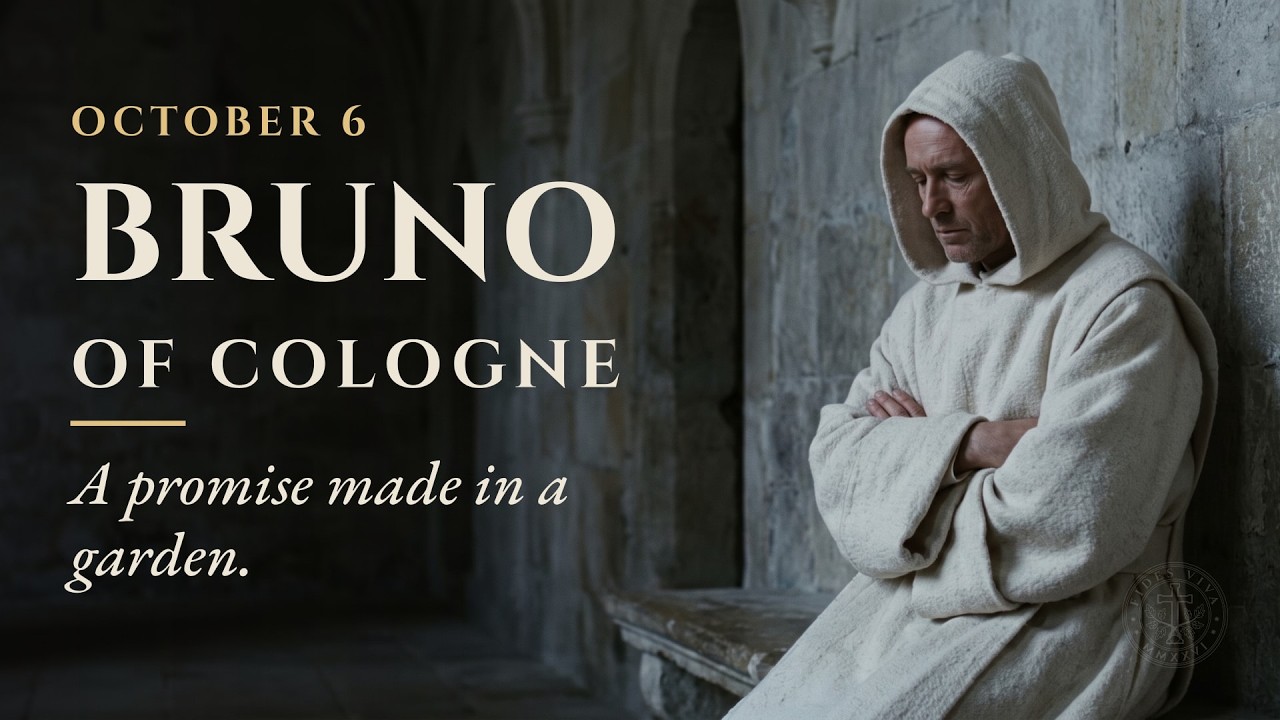
In a forest in Calabria, in the south of Italy, an old monk is writing to a friend from long ago, now an important man in Reims, in France, to remind him of a garden and a promise made to God. That old man is Saint Bruno of Cologne. He had been a master in Reims, and the city wanted him as its archbishop. He chose what monks call the desert: the solitude of the mountains. And from there the Carthusians were born. For centuries people have said he was driven by a dead man who sat up in the middle of his own funeral, in Paris. Bruno kept a different scene: three friends who promise, "burning with divine love," to leave what passes away for what is eternal. Keeping that promise cost him a teaching chair, the chance to be an archbishop and, because he obeyed a pope who had once been his student, the house he had built in the snow.
And that friend? Did he keep it too?
The Master in the Cloister of Reims
For some twenty years, that old man's voice filled the cloister of Reims Cathedral. Beneath the arches, Master Bruno, a cleric from Cologne, explains the Psalms and the letters of Saint Paul aloud. His students listen to him in one of the most renowned schools of the age. Among those young men sits one named Odo of Châtillon. One day he will be pope.
As the years pass, the master is entrusted with more. He becomes chancellor of the Church of Reims, and the cathedral's documents pass through his hands.
That cloister lies at the heart of the Church in France: Reims is its great metropolitan see, and Bruno is one of the seventy-two canons of its cathedral. He has a teaching chair, an office, a house, an income and a respected name.
But the Church of those years is fighting simony, the buying of a Church office with money or favors.
In this very city, when Bruno was a student, a pope gathered a council and deposed bishops who had bought their sees.
Now the wound is in their own house. The archbishop's see of Reims falls into the hands of Manasses of Gournay, who is accused of bribing his way into it.
Opposing him has a price.
At the end of 1076, several canons leave Reims of their own free will. They know they could lose everything. Among them are Bruno and two of his friends, Raoul le Verd and Fulco, whom everyone calls the One-Eyed. Outside the city, the Count of Roucy opens the gates of his castle to them.
A handful of canons in exile can do little against an archbishop. But one road is still open to them. The pope's legate, his envoy in France, has summoned Manasses to a council in Autun to answer the charges against him.
Almost Alone Against the Archbishop
In Autun, a council of bishops is waiting for the archbishop of Reims. It is September 1077. Presiding is the legate, who has summoned there every prelate suspected of simony. Manasses does not appear.
The exiled canons do come. Before the council, they accuse their archbishop of buying the see of Reims and of consecrating a bishop who had received his office from the king's hands. The council suspends Manasses.
The reply is waiting for them when they return. A chronicler of those years, Hugh of Flavigny, tells how the archbishop "laid an ambush for them, plundered their houses, sold what they had to live on and confiscated their property." The men who spoke out at Autun are left with no roof and no income.
Meanwhile, the legate writes to the pope. In his letter he commends Bruno as a master of the Church of Reims, a man of integrity, worthy to suffer persecution for the name of Jesus.
But the archbishop does not give up. He travels to Rome and, before Pope Gregory VII, swears an oath over the body of Saint Peter. And the pope gives him back his see.
With Manasses back in his place, the exiles' united front breaks apart. The provost, who presides over the cathedral canons and had gone into exile with them, makes peace with the archbishop and draws all the others along with him. All but two: Bruno and another canon, Ponce. The two of them remain in exile, their property still confiscated.
The archbishop then writes a defense for the Council of Lyon. It reads: "But this Bruno does not belong to my Church. He was not born there, nor was he baptized there." And he complains that he has received from Bruno nothing but malicious, undeserved treatment.
The cleric from Cologne is left almost alone.
The defense does not save Manasses. The Council of Lyon deposes him, and the pope orders him to return what he took from Bruno and the other canons who were only seeking justice. In the end, the people of Reims drive Manasses out of the city.
The exiles come home. Bruno takes up neither his teaching chair nor the chancellorship again. But Reims thinks highly of him, and as its archbishop it would choose him over anyone else.
Victory puts the archbishop's chair of Reims within his reach. Bruno does not take it. His answer went back further, and for centuries another story has been told around that decision.
A Dead Man in Paris, and a Garden
The best-known version of his calling begins at a funeral. The Carthusians handed it down from generation to generation, and a seventeenth-century painter painted it for the cloister of the Carthusians in Paris. In that same city, Bruno is attending the funeral rites of a canon, Raymond Diocrès. The service goes on, and the question is read out: "How many are your iniquities and sins?"
Then, before Bruno's eyes, the dead man sits up in his coffin. His voice rings out in Latin, "Justo Dei judicio accusatus sum": "By the just judgment of God I have been accused." The next day the body rises again. On the third day, once more. In that telling, Bruno walks out of the church determined to leave the world.
Is that how it all began? About that funeral, the people who knew Bruno say nothing, and neither do the first to set down his life in writing. Bruno himself says nothing. And nothing places him in Paris. What Bruno handed down of his own calling is another scene, a far quieter one.
There is a little garden beside the house of a man named Adam, where Bruno is staying. Three friends sit there: Bruno, Raoul le Verd and Fulco the One-Eyed. They talk for a long time. They talk about what the world offers and never delivers, about riches that run out, and about the joys of eternal life.
And there, "burning with divine love," the three of them promise, make a vow and resolve to leave behind, before long, "the fleeting shadows of the world." They want to take the monk's habit. It is a vow, a promise made to God.
They only have to wait a little. Fulco has to travel to Rome, and the three agree to wait for his return. Fulco is delayed. Other matters get in the way. The fervor cools.
Raoul carries on with his life as a canon in Reims. Bruno, though, with the see of Reims within reach, leaves the city to follow Christ. Two companions go with him, Peter and Lambert.
Together they come to Burgundy, to Sèche-Fontaine, a place in the woods near the abbey of Molesme, with the agreement of its abbot. There they live as hermits, that is, as men who seek God apart from everything.
But there their paths part. Peter and Lambert stay with the monks of Molesme. Bruno then understands that his way lies elsewhere: not in community life, but in solitude.
He has begun to make good on his promise, but he still has nowhere to live it. Six other men are seeking what he seeks, and with them Bruno goes to knock at the door of a very young bishop, in Grenoble.
Seven Stars over the Desert
The man who opens his house to these travelers is named Hugh, and he has been bishop of Grenoble for barely four years. It is June 1084. Before him stand Bruno and his six companions, among them Master Landuino, a wise man, no longer young, who has come from Lucca. They are looking for a place to live as hermits, and they have not found one yet. They have come to him drawn by the fame of his holy life.
Not long before, the bishop had had a dream. He told it to Guigo, his friend and confidant for twenty-six years. In that dream, Hugh saw God building a dwelling for his glory in the desert. And he saw seven stars showing him the way.
Now, at his door, stand seven men.
Hugh welcomes them with joy, and even with reverence. He listens to them and makes their plan his own.
"Ipso consulante, juvante, comitante": with Hugh advising them, helping them and walking beside them, the seven climb the mountain.
There lies their desert: a narrow gorge between peaks, with snow and cold, and only one pass to get in. Its name is Chartreuse, and from it the Carthusians will be born.
They build cells of logs and planks, at first for two monks each. A covered cloister links them. Water from the spring runs to them through hollowed-out logs. Only the church is made of stone, and they dedicate it to the Virgin and to Saint John the Baptist.
In the cell, there is prayer, the study of Scripture, the copying of books by hand. Outside, the snow. Inside, the silence. At last, Bruno is living what he promised in the garden.
The bishop, though, does not stay down below. Fighting the abuses in his diocese had stirred up in Hugh an old longing to be a monk. One day he ran off to the abbey of La Chaise-Dieu to stay there for good, and it took an express order from Pope Gregory VII to send him back to Grenoble.
That longing is still alive. Hugh often climbs up to the desert. He loves to talk with Bruno, to be formed by him, to live at his side, and in the end he becomes almost one of them. Twenty years separate the two men.
And more than once, it is Bruno who has to send the bishop off the mountain: "Go, go to your flock and discharge the obligations that you have toward them." Hugh goes down, and after a while he climbs back up.
What has just been born seems made to last.
Far from that gorge, the young man who used to sit in the cloister of Reims listening to Master Bruno has been elected pope. And he needs his old master.
Obeying, and Losing the Desert
That pope is Odo of Châtillon, and now his name is Urban II. Early in 1090, when Bruno has been on the mountain for six years, he receives a formal order from him. He is to come down to the Curia, the pope's court, and assist him with his work and his counsel.
Bruno obeys "with an aching soul."
His brothers do not feel able to go on without him, and they decide to scatter. Bruno tries to stop them, but he cannot.
Then, in agreement with Bishop Hugh, he hands over the lands of the desert to the abbey of the Chaise-Dieu, the very abbey where Hugh had once wanted to stay as a monk. He writes out the deed of cession in his own hand. With that parchment, the desert he had built is no longer his.
Then the brothers think better of it. They gather again, take his advice and decide to stay. Bruno sets Landuino, the wise man from Lucca who had climbed the mountain with him, at the head of the community as prior. And he leaves the mountain through the gorge's one pass, on his way to the pope.
The lands, however, now belong to the abbey, and getting them back is slower than Bruno had hoped.
So the pope steps in. He writes to Seguin, the abbot of the Chaise-Dieu: "We have called our most beloved son Bruno to the service of the Apostolic See. Since he has come to us, we cannot—because we must not—allow his hermitage to suffer any harm." He also tells him that the scattered brothers have come together again by the inspiration of God.
Seguin returns the Chartreuse to Landuino. In the written record he notes one detail: the deed in Bruno's hand cannot be found.
The house on the mountain is safe, and his brothers are still living in it. The man who built it is far away, serving his former student.
And the pope's court is no longer in Rome.
A Mitre Refused and a Forest in Calabria
Bruno heads south behind a pope who has lost his city. In the summer of 1090, the troops of the emperor Henry IV and of his antipope, a pope set up by the emperor against the rightful one, have forced Urban II to leave Rome. His whole court goes with him, along the roads of a south ruled by Norman princes.
Along the way, a church without a shepherd sets its sights on the former master of Reims: the church of Reggio, in Calabria, which has just lost its archbishop.
Its clergy elect Bruno. The pope approves the election. So does the Norman duke of Apulia. And both of them press him to accept. In Reims he had got out of being made archbishop by leaving. This time he escapes it with a name: Rangier, another former student of his, who lives very close by, in the abbey of La Cava. Bruno manages to have Rangier elected instead.
Wherever the court goes, its noise goes too. Bruno cannot bear that din or those ways. He is still in love with his old solitude and its peace, and he fears they will offer him another see. He pleads with the pope and, after great effort, wins permission to return to the solitary life.
He wants to go back to his brothers at the Chartreuse, to his desert of snow. But the pope keeps him in Italy, and his own people remain on the far side of the Alps.
A high valley, covered in forest, on the eastern slope of the mountains that run through Calabria. People call it La Torre, and it lies in the diocese of Squillace. This is the place Bruno chooses in 1091, with a few companions. Out of planks they build a little chapel where they can gather to pray. And deep in the forest, to live in, huts covered with mud.
It is his second desert.
A gentle legend tells that it was the hunting dogs of Count Roger, the great Norman lord of Calabria, that found Bruno there at prayer, and that the count bowed before him. Most likely the count already knew him. That same year, the count visits them and gives them the lands where they have settled.
Bruno has found his silence again, but now his brothers on the mountain can only receive letters from him.
The years pass in the forest. In Reims, the friend from the garden, Raoul le Verd, now presides over the canons of the cathedral.
Letter to a Friend Who Never Came
Bruno dips his pen to write to his old friend. Raoul has not forgotten him: he has sent him letters full of affection and done him many kindnesses. Bruno had written to him once before, through a pilgrim who was never seen again. This letter will be carried by one of his brothers, who will tell Raoul in person about the life they lead there. And Bruno tells him about the place: “I live in a desert in Calabria, far removed on every side from any town.”
He does not live alone. Some brothers are with him, several of them very learned, who keep watch like sentinels, waiting for the Lord, ready to open to him the moment he knocks.
Then he lets himself be carried away by what lies before him. Mild, healthy air. Broad plains between the mountains, green meadows. Shady valleys where water runs from rivers, streams and springs. Watered gardens and fruit trees.
But he stops himself. The wise man's delights are of another kind, and they are divine. Even so, such sights bring comfort and rest to a spirit worn out by hard discipline, because “a bow kept always bent will slacken or break.”
Yet it is not the landscape that keeps him in the forest. What benefit and divine joy the solitude and silence of the desert bring to those who love them, “only those who have experienced it can know.” There, the days have another measure: “Here one lives an active leisure, and rests in a quiet activity.” They work without agitation and rest without ceasing to act.
And then he puts to Raoul the question of his whole life: “What greater good is there than God? Still more, is there any other good besides God?” He sets before his friend Christ, “the Truth that never deceives,” who calls all who labor and are burdened to come to him.
That is why he reminds him that he is bound by a vow to the Lord almighty. “Do you remember, my friend, the day when you and I were together with Fulco the One-Eyed in the little garden beside Adam's house, where I was staying at the time?”
Bruno urges him to free himself from the debt of that vow as soon as possible. And he opens his heart: “if it should happen — God forbid — that you departed this life without paying the debt of your vow, you would leave me in the deepest sorrow.” He asks him to come on pilgrimage to Saint Nicholas, and then to come on and visit the one who cares for him like no one else.
And the friend from the garden, did he keep his word in the end? Raoul stays in Reims.
He will not come. But someone else does reach Calabria from beyond the Alps: Landuino, the prior of the Chartreuse, and he is ill.
Landuino and the Letter That Arrived
Sitting across from Bruno, the prior tells him in detail how the brothers live on the mountain: how strictly they keep their observance, their holy love, their tireless zeal for purity of heart. Through him, Bruno sees his sons again.
But the man speaking suffers from many grave illnesses, and Bruno wants to keep him in Calabria, at his side, so that Landuino can be cared for. Landuino will not agree. Far from his brothers, nothing seems healthy or joyful to him. With many tears and sighs he lets Bruno see how much he loves them.
Bruno does not insist, so as not to wound him or his brothers. He lets him go back and entrusts him with a letter for them.
He opens it this way: “Brother Bruno, to his beloved brothers in Christ.” He rejoices in virtues that keep growing and, in the very next line, accuses himself: “I grieve and am ashamed to remain sluggish and negligent in the misery of my sins.”
Then he encourages them: “Rejoice, therefore, my dearest brothers, in your happy lot.” They have reached “the calm and safe rest of the most sheltered harbor.” To the lay brothers, the ones who work with their hands, he speaks separately: “though you are not lettered, almighty God writes with his finger on your hearts not only love but also knowledge of his holy law.” And obedience he calls the key and the seal of all spiritual observance.
As for Landuino, Bruno grants the community one single permission: to act in his place and, respectfully, to make their prior take whatever they prepare for his health.
And he closes: “my only desire, after God, is to come and see you.”
Landuino sets out for home. On the way, the schism crosses his path: he falls into the hands of the antipope's supporters. They want to force him to recognize the antipope, and they try threats and promises, tricks and violence. The prior does not bend, and they hold him prisoner for several months.
When at last they release him, very weak, he takes refuge in the monastery of Saint Andrew, at the foot of Mount Soratte, north of Rome. There he dies in September of 1100, and there they bury him, far from the brothers he had wept for.
The letter, though, reaches the Chartreuse, and the brothers it was written for. The messenger never returned to their cells. Bruno's words did.
In Calabria, Bruno remains far from everyone he wanted to see. The following year it is he who feels his hour approaching, and he calls his brothers around him.
“I Firmly Believe”
The brothers are already with him in the forest of Santa Maria della Torre. Bruno knows that his hour has come to pass from this world to his Lord and Father.
In front of them he goes back over every stage of his life, from his childhood on. He vividly recalls the notable events of his time.
Then he makes a specific request: that they be witnesses of his faith before God.
And then he speaks aloud, at length and from the depths of his heart: “I firmly believe in the Father, in the Son and in the Holy Spirit.”
He professes his faith in the Son of God, conceived of the Holy Spirit in Mary, the Virgin. He confesses that he was seized out of envy, insulted and scourged. That he died and was buried. That he rose again and ascended into heaven.
He confesses the sacraments of the Church. And he dwells deliberately on one: what is consecrated on the altar is the true Body, true Flesh and true Blood of our Lord Jesus Christ.
Last of all, he confesses the resurrection of the flesh and eternal life.
The following Sunday arrives, the day on which the Church celebrates the resurrection of Christ. It is the sixth of October, 1101.
Bruno's soul leaves his mortal flesh.
The same brothers who heard his faith carry him to the small cemetery of the hermitage of Santa Maria, among the trees. There they lay him to rest. It is the land he chose for a life of silence, and there he remains.
Today, in the corner of the forest they call the Dormitorio, the grave cut into the rock where they laid his body is still there for anyone who makes the journey to see it.
At the hermitage, after the burial, the brothers take up their pens. They must announce his death to the churches and monasteries of Europe and ask them to pray for him.
One Hundred and Seventy-Eight Voices
The news leaves the forest on a mortuary roll, a long parchment that a messenger carries from church to church, hung from his neck, so that each community can write its tribute.
The messenger crosses Italy, France, Germany and England. At every door they unroll the parchment, and someone adds a few lines beneath the ones already there. In the end there are one hundred and seventy-eight churches and communities. Many of those who write had known him.
His epitaph portrays him as those who lived beside him saw him: his face always joyful, a man of few words, his temper always even. He guided his own with a father's authority and a mother's tenderness.
One of those voices comes from Cormery, in France. Maynard, the prior of that house, had been Bruno's student in the cloister at Reims. He was preparing to travel to Calabria to see his old master and entrust his soul to him. This time it was the disciple who wanted to go and see him.
On All Saints' Day of the following year, the parchment reaches Cormery before he can set out. Maynard weeps. On the roll itself he writes that he could not hold back his tears.
The Church never opened a formal process for Bruno. In 1514, Leo X authorized his feast on his own papal authority, without that process, what is called an equipollent, or equivalent, canonization, and in 1623 Gregory XV extended the feast to the whole Church.
Carthusian monks still keep his silence today in the United States, at the Charterhouse of the Transfiguration in Vermont, and in England, at St Hugh's Charterhouse in Parkminster, West Sussex.
In Serra, the town that grew up beside his forest, Bruno's remains came to light in the early sixteenth century beneath the church of Santa Maria, alongside those of his companion and successor in Calabria. A silver bust made in Naples holds the two of them, with an inscription in Latin:
“In morte quoque non sunt divisi”: even in death they were not parted.
At Pentecost, his relics are carried in procession through the firs to Santa Maria, the place where Bruno lived his last years and where he died.
There, in that forest, the master who gave up a teaching chair and a see kept, until his last Sunday, the promise he had made to God in a garden.
Saint Bruno, priest and hermit, father of the Carthusians, who, burning with divine love, left behind the fleeting shadows of the world, obeyed even when it cost you your desert, and confessed your faith before your brothers at the end of your life: obtain for us from God the grace to be faithful to what we have promised Him and to discover, in the silence, that there is no other good apart from Him. Pray for us. Amen.