At noon, the galleys collide in the Gulf of Lepanto.
That same day in Rome, those who cannot fight walk the streets in procession, praying the Rosary. It is Sunday, October 7, 1571. That is why, every October 7, the Church celebrates Our Lady of the Rosary.
Rome will wait two weeks to learn who has won.
But that prayer is far older than the battle. It began in hands that kept count of their prayers with stones, and the name of Saint Dominic is bound to it as well. Whoever prays it does something very simple: they look at Jesus alongside his Mother, bead by bead.
In July 1917, in a village in Portugal, a Lady promised three shepherd children that in October she would tell them who she was.
How did a prayer once counted on stones come to have a day of its own?
Stones, Our Fathers and a Crown of Roses
In the desert of Egypt, in the fourth century, a stone falls onto the sand. And then another. They are dropped by a hermit named Paul, a man who has withdrawn into solitude to pray. He has set himself three hundred prayers every day. So as not to lose count, he gathers three hundred pebbles and lets one fall each time he finishes a prayer. And so, with a handful of stones, prayer begins to be counted.
Seven centuries later, at the great abbey of Cluny, in France, the monks' prayer is the psalms, the hundred and fifty songs of the Bible that the Church has prayed since ancient times. They sing them in choir, by day and by night. But lay brothers also live in the abbey, and most of them cannot read. How are they to pray a hundred and fifty psalms? When a brother dies, they pray fifty Our Fathers for him in place of the psalms. It is a kind of psalter for those who cannot read, made of short prayers, repeated and counted.
Mary has been honored since the first centuries. But in the twelfth century the people begin to repeat to her, over and over, the words with which the angel greeted her. And so the Hail Mary joins the count. Some pray it on their knees. Of Saint Albert it is told that he kneels a hundred times a day, and each time says a Hail Mary.
In England, the rule of certain women who live enclosed in a cell beside a church sets them fifty Hail Marys, in sets of ten. It is the decade still prayed today.
But so much counting has a danger, that of praying in a hurry just to reach the number. In the Middle Ages a story goes around about Eulalia, a woman who prays a hundred and fifty Hail Marys every day. One day, the story says, Our Lady asks her to pray only fifty, but slowly. What matters is no longer the number, but each greeting.
Counting no longer needs stones. In thirteenth-century Paris, whole guilds of craftsmen make strings of beads, which they call “paternosters.”
From that same century comes a much-loved legend, told all across Europe. A young monk is praying Hail Marys. From his lips, Our Lady gathers rosebuds, one by one, and weaves them into a garland for her own head.
Because of that image, the prayer is called the rosary, from the Latin for a garland of roses, like the flowers the faithful use to crown images of Mary. The prayer that began with stones in a hermit's hand now bears the name of flowers. Centuries later, whole cities will see their images of Our Lady of the Rosary crowned.
One name is still missing, the one tradition will bind forever to these beads. At that time, a Castilian friar is preaching along the roads of southern France, Dominic de Guzmán.
Saint Dominic, a Carthusian and a Preacher
Dominic goes from village to village, speaking of Christ to anyone willing to listen. The Albigensians have spread through those lands, a movement that has broken away from the faith of the Church.
For centuries, on the feast of the Rosary, the Church read out this story, “as it has been handed down.” When the Albigensians were raging against the priests of the Lord, Dominic raised his eyes to heaven, toward the Virgin Mary. And he turned to a simple way of praying: the Rosary, which was also called the Psalter of Our Lady. She asked him to preach it to the peoples as a defense against heresies and vices.
The friar spread it. And the faithful, with the angel's greeting on their lips and kindled by those prayers, began to be changed into new people.
It is the scene so many paintings would later show: Our Lady placing the rosary in Dominic's hands. But the beads are still only that, beads. What will give them a soul will be born much later, in the silent cell of a monk.
In the early fifteenth century, at the charterhouse of Trier, in Germany, there lives a young monk named Dominic of Prussia. He is a Carthusian, a monk who spends almost his whole life in silence, alone in his cell. His superior advises him to pray fifty Hail Marys every day. And the young man has a simple idea, to write fifty short phrases about the life of Jesus, one for each Hail Mary.
So each Hail Mary opens a scene from the life of Jesus, from his birth to his resurrection. These are the mysteries, contemplated one Hail Mary after another. Counting has become a way of looking.
Everything still has to be put in order. Some fifty years later, a Dominican friar, Alan de la Roche, comes across those Carthusian phrases in Flanders and falls in love with them. He arranges them into fifteen groups of ten Hail Marys, the decades, and founds confraternities, groups of the faithful who pray together and help one another. And wherever he goes, he tells the story of Our Lady and Saint Dominic. From his voice it passed to the religious houses, to the confraternities and to the whole Church.
In 1569, in Rome, a pope who had been a Dominican friar as a young man sets that same story down in a papal bull, a solemn document bearing the papal seal. He signs it for a Church he sees as “shaken by heresies” and “afflicted by so many wars.” His name is Pius V, and he governs a Rome that watches with fear as the Ottoman fleet advances.
Lepanto: Those Who Could Not Fight
To face that advance, Pius V has brought several Christian kingdoms and republics together in an alliance: the Holy League. Their galleys gather in the Mediterranean under the command of Don John of Austria. Before they put to sea, the Pope sends him his blessing and a piece of advice that has nothing to do with strategy: leave behind the soldiers who lead wicked lives.
The old man in the white habit prepares in his own way: he fasts three days a week and spends many hours each day in prayer. He has ordered prayers in every church in Rome.
The people of Rome cannot board a galley or take up a weapon, so he sends them to pray the Rosary. While the League's armada searches for the Ottoman fleet, beads pass through fingers all over the city.
On the first Sunday of October, around midday, the two fleets meet near the Echinades Islands, at the entrance to the Gulf of Lepanto. They fight for about three hours. In the end, the League wins.
The cost is high. It is estimated that the Christian fleet loses some seven thousand five hundred men and seventeen ships, and that between twenty and thirty thousand Turks are put out of action.
On the Ottoman galleys, Christians turned slaves rowed chained to the benches. By some estimates, between twelve and fifteen thousand of them walk free of their chains that day.
In Rome, that same Sunday, the confraternities of the Rosary go out in procession, while far away men are fighting at sea.
Pius V's earliest biographers say that on that day, just as the battle is ending, he is going through business with his treasurer, Bartolomeo Busotti. Suddenly, the Pope stands up. He opens the window. He looks up at the sky for a moment. Then he turns to his treasurer: “This is no time for business; hurry and give thanks to God, because our fleet has just defeated the Turks.”
But no messenger confirms what the Pope said at the window. Rome knows nothing. The days go by, and in the palace the waiting grows painful.
Six days after the battle, the only news to reach the city is that the two fleets are close to each other. Nothing more. Who has won, who has died, whether there has even been a battle: no one can say.
The Pope orders prayer day and night in every monastery in Rome. And he is the first to pray. Night after night, whole communities keep vigil, praying for men who may no longer be alive.
On the night of October 21 to 22, a courier finally reaches the city. He has been sent by the nuncio in Venice, the Pope's representative to that republic. He brings news of the victory.
The courier hands it to Cardinal Rusticucci, who handles the Pope's affairs of state. He does not wait for morning: he has the Pope woken.
The old man listens. And he bursts into tears of joy. What rises to his lips is a line from the Gospel.
“Nunc dimittis servum tuum in pace.” Now, Lord, you may let your servant go in peace. These are the words of the aged Simeon when he held the Child Jesus in his arms.
Pius V gets out of bed. He kneels and gives thanks to God. Then he lies down again, but he can no longer sleep.
Now that the city knows, the Pope puts the two things together. The battle was won on the first Sunday of October. That same day, the confraternities were praying the Rosary through the streets of Rome.
For Pius V, the victory has one source: the Virgin Mary, whom his people were calling upon, bead by bead, while others fought. He has the bells rung. And he orders that every year, on that anniversary, Our Lady of Victory be remembered.
And so the feast is born. The prayer of those who could not fight now has a day of its own.
Pius V will not live to celebrate the first anniversary. He dies the following spring, and today he rests in Saint Mary Major, the great basilica of Our Lady in Rome. It will be his successor who changes the name of that feast.
From the Name of a Victory to the Name of a Prayer
The victors did not claim the victory for themselves. In Venice, beneath a painting of the battle in the Doge's Palace, the Senate of the republic had these words written: “Not our strength and arms, nor our commanders, but Our Lady of the Rosary helped us to victory.”
In 1573, the Dominicans go to Gregory XIII, the successor of Pius V. He orders that the first Sunday of October be celebrated as the feast of the Rosary in every church that has an altar of the Rosary.
The feast of a victory now bears the name of a prayer. Centuries later, that name will be heard again in a field in Portugal.
By then, Our Lady of the Rosary has already crossed the ocean. In the New Kingdom of Granada, the land that is now Colombia, the painter Alonso de Narváez has painted her on a cotton cloth woven by Indigenous hands. On either side of Our Lady and the Child, he has placed Saint Andrew and Saint Anthony of Padua.
The cloth ends up in a thatch-roofed chapel in Suta. More than ten years of damp leave it blurred and faded.
Years later it is taken to Chiquinquirá, but it is so damaged that it is left abandoned in a room that was once an oratory. A woman born in Seville, María Ramos, comes to live in the village. She repairs the old oratory and hangs the cloth in the place of honor in the chapel, even though you can barely make out what it shows.
People in Chiquinquirá tell, and the Church in Colombia holds it as its own story, that on December 26, 1586, María Ramos steps out of the oratory. Just then, an Indigenous woman named Isabel walks by with her son. She looks inside and calls out to her:
“Look, look, ma'am!”
María turns her eyes toward the painting. The image is surrounded by bright rays of light. The colors have come back, glowing again. Not a tear remains, not a single hole.
Today Our Lady of the Rosary of Chiquinquirá is the Patroness of Colombia, and the Dominicans keep watch over that canvas.
The feast would keep growing with each victory. In 1716, Prince Eugene defeats the Turks once again, in Hungary, beside the fortress of Peterwardein. It is the morning of the feast of Our Lady of the Snows.
In Rome, Clement XI sees in that date a sign of Our Lady's intercession, and he extends the feast of the Rosary to the whole Church.
What began in the streets of Rome is now celebrated across the entire Catholic world. But one painting of the Rosary has yet to travel in the humblest of carts. In the second half of the nineteenth century, near the ruins of Pompeii, there lives a lawyer who had drifted away from the faith.
Pompeii: The Lawyer and the Painting on the Cart
That lawyer's name is Bartolo Longo. He has already come back to the Church after passing through spiritualism, the practice of calling up the spirits of the dead. Since 1872 he has been looking after the lands of Countess De Fusco in the valley of Pompeii, where the farming families live scattered among farmsteads and country houses.
Coming back has not brought him peace. On October 9 of that year, the storm in his soul torments his heart and his body more than usual. He leaves the house and walks with no direction. He reaches the most desolate corner of the valley, the place the farmers call Arpaja, as if the harpies of the ancient myths lived there.
There is no one.
He stops short. He seems to hear a friendly voice whispering to him: “If you seek salvation, spread the Rosary. It is Mary's promise.”
Longo raises his face and his hands to heaven. He cries out to Our Lady that if she truly promised Saint Dominic that whoever spreads her Rosary will be saved, then he will be saved, “because I will not leave this valley until I have spread your Rosary.”
No one answers. All around him, a silence like the grave. But suddenly a great calm comes over him. In the distance the Angelus rings, the prayer the bells announce at noon. He falls to his knees in that empty field to pray it. When he stands up, he feels a tear on his cheek.
From that day on, he goes from house to house through the valley. He knocks on the farmers' doors and gives them rosaries and medals. Because they are made of metal, those poor people think they are valuable, and they gladly accept them. But many of them can barely pray the Hail Mary.
Over the years, he wants to give them something more. In November 1875 there is a parish mission in the valley, a few days of preaching for the country people. Longo does not want it to end without leaving them a painting of Our Lady of the Rosary, so that they can gather before it every evening to pray.
To find one, he goes to Naples. In a square, beside a painter's workshop, he runs into the Dominican Alberto Radente, the friar who had accompanied him in his return to the faith. They go in together. A small painting of Our Lady of the Rosary costs four hundred francs. “That's far too much!” says the friar. Back out on the street, he tells Longo that he once bought an old one from a junk dealer for three francs and forty centimes, and that years ago he gave it to a nun, Sister Maria Concetta De Litala.
Longo goes to ask her for it. The moment he sees it, his heart stops. The canvas is worm-eaten. Right above Our Lady's head, a whole handspan of it is missing.
The nun will not let him leave empty-handed: “Take this image; surely it will manage to draw a Hail Mary out of someone.”
The painting measures one meter by one point four meters, and it will not fit on the train. Angelo Tortora is the carter of Pompeii: he clears out the stables of wealthy families and sells the manure to the farmers. He agrees to take it. He sets the painting on top of the load already in his cart. And he will not take a penny: it is enough for him to have carried Our Lady.
That is how Our Lady of the Rosary comes into the valley of Pompeii. On a cart full of manure.
That evening, in the parish church, those present look at the canvas, and a smile touches their lips at that ugly old “daub.” The painting is left in a corner, behind the altar.
A few months later, a young girl who was close to death, Clorinda Lucarelli, is healed, and her recovery is taken as a sign that the work pleases Our Lady. In May, the first stone is laid for a church to house that forgotten painting. Seven years later, a pope writes to every bishop in the world.
October, the Month of the Queen
That pope is Leo XIII, and what he asks of the whole Church bears the name of a month: he consecrates the entire month of October 1883 to the Queen of the Most Holy Rosary.
For that month he asks every parish to pray five decades and the litany, the series of invocations to Our Lady, during Mass or before the Blessed Sacrament exposed on the altar. The feast already belonged to the whole Church. Now the prayer has its own month as well.
That same October, on the 14th, twenty thousand pilgrims gather in the valley where Bartolo Longo had once knocked on doors, one by one, with rosaries in his hands.
They all look at the same canvas. It is the one that came on the cart years before and spent its first evening in a corner, behind the altar. Before it, they pray together, for the first time, the Supplication to the Queen of the Holy Rosary, the prayer that came from Longo's heart.
Twenty thousand voices end with the same words: “O Blessed Rosary of Mary, sweet chain which unites us to God.”
The vow he cried out at Arpaja does not remain just words. In the years that follow, Longo builds an orphanage beside the shrine. From their prisons, the prisoners themselves ask him to care for their children, and for them he opens another home. To care for the orphan girls, he himself founds a congregation of Dominican Sisters. In Pompeii, the prayer counted on beads becomes bread, a roof and a school.
One step was still missing for the day of the feast. For centuries it had been kept on the first Sunday of October, so its date changed every year. In 1913, Saint Pius X fixes it on October 7, the very day the galleys clashed at Lepanto. It is the day the Church keeps in its calendar today as the memorial of Our Lady of the Rosary.
Since then, the day has not moved.
Four years later, in a village in Portugal, three shepherd children hear the Angelus bell and begin to pray the Rosary.
Fatima: The Name Promised for October
The field where they pray is called the Cova da Iria, near Fatima. Lucia, Francisco and Jacinta take their flock there.
On that May 13, 1917, they see a Lady. In her hands she holds a rosary of white beads.
Lucia is the one who speaks with her, and it is through Lucia that the Lady's words reach us. That day they are a request: “Pray the rosary every day, to obtain peace for the world and the end of the war.”
About who she is, not a word.
In July, in the same place, the Lady asks the same thing again. They are to keep praying the rosary every day in honor of Our Lady of the Rosary, to obtain peace, “because only she can help you.” The title has now been spoken. But she says it as if speaking of someone else.
Lucia asks her who she is.
The answer is held back: “In October I will tell you who I am and what I want, and I will perform a miracle for all to see and believe.”
In the village, not everyone believes the children. The parish priest doubts what they say. The mayor tries to talk them out of it. And on one thirteenth, the day they were due to return, they cannot go to the Cova da Iria: they have been taken into custody.
But the three keep coming back. October draws closer and closer, and with October, the promise.
October 13, 1917, is a cold, gray day. The rain does not let up. Out in the open field, between fifty and seventy thousand people wait, soaked to the skin, their eyes on three children.
Lucia asks the Lady what she wants.
And at last the Lady speaks the name she had promised in July: “I want to tell you that a chapel is to be built here in my honor, that I am the Lady of the Rosary, and that you are to go on praying the rosary every day.”
It is the name of the feast that was born on the day of Lepanto.
What she asks next is not about herself, but about her Son, Jesus. Looking sadder, she says: “Do not offend Our Lord any more, for he is already so much offended.”
She opens her hands, and their light is reflected onto the sun. As she rises, her own light goes on shining onto it. Then, beside the sun, the children see Saint Joseph with the Child Jesus, and the Virgin dressed in white, with a blue mantle. Saint Joseph and the Child seem to bless the world, tracing the sign of the cross with their hands.
Below, the drenched crowd lifts its face to the sky and sees something else. The sun spins. It changes color.
Thirteen years later, the Church declares those apparitions worthy of belief. Francisco and Jacinta are saints today. Fatima and the Rosary do not name two different Virgins: they are two names for the same Mary.
The Lady had asked for a chapel in that field. Far from there, in Cádiz, another of her images had had its home for centuries.
What Was Saved from the Fire
Her story as Patroness begins in 1755, when the Lisbon earthquake also shakes Cádiz. The frightened people of Cádiz run to the door of the convent of Santo Domingo. They beg the Dominican friars to carry Our Lady of the Rosary out in procession and stop the force of the sea. Nine days later, the city names her its Patroness.
Almost two centuries later, on May 11, 1931, a mob sets fire to the church and the convent. Before fleeing, the friars manage to save what they can.
They carry out the Blessed Sacrament, the consecrated bread of the Eucharist. And from the image of their Patroness, two pieces: Our Lady's hands and the Child.
The rest of the image is consumed by the fire.
Twelve years later, a sculptor from Seville who has become a Dominican friar carves a new image of the Patroness for Cádiz. The hands that hold the rosary are the ones the friars carried out of the fire. The Child she holds in her arms is the very same Child.
Sixteen years after the fire, the Cardinal Archbishop of Seville places the crown on Our Lady's head. It is a canonical coronation, carried out with the Pope's authorization.
Today she still stands in her niche at the center of the high altarpiece of Santo Domingo, with those hands and that Child.
The garland of roses that gave the prayer its name is now a real crown on the head of Our Lady of Cádiz.
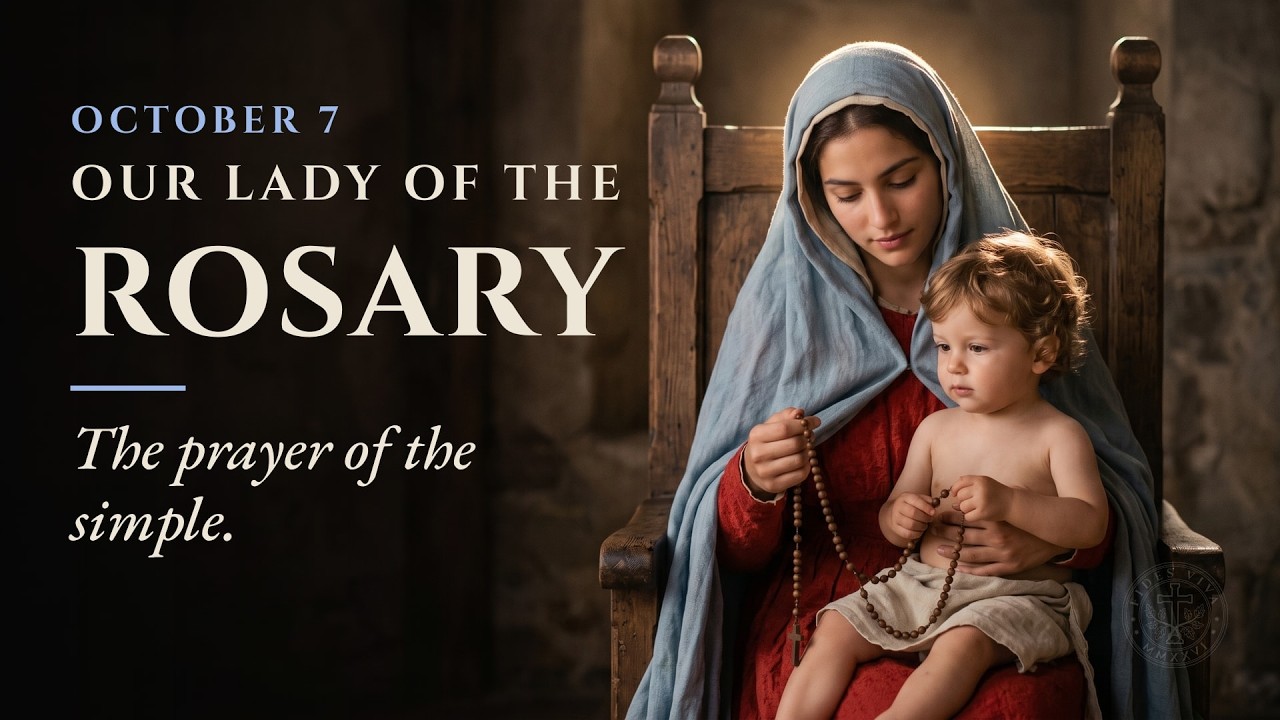
Like so many images of the Rosary, this Mother holds her Son. And the prayer said before her walks through the life of that Child.
Seeing Christ Through Mary's Eyes
A hand moves one bead along, and then another. One Our Father, ten Hail Marys, and then you begin again. Put that way, it seems like very little. But each decade pauses before a mystery in the life of Jesus, and whoever prays looks at it together with Jesus's Mother.
In Nazareth, a young woman listens to an angel and answers yes. In Bethlehem, that same young woman wraps her newborn son and lays him in a manger.
Years later, the Mother stands beside the cross, watching her Son die. On the third day, Jesus rises. And in Jerusalem, in the midst of the disciples at prayer, the fire of Pentecost comes down.
The Hail Marys run underneath, like a heartbeat. The gaze, though, rests on the face of Christ. It is the gaze of Mary, who kept all these things and pondered them in her heart. Whoever prays the Rosary learns from her to look at her Son this way: slowly, one scene after another.
For centuries there were fifteen of these mysteries, as many as the decades that echoed the hundred and fifty psalms: the joyful, the sorrowful and the glorious. In October 2002, John Paul II signs a letter on the Rosary, and with it he opens a Year of the Rosary for the whole Church. He also proposes something new, which he leaves to each person's free choice: five mysteries of light, drawn from the public life of Jesus.
At the Jordan, Jesus steps into the water to be baptized. At a wedding in Cana, his Mother notices that the wine has run out, and he turns water into wine. Along the roads, he proclaims that the Kingdom of God is at hand and calls people to conversion. On a mountain, his face is transfigured before three disciples. And at the Last Supper he takes the bread and gives it as his Body: this is the Eucharist.
At the end of the letter, John Paul II places it in Our Lady's hands. She is Our Lady of Pompeii, in the shrine built by Bartolo Longo, the lawyer from the desolate valley.
It is the same worm-eaten canvas that arrived on top of a cartload of manure. Those present smiled at the sight of that “daub,” and it spent its first evening pushed into a corner behind the altar.
Now, in spirit, a pope lies prostrate before it.
And the lawyer who entrusted it to a carter is still waiting for the Church's final word.
This October
Bartolo Longo grew old beside that painting. He died at eighty-five in the same valley where once, alone and tormented, he had shouted his promise to Our Lady that he would not leave without spreading her Rosary. The vow had been kept.
Leo XIV declares him a saint in Saint Peter's Square on October 19, 2025.
The following year, at the end of September, the same pope prays the Angelus at Lourdes. It was there that the Immaculate Conception appeared to Saint Bernadette, rosary in hand. From that place, Leo XIV asks all the faithful to pray the Rosary throughout the month of October, for one specific intention: that wars may cease.
As on that Sunday of Lepanto, the prayer is back in the hands of those who cannot stop a war. This October, the whole Church is invited to take up the rosary for peace.
The prayer that began with stones in a hermit's hand has its own day because, on the Sunday of Lepanto, those who could not fight prayed it through the streets of Rome. And it gives Our Lady her name because, bead by bead, it looks with her upon the face of her Son.
Virgin Mary, Mother of Jesus, you who kept in your heart every word and every gesture of your Son: teach us to look upon his face with you, bead by bead, in joy and in sorrow. You who welcomed the prayer of those who could not read, of those who could not fight, and of the children in the rain, receive ours as well. Obtain for us peace in the world and in our homes, and may this sweet chain unite us always to God. Queen of the Most Holy Rosary, pray for us. Amen.