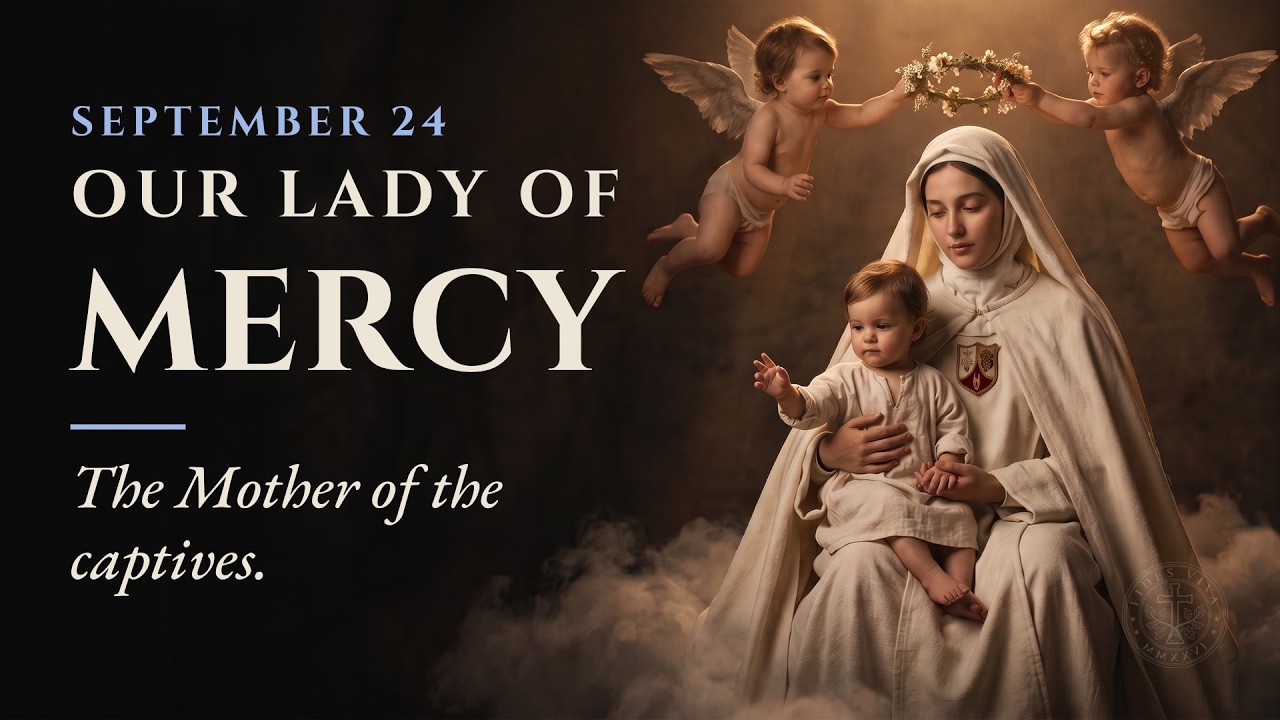
Today, prisoners pray to Our Lady of Mercy. Her name was born eight centuries ago on the shores of the Mediterranean, out of one very concrete work. To do mercy meant going door to door, begging alms coin by coin, until you had gathered the price of one person held captive across the sea. And bringing that person home.
The friars who did this work in the name of Saint Mary still remember a journey to Tunis. The money covered two hundred and nine captives. Not all of them. One of those friars, Pedro de San Dionisio, stayed behind.
He stayed with the ones who could not get out, so that they would not lose their faith as well.
Many have heard that the Virgin appeared one night to a merchant of Barcelona. That night is kept in the memory of the Order. Alongside it lie the parchments of those same years, with their names and their dates.
How did the price of a captive become a name for the Mother of God?
Coin by Coin
In the late twelfth century, the Mediterranean divides Christian and Muslim kingdoms at war with one another. There are battles. There are raids, swift attacks to plunder a coast and carry people off. And there are corsairs who prey on ships. Every blow leaves people captured, on both sides: Muslims held captive in Christian lands, Christians held captive in North Africa.
The captive is plunder. He is sold as a slave. He is put to the oar of a galley or to forced labor. He is locked in a dungeon. He goes hungry.
For the Church, though, there was a danger deeper than hunger. Far from home, a Christian captive could renounce the faith: abandon it under pressure or out of fear.
There were ways to get them out. In Aragon the exeas were at work, and in Castile the alfaqueques, agents who negotiated releases. From the last third of the twelfth century, the usual path for poor captives was redemption, that is, paying a ransom through intermediaries. In France, with a similar aim, the Order of the Trinity, which began with Saint John of Matha, was already at work.
After the great Christian victory at Las Navas de Tolosa, in 1212, come years of treaties and truces that make ransoms easier. But the corsairs are still at sea, and a safe-conduct, the written permit to travel under protection, can turn out to be worth nothing. In the Crown of Aragon, the king's campaigns against Majorca and Valencia coincide with a flowering of charitable works born around the year 1200.
In Barcelona, the Mercedarian chroniclers date to 1203 the first steps of a man named Peter Nolasco. From his father, Bernard, he had learned the merchant's trade. With other laymen, people with no habit and no vows, he traveled through Catalonia and Aragon collecting alms, and every year he ransomed captives. He was a trader who bought people instead of goods. To bring them back to their own people.
In 1301, a king of Aragon, James II, wrote to Pope Boniface VIII about those first companions. He said of them that "they had great devotion to Christ, who redeemed us by his precious blood." To redeem was the very word they used for ransoming a captive. With coins, they paid for one man's freedom. In their faith, the freedom of all had been paid for by Christ, with his blood.
They collect with collection boxes, alms chests, and sacks. They ask in churches and at crossroads. In the market halls, where merchants make their deals. In the mills and the bakehouses, where sooner or later the whole town passes with its grain or its dough. Lay helpers dressed in white go out to ask for alms. And a confraternity, a brotherhood of the faithful, devotes itself to alms for the captives.
Then comes the bargaining. Negotiating a ransom takes two to four months. And it has a price. In the thirteenth century, a captive costs eight, ten or fifteen pounds. A horse costs fifteen.
A person, the price of a horse.
That brotherhood of laymen, with its sacks and its money boxes, would become an Order approved by the pope. The Mercedarians trace that step back to a single night in August.
A Night in August and the First Records
By then, Nolasco had spent years on the roads, ransoming captives, and their number kept growing. He turned to prayer to find a way forward. For centuries, the Order has guarded what happened next. On the night of the first of August, 1218, Mary, the Mother of Christ, stepped into his life in a special way. She enlightened his mind and moved his will to turn that brotherhood of laymen into an Order of the Church.
The next day, the merchant went to the royal palace and laid out his plan. The counselors of the court listened to him. The king, James I, was about ten years old at the time.
This is how the Mercedarians told the story of their own birth. On the tenth of August, before the high altar of Barcelona Cathedral, above the tomb of Saint Eulalia, Bishop Berenguer de Palou receives Nolasco and his companions. He gives them the white habit. He also gives them the Rule of Saint Augustine, the norm of common life they were to follow, and the cross of his cathedral. The boy king gives them his coat of arms, the bars of Aragon, and the Hospital of Saint Eulalia. The first friars make their profession right there.
The Order would always receive whoever knocked at its door with a single question: "Do you wish to receive the habit of Saint Mary?" The answer was just as brief: "Yes, I do."
Those first friars were convinced that Mary had taken part in their founding. That is why they called her Mother and Foundress.
The parchments of those years speak another language, one of offices and places. The first document to name Nolasco is dated in Perpignan in 1226, and calls him "rector of the poor." Then comes a legacy, a bequest someone leaves for ransoming captives. Another document presents him as collector and keeper of the alms for the captives. In 1232, a nobleman of Barcelona buys a stretch of beach by the harbor and gives it to him. There, by the sea, the house of Saint Eulalia will rise. By 1234, Nolasco is already running a hospital for captives.
On the seventeenth of January, 1235, in Perugia, Pope Gregory IX signs a bull, a solemn letter bearing his seal. It is addressed to the Master, Friar Peter Nolasco, and to the friars of the house of Saint Eulalia in Barcelona. It confirms the Order under the Rule of Saint Augustine. It is the first secure papal act to survive. The brotherhood of the money boxes is now an Order of the Church.
When James I conquers Valencia, in 1238, he is a grown man. He then gives Nolasco houses and a mosque that had been turned into a church. That is how the king appears in the records of the time: as protector of the work.
The memory of the night and of the cathedral was slow to be written down. In 1358, another king of Aragon, Peter IV, describes in a letter to the pope the founding on the tenth of August, with the bishop and with James I. In 1445, a friar of the Order, Nadal Gaver, writes the first history of the Mercedarians. In its pages, the account of the apparition is at last set down in writing.
Because of that king's age, and because the earliest parchments are dated 1226, the year 1218 remains in doubt. The memory and the records tell the same birth by different clocks.
In the seventeenth century, some Dominicans argued that the true founder had been Saint Raymond of Peñafort, a canon of Barcelona who in 1218 was not yet a Dominican and who later served the pope as a jurist. In 1688 the altarpiece of the Chapel of Our Lady of Mercy was completed in the cathedral, and on it Nolasco kneels before the king and before Raymond. In 1920, a Mercedarian friar published a refutation of that claim.
The memory and the parchments alike tell of what those men did across the sea. They carried the money, and they paid. And when the money was not enough, one of them stayed behind as a pledge.
Those Who Stayed
The captives already set free boarded the ship and went home even though their ransom had not been fully paid. In Muslim lands, a friar stayed behind as a pledge until the rest of the money arrived. The Order remembers this practice as Nolasco's new contribution. To the old custom of paying ransoms, he and his friars added themselves.
In Tunis, in 1247, Friar Pedro de San Dionisio was not working alone. He had come with another redeemer, Bernardo de Pradas. Together they managed to bring out two hundred and nine captives. Others were still held there, in grave danger of renouncing the faith, and nothing was left to pay for them. Bernardo set sail with the freed captives. Pedro remained in the city, beside those who were still prisoners.
His brothers kept the memory of how it ended. He was arrested. They beat him through the streets. Outside the walls, they beheaded him.
Also alive in the Order's memory is Friar Teobaldo de Narbona, a Frenchman, together with his companion, Fernando de Portalegre. In 1253 they were negotiating ransoms in North Africa. They had given their word to two powerful men of a city on that coast: they would buy the captives those men had. But the money went to others. To children. To women. To religious and to knights. One hundred and twenty-nine people walked free.
The two powerful men answered with a trap. They paid a young woman to accuse Teobaldo of deceiving her with a promise of marriage. The sentence left him two ways out: renounce his faith and marry her, or die at the stake. Teobaldo was burned and stoned to death. Fernando was beaten and forced onto a ship.
In 1255, Pope Alexander IV calls these friars "the new Maccabees in the time of Grace." The Maccabees are the brothers in the Bible who chose to die rather than betray their faith.
About another redeemer, Peter Armengol, the Mercedarians tell an astonishing story. Before he took the habit, he had been a bandit. In 1266 he stayed behind as a hostage in Bougie, a port in North Africa. The money did not arrive in time. They hanged him.
The next day, Friar Guillermo de Florencia arrived with the ransom. He found Armengol alive, "by the singular protection of Mary." He lived until 1304, his neck twisted for the rest of his days.
On the first of May, 1272, the Order sets down in Catalan its first Constitutions, the rules of its life. They state the Order's purpose: to visit Christian captives and set them free. And they ask each friar for a particular readiness.
That all of them "be always gladly ready to give their lives, if need be, as Jesus Christ gave his for us."
In those same pages, the Order also receives its official name. And that name opens with the Virgin Mary.
La Merced
That name did not come from any office. The people of Barcelona gave it.
On the twenty-ninth of April, 1249, the city's bishop allows the friars to build a church inside their hospital-house, on that strip of beach by the harbor. They dedicate it to Saint Mary. The neighbors, though, name it for what they see done there every day.
In those days, "merced," the word for mercy, meant one concrete work of mercy: ransoming captives. In Catalan, the language of the street, "fer mercè" meant freeing someone from slavery. That is why people called that church simply La Merced, the Mercy. And the Virgin on its altar, Saint Mary of Mercy.
She is the same Virgin Mary, the Mother of Jesus. What is new is the title under which she is invoked.
On that first altar stood a seated Virgin with the Child, carved in marble and painted in colors.
On the third of May, 1258, the name born in the street enters a document from Rome. A bull of Alexander IV, a solemn letter from the pope, calls the Order for the first time by the title "Blessed Mary of Mercy." The rules of 1272 settle it: the Order of the Virgin Mary of Mercy for the Redemption of Captives. The same rules clothe the friars in white wool. It is the habit of Saint Mary.
Every day the friars prayed the Office of Saint Mary, the Church's prayers dedicated to her. On Saturdays they celebrated the Mass of Our Lady and sang the Salve Regina, most likely from Nolasco's own time.
In 1295, in Palma de Mallorca, Our Lady of Mercy takes another form: carved in stone, she opens her mantle and shelters a group of people beneath it.
On the thirteenth of September, 1361, the prior of the Mercedarian house in Barcelona commissions a new altarpiece, with an image of the Virgin to replace the marble one. It is the carving Barcelona still venerates. It is made of painted and gilded wood, and it stands one point four meters tall. The Virgin is seated, with the Child on her knees and her mantle fastened with a brooch. Her head is uncovered and her hair gathered at the nape, because she was made to wear a metal crown. The carving is attributed to the sculptor Pere Moragues.
Among the friars of Barcelona, a tender legend passed from one generation to the next. They said that when they fell asleep, the Virgin took their place in the choir. She herself said Matins, the prayer before dawn, and at night she blessed their cells.
They called her the Commander of the Choir, the one who presided over it.
A century before that carving, in the same hospital by the sea, a young woman from Montcada Street had asked for the white habit.
By Sea, Across the Centuries
Her name was Maria de Cervelló. On the twenty-fifth of May, 1265, she made her profession, the promise to belong to God forever, and became the first Mercedarian sister. Her place was in the Hospital of Saint Eulalia, among the poor, the sick and the captives coming home from across the sea. She served there until her death, on the nineteenth of September, 1290.
Her incorrupt body still rests in the Basilica de la Mercè. Every year on the nineteenth of September, it is shown to the faithful.
Of the founder, by contrast, not even the tomb remained. In 1767, when the Gothic church was torn down to make way for the new one, the foundations were dug up in search of it. It was never found.
Her brethren called Maria de Cervelló "del Socós," which in Catalan means "of Help." They said she had been seen, both in life and after her death, coming to the aid of ships sent to ransom captives in the middle of a storm. That is why sailors take her as their patroness.
The Mercedarians used to tell the whole story of one voyage in 1295. The redeemers are sailing for Algiers when a storm catches them. They entrust themselves to Saint Mary del Socós and come through alive. Then corsairs arrive and seize the ship. The small boat, carrying the friars and the ransom money, is left adrift until some Genoese ships pick it up. In Algiers they ransom ninety-seven captives. The friars themselves end up in prison. And they come back to Barcelona with every one of the captives.
There were storms at home, too. In 1317 a chapter, the assembly that governs the Order, split in two. Some wanted a lay Master at its head, as Nolasco had been. Others wanted a cleric, a religious ordained as a priest. In January 1318, Pope John XXII made the decision: he named the cleric Raimundo Albert Master General and left the lay leaders in charge of their houses. Ever since, the Order has been governed by clerics.
That same year, as his brethren remember it, Friar Claudio de Tonelles sets out on the road. He travels through Languedoc, Roussillon and Catalonia, begging alms. He carries a banner showing Our Lady of Mercy between two kneeling captives, with a motto in Latin:
"Haec est porta coeli," this is the gate of heaven. He preaches in the town squares, and people end up calling him Friar Claudio de Portaceli.
Fourteen friars cross to Algiers. They ransom three hundred forty-six captives. Thirteen of those friars never return: they stay to comfort and serve the ones still held there. By about 1334, all of them had died there.
The alms were never quite enough. The Order's goods belonged to the captives. In 1424 the community in Barcelona decided to sell the sacred vessels and the jewels of the sacristy. They wrote down the reason: "for the living vessels must be kept first."
Every redemption had its rite. The redeemers set out with a two-sided banner. On one side was Christ crucified, or Christ descending into Limbo, the place where the just awaited his coming. On the other, the Virgin covered the captives with her mantle. A ceremony sent them on their way.
The return was a celebration. The ransomed captives had their hair and beards cut and were given new clothes and a little money for the road. They walked in procession with the white Mercedarian scapular on their chests, and the redeemers came last. The Te Deum was sung, the hymn of thanksgiving. Then came the Mass of Our Lady of Mercy, with a sermon that told the story of the ransom from beginning to end.
Over the centuries, the promise came to be spoken aloud. From the rules of 1588 and 1692 onward, each friar making his profession pronounced the fourth vow: to stay behind as a pledge, a hostage, if the ransom required it.
In 1577, in Algiers, the redeemers Jorge del Olivar and Rodrigo de Arce pay for the freedom of one hundred six captives. Among them is a man named Rodrigo. For his brother, the price demanded is too high, and they cannot get him out.
Olivar stays behind for a year as a hostage. He becomes friends with the brother who could not leave. Together they plan an escape, and the escape fails.
That captive's name was Miguel de Cervantes. Years later he would remember the Mercedarian friars in two plays about his captivity, The Bagnios of Algiers and The Traffic of Algiers.
By then, across the ocean, Mercedarian friars were already walking alongside the first foundations in the Americas, and there the Virgin's name was about to change.
Virgen de las Mercedes
The first trace is on an island. On Hispaniola, people have long told that in 1495, after Columbus's first battle with the island's native people, the miracle of the Cross took place, and that Our Lady of Mercy appeared. On that spot, the Santo Cerro, a chapel dedicated to Our Lady of Mercy was built, as that same memory holds, by the wish Columbus left in his will. The Mercedarians count it as their first shrine in the Americas. In 1616, Our Lady of Mercy was proclaimed patroness of Santo Domingo.
The change came farther south. Around 1536, in Peru, the name appears in the plural for the first time. Where people had once said la Merced, now they begin to say las Mercedes.
On the people's lips, the word grows wider. Las mercedes are the favors and graces people ask of the Mother of Christ. That is how the title Virgen de las Mercedes was born.
On the twenty-second of February, 1696, Rome extended the feast of Our Lady of Mercy to the whole Latin Church and set it on the twenty-fourth of September.
Facing the Pacific, in northern Peru, the port of Paita keeps a story of its own. Its faithful tell it, and their archbishop, José Antonio Eguren, has recalled it for his people.
In 1741 the privateer George Anson arrives. He sacks the port and sets it on fire. He tries to cut off the head of the image of the Virgin. But the sword grows very heavy in his hands. It leaves only a wound on her neck.
Anson takes the image to his ship. A storm breaks, and the crew throws her into the sea. The next day, the townspeople find her on the shore. They gather her up and carry her in procession back to her church.
The wound on her neck can still be seen. In 1960, the image of Paita was crowned with the Church's approval.
In 1812, General Manuel Belgrano places his army under the protection of Our Lady of Mercy. The Battle of Tucumán comes on the twenty-fourth of September, her feast day. Belgrano wins.
On the fifth of October he sends flags and standards to the church of Our Lady of Mercy in Buenos Aires and arranges a novena, nine days in a row of prayer in thanksgiving. On the twenty-seventh of October he names her General of his army. And he hands her his baton of command, the staff that marks the one who leads the troops.
The newborn republics followed the same path. In 1823, the first Congress of Peru declared her Patroness of the Arms of the Republic. Quito took her as its patroness against earthquakes in 1851. In 1861 she was declared patroness of the Republic of Ecuador and of its Armed Forces, with the twenty-fourth of September as a national feast day.
All across the Americas, her images were crowned. The one in Tucumán received its crown on a twenty-fourth of September, in 1912.
By the time Belgrano handed over his baton, it had been a long while since any Mercedarian friar had crossed the Mediterranean with ransom money. The Order's last redemption of captives had taken place in 1779.
From Captives to Prisoners
That last time, two French friars made the journey, Domingo Pablo de Villa and Claudio de Chevillard. They went together with the Trinitarians, who also ransomed captives. In Tunis they paid for the freedom of fifty-four captives. In Algiers, for twenty-four more. After that, the Mercedarian friars had no one left to ransom across the sea.
The work did not end with the ships. The friars went looking for those who were still locked away, and they found them very close by, in the prisons. In Mexico, a provincial superior of the Order named Burguichani served as prefect of prisons. By 1874 he had accompanied one thousand and ten people condemned to death. In 1895, the Order's rules put service to prisoners in writing.
In Barcelona, a city that had held Our Lady of Mercy as its patroness since the seventeenth century, and whose diocese had also declared her patroness in 1871, her image still stood in the basilica by the sea.
In July 1936, in the first days of the Spanish Civil War, the Basilica de la Mercè burned. The Gothic carving was thrown onto the tabernacle, the place where the Eucharist is kept, and then to the floor.
On the twenty-seventh of July, Teresa Coll and three agents sent by the regional councillor José María España entered the church. They said they had come for the safe. They left with the Virgin, covered with a sheet.
They hid her in the Capitanía, the friars' old convent. Later she was moved to the Montjuïc museum. Father Luis Pelegrí, who had set that rescue in motion, was murdered on the twenty-ninth of March, 1937.
During the restoration of 2021 and 2022, as the carving was being cleaned, the blow from the war appeared on her forehead, filled in with putty. It is still there.
On the twenty-seventh of April, 1939, Our Lady of Mercy was declared patroness of prisons in Spain. That same year, a Mercedarian began serving as chaplain, the priest who cares for prisoners, at the Modelo Prison in Barcelona. He stayed there for twenty years.
In 1969, the feast was removed from the calendar of the whole Church. In 1986 it returned in the Collection of Masses of the Blessed Virgin Mary, and the Order, Barcelona and several countries of the Americas still celebrate it. That year, Saint John Paul II spoke to the Mercedarians gathered in their chapter. He said that the title they bear was "a wonderful program of life that speaks of mercy, redemption, conversion, forgiveness."
In June 2026, during his visit to Catalonia, Pope Leo XIV entered the Brians 1 prison to meet people deprived of their freedom. He was welcomed by the chaplains and the volunteers who accompany them. A Mercedarian, Father Jesús Bel, offered him a few words of welcome.
On the twentieth of September, 2026, the Gothic carving left its basilica and was carried in procession to Barcelona Cathedral, where Auxiliary Bishop David Abadías presided at Mass.
Every twenty-fourth of September, in the prisons of Spain, the Eucharist of Our Lady of Mercy is celebrated, the Mass in which Christ gives himself for all. Pope Benedict XV spread a short invocation to the Virgin: "Most Loving Mother of Mercy."
Mercy began as a payment for one person's freedom. Today it takes the form of hours of visiting, of a word, of a Mass in a prison yard.
At every one of those Masses, the Mother of Mercy stays beside those who are waiting to go home.
Saint Mary of Mercy, Mother of the Redeemer: the friars who crossed the sea in your name to bring captives back home called you Mother. Look today upon prisoners and their families, upon those far from their loved ones, and upon all who live through any captivity of body or soul. Obtain for us from your Son, who redeemed us by his precious blood, the freedom of the children of God and a heart ready to do mercy. Mother of Mercy, pray for us. Amen.