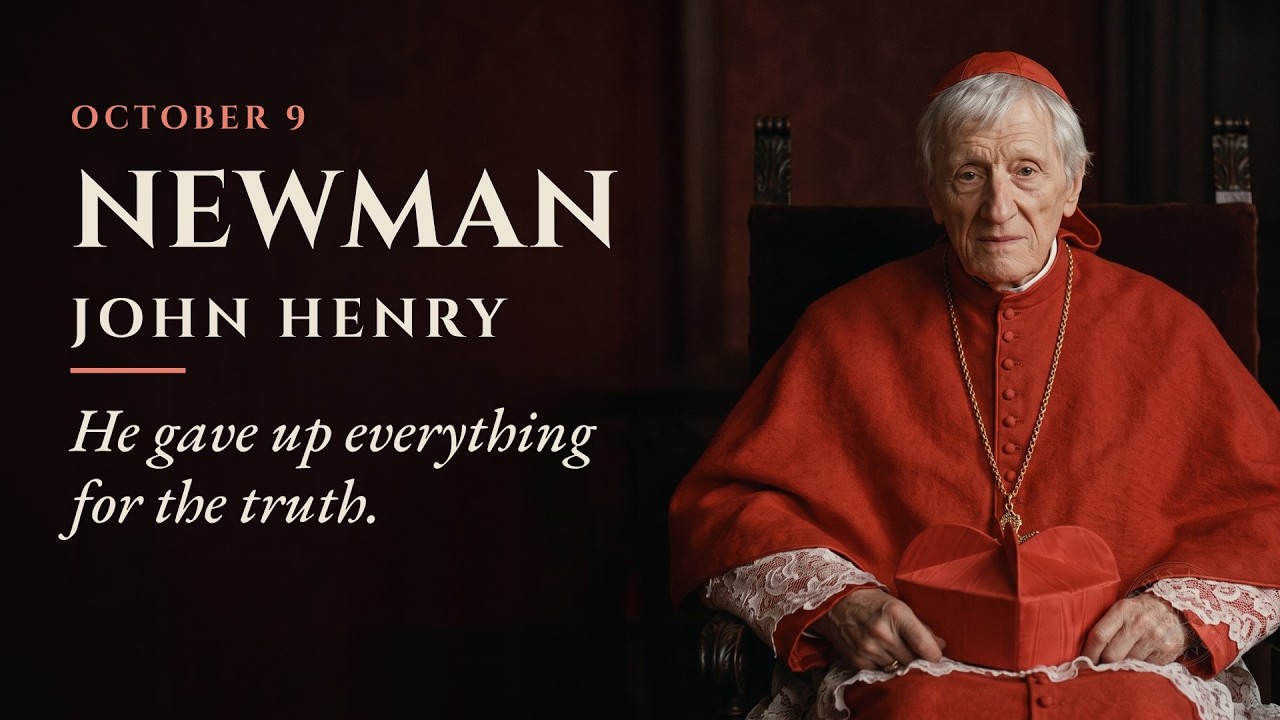
An Italian priest, soaked from head to foot, comes close to the fire to dry himself. It is nearly midnight. A door opens, and the man who comes in falls to his knees before him. It is John Henry Newman. An Anglican clergyman, he had preached for years from the pulpit of the University Church in Oxford. To reach that room, he had given up that pulpit, the parish he loved and some very dear friends. That night he asks to enter the Catholic Church.
The next day he was received into it, and that is why every ninth of October the Church celebrates him as a saint and a Doctor of the Church. People still pray his verses "Lead, Kindly Light", which do not ask to see the whole road, because one step is enough.
Two healings that the Church examined and approved as miracles bear his name. And when his grave was opened in 2008, it did not hold what anyone expected.
Himself and His Creator
In the autumn of 1816, Newman was a fifteen-year-old schoolboy at Ealing, on the edge of London. He was the eldest of a banker's six children, and that same year his father's bank had failed. In his country, the Church of England was the Church of the State. Catholicism was thought of as a "very un-English" communion that, so people believed, survived by cunning and intrigue. And the boy himself, from a book he read at the time, came to believe that the Pope was the Antichrist. The man who, almost thirty years later, would fall to his knees at Littlemore stood at that time at the opposite pole.
But that autumn, with his family's fortunes in ruins, a clergyman talked with him and put books into his hands. For the first time, the boy received a definite creed. It was an inward conversion, and he would always be more certain of it than that he had hands and feet. From then on he rested in the thought of two, and two only, absolute and luminously self-evident beings. They were himself and his Creator.
In that same season he understood that it was God's will that he should lead a single life.
The following year he went up to Oxford as a student. There, the first name he heard spoken with reverence, rather than admiration, was that of John Keble, a young clergyman of Oriel. One day, out walking, a friend exclaimed, "There's Keble!" And Newman looked at him with awe.
In the spring of 1822, Oriel sent for him. He was playing the violin when the messenger came. He had been elected a Fellow, which gave him a place and a livelihood in the college. "Very well," he replied, and went on playing. As soon as the man had gone, he flung the violin aside and ran down the stairs. On the way, tradesmen who had already heard the news bowed to him, and fifty years on he had still not forgotten their faces.
He was expected in the college tower, to shake hands with the Provost and the Fellows. It was the first time he had ever been in the same room as Keble. He bore it all until Keble took his hand; then he felt "so abashed and unworthy of the honour" that he wanted to sink into the ground. The bells of three towers rang for his election, "and I had to pay for them," he confided to his mother.
There he would also find a companion who would change the way he prayed. His name was Hurrell Froude, and his health was so frail that in the end it would take them both to the south of Europe.
A Work to Do in England
Over the years, his friendship with Froude grew close. Newman was already a priest of the Church of England and Vicar of St Mary's, the University Church. This friend fixed deep in him a love for the Blessed Virgin. Little by little, Froude also led him to believe that Christ is truly present in the Eucharist, beneath the bread and wine.
When Froude's health broke down, Newman set out with him and Froude's father for the south of Europe, in search of a climate that might bring him relief. They traveled to Malta, Corfu, Sicily and Rome. In Rome they came to know Nicholas Wiseman, a young priest of the English College there. On parting, Wiseman expressed the wish that they might come back. Newman answered with great gravity, "We have a work to do in England."
Afterwards he went back to Sicily alone, and his sense of a mission grew stronger. He made his way into the interior of the island, and at Leonforte he fell ill with fever. The servant who was traveling with him thought he was dying and asked for his last directions. Newman gave them. But he kept saying, "I shall not die, for I have not sinned against light, I have not sinned against light." He was never able quite to make out what he had meant.
He lay nearly three weeks in bed at Castro-Giovanni. On the morning he was at last to leave the inn for Palermo, he sat down on his bed and began to sob bitterly. To the servant who had nursed him he could only say, "I have a work to do in England."
He did not die in Sicily. His grave would be in England, and one day it would hold a surprise of its own.
Homeward bound and still convalescent, he wrote some verses he called "The Pillar of the Cloud", after the pillar of cloud that led Israel through the desert. Today they are known by their opening words, "Lead, Kindly Light". He dated them at sea, on the sixteenth of June 1833.
The man who had wept at the inn does not ask to see the end of the road. "Keep Thou my feet," he prays; "I do not ask to see the distant scene; one step enough for me." And the poem closes with the morning, when the angel faces he had loved long since, and lost awhile, smile again.
In July he landed in England at last. And he found that his friends had begun something without him.
The Shadow of a Hand on the Wall
Some of his Oxford friends, on seeing him, were not sure it was really him, and hesitated before they spoke to him. He came back with the joy of health restored and of home regained. But he also carried a question that had troubled him for a long time. England was coming out of the great upheaval of political reform, and he did not know how to keep his Church from being "liberalized", that is, given over to the ideas of the day.
Keble, Froude and others were already writing to one another and joining their counsels. One Sunday in July, Keble went up into the University pulpit and preached the sermon that would be published as "National Apostasy". Newman always kept that day as the start of the religious movement that history would call the Oxford Movement.
Neither he nor Froude had a reputation to lose. "Froude and I were nobodies." One colleague wanted a committee, with rules and meetings. Newman did not wait. On his own initiative he began a series of short pamphlets, the Tracts for the Times, and he was their editor and their chief author. When some friends in London wanted them stopped, he was ready to give way. Keble and Froude were not. They were angry with him for yielding, and argued hard for the Tracts to go on.
Six years later, those tracts had made him the leading figure of the movement. For more than two years he had set aside his controversy with Rome. In the middle of June 1839, with the Oxford Long Vacation just begun, he immersed himself in the history of the Monophysites. They were Christians of fourteen centuries ago, cut off from the rest of the Church by the way they understood Christ. And there, for the first time, a doubt came to him about the soundness of his own Church. In that ancient dispute he saw his own age reflected. "I saw my face in that mirror, and I was a Monophysite."
In September, some friends put into his hands a review with an article by Wiseman, which compared his Church to another ancient group cut off from the rest. He did not see much in it. But a friend who was still a Protestant pointed out to him some words of Saint Augustine quoted there, and repeated them to him again and again:
"Securus judicat orbis terrarum", the judgment of the whole world is sure.
When his friend had gone, the words kept ringing in his ears.
They sounded to him like the "Tolle, lege", "take up and read", that Augustine had heard before his conversion. The middle way he had defended for his Church, between Rome and the Reformation, was "pulverized".
He told only two close friends. Then he grew calm again, and his old convictions held firm.
But he had seen "the shadow of a hand upon the wall". And one who has seen a ghost cannot live as if he had never seen it.
The ghost would come back. Two years later, a tract of his own, Tract 90, would turn the whole of Oxford against him.
Three Blows
In Tract 90, Newman read in a Catholic sense the Thirty-Nine Articles that summed up the faith of the Church of England. It came out in February 1841, and an immense commotion followed. The Heads of the Oxford colleges, meeting as their board, called that reading an "evasion".
Newman told a friend that they had just done a violent thing. "Do not think this will pain me," he added; "my shoulders shall manage to bear the charge." To Edward Pusey, professor of Hebrew and his friend for nearly twenty years, he also assured him that he would withdraw the tract if the bishop wished it. And if they demanded it, he would resign his parish.
His first impulse was to obey without a word. One Sunday, the Bishop of Oxford sent word that he should write him a letter "at once". On Monday he wrote it. On Tuesday it was at the printer's. On Wednesday it came out. By Thursday it was already in London. And the Tracts were to be stopped.
That summer he took refuge in Littlemore, a village near Oxford, far from all controversy. There he meant to translate Saint Athanasius, the great defender of faith in Christ against the Arians. But between July and November he received three blows which broke him.
The first came from his books. He had barely begun to translate when, in the history of that ancient crisis, "the ghost had come a second time". The second came from the bishops, who one after another censured him in their pastoral charges, in a series of condemnations that would go on for three years. The third was a bishopric for Jerusalem, being prepared by the Archbishop of Canterbury. An Anglican bishop was to be consecrated to govern the Lutheran and Calvinist congregations of the East. That blow finally shattered his faith in the Anglican Church. He sent a solemn protest to the Archbishop and to his own bishop.
From then on, as an Anglican, he was "on his death-bed", though he would come to realize it only by degrees.
In those years an Irish priest from the seminary at Maynooth, Doctor Russell, came to see him in Oxford. He did not speak to him of controversy. Afterwards he sent him sermons by Saint Alphonsus and some Roman books of devotion, and let him alone. That gentle man had, perhaps, more to do with Newman's conversion than anyone else. In those pages Newman found that the Catholic Church lets nothing stand between the soul and its Creator. Between man and his God, all is face to face. "He alone creates; He alone has redeemed."
In April 1842 he settled at Littlemore with a few friends, in a former coaching house. The stable became a library; the granary, cells. They prayed, studied and fasted.
Even there they would not leave him in peace. One day, as he came in through his own door, he found a party of undergraduates inside. Heads of colleges rode their horses round those poor cottages, "as mounted patrols". "Why can they not let me die in peace?" he asked himself. Wounded animals creep into some hole to die, and no one begrudges them that.
A newspaper reported as fact that an "Anglo-Catholic Monastery" was going up at Littlemore, with cells, chapel, refectory and cloisters. His bishop wrote to him. He was not accusing him, but he asked for an explanation. Newman answered him by letter. There was no monastery. There was no chapel. There was no refectory, hardly even a dining-room. "The 'cloisters' are my shed connecting the cottages." For at least thirteen years he had longed for a more regular religious life. And he found it very cruel that sacred matters, between himself and his conscience, should be made a matter of public talk.
In that watched silence another answer began to ripen, one that would no longer fit in a letter. The time was coming to speak through acts, and those acts would cost him the pulpit of Saint Mary's.
Speaking Through Acts
The first of those acts was a public retraction of the violent charges he himself had made against Rome. It came off the press in February 1843, after three months of deliberation. The idea of the Pope as Antichrist, which he had carried since he was fifteen, stained his imagination until that very year, 1843.
That summer, a guest who had been living in his house at Littlemore for a year became a Catholic. He had promised Newman to stay quietly in the Church of England for three years. Newman told his bishop. If he was to be held responsible for that broken promise, he felt he could no longer go on serving that Church.
He went to London to resign Saint Mary's, because in Oxford he could not legally do so. He asked to keep Littlemore. There he had built a church and a sort of parsonage; he had made it a parish, and he loved it. The request was refused. To a friend he confided the deeper reason. He believed that the Church of Rome was the Catholic Church, and that his own was not part of it.
A week after resigning, he went up into the pulpit at Littlemore. It was the anniversary of that church's consecration, and it was his last Anglican sermon. He returned to the same verse of the Psalms he had preached on the very first time, nineteen years before, the verse of man going forth to his work and to his labour until the evening.
He spoke of Christ, taking leave of his disciples at a supper. He grieved over a "mother" who bears children and dares not own them. And, without naming himself, he asked that if anyone had ever helped them, they would remember such a one in time to come, though they heard him no more, and pray for him.
Two years of waiting followed. He lived as an ordinary member of the Church of England, no longer acting as a clergyman and never attending a Catholic Mass, and he did so on principle, because he had never been able to understand "how a man could be of two religions at once".
One day at Littlemore, his first book of Latin verses, from when he was nine, came back into his hands. As a child he used to cross himself on going into the dark, without knowing who had taught him. On one of those pages he had drawn a cross and what looked like a rosary. It took his breath away.
In Oxford, during the end-of-year ceremonies of 1845, Pusey still would not believe that he was going to lose Newman. "I trust that we shall keep him in the end," he told a friend.
In October, word reached Littlemore that an Italian Passionist priest, Father Dominic Barberi, would be passing that way. Newman already knew what he would do once Father Dominic stood before him.
The Night at Littlemore
Newman took up his pen on the afternoon of October eighth, 1845 and wrote to several friends, "I am this night expecting Father Dominic, the Passionist… I mean to ask of him admission into the one Fold of Christ." He added that Father Dominic knew nothing of his intention.
From his youth, that Passionist had set his heart on the countries of the North and on England, and he had waited almost thirty years to set foot there.
Then, in the old coaching inn, there was nothing left but to wait.
It was an hour before midnight when Father Dominic reached the house. He was soaked to the skin, and he planted himself before the fire to dry off.
Then the door opened.
Newman was at his feet, on his knees. He asked him to hear his confession and to receive him into the Catholic Church.
That same night Newman began his general confession, setting before God the sins of his whole life. It lasted many hours.
In the little chapel of the house, the following afternoon, Father Dominic conditionally baptized him, in case the baptism of his infancy had been doubtful, and received him "into the one fold of the Redeemer". Twenty-nine years had passed since that autumn at Ealing when he knew himself alone with his Creator.
From then on he lived in peace, like one coming at last into port after a rough sea. There would still be hard questions, and he knew that ten thousand difficulties do not make one doubt.
But that peace did not spare him the cost. Wiseman was calling him to his side, and he had to leave Littlemore. In January he confided to a friend, "You may think how lonely I am." For twelve hours a verse of the Psalms had been sounding within him:
"Obliviscere populum tuum et domum patris tui", forget your own people and your father's house. Leaving was "like going on the open sea".
The last Saturday and the last Sunday he spent in his house quite alone, as in the first days when he had come to live there.
On the Sunday night he was already sleeping in Oxford, at the Observatory, in the house of a very dear friend. Several friends came up to see him for the last time. Pusey came up too, the friend who had trusted they would keep him, to say goodbye.
He called on his old tutor, and in him took leave of Trinity, his first college, which "had never been unkind" to him. Snapdragon, a wild flower, grew on the walls opposite his freshman's rooms, and for years he had taken it as a sign that he would live in his University until death.
On the morning of Monday, February twenty-third he left the Observatory. For thirty-two years he would see nothing of Oxford but its spires, far off, as they are seen from the railroad.
Wiseman, the same man who had said goodbye to him in Rome thirteen years before, was now sending him back to Rome, to discover what kind of Catholic priest he was to be.
Companions with Plenty of Good Humor
In Rome, Newman turned that question over again and again. He weighed several paths, and at last chose a family of priests, that of Saint Philip Neri, the Oratory. And he chose it with England in mind. In a letter written in Latin he set out his plan, and in it he spoke of the great English towns and of Birmingham.
The answer came at the end of February the following year. Pius IX was delighted, and he did more than approve the plan. He proposed that all who could should come to Rome. He would find them a house, they would make their novitiate together and return to England together. To every request the Pope answered in Italian, "Siano tranquilli", be at ease, "I will do everything."
That common life needed companions, and Newman knew the kind he wanted. Men with plenty of good humor, because without high spirits an Oratory would be "like bottled beer without a cork".
And they needed a house. The Pope himself chose it, Santa Croce in Gerusalemme, "un bel sito", a beautiful spot. Newman loved the name. It was there, as tradition has it, that Saint Helena brought the Cross and earth from Calvary.
If the Church had a centre, they were going to live in it, on the soil of Jerusalem in the heart of Rome. There were seven of them, and there they began their novitiate together.
Before going home, they had to become priests. In a cardinal's private chapel, with their companions as witnesses, Newman and his friend Ambrose St John received the subdiaconate and the diaconate within a few days. At the end of May they were ordained priests together.
Two weeks later, Newman said Mass in the room of Saint Philip Neri at the Chiesa Nuova, the room of the saint whose family he had chosen. He knew now what kind of priest he was going to be. Back in England, the Oratory put down roots in Birmingham, where Wiseman sent him.
There remained the work he had sensed in Sicily, and he found it at Bilston, an English town. In September 1849 cholera broke out there. The local priest could not cope. He was carrying the stricken to the hospital on his own back.
Newman went with Ambrose St John and a brother of the Oratory to lend him a hand. The epidemic abated almost as soon as they arrived. But people remembered for a long time how readily they went toward the plague for a priest who had no authority over them.
Soon he was sought outside England too. The bishops of Ireland wanted a Catholic university in Dublin, and in 1854 it was Newman they called to be its rector. For it he wanted a church that would be "a large barn, decorated in the style of a basilica, with Irish marbles". In its golden apse presides Our Lady, Seat of Wisdom.
Four years later he gave up the rectorship and came home to the Birmingham Oratory, in Edgbaston. There, in 1859, he was asked a favour by two bishops. That favour would lead someone in Rome to regard him as a dangerous man.
The Most Dangerous Man in England
The favour concerned a Catholic review, The Rambler. To head off a scandal over it, Cardinal Wiseman and William Ullathorne, Bishop of Birmingham, asked him to run it.
Newman agreed. In May he wrote in its pages that in practical matters the laity, too, might be heard, just as they had been consulted before it was proclaimed that the Blessed Virgin was conceived without sin, the Immaculate Conception. A professor suspected heresy. Ullathorne spoke with Newman, asked him to give up the review, and asked him, in words to this effect, "Who are the laity?"
Newman obeyed at once. He had never resisted, nor could he resist, "the voice of a lawful superior".
But the article reached Rome by another road. An English bishop denounced it, with a faulty Latin translation, to the Roman office that at the time oversaw the Church in England as mission territory. That office had authority over Newman. The objections raised there never reached Newman. With no answer from him, the cardinal who presided over that office took him to be disobedient.
From the papal court, an English prelate, Monsignor George Talbot, wrote home that a cloud hung over Newman, and called him "the most dangerous man in England".
In those years Newman confided to a friend that it might be God's will for his work to be done a hundred years later.
In January 1864 the accusation came out into the open, and from outside. Charles Kingsley, a clergyman of the Church of England, wrote in a magazine that truth for its own sake had never been a virtue with the Roman clergy, and that "Father Newman" taught as much. Newman protested. Kingsley went so far as to reply that he would doubt every word Newman said, for fear of being the dupe of "some cunning equivocation".
Newman called it "poisoning the wells", because if that were accepted, no one could ever again drink from anything he said.
Within half an hour he saw what to do. He would tell the whole history of his mind, from the child who crossed himself on going into the dark and the sick man sobbing in an inn in Sicily to the man on his knees at Littlemore. "I will vanquish," he said, "not my accuser, but my judges."
So the Apologia pro vita sua, the defence of his life, was born. The suspicion of double-dealing did not survive its reading.
That summer Monsignor Talbot called at Edgbaston looking for him, and afterwards wrote to him. He invited him to preach the Lenten sermons at his church in Rome, to a Protestant audience more educated than any to be found in England.
Newman replied, "However, Birmingham people have souls; and I have neither taste nor talent for the sort of work which you cut out for me."
Three years later, Ambrose St John, his companion at ordination and in the cholera at Bilston, went to Rome and made it clear that Newman had never received the objections. Pius IX asked the Archbishop of Dublin for a report on Newman himself, and it proved highly favourable. The cloud had lifted.
A call from Oxford still lay ahead.
Had He Lived So Long for This?
He came back to Oxford at the end of February, at the age of seventy-seven. Thirty-two years had passed since the morning he had left. Trinity, the college with the snapdragon growing on its walls, had elected him its first Honorary Fellow. This time the city was no longer a cluster of spires glimpsed far off from a railroad car window.
The following winter, on a Saturday in February, at his home in Birmingham, one of the Oratory fathers brought him a proposal in confidence. Newman and Ullathorne were both unwell, and this father went back and forth between them. The new Pope, Leo XIII, wished to make him a cardinal. Ullathorne, the same bishop who had asked him to give up The Rambler, had put his name forward.
By the next day, Newman had already replied. He did so with gratitude, and with modest objections against himself. From that humble letter a rumour was born, and by the middle of the month The Times had reported in London that Newman had declined the purple.
He had not declined. What he did want was to receive the biretta, the red cap of a cardinal, from the Pope's own hand, and not in England.
In Rome there was an objection. Someone pointed out that he had never held any of the offices from which cardinals are usually drawn. The Pope replied that he himself would set that precedent. Newman would be a cardinal without ever having been a bishop.
Shortly after his election, Leo XIII had told Commendatore De Rossi to wait and see his first cardinal, because in him people would see what his pontificate was going to be. De Rossi passed this on to those who were with Newman in Rome.
By about eleven in the morning, the rooms of the Palazzo della Pigna were full of English and American Catholics. It was the twelfth of May, 1879. The messenger arrived with the official sealed notification creating him Cardinal Deacon of San Giorgio al Velabro, an ancient church in Rome. Newman broke the seal and handed it to Bishop Clifford, who read it.
Then he spoke. He began in Italian and moved into "my own dear mother tongue". He stood the whole time, and his voice was strong and clear.
"It was a great surprise," he said. He had been through many trials, but they were over. And in front of them all he asked, "Was it possible that I had lived so long for this?"
Afterwards, the Cardinal went back to his rooms in Birmingham. Ten years later he would still be driving out through the snow, because someone needed his advice.
The Silk Handkerchief
In a large factory in Birmingham, all the workers were girls. The owners, who were Quakers, gathered the whole workforce every day to read the Bible and talk about it. The local Catholic priest had forbidden the Catholic girls to attend, and the owners wanted to know what the Cardinal thought.
It was November 1889, and snow covered the streets. He was eighty-eight years old. He would not hear of waiting for another day. He got into the carriage and went to see them. Back in the carriage, he said, "If I can still do work like this, I am happy and content to go on living." A few days later, a room in the factory was set aside so that the Catholic girls could pray on their own.
On Christmas Day he celebrated his last Mass. His sight was failing him, and so was his strength. He was afraid of losing his balance as he took up the chalice with the Blood of Christ, and reverence forbade such a risk. So he stopped celebrating.
He did not stop preparing. He learned by heart a Mass of the Blessed Virgin and a Mass of the Dead, and every day he went through one or the other, with all its ceremonies. He hoped that the clearer light of spring would let him return to the altar. That day never came.
When he could no longer pray the breviary, the daily prayer of a priest, he said the rosary more than made up for it. In the end he had to give that up too, because he had lost the feeling in his fingertips.
Many years before, when he seemed to have been pushed aside and was very poor, someone had left a silk handkerchief at his door. It was a poor person whose name he never knew, and the handkerchief came with a message of respect. He kept it for more than thirty years.
In August 1890, when he took to his bed expecting to die, he asked for it to be brought to him, and he put it on. The doctors said he could quite well do without it. He received the last sacraments.
On the night of 11 August, at a quarter to nine, he died in his room at the Oratory, still wearing that poor person's handkerchief.
Eight days later they carried him to the Oratory's small cemetery at Rednal, in the hills near Birmingham. Thousands of people lined the streets as his body passed. As he had asked, they buried him in the grave of his friend Ambrose St John, his companion in Rome and at Bilston.
On the pall that covered the coffin was his motto as a cardinal:
"Cor ad cor loquitur", heart speaks to heart. For his grave he had chosen other words:
"Ex umbris et imaginibus in veritatem", out of shadows and images into the truth. The man who one summer had seen the shadow of a hand on the wall asked, over his own grave, for the whole truth.
For more than a century, the cemetery at Rednal kept its silence. In 2008, the Church opened that grave.
Out of Shadows into the Truth
On the hillside at Rednal, on the second of October, the feast of the Guardian Angels, the men digging expected to find a lead-lined coffin. It turned out to be made of wood, and the ground there was very wet.
The brass plate came to light, with his name and his title of cardinal. Pieces of brass, wood and cloth came to light too. Of the body almost nothing remained. The Oratory had always kept a few locks of his hair.
The priest in charge of his cause then recalled some lines of Newman's from The Dream of Gerontius, in which the soul that leaves the body feels a lightness beyond words. And he saw a providential meaning in that soil. In November, those locks of hair and what had been found in the grave were taken to the church of the Birmingham Oratory.
Both before and after that grave was opened, there were people who called on Newman. Jack Sullivan, a man from Massachusetts, was almost paralyzed by a serious disorder of the spine. He asked for Newman's intercession and, by his own account, recovered suddenly and completely. Soon afterwards he was ordained a permanent deacon.
The Church examined that cure and approved it as the miracle for his beatification. When Benedict XVI declared Newman Blessed in Birmingham, close to the streets where the crowds had said farewell to his body, it was that deacon who proclaimed the Gospel.
Years later, in Chicago, an expectant mother, Melissa Villalobos, was bleeding alone at home, with no strength left to call for help. She said, "Cardinal Newman, help me." The bleeding stopped at that very moment. That afternoon the doctors found that the tear causing the bleeding had disappeared, and her daughter was born healthy.
The doctors the Church consulted judged that cure to be instantaneous, complete and lasting, and the Church approved it as the miracle for his canonization.
When Pope Francis proclaimed him a saint in St Peter's Square, that little girl from Chicago was there, five years old.
In 2025, Pope Leo XIV proclaimed him a Doctor of the Church, a teacher whose doctrine the Church holds up to all the faithful, and co-patron of education alongside Saint Thomas Aquinas. In his years under suspicion, he had left his work in God's hands, for a hundred years later if need be. It had already carried weight at the Second Vatican Council. His mark could be seen there, in listening to the laity, in a doctrine that grows while remaining the same, and in conscience as the echo of God's voice. The memorial of Saint John Henry Newman was set for the whole Church on the ninth of October, the anniversary of that afternoon at Littlemore.
The house at Littlemore now belongs to the Oratory, and over the years others too have been received into the Catholic Church there.
In the little chapel where he was received, Mass is still celebrated. There, where a weary man at last entered the one Fold of Christ, the Church now asks with him to be led from shadows and images into the fullness of truth. And it hears once more his familiar words, "God has created me to do Him some definite service."
The light he asked for, one step at a time, still shines on the path of those who pray with him.
Saint John Henry Newman, priest and Doctor of the Church, you who followed the kindly light one step at a time, who left everything for the truth that night at Littlemore, and who served the people of Birmingham with patience, obtain for us an honest conscience, courage to take the step that God shows us, and faithfulness in the service he has entrusted to us, until, out of shadows and images, we come into the truth. Pray for us. Amen.