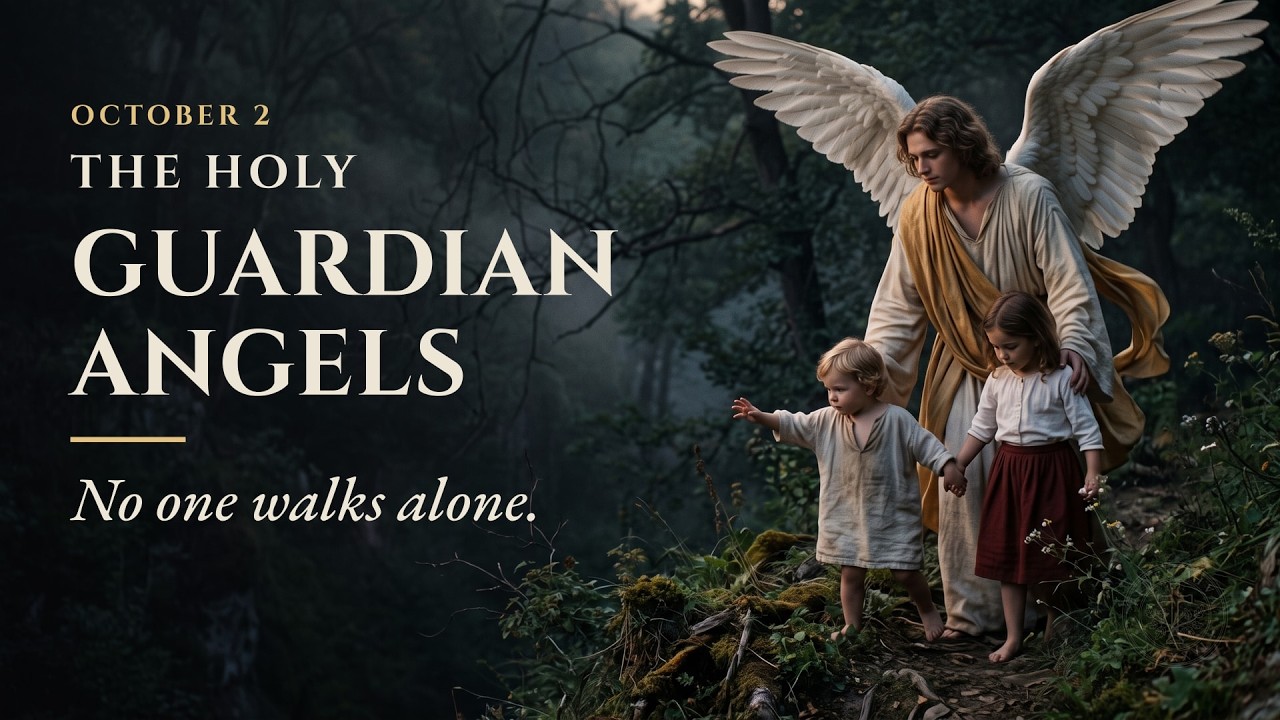
At night, in Jerusalem, someone knocks at the door of a house where people are praying for Peter. A girl recognizes his voice and runs to tell the others without opening the door. Inside, the answer comes calmly, as if everyone already knew: it must be his angel.
This is the certainty the Church celebrates every October 2, on the memorial of the Holy Guardian Angels, the day the Church remembers them in its Mass and in its prayer. Many people first prayed to them as children with "Angel of God, my guardian dear." The Church believes that this protection surrounds every life, from its very beginning to the hour of death.
There is a reason the date is October 2. The Church recognizes a real help that these angels give. And Padre Pio wrote down what happened the day he scolded his angel for arriving late.
But the first question still waits at that closed door: what did those Christians know that made them answer that way?
The Night the Cell Filled with Light
King Herod has had Peter locked up, and he plans to bring him before the people as soon as day comes. The Church in the city is still small, and now it is under threat. While the streets sleep, that community keeps praying to God for him without stopping. Prayer is the only thing it has in its hands.
There is no light in the cell. Peter is asleep between two soldiers, bound with two chains. On the other side of the door, more guards keep watch. At daybreak they will bring him out, and still he sleeps.
Into that darkness an angel of the Lord appears, and light fills the cell. The angel taps Peter on the side, wakes him and says, "Get up quickly!" The chains fall from his wrists.
What follows are ordinary instructions, the kind anyone hears before leaving the house: "Put on your belt and your sandals." And then: "Wrap your cloak around you and follow me." Peter does as he is told. He follows the messenger, thinking he is seeing a vision.
They pass the first guard post. They pass the second. Ahead stands the iron gate that leads into the city. And the gate opens by itself. They step outside. Together they walk the length of a street. Then, suddenly, the angel is gone.
Peter is left alone in the dark street, the cloak around his shoulders. Now he realizes that none of it was a dream, and he says so aloud: "Now I know for certain that the Lord has sent his angel."
The Church would always see in that night a sign that the angels watched over it from its very first steps.
Sure of what has happened, Peter goes to find his friends. He goes to the house of Mary, the mother of John Mark, where many are still gathered in prayer, and he knocks at the door. A young girl named Rhoda comes to the other side. She listens. She knows that voice. She is so overjoyed that she forgets to open the door and runs inside to tell everyone, leaving Peter outside, still knocking.
Inside, no one believes her. "You're out of your mind!" they tell her. Rhoda insists: it's Peter, he's at the door. And the people gathered there answer, "It's not him; it's his angel."
They say it without stopping to explain, the way people mention something everyone knows. Meanwhile, Peter keeps knocking. When at last they open the door and see him standing there, they are frightened. He tells them how the Lord has brought him out of prison. Then he leaves for another place.
That night, the iron gate opened by itself, while the door of a friendly house was slow to open. The certainty spoken behind that closed door came from a saying of Jesus, spoken with a child standing in the midst of his disciples.
A Child in the Midst and the Face of the Father
In Capernaum, by the Sea of Galilee, the disciples come to Jesus with a question: "Who is the greatest in the kingdom of heaven?"
Jesus does not answer them with a name. He calls a child over and places him in their midst. Then he speaks to them with the little one right there, in full view of everyone: "Amen, I say to you, unless you turn and become like children, you will not enter the kingdom of heaven. Whoever humbles himself like this child is the greatest in the kingdom of heaven. And whoever receives one child such as this in my name receives me."
The answer to who is the greatest is standing right in front of them.
With the child still there, Jesus adds a warning: "See that you do not despise one of these little ones, for I say to you that their angels in heaven always look upon the face of my heavenly Father."
Then he tells them about a shepherd who leaves the ninety-nine sheep to go in search of the one that has gone astray. And he ends like this: "It is not the will of your heavenly Father that one of these little ones be lost."
Those angels keep their gaze fixed on God and, at the same time, watch over the ones no one else even notices. This is the word those Christians in Jerusalem carried with them when they spoke of "his angel."
The Church did not let that word be lost. Centuries later, in Cappadocia, in the heart of present-day Turkey, the bishop Basil of Caesarea puts it in writing: "Beside each believer stands an angel as protector and shepherd leading him to life."
Basil had the believer in mind, the Christian. Another voice from the same age, that of Saint Jerome, a great scholar of Scripture, looks even further back, to the very first day of each life.
Commenting on this same Gospel, Jerome pauses in wonder: "How great is the dignity of souls, since each one, from the moment of birth, has an angel appointed to guard it."
Both voices live side by side within the Church.
What Basil and Jerome wrote, the Church still teaches today in clear words. It professes that angels exist, and it does so as a truth of faith: something that belongs to what it believes, not a pious opinion. They are spirits without bodies, with intellect and will, personal and immortal.
The word "angel" does not say what they are, but what they do. It is the name of their office: to serve God and to carry his messages. And at the center of that invisible world stands Jesus Christ. The angels belong to him, and they serve him.
The Church also teaches that human life, from its first moment until death, is surrounded by their watchful care and their intercession, which means their protection and their prayer. That is why this devotion begins in childhood and stays with the old as much as with the young.
That each person has an angel of their own is something the Church has believed and taught since ancient times, in words like Jerome's, though it has never proclaimed it a dogma. And the wings and white robes in paintings and statues are the language of art for speaking of what cannot be seen, never a portrait of anyone.
That watchful care reaches all the way to the final hour. Before that hour lies a whole lifetime, and it still remained to be said how one prays to this guardian and what help he gives. In the twelfth century, a monk's poem and a Lenten sermon said it.
A Poem in Canterbury, a Sermon in Clairvaux
In Canterbury, a Benedictine monk named Reginald is writing, in verse, the life of Malchus, a saint from the first Christian centuries. In the middle of those pages he pauses and leaves something more personal: a poem addressed to his own guardian angel.
What had been said in Jerusalem about someone else, "it is his angel," the monk now says about himself. The first lines of his poem call the angel "my guardian," in words very close to the prayer many children learn before any other.
"Angele Dei, qui custos es mei": Angel of God, who are my guardian. That is how the prayer begins in Latin. And right away it asks for four things that fit within a single day: to light and guard, to rule and guide.
For a long time people said these words came from Saint Anselm, who lived in Canterbury in those same years. Most likely they grew out of Reginald's poem, and the hand that gave them their final form remains unnamed. The prayer itself passed from one person to the next and found its way into many languages.
In that same century, at the Abbey of Clairvaux, an abbot devotes an entire Lent to a single psalm. He is Bernard, and he preaches seventeen sermons on it to his monks. In one of them he dwells on the verse that says God has given his angels charge over the just, to guard them in all their ways.
That verse has an uncomfortable history: it is the very one the devil used to tempt Jesus. Bernard reads it the opposite way from the tempter.
He marvels at what God has done for man, and he says so to God directly: "You send him your Only-begotten, you pour out your Spirit upon him, you promise him your glory." After the Son, Jesus Christ, and after the Spirit, God still places his angels at our side, because "heaven neglects nothing that can help us."
So what help does a guardian angel give? Bernard answers with three words. Reverence, for his presence. Devotion, for his kindness. Trust, for his protection. And he carries the first of them to where no one is watching: "Anywhere, in any place, even the most hidden, show reverence to your guardian angel."
When temptation comes, he counsels calling on the guardian. And before a road that is long and full of dangers, he puts a question to his monks: "They are faithful, they are wise, they are mighty. Why do we tremble?"
That is why the Church calls Bernard a great teacher of this devotion. Every October 2, the Church reads a passage from that sermon once again in the Liturgy of the Hours, the prayer that marks the hours of the day. It is a day that Rome would take centuries to place in its calendar.
The help the Church describes today carries the same spirit as the help taught at Clairvaux. It lies in gratitude to God, in the quiet composure of someone who knows they are accompanied, and in a serene trust when difficulties come.
Bernard asked for reverence even in the most hidden corner. Centuries later, it would be told of a wife and mother in Rome that her angel would not let her hide anything.
The Slap, the Golden Verse and the Archangel
What the abbot preached in his cloister, Frances lived in Rome in the fifteenth century. She was married and had three children. Her confessor, Father Giovanni Mattiotti, and those who gave testimony when her holiness was examined left an account that she had a guardian angel, and that this angel would sometimes correct her with a blow.
One afternoon, Frances is at a gathering of fashionable young women. The talk turns against people who are not there, and others are slandered. She listens and says nothing. She does not dare to defend anyone, or to get up and leave.
Suddenly the sound of a slap rings out. Everyone turns. The one with the red cheek is Frances.
Another time, it is her confessor she wants to hide something from. A blow bows her head down to the floor, and the one who is frightened is the priest.
That same angel also knows how to reward. Frances is praying the Office of Our Lady, a series of psalms and prayers in honor of the Mother of Jesus. In the middle of a verse, someone calls her. She puts down the book, answers the call without a word of complaint, and returns to her prayer.
She is called again, at the same verse. And again. And once more. Four times in all. The fourth time, when she comes back, she finds that verse written in her book in letters of gold.
Then her son Evangelista dies, still a child.
Time passes. One day the boy appears to her, surrounded by a great light. He does not come alone: beside him stands another youth, more radiant still. Evangelista tells his mother that this one will be her companion by day and by night.
He is an archangel. His face shines brighter than the sun, so brightly that Frances usually cannot look at him.
When the demons torment her too harshly, the archangel makes a gesture with his head and his eyes, and they flee. Long afterward, a Capuchin friar would describe a similar struggle in a letter.
The archangel stays with her for some twenty-four years. At the end of those years, Frances sees the Lord place a garland of olive on the archangel. And the archangel kneels before the Lord and thanks him for allowing him to care for Frances.
That woman prayed in a city that had been calling on the angels for centuries. And yet, in the calendar of Rome itself, not a single day of the year was yet set aside for the guardian angels.
How October 2 Came to Be
Rome was already praying to the angels in its Mass long before it had that day.
The plea was there. A day of its own was not.
And the push for the feast comes from below. In 1579, the Church of Córdoba writes to Rome to ask for a day for the guardian angels, and other cities in Spain ask for the same.
At first, Rome leaves it to each church to decide. In 1670, Pope Clement X extends it to the whole Church and gives it the first free day after the feast of Saint Michael on September 29: October 2.
In the early twentieth century, a Capuchin friar in southern Italy was writing letters about the very thing that feast celebrates: his own guardian angel.
A Letter to Babbo and Bells in Madrid
That friar is Padre Pio of Pietrelcina. His most intimate letters go to his spiritual director, Father Agostino, whom he calls "Babbo," which is Italian for dad. One of them tells what happened to him one day with his angel.
Evil spirits beat him, and at times Padre Pio feels close to death. One Saturday he believes that this time they will finish him off. He writes: "I no longer knew which saint to turn to; I turned to my angel." The angel keeps him waiting a while. At last he appears, the friar recounts, "hovering around me and singing hymns to the Divine Majesty with his angelic voice."
What follows he himself calls "one of those usual scenes." The friar rebukes the angel sharply for keeping him waiting so long. To punish the angel, the friar will not look him in the face. He wants to pull away, to flee, to hide from him.
"But he, poor thing, came up to me almost in tears."
The angel holds him fast. Only when the friar raises his eyes does he see the angel's face, "all grief-stricken." And he hears what the angel tells him: "I am always beside you… my affection for you will not fade, even when your life does."
An exhausted man reproaches and hides. The one sent to guard him comes close and promises to stay.
With the same frankness, Padre Pio writes to a woman he guides by letter, Raffaelina Cerase. To her he admits that he treats his angel "like one of the family," and that the angel takes no offense at all. And to Raffaelina he leaves a charge: "Do not forget this invisible companion, always present to listen to you."
A few years later, the feast leaves its mark on another life, this time in Madrid. It is Tuesday, October 2, 1928: the feast day of the Guardian Angels. A young priest, Josemaría Escrivá, is making his spiritual exercises, a few days of retreat in silence and prayer. He is staying at the residence of the Vincentians, the missionaries of Saint Vincent de Paul.
That morning he has celebrated Mass. Afterward he returns to his notes, the papers where he has been jotting down what he senses God is asking of him. And as he reads them, the light comes. He wrote it down himself: "I received the illumination about the whole Work while I was reading those papers."
That Work is Opus Dei, which means "work of God." The priest kneels and gives thanks.
Later he will remember the sound of that moment. The bells of the nearby parish, Our Lady of the Angels, were ringing out for the feast.
Josemaría had been reluctant to found anything. From that day on, however, he begins to lay the foundations.
A devotion so alive also needed care. In the mid-twentieth century, in Innsbruck, a movement arose that began to give the angels names and roles, and the Church had to speak.
What the Church Watches Over
That movement grew up around a mother, Gabriele Bitterlich, and it took this name:
"Opus Angelorum."
In 1992, the Holy See declares that the movement's theories about the names and roles of the angels are foreign to Scripture and Tradition. The association obeys: it sets those theories aside, and its statutes are approved. The Church did not snuff out that devotion: it brought it back to its proper course.
The Church knows the names of only three angels: Michael, Gabriel and Raphael, the companion of Tobias. Anyone searching for the secret name of their angel finds something simpler: a companion sent by God.
At the memorial Mass, the Church reads the promise of an angel sent ahead of a people on their journey.
Until the Hour of Death
The priest opens that Mass with the day's own prayer: "O God, who in your unfathomable providence are pleased to send your holy Angels to guard us, grant to your suppliants that we may always be defended by their protection and rejoice eternally in their company."
After the promise of the angel who goes ahead of the people, the Gospel is proclaimed: the child whom Jesus placed in the midst of the disciples. His words about the little ones ring out once more, and about their angels, who always behold the face of the Father. What was said in Capernaum is heard again at the Mass of the memorial.
What the Church asks at the altar, many families ask in a quiet voice. When they get up and when they go to bed, they pray "Angel of God, my guardian dear." Sometimes they join that prayer to the Angelus, the prayer that recalls the angel's announcement to the Virgin Mary.
That companionship reaches the last hour too. When someone is dying, the Church prays that the heavenly spirits will come to their aid. Beside a bed, between a candle and hands folded in prayer, the scene repeats what that house in Jerusalem did when it would not stop praying for Peter.
At the funeral rites, beside the Paschal candle, the flame that stands for the risen Christ, the Church sings an ancient chant as it bids farewell to the one who has died:
"In Paradisum deducant te angeli": may the angels lead you into paradise. And it also asks that they keep watch over the grave.
Saint Thomas Aquinas taught that our guardian does not leave us after death, but remains with us in heaven. Angels have no body, so there is no angel's tomb to visit and no relic to venerate. Their place is the face of the Father, and each person's road to him.
The watchful care that has accompanied a life from its very beginning arrives where the angel has been looking all along: the face of the Father.
Father of mercy, who entrusted to your angels the task of guarding us in all our ways and willed that the angels of the little ones should always behold your face: through Jesus Christ, your Son, the center of the world of angels, grant that we may live each day with gratitude, reverence and serene trust under the watchful care of our guardian angel; may he uphold us in temptation and in the night, and at the hour of our death lead us to you, to rejoice for ever in his company in your presence. Through Jesus Christ our Lord. Amen.