A young man walks across the sand with his torso bare and his hands bound behind his back. Behind him, a wide gray river; ahead, a mat of woven straw. He kneels. Around him, soldiers, military standards planted in the sand, and a handful of onlookers in silence. Weeks before, they had asked him the only question that mattered.
"Are you a faithful Catholic?"
"Yes, I am Catholic."
It is September 1846, in the kingdom of Joseon—Korea, as it was known then—and that answer costs him his head. He is twenty-five years old. His name is Andrew Kim Taegon, and he is a priest: the first of his people, and the only one.
Three months earlier they arrested him on the coast dressed in mourning clothes—a hemp tunic and a bamboo hat so wide it covered his face. That was how he had moved for months, by night, from house to house, so no one would recognize him. Now his hair is pulled back to bare his neck, and his face is exposed. He has nothing left to hide.
There is no temple. There are no bells. There is no one from his family. Only a river, a sword, and a handful of strangers.
What leads a man to answer like that, knowing what waits for him?
He was not the first from his land to pay that yes. He would not be the last.
Faith Without a Face: Books in the Shadows
Every winter at the end of the eighteenth century, a long caravan would leave Hanyang—the capital of the kingdom, the city we now call Seoul—heading north. Officials in wide coats and horsehair hats, servants, horses laden with gifts for the emperor of China. It was the tributary embassy, the only door Joseon had to the world. The kingdom stood on the teachings of Confucius, and order began at home: the son honored the father, the father honored the ancestors, and all honored the king. The wooden tablets bearing the names of the dead, venerated in every household with incense and bows, were not decoration. They were the foundation of the state. Whoever touched them touched the throne.
In Beijing, some young scholars were looking for something else. The Jesuit missionaries at the imperial court had written in classical Chinese treatises on science and on religion: they spoke of a God who had become human. In Korea it was called seohak—"Western learning." It was bought like any other knowledge, hidden among clothes, and brought home in saddlebags.
Back in Joseon, they read them together. A room with heated floor, a lamp burning oil, sliding doors of paper. Young yangban—the lettered nobility—bent over the pages, arguing over each character. They had gone looking for knowledge and found a face. They read that there was only one God, creator of all. That God had a name: Jesus Christ. That He had died for men, and that before Him the nobleman and the servant, the man and the woman, were worth exactly the same. In a kingdom of castes, that was an earthquake said in a low voice. They believed. And then they ran into the problem: nowhere in all of Korea was there anyone who could baptize them.
In 1784, one of them—Yi Seung-hun—traveled to Beijing with the embassy and sought out the missionaries. He asked for baptism. They gave him the name Peter. And when he returned to Hanyang, he did the only thing he could do: he baptized his friend Yi Byeok himself, and then the others, one by one. This is how the Church of Korea was born. Without a temple, without clergy, without a single missionary who had ever set foot on its soil. They even appointed among themselves who would serve as bishop and priests. When they consulted Beijing and were told that it was not valid, they obeyed and stopped.
The price came in 1791. In Jinsan, the mother of a convert, Paul Yun Ji-chung, died. A son was to place her tablet and make the prescribed bows. He did not. To the state, that was not an opinion: it was denying the father, and denying the father meant denying the king. He and his cousin James Kwon Sang-yeon were beheaded in Jeonju. The first ones.
An empty field, and the earth drinking the blood.
The community did not fall apart. It grew. In 1794, a priest finally entered, hidden: a Chinese man, James Zhou Wen-mo. For seven years he said Mass in private rooms and heard confessions in whispers; in the whole kingdom there was no other. In 1795, in a family already Christian, a boy was born named Paul Chong Hasang. His father, Augustine Chong Yak-chong, had given up his career in government. Around 1799 he wrote something no one had written before: a catechism in hangul, the simple script of the common people, for those who could not read Chinese characters. He called it the Jugyo Yoji. The faith that had entered through the books of the learned began to speak in the language of the servants.
In 1801 the kingdom struck. Under the regency of Queen Jeongsun, the persecution called Sinyu broke loose. The priest Zhou was executed. Augustine Chong Yak-chong was beheaded; his son Paul was six years old. Hundreds died. And a young Christian, Hwang Sa-yeong, wrote on a strip of silk, in tiny characters, a letter to the bishop of Beijing asking that foreign powers intervene. The letter was intercepted. For the court, Christian faith became what it feared most: a betrayal. And the law hardened for decades to come.
And yet, in rooms with paper doors, with lamps burning low, they kept gathering. No one guided them, and no one outside knew they existed. How does a faith like that survive? They knew only part of the answer: they kept believing, they kept baptizing their children, and they kept waiting for someone who had not yet come.
The Plea and the Wait: The Layman Who Crossed Borders
The Yalu River freezes in winter, and across the ice you can walk on foot. At the back of the caravan, a servant twenty-one years old leads a horse and walks with his head down, among the servants no one looks at twice. It is Paul Chong Hasang, the boy who in 1801 lost his father. No one sent him from the palace: he has hired himself as a servant and interpreter to the embassy, the only legal way to leave the kingdom. And sewn into his clothes, folded and stitched, he carries a letter that is not his own: it is from all the Christians of Korea.
It is the winter of 1816. In Beijing he slips away from the caravan just long enough to reach the bishop and place the letter in his hands. The petition fits in a single sentence: send us a priest. An entire people has gone years without Mass, without confession, without anyone who can consecrate bread and wine. And the answer fits in two words: not yet. There are no men. There is no safe route. There is no one who will dare.
He goes home. The next winter he hires himself again, crosses the ice again, goes to Beijing again with the same letter. And the winter after. And the one after that. Twenty years.
Anyone who has waited years for an answer that does not come knows what each journey costs. You have to go back and ask again, knowing that almost certainly they will say no. And you have to go back to Korea and tell those who are waiting that the wait continues.
The man who crossed the ice also knew how to write. When the day came that the state would demand an accounting from him, he would address the first minister of the kingdom in a document signed with his own name. It was the Sangjaesangseo, the letter to the prime minister. He did not ask for mercy. He explained. He reasoned—with the logic of a scholar trained in the classics—that believing in Jesus Christ was not betraying the king. Honoring the God of heaven was not scorning the father on earth. It was the first Christian apology written in Korea, and Korea still studies it today.
While he went back and forth, the community did what it could without a priest. In rooms with heated floors, the door shut, someone read aloud from the Jugyo Yoji, the catechism his father had written, and the others repeated it. The laypeople themselves baptized the newborns with water and the words they had learned, and prayed the rosary with wooden beads. And on the same mat knelt a nobleman and his servant, a widow and a young girl, because before Christ they were equal, even if outside the room the law said otherwise. In Paul's house, his mother Cecilia Yu and his sister Isabel kept that place of gathering alive.
But one of those letters kept traveling. From Beijing, passing from hand to hand, a plea from the Christians of Korea reached Rome. And Rome read it. On September 9, 1831, Pope Gregory XVI established the Apostolic Vicariate of Korea, a missionary territory with its own bishop. He entrusted it to the Paris Foreign Missions Society. Fifteen years after that first crossing on the ice, a servant of the embassy had won for his country what no king would have given: a shepherd with a name in a decree.
But a decree does not cross the Yalu. Between Paris and Hanyang lay half the world, a closed sea, a border with guards, and a law that punished with death any foreigner who crossed it. A name on a paper does not hear confessions or consecrate. Who would answer twenty years of waiting? How long can a people hold on when, year after year, the only fruit is the same answer: not yet?
Calling Without Return: The Journey of Three Boys
Ten years before that decree, on a pine-covered hill in Chungcheong province, a child is born. The village is called Solmoe, "the pine mountain." The house is mud brick and thatch, with a heated floor and paper doors. There are no colorful silks. The family is yangban—the lettered nobility—only in name. In everything else they are poor farmers. And they are Catholic for three generations back: the boy's great-grandfather died for the faith. It is August 21, 1821, and the newborn wrapped in unbleached cotton is named Kim Taegon.
Growing up Catholic in Solmoe means growing up in hiding. The family leaves the village and takes refuge in the mountains, in a hamlet called Golbaemasil. There the boy learns to read from a prayer book copied by hand in hangul, carries firewood, prays the rosary with wooden beads. No one has to explain the danger to him: he breathes it. His father, Ignatius Kim Che-jun, is the catechist for those scattered houses.
In the winter of 1836, a foreigner crosses the Yalu heading the opposite direction from the caravans: toward the inside. It is Father Pierre Maubant, a Frenchman, one of the first priests of the Paris Foreign Missions Society to enter Korea. He is disguised as a mourner, wearing the large bamboo hat that hides his face, and he has come to answer the letters. That same year he reaches the Kim family. And in a closed room, with two or three witnesses, he baptizes the fifteen-year-old boy.
There is no baptismal font or church. The baptisms of those years happened this way: a brass bowl, water poured three times over the bowed head, the words in Latin spoken barely above a whisper. The boy receives the name Andrew, the apostle who left his nets when Jesus called him from the shore. The faith that until then was the inheritance of the house becomes, that afternoon, his own choice. And in that kingdom, that choice was a crime punished by death.
Maubant notices him, and two other boys the same age: Thomas Choe Yang-eop and Francis Xavier Choe Bang-je. Korea needs priests born in Korea, and there is no place in the entire kingdom where they could be trained. They will have to be sent away, to the Society's college in Macau, thousands of li away—a measure of distance just under half a kilometer—with no set date of return. The missionary makes the proposal. Andrew's father agrees.
No document preserves what the boy said when they made the proposal to him, or what he felt. Andrew Kim's vocation is known only by its consequences, not by any written confidence: he accepted, and he left. Anyone who has watched a fifteen-year-old son leave home without knowing if he will return understands what that consent cost the father, and the silence of a mother in the doorway.
They set out on foot. Three teenagers in traveling clothes, toward the north, toward the border, toward Manchuria. Then the endless south of China. Months of walking. Thousands of li before they finally see the bay of Macau, filled with Chinese junks, and the whitewashed house of the college with its green shutters.
And there everything changes: the language, the food, the clothes. The single braid of an unmarried man disappears; the hair is cut short in the European way, and over the shoulders falls first the student's cassock and then the black cassock with its white collar. Latin, French, philosophy, theology. When unrest shakes Macau, they are sent even farther: to the Philippines, to the Dominican hacienda at Lolomboy, among palm trees, ponds, and a humidity that does not ease even at night. The years of study bring fevers, exhaustion, dark circles on a face not yet twenty.
Francis Xavier Choe Bang-je does not make it to the end. He falls ill and dies far from home, never to see Korea again, never having touched an altar. Of the three who left, two remain.
Thomas and Andrew remain in a whitewashed cloister, halfway around the world from everything they know. They are eighteen years old. And in Korea, while they decline Latin verbs, things begin to unravel. Every letter that crosses the sea takes months to arrive, and each one may carry a name. The name of the father who consented, the catechist of a hidden hamlet, is as exposed as anyone's. To study in order to return and serve a people, knowing that very people is being killed, unable to do anything from so far away. Soon a letter would reach Macau with news from home. And it would split Andrew Kim's life in two.
The Blood of Fathers: Persecution and Loss
In a house in Hanyang, in the summer of 1839, a bishop removes the bamboo hat that hides his face and sits down to write. His name is Laurent Imbert. Two years ago he entered the kingdom on foot, disguised as a mourner like Maubant, and since then he has lived as all the shepherds of this land live: Mass before dawn, confessions in a whisper, a different house each night. The bishop's face is already gaunt, the face of a man who has not slept twice under the same roof.
That summer someone betrays the missionaries. The persecution begins that Korea remembers by the year it happened: Gihae. Soldiers enter houses, arrest whole families, and for every foreigner who does not appear, Koreans who do appear are made to pay. Imbert understands this, and does what Jesus did, the Good Shepherd he serves: he gives himself up. And he writes to Maubant and Chastan, hidden in the provinces, urging them to do the same. Both priests obey and turn themselves in.
On September 21, 1839, they are taken to the military field of Saenamteo, on the bank of the Han River. Sand, willows, military standards planted in the ground. They strip the three Frenchmen from the waist up and make them kneel. Three Frenchmen who had learned Korean to whisper absolutions are beheaded on the same afternoon.
Korea is left without a single priest.
The next day, at Seosomun—the dusty plaza by the Small Western Gate, outside the city wall—it is Paul Chong Hasang's turn. He is forty-four years old. He crossed the Yalu for two decades asking for priests, and when they arrested him he was studying for the priesthood himself. Before the judges he denied nothing: the man who had signed his name to a public defense of the faith was not going to hide it in a cell. On September 22, they behead him.
And his house falls with him. His mother, Cecilia Yu So-sa, already very old, a widow of the martyr of 1801, endures the tortures and dies in prison shortly after. His sister Isabel dies as well. In thirty-eight years, that family has given a father, a son, a mother, and a daughter.
Gihae makes no distinction. In those weeks, nobles and servants die, widows and girls who had consecrated their virginity, village catechists, and a child of thirteen. All for the same confession: that Jesus Christ is Lord, and that before Him a yangban and a slave are worth exactly the same. In Joseon, that was what could not be forgiven.
Among the names of Seosomun is one Andrew Kim will recognize before any other. Ignatius Kim Che-jun, poor farmer and noble in name only, catechist of a hidden hamlet in the mountains. The man who three years before had said yes when a missionary asked for his son. They behead him in the same wave, around forty-three years old.
Anyone who has sent someone off through a doorway without knowing if there will be a return understands that wait. Ignatius Kim did not live to see it end.
The letters take months to cross the sea. When this one reaches Macau, the Korean autumn when it all happened is long past. A seminarian of eighteen, in a black cassock, his hair cut short in the European style, unfolds it in a whitewashed courtyard. He reads that his bishop is dead. That Maubant, the man who poured water over his head and chose him, is dead. That Paul Chong Hasang, who asked for two decades for the priest Andrew is trying to become, is dead. And then he reads his father's name.
There is no grave to visit. There is no body to wash, no rite to fulfill. In Korea, to bury the father is the first duty of a son, what you learn before how to read. Andrew Kim cannot do it. Between Macau and that plaza in Hanyang lies an entire sea and an empire, and his father was executed for the same faith Andrew studies in Latin.
No line from his hand survives from that day. What he felt stayed in the courtyard. What he did, though, we know: he continued his classes, the fevers, the declensions, obedience to superiors who were also grieving their own. The price of the road, which until then had been a word in letters, had now a face with a short mustache and hands cracked from a farmer's work.
A boy of eighteen has lost the father who gave him life, the one who baptized him, and the one who made his journey possible, all in the same week, for the same cause. No one can answer for him what that demands. And the silence with which he received it was, from that autumn on, the beginning of a road that had no turning back.
The Shepherd Awaited: Ordination and Return by Sea
Six years later, in Shanghai, a young Korean man lies facedown on the floor of a brick church. It is August 17, 1845. Four days before his twenty-fourth birthday. The church is called Jinjiaxiang and it is poor: wooden benches, lit candles. Before him stands a bishop, thin and burned by the sun—Jean-Joseph Ferréol, the third Apostolic Vicar of Korea. He had already ordained him deacon in Manchuria. He has come here to finish what the kingdom of Joseon forbids to begin.
The rite is Rome's, in Latin, the same as in any cathedral in Europe. The bishop lays his hands on him in silence. Then he takes the chrism and anoints the young man's palms; afterward he binds them with a cloth of linen. He crosses the stole over his chest and places the chasuble over it. He gives him the chalice with wine and the paten with the host. They are the hands of a farmer's son, broad, calloused from walking and rowing. From this afternoon on, they are consecrated to hold the body of Christ.
No one shouts. Barely anyone is there. But in this Chinese church, what the Korean community has asked for over sixty-one years is finally fulfilled. From the day Yi Seung-hun returned from Beijing with the water of baptism until this August afternoon, Korea has never had a priest born from its own soil. Now it has one: Andrew Kim Taegon, presbyter.
Shortly after, he celebrates his first Mass; the memory of the mission places it in a chapel outside the city, though the exact day is not recorded. Over the bread and wine he pronounces for the first time the words of Jesus at the last supper, in the language he learned through grammar books in Macau and Manila. No paper preserves what he felt that morning. What he carried to the altar is known: a father beheaded, a bishop beheaded, the missionary who baptized him beheaded, and a pine-covered village he has not seen since he was fifteen.
What remains is the hardest part: to go home.
Chong Hasang crossed the frozen Yalu to ask for a priest; the priest they asked for now returns by water. With Ferréol and with a missionary newly arrived from France, Antoine Daveluy, he boards a small fishing boat with a square sail. He wears sailor's clothes, with the cassock hidden. Under his clothes he carries the holy oils and the corporal.
The Yellow Sea in autumn is lead-colored. Within days a storm breaks their rudder. Then the mast. The boat is left without a helm, at the mercy of the waves, and weeks pass this way. A sick bishop, a missionary who has never seen Korea, and a twenty-four-year-old priest, seasick like any man, in a wooden shell between China and home. The letters he wrote those years speak of the sea with the dry, practical eye of a sailor.
Until one evening the coast appears. It is Chungcheong, the same province where he was born. They come ashore without a sound, already at night, the way you enter a country that punishes with death what they have come to do. No bell. No welcome. Only sand and, beyond it, the hills where communities are hidden that have waited years for a priest.
A people waited sixty-one years for one of their own, and now they have him: a single priest from Korea, twenty-four years old. What can one priest do for a people like this? He steps onto the sand with the joy of someone who comes home and the certainty of someone who knows his head has a price on it. Both at once. And neither weighs less than the other.
Sacrament Under Threat: Mission and Arrest
A man walks at night along a mountain path wearing a bamboo hat so wide it hides his face. He wears undyed hemp, the clothes of someone in mourning. In the Joseon of those years, mourning wrapped the one who wore it in a respect that turned away questions, and that hat with its enormous brim hid the face better than any mask. Under the robe, pressed against his chest, he carries the holy oils, the stole folded, and a chalice that folds to fit in a hand.
This is how Andrew Kim Taegon moves through the hidden communities during the autumn of 1845 and the winter that follows. He arrives at a village as evening falls, enters a house of mud and straw, and the house becomes a church. A wooden chest serves as an altar. On the chest, the portable altar stone, the consecrated slab; on top of it, a linen cloth and two candles. The oil lamps are turned down so low they nearly go out. The men kneel on one side on the warm floor; the women on the other, behind a cloth screen, as Korean custom requires.
Before dawn, in the room next door, he hears confession. One by one, in whispers. For sixty-one years, Koreans who managed to confess did so before a priest from outside, Chinese or French, in whatever language that man had managed to learn. Tonight, for the first time, a Korean speaks his sins in Korean and hears Christ's forgiveness in Korean. Sixty-one years of waiting answered in a whisper.
Ferréol, hidden in the kingdom, knows that one priest is not enough. There are missionaries waiting outside for a way in, and the Yalu frontier, the path Chong Hasang had crossed, grows more guarded each season. Another door is needed. So the bishop sends the youngest of his men toward the west, to the coast, to find it by sea.
In 1846, as the warm months arrive, the priest is among the islands of the Yellow Sea, talking to fishermen. He negotiates. He asks about currents, about anchorages, about Chinese boats that come near in summer. He draws by hand a map of the coast so that someone, someday, might follow it to a safe landing. It is the work of a sailor and a smuggler, done by a man who received the chalice less than a year ago.
In June they expose him. Someone suspects, someone asks, and the man in the bamboo hat is not mourning at all. They arrest him on the coast. They take his hat, bind his hands, and take him to Hanyang, to the prison of the Uigeumbu, the tribunal of the king that judges crimes against the state. Ten months before, he left Shanghai with his palms wrapped in chrism. Now they bind his wrists with a prisoner's red cord.
The interrogations last through the summer. They put a wooden yoke around his neck, the canga, a heavy wooden board with a hole for the head. They beat his thighs with the torture rod, the gonjang, until the skin splits open. They cross his legs between two poles and twist them, the torment called juri, which swells the ankles and breaks men larger than he is. They want to know who hid him. They want names of foreigners, houses, roads. He gives none.
And they want to know something else. The judges, in official robes and horsehair hats, ask him plainly: "Are you a faithful Catholic?" The prisoner is twenty-five years old, his wrists raw and his back purple with bruises. He answers: "Yes, I am Catholic."
He makes no speech. He does not beg for mercy. He does not deny Jesus Christ and he does not betray anyone: the two loyalties, to God and to his people, fit in a single short sentence.
The officials discover that the prisoner has studied. He writes in Latin, reads French, masters Chinese characters. He knows countries they have only heard named. They give him paper and brush, and the condemned man traces for the court of Joseon a map of the world: the continents, the seas, the kingdom's place on earth. They have him translate texts of Western geography. The men who are going to kill him watch him work with an admiration they cannot confess aloud. He serves his king in what he can, and does not yield in what he must not.
September. The sentence is already decided, and he knows it. In the darkness of the cell, with the same brush that drew the world, he writes to his people. Not to the judges: to the farmers of the villages, to the women behind the screen, to the people whose confessions he had heard in Korean. He calls them "my very beloved brothers." He asks them to stay united, not to lose heart when they are again without a pastor. And he leaves them a question that the Church still reads every September 20: "We have received baptism, entry into the Church, and the honor of calling ourselves Christians; of what use will it be to us if we are so only in name?"
He stops defending himself. He becomes a pastor in writing to a community that will outlive him.
He is twenty-five years old and thirteen months a priest. How far can someone hold out rather than renounce his faith or his people? To the end of the paper. The letter is finished. Outside, over the roofs of Hanyang, night falls, and the Han River keeps flowing toward the west.
Saenamteo: The Surrender Consummated
On September 16, 1846, the cell door opens. They remove the canga. They leave the cord. A detachment of soldiers escorts him out of the Uigeumbu and conducts him southwest, beyond the walls, down the road toward the river.
The place is called Saenamteo. It is the field where the army conducts its exercises, on the very bank of the Han: a sandbar, a row of willows, military standards planted in the ground. This is not where thieves are executed. This is where those who have struck against the kingdom die, before the troops. Seven years before, on this sand, Imbert, Maubant, and Chastan fell—the three Frenchmen from his childhood; one of them, Maubant, had baptized him and sent him away to make him a priest. The student arrives at the place of the masters.
When everything is ready, the afternoon is already fading. A crowd has gathered: onlookers from the capital, farmers crossing the river, women with children by the hand. And mixed among them, without being able to say so, Christians who have come to see their priest die.
They strip the robe from his torso. They pass his hands behind him and tie them. They gather his hair high on his head so his neck lies bare. On the sand there is a mat of woven straw. He falls to his knees upon it, facing the river.
Before the blow, he speaks to the crowd, in their language. He says that if he has dealt with foreigners it has been for his religion and for his God. And he speaks the words the witnesses kept: "It is for Him that I die."
Him. Jesus Christ. Not a custom brought from outside, not an idea read in a Chinese book: the person for whom his great-grandfather had died and for whom his father and his bishop had lost their heads, named as the sole reason before all.
The tribunal records fix the day, the place, and the sentence. The memory of the faithful of Korea, who were there and told it father to son, keeps the rest. It remembers that the executioners, following military rite, pierced the lobes of his ears with arrows. That they sprayed his face with water and cast lime upon it, so that the condemned man's face would already be the face of a corpse. That there were eight of them, and that eight sword blows were needed.
The sword falls. And again. No one speaks on the bank. Only the river can be heard.
An autumn, a winter, a spring, and a summer: that is how long the first Korean priest lasted. His people had asked for him for sixty-one years, crossing the frozen Yalu with letters, dying at Seosomun, hiding foreigners under mourners' hats. They had him for thirteen months and gave him back here, on the sand of Saenamteo, with the sun already low over the Han.
The body stays where it fell. Exposed, guarded by soldiers, so the city will see it and learn. The crowd disperses along the road back to the walls. The standards move in the river wind. On the mat, in the sand, the body of a man of twenty-five who traced for his judges a map of the world and wrote to his people "my very beloved brothers."
Someone will have to come for him. Someone who will dare, at night, with the guards only steps away, to take what the kingdom wants to rot in plain sight.
The bank falls dark. The body stays there.
Memory and Seed: The Community That Keeps Watch
Nights pass. The soldiers take turns beside the sand, light fires, grow tired of guarding a corpse that no one seems to claim. Weeks later, Christians come down to the river without light, when no one is watching anymore. They lift him from the mat and wrap him in white cloth. The memory has always held that a young man, Yi Min-sik, took that weight onto his shoulders with the guards only steps away. It was also told that the body, after so many days in the open, was remarkably intact.
There is nothing ceremonial about what they do. It has the name of a crime. Anyone caught carrying an executed prisoner faces the same sword. So they walk at night, by mountain paths, and hide by day. They move away from the capital, day after day, until they reach a narrow valley between wooded hills, with a stream at the bottom, in the lands of Anseong. It is called Mirinae.
On October 30, 1846, they lower him into the earth. Without procession, without singing, without bells. A prayer said in a low voice and a stone without a name on top. Six weeks after Saenamteo, the first priest of Korea has a grave that only a few know.
Whoever has buried one of their own knows what weight a farewell carries without its rites: almost everything was missing here. What mattered remained: the certainty that the body was that of a priest of Jesus Christ. And the certainty that a people who had waited sixty years for their shepherd would not leave him to rot in the sand as a warning to anyone.
The bishop who had ordained him kept walking through the kingdom under the hat of mourning, until his body gave out. Jean-Joseph Ferréol died exhausted on February 3, 1853. Before he died he asked one thing only: that they bury him in Mirinae, beside the young man on whose head he had laid his hands in Shanghai. His words about him were few and clear: "I have loved him as a father loves his son." Today the two rest in the same hillside.
The other boy from Macau, Thomas Choe Yang-eop, came back to Korea ordained and walked. Twelve years traveling on foot through the hidden communities, hearing confessions and baptizing where no one could see him. He died of exhaustion in 1861, without sword and without executioner. The Church of Korea calls him the martyr of sweat, to place him beside the martyr of blood.
Antoine Daveluy, the one who had passed with Andrew Kim through the storm on the Yellow Sea, did something else while he still could. He gathered the testimony of those who had survived and remembered the dead, and he set it all down in writing. Thanks to those pages we know the names today. In 1866, under the regent Heungseon Daewongun, the greatest persecution of all broke loose—the Byeongin persecution. The bishop Berneux fell. Daveluy fell, beheaded on a Good Friday on a beach. With them, thousands of the faithful. Downriver from Saenamteo, a cliff over the Han filled with executions until it earned its name: Jeoldusan, the hill of severed heads.
What remains of a life like that, and of so many together? A grave on a hillside remains, with a stone that for years said nothing. The community remains, once again without a shepherd, still kneeling on the heated ondol floors to pray in Korean. And something remains that the kingdom did not foresee: that a faith buried in secret behaves like a seed, and that one day those names would be spoken aloud again, without anyone having to hide to hear them.
The Blood That Flowered: Legacy and Canonization
In 1928, brick-laden carts climb the valley of Anseong. Beside the two graves on the hillside, a small church rises so that whoever comes to Mirinae will know whom they have come to find.
Across all of Korea it happens the same way. In Solmoe, among the pines where he was born, the straw house of the Kim family is rebuilt. On the cliff of Jeoldusan a sanctuary with curved lines stands above the Han, and beneath it a museum holds the relics of twenty-seven saints. At Saenamteo, over the sand where the executions took place, there is now a chapel. At Seosomun, where Paul Chong Hasang died, a park covers a concrete museum with light falling from the ceiling. The places where the kingdom killed have become places where people kneel.
Rome took time to speak, but it spoke. In 1925, seventy-nine Korean martyrs were beatified; in 1968, twenty-four more. One hundred three names, waiting for a final step.
That step did not come in Rome. On May 6, 1984, in the great plaza of Yeouido in Seoul, an immense crowd waits beneath umbrellas and handkerchiefs, with skyscrapers behind them. Two hundred years have passed since the first baptism. Before them, John Paul II inscribes the one hundred three among the saints. Ten missionary Frenchmen, forty-six Korean men and forty-seven women, from thirteen to seventy-eight years old. It was the first canonization celebrated outside the Vatican. It was held here, on the soil that had drunk that blood.
In the homily, the Pope named what made this Church distinct: "a community unique in the history of the Church for having been founded entirely by lay people." And the names were read. The name of Bishop Imbert and Father Maubant. The name of Cecilia Yu, the old woman. The name of Columba Kim, the young girl. The name of Peter Yu Tae-chol, the boy of thirteen. The name of Ignatius Kim, the peasant of Solmoe, and that of his son. Names that for a century and a half had been whispered, spoken aloud now, without anyone having to glance toward the door.
Some were absent. In 2014 Pope Francis returned to Seoul and beatified another one hundred twenty-four martyrs. Among them was Augustine Chong Yak-chong, the scholar who wrote a catechism in the language of the people and died in 1801: the father of Paul, united with his son on the altars thirty years later.
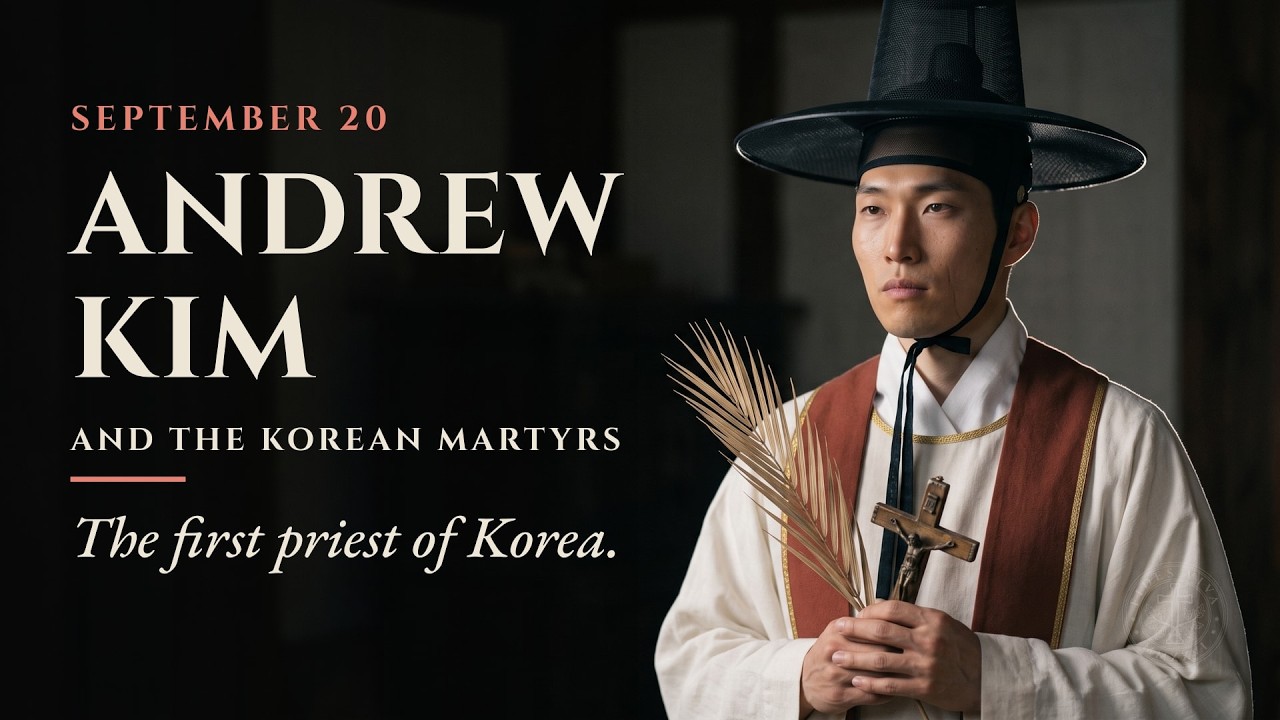
And how does Korea remember the priest, twenty-five years old? In two ways that do not contradict each other. Western painters dress him in a black cassock with a red stole over his chest: the priesthood and the blood. Koreans paint him in undyed hanbok and the bamboo hat that hid his face on the roads. Between 2020 and 2021 his country marked the two-hundredth anniversary of his birth with a jubilee year. And in Seoul it is told with pride that since September 2023 his marble figure, in hanbok, looks out from a niche on the outside of the Basilica of Saint Peter.
Today about six million Koreans, nearly one in nine, are Catholic in a country where half profess no religion at all. Each September, the month of the martyrs, pilgrims walk from Seosomun to Jeoldusan and from Saenamteo to Mirinae, with the same faith as those names read in Yeouido. And in August 2027 Seoul will host World Youth Day with Pope Leo XIV, the first celebrated in a country where Catholic faith is a minority: among its patrons, announced on April 27, 2026, are Andrew Kim Taegon and his companions. The official prayer asks the Lord to kindle in hearts "the flame of the faith of the Korean martyrs."
A faith that began in a closed room, with books in Chinese and no one to baptize them, will fill a plaza with young people from everywhere in the world. The names read in Yeouido still echo. And a question lingers that is no longer only Korea's: to whom does an inheritance like this belong, won by people who believed in Jesus Christ before they had cathedrals or clergy of their own, and paid for it with everything they had.
When the Shepherd Is Absent: A Quiet Invitation
In Mirinae, as the evening falls, a young Korean woman lights a candle before the stone marker on the hillside and stands there, saying nothing. Behind her, other young people sit in the grass. In the valley, only the stream can be heard, and little else.
For that silence to be possible, it took scholars reading by lamplight books that could have cost them their heads. It took a servant crossing the frozen Yalu twenty times over with the same plea, and almost always the same answer: not yet. It took a bishop who came out of hiding and gave himself so that his people would stop dying. It took an old woman, a young girl, and a boy of thirteen kneeling on the same ground as nobles. And it took a father from Solmoe letting his son of fifteen walk away without knowing if he would ever come back.
He came back. He came back a priest, in a boat with the rudder broken, to hear confessions at night in Korean and say Mass over a wooden chest. He lasted thirteen months.
What remains is the question from that sand: what moves a man to answer like that, knowing what comes next. His life answers with what he did, not with words. He learned a language that was not his so he could speak the words of forgiveness in his own. He wrote from his cell to the people he was about to leave without a shepherd again and called them beloved brothers. And on the bank of the Han, before the onlookers, he said whom he was dying for. Not an idea. Jesus Christ, whom his people had come to know in books and waited sixty-one years for a bread no one could consecrate for them.
We too live among smaller questions. There is no tribunal, no river. There is a table after a meal where someone asks, half joking, if we still believe in that. A Monday when faith weighs and it would be easier to leave it at home. A wait that stretches without an answer, like that servant's on the ice. What do we answer when the question comes like that, in a quiet voice, with no one threatening us?
He said yes. At twenty-five, with his wrists marked by the cord, nothing more.
In Mirinae the candle keeps burning as the young people rise and walk down the path of crosses. Beside the Korean priest rests the French bishop who loved him as a father loves a son. The people who asked for a shepherd for sixty years buried him at night and saw him rise to the altars in their own land. That seed buried in a valley of Anseong has given its harvest.
Saints Andrew Kim Taegon, Paul Chong Hasang, and Companions, martyrs of Korea, patrons of the Korean people and clergy and witnesses to the faith, pray for us.