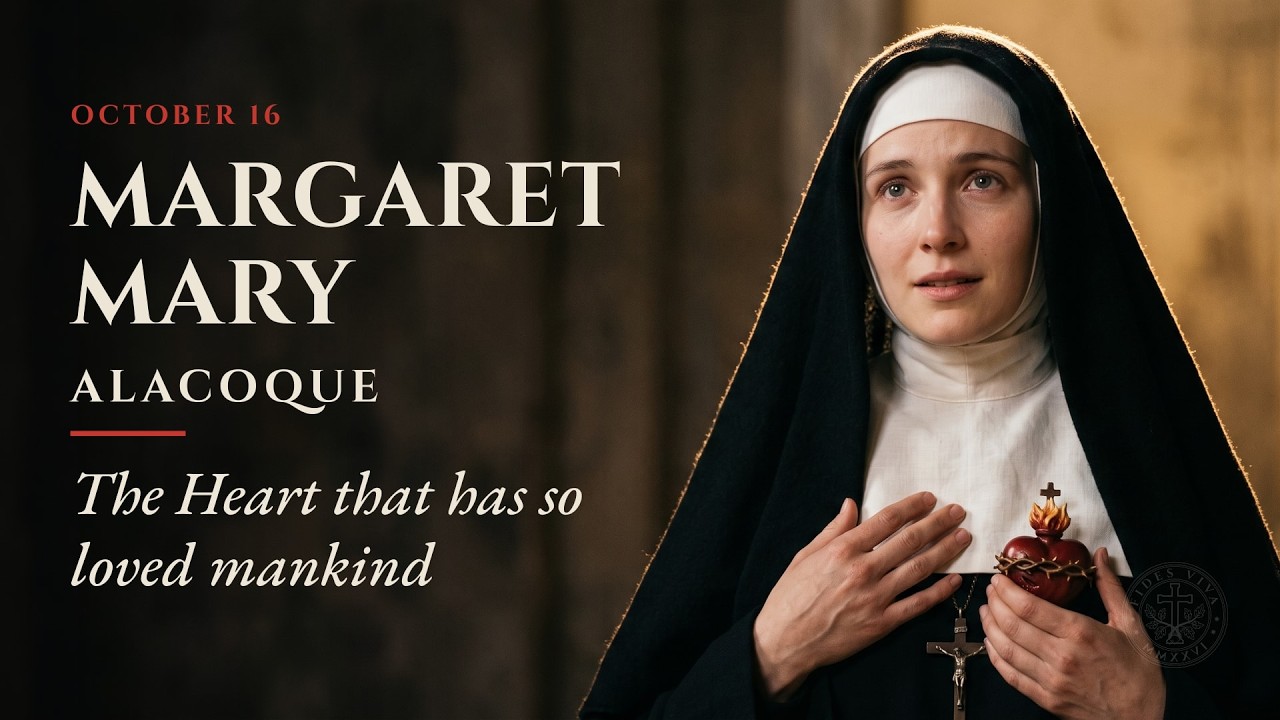
To give back to Christ love for love. That is all Margaret Mary Alacoque desires, a nun of twenty-seven, kneeling before the Blessed Sacrament, the consecrated Host exposed on the altar, in the chapel of her monastery at Paray-le-Monial, in Burgundy. There Christ asks her for a feast in honor of his Heart. Today the whole Church celebrates it. But in her own monastery almost no one believes her. Some of the sisters mock her and call her a visionary, deluded by her own imaginings.
Under Lock and Key
Before she was that nun of Paray, she was a young woman who needed three permissions and a borrowed coat just to get to Mass. She lives in Lhautecour, a hamlet in the Charolais, in the south of Burgundy, in the sixteen-sixties, when Louis XIV reigns in France. Since the death of her father, a royal notary, her mother no longer runs the house, though she still lives there. The ones in charge are three relatives, a grandmother, an aunt and a great-aunt, who keep everything under lock and key.
Margaret had come back to that house very ill. As a child she had been sent to board at a convent of nuns in Charolles, and there an illness began that left her unable to walk for about four years. Since no remedy could cure her, she was consecrated to the Virgin, and she promised that if she recovered, she would one day be one of her daughters, that is, a nun. And she recovered at once. But she is not free. With everything locked away, she sometimes cannot find anything to wear to go out, and has to borrow a hat and a coat. The church is far away, and to go there she needs permission from all three. If one agrees, another refuses, and often she cannot go at all. Then she weeps.
And when they see her crying, they accuse her of meeting some young man and of using Mass as an excuse. So she hides in a corner of the garden or the stable to pray to God through the Virgin, and spends whole days there without eating. At dusk, poor people from the village bring her a little milk or some fruit, and when she comes back to the house she is scolded for neglecting her chores.
She bears no grudge against those three women. She considers them virtuous people, whom God uses to test her.
Her mother falls ill with a severe case of erysipelas, an infection that inflames the skin and opens a wound, and it is Margaret who nurses her, alone, because no one else in the house looks after her. A passing surgeon says that only a miracle can save her.
On New Year's Day she goes to Mass and asks Christ to be her mother's physician himself. And she, who had never been able to look at a wound, dresses it every day with her own hands. Within a few days the wound closes.
But the same young woman who prays in the stable also wants to enjoy herself, now that her health allows it, without thinking much about her promise. She dresses up, seeks company, and one year, at Carnival, she puts on a costume with other young women. She will weep over it all her life. In the middle of the festivities she suddenly feels the love of God pierce her heart as if with burning darts, and the pain leaves her speechless.
One night, as she takes off her party clothes, Christ appears to her torn by the scourging, as in his Passion. He tells her that her vanity has brought him to this, and that she is wasting time for which he will call her to account. Margaret weeps bitterly. Then she goes back to her vanities.
Rather Die Than Change
In those years the marriage proposals begin to arrive. For her mother, a wedding is the only way out, because once her daughter marries, the mother can go and live with her. She tells her so again and again, in tears, and says that a young woman should be married by twenty. The three relatives press her too. For Margaret it is torment, and she even begins to think she can free herself from another promise, an older one still.
When she was about five, in the chapel of Corcheval castle, her godmother's home, Margaret was hearing Mass on her knees. Between the two elevations, when the priest raised the Host and then the chalice, she said, "My God, I consecrate my purity to you and make you a vow of perpetual chastity." She did not know what "vow" or "chastity" meant. Now the young woman of Lhautecour wonders whether a promise made without understanding it truly binds her. And she also fears losing her soul if one day she enters a convent, because she believes religious life demands a holiness she will never reach.
One day, after she receives Communion, Christ shows himself to her as the most beautiful and powerful of all her suitors. He asks her how she could break with him to go off with another, and promises never to abandon her if she is faithful to him. A great peace fills her. Margaret resolves to die rather than change, and asks that all the suitors be sent away.
She has decided to become a nun, but it will be three years before she can enter a convent. One of her brothers, who loves her dearly, tries to talk her out of it and keeps her at home. A Franciscan friar traveling through the district to preach the jubilee, a special time of forgiveness and confession open to all the faithful, hears her confession and then speaks with her brother. When her brother asks her again what she wants, she answers that she would rather die than change. Then he promises to help her and takes charge of negotiating the dowry, the money a family gave the convent when a daughter entered.
She is sent to Mâcon, to the home of an uncle on her mother's side whose daughter is an Ursuline nun, so that she can enter her cousin's convent. Margaret tells her cousin that if she entered there, it would be out of affection for her, and that she wants a convent where she knows no one, so as to be a nun for the love of God alone. Within, she hears a voice telling her she is wanted not there, but among the Daughters of Holy Mary, the Visitation nuns. In that house she looks at a portrait of Saint Francis de Sales, the bishop who founded them, and feels that the saint is calling her his daughter. The girl who promised she would one day be one of the Virgin's daughters has just heard the name of her home.
The Ursulines are about to open their door to her when word comes that her mother is gravely ill. Margaret travels all night, some ten leagues, back home. Afterwards several convents are suggested to her, and when they name the one at Paray, a Visitation convent, her heart leaps with joy.
On May 25, 1671, she enters the parlour of that monastery, the room with a grille where the nuns receive visitors. The moment she sets foot in it, a voice within her says, "This is where I want you." Now she does not want to go home without having her entrance arranged.
On a Saturday in June, the twentieth, she says goodbye to her mother. She loves her more than anyone, and she does not shed a tear. As she crosses the threshold of the monastery, it seems to her that her soul is parting from her body. At once she exclaims that God wants her there. She is twenty-three.
Without Reserve
God wants her there, but the house is not sure it can keep her. It is the summer of 1671, and the newcomer has to learn the simplest thing of all, how to pray. She asks her novice mistress, the nun who trains those just beginning, who answers her with an image. She should place herself before the Lord like a blank canvas before the painter. In prayer, Margaret, whom the convent now calls Margaret Mary, understands that the canvas is her soul, where Christ wants to paint his life of love, silence and sacrifice.
But she wants to give more than she is asked. She looks for penances she is not allowed, and she hears Saint Francis de Sales, the founder whose portrait called her his daughter in Mâcon, reproach her and tell her that the foundation of the Visitation is obedience, not austerities.
On August 25 she receives the habit and begins her novitiate, the time of testing before vows, and with it come the reproaches. At times she is so absorbed in God that she cannot come back to herself, what the house calls raptures. The Visitation was founded for a simple life, and in the community anything extraordinary causes unease. They tell her this is not the spirit of the Daughters of Holy Mary, and that if she does not give it up, she will not be admitted to her vows.
Then they order her to do something that mattered little in itself, but that everyone in her family loathed. So much so that when her entrance was arranged, her brother had asked that it never be required of her. She does not say what it was. Tradition says it was something as simple as eating cheese. Yet it revolts her to the very depths. She struggles for three days, and even asks to have her life taken rather than fail in obedience. Seeing her like this, her novice mistress withdraws the order and tells her she is not worthy to carry it out. Margaret Mary spends three or four hours before the Blessed Sacrament, and there Christ says to her, "There must be no reserve in love."
She goes back to the novitiate, kneels before her novice mistress and begs her, out of compassion, to let her obey. She is allowed. But the revulsion does not leave with that victory. She feels it again and again for some eight years.
As the day of her vows draws near, the community still fears she lacks the spirit of the Visitation. For the retreat of silent prayer that prepares her, they send her to the garden to look after a donkey and its foal. The days before she gives herself to God forever are spent making sure two animals do not wander where they should not.
There, among the hazel trees, Christ tells her to go and tell her superior that he will answer for her, and that he will fit his gifts to the Rule, the way of life laid down for the house, and to the will of her superiors.
On November 6, 1672, Margaret Mary makes her vows, and she holds on to that promise, that nothing God gives her will lead her away from obedience.
And for You in Particular
What Christ has prepared for her comes before the Blessed Sacrament, and it comes first as love. It is December 27, 1673, the feast of Saint John, the disciple who rested his head on the breast of Jesus at the Last Supper. In the Visitation chapel at Paray, Margaret Mary uses a little free time to pray on her knees before the Eucharist, and she feels the presence of God fill her completely.
Christ lets her rest a long while on his breast, as Saint John did at the Supper. Before asking her for anything, he says to her, "My divine Heart is so passionately in love with men, and with you in particular…" That Heart can no longer hold back its flames. It needs to pour them out, and it wants to do so through her.
Then he asks for her heart, and she begs him to take it. She sees her own heart inside the Heart of Christ, like a tiny atom being consumed in that blazing furnace. He gives it back to her as a flame, tells her that a pain will remain in her side, and gives her the name of beloved disciple of his Heart. She comes away from that prayer without any doubt that it is from God.
Months later, the Blessed Sacrament is exposed on the altar in the monstrance, the vessel in which the Host is shown. Jesus Christ appears to her, all radiant with glory, with his five wounds shining like five suns. Flames pour from his breast as from a furnace, and his breast opens and shows her his Heart. Now the love carries a wound. From men, he tells her, he receives nothing but ingratitude and contempt. That, he adds, hurts him more than everything he suffered in his Passion.
Only then do the requests come. Christ wants her to receive Communion as often as her superiors allow, and above all on the First Friday of each month. In the France of that time many people stayed away from Communion, because they did not trust in God's forgiveness and saw it as a reward kept for the perfect. He also asks her to rise every Thursday night into Friday, from eleven until midnight, and keep him company, lying prostrate, in his sorrow in the Garden of Olives, the night of his agony before the Passion. That hour of prayer is what we now call the Holy Hour. And he warns her to do nothing without the approval of those who guide her.
For generations, in parishes all over the world, the faithful have received Communion on nine First Fridays in a row, trusting in what they call the Great Promise. In Margaret Mary's writings, Christ promised that whoever does this will not die far from God.
But back then, in her own monastery, neither the Fridays nor the Thursday night are hers to decide. Trembling, she lays it all before her superior, who humiliates her and grants her not a single one of these things. Margaret Mary obeys, just as Christ himself had told her.
She falls ill. The fever returns more than sixty times. Her superior then orders her to ask God for her health, as a sign that all this comes from him. She asks for it, and she recovers. And she sees the Virgin, who promises her protection.
Behold the One I Am Sending You
Amid the criticism and the doubts, Christ had promised to send her his faithful servant and perfect friend, someone who would teach her to know him and to give herself up to him without any more resistance. A few months later, Claude La Colombière arrives in Paray, a Jesuit of thirty-four who has just been named head of the school his order runs in the little town. His superiors have sent him knowing that a nun there is living in anguished uncertainty. It is Lent of 1675. For Margaret Mary, what is at stake is knowing at last whether what she lives comes from God, because the theologians she has been able to consult have only deepened her fear of deceiving herself.
One day the Jesuit speaks to the community. As she listens to him, she hears Christ say within her, "Behold the one I am sending you."
Soon afterward, Margaret Mary kneels before the Jesuit to make her confession. The priest does not know her, and yet he keeps her a long while, as if he knew what was happening inside her. She does not dare to open her heart, and after an hour and a half she leaves. She comes back another day and tells him how hard it is for her to speak to him. He answers that he is glad to have given her a chance to offer God a sacrifice. Then Margaret Mary opens her whole soul to him.
Father Claude assures her that there is nothing to fear in what she is living, because it does not draw her away from obedience. He teaches her to receive God's gifts with humility and gratitude, and he also goes to reassure her superior. For the first time, someone who has truly listened to her believes her.
And so June comes. It is the octave of Corpus Christi, the eight days that follow the feast of the Eucharist, and Margaret Mary is on her knees before the Blessed Sacrament. She feels God filling her with gifts, and with them comes the desire to give him something in return. Christ tells her that she can give him no greater proof of love than to do what he has asked of her so many times. Then he shows her his Heart and says, "Behold this Heart which has so loved men that it spared nothing, even to exhausting and consuming itself, to show them its love."
In return, he tells her, that Heart receives above all ingratitude, irreverence and coldness in the Eucharist, the sacrament of his love. What hurts him most is being treated this way by hearts that have been consecrated to him. So he asks her for a feast to honor his Heart on the Friday after that octave. On that day people will receive Communion and make an act of reparation, which means giving love back to the one who has been wounded by indifference, like keeping company with a friend everyone else has left alone. On those who honor him in this way, he promises to pour out his love.
She answers that she does not know how to do it. Christ sends her to the faithful servant he had promised her, Father Claude. The Jesuit listens to her and tells her to put it all in writing.
The sisters who shared those years with her remembered a day when Father Claude was celebrating the community Mass. As Margaret Mary comes forward to receive Communion, Christ shows her his Heart as a blazing fire, and two other hearts sinking into it. And he says to her, "This is how my pure love unites these three hearts forever." He wants her and the priest to be like brother and sister, with an equal share in the gifts God gives to each.
Outside the chapel, that trust comes at a price. In the community they begin to say that Margaret Mary is deceiving Father Claude with her illusions, but he does not abandon her.
Am I Not Enough for You?
Even so, in September 1676, Father Claude leaves Paray. His superiors send him to London as preacher to the Duchess of York, at the court of England.
Margaret Mary is left without the priest who listened to her and set her mind at rest. For more than a year she has had someone who did not take her for a woman fooled by her own imaginings. Now she is alone again in a house that doubts her. While that absence still hurts, she hears Christ ask her, "Am I not enough for you?"
Across the sea, Father Claude spends a few days of February 1677 on retreat in London. In his notes he writes that God wants to use him to make known the devotion entrusted to him by a person to whom God speaks in confidence. He adds that he has already made it known to many people. He does not write her name, but that person is Margaret Mary. Far from Paray, where people said he was letting himself be deceived, the priest makes that nun's message his own.
At the end of 1678 a false accusation of a Catholic conspiracy catches up with him. He spends three weeks in a London prison, and he is expelled from England with his lungs failing.
He returns to France, and he never recovers. When he grows worse, he is sent back to Paray. In one of his last letters to Margaret Mary, he calls that illness one of the greatest mercies God has ever shown him.
Father Claude dies in Paray on February 15, 1682, the first Sunday of Lent. He is forty-one years old.
Margaret Mary keeps a grateful memory of the man to whom Christ wished to unite her as a brother. She says his gift was bringing souls to God. And she also says that the devotion to the Heart of Jesus, which he received from her and defended when so many doubted it, raised him higher in glory than everything else he did in his life.
A Visionary, They Said
Margaret Mary had already accepted living among people who did not believe her. One day, Christ had set two paths before her.
In one hand he shows her the picture of a happy life as a nun, with good health and the esteem of everyone. In the other, the picture of a life that is poor and crucified. He tells her to choose, and that in either one he will give her the same gifts. She answers that she wants only him. Then Christ chooses the crucified life for her, and Margaret Mary kisses the hand that offers it.
That life reaches her by the closest path of all, through her own sisters. In a community that has distrusted anything extraordinary since the day she arrived, a nun who says she sees Christ and hears his voice is bound to be suspected. Sisters and superiors take her for a visionary, someone deluded by her own imaginings who clings to her illusions. Some do not believe her. Others mock her.
Some go further and believe she is possessed, in the grip of the devil. They sprinkle her with holy water, the water the Church also blesses to drive away evil, and they pray over her to cast out the evil spirit. She does not pull away. While they pray, she hears Christ tell her that he loves holy water and that he loves the cross. And she resolves to accept every trial with humility.
The trials also come from the one who governs the house. The new superior, Mother Greyfié, carefully examines what Margaret Mary is living through. On the last day of 1678 she acts as a notary, the person who sets down a solemn act in writing and vouches for it. In the form of a will, she draws up the deed by which Margaret Mary gives Christ everything she has. And Christ, in turn, names her the heiress of his Heart.
Margaret Mary loved that superior dearly, because Mother Greyfié helped her give up her own preferences.
Later, the same superior sets her a test that seems to ask the impossible. Margaret Mary is hardly ever well for four days in a row. As the earlier superior had done, Mother Greyfié orders her to ask God for good health as proof that what she is living comes from God, this time for five months in a row. Her health holds for all five months, and it lasts until the end of 1683.
A Small Ink Drawing
Since 1684, the nun so many dismissed as a visionary has been novice mistress. She has been with the novices for a year and has still not found a way to begin honoring the Heart of Jesus, as Christ asked her during the octave of Corpus Christi.
July 20, 1685, is the feast of Saint Margaret, the saint whose name she bears, and that year it falls on a Friday, the day Christ had joined to his Heart. The novices have prepared a few small honors for her. She asks them to offer those honors not to her, but to the Sacred Heart. So they set up a little altar, place on it a small ink drawing of the divine Heart and kneel before it, a handful of young women gathered around a sheet of paper.
Word spreads through the house, and the house reacts as it has reacted since Margaret Mary's novitiate, wary of anything out of the ordinary. They accuse her of trying to bring in a new devotion. They humiliate her, and the novices too. The superior forbids her to put the picture anywhere it can be seen, and allows her to honor it only in private.
The threats grow harsher. They even tell her they will lock her up and bring her before a cardinal, a powerful man of the Church who was living in Paray at the time. All for a drawing. Margaret Mary, for her part, has never known such peace or such joy as in those days. In the middle of the storm she hears Christ say to her, “Fear not, I will reign in spite of my enemies.”
The change comes from the last place anyone would expect. Mother Greyfié, the superior who had tested her so hard, now governs another monastery of the order. There she consecrates herself and her whole community to the Heart of Jesus, and she sends Margaret Mary a copy of that image. In Paray, the news carries weight. The sister who had opposed her most, a friend of hers since the novitiate, reasons that if a superior so faithful to the Rule of their order has done it, there is no longer any reason to doubt. On the Friday after the octave of Corpus Christi in 1686, the sisters find in the choir a little altar with that image and a note inviting them to consecrate themselves. This time they all kneel, old and young alike, and Margaret Mary and her friend embrace. Then they decide to build a chapel in the garden dedicated to the Heart of Jesus.
Meanwhile another order reaches her, and this one touches one of the things she finds hardest, writing about herself. The Jesuit who is guiding her soul at the time tells her to write down her life and forbids her to burn anything before he has examined it. She obeys.
Page by page, the house at Lhautecour finds its way in, then the grille of the parlour, and the prayer before the Blessed Sacrament in which she saw her heart within the Heart of Christ. So the story of her life is born, written in her own hand, a notebook of sixty-four pages. It remains unfinished, because in the autumn of 1686 that Jesuit leaves Paray without having read it. She puts the notebook away in a cupboard and locks it with a key.
The Key to the Cupboard
The notebook is still in its cupboard, under lock and key, when Margaret Mary's body begins to give way. In July 1690, gravely ill, she begins a last retreat to prepare herself to die. On October 9 a fever confines her to bed in the infirmary, and the doctor says nothing more can be done.
The sisters stay with her. One night, with the fever very high, Margaret Mary says to them, “Oh, I am burning. If only it were with divine love, what a comfort that would be!” She asks them to pray that God will forgive her. She also asks them to love him with all their hearts, to make reparation for the love she has not given him. And in the midst of that burning, a cry escapes her, “What happiness it is to love God!”
They offer her comforts, and she refuses them all. Again and again she repeats a verse from the Psalms, the one that tells God there is no one for her in heaven but him, and nothing on earth she desires besides him.
But there is something she has not yet let go of. She fears that once she dies, people will honor her. She calls the sister who nurses her in the infirmary and asks her to write to the Jesuit who told her to set down her life, so that he will burn the letters she sent him. Then she begs for one thing more, that the sister burn the notebook kept in the cupboard.
In this, the nurse does not obey her. She tells her it would be more perfect to give the key of the cupboard to the superior, and so sacrifice her own will.
For Margaret Mary, it means giving up the last thing she wanted to keep hidden. It costs her dearly.
She hands over the key.
In the house at Lhautecour, the keys of those three relatives locked everything away from her for years. She herself places the last key of her life, freely, in other hands.
On October 17, as night falls, the priest comes to give her the Anointing of the Sick, the sacrament by which the Church anoints the gravely ill and commends them to God. The sisters pray around the bed.
As she is anointed, Margaret Mary murmurs the names of Jesus and Mary.
At about eight in the evening, she dies. She is forty-three.
The next morning, through the streets of Paray, people repeat the same words, “The saint is dead!”
The key stayed in the superior's hands, and the fire never touched those pages. The notebook Margaret Mary wanted burned is kept in Paray, in her own handwriting, and in it the woman almost no one believed still speaks.
Love for Love
What Paray repeated through its streets the morning after her death, the Church will say slowly, over more than two centuries. The feast comes first.
The feast that Margaret Mary heard Christ ask for before the Blessed Sacrament, on the Friday after the octave of Corpus Christi, is at first granted to very few, before anyone has approved her writings. In 1856 Pius IX extends that feast to the whole Church, because the bishops of France and of almost the entire Catholic world ask him to. The Church makes its own the heart of what she saw, a love that asks to be returned, and obliges no one to believe every detail as a truth of faith.
Meanwhile her cause moves forward, the long examination by which the Church studies a life before holding it up to everyone. As early as the summer of 1830 her tomb is opened in Paray, and during that examination two instantaneous healings are recorded.
Pius IX declares her Blessed in 1864, which means he allows her to be honored publicly in the Church. Benedict XV later approves the miracles attributed to her and, on May 13, 1920, proclaims her a saint for the whole Church. She is the same nun her sisters laughed at, calling her a visionary.
More than three hundred years after her death, a reliquary holding some of her bones, a collarbone and a rib, arrives at the Visitation monastery in Mexico City. The nuns, daughters of the same order that received her in Paray, place it in their choir. From six in the morning they pray with her for the Visitation and for peace in their country, and they keep it company with vigils and Holy Hours, like the one Christ asked of her on Thursday nights. Her relics have also traveled to parishes and monasteries in Latin America and Spain.
And in Paray, beside the choir where she knelt before the Blessed Sacrament, there is a small chapel. There pilgrims kneel before a reliquary. What they see is a wax figure dressed in the habit of the Visitation, and beneath it rest almost all her bones.
All her life, the question was whether anyone would believe that shy woman. Those who come to her reliquary now give back to her, without a word, what she gave back on her knees to a Heart that asked to be loved.
Saint Margaret Mary, on your knees before the Blessed Sacrament you longed to give Christ love for love. You kept obeying when almost no one believed you. Ask for us the spirit with which God enriched you, so that we may know the love of Christ, which surpasses all knowledge. Stay beside the sick who find no relief, those who are not believed, and those who keep watch alone in the night. Teach us, as you learned, to put no reserve on love. Pray for us. Amen.