The letter of freedom reached the mines of Sardinia with a list of condemned Christians, and Callistus's name was missing from it. The others walked out, one after another. He fell to his knees and, weeping, begged to be released too. The old man who had brought the letter spoke up for him, and the governor gave way.
That scene was kept for us by Hippolytus, the man who fought Callistus hardest. That convict from the mines would one day become bishop of Rome, and the same Hippolytus would then accuse him of taking back repentant sinners and people others had cast out. The man who begged not to be left off a list would carry, as bishop, the charge of leaving no one out.
The Widows' Money
As Hippolytus tells it, the fall began with other people's money, in the Rome of the emperor Commodus, at the end of the second century. At stake were the savings of ordinary people.
Callistus was the slave of Carpophorus, a Christian in the emperor's household. His master handed him a considerable sum "because he was of the faith" and told him to make it grow through a bank.
The bank opened in the Piscina Publica, a district in the south of the city. Widows came there, and so did the brothers and sisters, as Christians called one another. They left their deposits with Callistus, convinced they were placing them in the hands of Carpophorus.
Callistus lost it all. Someone warned the master, and Carpophorus demanded an account.
His answer was to run for the sea. At Porto, the port of Rome, Callistus boarded a ship about to sail. Carpophorus went after him. The ship was still riding at anchor in the middle of the harbor, and the boatman was slow to move. From the deck, the slave saw his master reach the quay. Then he threw himself into the water.
The sailors scrambled into the boats and rowed toward him, while people on shore shouted. They hauled him out of the sea, soaked through. Carpophorus took him back to Rome and shut him in the punishment mill. Slaves were sent there to push the millstone that ground the grain.
The mill door opened at the urging of some brothers and sisters in the faith. They went to Carpophorus and asked him to let Callistus out, because Callistus said that certain people owed him money. Many of those who pleaded for him were weeping over the deposits they had lost. Carpophorus gave way.
The first hands held out to the fallen slave belonged to the very people who had lost their money in that bank.
He came out with nothing to pay them back. One Sabbath he walked into a synagogue in Rome, saying he had come to see the people who had his money. The Jews of the city had a recognized right to read their laws in public, and they were gathered to do just that. A riot broke out and, as Hippolytus tells it, he came out of there beaten.
They dragged him before Fuscianus, the prefect of Rome. The Jews accused him of stopping them from reading their laws, "saying that he is a Christian."
Carpophorus came to the court and spoke to the prefect. "I beg you, lord Fuscianus, do not believe him, for he is no Christian, but is looking for a chance to die."
The accusers kept pressing. Fuscianus had him flogged and sentenced him to a mine in Sardinia. Persecution in those years came and went, and in that mine there were other condemned Christians. His master had denied that Callistus was a Christian, and still he ended up among them.
Hippolytus mockingly calls that sentence Callistus's "martyrdom." But whoever suffers like that for the name of Christ and survives has another name in the Church, confessor of the faith.
Flogged and condemned, Callistus set out for the island of the mines.
Far from the mines, a woman very close to Commodus was about to ask for the list of those prisoners.
The Sardinia List
That woman was Marcia, who shared the emperor's life and, in Hippolytus's words, was God-loving. She wanted to do a good work, and she chose the freedom of the Christians condemned in Sardinia.
For that she needed their names. She asked the bishop of Rome, Victor, for them. With the list in hand, Marcia obtained from Commodus a letter that set free everyone named on it.
Victor's list named the fellow Christians working in the island's mines. One was missing. Callistus's name had been left off.
Hyacinth, by then an old man, crossed the sea with the letter and handed it to the governor of the island, who set free everyone on the list.
The men who left free, Hippolytus does call martyrs, the name Christians gave to the witnesses of Christ. This time he says it without any irony.
Callistus was still in the mine. He turned to Hyacinth, the old man who had brought the letter. He fell to his knees before him and, in tears, begged that he too be allowed to go.
Hyacinth was won over by his pleading. He went to the governor and asked for the freedom of this man the letter did not name, assuring the governor that Marcia had allowed it. The governor gave way. Callistus left the mines after the others.
First it had been the fellow Christians who wept for him before Carpophorus. Now it was an old man pleading for someone who wasn't on the list.
Rome was still ahead. Callistus's return weighed on Victor. In Hippolytus's words, the bishop "was deeply grieved at what had happened, but being a compassionate man, he took no action."
Nor did he leave him to fend for himself. He sent him to live at Anzio, on the coast, away from the city, and gave him a monthly allowance to live on.
So, that time, mercy took the shape of an allowance every month and a place by the sea. Callistus lived at Anzio for as long as Victor governed the Christians of the city.
When Victor died, Rome had a new bishop, Zephyrinus. And Zephyrinus sent for the man from Anzio.
The Cemetery for All the Brothers and Sisters
Of what changed in him between the mine and Anzio, the sources say nothing. What they tell is what he did next. The man from the coast did not come back to Rome to stay on the sidelines. Zephyrinus took him on as a helper in looking after the clergy, that is, those who served their fellow Christians in the bishop's name. Then he gave him one more task. The community's cemetery was placed in his hands.
Until then the Church had supported him from a distance. Now the man who had lost the widows' savings was entrusted with the care of the cemetery of the Church of Rome.
The Church remembers him in those years as a deacon, one of the ministers who assisted the bishop in serving the community. He was the man who had come back from a long exile in Sardinia.
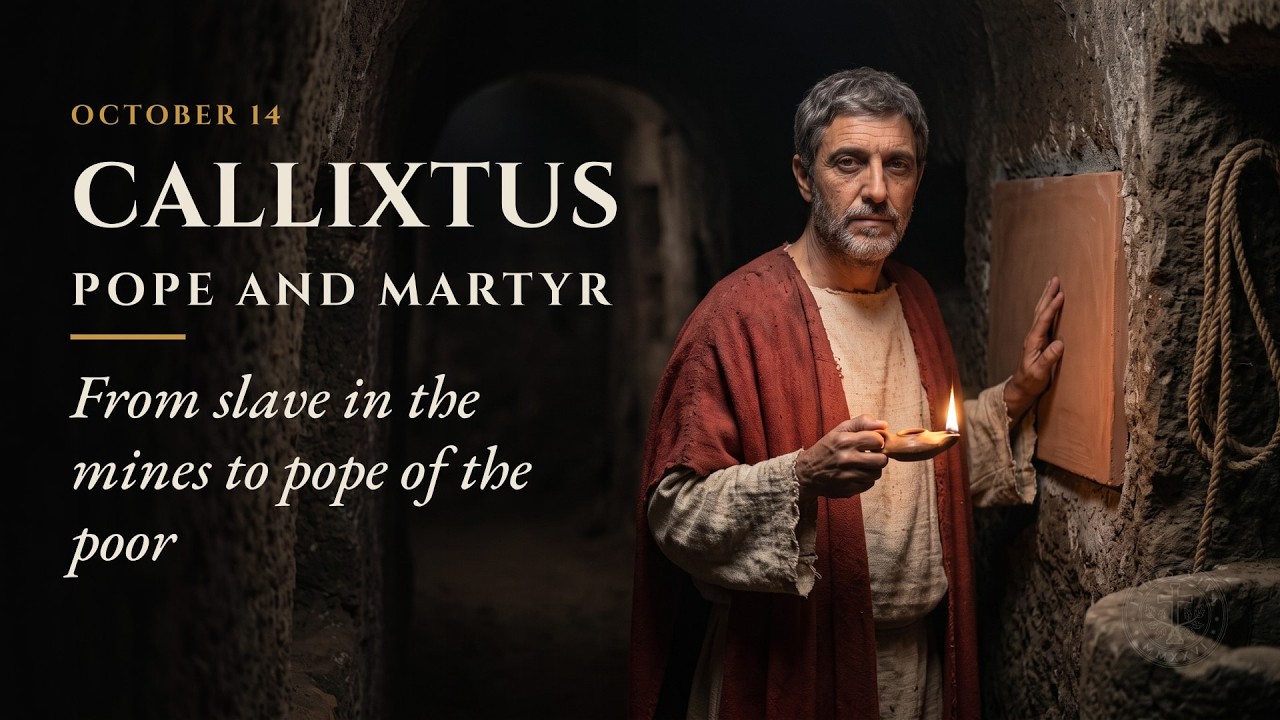
Callistus went down into the cemetery on the Appian Way. Beneath the fields ran galleries dug into the tuff, a soft volcanic stone that can be cut by hand. Along the walls, niches were lined up one above another, sealed with stone slabs. The only light came from a clay oil lamp.
That cemetery did not belong to a family or to a guild. It belonged to the whole community and was open to all the brothers and sisters. The man who had pushed the millstone and gone down into the mine was working underground once more, now for the dead of his Church.
The Christians who laid their dead there were waiting for the resurrection Christ had promised. Caring for those tombs was that same faith turned into daily work. It is the same hope with which people still pray today at the grave of someone they love.
Along the galleries, small chambers were opened and painted in the early decades of the third century. They are called the Cubicles of the Sacraments, and they hold some of the oldest paintings in the catacombs. In time, almost all the bishops of Rome of that century would be buried in a crypt of that same cemetery.
The place still bears his name today, the Catacombs of Saint Callistus, because he looked after it for everyone. That slave would one day become pope, and that is why so many know him today as the pope of the catacombs.
Every October 14, the prayer of the Mass turns to God, who called Pope Saint Callistus to serve the Church and to promote devotion toward the faithful departed. It asks that the witness of Callistus's faith make us strong.
In California, at Christ Cathedral in Garden Grove, a chapel bearing the name of Pope Saint Callistus I was announced for dedication on his feast, October 14, 2024.
Zephyrinus died, and the Christians of Rome chose Callistus to succeed him as bishop of Rome. Among the presbyters, the priests who formed the bishop's council, there was one who refused to recognize him.
One God
That presbyter was Hippolytus, a theologian who wrote in Greek. Around the year 217, when Callistus took up the leadership of the Church of Rome, Hippolytus broke with it at once.
A small group chose him as bishop in opposition to the bishop of Rome. The Church calls someone who holds that place an antipope, a bishop raised up by a few against the lawful bishop. For Hippolytus, most of the Christians in the city now belonged to "the school of Callistus."
The hand that had preserved Callistus's plea, made on his knees, was the hand of his rival. Two men who had served the same Church no longer shared the Lord's table.
The break went back further. Already in the years of Zephyrinus, when Callistus was his deacon, people in Rome were arguing about God himself. If God is one, who is Jesus Christ in relation to the Father? Some, insisting that God is one, erased the difference between the Father and the Son, as if these were two names for one and the same.
One of those who taught this way was Sabellius. Once he was bishop, Callistus excommunicated him, that is, he cut him off from the communion of the Church.
Hippolytus stood at the other extreme. He set the Son apart from the Father so forcefully that Callistus accused him and his followers of believing in two gods. The words the bishop of Rome used to defend himself have come down to us by an unexpected road. His own rival preserved them, quoting them in order to accuse him. Callistus put it in these words.
"I will not profess to believe in two gods, Father and Son, but in one."
Hippolytus did not accept that answer. He accused Callistus of mixing the teaching of Sabellius with other errors, of saying in different words the very thing he had condemned.
The facts draw a different picture. The bishop had cut off from communion the man who confused the Father with the Son. And he had also rejected the one who seemed to separate them so far that they became two gods. Between those two extremes, everything suggests that he held fast to the faith of the Church, which worships one God and confesses Jesus Christ as the Son of the Father.
That dispute divided a community that buried its dead in the same galleries. The words weighed heavily because they decided whom people prayed to.
Yet Hippolytus's harshest accusation was not about God. It was about sinners, and the door through which Callistus let them come back.
The Ark
Hippolytus kept count of every charge. The first concerned the penitents, Christians who, after a grave sin, completed the time of penance the Church required before taking them back. Callistus received them back into communion. They returned to the Lord's table, beside their brothers and sisters.
He also received those whom other groups had driven out of their assemblies, and the bishop of Rome did not shut the door on them.
The other charges ran in the same direction. Callistus admitted into the clergy men who had married more than once, and he allowed a woman of rank to take as her husband a man who was free or a slave, even though the law did not recognize that union.
Callistus defended that way of governing, and he defended it with Scripture. He spoke of Noah's ark. Inside, while the waters covered the earth, dogs, wolves and ravens traveled together. Clean and unclean animals traveled there, all under the same wooden roof. The Church, he said, is that ark.
He also recalled a parable of Jesus. A man sows wheat in his field, and at night an enemy sows weeds among the wheat. The servants want to pull them up. The owner tells them to let both grow together until the harvest, because then the one will be separated from the other.
And he repeated the question the apostle Paul put to the Christians of Rome. Who are you to pass judgment on someone else's servant? Before his own master he stands or falls.
Many years earlier, a slave had been pulled out of the water at Porto. Fellow Christians who had lost their savings asked for him to be let out of the mill. In a mine, an old man took a risk for him, and in Rome a saddened bishop chose not to punish him. The ark that Callistus described to his accuser had already carried him.
That same door had enemies across the sea. In Carthage, on the coast of Africa, lived Tertullian, a Christian who had defended the faith in his writings and who had by then turned toward a far harsher discipline. He mocked the edict of a bishop he scornfully called "Pontifex Maximus, bishop of bishops." The edict itself, though, was in earnest, and Tertullian copied its words in order to attack them.
"I forgive the sins of adultery and fornication of those who have done penance."
In other words, whoever had fallen and done penance could come back into the communion of the Church. The edict bears no name, and who issued it remains an open question, since some think of the bishop of Rome and others of Agrippinus, the bishop of Carthage.
What Tertullian was attacking was the same thing Hippolytus objected to in Rome. Both men opposed the Church taking back, after penance, anyone who had committed certain sins.
The Church did not follow them. It kept open the door those two critics wanted to close, and went on welcoming, after penance, whoever came home.
Callistus led the Church of Rome for some five years, and he died in a way no one knows for certain. It was left to Rome to decide by what name it would remember him.
Martyr
His death came at a strange time. Around the year 222 the emperor Severus Alexander was reigning, and the Christians of the city were living through a time of relative peace.
That is why Callistus's death holds something of a mystery. In Trastevere the story is told of a riot of pagans, of a crowd said to have turned against him.
What the Church did with his memory, though, was written down.
In the fourth century, the Church of Rome kept a calendar in which it recorded its martyrs and the day on which it celebrated their memory. Beside October 14 there is a very short line.
"Callisti in via Aurelia miliario III." Callistus, on the Via Aurelia, three miles from the city.
Callistus is the first bishop of Rome entered on that list of martyrs. The Church held him to be a martyr, that is, a witness to Christ to the point of giving his life, and it still celebrates him as one today.
Hippolytus had used that word mockingly, for a slave's sentence to the mines. Now the Church of Rome was writing it, without irony, in its own calendar.
A single line was not enough for the faithful. Long afterward, someone told of his death in a long story, full of names and wonders, that today is read as legend.
In that story, the consul Palmatius accuses the Christians, and the soldiers who go to seize Callistus are struck blind as they enter the place where he is. A Vestal, one of the virgins consecrated to the sacred fire of Rome, sees the wonder and proclaims the "God of Callistus."
Overcome by what he sees, Palmatius asks for baptism, and Callistus baptizes him.
That same story tells how they killed a presbyter of Rome, Calepodius, and threw his body into the Tiber. Fishermen draw him out of the water and Callistus buries him. Today that name, Calepodius, belongs to the cemetery where the tomb of Callistus himself was found.
Then his own hour comes. He is locked away in a prison, and there, in the darkness, God comforts him with a vision. A soldier comes to the prisoner, and the prisoner heals him.
In the end they take him to a well.
And they throw him in.
So ends the ancient story. Centuries later, beside his tomb, someone painted that scene on the wall. In the fresco, the bishop falls into the well with a stone tied around his neck.
That fresco is not on the Appian Way, in the cemetery known by his name. It is beside a staircase, on another of Rome's roads.
At the Foot of the Staircase
The other road is the Via Aurelia, the one that left Rome on the Trastevere side. At that same distance the calendar of martyrs recorded, the Christians of that district had their own cemetery, probably the oldest along those roads. Today it bears the name of Calepodius, the presbyter whom the ancient story draws out of the waters of the Tiber.
That, then, is where Callistus was laid to rest. They placed him among his own, the Christians of Trastevere. His tomb lay at the foot of the original staircase, the oldest of those that led down to the galleries.
His remains did not stay on the Via Aurelia. Centuries later they were carried up to Trastevere, to the basilica Pope Julius had built "beside Callistus," the one known today as Santa Maria in Trastevere. His relics are venerated there.
In California, Christ Cathedral in Garden Grove announced a chapel in his name for his feast in 2024, with a relic of his for the base of its altar.
A few steps away, in the small church that bears his name, the faithful come to a well. At its stone rim, the people of Trastevere pray to the bishop who, in the story of his martyrdom, was thrown down into it.
Far from those prayers, the galleries of the Via Aurelia fell into ruin. The staircase and the tomb lay forgotten beneath dust and fallen rock.
In the 1960s, excavators began going back down that staircase. At the foot of the steps, the tomb came to light. On the wall, fragments of the fresco of the well remained. And beside the grave, one of the faithful had carved a few letters into the stone.
"Sancto Callisto Alfius votum solvit." Alfius kept his promise to Saint Callistus.
That inscription does not say what he asked for. It says that he prayed beside this tomb, that he promised something if he was heard, and that he came back to keep his word. It is a prayer with a name attached.
Once, in Sardinia, a condemned man knelt to plead. Beside Callistus's tomb, another man had left the memory of a promise kept.
His tomb was on the Via Aurelia, but the cemetery he had cared for on the Appian Way went on receiving the bishops of Rome of his century. One of them, a successor of his, would come from very far away, from that same island of the mines. And he would not come alone.
Return to Sardinia
That return had a long wound behind it, because the division hadn't ended with Callistus's death. Hippolytus remained at the head of his small group. For years, the Christians of Rome had two shepherds who did not share the same table.
That division was healed in a time of exile. In the year 235, under the emperor Maximinus, Pontian, the bishop of the city, and Hippolytus, the man who stood against him, were exiled to Sardinia.
It was the island of the mines. The same land where a condemned man, seeing that his name was missing from the letter of freedom, had begged in tears not to be left behind.
Around the time of that exile, Hippolytus returned to the communion of the Church. He was the learned presbyter who had told the story of Callistus's fall. He came back to the shared faith and to the Lord's table, beside the bishop he had refused to recognize.
The mercy Callistus had begged for on that island ended up reaching the man who had written down that plea to bring him down.
The remains of both men came back to Rome on an August 13. Pontian was laid in the Crypt of the Popes, and Hippolytus came to rest on another road, the Via Tiburtina. The Church venerates them both as martyrs of Christ.
And so Callistus's rival is a saint.
Callistus had spoken of an ark where clean and unclean animals traveled together, and of a field where the wheat and the weeds await the same harvest. Into that ark came even the one who had wanted to close it.
The slave who pleaded on his knees in the mines defended, as bishop, a Church with no door shut to the repentant.
Callistus left the mines because an old man spoke up for him before the governor. Almost all of us have someone like that in our lives, someone who stood up for us when we could not do it alone.
Saint Callistus, on your knees you begged not to be shut out of the freedom of your brothers and sisters. You watched over the resting place of the departed of Rome and opened the door of the Church to those who returned repentant. Obtain for us from Christ a heart that leaves no one outside his mercy. Accompany our departed with your prayer and console those who mourn them today, until the day of the resurrection. Pray for us. Amen.