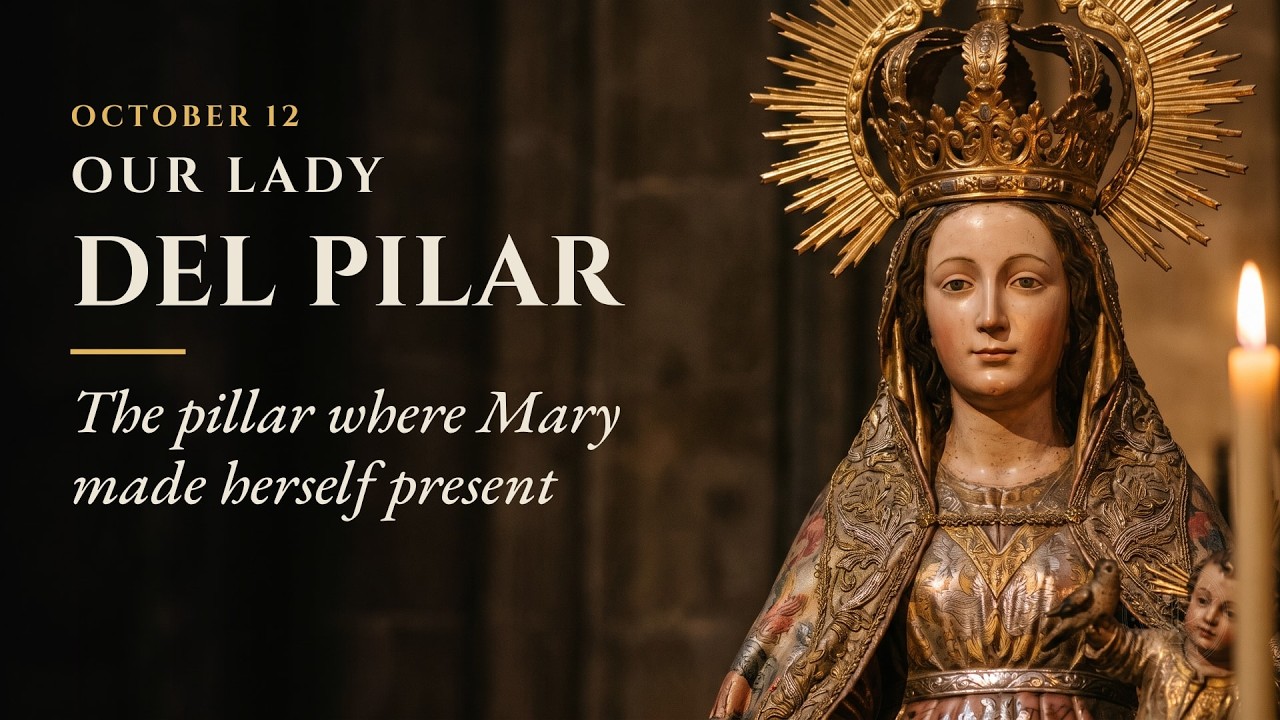
In Zaragoza, Spain, behind the small enclosure that holds the statue of Our Lady of the Pillar, there is a jasper column with a hollow big enough for a fist. No one carved it. It was worn away by kisses.
In Zaragoza they say that Our Lady herself left that column to the apostle James, on the banks of the Ebro, while she was still living. And that she promised him the stone would stay in its place for as long as the world endured. That is why she is called Our Lady of the Pillar.
Ever since, generation after generation, people have come to touch that stone and kiss it. A beggar from Calanda who had lost a leg came, and centuries later, a pope.
The Night by the River
Long before there was any church there, an apostle of Jesus was preaching on that very bank of the Ebro. That is how the Pillar remembers it. He was James, son of Zebedee and brother of John. The city lived under the power of Rome, and the few who followed Christ met in a house by the river, where they drew less attention.
Day after day, the apostle spoke to them of the kingdom of God. But the townspeople proved “rather hard of hearing and hard of heart.” Only eight men had believed. James's strength was failing, and he was beginning to wonder whether there was any point in going on preaching.
He had not come there on his own initiative. In Jerusalem, the Holy Spirit had made known to him a command from Christ, to go and preach in Spain. Before setting out, he went to see Our Lady. He kissed her hands and, in tears, asked for her leave and her blessing. She answered him: “Go, my son, and fulfill your Master's command.” And she asked him for something more. In the city of Spain where he converted the most men, he was to raise a church in her memory.
In Zaragoza, so far, there were only eight.
At night, the apostle and the eight withdrew to a threshing floor, an open field near the river where grain was threshed, and lay down on the straw. One of those nights, around midnight, weary from praying, the converts fell asleep. James was still awake. Then he heard the voices of angels singing:
“Ave Maria, gratia plena”, Hail Mary, full of grace.
He fell to his knees. And he saw her. Our Lady was standing on a pillar, between two choirs of thousands upon thousands of angels. It was the Mother of his Master, come from Jerusalem. She called him by name: “Behold, James, my son, the place appointed and set apart for my honor.”
She told him that her Son had sent that pillar from on high, by the hands of angels. The altar was to be set around it. There the Most High would work wonders through her intercession, for those who called upon her. And then she made him a promise.
“And the pillar shall remain in this place until the end of the world, and this city shall never lack worshipers of Christ.”
That column was a sign of the strength the apostle's faith was meant to have. From it Zaragoza's Virgin takes her name, Our Lady of the Pillar.
James gave thanks to Christ and to his Mother. The angels carried her back to her room in Jerusalem, and devotion adds that, since that night, the column has never moved from its place.
Zaragoza calls that night the Coming, and because of it, every day the city sings a very short prayer before the statue: “Blessed and praised be the hour when Most Holy Mary came in mortal flesh to Zaragoza.” In mortal flesh means in her own body, during the years of her life in Jerusalem.
With the eight men from the threshing floor, James began to build a small church by the river, around the column.
Stone, Parchment and a Virgin No Bigger Than a Hand
In 1118, when King Alfonso I conquered Zaragoza, the bishop of the city found a church of Saint Mary beside the river. He described it as greatly esteemed for its ancient renown for holiness. For centuries that riverbank had been receiving the veneration of the people. The column had never lacked those who came to pray.
For them, the bishop built a Romanesque church there. Still surviving from it, in the south wall, is the stone that crowned the doorway, bearing the Chi-Rho, the Greek letters of Christ's name woven together.
But the stone kept the place, not the story. James's night lived on in what the city told, and in 1297 a scribe wrote it down. In the last pages of a great book of commentaries on Job, he wrote in Latin the story of the apostle, of the eight sleeping men and of the pillar. That parchment is still kept in the shrine's archive.
But around 1435, fire broke out in the chapel. The flames reduced the altarpiece to ashes, and the church was badly damaged. Nothing remained of the statue that had been venerated before.
A cleric of the church, mosén Galve, then set out for Pamplona. Queen Blanche of Navarre was there, devoted to the Pillar and protector of its chapel, and she had to be told. The church's account book recorded his journeys and the reason for them: “the altarpiece was burned, and many and diverse jewels.”
The column had been left without Our Lady, and in the first half of the fifteenth century a new statue was carved for it. It is small, thirty-six centimeters, barely a hand's span, and carved from a single piece of wood. Our Lady stands, crowned. The Child sits on her left hand, naked. He holds a little bird and clings to the edge of his Mother's mantle.
The gown, the mantle, the hair and the crown are gilded. Only the faces and the hands have the color of skin.
It is attributed to Juan de la Huerta, an Aragonese sculptor. Since then it has been the statue that is venerated, standing on the column by the river.
Two centuries later, among those who came to her was a young man from Calanda with no right leg, who would sit and beg at the church door.
The Oil of the Lamps
He had lost that leg far from home, on a road near Castellón. Miguel Juan Pellicer came from Calanda, a village in Lower Aragon, and he was about twenty years old. He had gone down to that region to work. One day he was driving a cart loaded with wheat and fell to the ground. A wheel passed over his right leg and crushed it.
They took him to the hospital in Valencia, and he spent five days there. Then he asked to be moved to Zaragoza, to the Hospital of Our Lady of Grace. He had been devoted to Our Lady of the Pillar since he was a boy, because in Calanda there was a chapel dedicated to her. He entrusted himself to Our Lady before the operation, and he kept entrusting himself to her afterward.
In Zaragoza, the surgeon Juan Estanga cut off his leg two fingers' breadth below the knee. The surgeon's assistant, Juan Lorenzo García, took charge of burying it. Miguel's leg lay under the earth, at the hospital.
Once he had recovered, he did not go back to his village. He stayed in the city, begging at the door of the Pillar. And he crossed that threshold for more than begging. Inside the shrine he went to confession and to Communion, and received Christ in the Eucharist, in his Mother's house.
Every day he repeated the same gesture. He went up to the lamps burning before the statue. He dipped his fingers in the oil. And he rubbed it over the stump.
Those lamps burned before Our Lady and before the column by the river. It was a small act of trust.
So the years of begging went by, until in early March 1640 Miguel returned to Calanda, to his parents' house. Spain was at war with France, and in Calanda soldiers were lodged in the villagers' homes. The Pellicer family had to put one of them up.
On Thursday, March 29, the soldier was sleeping in Miguel's bed, and Miguel had to spend the night in his parents' room.
Half an Hour in Calanda
He lay down on the floor of the bedroom. The son of the house, with his one leg, was resting a few steps from his parents' bed. He was twenty-three years old.
Nothing set that night apart from any other. A farming family, a village with troops lodged in its homes, and a young man who had come home after years of begging at the door of the Pillar.
Half an hour went by.
It was between ten and eleven at night.
His parents came into the room.
They went over to him.
Miguel was asleep.
He had two legs.
And the right one was not just any leg. On the skin were a blemish and some scars that made it recognizable, the same marks Miguel had carried before the amputation. It was the leg the surgeon's assistant had buried at the hospital in Zaragoza.
On his own two legs, Miguel went back to Zaragoza. He walked into the very church where he had begged at the door, into the same chapel with its lamps. This time he had not come to ask. He had come to give thanks to Our Lady of the Pillar.
What happened in Calanda did not remain neighborhood talk. The Zaragoza City Council asked for a thorough examination. On June 5, 1640, a canonical process was opened in the archdiocese, that is, a formal inquiry before the archbishop, with witnesses called to testify. The Church would judge it, not the gossip of the street.
The decision belonged to the archbishop. Since the Council of Trent, the great gathering of bishops that had renewed the life of the Church, no new extraordinary event could be accepted without the approval of the local bishop.
Some two dozen witnesses testified. The inquiry went on for almost eleven months. The archbishop of Zaragoza, Pedro Apaolaza, was advised by nine theologians and canon lawyers, men who knew the teaching and the laws of the Church.
On April 27, 1641, Pedro Apaolaza signed his ruling. In it he declared that Miguel Juan Pellicer's right leg, “which had earlier been cut off, has been miraculously restored to him.”
Ever since, the ruling of 1641 has stood as the Church's judgment on what happened in that bedroom in Calanda.
The case soon traveled beyond Aragon. King Philip IV received Miguel in Madrid. A Carmelite friar wrote down in Spanish what had happened. A physician told the story in Latin, the language that scholars all over Europe read at the time. And so the name of a beggar from Calanda began to spread through cities where no one had ever heard of him.
In 1642, in Rome, a Jesuit reported the case to Pope Urban VIII. The leg of an Aragonese farmer had reached all the way to the successor of Peter.
But before all that, while the witnesses were still testifying, Zaragoza had made a decision of its own, and that decision looked toward a day in October.
Under the Mantle
That October, the city bound itself by a vow to keep every October 12 as a holy day, in memory of the Coming of Our Lady to the banks of the Ebro. Zaragoza made that vow to the Mother of the column.
Decades later, the Cortes of Aragon, the kingdom's assembly, asked Rome to let that story enter the prayer of the Church.
In 1723, Rome granted a proper Office, that is, the prayers the Church says in her liturgy on that day, with the story of the Coming woven into them.
Meanwhile, an immense church was rising around the column, with domes you can see from the river. At its heart stood the Holy Chapel, the small shrine that still keeps the little golden statue on its pillar.
But what people bring to that column is not stone. It is cloth.
In 1504, a man of Zaragoza named Juan Benedic left one hundred sueldos, the currency of the time, in his will, so that a mantle could be made for Our Lady. Since then, generation after generation, the mantles have never stopped coming. Today there are more than four hundred and fifty of them.
Who makes them? One was crocheted by a blind person. When the work was done, that person needed someone else's help to assemble it.
The mantle wraps the column at the statue's feet. It usually bears the color the Church uses at Mass that day. The mantles that have come from the countries of Latin America wait for another date, because Our Lady wears each one on that country's national day.
And the mantle does not always stay in the chapel. For more than three centuries, the simplest ones have left the church and been carried to the homes of the gravely ill across the city.
For those who lived far from Zaragoza, some three hundred years ago, the Measure of Our Lady was created, a ribbon that travels to anyone who cannot come to see her.
And so what people offer the Mother on her column comes back, folded in a mantle or rolled in a ribbon, to the home of the one who suffers.
Crowns and Uniforms
At the beginning of the twentieth century, some women in Madrid thought of a journey in the opposite direction, of bringing something from all over Spain to the column. Pope Pius X had opened a Marian jubilee. It was a time of grace marking fifty years since the dogma of the Immaculate Conception, the truth of faith that Mary was conceived without sin.
The Catholic Women's Association of Madrid, spurred on by the Countess of Gondomar, organized a national pilgrimage to the Pillar. The women wanted a canonical coronation, a solemn crowning carried out at the request of the Holy See. They would not go to see the Mother empty-handed. The crown would be the mothers' gift to the Mother.
The bishops asked Rome to extend the grace of the jubilee by one more year, so there would be time.
The women gave their jewels and their personal belongings. With them, thirty-three craftsmen of the House of Ansorena worked for forty-four days. From their hands came two crowns, one for Our Lady and one for the Child, set with diamonds, emeralds, sapphires, rubies and pearls. They also made a radiant halo of twenty-nine clusters of golden rays.
The crown traveled first to Rome, and the Pope blessed it in the Sistine Chapel.
On May 20, 1905, Archbishop Juan Soldevila crowned the little statue on behalf of the Holy See. He set it down in a written record in the form of a decree. Since then, the twentieth of every month has kept the memory of that day.
Another offering, far humbler, had begun in the chapel of a school. In Valdemoro, the orphans of Guardia Civil officers, men of one of Spain's police forces, were brought up and educated. In 1864 their first chaplain arrived, Miguel Moreno Moreno. He set up the chapel, placed a statue of Our Lady of the Pillar in it and taught those boys to love her.
That same year, the Corps bulletin named her patroness of the school. The boys grew up and put on the uniform. Then they were posted to barracks all over Spain, and Our Lady, whom they had learned to love at school, went with them.
The devotion of those orphans became the devotion of the whole Corps. Early in 1913, the director general of the Guardia Civil asked the king to make Our Lady of the Pillar its patroness. Alfonso XIII signed the Royal Order, an order from the king with force for the whole Corps.
Ten days later, another order gave her feast its meaning. It would be the feast of comradeship, the day for praying for fallen comrades.
And so, on their patroness's day, men in uniform pray before the Virgin of the column for those who are no longer with them. Years later, in the small hours of an August night, war would reach the very roof of the Pillar's own church.
The Bombs That Did Not Explode
At El Prat airfield, outside Barcelona, Manuel Gayoso started the engines of a three-engine plane at half past one in the morning. It was August 3, 1936, in the middle of the Spanish Civil War, and the moon was out. The aircraft belonged to the Spanish airmail company and was flying for the Republican side. The night before, it had been forced to turn back with a mechanical fault.
Parts had been fitted to its exhausts so that the flames from the engines would not be seen in the dark. It was to be the first night bombing of Zaragoza.
Over the city, the plane flew at about a hundred and fifty meters. It dropped four fifty-kilo bombs.
Two fell on the Pillar's church. They did not explode.
Another fell in the square. It did not explode either.
The fourth landed in the Ebro.
Beneath the domes, the little Virgin still stood upon her column. In the city, people spoke of a miracle. Long afterward, someone went so far as to deny that the Republic had planes capable of such a raid at the time; yet the Republican press had already reported the bombing that very summer.
Today, inside the basilica, people stop in front of two of those bombs. When someone asked for them to be removed, the guardians of the basilica and the heritage authorities answered that they would stay, because "they bear witness to a fact, without commenting on it."
In those same years of war, far from the planes, other hands were working for Our Lady. Some cloistered nuns, women who spend their whole lives within the convent walls, were embroidering mantles to cover the column of Our Lady. They did it on their knees, during their hours of recreation.
The bombs were still inside the basilica when, almost half a century later, a Pope walked through its doors as a pilgrim.
A Pope in Line, and the Feast Across the Sea
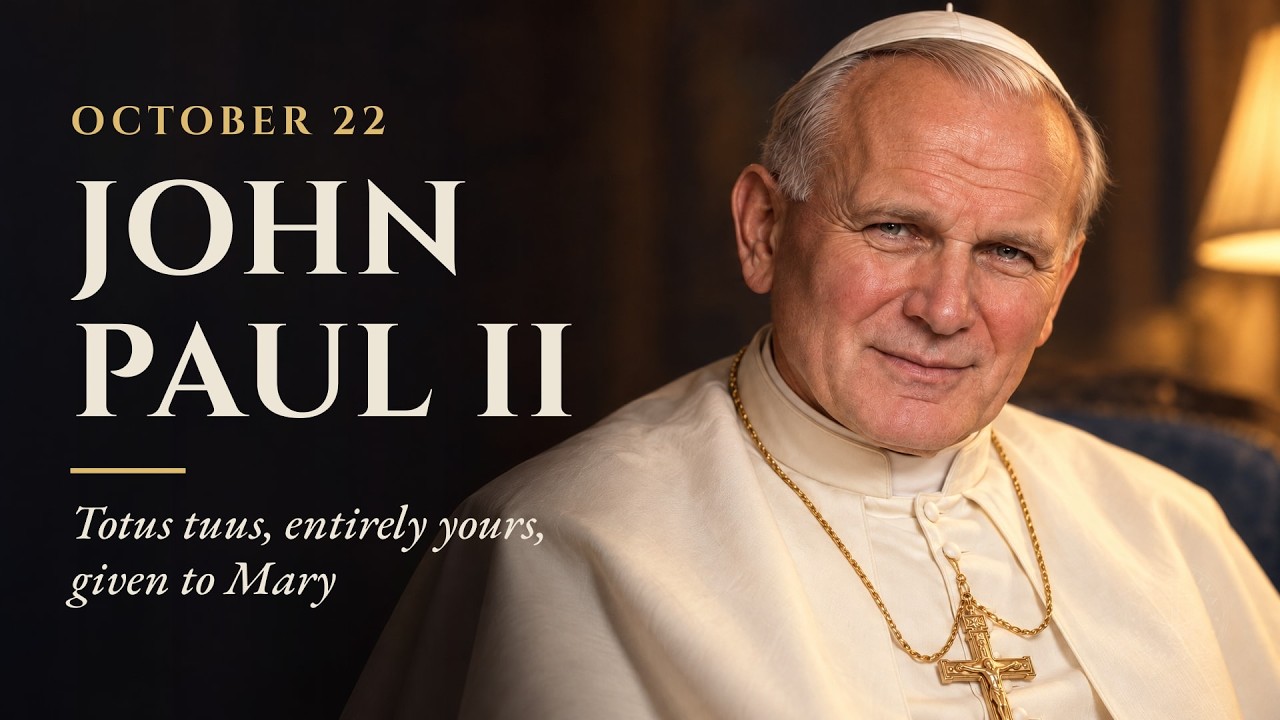
Inside, Saint John Paul II, the Pope from Poland, prayed before the little golden Virgin. It was November 1982, and no Pope had ever come to the Pillar as a pilgrim before. That day the statue wore a mantle embroidered with the papal coat of arms.
He entrusted Spain and the Hispanic nations to the Mother, and he invoked her as Patroness of the Hispanic World, the name by which her devotees honor her today. His prayer ended with three petitions: "Holy Virgin of the Pillar: increase our faith, strengthen our hope, kindle our charity." He kissed the Pillar and expressed the wish to see the column and Our Lady without the mantle.
He came back in October 1984. He was on his way to Santo Domingo, where the Church was preparing for the five hundredth anniversary of the evangelization of the Americas, and this time he was given what he had asked for, to see her without the mantle.
In the Holy Chapel, the statue stood without its mantle. Beneath the small golden Virgin, the column shone in its casing of worked silver, in the light of the two angels' candles. John Paul II prayed before her. Then he came closer, bowed, and kissed the Pillar once more, with the same gesture as anyone who waits their turn in line.
That is how the city sees her on the second, the twelfth and the twentieth of every month, in memory of the Coming, the feast and the Coronation.
The Pope continued on his way to the Americas. The column, by contrast, does not move from its riverbank, and yet its feast crosses the sea too. It begins in Zaragoza every October 12, when the flags of the Hispanic American countries hang from the pillars of the basilica, because that date coincides with the date in 1492 when Columbus reached the Americas. In the square, people in traditional dress walk in procession for the Offering of Flowers.
The feast travels in prayer as well. On that day the Church celebrates a proper Mass, with prayers and readings of its own for this feast, which begins by recalling the pillar that guided the people of Israel through the desert. Pius XII allowed the nations of South America to celebrate that same Mass. And so, on the other side of the sea, the same prayers are said that day as beside the Ebro.
And it reaches all the way to the other side of the world. In Zamboanga, in the Philippines, Our Lady of the Pillar is the patroness of the city, and her feast begins before dawn, with a Mass at three in the morning at the Fort Pilar shrine. Then a procession sets out from the cathedral. On that same day, the Church honors her in Spanish-speaking lands and in others that call upon her by this name.
Zamboanga also honors its patroness with a festival of its own, the Hermosa festival.
In South America there are churches that bear her name. In Buenos Aires, the Basilica of the Pillar prepares for the feast with a novena, nine days of prayer in a row.
But devotion also travels by word of mouth. In Argentina, a little boy learned a jota verse from his grandmother, a folk song of Aragon that begins "Our Lady of the Pillar says…". He sang it many times as a child.
That boy became Pope Francis, and in 2022 he recited it from memory and said that his grandmother had taught it to him. The column of Zaragoza had crossed the sea in a grandmother's voice.
I'm Going to See Our Lady
In Zaragoza, what is learned at home is also learned by climbing a few steps. People in Zaragoza say "I'm going to see Our Lady" as naturally as someone going to see their mother.
Every day, the Infanticos, the boy altar servers of the Pillar, climb the stairway of the camarín, the small enclosure where the statue stands, carrying other children in their arms or leading them by the hand. Some are newborns. Others have not yet made their First Communion. For a moment the boys bring them close to the feet of the statue, and then they come back down. Below, the families wait, often in a long line.
Behind the camarín there is another line. An oculus opens in the wall, a small round window, and through it you can see the jasper of the column. A hand rests on the stone. Then the lips draw near.
The people have worn that hollow away. One kiss, and another, and another, for centuries, until the stone was hollowed out. And the column is still in its place.
On either side of the statue, two silver angels hold candles. They are all that remains of the old chapel, and the purest wax is set aside for them. In the church, at any hour, a priest is waiting to hear confessions.
Every day, before the camarín, people sing the short prayer that blesses the hour of the Coming. And every January 2, on the date the city keeps for that night by the river, the basilica does not go dark. People keep vigil before the Blessed Sacrament, Jesus Christ present in the Eucharist exposed on the altar, and the archbishop usually presides.
Beside the column, the Mother's night has become a night before her Son.
Holy Mary of the Pillar, Mother of God and our Mother, as this city sings that you came beside the Ebro to comfort the weary apostle, draw near also to those who labor without seeing fruit and to those who have no strength left. Lead us to your Son, Jesus Christ, whom we adore in the Eucharist beside your column. Obtain for us from Him strength in faith, assurance in hope and constancy in love, and cover with your mantle the children who are brought to you, the sick who cannot come and those who beg at your door. Holy Virgin of the Pillar, pray for us. Amen.