A man in chains lifts his head in the darkness. From above comes music—flutes, drums, laughter that cuts through stone. He knows that sound. It is a tetrarch's feast.
He has been locked in that vault long enough for the iron to mark his wrists. Above, a young woman begins to dance. When she finishes, she will ask for a reward. A head. His.
It is the birthday of the tetrarch of Galilee and Perea. The prisoner is no thief, no armed rebel. His crime fits in a single sentence: he told the tetrarch to his face that it was not lawful for him to have his brother's wife.
And the tetrarch does not want to kill him. He admires him. He listens to him with pleasure. But tonight he will keep a vow made over wine, before his guests, while the music plays on.
The man below once gathered crowds on the bank of a river. An entire people came down to listen; a throne came to fear him. He could have stayed silent and lived. He did not. He asked for no mercy. He did not retract a single word.
All Galilee knows him by a single name: John, the one who baptizes in the Jordan.
But before the cell, there was a river. Before the river, a desert. And before all else, a promise spoken low, in sacred smoke, in the heart of Jerusalem.
A Name Written in Silence
In the last years of Herod the Great, some six years before our era, Judea lived under an aging king who distrusted everyone. He built fortresses in the deserts and covered the Temple in gold while Rome, from afar, watched it all. In the roads men spoke in whispers of a messenger yet to come; the people paid their taxes, kept the Law, and waited. In that air of expectation, an old priest drew the most solemn duty of his turn: to enter alone into the holy place and offer the incense.
His name was Zechariah, of the priestly division of Abijah. His wife, Elizabeth, descended from Aaron; both were righteous before God, both were old, and they had no children. That wound had been with them all their lives. As the people prayed outside in the courtyard, the old man moved through the dimness between the rising smoke, and then he saw it: standing to the right of the altar was someone. It was the angel Gabriel, and his message was precise: Elizabeth would bear a son, he would be called John, and he would walk before the Lord with the spirit and power of Elijah.
The old man doubted. He had human reasons to doubt: he was old and his wife was barren. But doubt, this time, had a price: he was struck mute. He came out of the sanctuary unable to pronounce the blessing; he made signs with his hands, and the people understood that he had seen something in there. When his turn ended, he returned to his house in the hills of Judea, the promise held fast and his voice gone.
Months later, a young woman from Nazareth climbed those same hills. Her name was Mary, and she too carried a son announced beforehand. At her greeting in the doorway, Elizabeth felt the child leap for joy in her womb. She spoke aloud what she recognized: the mother of her Lord had come. That was John's first witness—a leap of gladness at Jesus before either of them was born, before either could understand, before any word at all. Mary stayed about three months in that house. Two women heavy with child under one roof, an old man mute watching them, and a silence that was no longer empty.
The child was born, and Elizabeth's joy spread to her neighbors. On the eighth day they brought him to be circumcised, and all assumed he would be named Zechariah, like his father. Elizabeth said no: his name would be John. No one in the family bore that name, they protested. They asked the father to decide, and the old man called for a tablet. His hand trembled. He wrote: "His name is John." And in that act of obedience, his tongue came loose. Months of silence broke open in a song that blessed the God of Israel because He had visited and redeemed His people. The Church still prays it every morning, and calls it the Benedictus.
The neighbors came down from the hills telling what had happened, and across the whole region the same question ran: What would this child become? A name brought by an angel, a father who recovered his voice writing it, a life announced before it began. The stone house grew too small among the hillsides. The child grew strong in spirit. And beyond the last olive tree, toward the east, the empty land began—land that would one day be his school.
Desert: The Voice That Learns Silence
Years later, a young man walked alone through the wastes that fell toward the Dead Sea. He had left behind his parents' house, the olive trees, the village. Here there were no paths: only canyons of limestone, white and ochre, that the noon sun turned blinding. Nothing could be heard. Not a bird, not a voice, not water. Only the wind when it blew, and his own footsteps on the stone.
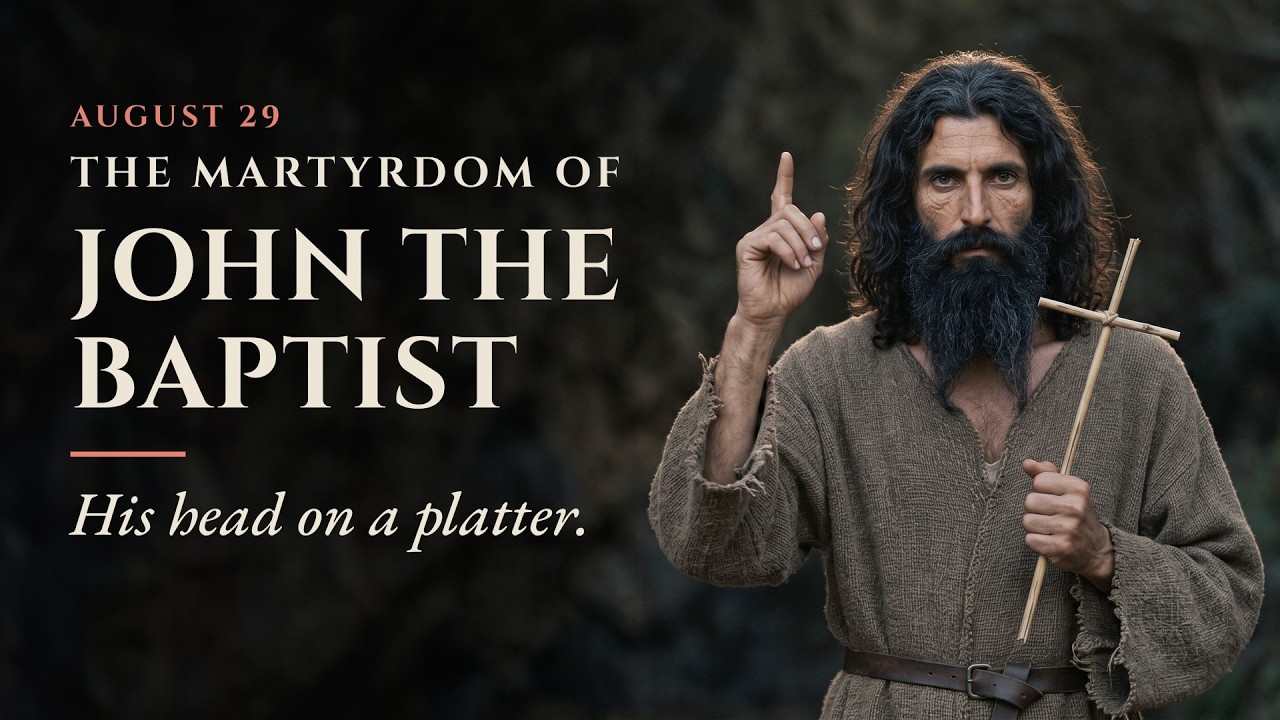
He wore a rough tunic woven from camel hair, cinched at the waist with a belt of leather. He ate what the desert gave him: locusts and wild honey. He slept in caves. He walked barefoot. With the years, his body became sinew and bone: his cheekbones sharpened, his cheeks hollowed, his hands and feet cracked. Anyone who saw him would have thought of the ancient prophets, of Elijah, the man in his hairy mantle and leather belt, who also spoke before kings. The angel had announced it in the Temple: he would walk before the Lord with the spirit and power of Elijah. The desert was carving him for that.
Why does a man go to such a place? He was not fleeing anything. He was not atoning for any guilt. He went to learn the one thing the village could not teach him: how to listen. In the desert no one applauded and no one argued; there was no one to convince, no one to perform for. What a man is, there, he is alone before God. Fasting stripped away everything extra. Silence stripped away the rest. And in that emptiness, day after day, year after year, the promise spoken over him before birth became certainty: Someone was coming, and it was his task to prepare the way.
He prayed. He waited. He prayed with the Scriptures of Israel, the same ones sung in a priest's house. There was a line from Isaiah that seemed written for this landscape: a voice crying in the wilderness, a way that must be straightened. He did not yet know that line would be his name.
Meanwhile, far to the north, in a village of Galilee, Jesus grew—the one John had greeted with a leap of joy before either of them was born. The two matured in silence, each hidden in his own place: one in a workshop among wood and tools; the other among stones under a sky without shadow. Israel still waited: Herod the Great had died, his sons divided the land, Rome appointed and removed governors. No one looked toward the canyons of the Dead Sea. No one knew that a voice was being sharpened there.
Years and years, beyond counting. Entire decades that fit in a single line: he lived in desert places until the day of his manifestation to Israel. A whole youth in a sentence. A whole apprenticeship of silence.
And what can come from a silence so long, from a life so bare? A word that owes nothing to anyone. A man from whom nothing more could be taken, because he had nothing; whom no one could buy, because he wanted nothing. One day, far off, a murmur of voices began to rise: people coming down from the villages toward the river. The hour of the desert had ended. The hour of the voice had begun.
The River and the Multitude: The Voice That Calls
In the fifteenth year of the reign of the emperor Tiberius, at a ford of the Jordan River where the water ran brown and narrow between reeds and tamarisks, a man dressed in camel hair began to speak. He preached a baptism of repentance for the forgiveness of sins: go down into the water, confess what weighs on you, come up ready to live differently. And something happened that no one expected from a stranger without schooling and without a name: people came. From Jerusalem, from all Judea, from the whole region of the Jordan. Families came down the dusty roads, and the ford filled with rolled-up tunics and bare feet in the mud.
His words offered no comfort. He called things by their name and made no exceptions for anyone. Tax collectors came—men hated for their trade—and he did not turn them away: he told them not to demand more than what was owed. Soldiers came, and he did not set them aside either: do no violence to anyone, he said; be content with your wages. He asked each one for something concrete, something he could begin tomorrow morning. That is why they listened: because this man who owned nothing asked nothing for himself.
And the people began to wonder if he might be the Messiah. It is the temptation of every life that has touched crowds: to keep what is offered. The answer came without a moment's hesitation. He was not the Messiah. He was not Elijah returned from heaven. When the envoys from Jerusalem pressed him to say who he was, he answered with the line from Isaiah that the desert had taught him: a voice crying in the wilderness. Prepare the way of the Lord; make his paths straight. A voice. Not even a name. And he added, pointing forward in time: "I baptize you with water; but one more powerful than I is coming, whose sandal strap I am not worthy to untie." To untie a sandal was the work of slaves. The most austere man in Israel, the one who drew multitudes down to the river, declared himself less than a slave to the one who would come after.
One day, among those waiting their turn, there was a Galilean of about thirty years. He came from Nazareth. It was Jesus, that kinsman whose closeness had made John leap with joy in his mother's womb before either of them was born. And for the first time, the voice that had not trembled before anyone resisted. I need to be baptized by you, he said, and you come to me? But Jesus insisted: it is fitting for us to fulfill it all. And John yielded. He obeyed the one he had come to obey. He brought him down into the brown water of the Jordan, as he did all the others, among sinners, and poured the water over his head.
As Jesus came up from the river, the heavens opened. The Spirit descended on him in the form of a dove, and a voice proclaimed him the beloved Son. John saw it. His whole life—the announcement in the Temple, the leap in his mother's womb, the long years of stone and silence—existed for this moment by the water.
The next day he saw him pass again and pointed with his arm outstretched: "Here is the Lamb of God, who takes away the sin of the world." Two of his own disciples heard the words and went after Jesus. One of them was Andrew, a fisherman from Bethsaida, who ran to find his brother Simon. This is how the precursor fulfilled his office: he formed disciples and gave them away. He lost them on purpose.
With time, those who remained at his side began to grow uneasy. Everyone is going to him now, they said; the one you baptized baptizes more than you. They expected perhaps a complaint, a defense of the master. They received something else. He compared himself to the friend of the bridegroom at a wedding: the one who prepares the feast, hears the bridegroom's voice, and rejoices that the joy is not his. And then he spoke the words that sum up his entire life: "He must increase, but I must decrease."
Decrease. Without bitterness, without longing for the crowd. Can a man rejoice that his own work recedes into the background, that he becomes unnecessary at the very moment of his fullness? This man can. The desert carved him for that.
But a voice like this troubles more than jealous disciples. The crowds hear it, and so does power. A tetrarch who has heard of this prophet rules in Galilee and Perea who flatters no one. And the word that did not lower its price for tax collectors or soldiers will not lower it before a throne either.
The Truth Before a Throne
The tetrarch's name is Herod Antipas. He is the son of Herod the Great, that king under whose reign John was born. He was educated in Rome and learned its ways and its calculations. On the shores of the Sea of Galilee he built a new capital bearing the emperor's name: Tiberias. He is a skilled survivor in a world of daggers. And he has done something that scandalized his people: to marry Herodias, the wife of his own brother, he has repudiated his first wife, daughter of the Nabatean king of Petra. The Law of Moses forbids it without equivocation. Everyone knows it. And no one says it aloud, because saying it to a tetrarch has a price that no one wants to pay.
John says it. Around the year thirty, with the naked word of one who has learned no other: "It is not lawful for you to have your brother's wife." Without insult, without diplomatic evasion, without measuring the distance between a barefoot prophet and a throne. The same concrete demand he made of soldiers and tax collectors, now applied to the most powerful man in Galilee and Perea.
Herodias does not forget. She is the granddaughter of Herod the Great, a woman who has wagered her entire lineage and position on this marriage, and John's words do not sound to her like doctrine: they sound like a sentence against everything she is. From that day she hates him and wants him dead. She waits only for the occasion.
The tetrarch is something else. He knows John is a just and holy man. He fears him, protects him, listens to him with pleasure, yet he is left bewildered by a voice that asks nothing, flatters no one, and does not yield. You can hear the truth with pleasure and refuse to obey it; that is Antipas, exactly. And beneath the fascination grows another fear, colder and more political: the crowds. An unknown man with no army moves thousands with a single word, and a man capable of that could one day move them against a throne. Moral scandal and fear of revolt join in the same decision. The tetrarch's soldiers go down to the river.
There is no resistance. The man who called Israel to straighten its paths lets himself be bound without complaint and sets out on his own toward the south. The march skirts the Dead Sea through increasingly desolate country. Ahead appears a conical hill suspended over precipices: Machaerus, the fortress that Herod the Great rebuilt on the eastern frontier of his realm. Walls with towers at the corners, a palace with columns and mosaic floors at the summit, and below, carved from the rock, cisterns and vaulted chambers. From its towers, smoke signals can be seen all the way to Masada and to Jerusalem. It is the eye of power over the wilderness. Now it will be his prison.
They put iron shackles on his wrists and ankles and lower him into a stone chamber. The man who lived for years under open sky is now between four walls. The sun that had bronzed his skin no longer touches it, and the desert tan begins to fade on his hollowed cheekbones. He eats what they give him. He sleeps on stone. All the horizon left to him is reduced to a crack of light, high, unreachable.
Herodias wants his death; Herod protects him from her, but does not give him back his freedom. Time passes. Above, power continues to govern; far away, in Galilee, Jesus walks through villages, and news of what he does reaches the cell through the disciples who still visit. The voice that made multitudes come down to the river can speak to no one now. But in that darkness something is still awake, and a question begins to take shape.
The Night of the Cell: Doubt and Fidelity
It takes shape slowly, in the darkness, and it is a hard question for a prophet. On the Jordan he had announced one who would come with the axe laid to the root of the trees, with fire that does not go out. And the news that filters down to the cell speaks of something else: a teacher who eats with sinners, who heals the sick, who forgives, who topples no throne. Where he expected judgment, mercy is arriving. With iron on his wrists and a long stretch of stone behind him, the firmest man in Israel finds himself without certainty. What if he misunderstood? What if he spent his whole life pointing toward the wrong place? He does not keep the doubt to himself. He calls two of his disciples—he still has them, they still climb to the fortress—and gives them a task unworthy of his voice: go to Jesus and ask. "Are you the one who is to come, or are we to wait for another?" The man who baptized him in the Jordan, who saw him come up from the water beneath the open sky, now needs to hear him say it. And in that question there is more faith than it seems: doubt does not turn him away from Christ, it pushes him toward him. A man can doubt with his back turned or doubt face to face, and John asks face to face, just as he had always spoken.
The two men descend the fortress path and walk north, dusty road, until they find Jesus in Galilee, surrounded by people. They repeat the question word for word. And he does not answer yes or no. He answers with what is happening before them all: the blind see, the lame walk, the lepers are cleansed, the deaf hear, the dead are raised, and the poor have good news proclaimed to them. These are the signs that Isaiah had promised for the time of the Messiah. John knows them by heart. Nothing more is needed: the man who learned to read the wilderness will know how to read this too.
When the messengers leave, Jesus turns to the crowd and speaks of the prisoner. What did they go out into the wilderness to see, he asks them. A reed shaken by the wind? A man dressed in soft clothing? Those who dress that way live in palaces. They went out to see a prophet, and more than a prophet. And then he speaks over him words he spoke of no other: "Among those born of women there has risen no one greater than John the Baptist." He says this of a prisoner. He says this of a man who, at that very moment, doubts in the darkness of that cell.
The disciples return with the answer. What face John wore when he heard it, no one wrote down; no word of his came out of that cell again. But one thing is certain: he did not recant, did not plead, did not buy his freedom with silence. He stayed where his truth had placed him. When hope wavers, faithfulness no longer rests on consolation: it rests on the word received, more solid than the mood of a day. In the wilderness he had learned to trust what God says above what he himself feels. Now that learning is all he has left. And it is enough.
Time keeps passing. And one night, through the crack high above, a sound comes that does not belong to the wilderness: ropes, voices, servants hurrying. Above, the palace lights up. The tetrarch celebrates his birthday, and the great men of Galilee are already climbing the hill to celebrate it. Below, on the stone, a chained man listens. No one has told him anything. There is no need.
The Banquet and the Silence
Above, the hall is ablaze with light. The magnates of Galilee, the officers, the men of power in the region recline on couches across a mosaic floor, between columns and oil lamps. Wine flows in cups of glass and bronze, servants move between the tables with trays. Through the high windows, the night of the Dead Sea is a black abyss that no one looks at. Herod Antipas presides over his own birthday. Tonight no one crosses him.
Then the daughter of Herodias enters to dance. A girl of fifteen or sixteen, slender and lithe, in a linen tunic drawn tight, with veils loose around her. She dances before the guests, and she pleases them. She pleases everyone, and above all the tetrarch, who has already drunk deep, who wants to appear generous before his great men. And he does what the powerful do when they wish to seem greater than they are: he makes an unmeasured promise. He swears to give the girl whatever she asks, even half his kingdom.
The girl goes out to consult her mother. And Herodias does not hesitate for an instant. She has waited a long time for exactly this: a public oath, witnesses, a husband trapped by his own word. She does not ask for gold, nor lands, nor a husband of royal blood. She asks for the only thing she truly wants. The girl returns to the hall and says it before them all: "Give me the head of John the Baptist here on a platter."
The tetrarch's face goes dark. The Gospels say it plainly: he was grieved. That is the whole man, right there: he knows John is just, he has protected him, he has listened to him with pleasure more than once, and gladly. He knows what they are asking is a crime. And he looks around: the diners, the oath, his honor. He could refuse; it would cost him only a moment of shame. He does not refuse. He prefers to kill a just man rather than lose face at his own feast. He sends for an executioner.
Below, the stone muffles the music. John hears footsteps on the stairs, and they are not the usual guards. The door opens. There is no trial, no sentence read, no witnesses. Not a single word of his survives that hour. The man who made multitudes tremble on the riverbank dies without an audience, in a cellar, while they toast above. He kneels. He draws his hair forward. The years in the wilderness have taught him not to fear the dark. He dies as he lived: taking back nothing he said, faithful to the one he had pointed to on the Jordan. A stroke of the sword. Silence.
The platter rises up the stairs. It is handed to the girl, and the girl carries it to her mother. Above, the feast goes on, as if nothing had happened. The guests might have seen the platter pass between the lamps, and perhaps some lowered their eyes. Below remain the open shackles on the stone and a body without a voice.
That is the whole death of the greatest man born of woman. No public square, no glory, no last word. He chose the truth, and the truth cost this: one night, a sword, the crossed caprice of a grudge and an oath. The music will fade with the dawn. The silence will not. And somewhere in Perea, men who loved him are about to find out.
Burial and Memory
When the news comes down from the fortress, they go up. The disciples of John arrive at Machaerus and take their master's body to bury it. No one stops them: dead, he frightens no one now. They give him burial, and a memory that comes down from the earliest centuries places that tomb in Sebaste, in Samaria, far to the north. Then they go to tell Jesus. And the Master, hearing it, withdraws alone, to a place apart. He too falls silent.
Over that tomb the centuries passed, and they did not forget it. Three hundred years later, under the emperor Julian, men profaned it; the ancients told how some of the bones were rescued and carried to Alexandria. Different traditions speak of the head: one venerates it in Rome, in the Basilica of San Silvestro in Capite; another reached the cathedral of Amiens; another is honored in the Great Mosque of Damascus. They cannot all be true. And perhaps it does not matter so much: what the Church has guarded most jealously is not a skull, but a testimony.
Around the year ninety-three, in Rome, a Jewish historian writes the history of his people. His name is Flavius Josephus. He never knew John; he is not a Christian; he writes as one who has no religious motive to do so. And yet he sets down in writing John's name, his preaching, and the fortress of Machaerus. Of his end he writes: "Herod killed him, although he was a good man and called the Jews to practice virtue, justice among themselves, and piety toward God." He adds something more: years later, Antipas was defeated in war by the king of Petra, and many Jews saw in that defeat a punishment for John's death. The tetrarch who wished to silence a voice remains in history, above all, as the man who ordered it cut off.
And the Church did not wait for historians. Already in the fourth century, in East and West, the memory of his martyrdom was celebrated: one of the oldest feasts ever given to a saint. It still lives today each twenty-ninth of August. John is, together with the Virgin Mary, the only one whose birth and whose death the liturgy celebrates. And each dawn, in the Lauds of the whole Church, the Church still prays the song that Zechariah sang on the day he recovered his voice over his son's cradle.
In our own time, the stone has spoken again. Since 2009, archaeologists working in Jordan have excavated the summit of Machaerus. Stone by stone, they have raised up again some of the columns of the courtyard where the girl danced. The courtyard, the cisterns, the cellars lie open once more above the Dead Sea. And farther north, the ford where John baptized receives pilgrims from all over the world. The banquets have passed. The kings have passed. The empire that held them up has passed. What remains is the wind over the ruins, and a name that two thousand years have not worn away. The voice fell silent one night in a cellar; the echo has not fallen silent yet.
When the Voice Falls Silent: An Invitation
A question waited in the darkness of that cellar, while the feast went on above, and it has not left with the centuries. Why choose the truth when it is known it will cost everything?
John did not answer it with a speech. He answered it with the whole shape of his life. In the desert he learned to need nothing, and a man who needs nothing cannot be bought by anyone. By the river he pointed to Jesus Christ and stepped back, content to remain behind, because his task was not to hold anyone but to deliver them. When his own grew restless to see everyone going with the other, he spoke of joy: the friend of the bridegroom, who hears his voice and that is enough.
And in the cell, when certainty became a question, he did not break faith: he asked, he listened, and he stayed. Before the tetrarch he spoke the words he knew would be costly, and he did not take them back. He did not seek martyrdom. He simply never found, in his whole life, a single reason to lie.
We come to a crossroads much like it, almost every week, with no fortress or executioner. It is the meeting where silence costs less. It is the report that would be wiser to soften before sending it. It is the conversation we put off, month after month, to avoid the price of an honest word. What do we keep quiet today for fear of losing what John never wanted to have?
We know his answer. He chose to speak. Not from pride, not from the pleasure of being right: he spoke because his whole life belonged to the One who came after him, to the Lamb he had recognized in the water of the Jordan. Whoever lives to point to Christ cannot point, at the same time, to a lie.
Over the wastelands of Judea the dawn breaks as it did then. The same harsh light on the same pale stone, the same great silence where a boy learned to listen before he spoke. From that silence came a voice that made a throne tremble; from that voice, a testimony that the Church's memory has never let fall silent. The greatest faithfulness is almost never seen: it is decided, as his was, in cellars where no one looks. He fulfilled the one thing he had come to do: to prepare the way of the Lord and to step aside in time.
Saint John the Baptist, Precursor of the Lord, witness to the truth, voice in the wilderness, pray for us.