His hands were still wet when he heard his name. He dropped the nets, left the boat and his father, and walked off behind a voice. No argument. No goodbye. What kind of heart answers like that?
The Nets by the Lake
The Sea of Galilee is, in truth, a lake: a sheet of fresh water sunk among golden hills, black basalt villages pressed against its shore. In the early first century, that shore smelled of fish, of pitch, of linen nets laid out to dry in the sun. Rome ruled from a distance and collected up close: at the docks, tax collectors weighed every catch, and the whole region lived under Herod Antipas, a prince on the empire's payroll. And beneath it all, like an ember under ash, burned an old expectation: a people waiting for one sent by God, though no one yet knew how to give him a face.
In one of those fishing villages, somewhere between Bethsaida and Capernaum, James was born, son of Zebedee and Salome, older brother of John. Not a single line survives of his childhood; the lake, though, lets us picture all of it. His was no poor household: Zebedee owned his own boat and had hired men in his service, and his name carried weight at the docks. Even so, in Galilee no one ate without getting wet. The boy grew up learning the trade from the bottom: mending linen, bailing water, hauling ropes, until his palms filled with calluses.
He grew strong and lean, shoulders broadened from years of hauling nets, with that quick temper the lake never softens. He worked by night, when the fish rise, and slept by day, when the sun burns hardest. He could read the water and the wind the way other men read a scroll. On the Sabbath, in the synagogue, he heard the old promises: that God had not forgotten his people. His life was already charted: his father's boat would one day be his sons' boat, and the days looked alike, one after another, like the waves.
Until they stopped looking alike.
One morning the work was the same as always: the boat run aground, linen nets spread across their knees, Zebedee dividing the tasks among his sons and the hired men. Mark tells it in few words, like a man who knows words are not needed. Along the shore came a traveler from Nazareth, a craftsman named Jesus, and the water carried his voice back. A little earlier he had called Simon and Andrew, the Zebedee family's fishing partners, as they cast their net:
"Follow me, and I will make you become fishers of men."
A few steps further he saw the other boat, and in it the two brothers, nets in hand, palms calloused by rope and hook. He looked at them. He called them. And here the Gospel records not a single word of reply: it says only that at once they left the boat and their father, and followed him. The nets stayed half-mended. The catch stayed unweighed. A family's whole inheritance, left leaning against the boat's rail like one more piece of gear.
Zebedee said nothing. Or if he said something, no one wrote it down. What remains is only the image: a gray-bearded father, standing among his hired men, watching his two sons walk away down the shore behind a stranger. Every calling has a cost, and part of it is always paid by the one left watching.
That readiness said almost everything about the man who had it. Almost everything. Because the same heart capable of leaving everything in an instant was capable, too, of burning for the wrong things. Very soon Jesus himself would give that fire a name — and it would not be a gentle one.
Sons of Thunder
The name came soon after. Jesus went up a mountain in Galilee, gathered those who followed him, and chose twelve from among them all, to be with him and to be sent out to preach. Among the twelve were the two brothers from the boat. And to them, and only to them, he stamped them with a nickname: Boanerges. Sons of thunder.
No one gives a name like that to a lukewarm man. A nickname like this is a portrait, and this one painted the sons of Zebedee whole: the decision that never waits, the word that outruns the thought, the zeal that burns and sometimes scorches. Jesus knew that fire better than they knew it themselves. And he did not choose James in spite of the thunder; he chose him with the thunder still in him, the way a man takes a whole character and points it somewhere else.
These were the days of fervor. The roads of Galilee churned with people: the sick carried in on stretchers, whole villages pouring out to the crossroads, words never heard before about a Kingdom drawing near. The son of thunder watched it all up close, dust on his sandals, eyes lit up. He was convinced that the Kingdom was about to break loose any moment, the way a storm breaks over the lake. Many in that land were hoping for thrones, armies, a Galilee free of Rome. He too dreamed big, in his own way; and he wanted a front-row seat when it all arrived.
On the road to Jerusalem, a village in Samaria shut its doors to them. And James's voice did not waver: "Lord, do you want us to bid fire come down from heaven and consume them?" Jesus turned and rebuked him: they did not know what spirit they were of. The Kingdom did not force its way in by destroying. It was the first pruning of that temperament, and not the last. Jesus did not put out James's fire. He took it with him. And very soon he began to bring him where only three were ever allowed.
The Three Who Saw the Glory
The first door opened in Capernaum. A man pushed through the crowd and fell at Jesus' feet. His name was Jairus, one of the leaders of the synagogue: his twelve-year-old daughter was dying. On the way to the house came news no father wants to hear: the girl had died — why trouble the Master any further? Jesus heard it, and asked only one thing of Jairus: not to be afraid, only to believe. And on reaching the house he let no one come in with him except three: Peter, James, and John.
Inside, the wailing of the mourners already sounded, the funeral flutes, the murmur of death settled into the house. Jesus said the girl was not dead, only asleep, and they laughed at him. Then he sent everyone outside. He took the father, the mother, and the three fishermen with him, and went in where the girl lay. A dim room. A bed. Total silence. He took her hand and told her to rise.
And the girl got up, and began to walk.
James stood three steps away. A fisherman with calloused hands knew what death was — he had seen it on the lake, in the villages, in the winters. And he had just watched it obey a voice. The same voice that had once called him from the shore. There was no thunder in him that time: only an awe that found no words. Jesus ordered them to tell no one what had happened. That shared secret bound the three of them in a new way, the way people are bound together after they have witnessed something too great to hold.
It had been a small room, a girl, a hand. The next time Jesus set them apart from the rest, there would be no walls: there would be an entire mountain, and a light no human eye was ready to see.
The mountain came soon after. Jesus again took the same three and led them apart, up a high mountain that tradition identifies with Mount Tabor. It was a windswept summit of rock and evergreen oaks, standing alone above the plain. They climbed without asking. And up there, before their eyes, the Master was transfigured: his face changed. His clothes turned a dazzling white, a white no one on earth could ever produce.
Beside him appeared two men in conversation: Moses and Elijah, the Law and the Prophets. Peter stammered something about putting up three tents; he did not know what he was saying. Then a bright cloud covered them, and from the cloud a voice called Jesus his beloved Son, and commanded that they listen to him. The three fell to the ground.
Facedown on the rock, his face bathed in that brightness, lay the man who had once asked for fire from heaven. Now he had it before him: a fire that consumed nothing, that only revealed who this man was, the one he had followed since the shore of the lake. Kings and prophets had longed to see something like this. A fisherman saw it.
When they raised their eyes, there was no one left but Jesus, alone, in his ordinary tunic. They came down the mountain in silence, keeping another secret. But a brightness like that is not forgotten. Dazzled by it, James would soon want to claim a place in that glory for himself — never suspecting the price of the seat he would ask for.
With that brightness still in their eyes, the dust of the road was waiting for them below. Jesus set out firmly on the road to Jerusalem, and the shortest way ran through Samaria. Jews and Samaritans had despised one another for centuries: they worshiped the same God and would not sit at the same table. Jesus sent messengers ahead to arrange lodging in a Samaritan village. And the village, learning the group was bound for Jerusalem, shut its doors to them.
Then the thunder spoke. The two brothers stepped forward, faces burning: "Lord, do you want us to bid fire come down from heaven and consume them?" It was no figure of speech: they meant it. They had just seen Elijah wrapped in glory on the mountain; now they wanted his fire. They were asking to see an entire village — women, children, the old — reduced to ash for a shut door.
Jesus turned to them and rebuked them: they did not know what spirit they were of. Nothing more. No lightning fell on the village, no sentence fell on the brothers. The group gathered their bags and walked on toward another village, and the sky over Samaria stayed unbroken above its rooftops.
It was a pruning, the first one. Jesus did not put out that fire; he bent its direction. He did not cast out the impatient man; he kept him close, the way one tends an ember that does not yet know what it is burning for. The Kingdom he proclaimed would not conquer by destroying, and James would have to learn it over the years, blow by blow, road by road.
But the thunder had another face, quieter and deeper than anger. It did not ask punishment for those outside: it asked a place among those within. And on that same road to Jerusalem, he was about to dare give it a name.
The Cup He Asked For Without Knowing
He dared to ask, near Jerusalem, in the middle of the march. In Matthew, Salome the mother kneels to ask; in Mark, the brothers ask for themselves, face to face. Perhaps it was both: an entire family driven by the same ambition. What they asked was enormous: the two chief seats of the Kingdom, at the Master's right and his left, on the day his glory came.
Jesus was not indignant. He looked at them and gave back one question: "Are you able to drink the cup that I am to drink?" In Israel's language, to drink another's cup meant sharing his fate completely: his road, his suffering, his death. The brothers did not hesitate: "We are able." It was the same answer as always — the boy who dropped his nets without a second thought: generous, bold, blind. They did not know what they were promising.
And Jesus took the promise seriously. Those seats were not his to give, he said. The cup, yes: "You will drink my cup." James heard a promise of glory and kept those words like a treasure. He had just received, veiled, the announcement of his own death.
The first sip was waiting nearby, closer than anyone imagined: in a garden of olive trees, at night, beyond the city walls.
Night came a few days later. After the Passover meal, Jesus crossed the Kidron with his own to a garden called Gethsemane. And once more he set the same three apart — Peter, James, John — who'd entered Jairus's house, who'd seen the mountain's light. This time there was no glory to behold. "Watch with me, and pray," he asked them. Then he went a few steps among the trunks and fell to the ground.
James wanted to keep watch. He pulled his mantle tight against the morning cold, eyes fixed on the shadow where the Master prayed. But sorrow weighs more than sleep itself, and his eyelids kept giving way. Nearby, Jesus agonized alone, sweat falling from him like drops of blood. Three times he came back to them; three times he found them asleep.
The man who said "we are able" could not stay awake a single hour. The man who had promised so much could not keep vigil an hour. And still, Jesus did not cast him aside. No rebuke struck him from the Twelve — only the gaze that had called him by the lake, still waiting.
Then came torches among the olive trees, the arrest, the flight. James too ran into the darkness, like all the rest. The cross went up without him at its foot.
It looked like the end of everything. But the water where it had all begun still had a shore waiting.
Weeks later, the lake saw them again. Seven disciples went back to Galilee, and among them the sons of Zebedee. One evening Peter said, "I am going fishing," and the rest got into the boat with him. All night they hauled empty nets, just as in the old days, with the very same hands.
At daybreak, someone was waiting on the shore. "Cast the net on the right side," he told them. They cast it, and could not haul it in for the sheer number of fish. Then John was the first to understand: "It is the Lord!" It was Jesus, alive, standing on the sand, coals glowing, bread and fish ready for them.
James jumped ashore with the others and ate breakfast by the fire with the Risen Lord. The water that had been a beginning came back now as a reunion. No one mentioned the flight from the garden. There was no need: that bread shared at dawn was already the forgiveness.
He had said "we are able" without knowing what he was promising. Now he knew what it cost, and he was still standing. The cup would come, but not the way he had chosen. Years would pass in silence; then a king would seek the favor of the powerful, and the promise would be kept, word for word.
The Sword and the Kiss of Peace
The years that followed found him in Jerusalem. Fifty days after that Passover, the Spirit came down like fire on the apostles gathered together, and the men who had hidden went out into the streets to proclaim Jesus Christ risen. From then on, the fisherman became a pillar: together with Peter and his brother John he held up the first community of believers, moving between the Temple and the houses where the bread was broken.
Almost no words survive from those years. He can be traced wherever the Twelve were: teaching under the porticoes, praying in houses, laying on hands. Nearly fourteen years of quiet labor, without thunder. His beard grew gray by degrees; the burning gaze turned steady without losing its fire.
And the horizon kept widening: the Master had already sent him out to the ends of the earth. Those years on the road brought him, at last, back to Jerusalem.
The Spanish tradition holds a bold memory: that James was the one who went farthest. That he sailed west, crossed the sea, and set foot in Hispania, the far edge of the known world, to proclaim Jesus Christ where no one had yet spoken his name. Roman roads under the sun, colonies of stone and sun-dried mud brick, marble gods in every forum. The fisherman of the lake, preaching at the end of the earth.
It was not an easy sowing. The word fell on hard ground; few listened, and the road was long. And in Zaragoza — the Roman Caesaraugusta — it has been told since time out of mind that one night, beside the Ebro River, discouragement got the better of the thunder. That the apostle prayed there, worn out on the riverbank. And that Mary, the mother of Jesus, still living in mortal flesh, came to comfort him upon a pillar of reddish jasper. That he should not fear: that land would believe. The man who had seen the light of Mount Tabor received, in the darkest night of his mission, a humbler and closer light.
So that land has kept it ever since, calling him its own. What is certain is that, years later, the apostle was again in Jerusalem.
And there a king was waiting for him.
The king was named Herod Agrippa, and he carried in his blood the most feared name in Judea: he was a grandson of Herod the Great. He had been raised in Rome, among princes, learning the difficult art of pleasing the powerful. And the art paid off: the emperor placed his grandfather's kingdom in his hands. But a borrowed throne needs support. Agrippa sought the favor of Jerusalem's leading men. And he found easy prey: the small community of those who followed Jesus.
The memory of the early Church kept it in a single line: "About that time Herod the king laid violent hands upon some who belonged to the church." And among those seized fell the first of the great ones: James, the brother of John. Soldiers led him bound through the streets of the city where he had watched his Master die. It was drawing toward the year forty-four; some fourteen years had passed since that Passover.
He stood before the tribunal with his tunic torn, his lip split, his wrists bound with rope. Gray already streaked his beard, but his hands were still a fisherman's hands. He did not bargain, did not stay silent, did not beg for mercy: he confessed Jesus Christ before his judges, with the same swiftness he had once dropped his nets. The thunder was still inside him. Only now it no longer called fire down on anyone: it burned whole, quiet, in his own voice.
The sentence was the sword.
And in that hall stood a man charged with leading the prosecution. He had gathered the charges, had pointed his finger at the apostle. Now he stood close by, listening to every word of the condemned man. And something inside him was beginning to crack.
A very old memory, passed from mouth to mouth among the first Christians until Clement of Alexandria set it down in writing, tells what happened next. That man, hearing the apostle confess Jesus Christ without his voice trembling, could no longer play his part. He had come to bring down a prisoner and left overcome by him instead. Right there, before the judges, he declared himself a Christian. The sentence embraced him too: the same sword, the same day.
They were led together to the execution ground. And on the way, the man who had raised the charge turned to his victim and asked his forgiveness.
James looked at him a moment. "Peace be with you," he said. And he kissed him.
It was the greeting of brothers: the kiss of peace that Christians gave one another when they gathered, the sign of belonging to one family. James gave it to the man leading him to death. Years before, he had wanted fire from heaven to consume a village for shutting its door. Now, on the way to the scaffold, he threw his own door wide open to the last man who had called at it. He did not die winning an argument. He died begetting a brother.
They walked the last stretch together: two men bound, one baptism of blood waiting for them at the end.
The street ended in a stone courtyard, and in the courtyard the executioner waited with the bared gladius — the short sword that carried out the king's sentences. James offered no resistance. There was no final speech. He knelt on the sun-warmed stone and bared his neck.
Years before, on a road in Judea, he had answered "We are able" without weighing what he promised. That morning he weighed it in full. The cup he had asked for so boldly reached his lips at last, and he drank it to the bottom — not on a throne beside a glorified Jesus, but under a sword, joined to a Jesus handed over.
The sword fell.
It was, in those days, drawing toward the year forty-four. The first of the Twelve to shed his blood for Christ was the son of thunder. And of all the apostles, his is the only death set down in the New Testament: a brief line, dry, without ornament, like a gravestone. His brother John, the other Boanerges, would die an old man, the last of them all. James opened the door.
Then, silence. No last words recorded, no wonder in the Jerusalem sky. The city went on with its markets and its prayers, and the silence weighed more than any word could.
The sentence was not the last news of that year. Months later, Herod Agrippa went down to Caesarea Maritima, the great port city of his kingdom, by the sea. One festival morning he entered the theater wearing a robe woven of silver. The coastal sun struck the fabric, and the king himself seemed to burn with light. He spoke to the people from on high, and the crowd, dazzled, began to shout that this was the voice of a god and not of a man.
Agrippa did not turn the praise aside. The Acts of the Apostles tell it plainly: an angel of the Lord struck him that instant, because he did not give God the glory. A sudden pain doubled him over before them all, and within days the king who had ordered James killed to win an ovation was dead.
The persecutor's sword had stopped nothing. The word of Jesus Christ kept growing, house by house, road by road, while the throne that tried to silence it stood empty.
And as for the apostle, everything seemed closed: a dry line in a book, a body mourned by his own. But God writes slowly. That memory would sleep for centuries, and wake far away, where the land ends and the sea begins.
The Memory That Walks
What comes next is no longer told by the Acts of the Apostles. It is told by the Jacobean legend, passed from pilgrim to pilgrim across generations until it was set down in the Codex Calixtinus, the great medieval book of the Camino. And it is a beautiful story.
It tells how two disciples of the apostle, Athanasius and Theodore, gathered his body in Jerusalem and carried it down to the coast. How they set it upon a rudderless boat, entrusted to God alone, and how in seven days the waves drove it to Roman Gallaecia, in the northwest of Hispania. There, at a port called Iria Flavia, the land is green and the mist rises off the ocean. Tradition named that voyage the Traslatio: the transfer of the body from the city that killed him to the shore that was waiting for him.
On land a queen of those mountains was waiting for them, named Lupa. The disciples asked her for help, and she gave them, with a hidden intent, a pair of wild bulls to pull the funeral cart. But the bulls came down from the hills as gentle as oxen: they bowed their heads, let the yoke be set on them, and began to walk with no one guiding them. Where the cart stopped on its own, there they dug the grave.
That is how the memory of the Camino painted it for centuries, in its illuminated manuscripts and in the stone of its porticoes: the Galilean who one morning left a boat on a lake and arrived, asleep forever, at a harbor in another boat. They buried him in a forest inland, and time did what time usually does: the name faded, the thicket grew over the stone, and that tomb was forgotten. Nearly eight hundred years.
Until one night, in the third decade of the ninth century, something trembled over that thicket. A hermit named Pelayo, who lived apart in the forest of Libredón, saw lights flickering among the trees. They were lights that settled again and again on the same spot, like a fallen star that refused to go out. So Compostela's memory has always told it. Pelayo did not keep it to himself: he went to tell the bishop of Iria Flavia, a man named Teodomiro.
The bishop climbed into the forest, fasted, and had the undergrowth cleared. And beneath centuries of soil and roots there appeared a small stone tomb, ancient, forgotten. Teodomiro recognized it as the tomb of the apostle James. Of that bishop, at least, there is no doubt: his tombstone, bearing his name and the year 847, was found beneath the cathedral in 1955. He asked to be buried beside the man he had found.
The news reached Oviedo, and King Alfonso II of Asturias set out with his court to see it with his own eyes. That royal journey, over mountains and valleys, was the first pilgrimage: the path he opened is still called the Camino Primitivo. Over the tomb he ordered a modest church built, and around it a place with a new name began to grow. Popular memory always read it this way: campus stellae — the field of the star. Compostela.
A tomb lost at the end of the world had just become a destination. What remained was to give the apostle a face the walkers could look upon.
Stone gave it to him. Alfonso's modest church soon grew too small for so many walkers. Another rose over it, and then the great Romanesque cathedral, which took more than a century to build. In 1188, a sculptor known as Master Mateo crowned the entrance with his finest work: the Portico of Glory. An immense façade, filled with prophets, apostles, and elders bearing musical instruments. And on the central column, facing every soul who arrives, he seated James.
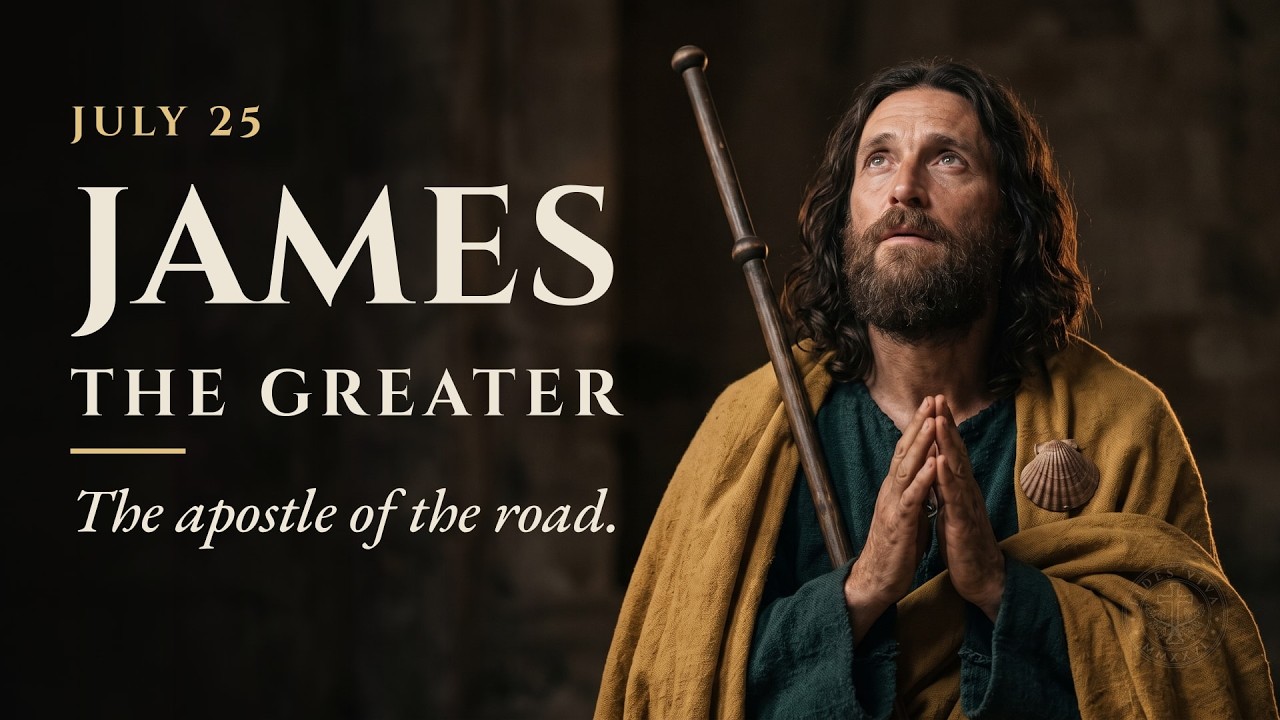
No one had preserved his features; that face is not a portrait but the memory of centuries carved into stone. And yet it says a great deal: the beard split into two points, the hair parted down the middle and falling to either side, the calm gaze of a mature man. The fisherman of thunder turned into a father waiting at journey's end. Not long after, in the thirteenth century, another image of him was placed above the high altar: a seated statue of painted stone. In the Baroque era they dressed it in a silver cape studded with scallop shells, the pilgrim's cloak.
Pilgrims climb up behind that image, by a narrow stairway, and wrap their arms around it. That is how the Camino has ended for centuries: not with a document or a stamp, but with an embrace.
The stone remained there, serene, watching the people arrive. But what it held beneath — the bones of the altar — still had its own crossing ahead.
That crossing came by surprise, and from the sea. In 1589, when the fleet of the English corsair Francis Drake landed at La Coruña, only days from Compostela, the city trembled for its treasure. To keep it safe, the apostle's remains were taken from their usual place and hidden inside the cathedral. They were hidden so well that, once the danger passed, the exact spot was forgotten. For nearly three hundred years pilgrims kept arriving, climbing the stairway, embracing the statue — with no one able to say for certain where the bones that had started it all now lay.
In 1879 someone decided to search. Excavations behind the high altar, by lantern light, brought to light a hidden niche holding the remains of three people. They were studied and compared, and in 1884 Pope Leo XIII settled the question with a solemn bull: those relics were the apostle James's.
(on-screen: "Deus Omnipotens, Leo XIII, 1884")
So the Church declared it, with the full weight of her authority; some historians still argue the point today. What no one disputes is what came after. The remains were placed in a silver urn engraved with the monogram of Christ and the figures of the apostles. They rest in an open crypt beneath the high altar, where anyone can kneel a step away from them. And the old path, which had been fading, filled again with footsteps.
A forgotten forest in Galicia, where lights once trembled in the night, has become the destination of millions. And the path born of that star does not belong to the past: it is full of footsteps right now, this very morning, under that same northwestern sky.
How Far to Follow
Today the sun rises on that same path, and it is not empty. Across the wheat fields of Castile a line of figures moves in the first light; in the damp forests of Galicia, boots sound on wet earth. Backpacks, walking staffs, and every so often a stone marker with the yellow scallop shell, the symbol that points the way. They come from every continent. Each one walks for something different: a promise, a grief, a question that has no name yet. Some know how to pray; others have forgotten how, and they walk anyway.
There have never been so many. In 2025, the pilgrim office that welcomes walkers in Compostela issued more than five hundred thirty thousand compostelas, the certificate that proves a pilgrim has reached the tomb. It is the highest number in its history. And something greater is near: in 2027, July twenty-fifth, the apostle's feast day, falls on a Sunday, which makes the whole year a Holy Year. The cathedral's Holy Door, walled shut the rest of the time, will open on December thirty-first, 2026. Millions will pass through it.
At the end of each stage the same gesture waits. Below, in the crypt, the silver urn rests in its half-light of small lamps. Above, on the great feast days, the botafumeiro — an enormous incense burner that swings across the nave — flies from one end to the other, filling the air with smoke and wonder. And behind the high altar, a narrow stairway climbs to the seated statue of the apostle, so pilgrims can embrace it from behind, hands resting on its stone shoulders. Some weep, others fall silent, others barely manage a word of thanks. Twenty centuries after that morning on the lake, every embrace carries on the same scene: someone who has left something behind to reach a friend of Jesus Christ.
The question from the beginning has not moved from that spot. What kind of heart answers like that, without arguing, without a goodbye. His whole life was the answer. He wanted the first place, and he took it: he was the first of the Twelve to give his life, his neck bared before the sword. The fire that once asked for judgment on a village ended up burning as a kiss of peace for the man who handed him over. His heart was not changed; only its direction was.
We too hold nets in our hands: a job that gives us security, a house that is hard to leave. And we too have an ordinary morning when something calls our name, very quietly. What nets still hold these hands when that voice is heard. The question has not aged. Today it is ours.
The lake was left behind twenty centuries ago. The voice that once passed along that shore still passes, every dawn, along every shore in the world.
James the Greater, apostle of the Lord, first to drink the cup and patron of pilgrims, pray for us.