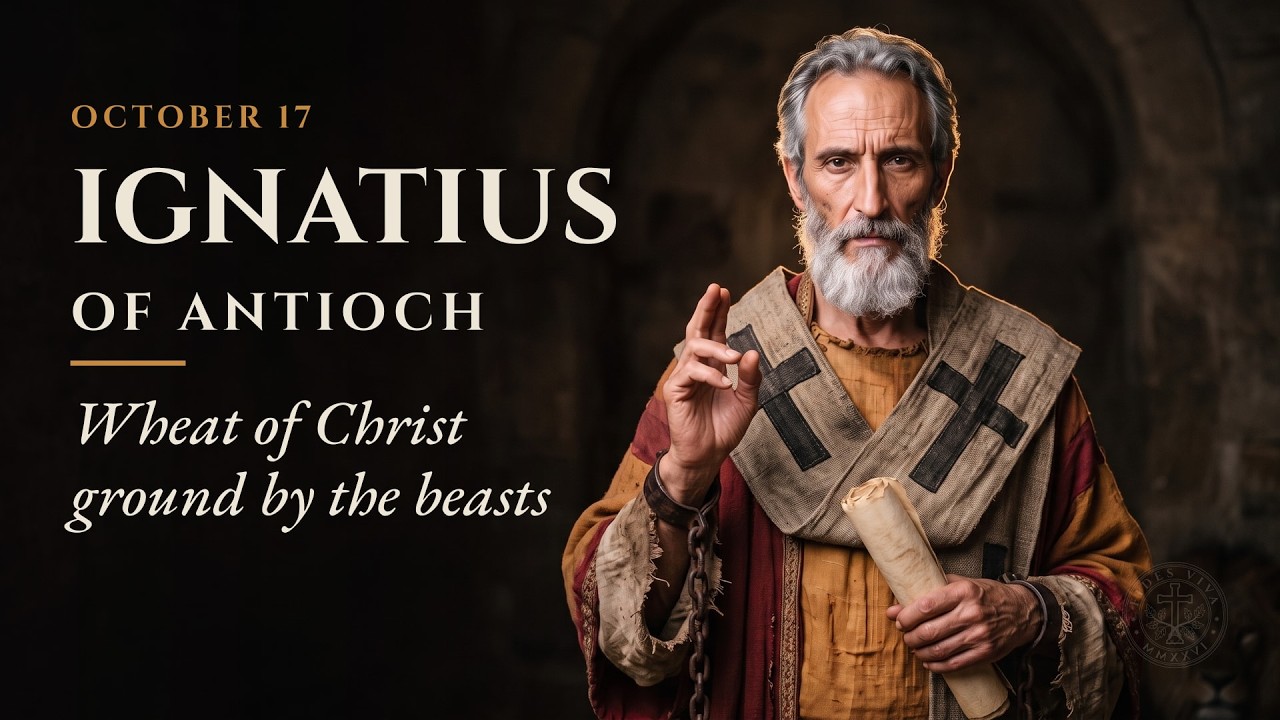
Ignatius, the bishop of Syria, condemned to the wild beasts, is being taken as a prisoner to Rome, and along the way he sends a letter to the Christians of that city, who have never seen him. He asks them for something no one would ever ask. Not to lift a finger to save him. He is afraid of their love, because they could free him from death, and then he would lose the chance to die for Christ, which for him means reaching God. So he begs them to keep silent, and in a single image he tells them what he wants to be, the wheat of God.
The man who pleads like this still has soldiers, the sea and many cities ahead of him. And what he asks for himself, to die for Christ, he confesses he is only beginning to learn.
Ten Leopards
Ten soldiers guard him without rest, by land and by sea, night and day. Ignatius calls them his ten leopards, soldiers who only grow worse the better they are treated. It is the time of the emperor Trajan, early in the second century, and the escort is taking Ignatius from one end of the Empire to the other, from the east to the west, as he himself puts it.
In the greeting of his letters he gives himself another name, Theophorus, which in Greek means God-bearer. Behind him lies his Church, the Church of Antioch, in Syria. He was its bishop, the one who guided all the Christians of the city, and now he has to leave them.
That Church lived in one of the three great cities of the Empire, beside the river Orontes. There, in Antioch, the followers of Jesus were first called Christians. No scene remains of how Ignatius came to the faith, or of how he came to lead that community. The ancient memory of the Church, which her liturgy still keeps, counts him among those who listened to the apostle John, together with Polycarp, who would become bishop of Smyrna. And another tradition says that Peter himself had placed him at the head of that Church.
There is also a luminous memory from those years. A historian of Constantinople tells, centuries later, that Ignatius saw the angels praising the Most Holy Trinity, the Father, the Son and the Holy Spirit, in two choirs answering each other. The bishop brought that way of singing to his Church, one group of the faithful facing the other, their voices taking turns. And from Antioch it spread to the other Churches.
But of how that bishop passed from the choir to the chains, he never says a word in his letters. A later account of his martyrdom, told and retold over the centuries, places him before the emperor Trajan in Antioch itself. The emperor has ordered the Christians to worship the gods. There Ignatius confesses his faith in Christ, and Trajan orders him taken in chains to Rome, to be food for the wild beasts.
From Syria a long road begins toward the west, and in every city there will be Christians coming out to find him. Along the roads of Asia Minor, today's Turkey, with his ten leopards beside him, the bishop of Antioch enters a city of that land, Philadelphia.
A Cry in Philadelphia
The Christians of Philadelphia gather in assembly, and the prisoner stands in their midst. He asks them to stay united with those who guide them, with the bishop, with the presbyters, the elders who help the bishop lead the community, and with the deacons, the servants of all. He does not say it quietly. Before the whole assembly, he cries out, "Give heed to the bishop, to the presbyters and to the deacons."
But some look at him with suspicion, because there are divisions in that Church, and they suspect that someone told the newcomer about them before he arrived, and that this is why he speaks this way. A stranger in chains seems to know too much.
Ignatius calls Jesus Christ as his witness, the One for whom he wears his chains, that no human being has told him anything, because the words that came from his mouth were proclaimed by the Holy Spirit. And what he was asking was simple, that they do nothing without the bishop, that they love unity and flee from divisions. He adds that God does not dwell where there is division and anger, but that the Lord forgives all who repent and return to unity.
The argument does not end there. Some set him a condition for believing, and he hears them say, "If I do not find it in the ancient writings, I do not believe in the Gospel." They want to see it first in the archives, in the ancient writings, before they accept what is proclaimed about Christ. Ignatius answers them, "It is written." And at once they reply, "That is exactly what has to be proven."
The bishop of Syria does not go looking for another text, because for him the ancient writings are Jesus Christ himself, his cross, his death, his resurrection and the faith that comes through him.
Along that same road from Syria, two companions come after him, Philo, a deacon from Cilicia, and Agathopus, a Syrian Christian, who follow him for the sake of God. The Christians of Philadelphia receive them, but some treat them with dishonor.
Later, from another city along the way, Ignatius sends a letter to that Church and thanks those who welcomed his two friends. For those who insulted them he asks only one thing, that they be forgiven by the grace of Jesus Christ.
Then the prisoner and his guards continue on toward Smyrna.
Those Who Hurried to See Him
In Smyrna, no one looks at him with suspicion. The escort halts in this city on the coast, where the bishop is Polycarp, younger than the prisoner, and the news of his arrival quickly spreads along the roads of Asia.
In Ephesus they learn that he is coming from Syria in chains, and they hurry to see him. Their bishop arrives, a man whose love is beyond words, and in him Ignatius receives the whole community of Ephesus. With the bishop come a deacon and Crocus, who comforts the prisoner in every way. Ignatius asks that this deacon stay with him a while longer.
Envoys from the Church of Magnesia arrive too. And from Tralles, further inland, comes its bishop, Polybius. Polybius rejoices so much with the prisoner in his chains that Ignatius sees the whole Church of Tralles in that one man. Ignatius calls his chains, the ones he wears for Christ, pearls of the spirit.
Then he begins to write. Four of the seven letters he will leave along the way are written in Smyrna, and almost everything we know about this man fits within those seven letters. He writes to Ephesus, to Magnesia, to Tralles and to Rome.
He tells the Ephesians that he is only beginning to be a disciple, and that he speaks to them as fellow disciples, companions learning from the same Master. He asks them to pray without ceasing for others, to meet anger with gentleness, arrogance with humility and insults with prayer.
What he leaves them is Christ, whom he calls the one Physician, born of Mary and of God, and he reminds them that Mary conceived him by the power of the Holy Spirit. Mary's virginity, the birth of her child and the death of the Lord were hidden from the prince of this world, as he calls the devil. Three mysteries accomplished in the silence of God.
He asks them, united with their bishop and their presbyters, to break one bread, the bread of the Eucharist, the bread broken at Mass. For the prisoner, that bread is the medicine of immortality, the antidote against death.
As he takes his leave, he names Polycarp with affection. And he begs them, "Remember me, as Jesus Christ remembered you." He also asks them to pray for the Church of Syria, from which he is being led in chains to Rome, and where he counts himself the least of the faithful.
Those Who Praise Him Wound Him
Amid so much affection, the prisoner also hears praise. As he sets out to write his counsel to the Christians of Tralles, the Church of Polybius, Ignatius stops before giving the first instruction. Should a condemned man give orders, as if he were an apostle?
He knows that he understands great things of God. For that very reason he holds himself in check, so as not to be lost through boasting, the pride that grows on what others say. Now he must be more afraid than ever and pay no attention to those who puff him up with praise, because every word of praise strikes him like a lash.
And he admits it plainly. "I desire to suffer, but I do not know whether I am worthy."
What he lacks is gentleness, the humble meekness that does not strike back, and in the prisoner's eyes, it is with gentleness that the prince of this world is overcome.
He holds back what he could say. He could speak to them of heavenly things and of the places of the angels, but he fears that these would harm them, because in faith they are still like little children. And he admits that he does not yet understand them himself, even though he wears chains for Christ.
The bishop of great Antioch, the man who could write with authority to any Church in Asia, calls himself a learner.
To stay firm he leans on others, and he is not ashamed to ask. He begs them to pray for him, so that he may become worthy of the martyrdom that awaits him and not be rejected at the end of the road.
He also asks them to remember the Church of Syria, the community he left behind.
And so the letter to Tralles ends, with his fear spoken aloud and left unanswered.
The Wheat of God
From Smyrna he also writes to Rome, and to the Romans he confesses another fear. There are brothers there who could easily set him free, and that is what he fears.
Ignatius dates the letter the twenty-third of August. The Ephesians will carry it, and Crocus remains with him, the man who has comforted him in everything and whom he truly loves.
If the Romans manage to keep him from dying, it will be hard for Ignatius to reach God. So he asks them to keep silent. If they stay quiet, he will belong to God. He asks them to let him be offered to God as a sacrifice, now that the altar is ready. And then, gathered like a choir, they are to sing to the Father because God has called the bishop of Syria from the east to the west.
For himself he asks for one strength alone, not only to speak but to will, not only to be called a Christian but truly to be one. He will gladly die for God, if they do not stand in his way.
He puts it in an image from the field and the table.
"I am the wheat of God, and I am ground by the teeth of wild beasts, that I may be found the pure bread of Christ."
He begs them to draw the beasts to him, so that they may become his tomb and leave nothing of his body. Nor does he give them orders. Peter and Paul could command, because they were apostles. He knows he is a condemned man.
The ill-treatment of his ten leopards, the soldiers who guard him, is teaching him to be a disciple, though that does not make him think himself already justified before God. Bound to them, the bishop of Syria sees himself back at the beginning, and he writes it down.
"Now I begin to be a disciple."
No kingdom tempts him anymore. Better for him to die in Jesus Christ than to reign to the ends of the earth. He seeks Him who died for us, and he longs for Him who rose for us. Of the Romans he asks only that they let him imitate his God and suffer as He suffered.
He is alive, yet longing to die, and he says why.
"My love has been crucified." No fire that craves to be fed burns in him any longer, and within him there is living water that says to him, "Come to the Father."
He does not want the food that perishes. He wants the bread of God, which is the flesh of Jesus Christ, and for drink His blood, which is incorruptible love.
As he closes the letter, he turns back to his own people. He asks the Romans to remember the Church of Syria in their prayers, a Church that now has God for its shepherd in his place. Only Jesus Christ and the love of the Christians of Rome will watch over it.
He sends them the greetings of the Churches that have welcomed him in the name of Jesus Christ, and not as a mere passing traveler. Even those that did not lie on his route came out to meet him, city by city.
And he asks them one last favor, to let those who went ahead of him from Syria to Rome know that he is already near.
If It Was Only an Appearance
The escort leaves Smyrna and takes its prisoner north, to Troas, a port in the northwest of Asia Minor that looks out over the sea. There Philo, the deacon from Cilicia, and Agathopus catch up with him, the two companions who had been following behind him from Syria and whom some had dishonored in Philadelphia. At his side is also the deacon from Ephesus, the one the Churches of Smyrna and Ephesus sent with him, and whom Ignatius holds up as a model servant of God.
Through that deacon he sends a letter to Smyrna, the Church that has just given him hospitality. He begins by giving glory to Jesus Christ for the faith of those brothers, as firm as if they were nailed to the cross.
But in the communities of Asia there are teachers who say that Christ only seemed to have flesh and to suffer. Against them, the prisoner confesses Christ and leaves nothing vague. He was truly of the line of David and truly born of a virgin. He was truly nailed in his flesh under Pontius Pilate. He truly suffered and truly rose again. After he rose, he told those who were with Peter to touch him and see that he was not a spirit without a body, and they touched him and believed.
For Ignatius, the flesh of Christ and his own chains stand or fall together, and he writes it plainly.
"If these things were done by our Lord only in appearance, then I too am in chains only in appearance."
Why, then, has the prisoner handed himself over to death, to fire, to the sword and to the beasts? To be near the sword is to be near God.
He also recognizes those teachers by what they fail to do. They care nothing for the widow, the orphan, the oppressed or the hungry. They stay away from the Eucharist and from prayer, because they do not confess that the Eucharist is the flesh of our Savior Jesus Christ.
So he asks Smyrna that no one do anything in the Church without the bishop, and that they hold as true only the Eucharist celebrated by the bishop or by someone the bishop entrusts with it. And he sums it up in a single sentence.
"Where Jesus Christ is, there is the Catholic Church."
Catholic means whole, universal. In the Christian writings that have come down to us, this is the first time anyone calls the Church by that name.
As he takes his leave, the prisoner thanks the Christians of Smyrna for caring for him in everything and for welcoming Philo and Agathopus. And he thanks them for one thing more, that they were not ashamed of his chains.
They Have Reached Harbor
Ever since Smyrna, every letter has ended with the same request, that they pray for the Church of Syria. In Troas the answer arrives. The Church of Antioch has come through a hard time, one the letters do not explain, and it is at peace thanks to those prayers. It has its ordinary life back.
The prisoner writes to Polycarp, the bishop of Smyrna who gave him hospitality. The news lifts his spirits, and now he rests in God without anxiety, hoping to reach Him through suffering and to be truly His disciple.
What he does with that joy is share it. He asks Polycarp to gather his Church in solemn council and choose someone dearly loved and diligent, worthy to be called God's messenger, to go to Syria. He had already asked the whole Church of Smyrna for the same thing, a delegate who would travel with a letter to rejoice with the brothers in Antioch that they have reached harbor.
And thinking of whoever must make that journey, he adds, "A Christian is not his own master, but is at the disposal of God."
To Polycarp, who is younger than he is, he speaks as bishop to bishop. He rejoices at having seen his face, in which he found nothing to reproach. He reminds him that not every wound is healed by the same remedy. And he puts it in an image from the blacksmith's forge.
"Stand firm, like an anvil under the hammer. It is the mark of a great athlete to be struck and to win."
Polycarp must not neglect the widows. He should gather the faithful often and seek out each one by name. He should look to the One who is above time and became visible for our sake, who could not suffer and chose to suffer for our sake. And baptism is to be his armor, faith his helmet and charity his spear.
Ignatius wanted to write to more Churches, but there is no time left. His guards receive the order to leave at once, and they must sail from Troas to Neapolis, on the coast of Macedonia, in what is now Greece, across the sea. The prisoner is not the master of his own road. So he asks Polycarp to write in his place to the Churches he will not be able to reach.
Before closing the letter, he greets the people of Smyrna one by one. A woman with her whole household and her children, and two friends he loves.
The letter sets out for Smyrna, and the prisoner for Neapolis.
Sure News
From Neapolis they take him, probably overland, across Macedonia. In Philippi, as the bishop of Smyrna will tell soon afterward in a letter, the Christians come out, as they should, to accompany the prisoner and with others who, like him, are weighed down with chains.
For Polycarp, the fetters of these prisoners are the adornment of the saints and the crown of God's chosen ones.
So in that letter to the Church of Philippi, he begins by rejoicing in that companionship. Further on, he asks them for patience. And so that they know what patience he means, he sets before them the patience they saw with their own eyes in the blessed Ignatius, in others who also suffered, in Paul and in the rest of the apostles.
None of them ran in vain. They are already in the place that is their due, with the Lord with whom they suffered, because they did not love this world, but the One who died and rose again for our sake.
In that same letter, Polycarp also makes a promise. The Philippians have asked him, and so has Ignatius, that whoever travels to Syria to rejoice with the Church of Antioch should carry the letter from Philippi too, and Polycarp will see to it as soon as he finds the chance.
Along with his own words, he sends them the letters of Ignatius that he has, because they speak of faith, of patience and of growing in the Lord. And so the letters the prisoner wrote on his journey take to the road again, now in a messenger's hands, toward the city he passed through in chains.
And before taking his leave, Polycarp adds a request. If they have any sure news of Ignatius and of those who were with him, they should let him know.
Polycarp already places his friend with the Lord, and still he asks after him.
The Arena of Rome
No letter answers Polycarp's question. The answer remained in the memory of the Church, which held that this bishop reached Rome.
Jerome, a Christian scholar of the late fourth century, tells of a moment from those days. Ignatius, already condemned to the wild beasts, hears the lions roar. And with the ardor of one who longs to give his life for Christ, he returns to the image he had sent to Rome from Smyrna, the wheat that is about to be ground.
Ignatius is handed over to the beasts, and tradition places his death in the city's great amphitheater, the one known today as the Colosseum. No one takes from him the end he had asked for.
In Antioch, his Church set the day. It placed his death on the twentieth of December, around the year 107, under the emperor Trajan, and on that date it celebrated the memorial of its shepherd.
Tradition also recalls who brought him back. It was Philo and Agathopus, the two companions who had followed him from Syria. They gather his remains and carry them home, to Antioch.
The man who asked that the beasts leave nothing of his body returns to his city. They bury him outside the gates, beside the road that leads to the suburb of Daphne.
Jerome says that at the end of the fourth century his remains still rested there.
Beneath the Altar
Those remains did not stay forever beside the gate of Daphne. Centuries later, as the memory of Rome holds, they made the same journey Ignatius had made in chains, from east to west. In the year 637 they arrived at the Basilica of San Clemente, not far from the Colosseum.
Today the high altar of that basilica rises above the confessio, the crypt beneath the altar where the remains of martyrs are kept. There, as the Church of Rome affirms, two bishops of the earliest times rest together, Saint Clement, one of the first successors of Peter in Rome, and Saint Ignatius, the bishop of Syria. Behind the altar, at the foot of the mosaic that covers the far wall, an inscription recalls that a tooth of Ignatius is kept in that place.
He wanted the beasts to be his only tomb. What remains of him now rests beneath the table where Mass is celebrated.
Today the Latin Church keeps his memorial every year on the seventeenth of October, the date given to him by the Church's latest calendar reform, with a Mass of its own.
In the United States, a parish in the town of Antioch, Tennessee, in the Diocese of Nashville, bears his name, Saint Ignatius of Antioch.
In the Mass of his memorial, the Gospel of the grain of wheat is read, the passage where Jesus says that if the grain falls into the earth and dies, it bears much fruit. When the bread and wine are presented, the priest recalls that God received Ignatius as the wheat of Christ, made pure bread through martyrdom, and asks God to accept the sacrifice of his people as well. And in the most ancient Eucharistic Prayer of the Roman Rite, the great prayer at the heart of the Mass, his name is spoken among the martyrs the Church remembers before the altar.
Then comes the moment of Communion. The faithful draw near to the bread that the prisoner of Troas called the flesh of our Savior. As they come forward, the Communion Antiphon is said, a few brief words for that moment, and they come from the letter he sent from Smyrna to the Christians of Rome.
"Frumentum Christi sum," I am the wheat of Christ.
After Communion, the Church asks God that all may be Christians in name and in deed, the very thing that bishop in chains asked for himself when he begged the Romans not to save him.
In his letters from the road, Ignatius saw himself as a beginner, and we too come to that same bread, beginning each time to be disciples.
Saint Ignatius of Antioch, you who walked in chains toward Rome and offered yourself as the wheat of Christ, to become pure bread. You who were afraid of not being worthy and asked your brothers to pray for you. Obtain for us the grace to receive the bread of the Eucharist with faith. Obtain for us that we may be Christians in name and in deed. Remember those who suffer today, the sick, those who are afraid and those who are alone. May they find, as you did, rest without anxiety in God. Pray for us. Amen.