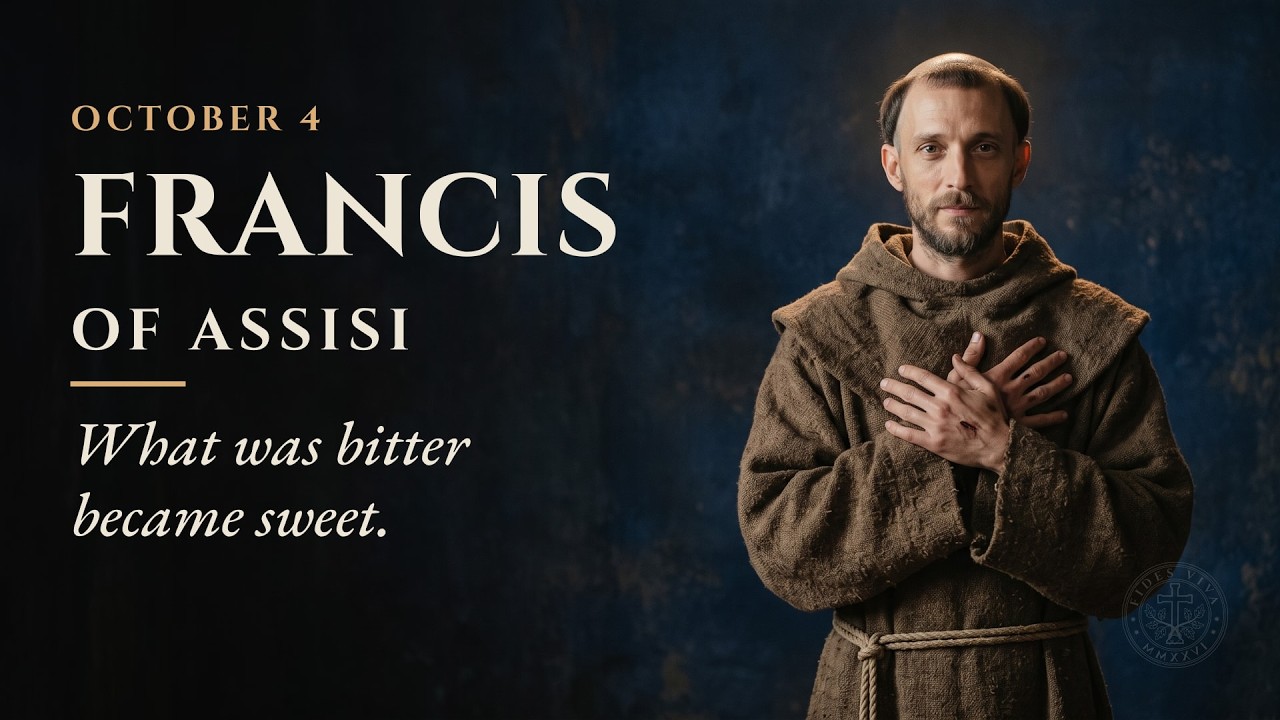
This year, almost four hundred thousand people booked a time in Assisi to pass before his remains. They came to see a man who, eight centuries ago, met his own death with joy.
In his last weeks, almost blind, he asked his doctor to hide nothing from him. When he learned how long he had left, he raised his hands to heaven and called death his sister.
As a young man he had been the rich son of a merchant. The sight of lepers was bitter to him, until the Lord led him among them.
The stories about him include a wolf, birds that listened, the first Nativity scene and a prayer for peace. Not all of those stories go back to him. His companions told what really happened, and also what they saw on his body when he died.
What happened to that young man, between the revulsion he felt back then and the joy that still fills Assisi today?
Assisi, a City at War
That young man grew up in a city at war with itself. In Assisi, the common people and the merchant class had taken up arms against the nobles, and some noble families crossed the valley to take refuge in Perugia, the rival city. Down below lived the lepers: people with leprosy, kept apart in hospitals outside the walls, like the one at San Salvatore delle Pareti.
He was the son of Pietro Bernardone, a wealthy cloth merchant, and he was taken prisoner in the war with Perugia, around 1202. He had been baptized John, but his father called him Francis. He was the young man of parties and songs, the one who spent money freely and stitched scraps of expensive cloth onto plain fabric.
He spent a year in prison, and they let him go because he was ill. His recovery was long. When at last he walked out into the countryside, leaning on a stick, the beauty of the fields no longer delighted him as it once had.
Even so, when a nobleman of Assisi armed himself to go to Apulia, in the south, where Walter of Brienne commanded the pope's troops, Francis saw his chance. He wanted a count named Gentile to make him a knight. He dressed in the most expensive clothes he could find, though shortly before he had given his new clothes away to a poor knight.
That night he dreamed that someone called him by name and led him into a palace full of shields and gleaming weapons. He asked whose it all was, and was told it belonged to him and his soldiers. In the morning, whenever anyone asked why he was so happy, he answered: “I know that I am going to be a great prince.”
At Spoleto he fell ill and, half asleep, heard a voice asking him: "Who can do more for you, the lord or the servant?" Francis answered: "The lord." The voice pressed him: "Then why do you leave the lord for the servant?" And he asked: "Lord, what do you want me to do?" The voice told him: "Go back to your own land, and there you will be told what you are to do." He could not sleep for the rest of the night.
At dawn he rode back to Assisi as fast as he could, full of joy. He gave up on Apulia. He began to withdraw to pray alone in a cave near the city, torn by inner struggles and filled with a new joy. To his friends he spoke in riddles about a treasure, and about great and noble things he would do in his own land.
No one had yet told him what he was to do. The answer was waiting for him on the road, outside the walls, where the lepers lived, the ones he had always avoided.
The Bitter and the Sweet
Until then, if he glimpsed the lepers' huts in the distance, he would hold his nose. When he gave them alms, he sent the money through someone else and turned his face away. One day, while he was praying, he heard that he must despise what he had loved, and that "in what once filled you with horror, you will find great sweetness and boundless gentleness."
Not long after, he was riding outside Assisi when he came upon a leper. He had to force himself. He got down from his horse, put a coin in the man's hand and kissed that hand. The leper gave him back the kiss of peace. Francis mounted again and went on his way.
Seeing lepers seemed extremely bitter to him. And the Lord himself led him among them.
Thomas of Celano, a friar who knew him, added a detail years later: when Francis looked back across the open field, the leper was gone.
A few days later he went back to the lepers' hospital with a great deal of money. He gathered them all together and gave alms to each one, kissing each one's hand. When he left, seeing and touching them no longer disgusted him: what had been bitter had turned into "sweetness of soul and body." In time he would come to live with them, washing their bodies and tending their sores.
Changed inside, he was passing San Damiano one day, an old little church on the verge of collapse, and he felt he should go in to pray. What happened there was kept in memory by those who lived with him. Kneeling before the image of the Crucified, he heard it speak to him by name: "Francis, don't you see that my house is falling down? Go, then, and repair it."
Trembling, he answered: "I will do it most gladly, Lord."
He took it literally: that church of loose stones. On his way out he found the priest sitting beside it and gave him money so that the lamp before the crucifix would never run out of oil. The voice had spoken to him only once, about a house that was falling down; the three calls and the "Church in ruins" of so many holy cards came in later accounts. But Thomas of Celano understood that this house was greater than a few walls: it was the Church that Christ bought with his blood. Francis began with the building.
From that day on he carried the Passion of Christ engraved on his heart. Once, on a road in the valley, he was going along crying out loud. A man heard him and asked why he was crying. "I am weeping for the Passion of my Lord," he answered. That Passion his brothers would one day see in his body.
But repairing a church took money, and he had nothing of his own. All he had within reach was his father's cloth. He made the sign of the cross, loaded the colored fabrics onto his horse and set out for Foligno.
Our Father, Who Art in Heaven
In the market at Foligno he sold the cloth, one bolt after another. Then he sold the horse as well and went back to San Damiano.
At San Damiano he offered the money to the poor priest. The man did not dare accept it, for fear of the young man's family. Francis tossed it onto a window ledge.
When Pietro Bernardone found out, he gathered friends and neighbors and set out to find his son.
Francis hid for a month in a cave that only one member of the household knew about. There he prayed in tears.
When he finally climbed back up to Assisi, thin and filthy, the people who knew him shouted that he was mad and pelted him with mud and stones. His father fell on him like a wolf on a sheep. He dragged him home and locked him in a dark place for many days, with arguments and with blows; some also remembered chains.
One day his father had to leave on a journey. His mother, who did not approve of what her husband was doing, went to her son and spoke to him gently. She saw that he would not give in, and she let him go.
When his father returned, he railed at her.
Then he turned to the law. He brought a complaint before the consuls, the city's magistrates, and they told him that his son, having entered the service of God, was no longer under their authority. Pietro Bernardone took the case to Guido, the bishop of Assisi.
Early in 1206, the bishop summoned Francis. He asked him to give back the money, which perhaps had not been honestly earned, and encouraged him: "My son, trust in the Lord, act like a man, and do not be afraid."
Francis went into the next room. He took off all his clothes, laid the money on top and came out naked before his father and everyone present. Under those colorful clothes he had been wearing a hair shirt, a rough garment of penance. In one account of that day, he stripped in silence. In his companions' account, he said that from then on he wanted to say "Our Father, who art in heaven," and not "father Pietro Bernardone."
His father gathered up the clothes and the money, and left.
Those present wept with compassion. The bishop embraced the young man and covered him with his cloak. From that day on the bishop was his protector.
With nothing of his own and a few rags on his back, Francis went off into the woods singing the praises of the Lord in French. Some robbers stepped into his path and asked who he was.
"I am the herald of the great King," he answered.
They beat him and threw him into a pit full of snow. He sprang out and went on singing.
For a while he worked as a kitchen hand in a monastery. In Gubbio, a friend gave him a tunic. Wearing it, he went back to Assisi, to the stones he had promised to raise.
This Is What I Want
Stone by stone, he raised the walls of San Damiano, then those of another church, and finally those of a small, abandoned chapel in the valley dedicated to the Virgin Mary: the Portiuncula. His heart burned with devotion to the Mother of all goodness, and there he stayed. He still dressed like a hermit, with a belt at his waist, shoes on his feet and a staff for the road.
One day in 1208, at Mass, he heard the Gospel in which Jesus sends his apostles out to proclaim the Kingdom. Afterward, he asked the priest to explain it to him. Those who were sent were to take no gold, no bag, no staff, no shoes and no second tunic.
"This is what I want, this is what I am seeking."
He took off his shoes right there. He set down his staff. He traded the belt for a cord and put on a rough tunic shaped like a cross. The Most High himself revealed to him that he was to live according to the form of the holy Gospel. And he also revealed the greeting they were to give everyone: "May the Lord give you peace."
That barefoot man began to draw others. Bernard of Quintavalle, a wealthy man of Assisi, sold what he owned and followed him, and Peter Catani came with him. A few days later Giles arrived, a simple, upright man. Others came, and when there were twelve of them, Francis proposed that they go to Rome and tell the pope what the Lord was beginning to do with them. They chose Bernard to lead them on the road.
In Rome, in the spring of 1209, Cardinal John of Saint Paul welcomed them and advised Francis to become a monk or a hermit. Won over by his persistence, he brought him before Innocent III, a powerful pope.
To some of the cardinals, that way of life seemed new and beyond human strength. The pope feared that such a life would prove too hard for those who came after, and he asked Francis to pray to learn whether it was God's will.
Francis came back, and in the Order they used to tell what he said to the pope then. It was a parable: a king had fathered children with a poor and beautiful woman of the desert, and he fed them in his palace. And Francis concluded: "I, my lord, am that poor little woman." Then the pope remembered a dream: the Lateran basilica was collapsing, and a small, despised friar was holding it up with his back. Saint Dominic's friars told that same dream about their own founder.
Innocent III approved Francis's way of life: "Go with the Lord, brothers, and as he sees fit to inspire you, preach penance to all." Francis knelt and promised him obedience, and the twelve received the tonsure, the shaved crown of clerics. When he heard the words "and let them be lesser" in the Rule, that way of life set down in writing, he gave the brotherhood its name: Friars Minor, the lesser ones, those who do not command.
Back in the valley, they moved into an abandoned hut at Rivo Torto, so cramped they could barely fit inside sitting down. Francis wrote each brother's name on the beams.
One day the emperor Otto came down the road with a great retinue, on his way to receive the crown. Francis did not go out to see him. He let only one brother go out, to tell the emperor that his glory would not last long.
The brothers asked Francis to teach them how to pray. He taught them the Our Father and a prayer for every church and every cross they came upon: "We adore you, Lord Jesus Christ, also in all your churches… because by your holy cross you have redeemed the world."
One morning a peasant showed up with his donkey and drove it into the hut. The brothers left for the Portiuncula.
One night in 1212, an eighteen-year-old girl from Assisi would come to that chapel of Our Lady.
Clare and the Sister Birds
Her name was Clare. It was the night after Palm Sunday. In the little chapel she promised obedience to Francis. Clare was of noble birth. Her family had been one of those that took refuge in Perugia in the years when neighbor fought neighbor. Now the daughter of that house was choosing to live poor.
Before she found her place, she passed through two monasteries. She found it at San Damiano, the church whose stones Francis had raised with his own hands. There the Order of Poor Sisters was born.
While the sisters stayed behind the walls of San Damiano, the brothers went out two by two along the roads, carrying the greeting of peace. Francis preached throughout the Spoleto Valley.
Near Menavia he saw a flock of doves, crows and jackdaws in a field, and he ran toward them. The birds did not fly away. He spoke to them just as he spoke to people: "My sister birds, you should greatly praise your Creator and love him always." They stretched out their necks, spread their wings and stayed there, looking at him. He walked among them, his tunic brushing against them, and he blessed them.
He himself told it, and so did the brothers who were with him that day.
In Alviano, the swallows would not let him preach. He told them to be quiet, and they fell silent.
He called every creature his brother or sister. One day he saw a sheep walking meekly in the middle of a herd of goats, and he rescued it, because it reminded him of Christ.
People, however, began to ask him for more than words. Thomas of Celano, the friar who knew him, gathered what the witnesses told. In Toscanella, a knight begged Francis to help his only son, who was lame. The saint held back. Then he prayed, laid his hand on the boy, and the boy took off running.
In San Gemini he placed three brothers in the corners of a house and commanded the demon to come out of a woman. It came out with a great uproar. And Francis, afraid he had been deceived, left that place ashamed.
In Gubbio, the city where an old friend had given him a tunic, he healed a woman's crippled hands, and she came back to find him, bringing him a fresh cheese.
And from that same city would come the story most often told about him: the story of a wolf.
Like Sheep Among Wolves
The story of the wolf, the one so many people have heard, was not told by those who lived with him. It appears more than a century after his death, in the Little Flowers, the stories gathered by the friars of the Marches, and it is still told to children today.
In Gubbio there was an enormous wolf that devoured animals, and people too. The townsfolk went out armed as if they were going to war, and in the end no one dared to go beyond the gates. Francis wanted to go and find it. His neighbors tried to talk him out of it, but he went anyway.
The wolf ran at him with its jaws open. Francis traced the cross in the air and spoke to it: "Come here, Brother Wolf! I command you, in the name of Christ, to do no harm to me or to anyone." The wolf closed its jaws and lay down at his feet like a lamb.
Francis reproached it for all those deaths. Then he offered it peace: the town would feed it, because it had done evil out of hunger, as long as it harmed no one again. The wolf placed its paw in his hand. It followed him meekly to the square and did it again, this time in front of all the people. It lived two more years in Gubbio. It went in and out of the houses without the dogs barking at it, and it died of old age.
The townspeople mourned it.
But the real danger, the one Francis had been seeking for years, was no legend at all. Around 1211 he set out for Syria to proclaim Christ to the Muslims, longing to die a martyr. Contrary winds drove him onto the coast of Dalmatia, across the Adriatic, and since the sailors refused to take him, he made his way back to Ancona hidden aboard their ship.
In 1219 he sailed again from Ancona and reached Damietta, in the Nile delta, in the middle of a crusade: the Christian army had the city under siege. One day he learned that the crusaders were about to go into battle, and the Lord let him understand that they would lose it. If he said so, they would take him for a fool; if he kept quiet, his conscience would reproach him. He asked his companion, who answered: "Father, it's not as if people are only now going to start taking you for a fool." Francis went and told them they would be defeated, and they laughed at him. During the fighting he had his companion get up and look. The first time the companion saw nothing; the second time, nothing either. The third time, he saw the whole Christian army in flight. Francis wept for them, above all for the Spaniards, whose own daring had decimated them.
Then he crossed the lines toward the sultan's camp, with one companion. The soldiers seized him and beat him. Al-Kamil, the sultan of Egypt, received him with honor and listened to him gladly.
Saint Bonaventure, the friar who wrote his life a generation later, told that on the way to the sultan's camp Francis was traveling with Brother Illuminato. When Francis saw two little sheep along the road, he said to him: "Trust in the Lord, brother, for the Gospel saying is being fulfilled in us: 'Behold, I send you out as sheep in the midst of wolves.'" Before the sultan, when he was asked who had sent him, he answered that God himself had, to show them the way of salvation.
And, according to that same Bonaventure, Francis went so far as to propose a great fire to the sultan, so that he could walk into it together with the sultan's priests. One of them, an old man, withdrew on hearing it. Francis then offered to go in alone, if the sultan would promise to convert along with his people. Al-Kamil did not dare, for fear of an uprising, and offered him valuable gifts, which Francis refused. There was also a witness from outside the Order. Jacques de Vitry, a bishop who was in the crusader camp, recounted that Francis preached to the Muslims for several days, with little fruit, and that the sultan had him returned safe and sound to the Christian camp.
There was no conversion, and no martyrdom, though he had gone looking for it. Francis came home to a brotherhood that no longer fit in any hut, where some were beginning to tire of the poverty of the early days.
A Christmas Eve in Greccio
In 1220, back in Italy, he placed the government of the brothers in the hands of a vicar of the Order, Peter Catani, one of the first who had followed him. Cardinal Hugolino, bishop of Ostia, became the Order's protector.
He no longer governed the brothers, and he allowed himself not a shred of vainglory. While he was ill, he had eaten a little chicken. Once he had recovered, on reaching the gate of Assisi, he told a brother to tie a rope around his neck and lead him through the town like a thief, calling out that he was a glutton. And when people praised him, he would ask a brother to insult him, and to the insults he would reply: "This is what the son of Pietro Bernardone needs to hear."
At the Portiuncula, a friar would tell afterward what happened there one day. Francis called Brother Leo, the companion who served as his secretary: "Brother Leo, write." "Here I am, ready."
It is not true joy, he dictated, if all the masters of Paris enter the Order. Nor all the prelates, nor the kings of France and of England. Nor if his friars convert all the unbelievers. Nor if he himself heals the sick and works many miracles.
True joy, he went on dictating, is this. He is coming back from Perugia in the dead of a winter night. There is so much mud and so much cold that icicles form on the hem of his tunic and cut his legs until they bleed. He knocks at the door for a long time. Inside, a brother asks: —Who is it? —Brother Francis. —Go away; this is no decent hour to be out on the road. You're not coming in. He insists. —Go away, you're a simpleton and an ignorant man; you're no longer one of us; there are so many of us, and of such standing, that we have no need of you. —For the love of God, take me in tonight. —I will not. Go to the Crosiers' place and ask there.
If he is patient and does not lose his peace, he concludes, "in this is true joy, and true virtue, and the salvation of the soul."
In November 1223, Pope Honorius III approved the Rule the brothers still keep today. Christmas was less than a month away.
About two weeks before Christmas, Francis sent for John, a nobleman of Greccio he loved dearly: "I want to celebrate the memory of the child who was born in Bethlehem." He wanted to see with his own eyes how the child had been laid in a manger, on hay, between the ox and the donkey.
That Christmas Eve, brothers came from many places, along with local people carrying candles and torches. They brought the hay, the ox and the donkey, and Greccio became a new Bethlehem. Francis stood before the manger, sighing, full of joy. Mass was celebrated over the manger. He was a deacon, the minister who proclaims the Gospel at Mass; he sang it and preached. When he called Jesus "the Child of Bethlehem," the word came out of him like the bleating of a sheep, and he ran his tongue over his lips, savoring it.
One of those present, a virtuous man, saw in the manger a child who seemed lifeless, and Francis waking him. They all went home full of joy. Afterward, that hay healed animals and helped women through difficult births, and over the manger an altar and a church were consecrated. The Nativity scene so many families set up each Christmas keeps the memory of that night.
Nine months later, Francis climbed a mountain in Tuscany with a single question for God.
La Verna
That mountain was La Verna, a hermitage of rock and forest that Count Orlando had offered him years before. There Francis kept the Lent of Saint Michael: forty days of prayer in honor of the archangel.
To learn what God wanted of his life, he took the book of the Gospels and opened it. He opened it three times. And all three times, the page spoke to him of the Passion of Christ.
In mid-September of 1224, in the solitude of the mountain, he sees something above him. It is a man with six wings, like a seraph. His hands are outstretched and his feet are together, nailed to a cross. Two wings rise above his head, two spread out for flight, and two cover his body.
Francis feels himself held in a gaze full of kindness, and the sight of him crucified fills him with dread.
He rises sorrowful and joyful at once.
And while he is still trying to understand what he has seen, the marks of the nails begin to appear in his hands and feet. Round heads show in his palms and on the tops of his feet. On the other side the points come through, bent over, as if someone had hammered them flat. In his right side a wound opens, bleeding, and turns his tunic and breeches red.
These are the stigmata: the marks of the Passion of Jesus Christ in a human body. The Passion he had carried in his heart since San Damiano had become flesh in him.
From then on he kept his hands and feet covered, and hid those wounds from everyone. Only a few came to know of them while he was alive. Brother Elias, who now led the brothers as vicar of the Order, managed to see the wound in his side. Brother Rufino, another of his companions, touched it by accident one day while rubbing him. The pain made Francis push his hand away.
He came down from the mountain with the wound kept hidden under his tunic. His eyes, too, hurt him more every day: he could barely stand the light.
The Canticle in the Dark
He could no longer walk the roads, so he preached riding a little donkey. Cardinal Hugolino, protector of the Order, and Brother Elias, who led the brothers, ordered him to have his eyes treated. But it was too cold to begin the treatment, and they had to wait.
He was living at San Damiano, where Clare and her sisters lived, in a tiny cell made of woven mats. For more than fifty days he had not been able to bear the light of the sun by day or the glow of the fire by night. The pain would not let him sleep. In the dark, mice ran over him and jumped onto his table while he ate. He and his companions took it to be a temptation of the devil.
One night, feeling sorry for himself, he prayed: "Lord, come to my help in my illnesses, so that I may bear them with patience." And he heard a voice telling him of a treasure so great that, beside it, the whole earth turned to gold would be nothing. The voice asked him to rejoice and to live in peace, "as if you were already in my Kingdom."
In the morning he gathered his companions. He wanted to compose a new song of praise to the Lord for his creatures, which serve everyone every day while no one thanks God for them. He sat down, gathered himself for a moment, and began:
"Most High, all-powerful, good Lord…" And he went on: "Praised be you, my Lord, with all your creatures, especially Sir Brother Sun."
He set it to a melody and taught it to the brothers. He wanted Brother Pacifico, who in the world had been known as the king of verses, to sing it from town to town with other brothers, as minstrels of the Lord. He named it the Canticle of Brother Sun, because the sun is the most beautiful of creatures and the one most like God.
It was written by a man who could no longer look at the sun.
Up in the town, the bishop had excommunicated the podestà, the magistrate who governed Assisi: he had cut him off from the communion of the Church. The podestà answered by having it proclaimed that no one was to buy anything from the bishop or sell him anything. The hatred kept growing.
"It is a great shame for you, servants of God, that no one cares to restore peace and harmony between the bishop and the podestà," Francis said. He added to the Canticle a verse for those who forgive for the love of God. He sent one brother to ask the podestà to come to the bishop's residence with the leading men of the town, and two others to sing there.
The two brothers sang the Canticle before the bishop, the podestà and all the people. The podestà rose to his feet, folded his arms, clasped his hands, and listened in tears, as if it were the Gospel. When the song ended, he said he forgave the bishop, and not only the bishop. "I would forgive the man who killed my brother or my son," he added. And he threw himself at the bishop's feet; the bishop raised him up and asked his forgiveness for his own temper, so quick to anger. The two embraced. Those who saw it took it for a great miracle.
Many people today pray the prayer that bears Francis's name, "Lord, make me an instrument of your peace." It first appeared unsigned in a French magazine in 1912, and a Capuchin later printed it on the back of a holy card of the saint: that is how the world came to know it as his, though it never came from his lips. The peace Francis made in Assisi took the shape of a song.
The Canticle was still missing one verse. In the Rieti Valley, a doctor cauterized his temples, burning them in an attempt to save his eyes, but even that could not halt the disease. In the spring of 1226, in Siena, Francis began to vomit blood.
Welcome, My Sister Death
Brother Elias, vicar of the Order, hurried to Siena as soon as he heard how Francis was. Once he arrived, Francis recovered enough to follow him to Le Celle di Cortona.
There his belly and legs began to swell. In those months, almost blind, he dictated his Testament. He began with the lepers: "When I was in sin, it seemed extremely bitter to me to see lepers. And the Lord himself led me among them, and I showed mercy to them. And when I left them, what had seemed bitter to me was turned into sweetness of soul and body." He recalled the faith the Lord had given him in churches and in the Body and Blood of the Son of God. And he recalled those first days, when a patched tunic was enough for the brothers, along with the greeting "May the Lord give you peace."
He also asked the brothers to live in poor houses, not to seek privileges from the Roman Curia, and not to add glosses to the Rule explaining how it ought to be understood. It pained him to see some of them drifting away from the simplicity of the beginning. And he made it clear that this text "is not another Rule": it did not come to change the one the pope had approved, but to remind them how to keep it.
He asked to go back to Assisi, and the town was glad to welcome him. A brother asked him which he would rather endure, this illness or martyrdom. He answered that he wanted only the will of God, though three days of this suffering were harder for him than any martyrdom.
They lodged him in the bishop's palace. There he had the praises he himself had composed sung day and night. Outside, the townspeople kept watch over the palace, afraid that if he died, someone would carry his body off to another town. Elias worried about what people would say of a dying man who sang. Francis asked him: "Let me, brother, rejoice in the Lord and sing his praises in the midst of my infirmities."
A doctor friend from Arezzo, Good John, came to see him. Francis asked him what he thought of his dropsy, the fluid that was swelling his body. The doctor avoided answering.
"Brother, tell me the truth; I am not a coward who fears death."
So the doctor told him: at the end of September, or on the fourth of October.
Francis stretched out his arms, raised his hands to heaven and cried out: "Welcome, my Sister Death."
He sent for Brother Angelo and Brother Leo, so that they would sing to Sister Death for him. They sang the Canticle in tears. Before the last verse, he added new lines: "Praised be you, my Lord, through our Sister Bodily Death, from whom no living man can escape."
Then, no longer able to see, he crossed his arms to bless the brothers in front of him. "On whom is my right hand resting?" he asked. It was resting on Elias.
Then he asked to be carried to the Portiuncula. On the way he had them stop, and he blessed the town. Many times he had said of Our Lady's chapel: "See to it, my sons, that you never abandon this place."
He asked them to lay him naked on the bare ground. He covered the wound in his side with his left hand and said: "I have done what is mine to do; may Christ teach you what is yours." The guardian, the brother in charge of that place, lent him under obedience a tunic, a pair of breeches and a hood, so that nothing he had on would be his own.
The brothers wept. Francis had them bring him a loaf of bread; he blessed it, broke it and gave each of them a small piece. He wanted them to read him the Gospel of John, where Jesus knows that his hour has come to pass from this world to the Father. He had the praises sung, and he himself intoned, as best he could, the psalm "With my voice I cried to the Lord." At the end he asked them to put a hair shirt on him and sprinkle him with ashes.
He died as evening fell on Saturday, the third of October, 1226, on the bare ground, among his brothers. He was about forty-four years old.
Franciscans call this passage from this life to God the Transitus.
And those keeping vigil over his body were about to see, at last, what he had hidden for two years.
What They Saw at Dawn
One after another, they bent over him. In his hands and feet were nails formed of his own flesh, dark as iron. In his side was the wound he had covered with his hand. That was what his brothers saw in his body when he died.
His flesh, once dark, had turned white, and his limbs were still supple. They kissed his wounds, and joy mingled with weeping. One of the brothers told how he had seen his soul rise like a star above a white cloud.
The next day they carried him up to Assisi. The procession stopped at San Damiano, the little church he had repaired with his own hands. There lived Clare, the young woman who had come to the Portiuncula one Palm Sunday night, together with her sisters. Through the small window where they received Communion, they looked at him and wept: "Father, Father, what are we going to do?" They kissed his wounded hands. Then the body was carried on, and the little window closed.
They buried him in the church of San Giorgio. That same day, beneath the bier that had carried him, a girl with a twisted neck was healed.
That healing was read aloud, along with many others, in Assisi in July 1228. Listening was Pope Gregory IX, the same Hugolino who, as a cardinal, had protected the brothers. That day he declared Francis a saint. A few days later he set his feast on the fourth of October, the day Thomas of Celano, the friar who wrote his first life, gave for his death.
A few years later they moved his body to the new basilica and hid it deep below. For almost six centuries it stayed hidden.
In 1818, after weeks of digging, they found it.
Almost half a century ago, a study of his remains revealed a man about five foot two, with deformed feet.
This year marks eight centuries since his death, and the Church is celebrating it with a Year of Saint Francis.
Four brothers carried the transparent urn to the foot of the altar in the Lower Basilica. Reservations to pass before it numbered in the hundreds of thousands.
The pilgrims filed past a small man who had asked to die with nothing of his own, not even his tunic. The young man who could not bear to look at lepers was led among them by Christ, and from there he came, singing, all the way to the bare ground. What bitterness of ours could turn to sweetness? His began to change on a road, the day he got down from his horse.
Saint Francis of Assisi, founder of the Friars Minor and patron of Italy, you who found sweetness where once there was only bitterness, who were left with nothing in the hands of God and welcomed death as a sister: obtain for us from the Lord a heart that knows how to draw near to those who suffer, to praise him in all his creatures, and to await in peace the day of our own passing to God. Pray for us. Amen.