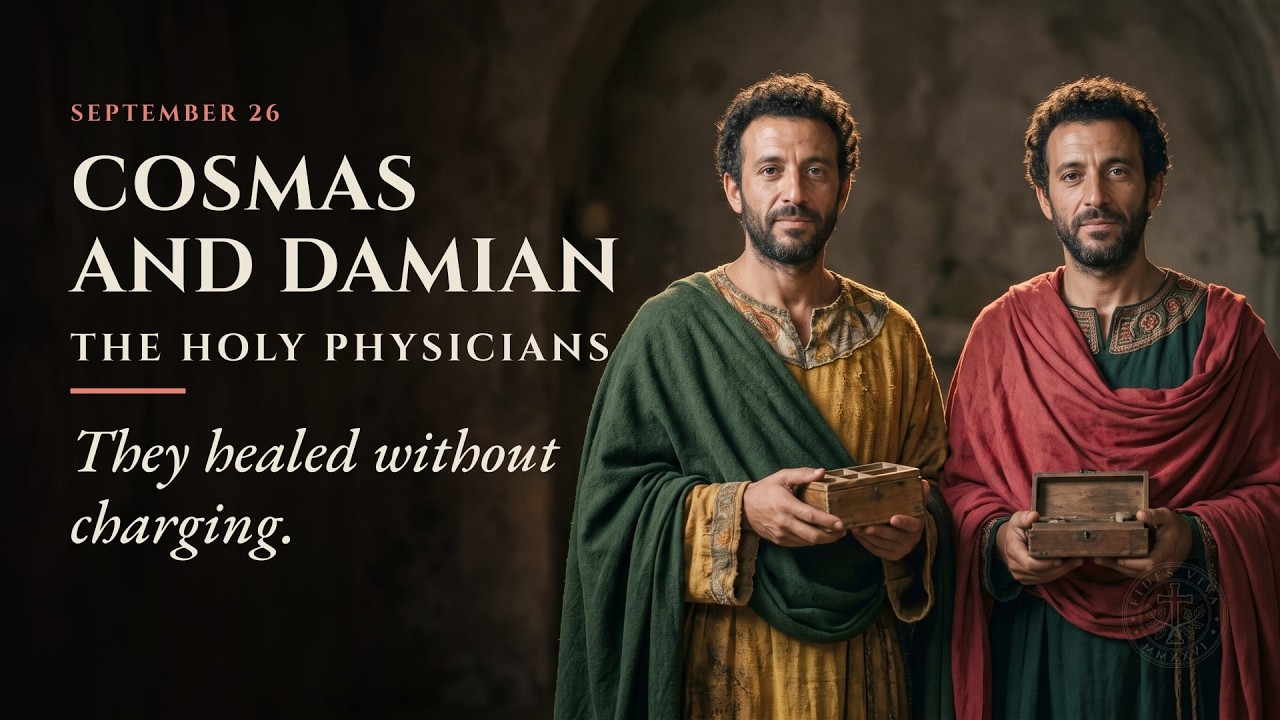
Cosmas and Damian were known as "the silverless." They were two brothers, both doctors, and the story goes that they never charged anyone. They left no letter and no book. Not a single sentence in their own hand survives.
And yet, for more than fifteen centuries, Christians have never stopped saying their names. In one of the prayers of the Mass, they are still spoken one right after the other, as if no one dared to separate them. The sick still turn to them. People keep retelling stories about the two of them: of healings, of twins and of wonders.
One of those stories tells of a sick man who woke in the night with a leg that was not his own.
Who were these two brothers, and how did the story of that man who looked at his leg by candlelight come down to us?
The Silverless
At the far eastern end of the Mediterranean, on the shores of the Gulf of Alexandretta, lay Aegea, a port city of Cilicia.
Inland, to the east, stood Cyrrhus. It was a Roman city in the north of ancient Syria, in the province of Euphratensis, not far from Aleppo. The memory of two brothers is shared between those two cities, one by the sea and one inland.
These were the last years of the third century, or perhaps the first years of the fourth. The emperor Diocletian was in power, and in his time, as Christians remembered it, believing in Jesus Christ came at a price. A Christian could be summoned before a magistrate. There he could be ordered to renounce Christ. Under that shadow, people healed, prayed and went on living.
Those who honored them from ancient times remembered them as brothers, and some as twins. In that tradition, their homeland was Arabia. Their faith is remembered in two ways: a medieval tale gives them a Christian mother, Theodora, while another, older tradition says they healed the sick after becoming Christians.
They were doctors. They healed men and women, and animals too. And they asked nothing in return. Not a single coin.
They did it for the love of God. That is why the name people gave them also has a Greek form, anargyroi, which means exactly that: the silverless. And they cared for more than the body: they also sought the good of souls, and many pagans who came to them became Christians.
When the Church remembers them each year, she does so with a beautiful kind of caution. It is held, she says, that they practiced medicine in Cyrrhus and healed many without charge. It is the tone used to care for a memory that has passed through many hands.
Refusing payment seems simple, as long as no one insists on paying. One day, a woman they had healed came back to find them, holding something in her hands.
Three Eggs
It was three eggs. In the story of the two doctors, as it was retold for centuries, that woman had come to them with nothing. She had spent everything she had on medicines, one after another, and none of them had cured her.
Now she was well. And she came back with the only thing she could offer.
The brothers would not accept it. Their rule held even for small things: no coins, no gifts, not even three eggs. The woman did not leave. She turned to Damian and begged him in the name of Christ.
He took the eggs. He did it so as not to hurt her, and so as not to scorn the name of the Lord.
Three eggs are not a price.
Those who tell this story give her a name, Palladia, and remember her as a woman with an issue of blood, that is, bleeding that would not stop.
That hurt Cosmas. To him, healing without silver allowed no exceptions, however small. Upset, he asked that when he died, he not be buried beside his brother.
Two brothers who had shared everything, their craft, their patients and their travels, were now divided by a few words about a grave.
That night, the Lord appeared to Cosmas. He did not come to rebuke Damian. He came to excuse him.
In the story, his brother's gesture had broken nothing: it had joined their free giving to compassion for a woman pleading in the name of Christ.
Even so, Cosmas's request about his own burial had already been made.
With that request still standing, Diocletian's persecution began.
The fame of the two physicians who healed without charging, and through whom so many pagans had become Christians, reached the ears of Lysias, the Roman prefect. Lysias had them summoned before his tribunal.
Before Lysias
Lysias asked them who they were and where they came from.
They gave their names, Cosmas and Damian, and named their three other brothers as well: Anthimus, Leontius and Euprepius. Their homeland was Arabia. And they added: "Christians know nothing of fortune."
That answer carries a confession: their life is ruled not by chance, but by Christ.
Then Lysias had the other three brothers brought in and gave all five a single order: to offer sacrifice to the idols, all together.
They refused. They would not sacrifice, and they scorned the idols.
Lysias had them tortured in their hands and feet. Even then they did not yield.
From here on, their martyrdom is the one Christians retold for centuries, full of wonders.
They are bound with chains and thrown into the sea. An angel of the Lord brings them out of the waters, and they stand before the judge again.
Lysias accuses them of defeating his gods with spells. He asks them to teach him that witchcraft and promises to follow them. At that moment, two demons fall on him and strike him in the face. The judge cries out, begging them to pray to the Lord for him.
And they pray for him. For the man who had just thrown them into the sea.
The demons leave him. But Lysias, recovered, says it was the wrath of his gods for having thought of abandoning them, and that he will not let them be offended.
He has a great fire lit, and they are thrown into it. The flame turns away from them and reaches those who are watching. It kills many.
Then they are stretched on the rack, a frame that pulls the body until the joints give way. The torturers rage against them more than against any other man. And they are taken down from the rack whole, without a wound and without pain.
Lysias has Anthimus, Leontius and Euprepius locked in prison. Cosmas and Damian he has crucified.
On the cross, the people throw stones at them from below. The stones turn back on those who throw them and wound many.
Beside himself, the judge has the three brothers brought out and set beside the cross. Four soldiers shoot arrows at Cosmas and Damian. The arrows turn back and wound many. The martyrs they do not touch.
Lysias has lost on every front. He is in anguish unto death.
He orders the sword.
The five brothers die together, beheaded: Cosmas, Damian, Anthimus, Leontius and Euprepius.
Not one of the five denied Christ. Not before the idols, not before the judge, not before the sword.
There was still the burial.
Those who gathered up the bodies had not forgotten what Cosmas had asked in his anger. They did not know whether to bury him beside Damian or to respect his words.
Then a command was heard. Some say it was a voice; others, and this is how the painter Fra Angelico showed it, say that the very dromedary carrying Damian's body spoke: "Do not separate them in burial, for they are not separated in merit."
And so they buried them together.
Cosmas's harsh words did not have the last word. The last word belonged to the life the two had shared: the same faith, the same patients, the same death for Christ.
One tradition places that shared grave in Cyrrhus; another, in Aegea.
In Cyrrhus, by the fifth century, a bishop would speak of the basilica that the two saints had in his city.
The Tomb and the Road of the Sick
That bishop's name was Theodoret, and he was the shepherd of Cyrrhus. When he mentions the church of the two martyrs, he calls it magnificent.
Where one of the traditions placed the brothers' grave, there was no longer just a tomb. There was a shrine.
Devotion to them soon reached the capital of the Eastern Empire. In Constantinople, in the first half of the fifth century, there were already two churches dedicated to the saints.
Farther east, in Edessa, in the year 457, a hospital was built. It was placed under the protection of the two doctors.
The men who had healed without asking for anything now had a house for the sick that bore their name.
In the sixth century, the emperor Justinian ruled from Constantinople. He had the city of Cyrrhus splendidly restored in honor of the two saints.
A story is told about the emperor himself. He had fallen gravely ill. He recovered, and he credited his healing to the intercession of Cosmas and Damian, that is, to their prayer before God on his behalf.
In gratitude, he rebuilt and adorned their church in Constantinople. That church became a famous place of pilgrimage.
The most powerful man in his world had been among the sick who came to them.
In the East, the stories about them multiplied so much that the Greek Church came to honor three pairs of saints with the same names and the same profession. There, their feasts fall on three different dates: July first, October seventeenth and November first.
By then the name of the two doctors had crossed to the far side of the Christian world. In Gaul, in the sixth century, a bishop of Tours named Gregory was gathering what people said about the martyrs and their tombs.
About Cosmas and Damian he writes words that sum up the whole road of the sick: "If any sick person comes full of faith to pray at their tomb, he is healed at once."
And he adds: "Many also relate that these Saints appear to the sick in dreams, showing them what they must do."
In those accounts, the two brothers went on doing what they had done in life.
Those who came to their tomb brought no silver. They brought their pain and their prayer.
In those same centuries, a prayer book from Visigothic Hispania was already speaking their names.
And in Rome, in the years of Justinian, a pope was looking at two old buildings in the Forum.
Rome and the Ethiopian's Leg
The two doctors were no longer strangers in the city. Their memory had taken root in Italy, above all in Rome and in Apulia, in the south of the peninsula. Early in that century, Pope Symmachus had consecrated to them, on the Esquiline Hill, an oratory, a small chapel for prayer.
The pope now gazing at the Forum was Felix, the fourth of that name, whom the Church honors as a saint. Around the year 527, he turned those buildings into a church and dedicated it to Cosmas and Damian.
Those buildings stood on the Via Sacra, the great street of the Forum. Among the oldest stones of Rome, two doctors from the East now had a home.
The church was covered with mosaics, images made from small pieces of stone and glass. Even today they rank among the city's most precious artistic treasures. Anyone looking for the doctor saints in Rome finds them there.
The centuries passed, and the stories told about them kept growing. Around 1275, Jacobus de Voragine gathered the lives of the saints, as they were told in his day, into one book: the Golden Legend. Cosmas and Damian found their place there too, with their wonders. That book spread across all of Europe and gave painters scenes for centuries to come.
One of those stories smells of the fields. A farmer, tired from reaping, fell asleep outdoors with his mouth open, and a snake crawled inside him. That night the pain gave him no rest, and he kept calling on the saints. As the pain grew worse, he went to the saints' church. There sleep suddenly overcame him, and the snake came out the way it had gone in.
Another is darker. A man who had to set out on a journey entrusted his wife to the two saints and left her a token: if he ever sent for her with it, she was to come and meet him. One day someone who looked like a man came to the house, bringing that token as if her husband had sent him. It was the devil.
Before going with him, the woman made him swear on the saints' altar. He swore. They set off on horseback. In a lonely place, the false messenger tried to throw her to the ground and kill her.
She called on God and on the saints. And the saints came, with a great multitude clothed in white. They rescued her, and the devil vanished. Then they told her that they were Cosmas and Damian: she had trusted in an oath sworn on their altar, and that was why they had come.
Of the wonders told about them, there is one that painters returned to again and again. In Rome, in a church dedicated to the two saints, there was a man who served it devotedly. A cancer was eating away his thigh.
One night, in a dream, he saw Cosmas and Damian beside his bed. They carried an instrument and ointment. One asked the other: "When we cut away the rotten flesh, what will we fill the empty place with?"
The other answered: "Today an Ethiopian was buried in the churchyard of Saint Peter ad Vincula. He is still fresh. Let us bring his flesh from there." Saint Peter ad Vincula, that is, Saint Peter in Chains, is another church in Rome. And so they did: they took away the diseased thigh and put the Ethiopian's in its place.
The church servant woke up. He felt no pain. He reached out and touched his leg: it was sound, without a wound. He took a candle and held up the light.
That leg was not his.
He leapt out of bed full of joy and told everyone what he had seen in his dream and how he had been healed. So they went to the Ethiopian's tomb. They found his thigh cut off and, inside the tomb in its place, the servant's diseased thigh.
The Church never issued a formal judgment on these wonders. It let them live on in the devotion of the faithful, who retold them and painted them generation after generation.
Yet there remained the most fragile part of any memory: their remains.
From Rome, in the year 965, relics set out northward, bound for Bremen: remains venerated as theirs.
The Journey of the Skulls
In Bremen, in northern Europe, those remains found a new home. Far behind them lay the port of Aegea, the streets of Cyrrhus and the stones of the Forum. The Christians of that city had never seen two doctors from the East. Even so, they began to venerate them.
Around 1420, a reliquary was made in Bremen: a chest in which venerated remains are kept. It was shaped like a church. It was made of oak, covered with plates of gilded silver, rock crystal and blue enamels. On its doors, paintings showed scenes from the life of the two brothers.
Inside, on cushions embroidered with pearls, rested two skulls.
In Madrid, in 1582, a woman who had once been an empress entered a monastery to stay. Her name was Maria of Austria. She was the sister of King Philip II and the widow of Emperor Maximilian II. For her retreat she chose the monastery of the Descalzas Reales, a house of Poor Clare nuns.
With her, two skulls brought from Bremen remained there, venerated as those of Cosmas and Damian.
The nuns keep them in a case of agate and silver. Byzantine silver diadems, bearing an inscription in Greek, encircle the skulls. They rest in the enclosure, the part of the monastery where the nuns live and where the public does not go.
Alongside them, the community keeps the memory of a long journey. That journey began in Aegea, went on toward Armenia, passed through Constantinople and Rome, and at last reached Bremen.
The chest from Bremen did not stay put either. In 1649, through the efforts of the Elector Maximilian I, one of the princes who chose the emperor, the reliquary traveled to Munich. It was carried in procession through the streets to Saint Michael's Church.
It is the largest Renaissance church north of the Alps. The reliquary is still there, in a side chapel off the nave, behind a grille.
And so two churches keep skulls venerated as those of the doctor saints, one in Madrid and the other in Munich. In both, the journey of those remains passes through the same northern city. In both, they are still venerated today.
The chest at Saint Michael's, moreover, does not always stay shut behind its grille. Once a month, someone opens it for the sick.
The Sick Still Come
The sick are not the only ones who come to them. Those who care for the sick have made them their own as well. The Church honors the two brothers as patrons of physicians and surgeons. Artists have painted them many times in a physician's cap, with the instruments of their trade.
In Madrid, a Brotherhood bears their name. Its members are mostly health professionals.
Every September twenty-sixth, the Church remembers them with an optional memorial, meaning a celebration that each community may keep in their honor on that day. Until the calendar reform of 1969, their feast fell on the 27th.
There is one place where their names wait for no date at all: the altar.
At Mass, the priest says a great prayer in which he consecrates the bread and wine: the Eucharistic Prayer. There are several, and the first is called the Roman Canon. In one of its passages, the Church remembers those who are united with the offering of Christ: the Virgin Mary, the apostles, the martyrs.
When the priest prays that list in full, at its very end, one right after the other, two names are heard: Cosmas and Damian.
Who put their names there, and when? No document tells us. Scholars place it in the Rome of those same popes: some point to Symmachus, of the oratory on the Esquiline; others to Felix, of the basilica in the Forum.
By around the year 600 at the latest, under Pope Saint Gregory the Great, that list of martyrs was closed. Ever since, Cosmas and Damian have ended it.
Not a single written line of theirs survived. Yet their names are spoken beside the sacrifice of Christ, made present on the altar. There, too, no one separates them.
In Munich, on the third Wednesday of every month, at six in the evening, Saint Michael's Church holds a service for the sick.
The sick and their families arrive, one after another. In the side chapel, behind the grille, the chest of oak and silver that once left Bremen is opened. Inside are the two skulls.
Then a priest makes his way from one person to the next. He stops before each sick person and each relative, and gives every one of them a blessing.
Each person receives it with their own pain, before the two brothers.
Before that open chest, what Cosmas and Damian gave without asking for silver still reaches those who suffer.
Lord Jesus Christ, physician of bodies and souls: you gave Saints Cosmas and Damian hands that healed without asking anything in return, and a faith that did not break before the judge. Through their intercession, sustain the sick who come to you with their pain, stand beside those who care for them, and teach us to give freely what we have freely received. Saint Cosmas and Saint Damian, pray for us. Amen.