They beat him to the ground. They drove him out of the city. And he, the moment his wounds had closed, picked up his staff and set out on the road back. It was not the first time. It would not be the last.
The City by the River
Ravenna has always kept the memory that its first shepherd came from far away: from Antioch, the great city on the Orontes River, in the heart of the Roman East. There, in the earliest days of Christianity, that memory tells, a child was born to a pagan family, and they named him Apollinaris.
Antioch was a whole world inside a single wall. A colonnaded avenue crossed it from end to end, wide as a river of stone, and beneath its porticoes pressed a crowd that spoke Greek, Syriac, Latin. It smelled of spices, of oil, of fresh bread; it rang with hammers, with haggling, with cartwheels on the paving stones. In its temples the incense burned before Zeus, before Apollo, before the Fortuna of the city. A goddess crowned with ramparts who, as everyone believed, watched over the fate of every household.
It was the Roman Empire at its proudest hour. The legions held the borders, the ships stitched the Mediterranean port to port, and one same peace, kept by force of arms, covered half the world. In all that vastness, faith in Jesus of Nazareth was only beginning: a handful of men and women who gathered in houses, broke bread, and spoke of a crucified man who had conquered death. A small piece of news, suspect in the eyes of power, that traveled without armies, mouth to mouth, along the sea roads. And it was in Antioch, as time went on, that the followers of that way would first be given a name: Christians.
Apollinaris knew nothing of that new God. He had grown up in a comfortable house, among gods of marble and teachers of rhetoric, and the whole city seemed made to his measure. He was a sharp boy, quick and persuasive with words; light olive skin, dark wavy hair, and a first beard just beginning to round out his face. He wore a plain linen tunic, leather sandals on his feet, and he liked to stop beneath the columns to watch the crowd go by: desert caravans, sailors from the harbor, priests on their way to the temple.
He lacked for nothing, and nothing troubled him. He honored his father's gods the way one honors a custom: without questions. The days resembled one another, calm and predictable, and perhaps a whole life would have passed like that, comfortable and without a name, one more among the millions of the Empire.
But down those same streets a fisherman would soon walk, come from far away, a stranger from Galilee with broad hands and a voice weathered rough, carrying news that none of those cities had yet heard. And when that news reached the boy in the linen tunic, nothing — not the house, not the gods, not the city by the river — would ever be enough for him again.
The Fisherman Who Spoke of a God Who Loves First
So his own people tell it, handed down from one generation to the next: one day, amid the crowds of Antioch, the voice of a stranger named Peter was raised. A fisherman from Galilee, well on in years, with broad hands hardened by the nets. He brought no riches, no titles, no escort. He brought a word.
And it was a word unlike any other. The gods of the city demanded offerings to turn favorable; their favor was bought, bargained for, feared. This man spoke of something else: of a God who loves first. A God who does not wait for man to seek him, but goes out himself to look for him. A God who had given his own Son for the world before the world ever asked.
Apollinaris stopped to listen, perhaps out of curiosity, perhaps out of a good listener's habit. And the word reached him. The fisherman's voice was not polished, and yet it carried more weight than all the speeches he had heard beneath the columns. That boy who had everything discovered all at once the one thing he did not have: the certainty of being loved before he could earn it. Of having been found before he ever set out to search.
There are decisions that are not made: they are received. The young man asked for baptism, the water that sealed his entry into the new life, and from that day he was one of those whom, in his own city, people had begun to call Christians. He left his father's house, the gods of marble, the comfortable and predictable life. He went after the fisherman.
At Peter's side he learned a craft taught in no school of rhetoric: the craft of the shepherd. He learned to lay hands on the sick and to break bread as the Lord had broken it. He learned to speak to the simple without ornament, and to the powerful without fear. Above all, he learned by watching: how the master carried the weak, how he forgave, how he stayed.
Then came the road. The years beside the Apostle led him from port to port and from highway to highway, toward the west. He slept in inns and on the decks of ships, knew the weariness of long days and the joy of the small communities that welcomed them as brothers. Until one day the walls of Rome rose before them: the city that ruled the world.
Rome dazzled him and awed him at once. Marble forums, crowds, palaces; and hidden among the blocks of crowded tenements, a few houses where the believers gathered as night fell. There, by the light of the lucernae, the little oil lamps, the Scriptures were read and the bread was broken in low voices. The whole Church fit then into a handful of dim rooms.
On one of those nights, the disciple was ripening, without knowing it, for an hour he did not yet know. And the master had long kept a destiny in mind for him: a distant place, beside another sea, from which he might never return.
Sent to the Harbor at the End of the World
This is how Ravenna remembers the beginning of it all, this hour among the others. That morning, in the dimness of the Roman house, Peter at last spoke a name: a city in the north, among lagoons and canals, on the Adriatic. And beside it, a harbor called Classe, where the Empire moored one of its two great war fleets.
No one had carried the Gospel there. Hundreds of sailors served aboard those ships, and many came from the east: Syrians, Greeks, men of the coasts Apollinaris had known since childhood. They spoke his language, they carried the same longings. For a son of Antioch, that far-off harbor was, though he did not know it, ground already prepared.
The master offered him no guarantees. There was no community waiting to receive him, no letter to announce him, no promise of success. Only a charge: to go, to proclaim, to stay. And for that charge, a gift. Peter laid hands on him, as had been done from the beginning: the fisherman's broad palms on the bowed head of the disciple, a prayer in a low voice, the full weight of a mission. With that simple gesture he made him a bishop — that is, the shepherd of a community: one that did not yet exist and that he would have to gather, sheep by sheep, in an unknown land.
Then came the farewell. Neither of them was young anymore; both knew what the roads cost, and what the Empire was beginning to think of the Christians. Perhaps they would not meet again in this life, and they did not hide it from each other. The embrace between master and disciple was that of men who give themselves to the same thing by different roads: one stayed at the heart of the Empire; the other set out for its edge.
Then the sea. Days of sailing along the coast of Italy, the walking staff lashed to his satchel and a single word for all his baggage. When the low Adriatic shore appeared at last on the horizon — pine woods, marshes, war masts standing in rows — the traveler looked out from the deck at the land Peter had entrusted to him.
No one was waiting for him on that quay. No one knew his name. And yet something was about to begin there that would last nearly two thousand years.
The Stranger Who Healed in a Name
The harbor of Classe took him in without a glance. It smelled of pitch, of salt, of wet timber. Along the docks the warships of the Adriatic fleet stood in rows, and ashore a whole world seethed — warehouses, taverns, shouting: dockhands, soldiers, merchants, sailors come from every corner of the sea. One more stranger stepped ashore that day, satchel on his shoulder and his staff worn down by so much road. No one asked his name.
It did not take him long to find what Peter had sensed. Among those sailors were Syrians, Greeks, men of the east who spoke his language and carried the same homesickness. With them he began: a conversation on a quay, a word in a tavern, the news of a God who loves first, spoken in a low voice to anyone who would hear it.
The old records of Ravenna tell that, soon after his arrival, word of that stranger reached the house of a tribune of the garrison, an officer of the Roman army. His wife had long been ill, wasting away, with no cure in sight. Apollinaris entered the house, bent over her, and prayed, calling on the name of Christ. And the woman rose up well.
That house was the first to open. Gratitude ran from door to door, and with it a question: who was this God able to give back health and ask nothing in return? The conversions multiplied. In pagan Ravenna a breach had just opened, silent still, through which the light was beginning to enter.
Then came some twenty years of patient sowing. The stranger put down roots: he learned the streets, the names, the wounds of that people of water and salt. At night, in borrowed houses by the harbor, he gathered his own for the breaking of the bread — as the first Christians called the Eucharist: the bread broken and the cup shared in memory of the Lord. It was a worship without temples, without statues, without the smoke of sacrifice: a table, a word, a few faces. By the light of the oil lamps he read the Scriptures, laid hands on the sick, baptized.
Whole families asked to enter the faith: the father, the mother, the children, the servants of the house. The community grew without a sound, the way roots grow underground. Some of those sailors, when they set out again, carried the faith with them to other harbors: this was how the Gospel traveled then, from mooring to mooring. And the shepherd grew old with his flock: his hair turned gray, his brow cleared, his hands grew expressive from so much blessing. Ravenna and Classe were already, without the city itself knowing it, one Church.
But that city was Roman, and its religion was a public affair. The temples, the incense, the sacrifices to the gods were no private devotion: they were loyalty to the Empire, and they were carried out in full view of all. To refuse was understood not as an opinion but as an offense against the whole city. And the Christians refused. The authorities began to take note of the stranger who healed in a name that belonged to no god of Rome. They summoned him, they questioned him, they demanded that he sacrifice to the idols. He answered without defiance and without fear, with that firm meekness no one could bend: he could not give to statues what belonged to the living God alone.
The more his flock grew, the more troublesome his presence became. What was gratitude to some was scandal to others; every house that opened to the faith closed its door to the temples. And the city, little by little, began to look for a way to be rid of him.
The Shepherd Who Always Came Back
Ravenna's memory kept from those years a whole tale of leavings and returns, handed down from parents to children the way the dearest things are handed down. And it begins where storms tend to begin: in success. Someone denounced him. Too many conversions, too many houses that no longer bought incense for the temples. The soldiers came for him. They dragged him before the crowd and beat him with rods, in front of everyone. Then they drove him beyond the walls, with orders never to return. He was near sixty by then. His hair had turned almost wholly white, and from that day he carried on his back and forearms the marks of the rods, and a thin scar above his left brow.
The faithful told, too, that around this time he gave back life to the daughter of a patrician, one of the city's noblemen. The girl had died; he prayed over her in the name of Christ, and the girl opened her eyes. Every sign kindled faith in some and alarm in others. Gratitude and fury grew together, house by house.
Cast out, he did not stop sowing. Exile carried him inland, to Bologna, and there he did the only thing he knew how to do: speak of the God who loves first. He would stop in the markets, enter the houses that opened to him, pray with the sick. The exile was still a shepherd; he had only changed his pasture. Nothing he sowed was lost: in Bologna too there were believers when he left. And all the while, across the roads, his community in Ravenna held on without him, meeting in secret, waiting.
They did not leave him in peace for long. A new exile put him aboard a ship, this time to send him far in earnest: out to sea, bound for the east. But the Adriatic has designs of its own. Off the coast of Dalmatia — the eastern shore of the sea, a land of gray cliffs and fishing villages — the ship broke apart in the storm. The old man reached the beach soaked, barefoot, his cloak clinging to him with salt. He had lost everything but the Word he carried within. And the moment he caught his breath, there too he began to preach the Gospel. There too they abused him for it.
It was told along those shores that, while he passed through, a famine came to an end. The people remembered him afterward as a blessing the sea had brought them without meaning to. Some old memories add still more road: a mission of about three years in the lands of the north, among peoples who had no name even for the God he preached. Wherever they threw him, he sowed.
But his heart had only one bearing. As soon as he could, he came back. He crossed the sea again, retraced the roads, and one morning his people saw him appear in the harbor: older, thinner, his face weathered by salt and years. The joy of that reunion did not last long. They seized him, they tortured him, they exiled him again. And he came back. Another capture, fresh wounds over the old wounds, another exile. And he came back. Three times he returned to his flock; three times the city tore him from it. His people learned to wait for him: someone watched the harbor, someone kept oil ready to dress his wounds, someone left a door unbarred in case he came by night. And he came. He walked with a limp now after each beating, leaning on his staff, his brown tunic patched from so much traveling. Anyone would have told him he had given enough, that no one could ask more of him, that he had earned the right to grow old in peace on some other shore. Perhaps they did tell him. But for him the question was not whether to return, but when he could.
There are no trumpets in this kind of courage. No one applauds it in the moment; it looks too much like stubbornness. It is the courage of a man of seventy who, still aching, sets out for the city where the rods are waiting for him. But seen up close, the gesture says something else: his own people were there. The ones baptized in the harbor nights, the families gathered around the bread and the cup, the sick over whom he had laid his hands. A shepherd does not choose the pasture; he loves the sheep he has. And his were in Ravenna. So every road, whatever the Empire did, ended by pointing to the same place.
Each return, though, drew him closer to an ending he seemed to have accepted long before, with the same calm he brought to the road. In Rome, meanwhile, the emperor had changed, and power was sharpening a decision that would reach even this corner of the Adriatic. One last journey home remained. And it would be the final one.
Not from a Single Blow
In Rome the emperor was now Vespasian, a practical soldier who had built his throne on a year of civil wars. Under his rule, so Ravenna always remembered, a decree against the Christians reached the Adriatic. It was no longer the uproar of one city, the accusation of a few neighbors. Now the whole Empire put a name to the crime. And in Classe everyone knew who headed the list.
This time they did not exile him. They hunted him. His people begged him to hide, and the old man, who had never once drawn back from anything, agreed to stay out of sight for a while. He was about seventy now. His body was worn down by the roads, his eyes fixed on his people. For weeks the bishop of Ravenna lived hidden a few steps from his flock, so close he could almost hear it breathe.
They found him. One dawn, in the poor quarter of Classe — the mean houses that grew outside the walls, hard against the harbor — they fell on him. They were many, and he was an old man. The rods rose and fell. He went down, and they kept on. When at last they tired, they left him lying in the dust, taking him for dead, while the first light gilded the roofs of the harbor.
He was not dead. And he was not alone. His people came running, lifted him from the ground with infinite care, and carried him to a house. The sick he had healed now washed his wounds. The families he had baptized watched over his sleep. After a whole life spent holding up his flock, it was the flock that held him up.
The memory of his own adds that he lingered several days. And that he spent them as he had lived: turned toward them. With what strength he had left he raised his hand and blessed them, one by one, those who came in to say goodbye. There were no complaints. There were no words against anyone. Only that same meekness of always, now stripped entirely bare.
One morning he did not wake. His people counted the days and kept the date: it was a twenty-third of July. He did not die from a single blow. He died from all the blows he had taken across a whole lifetime, never once ceasing to come back.
They buried him nearby, in the field of graves beside the harbor, among the nameless dead of Classe. One more stranger under the soil of the Adriatic, a thousand miles from the river of his childhood. It could have ended there: a grave among graves, a name the wind wears away. But that blood was seed. Before that patch of earth the people kept stopping — first a few, then whole generations. And what grew from that silence can still be seen. Centuries later, over that same grave, a voice would rise — and after it, something more than a voice.
Gold Over the Grave
The name was not lost. As the Empire that had condemned him crumbled century after century, the people of Ravenna kept coming to that grave beside the harbor. The oldest calendars of the Church already carried his name written among the martyrs. The seed had taken: where once a handful of persecuted believers had gathered, a whole Church was now growing, and that Church knew to whom it owed itself.
Four centuries after that dawn, the voice came. The bishop of Ravenna in those days was named Peter Chrysologus — "the golden-worded one" — and one day he preached to his people about the first of all his predecessors. He called him bishop and martyr. And he taught something that sums up that life better than any crown: God preserved Apollinaris in life for a long time for the good of his Church; he was a true martyr, though he did not die from a single blow, because his self-giving was that of every single day. It is the oldest and firmest word that history keeps about him. One bishop spoke of another, joined across four hundred years and one same see.
A century later, the memory turned to stone and light. Ravenna was living its highest hour then: it had been the capital of the West, and it was now a jewel of the empire of Byzantium, a city of mosaics and of marble carried in by sea. In the year 549, over the very place of the grave, Archbishop Maximian consecrated the great basilica of Sant'Apollinare in Classe, begun years before under Bishop Ursicinus. Three brick naves, two rows of veined marble columns brought from the East. And at the far end, ablaze with gold and green, the apse.
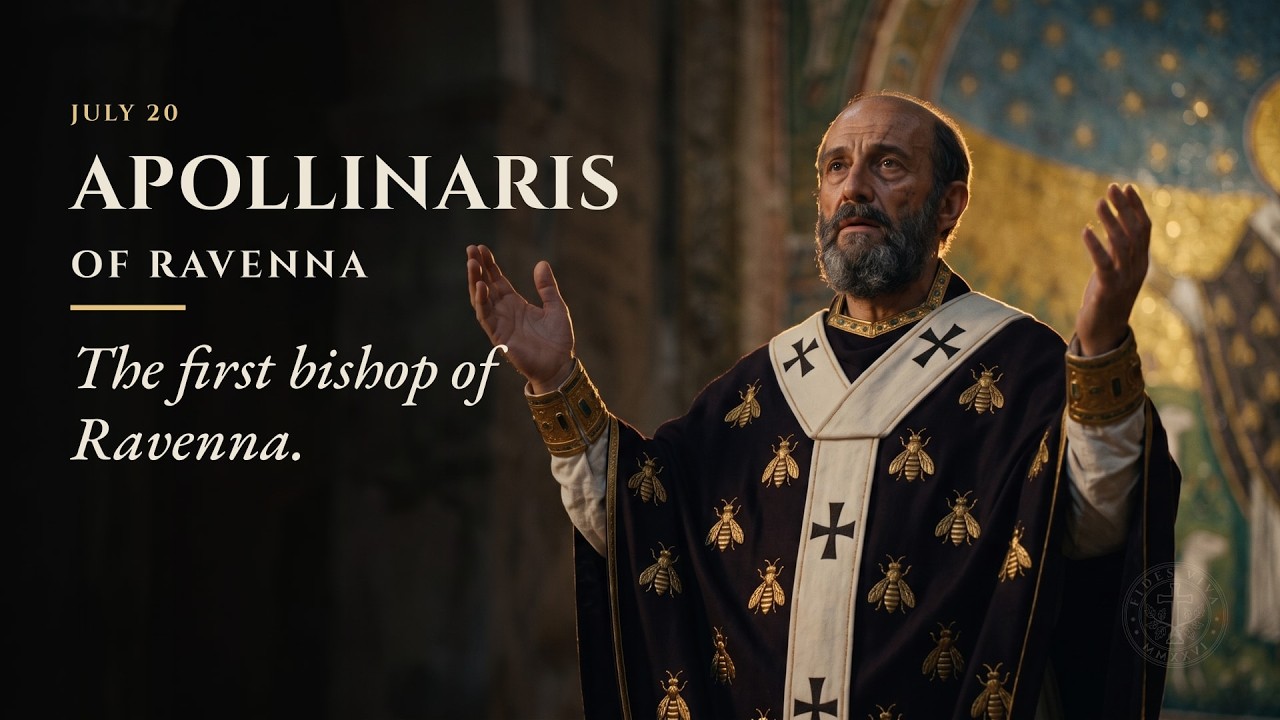
There he stands. Upright, his arms open in prayer, among twelve white lambs on a flowering meadow. He wears a dark chasuble strewn with bees of gold, an ancient symbol of eloquence that labors, and the pallium, the white band with crosses that set bishops apart. Around his head, a halo: the golden circle with which art crowns the saints. And over it all, a great cross of gems suspended in a sky of ninety-nine stars. The artists of Ravenna did not show him suffering. They showed him praying. That was the city's last word about its first shepherd: not the rods nor the dust, but intercession.
It was not the only gold. In the heart of Ravenna, another basilica added him to its procession: in Sant'Apollinare Nuovo, a long line of martyrs robed in white moves across a field of gold toward Christ, and among them he walks, his name written above his head: Saint Apollinaris. (sobreimpreso: "SANCTVS APOLLINARIS")
In the seventh century, at last, the city set down in writing all that it remembered: the whole life of its first bishop, from Antioch to the poor quarter of Classe. Scholars see in those pages a late work today, written some six hundred years after, when the see of Ravenna was defending its rank against others. That may be so. But even so they say something true: six centuries later, a whole community still needed to tell of that man, to keep the memory of the one who loved it first. (sobreimpreso: "Passio Sancti Apollinaris, s. VII")
His body, too, was treated as a treasure. At the end of the ninth century, his remains were brought down to a crypt built beneath the altar of the basilica. In the Middle Ages, the monks of the city claimed to have carried them to Sant'Apollinare Nuovo to keep them safe from pirates. The two basilicas laid claim to the saint with such stubbornness that it took a pope, Alexander III, to settle the quarrel in 1173. Much later, in 1874, the head and the right hand were moved to the cathedral of Ravenna, where they are venerated still. Other relics crossed the Alps into the lands of the Rhine. There the German city of Düsseldorf holds him as its patron today. Rarely have a man's remains said so plainly how much he was worth.
The basilica still stands, among the pines and the marshes of the old harbor. Since 1996 it has been part of the heritage of humanity; and every twentieth of July, the whole Church makes memory of Saint Apollinaris, while Ravenna honors its patron as it has honored him for nearly two thousand years. Visitors enter today through that same immense nave, between the marble columns, and walk toward the far end. The light shifts with the hour. The gold does not.
And those twelve lambs are still there, around the shepherd, six on either side, on the green meadow. Nothing of that faithfulness was lost: it turned to stone, to light, to prayer. And that man still stands in the apse, his arms open, as though he had never once stopped coming back.
Those Who Come Back
Why did he keep coming back? His whole life was the answer, without a single speech. He came back because that city held people with names and faces: the woman he had healed, the families who broke bread with him, the sailors who waited for him on the dock. He did not come back out of duty. He came back out of love for one particular people. It was not the courage of a moment: it was a stubborn love that always knew the way home.
We too keep a place like that: that call we have been putting off for months, someone we are afraid to face again.
The mosaic says the rest. In the gold of Classe there remains an old man at prayer, a meadow in bloom, twelve lambs that never once left his side. Nearly two thousand years on, the shepherd who did not leave is still there, standing, his arms open.
Saint Apollinaris, first bishop of Ravenna, good shepherd who always came back to your people, faithful martyr of the Church of Christ, pray for us.