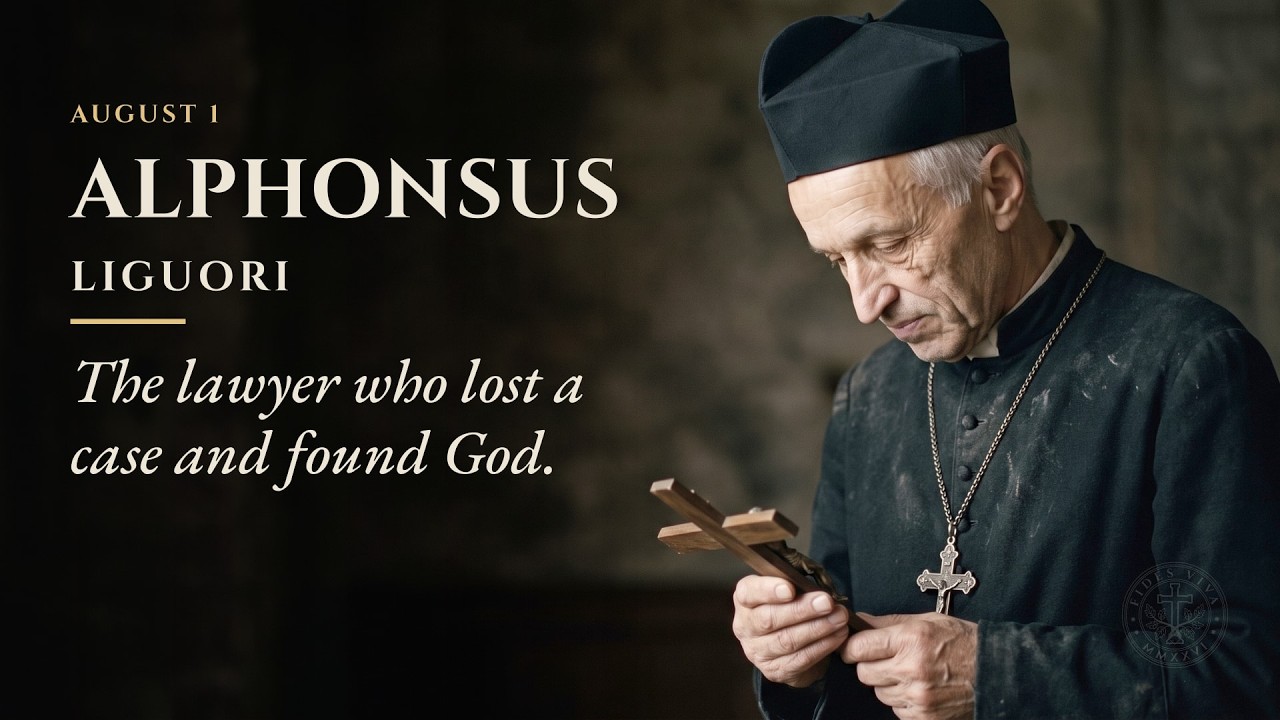
The courtroom has gone silent. A young lawyer in a black robe and powdered wig stares at the file trembling in his hands. All of Naples knows his name. His career has just ended, and he does not know it yet.
The Child Prodigy of Marianella
Naples, at the close of the seventeenth century, was one of the most populous cities in Europe. Bell towers and gilded domes, endless processions, palaces with staircases open to the sky; and below, in the alleys, hanging laundry, fish stalls, thousands of barefoot poor who slept wherever night found them. Silk carriages crossed paths with children begging for bread; the air smelled of sea, frying, and incense. Beyond the walls, in the mountains of the interior, whole villages lived without a school or the sacraments, with no one to speak to them of God. That world was waiting, without knowing it, for a lawyer.
On the edge of that vast capital, among orchards and vineyards, a country house of pale stone bore the name Marianella. There, on September 27, 1696, the first son was born to Don Joseph de Liguori, a galley captain of the kingdom, and Anna Cavalieri. They baptized him with eight names, as befit an heir of the Neapolitan nobility; the first of them, Alphonsus Mary. The father saw in that cradle the promise of the family name. The mother, a quiet woman who raised her children on prayer and almsgiving, taught him to pray before she taught him his letters.
The promise showed itself early. The boy learned with an ease that unsettled his teachers: Latin, painting, and above all music. Hour after hour at the harpsichord, the elegant keyboard instrument of the drawing rooms of his time. Don Joseph, a man of the sea, demanding to the point of harshness, had already mapped out that life: a brilliant career, an advantageous marriage, a name raised higher still. And to reach it he chose the surest road in the Naples of that age: the law.
At sixteen, when others were barely beginning, he already held a doctorate in both laws, civil and canon. It came by special dispensation: the law had never allowed for doctors so young. The academic robe fell that day on a body still a boy's, small, slight, with dark and intense eyes. The teachers smiled; the father did the math: the courtroom was not far off now.
Three years later he entered the courts, and in eight years of practice earned a name few veterans ever reached. It was said in Naples that the young lawyer never lost a case. The mornings of the courthouse had their own liturgy: judges in powdered wigs behind their tables, inkwells, files bound with ribbon, light falling from tall windows. And at the center of it, that small man everyone had to hear. He had a memory that could hold whole law codes and a quick mind that found the crack in any argument set against him. When he spoke, the room listened; when he finished, the case was usually decided.
Everything was in place: the talent, the name, the future. At twenty-six he had it all, and all of it rested on a single condition: never lose. No one walks such a tight rope for long. On the court's docket, already waiting its turn, sat an enormous case, the kind that makes or breaks a name.
With it would come the morning the whole courtroom fell silent.
The Fall and the Sword Laid Down
The great case came in 1723: a dispute between two noble houses, with an entire estate and a fortune at stake. He prepared it as he prepared everything: weeks of study, every document read and read again, every argument sharpened. Before the court he spoke with his usual confidence, and for hours the room was his.
Then the opposing side laid a document on the table. He knew it; he had held it in his own hands. But its decisive meaning had slipped past him, and the whole structure of his defense rested on that mistaken reading. He confirmed it there, on his feet, in front of judges and colleagues alike. There was no answer to give. The silence that followed weighed more than any verdict.
He gathered his papers slowly. On his way out, he was heard to say that the world had deceived him. He was twenty-six, his talent untouched and his name in ruins. He never set foot in that courtroom again.
The days that followed were silent. The city that had repeated his name went on with its lawsuits; he stopped appearing. He sought refuge where his boyhood faith used to take him: in prayer and in works of charity. Among them was a visit to the Hospital for Incurables, vast wards of narrow beds where those with no cure and no home came to die.
So it was remembered by those who knew him closely. One afternoon that same year, while tending the sick, he felt himself wrapped in a light he could not explain. Within him he heard a voice asking him to leave the world and give himself to God. He walked out shaken, and the voice reached him a second time. This time he did not argue back. The man who could answer any objection found nothing to say.
He walked to the Church of Our Lady of Mercy. He unbuckled the sword of a gentleman, the mark of his rank and his future, and laid it at the feet of the image of the Virgin. No witnesses, no words. That quiet gesture was his cleanest plea yet: he was changing courts, and changing causes. From then on he would defend souls, and the advocate of mankind would speak for him.
His family's memory holds the storm that followed, too. Don Joseph had staked every plan on that son: the career, the advantageous marriages, the family name climbing higher. Watching him trade the robe for the cassock looked to him like ruin. Harsh words passed between them, and a long estrangement followed: the father refused to accept the path his son had chosen.
The son did not turn back. He put on the plain black cassock of those preparing for the priesthood and returned to his studies, this time theology. The same memory that had once held whole law codes filled now with Scripture. He spent hours on his knees; he grew thin; the long vigils hollowed his eyes. And again and again he returned to the Incurables and to the Chapel of Christian Doctrine, learning to speak of God in the language of the simple.
On December 21, 1726, at thirty, he was ordained a priest. The hands that had signed legal briefs were anointed now for another defense, and the cause of his life was sealed before another Judge.
Those who knew him then told of how the other wound finally closed. One day Don Joseph walked into a church where his son was preaching and stayed at the back, listening. The boy he had raised to shine spoke of the love of Jesus Christ with a simplicity that disarmed him. The old captain left the church at peace with the calling he had once fought.
One question still hung low over Naples: what does a man do who has lost his name and his cause? The answer was not found in any drawing room. As evening fell, the new priest began going down into the alleys of the port, where the lazzaroni lived: porters, barbers, drifters, the barefoot poor no one counted. Among the hanging laundry and the smell of fish he stopped, looked at them, and began to speak. For the first time, the most famous lawyer in Naples stood before the ones he would defend for the rest of his life.
The Advocate of the Most Abandoned
Those evening gatherings soon became a habit. When the workshops closed, porters, barbers, and street vendors gathered in a doorway, in a back room, around a single candle, to pray the rosary and learn the teachings of the faith. They called them evening chapels, and their novelty lay not in the place, but in who led them: the people themselves. One porter taught another what he had learned; a barber repeated to his neighbors the words of Jesus Christ. The priest moved from one gathering to the next, encouraging, correcting, then stepping aside. Soon there were dozens scattered across Naples. Without fully intending it, he had found his deepest instinct: the people evangelizing the people. From that same root came his first written work. In 1728 he published the Eternal Maxims, a small book of meditations for people with no Latin and no libraries. The man who had once drafted legal arguments for judges now wrote so that a craftsman could ponder death, heaven, and the love of God in his own words. It was only the beginning.
The work cost him his health. Around 1730 he was sent to recover in the mountains above the Amalfi Coast, to Scala, a village perched on terraces among cliffs and chestnut trees. He was looking for fresh air; he found something else. Along those stone paths lived shepherds and goatherds who rarely came down to town. Sitting with them, he discovered they did not know who Christ was, that no one had taught them to pray, that they died without the sacraments. The capital had priests to spare; a few days' walk away, whole families lived worse than animals. Something lodged itself in him. The barefoot poor of Naples at least had a church around every corner; these people had no one. The lawyer had just found his true clients at last: the most abandoned.
Scala held something else too, a story still told among those who knew him. In the village monastery lived a nun, Sister Maria Celeste Crostarosa. She claimed to have seen, in prayer, They asked Alphonsus to examine those visions, and the former lawyer brought his old craft to the task of discernment: question, compare, weigh every word. He consulted others, he doubted, he prayed. In the end he recognized in that cloistered voice the same call he had heard among the beds of the Incurables. On November 9, 1732, in Scala, with a handful of companions, he founded the Congregation of the Most Holy Redeemer. The purpose fit in a single line: to bring the Word of God to the most abandoned, to those with no one to care for their souls. No polished pulpits, no elaborate sermons: village-to-village missions, plain preaching, long confessions, and Jesus Christ proclaimed as the Redeemer who forgets no one.
The work started out fragile. Disputes over the rule soon followed, along with disagreements with Monsignor Falcoia, his spiritual director. Then several of the first companions left, unconvinced of the path ahead. There were stretches when the congregation seemed to shrink to little more than its founder. He kept going. He had lost one case before men; this cause he did not intend to lose. The years that followed were years on the road: dusty paths, village squares, night fires. There, farmers and goatherds heard those men in black speak of a Redeemer who remembered them. Alphonsus preached with a crucifix held high and words simple enough for a child to follow. But the mission would end, the missionaries would move on, and the people were left alone again with a memory too short to hold. A voice fades when the preacher leaves; a page stays. The question began working inside him: how to write of God so that even a shepherd who could barely read his letters could still pray, and still understand.
The answer was waiting for him far from the fire, in the quiet light of a writing desk.
Doctrine Born of the Road
There, between one journey and the next, the pen became his second mission. In 1745 he published Visits to the Blessed Sacrament: a pocket-sized book holding one short meditation for every day of the month. It was written so that anyone — a widow, a mule driver, a boy from some workshop — could step into any church and kneel before the tabernacle. There, one could speak to Jesus Christ the way one speaks to a friend who is waiting. No theological heights here: short lines, plain affection, a prayer simple enough to fit inside a tired and ordinary life. The people understood it at once, and the little book passed quickly from hand to hand.
But his greater work grew out of another place entirely: the confessional. Thousands of hours listening to farmers, soldiers, and exhausted mothers had taught him something the books of his time did not say. Many confessors of that era treated sin with such severity that the penitent left crushed, stripped of strength and hope. Others swung to the opposite extreme, excusing everything and demanding nothing at all. Alphonsus searched for a path between those two shores. In 1748 the first edition of his Moral Theology appeared, and for nearly forty years he kept revising it, edition after edition, weighing each case as the lawyer he once was. His principle fit in a single line: God's law binds when it is certain, and in doubt, a well-formed conscience must never be crushed. The confessor, his whole practice insisted, is father and physician long before he is a judge.
In 1750 he sent The Glories of Mary to print. The former lawyer now wrote of another advocate: Mary, mankind's defender before God, a mother who turns no cause away as lost, however hopeless it seemed. Page after page, commenting on the Hail, Holy Queen, he showed a Mother to whom one could always turn. The book was prayed far more than it was read, which was exactly what its author had wanted all along.
The work brought him faces, too. In 1752 he admitted into the congregation a tailor from Muro Lucano, thin and frail, named Gerard Majella. He was a lay brother, without formal studies or ordination, and yet the founder came to regard him as a living saint: obedient to the point of heroism, poor to the extreme, known among simple people for wonders among simple people. He died in 1755, at twenty-nine, consumed by tuberculosis. Alphonsus mourned him the way a father mourns a son who goes ahead of him on the road. A century and a half later, the Church would canonize him.
The pen never rested. In 1758 he published Preparation for Death, grave and quiet meditations on the end that awaits everyone without exception. And in 1759 came the treatise that summed up his deepest conviction: The Great Means of Prayer. The whole treatise insisted on a single truth: whoever asks, receives; whoever stops asking, is left without strength. He explained it with the image of a nest: "Little swallows do nothing but cry out, seeking help and food from their mothers. In the same way, we must always cry out, asking God's help to escape the death of sin and to grow in his holy love."
Truth and mercy walked together in those pages, just as they had walked together along the roads of the mission. He was sixty-six years old, and believed his life was already set on its course: writing, hearing confessions, preaching until the very end. Then, in 1762, a sealed letter arrived from Rome. It offered him the one thing he had never sought.
On the table, beside the pen, someone would soon set down a bishop's ring.
The Bishop Who Sold His Carriage
The letter bore the seal of Clement XIII, and it named him bishop of Sant'Agata dei Goti. He answered with every argument within his reach: his sixty-six years, a health long since spent, the congregation that still needed him. None of it changed anything. Rome insisted, and obedience, which had governed his whole life, weighed heavier than every argument he could raise. That same year, 1762, he received episcopal consecration and set out at once for his new see. It was a town of pale stone perched on a spur of volcanic tuff, ringed by parched fields, with a small cathedral and a palace that would soon look like a convent.
He had not come to this office to rest. He reformed the seminary and demanded of his priests the same rigor he had demanded of himself. He walked the towns of his diocese preaching missions, the way he had done for thirty years across the mountains. At solemn functions he wore the violet cassock; at home he kept wearing the same patched black habit of a Redemptorist. His table was the table of a poor missionary. Whoever came looking for the bishop found him, almost without fail, in the confessional or before the tabernacle.
Then came the hunger. In 1764 famine struck the kingdom: grain disappeared from the markets, and bread reached impossible prices. Whole families arrived at the gates of the episcopal palace with empty hands. The bishop gave no speeches about charity. He simply sold what he had. His belongings went one by one, and at last the carriage itself, the one his rank required, bought grain and bread. The love of Jesus Christ that had filled so many books was now measured out in sacks, carried across a courtyard. The doctrine of the confessor — father and physician rather than judge — became flour in the hands of the starving.
He served that see for thirteen years, and his body paid the price. Fevers grew frequent; arthritis twisted his hands out of shape, and his neck began bending slowly toward his chest, with no remedy. More than once he asked to be allowed to step down. In 1775 Pope Pius VI finally granted the resignation.
Half a century before, as those closest to him remembered it, a young man had laid his sword down at the feet of an image of the Virgin. Now an old man laid down the miter and the crosier with that same unspoken silence. Two surrenders, one same cause. He went back to Nocera de' Pagani, to a house of his own congregation, with nothing but the same black habit he had always worn.
He believed he had come back to die in peace, praying among his brothers, close to the tabernacle. Twelve more years of life still awaited him. And the deepest stripping of all, the one no hunger and no fever could have foretold, had not yet begun.
Stripped of His Own Work
In Pagani, illness finished its work on that small body. Arthritis bent his head until his chin sank into his chest; the constant pressure wore the skin raw. The hands that had written more than a hundred books grew gnarled and twisted. Nearly deaf, his sight fading, he spent his hours in a wicker chair, a blanket over his knees, praying before a tabernacle he could barely make out. On paper, he remained superior of his congregation. But governing required reading, and reading had become impossible.
That weakness gave rise to the wound. The Neapolitan court demanded changes to the institute's Rule before granting it approval, and in 1780 a text adapted to those demands was placed before him to sign. He did not notice what he was signing. He trusted, as he always had, and set his name almost blindly on a document that altered the very heart of his life's work. When the news reached Rome, the answer came as a sharp blow: Pius VI recognized as true Redemptorists only the houses within the Papal States. The founder now stood formally outside the congregation he had founded.
The lawyer who in his youth had never lost a case no longer had eyes even to read the record of his own case. He did not defend it. He accused no one, demanded no explanation, wrote no brief in his own defense. Facing the ruling that stripped him of everything, the old man answered in seven words: "God wills it; his will be done." He had taught for half a century that conscience is not to be crushed but rests in the mercy of God; now it fell to him to prove it with the only thing he had left: his name within his own work.
He stayed where he was, in his cell at Pagani, obeying like the least of his brothers. He prayed, kissed a small image of the Virgin, offered up the pain of his raw, bent neck. But the stripping from outside was about to be followed by a deeper one, no one could see.
In the dimness of that cell, his nearly blind gaze was lost in something no brother could enter with him. The silence grew denser. And within that silence, without a sound, night began to fall.
The Night and Fidelity
It fell in 1784, when he was around eighty-eight, and it lasted eighteen months. This was no passing sorrow: it was a siege. Temptations against every article of the faith, one by one, as if a ruthless prosecutor stood before him, dismantling everything he had ever believed and taught. Scruples turned every memory into an accusation. Nighttime terrors, tormenting visions, and only a few intervals of calm, brief as truces. The man who had eased thousands of consciences in the confessional now trembled before his own. The teacher who had written that prayer obtains everything now prayed and felt nothing at all.
And yet he let go of nothing. When faith gave no feeling, faithfulness held him up. He kept praying at the same hours of every day, with the same words as always, even when they tasted like ash. He gripped the crucifix between his twisted fingers; he kissed the small image of the Virgin though he could no longer see her face. He had taught that whoever prays is saved. Now he lived it in darkness, clinging to Jesus Christ by will alone, like a shipwrecked man who cannot see the shore and keeps swimming.
In that darkness there was no defeat. There was only waiting.
His brothers kept what came next in memory. This is how they told it afterward: once the night had passed, the light returned in a measure no one expected. The old man was seen rapt in prayer, lost for hours before the tabernacle. Around the house they spoke in hushed voices of ecstasies, and of words of his that foretold what had not yet happened. The peace he had defended blindly came back to stay.
What remained was a bent body, nearly blind, nearly deaf. And within it, a man at peace, the eyes of his soul lifted toward the one thing still to come. He no longer expected anything from this world. He was waiting for an arrival. Outside, summer ripened, and in the hot July air the bells measured the hours, one by one, drawing him slowly toward the final toll.
Death at the Angelus and a Living Legacy
The last toll came on August 1st, 1787. He was ninety years old. The agony had begun the night before. His brothers kept vigil at his bedside all night, praying softly, kneeling around the old man who had so often taught them how to die in peace. There was no tension, no fear — only a breath growing quieter, little by little, like a candle burned all the way down. Between his misshapen, twisted hands lay the small image of the Virgin that he had kissed so many times before. And when the August sun filled the window and the bell began to ring the Angelus — the angel's greeting to Mary, prayed three times a day in every village of the kingdom — the advocate of souls surrendered into the hands of the advocate of mankind. And through her, into the hands of Jesus Christ, the Redeemer he had served, cause by cause, soul by soul.
The Church wasted little time proclaiming what the people of Pagani already knew. In 1816, Pius VII declared him Blessed, and by 1839 Gregory XVI had numbered him among the saints. In 1871, Pius IX proclaimed him Doctor of the Church: the teacher who had taught how to join truth with mercy took his place, book and pen in hand, among the great teachers of the faith. And in 1950, Pius XII named him patron of confessors and moral theologians: from then on, every priest who sits down to hear a conscience has as his intercessor the man who never wished to crush a single one.
His body rests today beneath the high altar of the basilica in Pagani, only a few steps from the cell where he died. Pilgrims still come to the urn, kneel before it, and leave their lost causes there. And the congregation that once excluded him from its ranks now honors him as father. Redemptorists still preach today in more than eighty countries, still seeking out the most abandoned, with Alphonsus's books in their hands. His Visits are prayed before tabernacles; his pages on Mary go on consoling; his carol is sung every Christmas in Italy. Every first of August, the whole Church still remembers him.
More than two centuries later, his cause is still open. And it is still being won exactly where he won it first: quietly, on one's knees, one soul at a time.
When the Cause Is the Soul
At the start, a question hung in the silence of a courtroom: what does a man do when he loses everything he was trained for? Alphonsus answered with no speeches. He set down his robe and climbed to mountains no one else wanted to climb. He traded the applause of the courtroom for the whisper of the confessional. He wrote for those who had no one to explain God to them in plain words. And when even the work of his own hands was taken from him, he kept praying. His answer lasted sixty-four years, and it ended at the toll of a bell, with Mary between his fingers.
Alphonsus never put it in those words, but his life said it plainly: that failure did not close the cause — it opened it. And in the night of 1784, when prayer brought him no comfort and faith itself seemed to have gone dark, he kept praying just the same, expecting to feel nothing in return.
We too know, in our own measure, that room falling silent. The morning when years of work pass into other hands, and we walk home without the name that once held us up, not knowing who we are when no one is applauding.
The courtroom's question still hangs in the air, still warm: do we dare lay down the sword, the pen, the name, when the cause is no longer ours, but Another's? He laid his down at the feet of an image of the Virgin. Ours is written in none of his books.
A lost case can be the opening line of another life. Alphonsus's cause has been writing itself for three centuries, in every confessional where a conscience breathes easier, in every village where someone prays in simple words.
Saint Alphonsus Liguori, father of the most abandoned, patron of confessors and moral theologians, Doctor of the Church, pray for us.