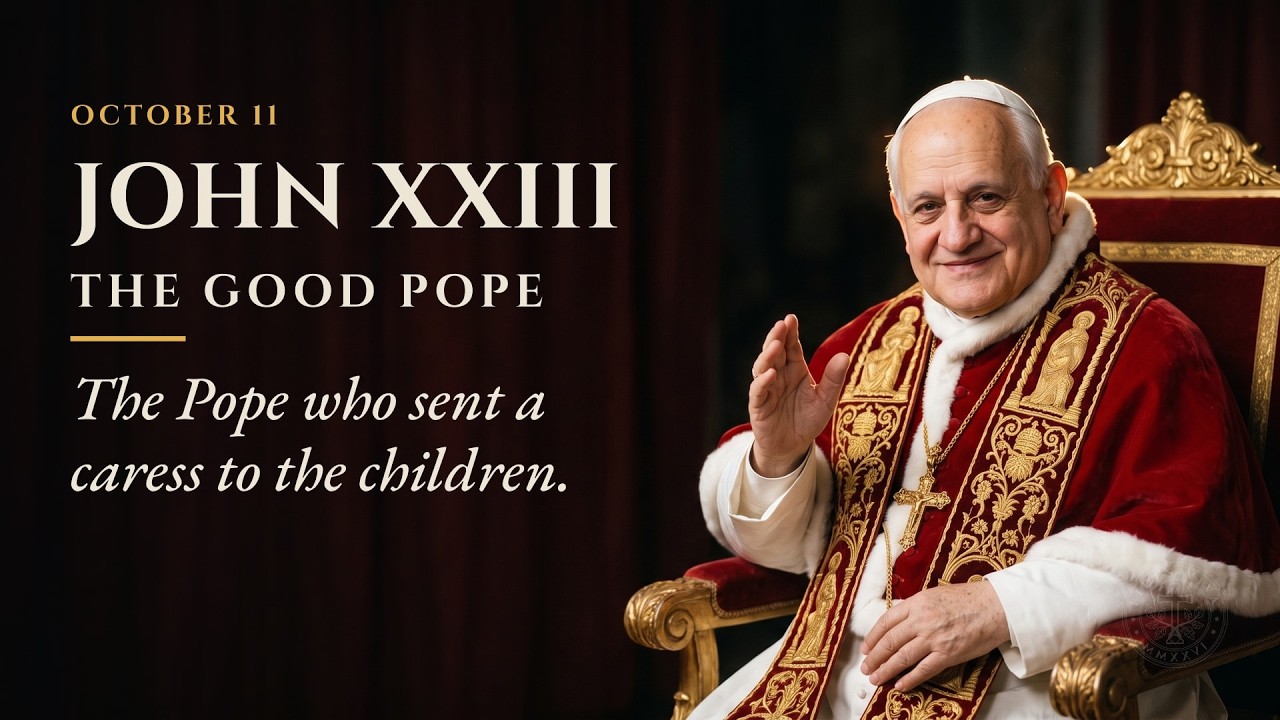
More than a hundred thousand people filled Saint Peter's Square with candles and torches, and the floodlights were still off. Behind a curtain, John XXIII, the old man the crowds called Good Pope John, looked out. He would give the blessing, he told his secretary, “but I won't speak.”
And he spoke.
That morning he had opened the Council, the great gathering of the world's bishops. That night he said that his own person counted for nothing. He asked the parents, when they got home, to give their children a caress from the Pope.
He had not learned to be such a father in Rome.
The Hill of the Sharecroppers
That father had started out as one of many children. In Sotto il Monte, a hillside village in the province of Bergamo, in the Lombardy of the late nineteenth century, the Roncalli family lived as sharecroppers. They worked land that wasn't theirs and shared the harvest with the owner. There were many mouths under one roof. At the head of the household was a great-uncle, Zaverio.
Angelo Giuseppe Roncalli was born there on November 25, 1881, and he was baptized in the village parish that very same day.
His first faith had two faces. One was Zaverio's, the farmer and godfather from whom he received his first and most fundamental education in the faith. The other belonged to the parish priest, Father Francesco Rebuzzini. Under his guidance, the boy from the hill was marked by the Church in a way that never faded.
Before he was a father to anyone, he himself had two. A farmer gave him the faith at home, and a village priest formed him for the Church.
In 1892, still a child, he left the hill and entered the seminary in Bergamo, the house where future priests are trained. There, at fourteen, he began filling notebooks with spiritual notes, his resolutions and his prayer set down in writing. Those notebooks would stay with him all his life, and after his death they would be published under the title “Journal of a Soul.” From then on he opened his heart faithfully to a spiritual director, a priest who accompanies another person's inner life closely.
Soon after, he joined the Secular Franciscan Order, made up of people who live the rule of Saint Francis out in the world, without entering a friary, so that he could follow the Gospel of Jesus Christ with simplicity.
A Spanish priest and writer who admired him used to tell, with affection, about one of his habits. Angelo would make his resolutions for just twelve hours, and the next day he would make them again. In that spirit, as a very young man, he had written a list of ten resolutions. That list is the one many people know today as “Only for Today.”
The notebooks kept filling. And a scholarship would soon carry the seminarian from the hill all the way to Rome, where he was to become a priest.
Secretary, Teacher and Chaplain
In Rome, the scholarship student at the Pontifical Roman Seminary had to set his books aside for a year to do his military service. Then he went back to his studies.
In August 1904, in one of the two twin churches of the Piazza del Popolo, he lay face down on the floor before the altar while the Litany of the Saints was sung. When he rose, the boy from the hill belonged forever to Jesus Christ and to his Church. And from that day on, one desire went with him, to care for souls up close, as a shepherd.
But his first assignment was not a parish. The following year, the new bishop of Bergamo took him on as his secretary, and with him he traveled to the parishes of the diocese on his pastoral visits. At his side, for nine years, he learned what it means to be a pastor and gained a deep experience of souls. At the same time he taught at the seminary.
And he studied a bishop who, centuries before, had visited that very diocese, Saint Charles Borromeo. He published the records of Borromeo's visit to Bergamo.
In June 1914 came the first test of his obedience. In Rome, where he had gone with the seminary rector, Cardinal De Lai held him back for a few minutes: “Professor, please, be careful when you teach Scripture.” Roncalli had never taught Scripture.
He wrote to the cardinal to reaffirm his loyalty. The cardinal's answer came by letter, and at last it explained the warning. He had been told that Roncalli was reading Duchesne, a historian of the Church, and leaning toward a school of thought that emptied tradition of its value. Roncalli took up his pen and replied. That information had not come from anyone who knew him well. Of Duchesne he had read only about fifteen pages. He defended himself with the truth, and without a word of rebellion. He did not yet have a motto, and already he obeyed in peace.
Then obedience took him to war. In 1915 Italy entered the First World War, and the teacher was called up as a medical sergeant. The following year he became a military chaplain, the priest who accompanies soldiers, in the hospitals behind the lines. There, what he had learned beside a bishop was put to the test beside the beds of the wounded.
Once the war was over, in 1921, Pope Benedict XV called him to Rome to work for the Society for the Propagation of the Faith, the body that supports the missions all over the world. He obeyed, and he did not stay behind a desk. He traveled through many dioceses of Italy to organize groups that would support the missions. And that call was going to take him farther still, to a country he did not know.
Obedience and Peace in Foreign Lands
The country was Bulgaria. In 1925, Pope Pius XI named him apostolic visitor, the Pope's envoy sent to come to know a faraway Church up close and to care for it. For that mission he was ordained a bishop in Rome. On his coat of arms he took as his motto what he had already been living, and what he would live out with his whole life:
“Oboedientia et pax,” obedience and peace.
In April he arrived in Sofia. The country's Catholics were few and scattered, and he went to visit their communities one by one. With the other Christian communities he built ties of respect. When the earth shook in 1928, he came with help for the victims of the earthquake.
They were years of small steps, of work that was hardly seen. There he suffered misunderstandings and bore them in silence. In that silence he learned to abandon himself more and more to Jesus crucified. That was the peace of his motto.
Then more was asked of him. He was named apostolic delegate to Turkey and Greece, that is, the Pope's envoy to the Catholics of those countries. Turkey had just declared itself a state with no official religion, and the delegate worked to make sure the Catholics did not feel shut out in their own land.
In Greece he sought to draw closer to the Patriarch and the metropolitans, the Orthodox bishops of the great cities. Among Orthodox and Muslims alike, his manner was always one of respect and dialogue. The peace of his motto had become a way of dealing with people of another faith.
Then the Second World War broke out, and Greece was devastated by the fighting. Now peace had to become help. The delegate set about finding news of prisoners of war. And with a piece of paper he brought many Jews to safety. It was the transit visa of the Apostolic Delegation, an official document from the Pope's envoy that allowed them to cross the country.
In the middle of the war, that document opened a way through.
As the war came to an end, obedience took him to Paris. In December 1944, with France newly liberated, Pius XII named him nuncio, the Pope's ambassador to a state. The country was then increasingly separating its public life from the faith. The nuncio helped prisoners of war and went on pilgrimage to the shrines of France.
In the midst of diplomacy, every day he set aside a long time for prayer and meditation. What sustained him was a simple desire, to be a priest in any circumstance.
After almost thirty years away from Italy, the desire of his ordination day was at last about to be fulfilled. Souls to care for were waiting for him, in Venice.
I Will Be Called John
In 1953 Pius XII made him a cardinal, and a few days later named him Patriarch of Venice, the ancient title of that city's bishop. He was seventy-one. After so many years among embassies and offices, he was going back to caring for the faithful directly, and that return gave him great joy.
In Venice he venerated two holy pastors, Saint Lawrence Justinian and Saint Pius X. As his secretary he had a young priest, Loris Capovilla, who would stay with him to the very end.
Every year, to rest, he went back to Sotto il Monte, to the hill where he had been baptized.
In October 1958 Pius XII died. The cardinals gathered in conclave, the closed meeting in which they elect the Pope. On the fourth day, the one they chose was the Patriarch of Venice. He was almost seventy-seven.
When they asked him whether he accepted, he began with a verse from the Bible: “I trembled, and I am afraid.” What he knew of his own poverty, he said, was enough to confound him. But he accepted, because in the votes of his brother cardinals he saw “the sign of the will of God.” And he bowed his head “to the chalice of bitterness and to the patience of the Cross.”
Then he said in Latin what he wished to be called:
“Vocabor Ioannes,” I will be called John.
To him it was a sweet name, because it had been his father's. And a gentle one, because it was the name of the humble parish where he was baptized. Countless cathedrals bore it, beginning with the Lateran, the Pope's cathedral in Rome. He recalled that twenty-two popes had been called John, and that almost all of them had reigned only a short time. That is how he came to be the twenty-third.
But he loved that name above all for the two Johns closest to Christ. One was the Baptist, “unconquered witness to the truth.” The other was the beloved disciple, who leaned on the Lord's breast at the supper. At the end he asked God, if it so pleased him, for strength “even to the shedding of blood.”
In becoming father of the whole Church, he had taken the name of his own father and of his baptismal font.
He had just recalled that almost all the popes named John had reigned only briefly. Three months later, before a small group of cardinals, he spoke a word that none of them expected.
A Sudden Light and a Shepherd in the Streets
The Pope had gone to the basilica of Saint Paul, on the outskirts of Rome, for the feast of the Conversion of the Apostle. It was January 25, 1959. There, before the cardinals, he spoke the word that had welled up suddenly in his heart and on his lips. He said the words ecumenical council, a gathering of all the world's bishops with the Pope.
To him it was "an unexpected touch, a ray of light from on high, a great sweetness in the eyes and in the heart."
The decision was his own. Beforehand he had discussed it privately with a few, among them his Secretary of State, Cardinal Domenico Tardini. That word was followed by a fervor that stirred all over the world, and then came three years of preparation.
During those years, the Bishop of Rome went out into the streets. He went into the city's prisons, hospitals and parishes, and to everyone he brought his smile. In one of those hospitals, wearing his red cape, he stopped beside a little boy. The boy looked up at him and asked if he was Santa Claus.
The question drew a huge smile from him.
The people of Rome began calling him Good Pope John, and that name would stay with him for good. They were the same people who would one day fill the square again, this time for him.
Behind that smile there was a prayer. At Mass, before the altar where the sacrifice of Jesus Christ is made present, he would often pray, "Heavenly Father, Father of mercy, accept the prayer of your servant." He began with his own sins and with the health of his soul and of his household. Then he widened the circle and prayed for rulers, bishops and consecrated souls, for sinners and the afflicted, and for the souls in purgatory. And he ended by asking for the light of faith for those who do not know it and for the separated brethren, the Christians who are not in communion with Rome.
In that year of the announcement, during a few days of retreat, he kept thinking of a nineteenth-century pope, Pius IX, "of holy and glorious memory," and he wished, by imitating him in his sacrifices, "to be worthy of celebrating his canonization." It was a wish that would remain open for a long time.
Meanwhile, the three years of preparation were flowing toward a single day in October 1962. Before living it, the Pope wanted to place it in Our Lady's hands.
October 11: The Morning and the Moon
The Pope went to Loreto, the shrine of Our Lady near the Adriatic Sea, as a pilgrim. He went to venerate the mystery of the Incarnation, the mystery of God becoming man in the womb of Mary. He was a man of eighty who, a few days before the great opening, knelt where pilgrims kneel.
Then came October 11, 1962. That year, in the Church's calendar, it was the feast of the Divine Motherhood of Mary. Today the Church keeps the memorial of Saint John XXIII every October 11.
In Australia, in the Diocese of Parramatta, the parish of St John XXIII at Glenwood-Stanhope Gardens honors him as its patron and keeps his feast on that day.
In the morning, the nave of Saint Peter's was filled with bishops who had come from all over the world. They sat in long tiers of seats on either side, and in the center lay Peter's tomb. Among them were also observers from other Christian confessions, there to listen.
"Gaudet Mater Ecclesia," "Mother Church rejoices." With those words the Pope began the address that opened the Second Vatican Council.
Before looking ahead, he named those who were missing. There were shepherds who could not be there because they were in prison for their faithfulness to Christ. Before the whole assembly, he confessed his sorrow for them.
Then he spoke of those who, in modern times, "can see nothing but prevarication and ruin." He said it seemed right to him "to disagree with those prophets of doom, who are always forecasting disaster."
He also explained the work that lay ahead of them. It was not a matter of repeating what the Church had always believed, but of setting it out anew. "The substance of the ancient doctrine… is one thing, and the way in which it is presented is another."
He called the Church by one of her oldest names, the Spouse of Christ, and said: "Nowadays, however, the Spouse of Christ prefers to make use of the medicine of mercy rather than that of severity."
And he lent the Church the words Peter spoke to the beggar asking for alms at the gate of the temple. The apostle had no silver or gold to give him, and still he told him to rise and walk.
He spoke of a "threefold ray" of unity, among Catholics, with separated Christians, and with those who are not Christians. He compared that day to a dawn, the first light that announces the morning. The light that had come to him so suddenly at Saint Paul's three years earlier was now the light of a whole assembly.
He ended with Mary. He called on her as the help of the bishops, the same Mother he had just visited at Loreto.
When night fell, no celebration had been planned, and the floodlights in the square were still off. Even so, people kept gathering with candles and torches, until there were more than a hundred thousand of them.
Upstairs, in the Apostolic Palace, Loris Capovilla, the secretary who had been with the Pope since Venice, asked him to look out through the curtains. Below, no faces could be made out. The crowd showed itself only by its murmur and its flames, thousands of small flames in the darkness.
The old man gave a simple instruction. "Open the window, I will give the blessing, but I will not speak."
The window opened onto the square. The white figure appeared in the frame of light, and the blessing had to wait.
"Dear little children… I hear your voices." He spoke without notes, the way you speak to your family from the doorway of home. "Mine is only one voice, but it sums up the voice of the whole world."
Then he looked up at the sky that night. "One might say that even the moon has hurried here tonight."
Then he spoke of himself. "My person counts for nothing; it is a brother who speaks to you, a brother who has become a father by the will of our Lord."
And he said it in the language of the Church as well. "Fratres sumus," we are brothers.
He called upon the Immaculate Virgin, whose sublime privilege the Church was celebrating that day. He recalled Ephesus, the ancient city where a council proclaimed Mary the Mother of God. The same Mother of the morning was now present in the darkened square.
Before blessing them, he asked them to take something home.
"When you return home, you will find your children; give them a caress and tell them: this is the caress of the Pope."
"Perhaps you will find some tear to dry…" And he added: "Let the afflicted know that the Pope is with his children."
Then he gave the blessing he had come out to give. He wished everyone good night. And about the assembly he had just opened, he left one last sentence. The Council, he said, "has begun, and we do not know when it will end."
That morning he had spoken to the bishops of the world as the successor of Peter. That night, from a window, the son of the hill spoke to the families of Rome as a father.
Two weeks later, the darkness frightening millions of families was no longer the darkness of a square.
"Peace, Peace!"
This time there was no window and no square. There was a Vatican Radio microphone and, on the other side of it, the whole world. These were the days of the Cuban Missile Crisis, when many feared that a war would break out.
The Pope began with a prayer of Nehemiah, from the Old Testament. "O Lord, let your ear be attentive to the prayer of your servant."
The Council had barely opened, and already "threatening clouds" were darkening the horizon and sowing panic in homes. And he lent his voice to those who had no microphone at all. He repeated the cry of children and of the old, "Peace, peace!"
Then he turned to those who had the power to decide. "We beg all rulers not to remain deaf to this cry of humanity." He asked them to do everything in their power to save the peace. And he gave the name of wisdom to something very concrete, promoting negotiations and accepting them at any time.
Of the baptized he asked that they join their prayers, because peace had to rest on justice. Then he blessed all who would work for it in the name of the "Prince of Peace," Jesus Christ.
The motto he had chosen when he became a bishop, obedience and peace, no longer stayed within his own soul. It had become a plea for the families of the world.
Meanwhile, inside the Council, a great tension was building. A Spanish priest and journalist who lived through those days in Rome tells what happened to one of the major texts prepared before the assembly. More than half the bishops voted against it, but not the two-thirds needed. It looked as if the assembly was about to split in two.
On the evening before he intervened, the Pope moved up his visit to the Pontifical Latin American College. There he recited from memory a prayer to Our Lady, the same one he had prayed as a boy.
The next morning he made his decision. He created a joint commission, with men from both sides, to write a new text. No one was to come away humiliated.
His widest-reaching word came in writing. Back in 1961 he had published an encyclical, a letter from the Pope to the Church and to the world, under the title:
Mater et magistra, "Mother and Teacher."
In 1963 he published another, with a title that summed up the plea of that autumn:
Pacem in terris, "Peace on Earth." He did not keep it for Catholics alone. He addressed it to all men of good will.
The letter on peace came out in the spring. A few weeks later, the illnesses he had been carrying for a long time began to grow worse.
"I Love Them, They Love Me"
The man who had spoken to the world from a window and into a microphone no longer left his room. His days had narrowed to a bed, a few familiar faces and prayer.
From that bed, in his last moments, he entrusted his testament to the Church. It fit into a single sentence. "What counts most in life is blessed Jesus Christ, his holy Church, his Gospel, truth and goodness."
Below, the square was full again. The same open space that had glowed with candles and torches one October night was now filling with people who had come for him.
Kneeling beside the bed was Capovilla, his secretary of so many years. He wanted the Pope to know what was happening outside. "Holy Father, there are only a few of us here in the room, but if you could see the Square!"
The dying man answered the crowded square with these words. "It is only natural, the Pope is dying, I love them, they love me!"
Eight months earlier he had sent his caress into the homes of Rome. Now those homes were returning the gesture.
Shortly before the end, Capovilla asked his forgiveness for not having been the secretary the Pope deserved. The Pope laid his hands in his secretary's hands.
"Loris, let these things go…" "What matters is that we have done our service according to the will of the Lord." And he went on: "We did not pick up the stones they threw at us; we have suffered together, we have loved and we have forgiven."
The obedience he had chosen as his motto when he became a bishop, nearly forty years of going wherever he was sent, came down in the end to the word service.
He died on the evening of June 3, the day after Pentecost, the feast on which the Church celebrates the coming of the Holy Spirit. He passed away in deep surrender to Jesus.
Capovilla was there until the very last moment. What he saw die was not an old man. It was a child.
Pray for Us
Saint John XXIII, son of the hill of Sotto il Monte, you served with obedience and peace wherever you were sent, and from a window you sent your caress to the children and your comfort to the afflicted. Obtain for us from God, the Father of mercy, the grace to recognize that what counts most in life is blessed Jesus Christ. Help us to love and to forgive in our homes, and to wipe away a tear close beside us. Pray for us. Amen.