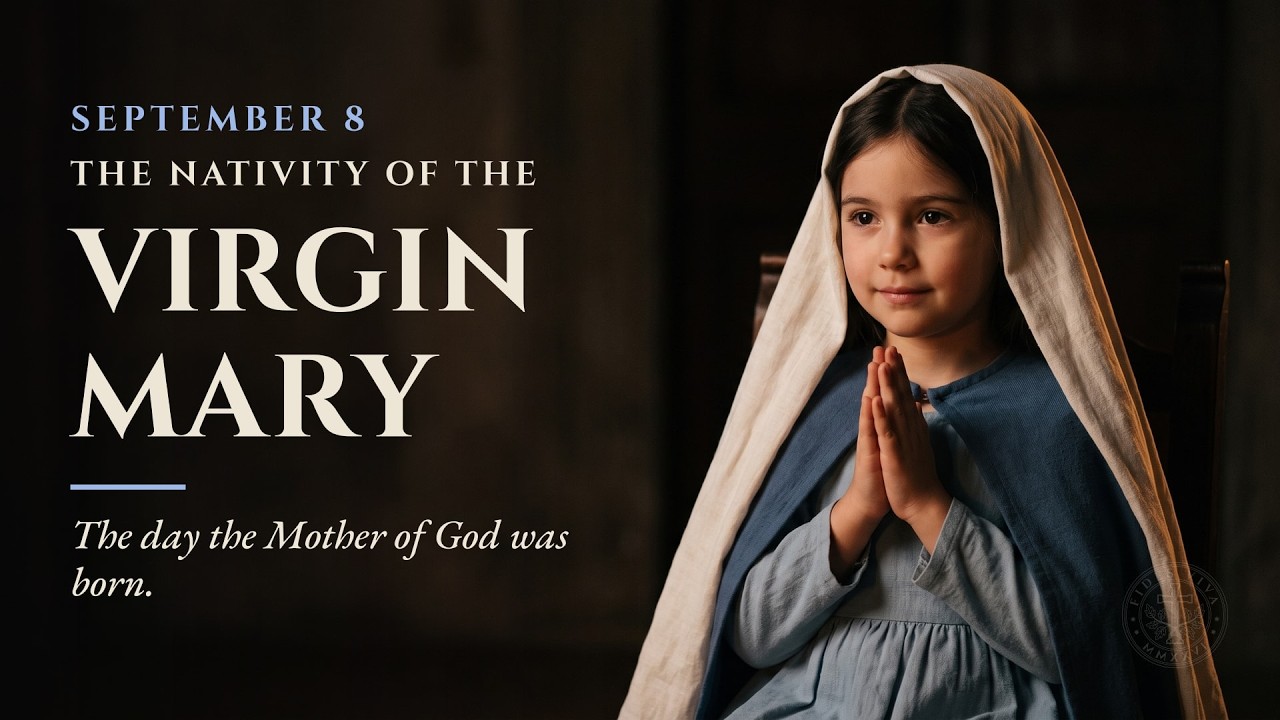
HOOK
Evening falls. In a courtyard of stone, an older woman lets the spindle slip from her hands and hides her face. She weeps without sound, the way one weeps when no one asks why anymore. She has waited for a child her whole life. She waits no longer.
And then, a voice.
It does not come through the door. It is not her husband, who forty days ago disappeared into the wilderness without farewell. It is a voice that promises the impossible: that this tired body will conceive, and that this house without a cradle will not be forgotten.
It happens in an occupied land, in a house like any other, and no chronicler writes it down. The Gospels say nothing of it either: about that day, Scripture keeps complete silence. Not a name, not a date, not a place.
And yet, seven centuries later, torches will cross the heart of an imperial capital by night to celebrate what began in that courtyard. Still today, every eighth of September, the entire Church sings it again, in East and West alike.
The Church keeps very few births in its calendar. This is one of them: the birth of a girl of whom the Bible says not a single word.
How did the hidden weeping of a small house come to light up the streets of Rome by night?
The Wound of Waiting
Weeks before those tears, a white-bearded man climbs the slope toward the Temple of Jerusalem at dawn, a lamb across his shoulders. If we were to place this scene in time, it falls in the final twenty years before Christ. Judea is a closely watched kingdom: Herod rules by Rome's grace, and taxes strangle shepherds and farmers alike. Above the esplanade, the Temple rises among scaffolding, faced in golden stone that wounds the eye in sunlight. Smoke from sacrifices rises all day long. And with the smoke rises the old hope of Israel: that God will send at last the Messiah, a savior from the line of David.
So an ancient account tells it—a story kept outside Scripture, one the Church has treasured with care. The man's name is Joachim. He is a keeper of flocks, devout, known in the city; and he carries a wound that cannot be hidden in his world: he has no children. When his turn comes before the altar, his offering is rejected in front of all. A man without descendants, they tell him, must not present himself first. In that Judea, a marriage without children was read as a door God had chosen not to open; barrenness hurt from within and, besides, it shamed in public.
Joachim does not argue. Nor does he go down to his house. He leaves the walls behind and loses himself in the Judean Desert, a sea of scorched ravines where only shepherds and their flocks endure. There he fasts for forty days and forty nights. An old man alone, under an enormous sky, with empty hands; a man faithful his whole life, asking himself whether God has ever looked upon him at all.
Down in the city, Anne does not know if her husband will return. Each morning she repeats the gestures of all the women of her time: grinding grain, lighting the fire, going for water. But each gesture weighs differently in a house where small footsteps have never echoed. At the well, the others arrive with children at their side; she arrives alone, and feels the glances that measure her. For years she has asked the same thing in every prayer. Anne has come to that exact point: the moment when prayer begins to look more like habit than hope.
That is where Anne is when evening falls in the courtyard. She does not weep over a new sorrow: she weeps over all the years together, over the husband who left without saying goodbye, over the old age that leaves no room for miracles. Alone with her pain, with no witness but the sky.
An old man in the desert. An old woman in a courtyard. Two faithful lives that seem to have worn away for nothing, separated by hours of walking and joined by the same wound. To any eye, from that marriage nothing more can be born.
What can be born when nothing is expected anymore? The silence of that house is about to break.
Promise in the Night
Anne lifts her face. The courtyard remains the same: the same stone, the spindle fallen, the lamp trembling. And yet nothing is the same. As tradition holds, in that moment at the edge of night, a voice brought the promise: the God of Israel has heard her prayer; she will conceive and give birth.
She does not ask for proof. She does not ask how, when her body ceased to hope so many years ago. And the old account remembers something more: that in the years of their waiting, this couple had made a vow—that a child received would not be kept for themselves, but would be brought to the house of the Lord, as one returns a gift too great to hold.
The people of Israel knew that road. Sarah, the wife of Abraham, became a mother in her old age; Hannah, the mother of the prophet Samuel, ceased to weep in the sanctuary of Shiloh. Again and again, salvation had moved forward where the way seemed closed: through mothers who could not bear children. Now that ancient path passes through a courtyard in Jerusalem.
The news crosses the desert too. Among the ravines where Joachim fasts, the voice reaches him as well: he may return; his prayer has been heard; his wife will conceive. Forty days of silence break in an instant. The old man rises, takes his staff, and sets out on the road back to Jerusalem, where his wife waits for him.
Anne does not stay in the house. The account places their meeting at one of the gates of the city. Christian memory would later call it the Golden Gate, a scene medieval art would make one of its great themes. And there, among shepherds driving their animals in and women going for water, she sees him coming down the road: dusty, thinner, alive.
She runs. She throws her arms around his neck. Both weep now, this time with witnesses all around, and neither cares. An embrace of two old people at the gate of an occupied city: that is all anyone sees. The joy that comes late disarms like nothing else; there are embraces that are worth all the years they cost.
After that they return home through the familiar streets. No one stops them; no one suspects a thing. The promise lives hidden, with no guardians but an old shepherd and a woman who has learned to hope again in her own house. From that word spoken low will spring, without anyone knowing it yet, the path that one day will lead to Jesus Christ. But that lies far ahead still. For now there is an ordinary house, nine months to come, and a new waiting: the first sweet waiting of their lives.
A Birth Without Witnesses
Nine months later, the house fills with women's voices. Neighbors come and go with water and cloth; the midwife has ordered the courtyard door closed. Inside, in the half-light, Anne is in labor. An oil lamp lights the low bed of woven mats; outside, Joachim stands waiting, not daring to sit, while the morning passes over Jerusalem like any other.
And then, a cry. Thin, brief, alive.
The midwife leans over the mother and tells her what has been born: a daughter. Anne's answer is preserved in an account from the second century, the Protoevangelium of James—an early memory that the Church has held dear, never confusing it with Scripture. The old woman, exhausted on the blankets, says: "My soul has been magnified on this day." She does not ask for a son. She does not mourn anything. She receives the daughter as one receives what was no longer expected.
The women wash the newborn in a bowl of clay and rub her skin with salt, as was done then with the children of Israel. Then they wrap her in narrow bands of pale linen, round after round, until only her face is left uncovered. Eyes half-closed, dark down on the small skull, a body so slight it fits in two hands that wrap it with the skill of one who has swaddled many children, and with the tenderness of one who knows what it cost to wait for this one. They place her in her mother's arms, and the mother looks at her as one looks at the dawn.
And then comes the name. That old account keeps it without ceremony, spoken within the house: Miriam. Mary. Miriam: a common name among the women of Israel, one of the most ordinary in that Judea. No voice is raised to speak it. No one records it in any register.
Because outside, that day, nothing happens. Herod remains in his palace. Soldiers make their rounds. In the Temple, the smoke of sacrifice rises as it does every morning. No chronicler notes the date; no traveler stops at the door. The woman who one day will be the mother of Christ has just been born, and no one beyond those walls knows it. What is decisive has entered the world, once again, without witnesses.
But houses remember. Christian memory did not keep only names: it kept a place. Tradition locates this dwelling beside the Probatic Pool—the pool of the sheep. Two great cisterns cut into the rock, north of the Temple, where the animals meant for sacrifice were washed. A conviction repeated often among the ancient writers explained the connection: Joachim, an owner of flocks, had built his house beside the water that served his trade. If that memory is right, the bleating of sheep and the sound of water accompanied the first days of the girl.
Four centuries later, when no one remained who had seen the two old people or heard that first cry, the Christians of Jerusalem pointed to those stones: here. In this house, beside this water. Faith remembers by loving places. And that stubborn love for crypts cut from the rock would be the seed of something no one that morning could have imagined. One day, in cities that did not yet exist and in languages not yet spoken, the birth of this girl would be celebrated. But before it became a feast, the memory had to grow as children grow: from mouth to mouth, from mother to daughter, until it became a story. And it began to travel very soon, almost at the pace of Mary herself.
Memory and Wonder
The same account that kept her name adds wonders that belong to the piety of centuries more than to history. It says the girl took seven steps at six months old, and that her mother caught her at the seventh. There is a story that Anne, seeing this, turned one room of the house into a small sanctuary: nothing impure was to touch her there, and only daughters of Hebrews were to enter and care for her. No one made a note of these scenes; no one could have. They are the way a community in love said what it believed: that this child was set apart from the beginning, before she could speak.
Devotion does not lie when it exaggerates. It translates.
There was, though, a promise to keep. During the years of barrenness they had made a vow: if a child came, the child would be given back to the Lord. And the old memory places that fulfillment when the girl was three years old. They bring her up to the Temple, among lamps lit by young Hebrew women, and offer her to the service of the sanctuary. The little girl—the account says—climbs the golden stone steps alone, without anyone needing to lead her by the hand. And the piety of centuries wanted to see still more: that in those courts an angel fed her from his own hand.
That gesture—to receive a gift and open your hands to give it back—is among the hardest that exist. That is what the scene holds, with history or without it.
And then, for entire generations, all of this lived only by word of mouth. From mouth to mouth, from mother to daughter, in the houses where bread was broken and people spoke of Jesus. Until in the second century, somewhere in the Christian East, someone set it down in writing. That is how the Protoevangelium of James came to be. It was not a chronicle, but a memory written with love before it was written as record, by a community that loved Jesus Christ and wanted to know his mother from the cradle. That text fixed forever two names that Scripture had left silent: Joachim. Anne. The Church never read it from her altars as she reads the Gospels; but she did not let it be lost either.
A memory made into words can travel. It can cross seas, learn other tongues, light lamps far from the house where it was born. What was still needed was for it to become stone, and date, and song. What was still needed was for the whole Church to learn to celebrate that dawn.
The Dawn of the Feast
Four and a half centuries after that birth in shadow, the name of Anne's daughter filled an entire city. It was the year 431, in Ephesus, on the coast of Asia Minor. The bishops of the whole Church, gathered in council, had to answer an enormous question: whether Mary could be called Mother of God. And the answer was yes. Theotokos—she who gave birth to God: because the son who grew in her womb, Jesus Christ, is God made man. It was not a dispute over words. It was the very heart of the faith.
That word set the Christian world ablaze. Throughout the Empire, sanctuaries began to rise in her honor, and the feasts of Mary started to multiply like lamps lighting one after another. In Rome, just after the council ended, the mosaics of the triumphal arch of Saint Mary Major, painted between 432 and 440, already showed her enthroned in gold: one of the oldest images of Mary that Rome preserves.
And in Jerusalem, the memory returned to the place where everything had begun. In the fifth century, beside the remains of the Probatic Pool, a sanctuary rose with a name that was almost a map: Saint Mary Where She Was Born. Over the crypts held to be the house of Joachim and Anne, faith had laid stone, columns, an altar. And when that church was dedicated, the anniversary of its dedication was fixed in the calendar: the eighth of September.
That is the origin of the date. The feast of Mary's nativity did not arise from a document or a family record. It was born from the birthday of a church, built upon a house. That place, beside the water where the Temple's sheep were washed, became a date for the whole world.
A house had become a church. A dedication had become a feast.
From Jerusalem, the celebration climbed toward the capital of the Empire. Around the year 560, in Constantinople, a deacon of Syrian birth named Romanos the Melodist—the great poet of Byzantine liturgy—sang a hymn about Mary's nativity. It is the first liturgical witness we know of the feast: the proof that the memory of a small house was already being sung, in full voice, beneath the domes of the most powerful city on earth.
The West took a little longer, but it arrived. In the early seventh century, between 614 and 631, the feast already appears in the calendar of Sonnacio, bishop of Reims, in Gaul. The dawn was advancing from east to west, as dawns do.
And then it entered Rome. At the end of that century, the Church was governed by Pope Sergius I, a man from a Syrian family settled in Palermo: someone of the East sitting in the seat of Peter. He had been trained in Rome's school of singers, and chant and the Church's liturgy were his work before they were his office. At some point in his pontificate he decreed that the four great feasts of Mary—the Annunciation, the Purification, the Dormition, and the Nativity—should be honored in the city with a litany and a procession. At night. With torches.
The whole city took to the streets. The procession left the church of Saint Adrian, right in the Roman Forum, the old Senate house now turned into a house of prayer, and moved forward among the ruins of the Empire. Fallen columns, arches of dead emperors, marble that had seen legions pass. Ahead, the litanies sung; behind, the people: artisans, mothers with children asleep on their shoulders, elders. And through the middle, a river of small flames: hundreds of flames rising toward Saint Mary Major, where the Mass of the feast awaited.
Seven centuries before, more or less, an oil lamp had lit a newborn girl in a house in Jerusalem. Now thousands of torches crossed the world's capital by night to celebrate that same birth. The city of the Caesars, which never knew that girl existed, poured into the streets for her.
A question hung in the air, held up by all those flames: what had the Church seen in that nativity to place it this way, with fire and with song, in the heart of her year. The answer was ripening in the East. And it would arrive put into words.
The Dawn Before the Sun
In the eighth century, two preachers gave the feast its final language. The first was Andrew of Crete: born in Damascus, a monk in Jerusalem, later archbishop on the island of Crete, and one of the great poets of Eastern liturgy. When he spoke of Mary's nativity, he called it "the beginning of the festivals," and said it serves "as a door toward grace and truth." A door. The image is no accident: the Byzantine liturgical year begins in September, and the first great feast the believer crosses upon entering is this one. Before Christmas, before Easter, the year opens with a girl.
The second was John Damascene, a monk of the monastery of Mar Saba, hanging above the desert of Judea. The memory of Jerusalem wished that he would speak one of his homilies right there: in the basilica raised beside the Probatic Pool, over the same house from which everything came. His words are preserved: "We have very good reasons to honor the nativity of the Mother of God, through whom all mankind has been restored and the sorrow of the first mother, Eve, has been transformed into joy." And he greeted the two elders of that house across eight centuries: "O blessed pair, Joachim and Anne, all creation is indebted to you!"
The liturgy condensed that faith into a single phrase, which is still sung every eighth of September. "Your nativity, Virgin Mother of God, announced joy to the whole world: for from you was born the Sun of Justice, Christ our God." That is the key to it all. Mary is the dawn: the light that is not yet day, but already announces the sun. To celebrate her nativity is to celebrate that day is breaking.
The Church's calendar holds that logic with moving precision. Of all the saints, we celebrate the day of their death, their birth into heaven; and only three earthly births have their own feast: that of Jesus Christ, the twenty-fifth of December; that of John the Baptist, the twenty-fourth of June; and that of Mary, the eighth of September. The sun, the voice that announces it, and the dawn that precedes it. No one else.
Between the seventh and ninth centuries the feast was fixed in Rome's great liturgical books, the sacramentaries, and it would not move again. Centuries later, when in 1854 the dogma of the Immaculate Conception was defined—Mary preserved from sin from the first instant of her existence, in Anne's womb—the logic of her date became clear. The eighth of December. Exactly nine months before the eighth of September. Conception and birth, as in any human life. The calendar counts the months as a mother would count them.
Devotion, meanwhile, poured itself into stone and into color. Around 1140, the Crusaders raised in Jerusalem the present church of Saint Anne over the remains of the Byzantine basilica and the crypts held to be the house of her birth: stone pointed to the same place again. In Padua, between 1303 and 1305, Giotto painted the scene in the Scrovegni Chapel: Anne resting on the bed, midwives with the girl in their arms, Joachim in the doorway. In Florence, Ghirlandaio painted it; in the East, icons repeated for centuries their same domestic gestures: the bath, the basin, the women. And in Milan, where the feast had been celebrated since the tenth century, the whole city came to be placed under that title: its cathedral, consecrated in 1572 by Saint Charles Borromeo, is dedicated to Maria Nascente. A forest of marble, the Duomo, raised for a newborn girl.
The echo reached intact into the twentieth century. In 1950, Pope Pius XII, in proclaiming the dogma of the Assumption, recalled in writing that his predecessor Sergius I had prescribed the litany and procession for the four feasts of Mary, the Nativity among them. Twelve hundred years later, Rome still recognized itself in those torches.
And it reaches to this day. In 2025, a document approved by Pope Leo XIV said again, in new words, what the antiphon has sung for more than a thousand years: that all devotion to Mary looks to Christ, the sole mediator, and that honoring her is honoring the hidden beginning of her Son's work. The dawn does not compete with the sun. It announces it.
Every eighth of September, in Jerusalem, stone steps still descend into the crypt of the Basilica of Saint Anne, beside what remains of the Probatic Pool. There, in the rock held to be the house of Joachim and Anne, the solemn liturgy is celebrated on that day. And at the same hour, thousands of miles away, there are pilgrimages in villages of Spain and the Americas, novenas, bells, mothers expecting a child and who draw near to ask a blessing. Twenty centuries later, the date still gathers people around the same thing: a girl who was born without anyone knowing it.
A feast that began as the birthday of a church has crossed empires, councils, cathedrals, and centuries. And it holds intact its deepest question: what a small light announces when the sky is still dark. That question no longer belongs to the past alone.
When the Sun Has Not Yet Risen
Because the question that opened everything still stands: why does the Church celebrate the birth of a girl about whom the Gospels say not a single word.
The answer lies not in any archive. It lies in the path the memory itself traveled: a house beside the water, two elders who no longer expected anything, a story written with love before it was written with records, a church dedicated, a hymn, torches at night. The Church celebrates this birth because it learned, by looking at it, something no document could teach: that God begins his greatest works where no one is watching. Anne did not know what she held in her arms. The midwives who washed her that night did not know. And on that girl hung the coming of Jesus Christ into the world.
That is why the feast bears the name of dawn. The dawn makes no sound. It does not yet warm. When it appears, the sun is still below the horizon; but whoever sees it knows already that the night is lost. To celebrate the eighth of September is to celebrate exactly that: light when it is not yet day.
Of the three births the calendar keeps, this one is the most silent. Angels sang of Christ's birth; the Gospel recorded John's. No one recorded Mary's. And yet the hope of the world passed through that ordinary house, through that cry of a newborn girl that no one noted down.
We too live surrounded by beginnings that have not yet shown their fruit: the child just born, of whom we know nothing; the treatment barely started; the first day at a job that may not last. How many times do we dare to rejoice in something we have not yet seen grow?
Anne dared. That ancient story tells us that on the very day of the birth, when her daughter was nothing more than a small body wrapped in linen, she said her soul had been made great. She did not wait for the fruit. She celebrated the dawn.
Twenty centuries later, the bells of the eighth of September still say the same thing in countless villages and shrines: what began that night, without anyone seeing it. That night in occupied Judea did not know it yet. But in a house beside the water, without witnesses, dawn had already come.
Most Holy Virgin Mary, dawn of our salvation, pray for us.