By the Anio, hands tie a stone to the neck of a woman who stands unafraid. A few words before an altar would save her — and her seven sons. She says nothing, and she looks at the water the way one looks at a door.
A House in the Shadow of the Palace
The whole world answers to a single man. From the walls of Britannia to the sands of Syria, one profile travels stamped on the coins: Hadrian, emperor of Rome. He has inherited the empire at its height and crosses it without rest — cultured, curious, a tireless builder, alert to the oracles. In every city, incense rises from the public altars: to burn a few grains before the gods is a civic act of loyalty, as required as paying taxes. To refuse is treason. And yet, behind certain closed doors, there are those who pray in low voices to a God who has no statues.
A day's journey east of Rome, Tibur — present-day Tivoli — leans over the gorges of the Anio — today's Aniene. Waterfalls thunder between walls of travertine, silvered olive groves climb the slopes, and the great sanctuary of Hercules Victor rises on terraces above the water. The emperor has set his eye on this land. For years, thousands of laborers raise beside the town the vastest residence in all the Roman world. Colonnades that seem never to end. The pool of the Canopus lined with columns. An island of marble ringed by water, so that an emperor might be alone with his thoughts. A paradise of stone, made to outlast the memory of men.
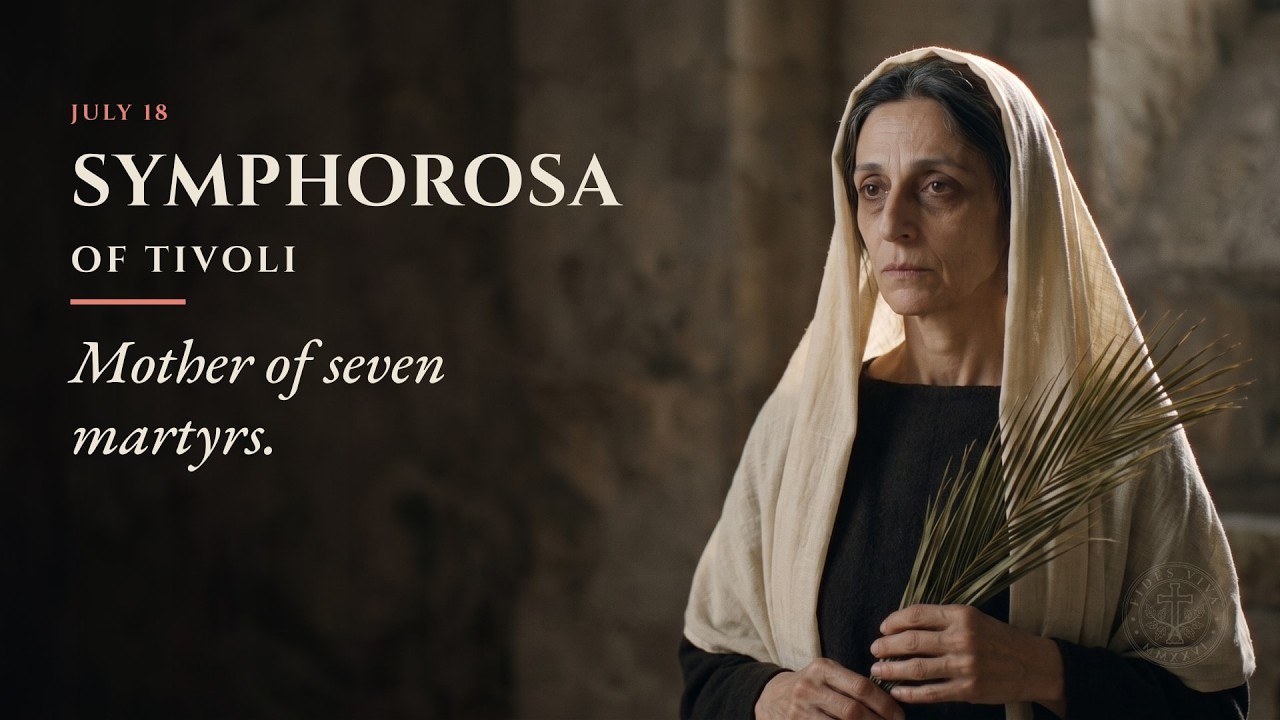
The din of that work reaches, muffled, the paved streets of Tibur. And among those streets the town's memory keeps a far humbler door. Behind it, it remembers a daughter of its nobility: Symphorosa. A matron small of stature, her gaze steady and calm, dressed without a single jewel, like one who has no need to shine. She is married to Getulius, a tribune of the Roman army — an officer who has heard the name of Christ and has believed.
Seven sons have been born of that marriage: Crescens, Julian, Nemesius, Primitivus, Justin, Stacteus, and Eugene. Seven staggered ages that fill the house with running feet, with arguments, with spun wool and freshly broken bread. It is a comfortable family of the town's aristocracy, with lands and a name; it could live as all the others live — sacrificing to Hercules at the festivals, lighting incense in the emperor's honor. It does not. Its most closely guarded wealth cannot be seen from the street.
Evening falls. When the town grows quiet, the mother lights a small oil lamp, and the seven gather around her. They pray in low voices, almost a whisper, to a God whom Rome does not recognize: a God with no temple in the forum, no smoke, no statue, who asks for the whole heart. And so the children learn, before anything else, that there is Someone greater than the emperor. Outside, across the valley, the torches of the imperial works burn bright. Within, a single flame lights eight bowed faces. Two worlds, a step apart, still untouching.
No one who saw them would guess the danger. The father serves the emperor with honor; the mother is respected in the town; the sons grow strong. But in this house they pray to a God the law does not shelter, and its head is a tribune of Rome. A man who dons each day the uniform of an empire to which he can no longer offer incense. That peace rests on a knife's edge. Getulius knows it. In time he lays down his command and withdraws to his lands in the countryside, seeking to live his faith away from watching eyes. It will not be enough. One morning, the news no wife wishes to receive crosses the threshold of the house.
The First Blood
It fits in a few words: Getulius will not return.
He had sought a quieter life. Away from command, on his lands in the countryside, the former tribune wished to serve his God without noise, without provoking anyone. But an officer of Rome does not go unnoticed. The believers of the valley later told one another, house to house, how it had ended. They seized him together with his brother Amantius, a tribune like him, a believer like him. Before both of them they set the same thing: a lit altar, a few grains of incense, a whole life in exchange for a gesture. Both said no. There were threats and there were torments; neither of the two gave way. They died together, so the memory runs, in the countryside toward Gabii, a few hours' walk from the house where seven sons awaited their father.
In Tibur, the wife hears the news on her feet. There is no body to keep vigil over yet, no grave to visit; only a name, and seven pairs of eyes watching her, waiting for an explanation. She puts away the ribbons of a matron and covers her hair with the veil of widows. She lays aside the light colors; from that day she wears wool of brown and gray, without a single jewel. Grief thins her and lights the first gray at her temples. She could blame the God for whom her husband died; she does the opposite — she takes hold of Him with both hands. But the blow does not bend her.
One evening, Symphorosa gathers the seven around the lamp. And she speaks to them of their father: not the way one speaks of a misfortune, but the way one speaks of a victory that is hard to understand. She tells them who he was: a soldier of Rome, a man of honor, who served his emperor without ever lying. And she tells them why he died: because he had found a treasure worth more than life, and would not pretend he did not have it. The little ones listen without grasping it all. The older ones grasp too much. That evening, the seven learn who their father was by the way he died.
Something changes then in that house. The lamp is still lit each nightfall, but the head of the prayer is now held by a woman in a dark veil. The table serves as an altar; the courtyard, as an atrium; the mother's voice is the whole school of the faith. The entire house has become a small church, and the one who presides over it is a widow. Each day the eight call together upon the name of their God, in low voices, behind closed doors. Grief does not shut her in: it lifts her to her feet. What the father confessed in dying, she will teach in living; that is the inheritance, and she does not mean to let it be lost.
The years do their quiet work. Crescens, Julian, Nemesius, Primitivus, Justin, Stacteus, and Eugene grow staggered like the rungs of one ladder; on the eldest, a beard is already showing. The youngest scarcely holds any memory of his father: he knows him through his mother's voice. Each one prays each day, with her, to the God for whom Getulius gave his life. None of them hides it entirely; none of them proclaims it. They live as the father lived in his last years: faithful and discreet, not seeking the storm.
But the faith of that house now hangs entirely on a single woman. And the persecution is not over: it dies down and flares again, like an ember no one quite manages to stamp out. One day, the air of Tibur changes. Questions circulate, names are spoken, someone looks too long toward that door. The widow of Getulius does not wait for them to come for her sons. She takes them with her, closes up the house, and vanishes from everyone's sight.
The Catechism of the Hiding Place
An old memory of Tibur keeps the place where they went: a dry cistern, cut into the rock, beneath the city. For months — so it was told, from one generation to the next — that dark hollow was their home. The walls sweated damp. The air smelled of wet stone and burning oil. A single oil lamp measured the days: while the flame burned, there was prayer; when it went out, there was night.
They lived on the little that friendly hands lowered in silence. The boys learned to speak softly, to move slowly, to tell apart the footsteps that sounded overhead. And the cistern kept the habits of the house: prayer at the same hours, the name of God called upon each day in a low voice. The mother could have used those months for one thing alone: teaching them to survive. How to keep quiet, how to pass unnoticed, what to answer if someone asked. It would have been the natural thing; it was what any mother would have done. She did something else.
Beside the flame, she spoke to them without pretending. Of the danger first: what Rome did to those who would not bend the knee, they already knew from their father. Of the reward after: a life that does not end, and a reunion no sword can prevent. And at the end she confessed the thing that cost her most to say: her own fear. She did not fear dying; she feared that one of the seven might falter, that a gesture lasting an instant might part a son from his father forever. A heroine carved in marble would have kept that fear silent. She was a mother of flesh, and she set it before them all.
There, in that darkness, everything that would follow was decided. She held both possible inheritances in her hands, and could give only one of them whole. She could give them safety: it was enough to teach them to yield a little, to say with their lips what their hearts denied. Or she could give them hope: the whole faith, undiminished, with all its cost. She chose hope, knowing what it might cost. She forced it on no one: she offered it, the way one offers bread, and waited.
And the seven received it. Each at his own age and in his own way: the older ones weighing the risk like grown men, the youngest leaning on the faith of his brothers. No one asked for anything else. In that sunless cistern, eight free wills said yes to the same thing.
The seed was sown in the darkness. No one yet knew whether it would hold up in the light; it is one thing to believe under the shelter of a lamp, among brothers, and quite another to believe standing upright, in broad daylight, before power. That trial had no date yet, but it was already drawing near. Across the valley, the scaffolding had fallen at last: the emperor's villa was finished. And in its newly opened halls, its master was preparing to consult the gods. The gods were about to speak a name.
The Name That Troubled the Gods
The master of those halls had ruled the world for twenty years. Hadrian: tireless traveler, architect, a man of letters who had crossed his empire from frontier to frontier. He was near sixty now, and his last years would remember him ill and somber, ever more attentive to omens and oracles, as the old memory tells of him. He wished to open the villa as the rite required: with sacrifices to the gods, that they might bless the new walls. The braziers burned, he drew the edge of his toga over his head, and he inquired into the will of heaven.
So the faithful who kept her memory told it afterward: the gods, when consulted, announced no wonders and promised no abundance. They complained. "The widow Symphorosa and her seven sons torment us every day by calling upon their God; if she and her sons sacrifice, we promise to grant all that you ask."
A complaint from the gods. In the heart of the imperial sanctuary, among freshly polished marble, the pagan heaven confessed itself in trouble. And what tormented it was no army, no conspiracy, no rebel province. It was a prayer. The low voice of a hidden widow and her seven sons, who each day, at the same hours, spoke the name of their God. That flame which had burned in a cistern, barely able to light eight faces, weighed in the balance of the world more than all the braziers of the empire. No one had sought it. The family only prayed; and power trembled.
The condition was stated in the oracle itself: there would be no favor from the gods until that family sacrificed. Hadrian, who had raised temples on three continents, found that his most cherished work depended, by his own gods' word, on the incense of a widow from Tibur. A healthy man might have shrugged it off. The ailing emperor could not allow himself that: he needed heaven's favor as he needed air. He gave the order. Let them find her. Let them find her and the seven, and bring them to sacrifice.
The soldiers were not long. A hiding place holds while no one truly searches for it; when a whole empire asks after a name, the walls end by speaking. Symphorosa was found and arrested. No one afterward recalled a flight or a struggle: she came out of the darkness into the July light, in her widow's veil and her brown wool, escorted as though she were dangerous. They led her to the great Temple of Hercules Victor, the terraced sanctuary hanging above the Anio. There the smoking altar waited. And before the altar, the most powerful man in the world.
The Widow Before the Emperor
They had raised it centuries earlier on terraces of stone, hung above the gorge of the Anio: the sanctuary of Hercules Victor, the pride of Tibur. Below, the water roared among the rocks; above, the altar smoked, and the statue of the god kept watch from its pedestal. Among columns, priests, and guards, the emperor himself waited. They made her cross the portico between two rows of spears. She walked upright, her veil in its place and the gray showing at her temples; she did not look like a prisoner on her way to judgment, but like a mother who knows where she is going. All the weight of Rome, gathered to break a widow from the provinces.
So little would have done it. A few grains of incense over the coals, a slight bow before the marble. With that smallest gesture she would recover her home, her name, and the lives of her seven sons. In Rome's eyes it was no betrayal of anyone: it was an act of civic loyalty, what any sensible subject would have done without a second thought. So the martyr's memory kept it: the emperor himself asked it of her. And Symphorosa — small, in mourning, worn thin by months in hiding — said no.
There was no defiance in her voice, and no scorn. She spoke like someone explaining a very simple thing. The words that remained of her, repeated afterward among the faithful for centuries, run like this: "My husband Getulius and his brother Amantius, tribunes of yours, chose torment rather than sacrifice to the idols, and by their death they conquered like good athletes."
Tribunes of yours. Before the emperor, the widow named her dead and called them victors. Like good athletes: the image was Roman to the bone, the runner who finishes the race and receives the crown. Only the crown she saw was given by no stadium. In a single sentence, the whole vocabulary of power was turned inside out: the executed were the champions, and the torment became victory.
Hadrian reached for the one thing left to him. He warned her that, if she would not sacrifice to the gods, she herself would be the one sacrificed. And then came the answer: "Where does such happiness come to me, that I should be found worthy to be offered to God as a victim together with my sons?"
Happiness. The emperor threatened death, and the mother answered with thanks, like one receiving long-awaited news. There was no craving for death in her; there was something more unsettling: the certainty that what Rome called punishment was, in truth, an offering. He could take her life; he could take nothing from her that she had not already given. Before a freedom like that, power runs out of words.
What the word could not do was handed over to force. They struck her before the altar, again and again, until her face was bruised. As she stood firm, they tore off her widow's veil and hung her by her own hair. Over that pain the memory does not linger, and there is no need to linger: enough to know that it lasted, and that she passed through it without withdrawing a single word. That small body, a mother of seven, endured what walls do not endure.
Nothing broke her. Not the promise, not the threat, not the pain. In the temple raised to Hercules, the god of conquering strength, the conqueror was a widow with no weapon at all. To the emperor, master of every army on earth, one recourse remained. He turned toward the roar rising from the depths of the gorge, the one that had been sounding beneath the temple all morning.
The river.
They led her out of the temple. Down the stairs, among the guards, the path descended toward the green waters of the Anio.
The River as a Door
Below waited the river. The Anio ran green and swift between the walls of travertine, the same river that had sounded all her life beneath the streets of Tibur, the same one an emperor had wanted as background music for his paradise of stone. It was the eighteenth of July. The morning light was beginning to gild the water.
They tied a great stone to her neck, made fast with a rope. No one kept the memory of a cry, a plea, a struggle. She stood at the water's edge, her hair loose and her face beaten, and she looked at the water with the same calm with which she had looked at the emperor.
Somewhere, under guard, her seven sons were still breathing. She would not see them again in this world. She would not know whether the eldest held the gaze, whether the youngest trembled in the night. The prayers beside the oil lamp, the months in the cistern, the words spoken low about fear and hope — everything she had sown lay from now on beyond her hands. To die before them, without seeing them falter and without seeing them prevail, was the barest act of trust a mother can offer: to let go of everything, and leave it in the hands of God.
For her people, water was no image of death. In water one was reborn: it was the sign of Christian baptism, the beginning of a life no emperor could touch. They pushed her in. The Anio closed over her almost without a sound — a circle that opens, widens, and dissolves — and the current went on its way, indifferent, toward the valleys.
Beside that river Hadrian had raised the vastest residence in all the Roman world, certain that stone would make him eternal. Beside that same river, on a July morning, stone served another purpose: it carried a widow to the bottom, and opened for her the door of heaven. Rome believed it was closing a case. Heaven received a mother.
She had died first. Without seeing a single one of the seven fall, without seeing a single one hold firm. Her part was finished; theirs was only beginning. That night, in Tibur, seven young men slept under guard for the last time. And the next morning, around the temple of Hercules, the soldiers drove seven stakes into the ground.
The Seven Stakes
Dawn came over the terraces of the sanctuary. Seven stakes and seven names: Crescens, Julian, Nemesius, Primitivus, Justin, Stacteus, Eugene. The eldest was near twenty-eight; the youngest had only just ceased to be a child. They bound them around the temple of the god their mother had refused to honor, within sight of one another, so that fear could do its work.
For each of them a single word would have been enough. A handful of incense over the coals, and the rope loosened, and life went on. Not one of them spoke it. They died one by one, each of a different wound; the old memory counted them all, and there is no need to repeat them. What matters is enough: not one of them turned back. What their mother had kindled in the darkness of the cistern held firm in full daylight, seven times over.
Centuries earlier, under another persecution, a mother had watched her seven sons die rather than betray the law of their God, and she had sustained them one by one with the hope of eternal life. The first Christians who remembered that morning in Tibur thought at once of her: the mother of the Maccabees now had a sister beside the Anio.
The bodies were thrown together into a deep pit. The pagan priests gave it a name of contempt: the pit of the seven put to violent death. They believed it was an ending.
(on screen: "ad septem biothanatos" — "the seven put to violent death")
The storm eased. A year and a half passed with no new sentences, and a man came in silence to that place. His name was Eugene, like the youngest of his nephews: brother of Symphorosa, a leading member of the curia of Tibur, the council that governed the city. A man of standing who risked everything for an act of devotion. He gathered the bodies of his sister and of the seven young men, and carried them by the road toward Rome. At the ninth milestone of the Via Tiburtina, he gave them an honorable burial.
No monument, no name carved in gold. Only a tomb at the edge of a road, among the fields, like so many others. And yet, from that humble grave beside the road something was about to be born that twenty centuries would not manage to erase.
Over that tomb beside the road, memory would begin to put down roots. Roots of stone.
The Memory That Did Not Sink
The pilgrims came first. Before there were any walls, there were already travelers who left Rome and walked nine miles of road to pray beside that tomb. And when the Church set down her oldest calendars in writing, the name was entered with the precision of a map: Symphorosa, at the ninth milestone of the Via Tiburtina. The Martyrologium Hieronymianum, the oldest list of martyrs the West preserves, kept the widow from the provinces in the official memory of Rome.
Then the memory turned to stone. In the fifth century, Pope Simplicius raised over the tomb a basilica the people knew as "the one of the seven brothers": brick naves, an apse open to the countryside, lamps burning on the very spot where a pit of contempt had once been.
Three hundred years later, the open country grew unsafe, and Pope Stephen II moved the remains inside the walls. A small church took them in, set into an ancient portico beside the fish market of Rome: Sant'Angelo in Pescheria. There, in the heart of the city, the family from Tibur stayed together.
And there, in the sixteenth century, history came to meet them. Under Pope Pius IV an ancient sarcophagus was opened, and inside lay a sheet of lead engraved in Latin.
(on screen: "Hic requiescunt corpora sanctorum martyrum Simphorosae, viri sui Zotici, et filiorum eius, a sancto Stephano papa translata")
It read: "Here rest the bodies of the holy martyrs Symphorosa, of Zoticus her husband, and of her sons, brought here by Pope Stephen." The names, together, after fourteen hundred years. Those who were present told of something more: that among the mother's remains there were still hairs, and a veil.
Pope Gregory XIII later distributed relics of the martyrs, and in 1587 a portion returned home, to Tivoli, to a new church beside the city. That church was destroyed by bombs in the spring of 1944; the devotion outlived its own walls.
Meanwhile, the earth began to speak. In 1632 a scholar of the catacombs, Antonio Bosio, identified the site of the tomb beside the road. In 1878, Enrico Stevenson excavated the basilica of Simplicius and confirmed what the old calendars had always said. And in 2003, close by, archaeologists found yet another basilica, underground, from the fourth century, with its catacombs. Today the ruins still stand in view beside the road, at the seventeenth kilometer of the old route out of Tibur: stone upon stone, the memory intact under the sun of Latium.
Every eighteenth of July, the Roman Martyrology speaks her name and the names of her seven sons. Tivoli honors her as co-patron; Roccadaspide and Tossicia hold her as their patron; and in San Chirico Raparo, in the south of Italy, a relic of her blood is venerated. Twenty centuries, and the feast is still alive.
Hadrian wished his villa to be remembered forever, and in part he succeeded: its ruins still astonish the world. But the river that runs beside them remembers today, above all, a widow.
One question remains. The one the water left open that afternoon.
The Inheritance That Does Not Sink in the River
What had that mother seen, to choose the water over a few words that would have saved her — and her seven sons?
She had watched her husband die with his head held high, and she had understood that his death was no defeat. For years she could have chosen the quiet life of a comfortable matron; she chose, day after day, fidelity. She had spent months in the gloom of a cistern, sowing hope in seven hearts without hiding her fear from them. She knew what a few words before the altar would buy: eight lives. And she knew their cost: everything she had poured into those lives. She could save her sons' bodies; she would not empty their souls. So she said nothing, and she looked at the water the way one looks at a door.
The deepest answer came from them. The next day, beside the seven stakes, not one of them turned back. Their mother was no longer there to hold them up, and they needed no holding. What she had left them did not depend on her presence: the seven carried within them the hope sown by the light of an oil lamp, and that hope weighed more than fear, more than the empire, more than death.
It had all begun with a prayer said in a low voice, in an ordinary house in Tibur. A hidden prayer that was enough to trouble an empire. Hadrian had legions, marble, and oracles; she had an oil lamp and seven sons who knew why it was lit. What is small and faithful weighs more than it seems. The emperor's paradise of stone is a marvelous ruin today; the faith prayed beside that lamp is still alive, twenty centuries on, in the voices of simple people who keep her feast each summer.
We too leave an inheritance, though we scarcely ever think of it. We leave it in an ordinary kitchen, on an ordinary night, when someone younger watches us and learns, without a word, what it is we truly care about. In that gaze the old question of Tibur is still alive: what do we want for those who come after us — that they live comfortably, or that they live whole. Symphorosa answered with her life. Ours remains to be answered, in silence.
She could not give her sons safety. She gave them hope: an inheritance that does not sink in the river. The Anio still runs between the walls of travertine, green and serene under the afternoon light. The waters that were once a grave pass gently now, as if they too remembered. They hold no stone anymore. They hold a name.
Saint Symphorosa, martyr of Tibur, faithful widow and mother of the seven martyrs, new mother of the Maccabees, pray for us.