HOOK — The Life Begins in Death
A woman crosses a church in silence, her fist closed around something hidden. She kneels before a side altar, beneath the image of a friar in white. And at the foot of the saint, she leaves a small iron object.
A lock.
It is not the only one. Beside hers lie others: brass, oxidized, freshly bought, some still with the key in place. They arrive each year at altars like this one, in Spain, in Mexico, in the Caribbean. Left by people falsely accused, by those who ask for strength to hold their tongue, by mothers who fear for their labor.
And there begins the strangeness. Because this saint is invoked by pregnant women, by midwives, by women who dread the hour of their birth. By him. By a man who is called, quite literally, "the unborn one": Raymond Nonnatus.
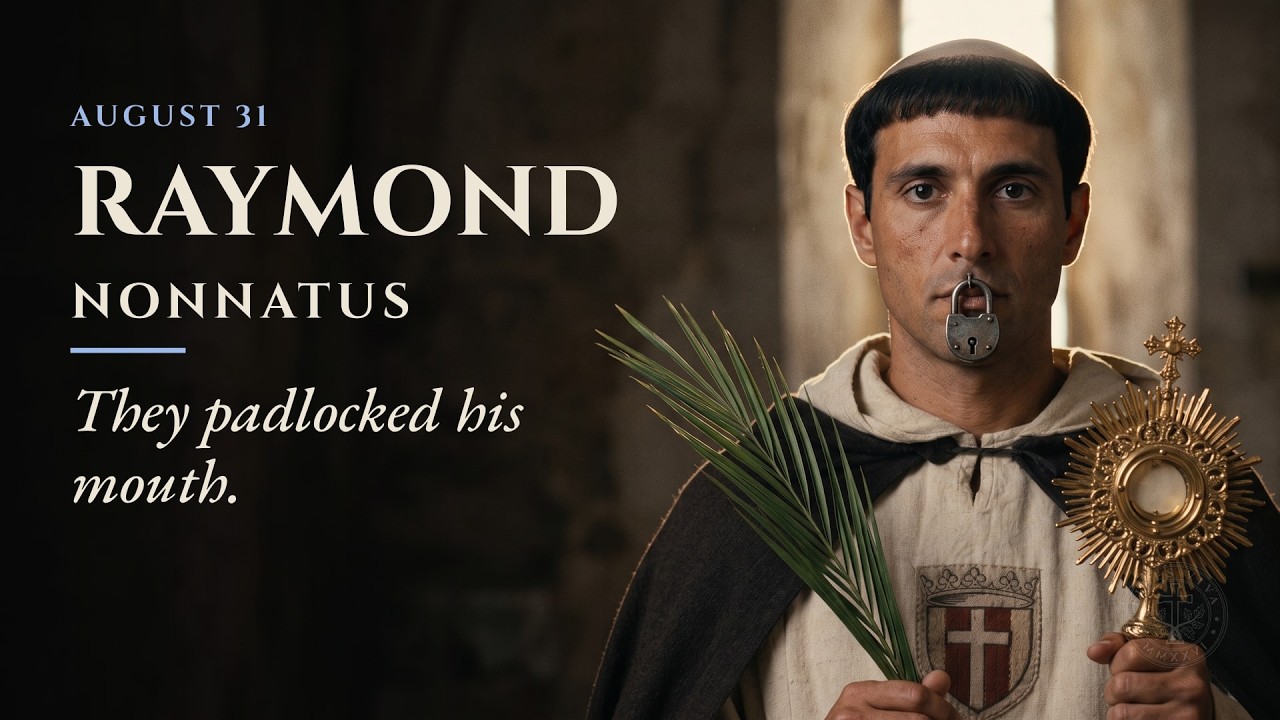
The image holds a monstrance in one hand. And if one looks closely enough, one discovers a detail no other saint bears: the lips, sealed shut with an iron lock.
He was a friar of an order born to buy the freedom of the captive. He left no writings, no sermons, no portraits. He left something else: an impossible name, lips sealed by iron, and centuries of mothers praying at the threshold of life.
The lock and the name come from the same place: a sea where freedom was purchased with coins of silver.
The Child Rescued from Death
In 1218, the Mediterranean was an open wound. Along the coasts of the Crown of Aragon, an unknown sail on the horizon could mean the end of everything: corsair galleys fell upon fishing villages and carried away men, women, and children to sell them in markets on the far shore. Captivity was not a rare misfortune—it was an industry. And parishes gathered coins, alms by alms, bequest by bequest, to buy back their own.
That year, in Barcelona, a man named Peter Nolasco founded an order dedicated entirely to that ransom: the Order of Mercy. He raised it with the backing of King James I and the counsel of a learned jurist, Raymond of Penyafort. His friars wore white and bore on their breast a shield with the cross of Barcelona over the stripes of Aragon. And to the three vows of every religious they added one of their own: the fourth vow of Mercy. If the ransom money ran out, the friar stayed behind himself as a hostage, in place of the captive. It was their way of following Jesus Christ closely, who gave his life as a ransom—with his own body, if need be.
Years before that founding, inland, far from the sea, something had happened that the Order of Mercy would make its own forever. Mercedarian memory holds that it was toward the year 1200, in Portell, a village on the high plain of Segarra. Fields of grain, walls of dry stone, low oaks, an enormous sky. There, a young woman had died carrying a child.
The whole village came to mourn. The house smelled of wax and straw. The dead woman lay on linen, her hands folded and her linen headdress in place; beneath her skirt, the belly at term still rose. The neighbors prayed in low voices. No one thought of the child anymore: where the mother died, what she carried died too. That was the world then, and no one questioned it.
Among those present was the lord of those lands: the Viscount of Cardona. It was he who saw what no one wanted to look at. Beneath the cloth, the dead woman's belly moved.
A different silence fell, deeper than grief. The Viscount drew his dagger. He opened the belly of the dead woman slowly, with the blade, and brought a living child into the light.
The newborn's cry split the mourning in two. In a house prepared for burial, they had to find quickly a clean cloth to wrap a life. The mother never saw him, never named him. The name came from the act itself: they called him Nonat—the unborn one. Because he had not been born as others are born. He had been rescued.
A name like that is not carried as any other. Each time someone spoke it, the boy would hear two things at once: a wound and a debt. The wound of the mother he never knew. And the debt of a life that had been given him by hands not his own, without his asking for it.
The child no one expected lived through the first cold, and grew. The fields and sheep of the dry plain waited for him, along with a chapel of stone where a carved Virgin seemed to be waiting for someone.
The Shepherd and the Silent Promise
This is how Portell remembers it: the father, noble in name but poor in means, set the boy to the humblest work of the house: keeping the flock. While still a child, he was seen across the dry plain—a thin, wiry youth in a tunic of raw wool, a leather satchel at his shoulder, a staff taller than himself. He left with the sheep before the sun broke the horizon and returned when the stones still held the day's heat.
It was a life of hands stained with wool and soil, of hard bread in the satchel, of counting heads at dusk. Work without witnesses and without rest, which teaches a man to be quiet and to be watchful: two things that boy learned for life. He spoke little. He watched closely. And among those fields was a place where his steps returned on their own.
A chapel of golden stone, dedicated to Saint Nicholas, with a single nave and a bell tower cut against the sky. There he would enter when the flock grazed nearby. He would stay on his feet, or on his knees on the stone, with no company but that carved image and the hum of heat outside. No one taught him grand prayers. He learned to speak with the Mother as one speaks with a mother, and through her with her Son, Jesus: in a low voice, with the things of the day, with the long silences of one who has no hurry.
On cold nights he slept beside the sheep, wrapped in his cloak, watching an enormous, clear sky. In Portell no one forgot what was told of him: that his life had been pulled from death, that he breathed on borrowed time. In others, an origin like that becomes shadow. In him it turned slowly into something else, at the pace of the flock: a gratitude he did not yet know how to repay, and a promise without words, made before the Virgin, to keep nothing for himself of a life he had not earned.
What can change the life of a quiet, poor boy who has seen nothing but these fields? Sometimes a word that spreads from mouth to mouth is enough. In Barcelona, meanwhile, friars dressed in white were gathering coins to buy the freedom of the captives. The Order's memory says only that the boy came to knock at their door. The shepherd heard, and something very old in him recognized it as his own. He asked his father's leave. And one day he set down his staff, looked one last time at the chapel, and took the road to the city.
From Flock to White Habit
At the end of the road waited something he had never seen: the sea. Barcelona, around 1222, was a city turned toward the water—galleys moored against the wall, the shouts of stevedores, the smell of salt, tar, fish. For a boy raised among grain and dry stone, it was another world entirely. But he had not come to watch ships. He asked for the friars in white, and someone pointed him toward a house near the harbor, with a hospital beside it and a door always open.
The Order's memory preserves what happened next: he was received by the founder himself, Saint Peter Nolasco, the man who a few years before had given shape to that family of rescuers. One day, in the cloister, before the brothers gathered, the former shepherd knelt and received from his hands the white habit—tunic, scapular, cloak, and on his chest the seal of Mercy, the white cross of Barcelona on red field with the stripes of Aragon. They shaved the crown of his head, the small tonsure of the religious. When he rose, the son of Portell wore the color of those who buy freedom.
The novitiate had two schools, and both were familiar to him. One was prayer: hours in choir, silence, the Eucharist each morning—and in the choir, the same Virgin before whom he had learned to pray in the chapel, now at the center of each day. The other school was harder. The Mercedarians professed a fourth vow that went further than any other commitment in the house: if the ransom money runs out, the friar himself stays behind as a pledge, in surety, until payment arrives. Whoever wore that habit signed with his own body.
His first assignment was the hospital of Saint Eulalia, where the Order sheltered the newly ransomed captives. There the young friar saw up close what freedom cost. Men arriving from Africa with their wrists marked by shackles, skin stretched over bone, the gaze of those who had stopped hoping. He washed their wounds, brought them water, held their heads so they could eat. And above all he listened: names of ports, of dungeons, of companions still waiting their turn.
Beside the beds he also learned the other craft of the house: the art of ransoming. Counting the coins from the alms chests, keeping the lists with the names of the captives, calculating what a man was worth in the markets of the Maghreb coast. And how many parish collections it took to bring him home. Work of patience and numbers, made of the same quiet attention he had learned counting sheep at dusk.
The years passed, and the brothers began to notice that friar who spoke little and never tired. Nolasco grew old; the work of ransom—traveling to captive lands with the ransom gold—called for younger shoulders. And when the house asked who was worthy to succeed the master, all eyes turned toward the same man.
The Scale of Ransom: Giving Until You Give Yourself
The charge came without ceremony: a leather purse, a list of names, and a blessing. Around those years, the former shepherd set out as a ransomer for the Order of Mercy, with a travel cloak over his white habit and the gold of alms tied at his belt. Behind him lay the safety of the cloister. Ahead, the roads south, where James I's campaign over the lands of Valencia was making and unmaking borders. Every incursion, every galley seized, left its harvest of captives.
He learned quickly that ransom was work done at thresholds. It was negotiated in courtyards, at customs posts, in campaign tents: here a father of a family, so much; here a boy, more, because he was young and valuable at the oar. He haggled in a low voice, without hurry, with the patient tenacity of someone who had no intention of leaving without his people. And when the bargain closed, came the moment everything else was for: the shackle opened, the iron falling to the ground, a man touching his wrists and still not believing it.
The caravans returning were his reward. Lines of thin men walking north, still bearing the marks of iron on their skin, learning again to walk without chain. Some wept at the sight of the first bell tower. He went among them, sharing bread, holding up those who faltered. He walked as one who knew his own life, too, had been paid for by another, and not with coins.
But the map of captivity did not end at the border. Across the sea lay Algiers, one of the great markets of men in the Mediterranean. Years later he embarked there with the Order's funds. The city appeared to him from the water as a slope of whitewashed houses, pressed tight against the harbor, blinding under white light. Below, in the baths of captives—courtyards with chains anchored to the wall, high skylights, heat like an oven—many Christians waited for a price.
Weeks of negotiation. One by one he bought freedoms: the gold of alms and legacies turned into fathers returned, into boys torn from the oar. The purse grew thin and the list did not. Each name crossed off left visible those still below—and among them, some who had already waited years for ransom, waiting for a turn that did not always come.
One afternoon he counted what remained and nothing remained. He had before him those he could not afford to buy. He could return to Barcelona, gather more alms, come back in a year—if by then they were still alive, if by then they still believed. Or he could carry through, to the very end, what he had sworn in his profession.
Mercedarian memory never forgot the day when, the money spent, Raymond put himself on the scale. He presented himself to the city's authority. He offered the only wealth left to him: his own person, in pledge, until payment came from Spain for the last of the captives. A friar in pledge was worth the promise of payment that would come from far away. The bargain was accepted. The men on the list boarded a ship for home; he stayed on the dock, watching the sail recede.
He had given all the gold, and then his word, and then his body. Nothing was left to offer—and precisely there, where surrender has no words, the true trial began. Behind him that same night, the dungeon door closed.
The Lock on His Lips
Inside, time was measured differently. Not by days, but by rations: hard bread, a cup of water, the turn of the chains. The heat pressed down from mid-morning and did not release until night; the whitewashed walls threw back the light from the high window like another punishment. There lived men from every port of the Mediterranean: fishermen seized on a beach, rowers defeated at sea, fathers whose families would never gather the price.
As a hostage, he was worth money; but he lived as the others did. He ate what they ate and slept on the same stone. He washed the wounds of shackles, held fevered heads, kept vigil over those who faded. And at night, in a low voice, he did what he had always done: speak of Jesus Christ to those beginning to doubt that anyone, on any shore, still remembered them.
His word did more than the chains allowed. Captives on the edge of renouncing their faith began to pray again; and it is said that there were those who came from the city itself to listen to him. That was no longer charity: it was a crime. A friar could buy Christians, but not win souls among the sons of Islam. He was condemned to be impaled.
The sentence was not carried out. Not from mercy: from calculation. Dead, that friar was worth nothing; alive, he was worth a great ransom, more than any captive in that courtyard. They commuted his death to imprisonment and the lash. The business remained intact.
There remained the problem of his mouth.
Tradition tells what came then, and for centuries it has not been able to tell it without trembling. They pierced his lips with a red-hot iron. Through the two wounds they passed the shackle of a lock. They closed it. And that is how they left him.
Eight months. The man who had crossed the sea to console could no longer speak a name, nor pray aloud, nor give even the smallest word of encouragement. The iron weighed on his face as he slept; the wounds closed badly and opened again. To eat was torment. To speak was simply impossible.
And yet he did not stop preaching. He preached in the only way left to him: by staying. He sat beside the one who wept and did not leave. He put his hand on the shoulder of the one who no longer expected letter or ransom. He looked into their eyes, long and without hurry, and in that gaze the captives found what words do not always carry: the certainty of not being alone. Whoever had Raymond near knew that Christ had not abandoned that courtyard.
The captives learned to read him without voice. A gesture to call to evening prayer. A piece of bread broken and shared, pushed toward the weakest. An inclination of the head that said: hold on. The silence that should have humiliated him became his longest sermon.
In the hours before dawn, before the heat woke, they saw him on his knees against the wall, still, the lock barely gleaming in the darkness. No one heard his prayer. There was no need. They had locked his mouth; they could not lock his faith.
His body, meanwhile, was wasting. His ribs showed through the scraps of his habit; his beard grew thin and uneven around the iron; his back bore the mark of every lash. Each day was the same as the one before. And each day he chose the same thing again: not to curse, not to surrender, not to stop serving with what remained—two hands, two eyes, and a presence that would not turn away from anyone.
Far away, in Barcelona, Peter Nolasco and his brothers gathered the price of his ransom, with the alms that sustained the Order. It took time, but it came, counted coin by coin as he himself had counted so many. It was paid. And one day, without warning, they opened the lock and withdrew the iron.
Freedom did not come all at once: it came with the pain of moving his lips again. The wounds healed slowly and left two round, pale marks in the center of his mouth, one above and one below. He would carry them to the end.
He could have gone home. But a different man came out of that Algiers courtyard. One who knew now that a word can be sealed with iron, and that there is a fidelity no lock can reach. Freedom was paid for; the scars were not. Those would travel with him, in the very center of his face, so that no one would ever forget how much a free man costs.
The Purple and the Return Without Glory
The Order's memory holds that return: in the port of Barcelona, around 1239, a crowd waited for the galley of the redeemers. Each return from Africa brought men back to their own, and the brothers came out to count them one by one, with more relief than words. That time, among the ransomed, came one in a white habit. His brothers embraced him carefully, as one embraces a convalescent. He spoke little and slowly: each word cost him a pull at the wounds still tender in his mouth.
He did not seek rest or recounting. He returned to the cloister, to the hours of prayer, to the sick in the hospital, as if Algiers had been just another journey. But the memory of that friar whose lips they had locked shut with iron did not stay in the cloister: it passed from brother to brother, from convent to convent.
And in Rome there governed Gregory IX, pope of new orders, attentive to the men his age was raising up. Tradition holds what followed: he created him cardinal deacon of Saint Eustace, with orders to present himself in the Eternal City. Of that cardinal title no clear trace remains today in the archives of Rome; the Order of Mercy, however, has never stopped telling it.
The man who had slept on the stone of a dungeon they placed the red mozzetta upon his shoulders, the small cape of the princes of the Church. Beneath it remained the white habit as always. The galero, the great red hat with tassels that marks a cardinal, never came to rest upon his head: an acolyte carried it, as one carries someone else's baggage.
He received the honor as he had received the lashes: without protest and without claiming it as his own. He asked for no retinue, no revenues, no house. The purple was for him one more obedience, another weight placed on a back that already knew what burden felt like. What was his remained elsewhere: in the lists of captives, in the price of ransoms, in the name of Jesus Christ spoken half-aloud beside a pallet.
He obeyed, as always. He prepared the journey to Rome with what he had: the habit, the mozzetta, a handful of companions. He left Barcelona toward the north, by the inland roads he had known since boyhood.
He did not go far. Within a few days' journey, fever caught him on the road, and his companions brought him to the nearest shelter: the castle of Cardona, rising on rock and salt. Rome would remain forever on the other side of that fever.
The Fever at Cardona: Dying on the Way
They gave him a bare chamber high in the fortress: walls of ochre-hued stone, a narrow window where the smell of the salt works drifted in, a pallet, a candle. Cardona. The same name as the viscount who, thirty-six years before, had opened with his dagger the way of his life. Providence seemed to close the circle with a symmetry no one had sought: born by the hand of a Cardona, he came to die beneath the roof of the Cardonas.
The fever rose for days and did not fall again. His companions wiped his brow, moistened his marked lips, prayed by turns beside the pallet. Someone removed the red mozzetta and left it folded on a chest, set to one side, as one sets aside what is no longer needed. Beneath it remained what had always been there: the white habit, now soaked with sweat, and a body worn thin that had been coin, hostage, and offering.
He never complained. Silence was not strange to him: he had lived, it is said, eight months without being able to open his mouth, and had learned there that God is also spoken to without words. But when he understood that death was coming, he asked for the one thing left to receive: the viaticum, the bread of the Eucharist that accompanies the dying in their last passage. And there was no priest in the castle at that hour to give it to him.
Legend tells that then the chamber filled with light. It was Christ himself who came to bring it, surrounded by angels dressed in the white habit of the Order of Mercy. The Lord Jesus, in person, placing communion on those lips twice pierced: once by the iron of Algiers, now by grace. The man who had made himself a ransom for others had no one to ransom him at the end. They came to fetch him.
He died on the thirty-first of August, 1240, without having seen Rome, without having worn the purple, still far from the fields where he had kept sheep. In Portell it is remembered from that time forward that the face, wasted by fever, became serene and luminous, as if death had taken years from him instead of adding them.
The news came down from the fortress to the valley and ran along the roads. And with it came, almost at once, the dispute: the count wanted him in Cardona, the friars in Barcelona, the people of Portell in their own land. Three hands pulling at the same body that in life had given itself without asking for anything.
The Blind Mule and the Return Home
Thus it is remembered in Portell: as none of the three would yield, someone proposed to leave the decision where everything else in that life had always rested—in God's hands. They brought a blind mule, an animal that could not see the road nor find its way on its own. They placed the shrouded body on its back, without reins, without rope, with no one leading it, and they let it go at the castle gates.
The mule began to walk.
It descended the slope without hesitation, as if it could see. It left behind the salt works and the valley, took the paths of the dry plain and went on, day after day, with no one to guide it. Behind it a procession began to grow: the friars, the count's men, peasants who came out of their farmsteads when they saw that animal alone with its white burden. No one dared to touch it. Slowly, all began to understand where it was going.
It crossed the whole region and stopped at last before a door the dead man knew well: the chapel of Saint Nicholas in Portell, where a shepherd boy had prayed alone, long ago, before a simple image of the Virgin. There it bent its legs and fell dead, the burden still intact upon its back. The journey ended exactly where it had all begun.
They buried him there, beside that Virgin of his childhood. The child drawn from a lifeless womb returned to the earth of Portell, beside the house where he had been born; the man who had crossed the sea rested by the fields where he had once tended sheep. No court had decided it. A creature that could not see had decided it.
Very soon the first pilgrims began to arrive: the sick, mothers with children in their arms, people from the dry plain who prayed before the tomb; from those days it is told that many returned home with the grace they had asked for. Over the humble chapel would rise, through the centuries, a great sanctuary. There would begin to hang painted tablets of thanksgiving, the votive offerings that still arrive today. When no one remained who had known him, memory found other hands: it passed from mother to daughter, from birth to birth, from prayer to prayer.
From that village tomb a devotion was to be born that could cross centuries and oceans.
History, Memory, and the Lock of Today
In 1603, in Seville, the painter Alonso Vázquez portrayed him for the cloister of the Order of Mercy in the hardest moment of his life: the friar in white habit, serene, while beside him they prepared the lock. That canvas fixed for all time how the world would see him—not in glory, but on the threshold of silence.
Rome came afterward, step by step. In 1626, Pope Urban VIII beatified him, and two years later formally authorized his veneration; for those celebrations a play was written whose title said it all: "The Saint Who Was Never Born and the Martyr Who Never Died." Alexander VII inscribed his name in the Roman Martyrology in 1657, with his feast on the thirty-first of August, and Clement IX raised him to the altars of the whole Church in 1669. By then, Mercedarian missionaries had already embarked his image across the seas; the friar of the lock crossed the same sea he had crossed in life, and found a home in Mexico, in the Caribbean, in the Andes. Today there are entire towns that hold him as their patron, from the Dominican Republic to the Philippines.
Much later, already in the twentieth century, the archives kept in Rome and in the Order itself returned a surprise. In their pages appears a friar named Raymond Surrons, native of Portell, appointed a redeemer, imprisoned in Algiers, punished with the lock—but a century later, between 1324 and 1338. There are those who read in those papers another time and almost another man; Portell and the Order of Mercy go on calling him, simply, Nonnatus. And at bottom, the archive and memory say the same thing: there was a son of that dry plain who spent his life ransoming captives and, as it has been told since then, paid with his lips the price of continuing to speak of Jesus Christ. The debate moves the dates; it does not move the surrender.
Over the chapel of the blind mule grew, century by century, a monastery so great that the region calls it the Escorial of the Segarra. In 1901 it returned to Mercedarian hands; in 1980 it was declared a monument. Inside, in a shrine, a glass urn holds the recumbent statue of the saint, supported by carved angels, as if suspended above clouds. And in its halls is preserved one of the three votive museums in Catalonia, along with Montserrat and Núria: an entire museum of votive offerings, painted tablets by anonymous hands, centuries of graces for births that ended well, for children who breathed, for mothers who lived to raise them.
Every thirty-first of August, thousands of pilgrims cross the dry plain to its door. That same day, in parishes of Spain and the Americas, women who are expecting a child are blessed. In Mercedarian altars of Spain and the Americas something else happens besides, something no decree commanded: people leave locks. Small ones, of brass, sealed with a key. They are left by those who suffer a false accusation, who were charged without guilt, who ask for strength to hold their tongue when it matters or to speak when it does. Midwives, birth attendants, newborns, the falsely slandered: an entire patronage woven from the threads of his own life.
The child drawn from death still keeps the door of life. Almost eight centuries later, each prayer before his altar repeats in a low voice what he did with his whole body: to take the place of the one who cannot defend himself. The life redeemed goes on redeeming.
When Life Is a Gift: A Final Reflection
The evening returns the color of bread to the dry plain. The shadow of the sanctuary stretches slowly over the fields where a boy once kept sheep, and inside, in the warm dimness of candles, a mother lifts her child in her arms before the image of the friar in white habit. The little one looks at the monstrance, the tiny lock beside the saint's lips. He does not understand yet. Nor does he need to: for centuries, many who prayed here came with nothing more than a painted tablet of thanks, and it was enough.
Over that stillness still hovers the question left open by a solitary chapel: what answer does a life received as an impossible gift give when nothing remains to offer but oneself. He answered it twice, without speaking a single sermon. In Algiers, with the purse empty and the shackles still full, he gave the only thing that remained his own, so that others might go free: his own body. And when iron sealed his mouth, he answered again: with a look, with his hands, with a stubborn gentleness that no lock could close.
There is something in that answer that disarms. A lock on the lips should be a defeat; in him it became his signature. What he could not say in those months of iron he still goes on saying: that the deepest witness does not always need a voice. And it shows where such strength came from. Whoever knows his life was redeemed before he could ask for it does not manage it like a possession: he spends it like a debt of joy, paying it in others.
We too know that threshold, in our own measure. The early morning in a hospital corridor where nothing is left to do but be there; the friend who has fallen apart, past the reach of advice; the work that falls apart overnight and leaves the hands empty. When the money runs out, the words run out, the strength runs out—what do we place on the scale?
He placed the only thing that was his. He stayed.
And so, when night falls over the Segarra and the last candle trembles before his altar, there is no sorrow in this place. The child born of a mother who had died rests, as it is remembered in Portell, in the same earth where as a boy he learned to pray. The debt he carried as his name was paid by an entire life. And the nameless hands that still leave a lock or a painted tablet gather, without knowing it, the fruit of that gift. Nothing has been lost of what that man loved.
Saint Raymond Nonnatus, redeemer of captives, martyr who never died, protector of women in childbirth and of the innocent, pray for us.