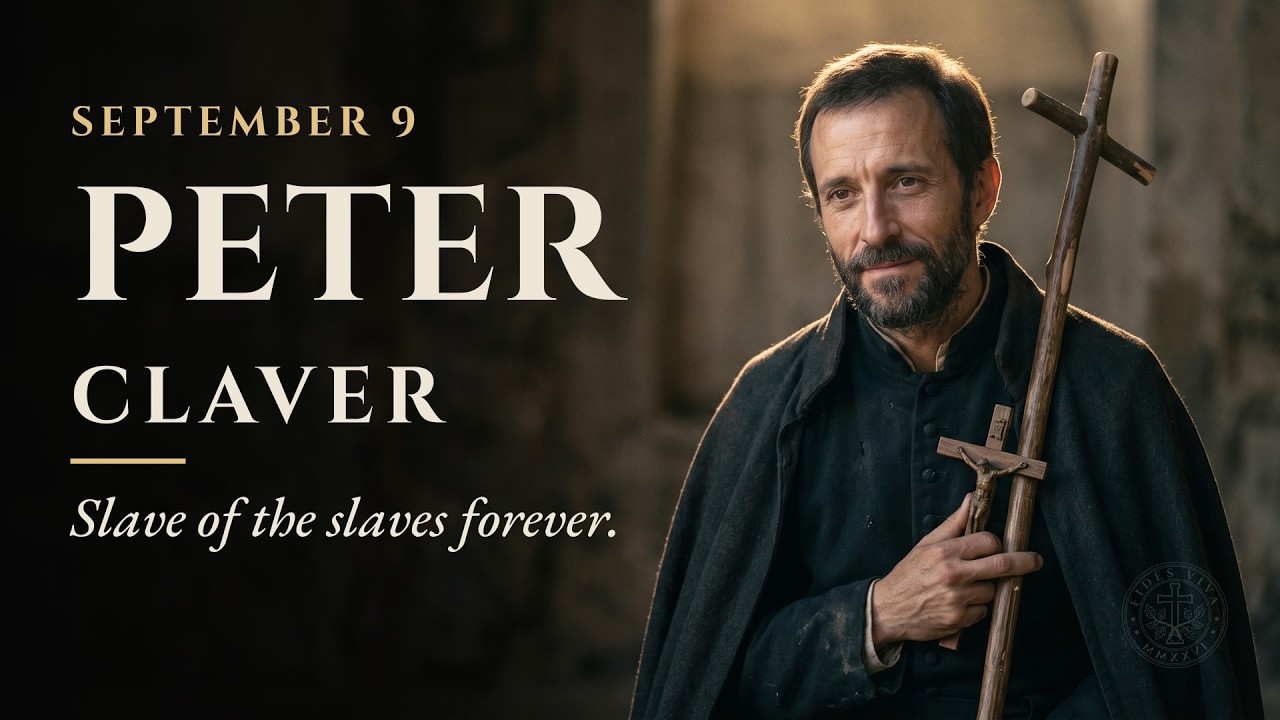
It is hot down there. Heat from wood and bodies, no air. A thin man descends the ladder, his back bent forward, gray at his temples. He crouches—the ceiling won't let him stand. Before him, in the darkness striped by the hatchway, lie bodies, irons, silence. He kneels beside the first one and opens a basket.
And a clay jug of water.
Oranges. Bread. A split lemon. He goes from one to the next, and to each he gives water before speaking a single word. He washes a wound with vinegar. He rests his hand on a burning forehead. Behind him come other men, African too, who know the languages of those lying here. He does not look at those counting the cargo. Only when the water is gone does he begin to speak.
It is the port of Cartagena de Indias, in the Caribbean, at the beginning of the seventeenth century. Here more enslaved Africans disembark than in any other port in Spanish America. The man in the black cassock is a Jesuit priest, Catalan, born across a sea and a world away.
He will climb back up the ladder. When another ship docks, he will descend it again. And another. And another. Forty years. The same dock. The same basket. No one asks him to; almost no one thanks him; many in the city do not even understand him.
What brings a man to choose the last place, and to remain there for a whole life?
A Wounded World and a Quiet Boy
June burns the wheat of the Urgell. In the fields of Verdú, a village of golden stone pressed around its castle and bell tower, the harvest is nearly ready and the air smells of straw and dry earth. It is a land of low horizons, no sea in sight, where the year is measured by rains and by reaping.
Far from here, that same summer, the world is becoming vast and cruel at once. The Hispanic Monarchy gathers beneath a single crown lands from three continents. From Seville, fleets sail toward the Indies. In the holds of other ships, with royal license and the tolerance of many theologians, men and women purchased on the coasts of Africa cross the Atlantic. No news of those ships reaches the fields of Verdú. And nothing yet announces that a boy from this village will spend his life descending into them.
On June 26, 1580, a son is born to a house of prosperous farmers, Pedro Claver and Ana Corberó. The parish custom of baptism records it, though no one keeps the exact day. They carry him to the church of Santa María, and there, with the water that makes him Christian in Christ, he receives his father's name. Pere. Peter Claver. A farmer's name, without coat of arms, spoken in a language of fields.
He grows among vines, almond trees, and grain, in dry land that drinks only when rain comes. The boy learns what the sons of farmers learn: to rise early, to keep silent, to finish what you start. Around twelve years old he passes through the parish school, where a master teaches him to read and write, and the first words of Latin—the language of the Church and of books.
Nothing in all of that foretells a saint. There are no visions in Verdú, no childhood vows, no prodigies in the garden. Those who knew him later summed him up in few words: short on speech and long on deeds, with a seriousness that in a boy almost unsettles. Something like that was already beginning in the boy from Verdú.
He is, besides, scrupulous: one of those who reviews each small fault as though it were grave, and doubts himself before anyone else. He sleeps little. He prays with a wooden rosary. And he keeps silent.
Then comes Barcelona. He goes to study grammar and then arts—what we would call philosophy now—in a city of gray stone, humid, with a port and bells, as different from the dry lands as water from salt. He trades the brown cloth for the black cassock of a student cleric, with cord and cap. At some point in those years he receives the tonsure: a small circle shaved at the crown that marks him as a man of the Church. It is a door half-opened, not a path.
A port brings news. Ships arriving from Italy, from Valencia, from farther still; names of lands no one in Verdú pronounces. The young man in the black cassock hears them, perhaps without giving them thought, while he learns to argue in Latin and to examine his conscience each night with the same care his father once used to review the rows of vines.
Whoever has felt, at twenty, that his life lies elsewhere without knowing where, recognizes this boy. He has no clear calling. He has a restlessness without a name, a seriousness too great for what is asked of him, and hands of a farmer that still do not know what they will serve.
Where does a vocation come from that does not yet dare to speak its name? What is missing for a farmer's son, who has everything close at hand, to feel that his place lies elsewhere? Barcelona does not answer. But at the end of its streets is the sea, and on the other side of the sea, a horizon that no one from his house has ever seen.
The Call at the Gate
On August 7, 1602, in Tarragona, a young man of twenty-two crosses the threshold of a novitiate house, and the door closes behind him. He leaves outside the fields of his father, his name, any future that is not this one. The house belongs to the Society of Jesus—a Jesuit order, still young, founded by Ignatius of Loyola barely sixty years before. Its members—the Jesuits—promise to go wherever the Church sends them, without choosing the place. A farmer's son has just surrendered himself to a house that can send him anywhere.
He trades the student's black cassock for the black cassock of the Society, with a cloth cord and a four-cornered bonnet. He receives the Spiritual Exercises: a month of silence alone with Jesus Christ, going slowly through his own life to know what God wants from it. The scrupulous boy finds there a channel for his seriousness. He sleeps less than the others. He fasts. He examines himself each night. And he continues to be silent.
After the novitiate comes philosophy. And in 1605, an assignment: the college of Montesión, in Palma de Majorca. He boards a ship for the first time. It is a small sea, a night's crossing, with the coast always near; but it is sea. Palma greets him with its golden stone, its whitewashed courtyards, its windows open to blue. At Montesión he studies, fulfills the offices of the house, prays. And each day he passes through the gate.
There is a wooden bench, a ring of keys, and an old man.
His name is Alphonsus Rodriguez. He is seventy-three years old. A merchant from Segovia in his youth, a widower, he entered the Society already old and without formal education, as a lay brother. That duty fell to those who would not be priests and who served in the kitchen, the garden, or the gate. He was given the gate, and he has been opening and closing it for more than thirty years. Nothing more. No one suspects then that this porter prays through entire nights, or what he writes in his notebooks. To the college he is the old man with the keys.
The young Catalan sits beside him. He returns the next day. And the next. No one kept the exact words of those conversations. But what the old man kept repeating to him, always the same thing, with the gentle, patient insistence of one in no hurry: that God was waiting for him in the Indies. On the other side of the ocean. Among people who had never heard of Jesus Christ.
There is no vision. There is no voice in the night, no heaven opening over the cloister. There is a man of seventy-three telling one of twenty-five what he does not dare tell himself. And there is a young man who doubts. Someone who doubts himself by habit does not trust a certainty that comes to him secondhand. Months pass. Perhaps years. The porter does not change his subject. The student does not change his face: he listens, lowers his gaze, returns.
Between 1605 and 1608, the young man who receives the call from another's lips makes it his own. One day he asks his superiors what the old man has been asking of him: the Indies. And the superiors say yes.
An old man on a bench. A young man who does not know how to say no. That is how, without thunder, the course of a whole life is decided.
What moves a timid man to say yes to a call he has not seen or heard, but only received from another's lips?
The horizon, which in Barcelona was a line at the end of the streets, now has a name and a departure date. What it still does not have is an answer to the deeper question: what is God waiting for him to do there? Alphonsus Rodriguez did not say, or did not know. The young man who leaves the gate will have to discover it with his hands.
The Other Side of the Sea
At Sanlúcar de Barrameda, where the Guadalquivir opens into the Atlantic, the ships of the Indies fleet wait for wind on some day that winter of 1610. A Jesuit of twenty-nine boards one of them with what little a Jesuit carries: the cassock, the breviary, a brass crucifix. Behind him lie Seville, and farther back Majorca, and farther still Verdú, with its fields and its farmhouse. Pedro Claver will never set foot on any of those places again. The sea he knew was the Mediterranean, with the shore always near. This one has no shore.
Weeks of ocean. The heat climbs each day. The bread hardens, the water in the barrels turns cloudy, bodies crowd below deck. And he travels as a free man. Other vessels arrive at the same port from the African coast, their holds full of people no one asked if they wanted to board.
April of 1610. Cartagena de Indias.
Heat reaches him before the city does: humid, heavy, smelling of tar, salt, and something he cannot name. Walls of coral stone close off a bay full of masts. On the dock, winches, barrels, merchants shouting. And a crowd like nothing he has ever seen: Spaniards in doublet and sword, indigenous people, mulattoes, and African men and women just lowered from another ship, nearly naked, with irons at their ankles and the brand of fire on their chest. The city is the gateway to the New Kingdom of Granada—the region that is Colombia today, governed then from Santa Fe and subject to the distant viceroy of Peru. It is also the largest port of entry for enslaved Africans in all of Spanish America. That same year an Inquisition tribunal opens here. Walls, commerce, and fear.
The young man from Verdú looks. He does not yet know what to do with what he sees. And he moves on, because his studies are not yet finished.
He goes up into the interior, to Santa Fe de Bogotá, more than two thousand meters high, and then to Tunja. There he studies theology: years of classrooms, Latin, debates. His body pays the price of acclimation. Tertian fevers, the kind that return every three days, leave him emaciated, his face even more angular and sharp. He studies with fever. He prays with fever. He does not complain.
Around 1615 he comes back down to Cartagena. And in the college of the Society he finds a man who has already done what he could not do at the dock: stay.
His name is Alonso de Sandoval. He was born in Seville, grew up in Peru, is around forty years old. For some time now he has been going down to the port each time a ship arrives from Africa. He has learned things that no classroom teaches. That the newly arrived are not one people, but many: Angolans, Biafara people, Wolof, Folupo people, with languages and customs of their own. That you must find interpreters who speak those languages. That you cannot baptize anyone without explaining first, in their own tongue, what they are receiving. And that before catechesis comes healing, food, drink. Sandoval asks the captives about their lands and their kings, and keeps those pages for a book that will take years to publish. To the newly arrived he teaches the method without speeches: by walking at his side down into the hold.
Claver learns in silence, as he did at Montesión: again an older man shows him the way, now with a ladder that smells of sickness.
On March 19, 1616, the feast of Saint Joseph, a young man lies face down on the floor of a church in Cartagena while the litany of the saints is sung. A bishop lays hands on him. He anoints his palms with oil, binds them, gives him the chalice with wine and the paten with the host. He rises a priest. He is thirty-five years old.
At his first Mass, in a damask chasuble of a poor college, a farmer's large hands lift the bread that is the body of Christ. Those are the same hands that will soon wash wounds in the darkness of a ship. He does not know yet how much. He knows what he saw at the dock, he knows what Sandoval has shown him, and he knows that none of it is enough. One man, facing a line of ships that does not stop arriving.
How does one answer such great suffering with hands so alone?
For now, by watching. And by staying silent. What matters most is still to be decided.
A Vow Forever
What matters most begins with the small. From 1616 on, when a sail is spotted in the bay announcing a ship from Africa, the new priest no longer stands idle at the dock. He goes out with Sandoval. And soon he goes alone, with the method learned from his teacher and with two legs he has no intention of sparing.
Before he goes down, he prepares. He wants to know the news before anyone else, and he offers a Mass to whoever brings it to him. He asks what nation the ship carries: if they are Angolans, if they are Biafara people, if they come from the rivers of Guinea. He walks through Cartagena looking for someone who speaks that language: African men who arrived years before and already understand Spanish. Some of them the college buys so they will live under its roof and be ready when needed. He fills baskets: plantains, oranges, lemons, bread. He loads clay jars with water. Then, only then, he goes down.
Sandoval's method becomes his habit. But there is a difference his companions at the college begin to notice. Sandoval studies the newly arrived: he wants to understand them, write about them, show the theologians of Seville what the traders do. Claver writes almost nothing. He bends down. He washes. He distributes. When the day's work ends, he goes back to the church and stays on his knees until late.
Six years like that. Six years of ships, baskets, and ladders. And then the day comes to say with a signature what his hands already do.
April 3, 1622. In the college church, during Mass, before Communion, Peter Claver makes his solemn profession: the final vows of a Jesuit. Poverty, chastity, obedience, and a fourth vow unique to the Society of Jesus: to go wherever the Pope sends him. He is forty-one years old. He has been in Cartagena for twelve years. In his hands is a paper with the formula written in his own hand, which he must give to his superior.
At the foot of the paper he signs his name. And adds three words in Latin.
Petrus Claver, aethiopum semper servus. Peter Claver, slave of the Ethiopians forever. Ethiopians: that is what the Church called all Africans then, without distinction of coast or nation. Slave: the word that at the dock of Cartagena is bought and sold. Forever: with no expiration.
There is no new habit and no added ceremony. The cassock is the same as yesterday, with the patch on the sleeve. Only a quiet man who writes a phrase and leaves it on the altar. But that phrase holds every door he has just closed. He has chosen, for Christ, the last place in the city, and has chosen never to leave it.
Whoever has signed something once that could not be undone—a marriage, a debt, a promise made beside a bed—knows what a signature weighs. This one weighs differently: it binds a free man to the people the city binds with chains.
What does it mean to choose to be slave of the slaves, not by a chain from outside, but by free vow? He does not explain it. The next day, if there is a ship, he goes down. And from that April morning his life has no other horizon than the dock: the same ladder, the same basket, the same habit, ship after ship.
Forty Years on the Same Dock
It is hot down there. A heat of wood and bodies, without air. One of the interpreters lights the censer as soon as he steps on the last plank. Light comes in stripes through the hatch and falls on bodies lying down, shoulder to shoulder, on damp wood. Chains. Dirty water in the corners. Men, women, and children who have spent weeks at sea without seeing sky. Some no longer move.
Peter Claver crawls forward. There is no other way. He touches an ankle with his hand, a forehead, looking for those burning with fever. Behind him, with the baskets, come Andrés Sacabuche, an Angolan; Ignacio Soso; Francisco Yolofo, from the rivers of Guinea; Domingo Folupo; José Monzola; Manuel Biáfara. Each one speaks the language of a different nation. One of them, whom they call Calepino at the college, understands eleven languages. Without them, the Catalan priest would be a mute man in the dark.
Water comes first. A clay jar that passes from mouth to mouth, slowly, holding up the head of whoever cannot lift it. Then what is in the baskets: plantains, oranges, lemons cut in half for the thirst, bread, ship's biscuit. A swallow of wine or brandy for the one who trembles, tobacco for the one who asks. Vinegar to wash. Strips of linen for the sores the iron has opened at the ankles. No one speaks of God yet. The interpreters say, in Angolan, in Wolof, in Biafara, the only thing that can be said: that they have not come to do harm. That this thin man wants them to drink.
He always keeps the cape over his arm, and it rarely comes back to the college in the same place. If a woman has arrived with nothing to cover herself, the priest's black cape is the first thing that covers her. If a sick man has nowhere to rest his head, the cape is folded and becomes a pillow. And if someone is dying in the hold, Claver wraps him in it. He carries him on his back, with help from an interpreter, and climbs the ladder to take him to the hospital. One garment, given so many times.
Only when the bodies have rested, when they no longer cry out from thirst or fever, does the word begin. And it begins with the fingers.
In the college courtyard, under an awning, he seats the newly arrived in rows. He takes the right hand of one of them and joins the thumb and index finger. He teaches him to bring that small cross to the forehead, to the mouth, to the chest. And he waits. He moves to the next. He comes back to the first, who has done it wrong, and corrects. He can spend an hour on that single gesture alone, going through three hundred, four hundred, one by one. Andrés Sacabuche translates each word, and also the silences. After will come the Our Father, the Hail Mary, the Creed. But first, the cross done right, because in that gesture everything he is going to tell them fits: that a God let himself be nailed to a cross for each one of them, and that God has a name, Jesus Christ, and that name is for them too.
An hour for a gesture. In a port where each one has been counted as a piece of cargo, someone stops in front of his right hand until it moves correctly. That, more than any sermon, is what they understand.
Then comes baptism. Standing or kneeling, in the courtyard or in the nave of the church, with a clay jar that he pours over the head while he speaks the words in Latin. Each one receives a Christian name and a godparent: an African who arrived years before, already Christian, who will extend his hand to him in the city. A name and a godparent.
From May 31, 1627, there survives a letter of his, written to his superior at the end of one of those days. It is almost the only thing at length he left in writing, and the Church still reads it every year on the saint's feast. He tells how he went down with two baskets of oranges, lemons, sweets, and ship's biscuit to a cargo of the sick just landed, and distributed them among those lying on the floor, stretched out and without strength. And how, when they had eaten and drunk, he spoke to them, with the interpreters, of God's love and of baptism. That same year, in Seville, Sandoval was publishing his great treatise on Africans and the slave trade. The teacher was printing a book. The student was writing a letter about oranges.
(on-screen: "De instauranda Aethiopum salute, Sevilla, 1627")
Not all his day is at the dock. When there is no ship, he goes up to the Hospital of Saint Lazarus, the lazaretto where the city locks away the lepers so as not to see them. He washes their wounds with his bare hands. He shows them a small brass crucifix and speaks to them of Christ, who touched lepers. He goes down to the jails, stone cells with shackles on the wall, and sits with the prisoners. When there is a condemned man, he spends the last night with him, and in the morning walks with him to the gallows. No one is obliged to be there. He is.
And once a year he leaves the city. He goes out with his wide-brimmed hat and saddlebags on his shoulder along the red-earth roads toward Turbaco and the savannas, where the estates are, the sugar mills with their presses, the mines. There live the Africans who were already sold at the dock and of whom no one heard again. He goes back to find them. He looks for the Africans where they work, near the palm huts. He hears confessions, baptizes the children, marries couples who live together without anyone having married them. When the afternoon rain falls hard, he waits under a roof of leaves and keeps going. The red-earth roads wear out his shoes, and the following season he goes out again.
Cartagena watches him, and not always favorably. When he opens the confessional, the ones who line up first are the Africans. The lords of the city, with their doublet, their white collar and their sword at the belt, have to wait behind, in the same nave, until the last slave is done. No one protests out loud. But there is murmuring. They reproach him for filling the college church with slaves and the smell of the hold. For baptizing too quickly. For treating his interpreters with a fondness that does not match their station. More than once within his own house there is someone who half understands him: the college puts the interpreters to other tasks, and it takes a letter from the General of the Society writing from Rome to get them back. Claver does not argue. He keeps hearing confessions in the same order.
In 1633 smallpox enters the city. The sick multiply in the houses, in the hospitals, in the barracks at the dock, and fear empties the streets. Claver does what he always does, but without rest: from one house to another, from one bed to another, washing, giving to drink, hearing confessions. The companions the college assigns to accompany him cannot keep his pace. One falls exhausted, and another takes his place. The second falls, and a third comes. He stays on his feet, with the cassock soaked, until the plague withdraws in 1634. He is fifty-four years old. The whole city has seen him, and for a time it stops murmuring.
Where does that body draw what it spends? Those who live with him know part of it. He sleeps little. He fasts almost always. When the house goes to bed, he goes back to the church and stays on his knees before the crucifix and before the Blessed Sacrament, sometimes until dawn. Brother Nicolás González, a lay brother from Plasencia, went with him to the dock and the hospitals for twenty-two years, and knew what hour he went to bed and what hour he came back to the church.
Those who saw him pray at night told later, under oath, things they did not dare say out loud while he lived. That sometimes he would become so absorbed he would not hear if they called him. That his body, at times, seemed to lift from the ground; so declared one of his interpreters, Domingo Folupo. That he knew a ship was coming before anyone had seen it in the bay. He, meanwhile, never spoke of any of that. He spoke of the jar of water and the cross done right.
The memory from the process also held a number: three hundred thousand baptized in those years. No one kept a register; it is the number given by the one who went with him and who wanted to sum up in something what could not be counted. But the number says less than the method. Three hundred thousand, for him, were never a crowd. They were one, and another, and another still, each one with his right hand in front of his face, learning to make the cross.
So the years pass. Sixteen thirty, sixteen forty. His hair turns white at the temples, his back bends a little more, his hands fill with small scars from washing sores and burning himself on the censer. But every time a sail shows in the bay from Africa, someone runs to the college to tell him, and he takes the basket.
Forty years. The same dock, the same ladder, the same clay jar. None of those days was different from the one before, and none was easier. How does such a self-giving sustain itself, day after day, among murmurs, exhaustion, and sleepless nights? Where does the one who gave away even the cape on his back find strength?
The body, for now, holds. But the body is seventy years old, and the misunderstanding and exhaustion have been building up in it like salt in wood. There is a question no one in the college asks yet out loud: what will become of this man the day he can no longer go down to the dock.
The Silence of the Cell
In 1650 the answer comes by itself, with another plague. The city fills again with the sick and he goes out again with the jar and the bandages, as in the years of smallpox. But this time the contagion does not stop at the college door. One morning he cannot get up. He is seventy years old. The fever leaves his right side shaking and his legs rigid, and when the worst passes, the shaking stays. The hands that washed sores no longer grip a bowl steadily. The mouth that taught so many to say the name of Jesus now forms words with effort. There is no recovery: what has broken does not mend.
They leave him in his room. It is the same as always, a small dark room built on the wall next to the college gate; one of his interpreters called it "the worst of them all." He had chosen it years before, and not only for penance: from there you could go out into the street at any hour, day or night, without waking anyone. And when someone came to tell him of a ship, the basket was two steps from the door. The door is still there. He cannot cross it now.
Four years. The bed of boards, a small table with an old rosary and a book he cannot hold, the crucifix hanging where he can see it. From the bed, the college can be heard: footsteps, the bell, the gate opening and closing. And when the wind comes off the bay, the port can be heard.
The college assigns a servant to care for him. He cares for him badly. There are days when the food comes late, or does not come, and he cannot eat alone. There are weeks when no one washes him. The beard, white, grows for two or three days without anyone to shave it; on his back sores open from lying in the same position so long. The cape, the black mantle that for forty years had covered others, is not in the room. He gave it away. What is left him is a brown blanket.
And he does not complain. Not to the servant, not to the superior, not to those who pass by the door. Those who were near told later, under oath, that they never heard him speak a single reproach.
It is hard to look at him. The one who carried the dying on his back down a ladder lies now at the mercy of hands in a hurry. The one who held so many heads so they could drink waits for someone to bring him a jar. What he fought in the hold—a body left in a corner like a bundle—he receives now in his own flesh, silent.
Whoever has cared for an old person, or has come to be one, knows what that silence weighs. To be washed late. To eat from a hand that wants to finish quickly. To have nothing left to give, only the patience to receive.
There, in the bed of boards, is his last descent to the dock. The vow said "forever," and forever does not end in 1650. He cannot serve anyone now with his hands; what is left him is to let himself be served badly, his eyes on the Christ on the wall, and ask for nothing else.
Meanwhile, Cartagena goes on with its business. Ships arrive. Others go down into the hold. In the street no one asks anymore about the thin priest with the basket. The city that murmured about him for forty years has done something harder than murmur: it has forgotten him.
What remains when there is nothing left to give with one's hands? In the dark room next to the gate, no one is watching. But that city still has an account to settle with him.
The Death and Recognition
It is September 8, 1654. In Cartagena the bells ring for the Nativity of the Virgin. In the room next to the gate, a man of seventy-four years barely responds now, and Brother Nicolás González, who has tended him for twenty-two years, enters and leaves that room. He knows him well: he went down with him to the dock, carried baskets and the dying with him. Now he can only stay near and wait.
The breath grows short. Before the bed still hangs the crucifix, the same Christ he had held close to so many of the dying in the hold so they would look at him before they left. Now it is he who looks at it.
And he goes out. Without cries, without a city at the door. He dies as he lived the last four years: silent, among few.
What happens after, Brother Nicolás González himself would tell years later, under oath, in the process opened by the Church. That pale, sunken face, the face of a sick man forgotten in a corner, changed. A serenity and a beauty no one expected settled on it, as if the four years in that cell had lifted all at once.
They dress him in the cassock, the alb, and the priestly vestments, and cross his hands over a crucifix. They carry him to the college church, lay him between yellow wax candles, on a black cloth, and sing the Mass for the Dead over him.
Then the city remembers. All at once.
The news goes down to the dock and up to the great houses at the same speed, and the church fills to the door. They come—the Africans from the houses and the estates, the free and those who are not, in their linen shirts; they come—the interpreters who knew him; they come—the gentlemen in doublet and white collar and the ladies in mantillas. No one orders the line. For once, in Cartagena, there are no first and no last.
And they step forward to the body, and they cut. A strip from the sleeve, a piece from the collar, a length from the hem. They take it home hidden as if it were something sacred. Of the habit they dressed him in for burial, little remains.
In the days that follow, the Cabildo of the city, its civil government, and the cathedral chapter, its canons, order that information be gathered at once about his life and his virtues. They ask those who saw him work to declare before a notary, under oath. The city that had reproached him for filling the church with slaves now asks that everything be written down before it is forgotten. Cartagena calls Peter Claver a saint long before Rome does.
That recognition came late. But it came whole. And from that week on, what was a habit of forty years—a basket, a jar, a ladder—begins to be something else: something a city decides to remember.
A Legacy Beyond the Dock
Rome takes almost two centuries to speak the same word. On July 16, 1850, Pius IX declares him blessed. And on January 15, 1888, in Rome, Leo XIII inscribes him in the catalog of saints. That morning three names are read in succession. John Berchmans, a young Flemish Jesuit scholar who died in youth. Peter Claver. And Alphonsus Rodriguez, the porter brother from Majorca who in a bench at Montesión had repeated to a timid young man that his place was on the other side of the sea. The old man and the young man from the gate enter through the same door on the same day.
Cartagena had already moved ahead. In 1884 Bishop Eugenio Biffi brings from Italy a new marble altar for the old college church. On it is set a sculpture by Vittorio de Montarsolo: an elderly priest, bent forward, as the city remembered him. After 1888, Leo XIII himself sends the gift that closes the circle. A gilded bronze and crystal reliquary. The remains come out of the chapel where they had rested and are placed beneath that altar. The man who baptized with an earthen jar now rests beneath the altar where the Body of Christ is consecrated.
The name begins to travel. The shrine preserves the memory that in 1896 the same Pope declared him patron of the missions among Africans. Two years before, a European religious woman, the Blessed Maria Theresia Ledóchowska, had founded a missionary association in Europe for Africa and placed it under his name. The slave of a port becomes patron of a continent.
The temple changes too. In 1921 they give it a new dome, the work of Gaston Lelarge, which from then on is seen from the sea, above the rooftops. And in 1985 Colombia does something no seventeenth-century kingdom would have understood: by Law 95 of 1985, Cartagena becomes the seat of Human Rights, with the shrine as its house and Peter Claver as its patron. The basket, the jar, and the cape have a new name now, a name of our time, but they point to the same gesture.
Two popes come to see him. On July 6, 1986, John Paul II stops to pray before the reliquary. Thirty-one years later, on September 10, 2017, Pope Francis does the same and prays the Angelus before the crowded square: "Here, in the Shrine of Saint Peter Claver, today God's Word speaks to us of forgiveness, correction, community, and prayer." And in 2022 new light falls on the restored reliquary. A few steps away, in the cloister, the cell still stands next to the gate, with its narrow bed and small table, and a room preserves the names of Andrés Sacabuche, Ignacio Soso, Francisco Yolofo, and the others—the interpreters—so they will not become a faceless crowd again.
Every September 9 the city prays the novena, fills the nave, blesses the workers of the port, and leaves flowers before the bronze. And in 2026 Pope Leo XIV publishes his first encyclical, on human dignity threatened by new forms of dehumanization, in an age of machines that learn to speak. (on-screen: "Magnifica humanitas, May 25, 2026"). Four centuries separate that text from a ladder in the dark, and the question is the same: how a face is recognized where once only cargo was seen.
They keep coming. Those who carry a sick person at home, those who bear work no one sees, those who have lost their name in a line. They stop before the glass and do not ask for great miracles. They ask for what he gave. A little water. A garment. Someone who bends down.
And the question that one day went down with him into the hold is no longer Cartagena's alone.
When the Gesture Rests in Our Hands
What leads someone to choose the last place for forty years. He never answered with words. He answered each time a sail appeared in the bay and he went out with the basket. Each time he took off his cape and stayed in his black cassock under the sun. He answered with three words signed in 1622: slave of the Ethiopians forever, of those no one wanted to touch, for the sake of Jesus Christ.
We have a hold nearby too. It is the neighbor who no longer leaves the house. It is the cashier no one looks in the eye. It is the message from someone who is suffering, the one we have not answered for days. When that sail appears, do we go down?
He went down. Ship after ship, until his legs would no longer answer.
Today, beneath the marble altar, behind the glass and the gilded bronze, a body worn thin from so much bending rests. Above it, on that altar, the Eucharist is still celebrated. The gesture that began with a jar of water still stands.
Saint Peter Claver, slave of the slaves, apostle of Cartagena, patron of human rights and of the missions among Africans, pray for us.