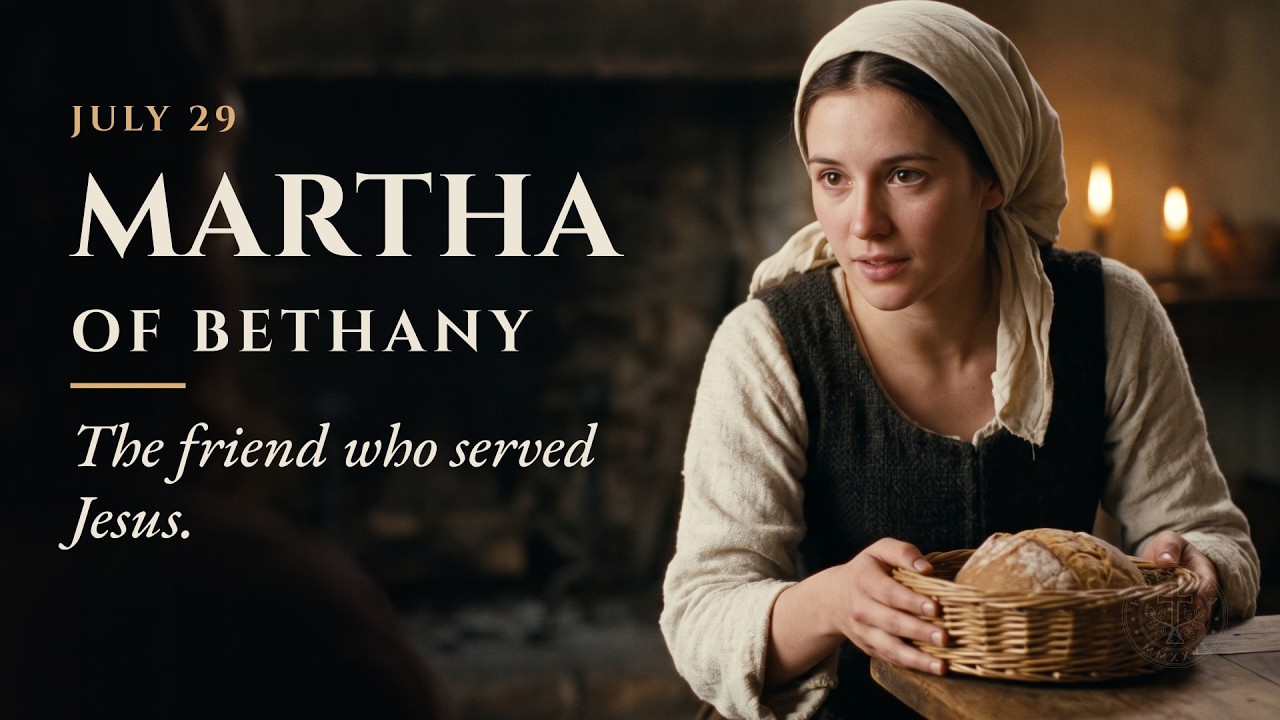
A woman in mourning, alone on a dusty road. Her brother has lain buried for four days. Before her stands the friend who came too late. And a question that asks for all her faith: "Do you believe this?" She is about to answer.
The House Where the Lord Rested
The world she lived in smelled of dust, bread, and olive oil. Judea lived under the rule of Rome: a prefect governed from Caesarea, his soldiers patrolled the roads, and tax collectors gathered the emperor's tribute in every village. In Jerusalem, the Temple Herod had built shone like a mountain of golden stone. In its shadow grew the tension between the powerful men of the sanctuary and a weary people, waiting for their God. In the middle of that waiting survived an ancient duty, almost sacred: opening the door to whoever came, offering water, bread, and shade. Hospitality was not courtesy. It was a form of faith.
Three kilometers east of Jerusalem, on the eastern slope of the Mount of Olives, a village of cube-shaped houses in pale limestone huddled together: Bethany. Along its walls ran the dusty road that climbed from Jericho toward the holy city. Around it, olive trees, fig trees, and almonds; beyond, the Judean Desert trembling under the sun. There lived a woman named Martha.
Of her childhood almost nothing remains: the village, the echo of a well-off family, a house that in time would become hers. That house we can see: a courtyard with a clay oven and jars of cool water, a room of mats and low tables. Oil lamps on the walls, a stairway climbing to the rooftop. The smell of fresh bread, of firewood, of figs drying in the sun. And at the center of it all, holding it all together, she stood.
Iron keys hung at her waist: the sign that the house was hers, and that she ran it. In that world, a woman recognized as head of a household was a rare thing; it took a strong will, and she had one to spare. She was a little past thirty, her skin olive-toned and warm from work between the courtyard and the well. Her hands were rough and reddened from the kitchen; her step was firm, the step of someone who did not wait for others to solve things. With her lived her two siblings: Mary, the youngest, gentle in her gestures and quiet in her gaze; and Lazarus, loved throughout the village.
Her door stood open to whoever arrived. She kneaded bread before dawn, drew water, lit the oven, set the table again and again. She served until she was worn thin, with that mix of love and exhaustion known to anyone who carries a household on their shoulders. No one called her a saint then. She was, simply, the woman who held the home together.
And yet, of this house the Gospel will say something it says of no other: "Jesus loved Martha and her sister and Lazarus." One single sentence, and inside it fits an entire home. For the Master from Galilee, who had nowhere to lay his head, found in Bethany a table set, a friendly roof, three faces waiting for him. When he came down to Jerusalem, with suspicion around the Temple growing, it was there he took refuge. Bethany was the house where the Lord rested.
One day, a guest who would change everything would knock at that door. And his first visit, the one the world still remembers, did not begin with a wonder, but with something far smaller and far more familiar: an argument between two sisters. One evening, the road brought footsteps she knew. The door opened — and with the guest came the scene that would mark Martha's name forever.
Martha, Martha
Jesus crossed the threshold, and the whole house sprang into motion. Martha welcomed him the only way she knew: by doing. Water for dusty feet, wood for the oven, the finest flour, the wine kept for special occasions. With the Master came disciples, voices, the hunger of the road; and every guest was, to her, a sacred debt paid with her own hands. She pulled up her sleeves, tightened her sash, and vanished between the courtyard and the storeroom. Her veil slipped loose in the rush; the heat of the oven pressed loose strands to her forehead. No one asked so much of her. She demanded it of herself.
Mary, instead, did something her sister must have found an impossible luxury: she sat down. She sat on the floor, at Jesus' feet, the way disciples sat before their teacher, and stayed there listening to his word. Still. Whole. As if the bread could wait. In the warm dim of the room, two sisters and two worlds: one motionless, drinking in every word; the other crossing back and forth, again and again, with jug and tray.
Each trip between the oven and the table weighed on her a little more. It was not only tiredness. It was that quiet wound known to anyone who cares for others and goes unseen: loving much, working much, and feeling that no one notices. Until the complaint, slow-brewed, broke out in front of everyone. She did not scold her sister in some corner. She went straight to the Master, with the bluntness of someone who knows she is his friend: "Lord, do you not care that my sister has left me to serve alone?"
For a moment, the room fell silent. Her complaint, as mistress of the house, hung in the air, in front of the guest. And Jesus looked at her. Not with the look of a judge, but with that of a friend who sees deeper. Then he spoke her name. Twice.
"Martha, Martha, you are anxious and troubled about many things; one thing is needful. Mary has chosen the good portion, which shall not be taken away from her."
In Scripture, being called twice by name is not rebuke — it is election: this was how God called Abraham, and Samuel; this was how Jesus would call Simon. Pure tenderness, that insistence of someone who loves and wants to be heard. Before correcting her, the Lord named her the way the chosen are named.
And the correction was not the one she feared. Jesus did not condemn her service; he did not say the table did not matter, or that the bread made no difference. He did not take away her apron: he set her heart in order. The problem was not doing, but doing it divided: anxious, scattered over many things, love turned into a debt to be collected. Mary had chosen the one thing that cannot be served on a tray: listening to the one seated in her house. And that portion, the Lord said, would not be taken from her.
We do not know what Martha did in that moment; the Gospel is silent. But no one who receives a correction like that, spoken by a friend, calling her by name, forgets it. Something was planted that afternoon: a question working within her, between the oven and the water jars. What was that one necessary thing, beneath her many things? The answer would not come in the kitchen, nor on some other quiet visit. It would come by the hardest road a house can cross.
Time passed. The same house, the same table, the same coming and going of Martha with the keys at her waist. Until one morning the familiar rhythm stopped short: Lazarus, her brother, burned with fever and could not rise. Over the house of Bethany fell its first shadow.
He Whom You Love Is Ill
The fever would not break. Martha fought it the way she fought everything: boiling water, changing cloths, keeping watch night after night beside her brother's bed. But this time her hands — the ones that held up the whole house — were not enough. And both sisters thought of the same name at once. They sent word to Jesus, a message short enough to fit in a single breath: "Lord, he whom you love is ill." Nothing more. No detailed plea, no instructions. Just the wound laid before a friend, certain that love would know what to do.
The messenger set out, and in the house the waiting began. Martha knew that road by heart: the Master had come down it so many times, carrying the dust of the road and the hunger of a long journey. Now she watched it from the threshold, again and again, straining to hear footsteps that never came. One day passed. Then another. For Martha it was the hardest waiting she had ever known: to have asked help from someone she loved, and to receive nothing back but silence. The fever climbed, the village held its breath, and the horizon stayed empty. The one who loved them did not come.
Lazarus died without seeing his friend again. The house that had fed so many filled with weeping. They wrapped him in linen and carried him, that same afternoon, to the edge of the village, to a tomb cut into the limestone rock. A stone sealed the entrance. And the dull thud of the stone settling into place was, for Martha, the sound of a world left without an answer.
From Jerusalem, less than an hour's walk away, many came to console the sisters. The house of hospitality filled with people again, but this time in reverse: now others brought the bread, and Martha received the comfort. Though how to receive it, she did not fully know. With her mourning veil drawn shut over her face, she stayed on her feet, greeting every visitor, steady as the beam that holds up a roof. Four sleepless nights had reddened her eyes and hollowed her face; her will, they had not touched.
Inside, it was another matter. Inside, one phrase had circled in her mind since the first night, still without a voice. The message had not lied: he whom you love. Then why the silence, why the empty road, why four days? Because it was four now. Four days in a tomb is certainty without a crack in it: no one mistakes that sleep, no one expects it to break. Grief had settled into Bethany the way winter settles in: to stay.
Then, on the fourth day, a murmur crossed the courtyard. Someone was coming down the road from Jericho. The Master was near; he was already entering the village. Mary stayed seated in the house, among the women in mourning. Martha did not. She pulled away from the visitors, crossed the courtyard, pushed open the door, and walked out alone onto the road, carrying everything inside her. Four days of questions went with her, searching at last for someone to tell them to.
Even Now I Know
She saw him from a distance, at the edge of the village, where the road narrows between the olive trees. He was walking, dust from the road on his sandals, his disciples around him. He was the friend of so many suppers, the guest at her table. And he was also the one who had not come in time. She walked toward him without slowing her pace, and when she reached him, for a moment, no one spoke.
Then she said what had been gnawing at her soul for four days. Not a greeting, not a formula of condolence. The truth, whole: "Lord, if you had been here, my brother would not have died." It was the reproach she had carried since the burial, spoken aloud at last. If you had come sooner. If the silence had not lasted so long. She said it to his face, with the same bluntness that once made her complain about her sister by the oven.
But in her mouth the reproach did not travel alone. Before the wound finished speaking, hope was already speaking too: "But even now I know that whatever you ask from God, God will give you." Even now. With her brother four days under the stone. With every sign pointing the other way. She did not understand the delay, did not understand the silence; and still she would not let go of his hand. Her faith did not rest on what she understood: it rested on who he was.
Jesus told her that her brother would rise again. She answered as one repeats what she learned as a child: yes, at the resurrection on the last day. She believed it truly. But it was a distant comfort, a horizon at the end of time, as far from the fresh grave as the sky above that noon. She was expecting a promise. She was about to receive far more.
Then he looked at her. And he spoke words he had said to no one else: "I am the resurrection and the life; he who believes in me, though he die, yet shall he live, and whoever lives and believes in me shall never die." He did not announce it in the Temple, before the teachers of the Law. He did not entrust it to the Twelve gathered in secret. He said it on a dusty road, to a grieving woman with reddened eyes. The resurrection was no longer a distant date: it stood before her, breathing, with a name. And then came the question that asked for everything: "Do you believe this?"
No miracle yet. The stone still in place. The tomb sealed, four days of death standing between the question and any proof. No one had seen anything; no one could promise her anything her eyes could confirm. To believe, in that instant, was to lean over the void with empty hands, with nothing to hold on to but the face in front of her.
And she answered: "Yes, Lord; I believe that you are the Christ, the Son of God, who is coming into the world."
One of the highest confessions of faith in the whole Gospel had just been spoken on a village road, from the mouth of a woman with a broken heart. Peter had said matching words at Caesarea Philippi, and on that faith the Church would be built. Martha's was born in grief, with her brother's tomb still sealed, before she had seen anything. She confessed no wonder, because there was none yet. She confessed a person. She believed Jesus was stronger than death while death had been winning for four days.
The woman of many things had finally touched the one thing necessary — and found it where no one looks: in the middle of sorrow, on the worst day of her life. The word she had received once by the oven had ripened in the open weather of grief, and now it bore fruit. Nothing outside her had changed. The stone still stood in its place. The mourning still lay on her shoulders. But the faith she had just spoken was about to be tested before the tomb itself.
First, though, someone remained who also needed to hear that the Master was near. Martha looked back toward the village, toward the house full of visitors where her sister still sat among the mourning women. And she turned back to find her.
Lazarus, Come Out
She did not burst in shouting the news. In the house full of visitors from Jerusalem, she found her sister among the mourning women, bent down to her, and spoke into her ear: "The Master is here, and he is calling you." The one who had heard her own name spoken twice with tenderness now knew how to name others that way. She had just uttered the highest confession of her life, and her first act was to step aside — to make room for her sister to have her own encounter.
Mary rose at once and went out. Those comforting her followed, thinking she was going to the tomb to weep. But she came to Jesus, fell at his feet, and said through her tears the same words Martha had said: if you had been here. All around her everyone wept, with that grief that spreads through a village in mourning.
Then Jesus was deeply moved in spirit. He asked where they had laid him. And he wept. The one who had just called himself the resurrection and the life wept for his dead friend, in front of everyone. He did not weep for lack of power: he wept because he loved. The people of Jerusalem said to one another how much he had loved him. Before giving life back, God wept alongside those who wept.
They walked to the tomb, a cave cut into the rock with a stone sealing its mouth. Jesus told them to take away the stone. And then Martha spoke. Her newly spoken faith had not lifted her feet off the ground: "Lord, by this time there will be an odor: he has been dead four days." It was the truth, and she had never learned to hold back the truth. She believed the man before her was the Christ; she also knew what four days do to a body. Jesus looked at her: "Did I not tell you that if you believed you would see the glory of God?"
They took away the stone. The mouth of the tomb stood open, dark, silent. Jesus lifted his eyes to heaven and gave thanks aloud to his Father, so the crowd would believe he had sent him. Then he cried out, in a voice that cut through the silence: "Lazarus, come out!"
And the dead man came out. He came out with his feet and hands bound in linen strips, his face wrapped in a cloth, back into the light of a day he had never expected to see again. Jesus told them to unbind him and let him walk. Martha watched the wrappings fall. She saw her brother's face — the face she had prepared for burial, the face she had wept over for four nights — blinking in the sunlight, breathing, alive. She had believed without seeing. Now she saw.
Many of the Jews who had come from Jerusalem to comfort the sisters believed in Jesus that day. But others went to report it to the authorities. The Sanhedrin met in alarm: if he was left alone, everyone would believe in him, and they feared Rome would come and destroy the Temple and the nation. That day they decided to put him to death. From then on Bethany was bound to the road to the Cross: the gift of life given to Lazarus would be, for the friend who gave it, the beginning of his own death.
In the house, meanwhile, there was a man restored to his own table, and two sisters who could not stop looking at him. Over that joy already hung the decision made in Jerusalem, one they did not yet fully know. One last time remained when they would all be together: the friend, the rescued brother, the two sisters. Six days before Passover, the house of Bethany would open its doors once more — and Martha would serve again, though never quite the same way.
The House Filled With Fragrance
Jesus came once more to Bethany. He knew what awaited him in Jerusalem, only three kilometers away, beyond the far side of the hill. And yet, before climbing that road up to the city, he wanted one more quiet evening in the house where he had always found rest. They prepared a supper. Lazarus, who had spent four days in the tomb, sat down at the table with him. A living man, eating bread beside the friend who had once called him by name out of the grave. And the Gospel tells it in two plain words: "Martha served."
The same verb as always. The same motion of her work-worn hands, the same tray, the same iron keys at her waist. But nothing was the same as before. No complaint crossed the room that night. She did not glance sideways at her sister, did not ask for help, did not keep count of what she carried alone. She served the one she had confessed as the Christ, the Son of God, and each dish on the table said it again. The restlessness of that first visit had become attention; the burden had become an offering. She did the same as always — and something inside her had stopped running.
Then Mary rose. She brought a jar holding a full pound of pure nard, a perfume worth nearly a year's wages. She poured it all over the feet of Jesus, and dried them with her own hair. And the house filled with fragrance.
The scent wrapped around everything: the bread, the oil lamps, the faces. The house that had once smelled of a burning oven, and later of four days of death, now smelled of perfume poured out without measure. Someone objected to the waste. Jesus defended Mary: the gesture spoke, without her fully knowing it, of his burial soon to come. One sister anointed his feet; the other served his table. Each of them, in her own way, loved him completely.
It was the last time the house of Bethany would welcome its friend before the Passover. Martha does not appear again in the story. Her trace in Scripture ends there — standing, serving in silence, the house filled with perfume. But the memory of the people kept something more. Through the centuries, that friendship went on being told in another way — beyond the sea, in the lands of Gaul.
Beyond the Sea: The Memory of Tarascon
The Provençal tradition tells that, years after the Lord rose from the dead, Martha left her house once more — this time for good. She set sail with Mary, with Lazarus, and other companions of the road, and the sea carried them far from Judea, all the way to the coast of Gaul, in what is now Provence. They came ashore in an unknown land, a land of a strange tongue and gods carved in stone, with no baggage but what they had seen and heard. And there they did what they had learned in Bethany: open the door, serve the table, speak of Jesus Christ, the friend who had conquered death.
Along the Rhône, fear had a name. People spoke of the Tarasque: a beast that rose from the water and devoured travelers. Armed men had failed against it. Martha went alone, with no sword and no escort, a wooden cross in one hand and holy water in the other. She traced the sign of the cross over the monster, sprinkled it with the water, and the beast grew still, like a tired animal. Then she bound it with her own belt and handed it over, tame, to the people who had feared it. The woman of the keys and the tray had conquered evil without raising her voice — with the plain faith of one who had already watched death retreat.
She stayed in that region for the rest of her days. Legend remembers her aged and luminous: a plain undyed wool tunic, a face sharpened by fasting, a gaze at peace. She spent her years praying and teaching the people of the river to pray to Jesus Christ, the God she had once served at table. She died there, and there they buried her, in the place that has carried her name ever since: Tarascon.
What came after is history we can touch. In 1187, while the church at Tarascon was being rebuilt, relics were found the people recognized as their saint's, and moved them to a new shrine; ten years later, on the first of June, 1197, the Archbishop of Arles consecrated it in her honor, in time raised to a royal collegiate church. In its crypt rests an ancient stone sarcophagus from the early centuries, venerated as her tomb, and beside it a monument of white marble commissioned by a king in the late fifteenth century: on the lid, the effigy of a woman asleep in a matron's veil; in its reliefs, Martha with the Tarasque at her feet.
And the Church today does not keep her as a figure of the past. On January 26, 2021, Rome added the shared memorial of Saints Martha, Mary, and Lazarus to the calendar of the whole Church, on the 29th of July. The three siblings were joined together again, as at the suppers in Bethany. The decree explains why: she welcomed the Lord Jesus generously into her home, her sister listened to him attentively, and her brother came out of the tomb at the command of the One who has humbled death. Hospitality, listening, faith: three gestures of a single house.
Twenty centuries later, a lamp still burns in the dimness of that crypt, over the ancient stone. Pilgrims walk down the steps, touch the marble, leave a prayer. And the question asked to her one midday, on a dusty road at the edge of her village, has not been buried with her. From Bethany to Tarascon, from the table served to the tomb venerated, it remains open — waiting in every house.
One Thing Necessary
That question, put to her at high noon at the edge of a village, asked everything a broken woman had left to give. Can someone believe, with a shattered heart and nothing seen yet, that the one standing before her is stronger than death? Martha did not answer it with a lesson. She answered it with her life. She said yes while the stone still sat in its place and her brother lay four days under the ground. She believed before she saw. And afterward she did nothing extraordinary: she went back to her house, picked up the same tray as always, and served the table — the way one serves a friend.
She left no writings, founded no communities, traveled no lands preaching. She left a house where Jesus Christ could rest. A fire kept lit, a door left open, a place set at the table. And that was enough: hers is the family of whom the Gospel simply says that Jesus loved them.
We know that weight too. The house that holds together because someone holds it together; the table half set while others talk; the daily care no one names. We move about, restless over many things — work, bills, the people who depend on our hands — and beneath them all, quiet, waits the one thing necessary.
It is not far off, and it asks for no grand gesture. It may take the shape of an ordinary morning: bread on the table, a door opening, someone's name spoken with tenderness. And, somewhere in the middle, a moment of silence to listen to the Friend already inside.
Even the complaint, spoken openly with a broken heart, can be prayer: she showed that on a road, without letting go of her friend's hand. The question from that midday has not aged. Martha has already given her answer, with the tomb still closed. Ours is still ours.
To believe before seeing. To serve as one serves a friend. As long as some house lights a lamp at nightfall, and someone sets the table with another in mind, the woman of Bethany will have someone who understands her. And the Lord, a place to rest.
Saint Martha of Bethany, friend of the Lord, she who believed before she saw, patroness of hospitality, pray for us.