A hand hesitates over a purse of coins. Outside, power hunts for him. He could hide it all and flee. Instead, he opens the door and begins to give. What treasure is worth more than life itself?
A Stranger in Rome
The world was falling apart. In the middle of the third century, plague swept through the cities of the Empire. The borders crumbled under the pressure of entire peoples on the move. Emperors rose and fell, lifted up and cast down by their own soldiers. In the streets, fear looked for someone to blame. And in the midst of that collapse, another Rome was growing in silence: men and women who gathered in borrowed houses, who buried their dead with hope underground. They served the poor in the name of Jesus Christ.
Long before all of that, the Christians of Hispania remembered that Lawrence was born in Osca, the present-day Huesca, a city of golden stone lying in the plain at the foot of the Pyrenees. There the light is dry and wide, the wheat ripens early, and the sky seems closer than elsewhere. Of him they would always remember the same thing: a straightforward manner, without deception, and a serenity difficult to shake. And from that land he departed one day, still barely a young man, toward the capital of the world.
So Rome remembered it: a long journey, straight roads crossing valleys and mountain passes, roadside inns of ill repute, dust on his feet for weeks. And at the end, the city. Nothing could have prepared a stranger for it. Temples of marble that threw back the sun, aqueducts crossing the sky like giants' bridges, blocks of brick buildings, tall as cliffs, where the poor crowded together. A multitude beyond counting: shouts from the markets, smoke from the ovens, stone gods on every corner. The boy from Osca walked through it all in his brown travel cloak, looking upward, knowing he was searching for something else.
What he was looking for had no marble facade. The Church of Rome lived then without temples: it gathered in the homes of believing families, around a table, beside oil lamps and bread broken in remembrance of the Lord Jesus. There the young Hispanian arrived, and there he asked to stay. Not to command, but to serve.
The years that followed shaped him slowly. The deacons of Rome read the Scriptures aloud, prepared the table of the community, and kept accounts that were not their own: in that service he was formed. But above all he learned names. The names of the widows of Trastevere, who waited for their portion of bread at the foot of the stairs. The names of the sick whom no one visited, in rooms without windows, on the upper floors of those brick blocks. He climbed with the basket on his arm, sat beside the sickbeds, listened. In every tired face, the community had taught him to recognize Christ himself. And he believed it with the dry, firm faith of his land: without speeches, with his hands.
No one paid much attention to him: another servant, a stranger with a Hispanian accent who handed out bread and always came back. No one imagined yet how much weight would come to rest on those slender shoulders. Because in the heart of that hidden community, unknown to them, a storm was gathering; and the service of each day was about to become a matter of life and death.
The Archdeacon and the Storm
On August 30th of the year 257, the Church of Rome chose a new bishop. His name was Sixtus, and he was a prudent shepherd—the kind who puts out fires instead of lighting them: in the midst of the dispute over the baptism of those returning to the Church, he kept communion with Africa and with the East, without breaking with anyone. As he took the lead of the community, he needed at his side a man of absolute trust. And he chose the man from Hispania with the bread baskets.
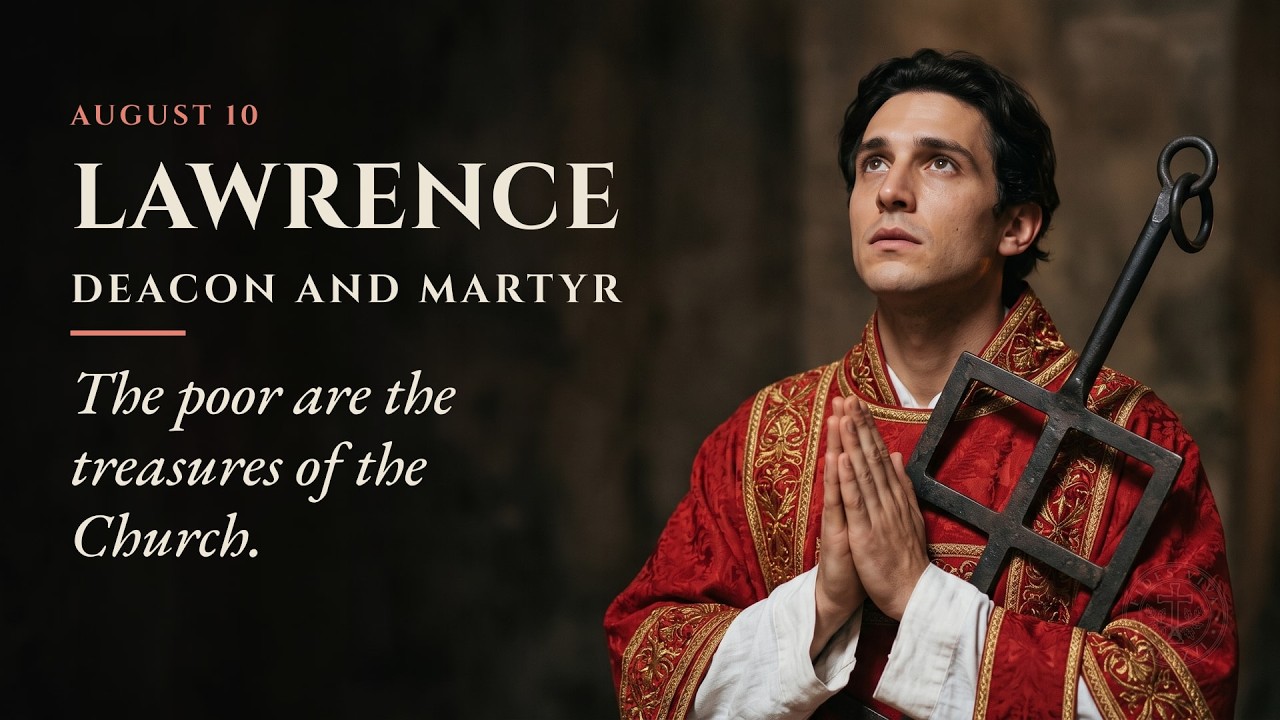
Lawrence was made archdeacon: the first of Rome's seven deacons. Seven men, as in the days of the apostles, ordained so that charity would have hands and a name. The archdeacon's task was the most delicate: to guard the goods of the Church, the offerings of the faithful, the coffers, the vessels of the Lord's table. And to distribute them among widows, orphans, the sick, and the poor. He also assisted the bishop in the liturgy, beside the altar with the book of the Gospels in his hands. Everything the community possessed passed through those fingers that had learned to count coins that were not his own without keeping a single one.
It was an immense trust, and it came at the worst possible hour. That same year, the Emperor Valerian signed an edict against the Christians. Valerian was not a fanatic given to outbursts: he was a senator of the old school, a dry military man, raised to the throne in the midst of collapse. He sought cohesion for an Empire that was coming apart. And he decided to find it by pressing down on the Church. The first edict forbade Christian worship and gatherings in the cemeteries—those corridors under the earth where the community prayed beside their dead.
Life changed all at once. Celebrations became briefer, more watched; doors were locked with greater care; every new face in the assembly was a question. Even so, bread still reached the widows, and lamps still burned. The Church of Rome did not scatter: it learned to breathe underwater.
A year later came the second blow, and this one left no room to hide. In the summer of 258, Valerian ordered that bishops, priests, and deacons be executed at once, without further trial, and that the property of Christians of rank be confiscated. The sentence no longer pursued a practice: it aimed at the men, one by one, for what they were. And behind the words of the edict loomed another hunger, older than any religion: the State, ruined by war and plague, wanted the money of the Church. That network of alms, sustained by the offerings of so many, made the Church of Rome a visible steward of wealth in the eyes of the treasury.
When the news reached the community in Rome, no one had to explain it. Sixtus was a bishop. Lawrence was a deacon. Their names were already written in that edict, though no official had pronounced them yet. That night, in the dimness of the house where bread was broken, bishop and archdeacon looked at each other knowing what was coming. Neither fled. They had learned from Jesus Christ that the shepherd does not abandon the sheep when he sees the wolf approaching, and that whoever serves the poor cannot save himself without them.
One question remained, and it weighed on every lamp burning in that house: when the soldiers came—and they would come soon—how would that community, which could no longer hide, respond? The days of August were beginning, and with them, the hour of trial.
The Farewell and the Promise
The answer came on August 6th. That morning, Sixtus went down to the Catacombs of Callixtus, along the Appian Way, to celebrate the Eucharist among the tombs of the martyrs. It was exactly what the edict forbade. It was what the edict punished with death, and yet he went: the community still needed to gather, and their bishop was there where their people were. In the midst of the celebration, soldiers burst into the crypt. There was no trial. The imperial order did not require one.
When Lawrence learned of it, he ran. He caught up with the soldiers who were taking his bishop and walked at his side, unafraid of being recognized, with only one wound in his voice. "Where are you going, father, without your son? Where are you hurrying, holy priest, without your deacon?" He was not asking for mercy for Sixtus. He was asking to die with him. The old man celebrated the sacrifice of Christ each day. The young man had assisted him at the altar, had handed him the chalice, had proclaimed the Gospel at his side. It seemed impossible to him that the offering they shared would end with one in glory and the other in the street, counting coins.
Sixtus turned toward him. And his answer has crossed the centuries with the same tenderness of that first day. "I am not leaving you, son; greater battles await you. In three days you will follow me."
It was not a pious comfort. It was an appointment. The bishop did not deny his deacon martyrdom: he announced it, with a date, as one entrusts a final task to his ministry. Greater battles. Sixtus would die that very day by the sword; his deacon still had four days ahead, and the father seemed to know they would be the hardest.
That same day, Sixtus was beheaded along with four of his deacons, there where he had been seized, among the tombs he had gone to honor. The Church of Rome was left without a head. And Lawrence was left alone, with the keys to the coffers in his hand and a promise burning in his chest: three days.
Three days. Others would have fled, or waited hidden for the time to pass. He understood that such a time is not waited for: it is filled. Each hour that remained had already found its master, and it was not the Empire.
The Final Distribution
This is how Rome remembered it: that very night, Lawrence opened the coffers. Inside was everything the community had entrusted to the Church over the years—leather purses full of silver coins, offerings meant for widows, donations from families no longer living. And there were the sacred vessels, the chalices and patens from the service of the altar, kept in trust by the community. The imperial treasury counted on finding it all there, ordered and complete, ready for confiscation. The archdeacon counted it one last time, but with another purpose: that no one be left out of the distribution.
He sold even the sacred vessels. It may sound harsh to the ear; for him it was pure consistency. That silver existed to serve the Lord, and the Lord Jesus was waiting elsewhere—in feverish bodies, in empty bellies, in the debts that drowned the poor. The metal that had held the blood of Christ became now bread, oil, ransom. He was not squandering the treasure. He was putting it where the Empire could never touch it.
For those days he walked the neighborhoods he knew by heart. The Trastevere of narrow alleys, with laundry hanging between walls and the smell of ovens mixed with the dampness of the Tiber; the insulae of brick where the sick lay in rooms without a window, three stories above the street. He climbed exterior stairs with the basket on his arm and the purse at his shoulder. He knocked on doors that had waited for him every week for years; this time he did not bring the usual ration, but everything. To each widow, more than she asked. To each orphan, what he would have needed in a year.
By night he continued to give, in the light of lamps, because the time allowed no rest and sleep seemed a luxury that belonged to someone else. There were hands that trembled to receive so much. Some woman might have asked why, and he could not tell the whole truth: that the Church was being hunted, that his bishop had died, that a day remained to him. He smiled, pressed those hands between his own, moved on. Those who saw him then did not see a man saying goodbye. They saw a deacon doing his work, the same as always, only to the end.
Because that was what it truly was, that distribution: the archdeacon's final lesson. The goods of the Church had never been his, not even the clergy's: they belonged to the poor, and he was only returning them to their owners. When the basket was empty and the last purse had changed hands, no one could take anything from him now. He had given everything. That night, he was the freest man in Rome.
And then came what could not be stopped. The prefect of Rome summoned him. The city knew that the Church held wealth; the State, exhausted by war and plague, wanted that gold. And the one who guarded it was a young deacon who answered the summons without hiding. Rome was about to demand the treasure from him. He had already given it all away. Or rather: he had transformed it into something the prefect was not expecting to find.
The Treasure Before Power
The prefect's hall was everything the Church was not. Veined marble, standards bearing the eagle, clerks with wax tablets, a curule chair set high. There the deacon appeared, in the linen tunic of his office and with empty hands. What happened between those walls, the Christians of the city told from father to child, until it became the memory of the whole Church.
The magistrate was direct. The State knew of the offerings, the donations, the silver vessels; it demanded their immediate surrender, in the name of the Emperor. And the deacon denied nothing. He answered that the Church was indeed rich—richer than Caesar himself could imagine; that he only needed time to gather before the prefect's eyes all that it possessed. The prefect, already seeing himself counting the silver, granted it without suspicion. Greed knows how to wait when it believes it will be paid.
Those hours were spent walking the city once more. But no longer to give: to summon. Word reached the blind who recognized the archdeacon's footstep before they heard his voice. The crippled to whom he had carried food up stairs without light. The widows, the orphans, the sick whom Rome preferred not to see. None asked too many questions. That man had given them everything; now he only asked them to walk with him.
When the time came, the doors of the atrium opened. There came no carts with coffers or slaves bearing silver. There came a slow line of rags and crutches, of eyelids closed over sightless eyes, of hands stretched out that knew the archdeacon's hand by heart. Silence fell on the hall like ash. The clerks stopped writing. Before the procession walked Lawrence, his wrists marked by rope and his lip split from the guards' blows. He stretched out his arm toward his own and spoke the words that Rome has not forgotten in seventeen centuries:
"These are the treasures of the Church."
It was not mockery or defiance. It was, quite simply, what he believed with his whole soul. In each of those worn bodies stood Jesus Christ, who had identified himself forever with the least. Silver runs out, gold is stolen, empires fall; but the poor remain, and in them the Lord remains. The Church had just revealed its true wealth before the power that sought to seize it. And power did not know what to do with it.
What it did know was how to punish. The answer came without reply before the whole hall, and scorned power always finds an executioner. The sentence was death; and, so that the affront would be paid in full, a slow death by fire.
Evening was falling on Rome. The deacon had one night left.
The Night and the Gridiron
What happened that night, the tradition of Rome has told with a fidelity that the centuries have not worn away. It was August 10th of the year 258, and night had fallen on the city. On a slope of the Viminal Hill, in the place that the city still marks, the executioners set a gridiron of iron over a bed of coals. Sixtus had needed only a sword stroke: that was the penalty the law prescribed for the clergy. For the deacon who had humbled the prefect, they wanted something slower. The fire that the edict had kindled against the whole Church was now to touch a single body.
They stripped him, leaving him only a linen cloth bound at the waist, and laid him on the iron. The executioners' iron forks held him against the gridiron; smoke rose up his side. He did not cry out. Those who kept his memory insisted always on this: there was no cry, no curse, no plea. He had given the coffers, the vessels, the bread of every distribution, and now he gave the only thing left to him. A man who has already given everything has nothing that fire can take from him. The Christians said afterward that his longing to reach Christ was in him stronger than the torment; that he had waited for that hour since the afternoon when Sixtus promised that in three days he would follow. The appointment was being kept.
And in the midst of the coals, as the memory of the ages recalls, he spoke words that have circled the world. He barely turned his face toward the executioner, and spoke with a serenity that disarms more than any defiance:
"This side is roasted; turn it over and eat."
There is no bravado in that phrase; there is a freedom that bewilders. The pain was real. The peace was deeper than the pain. The prefect had wanted an agony that would break the deacon, and he found instead a man master of himself, at peace, almost hospitable to his own death. The instrument meant to humiliate him became, forever, his emblem.
It was also said that, that night, among the smoke, some of those present saw the martyr's face wrapped in a gentle radiance, and perceived a sweetness in the air that did not come from the fire. The pagans saw nothing; they smelled nothing. As if the scene had two faces: the one power saw, a condemned man executed under law; and the one the poor saw, one more treasure the Church was giving to heaven.
Before dawn, it was all over. The executioners departed and the coals burned themselves out under the August sky. There remained a charred body on the iron and, around it in the shadow, a few who had not left. Rome thought it had settled the matter. But a martyr does not end where his body ends. With the first light, hands came to take him down from the iron, with the tenderness of one gathering up a son. The fire had done its work in a single night. The memory was only beginning its own.
Lamps in the Darkness
They carried him beyond the walls, along the Via Tiburtina, to a sloping field sown with cypresses: the ager Veranus. There a catacomb opened in the property of a widow named Cyriaca; the memory of the place adds that she was one of those the deacon had once relieved. They wrapped the charred body in linen cloths with spices, as one wraps the dead who are loved, and lowered him into a niche carved in the soft tufa of the catacombs. It was August 10th of the year 258. With Sixtus's promise fulfilled, Lawrence now rested beside the road.
There was no procession, no speeches. The persecution still held; gathering in cemeteries was forbidden. But as evening fell, someone came down into the gallery with an oil lamp and left it burning beside the stone. By the next day there were two. Then a line. The poor to whom he had given bread knew the way better than anyone, and they came to pray to Christ beside the man who had given them all he had. Each small flame in that darkness was a way of saying the fire had not won.
Seventy years later, the empire that had condemned him changed its face. The persecutions ceased and Christians came into the light. The memory of the Via Tiburtina has always held that it was the emperor Constantine himself who ordered a chapel built over the deacon's tomb. In the year 354, when Rome set down in writing the calendar of her martyrs, beside August 10th stood a single line: Lawrence, on the Tiburtina. A name, a date, and a road. On that line, firm, everything else rests.
Then came the voices. A generation later, in Milan, the bishop Ambrose wrote for his priests the farewell of Sixtus and the distribution of the goods. He wanted no minister of the Church to forget what the work of service is made of: it was his pen that saved that dialogue from oblivion. In Africa, another bishop preached his feast each August, and from his preaching this has been kept: that the longing to reach Christ made the martyr stronger than the torment. A poet from Hispania, from the land that memory gave as the deacon's birthplace, sang his passion in a hymn that is still read. And his name entered the oldest prayer of the Mass, beside the apostles and the first martyrs; whenever a priest speaks it, at any altar in the world, Lawrence stands again beside the table he served.
And over the tomb, the centuries built. Toward the year 440, a pope raised a basilica in the campo Verano. Toward the year 580, another built a church pressed against the tomb itself. And the thirteenth century fused them all into the basilica we now call Saint Lawrence Outside the Walls, with its portico of columns and its frescoes telling the life of the deacon. Beneath the high altar, in the confessio, the tomb sits exactly where those cloths left it one August dawn. And before it, burning, the lamps.
Seventeen centuries separate that first flame from the ones that burn this evening before the tomb. Entire empires have gone dark in that time; these lamps have not. No generation has wanted to be the one to let them die. A question remains: what does that crypt hold that Rome has not been able to forget? The stone gives part of the answer. The rest still lives, and still walks through the streets of the world.
The Treasure That Does Not Go Out
Ten centuries after that dawn, the tomb received a guest. In the thirteenth century, the relics of Saint Stephen arrived at the basilica—the first martyr, the deacon stoned in Jerusalem—and they chose to lay him beside Lawrence. A legend born from the affection of Romans tells that when they opened the sepulcher, the deacon's body moved to one side to make room for the new arrival. That is why the people began to call him, with a smile, "the courteous Spaniard." From then on, two deacons—the first of Jerusalem and the most beloved of Rome—share the same house beneath the same altar.
The house knew modern fire as well. On July 19th, 1943, in the midst of war, bombs fell on the San Lorenzo district and devastated the basilica: the portico wounded, the frescoes undone, the nave open to the sky. That same day, Pope Pius XII came to the neighborhood and stood among the rubble, with his people. Below, the tomb held fast, untouched. Six years later, the basilica stood whole again, restored stone by stone, because Rome could not live without it.
And the Church did more than restore stones. The Second Vatican Council brought the permanent diaconate back to life, and today thousands of men around the world wear the dalmatic that Lawrence wore. They proclaim the Gospel, serve at the altar, bring the bread of Christ to the sick, and care for the poor. They have him as their patron, and it could be no other. The work of organized charity remains an office with a name. In Rome there exists today an entire dicastery devoted to the work of charity, the direct heir of the coffer that the archdeacon emptied. And when Pope Leo XIV wrote of love for the poor, his words fell on soil Lawrence had already tilled: there was no need to cite him—it was enough to read them.
In the Holy Year of 2025, pilgrims walked again the ancient path of the Seven Churches of Rome, and one of them was still his. They descend to the crypt, kneel before the confessio, and contemplate a gridiron that generations of devotion have kept there as memory of that night.
Each summer, moreover, toward August 10th, the sky does its part. On those nights the Perseids cross the firmament, and Christian people in Europe gave them centuries ago a name that comes not from astronomy but from the heart: the tears of Saint Lawrence, sparks from his gridiron. It is folklore, not history; but it speaks to something true. There are memories so deep that people need to see them written even in the sky.
The prefect once asked where the treasure of the Church lay. Seventeen centuries later, the answer has not changed its face. The treasure still waits at the doorways, in the hospitals, at the gates where someone knocks and no one opens; and there are still hands that keep it and give it quietly, as that deacon did. One lamp lit, one loaf shared, one name written in the August sky.
To Contemplate the Treasure
What moves a man to give everything for a treasure he cannot see? Lawrence answered with his entire life. He counted coins for widows until the coffer lay empty; and when power demanded gold, he presented their faces. He had given so much, and so completely, that death found nothing left to take from him: he had belonged to Christ long before the flames.
We too keep something locked away, on the way to work, while on the threshold of home a face waits—one we prefer not to look at. He would have called it treasure.
The prefect's question has not grown old. The answer, this time, is ours.
In the crypt along the Via Tiburtina, a small flame burns beside his tomb. Seventeen centuries, and still someone returns to light it.
Saint Lawrence, faithful deacon, martyr of charity, patron of the poor and of the deacons of the Church, pray for us.