A man convinces a garrison to hold an impossible siege. The cannons open fire. A single shot shatters his leg. The soldier falls — and with him fall all his dreams. No one knows yet that this fall is a beginning.
The Nobleman Who Dreamed of Glory
By the close of the fifteenth century, Europe smelled of gunpowder and incense. Castile was closing out its final war against the kingdom of Granada; kings fought over borders with cannon fire, and soldiers, merchants, and friars crossed paths on every road. Christendom looked as solid as an ancient cathedral, but cracks were already spreading beneath the surface: soon a German monk would light a protest — one that would split the continent in two. It was an age calling for new men, though no one yet knew it.
Far from the courts, in the green, rain-soaked north of Guipúzcoa, the valley of the Urola sheltered a stone-and-brick tower house: the house of Loyola. It smelled of wet grass and woodsmoke; the bells of Azpeitia marked the hours of the valley. The lower half was a fortress wall, stone built to withstand sieges; the upper half was brick with rounded corners, built to last. Over the doorway, a coat of arms with two wolves and a cooking pot reminded everyone that this was a lineage of arms. There, in 1491, was born the last of the thirteen children of Beltrán Ibáñez de Oñaz and Marina Sáenz de Licona. They baptized him Íñigo — the name Ignatius would later make his own. In that house, the sons were raised to serve a king by the sword, and the youngest would be no exception.
Still a boy, he left the valley. He was sent as a page to Arévalo, into the household of Juan Velázquez de Cuéllar, chief treasurer of Castile — a world of salons, music, and ceremony, where a minor nobleman could learn to shine. And he shone. He spent nearly ten years there: a school of measured gestures and restless ambition. He learned to wear brightly colored doublets, to move among ladies, to dance, to handle a sword. He groomed with great care the dark brown hair that fell to his shoulders; years later he would admit how much vanity he had poured into it. He was small — just over five feet tall — but quick and wiry, and took pride in his well-made legs. He dreamed what so many dream at that age: fame, honor, to be someone.
When his patron's fortunes collapsed, the young nobleman entered the service of the Duke of Nájera, viceroy of Navarre. He traded salons for camps and dances for soldiering, and there he found his true hunger: military glory. He devoured tales of chivalry and pictured himself inside them — famous deeds, a name repeated with admiration, the favor of a great lady. Jealous of his honor to a fault, he let no slight pass unanswered. He prayed just enough, believed what he had inherited, and staked everything on a single card: winning honor in the eyes of men. Meanwhile two young kings — the emperor Charles and Francis of France — were fighting over Europe, and Navarre was one of their pieces.
A man like that, who staked everything on honor and arms — what would he do if it were all taken from him at once? The answer was already on its way, like distant thunder. It carried the name of a fortress and a date in May. War was coming to find him.
The Bullet That Changed His Aim
May 1521. A French army marches down on Navarre to reclaim it, and Pamplona opens its gates without a fight. Only the fortress holds out. Inside, the Castilian garrison counts the enemy and wants to surrender: they are outnumbered, with no relief coming. Ignatius refuses. He argues, he insists, he infects those men with his own sense of honor, until they decide to defend the indefensible.
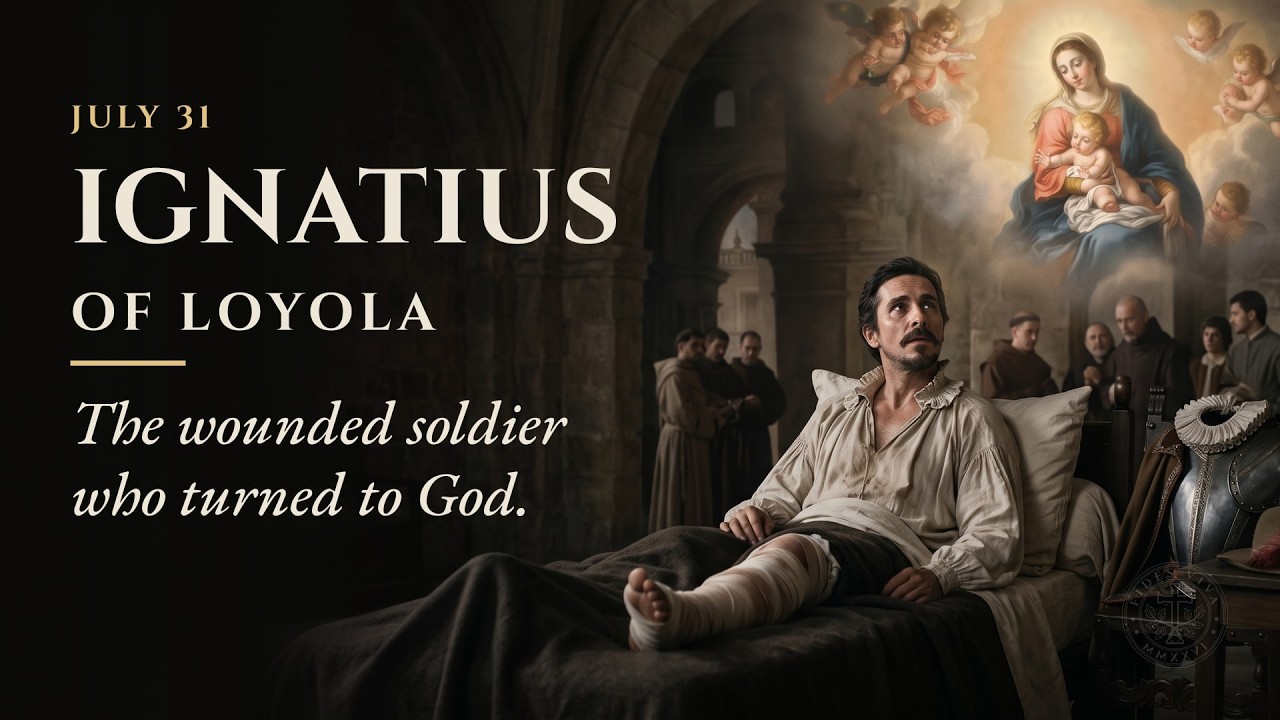
On the twentieth of May, the artillery begins to batter the walls. Hours of thunder. Stone flies, smoke covers everything. Ignatius stands on the breach, sword in hand, when a cannonball passes between his legs: it shatters his right leg and tears open his left. He falls at once. And with him, almost at once, the fortress falls.
What came next, he owed to his courage. The victors had watched that small man fight, and they did not treat him as spoils but with honor. They had their own surgeons tend to him and, two weeks later, set him on a litter bound for home. Days of travel followed, carried on porters' shoulders, ridge after ridge under the June sun, each jolt like iron in the broken leg. At last, in the distance, the green of the Urola. The Loyola tower received its youngest son, defeated.
That was where the worst began. The bone, jostled by the journey, had knitted crooked. The surgeons of the house were blunt: it had to be broken again and set once more. He agreed. There was no anesthesia of any kind; they stretched him on the bed and worked on living flesh. Not a single complaint was heard from him: only clenched fists, white knuckles. And when the bone, now firm, left a stump jutting out below the knee, he asked for one more thing: that they saw it off. The doctors warned him the pain would be worse still. He insisted. The reason was not heroic: it was pure vanity. He could not bear the thought of a misshapen leg inside a tight-fitting legging, of walking lame before the ladies. He fell silent again while the saw bit into bone, and afterward let them stretch the leg, day after day.
There were nights when the fever won and they gave him up for dead; then, slowly, his young body began to gain ground. He lay fixed to that tower bed, his leg splinted, the wooden ceiling his whole horizon. Weeks turned into months. The soldier who once dreamed of great deeds could not even sit up on his own. To keep from drowning in boredom he asked for the only thing he knew how to enjoy: tales of chivalry, warriors and ladies like the ones that had once filled his dreams. Someone went to search the whole house for them.
There were none. In the entire Loyola tower, not one book of knighthood remained. Only two thick volumes, bound in leather over wooden boards, that no one had ever opened for pleasure.
The Wrong Two Books
It was Magdalena de Araoz, his sister-in-law, who placed them in his hands. Mistress of the tower house, once a lady at the court of Isabella the Catholic, she tended the wounded man with the patience of someone in no hurry. She brought him the only thing the house had: a Life of Christ and a thick volume of the lives of the saints. (on-screen: "Vita Christi, Ludolfo de Sajonia · Flos Sanctorum")
He opened them out of pure boredom. And something began to stir. He read slowly through the life of Jesus Christ, the stories of Francis of Assisi, of Dominic, of the hermits of the desert. Then he would set the book aside and return to his old daydreams: great deeds he would perform, a noble lady he would serve, verses, words, favor won at the point of a sword. Whole hours slipped by like that. Then he would imagine the other path: walking barefoot to Jerusalem, eating nothing but herbs, taking on the penances the saints had taken on.
And one day he noticed the difference. The dreams of glory entertained him while they lasted; once they faded, they left him dry and discontented, like an empty cup. The dreams of imitating the saints brought joy too, but when he set them aside, the joy did not leave: it stayed, quiet, like an ember under ash. No one had taught him to look inside himself that way. Little by little he understood that these two movements came from different spirits, and that the heart, once a person learns to read it, speaks. From that bored convalescent's observation was born what he would later call discernment: the art of telling, among the voices stirring within, which one comes from God.
A question began to repeat in him, growing stronger each time: "What if I did what Saint Francis did, and what Saint Dominic did?" It was not a rhetorical question. It was a man of arms sizing up a new campaign, the only one worthy of him. That night in the tower there was no lightning, no voice from heaven: there was a decision, made by candlelight, from which he would never turn back. He would serve Christ the way he had once wanted to serve a king — with everything he had.
He himself would later tell how one night, keeping vigil, he saw Our Lady clearly, with the Child Jesus. That visit left him with such deep revulsion for his past life that it felt as if his past life had been torn away from him. The courtier of fine clothes and ladies no longer existed; in that same bed, another man was waking.
The soldier already knew what he wanted to be. But a knight does not become a pilgrim simply by wishing it: it took a gesture that would seal the choice forever. As soon as his leg could bear his weight, he left the tower and took to the road. His first destination: a mountain of rock spires, and a dark image of the Virgin.
The Sword Left Hanging
No mountain like it had ever risen before him: spires of gray rock thrust against the sky, and wedged between them, a monastery. Montserrat, March 1522. He limped up the pilgrims' road and asked for the one thing a man with his past needed first: confession. The general confession took three days. Three days to empty out thirty years — the vanity, the weapons, the debts of honor, everything he had been.
On the eve of the Annunciation he sought out a poor man and gave him his knight's clothes: the doublet, the hose, the cloak, every garment that still spoke of the courtier. He put on a rough sackcloth tunic, tied at the waist with a cord. And as night fell he entered the church, approached the altar of the Virgin — the Moreneta, the dark carved image with the Child on her lap — and hung his sword and dagger before her.
He knew the rite from his novels: the squire who keeps vigil over his weapons the whole night before being made a knight. He followed it to the letter, standing and kneeling until dawn, amid the glow of the sanctuary. Only no one buckled a sword onto him at daybreak. He left it hanging there for good. The soldiering remained; only the king had changed: from that night on he would serve Christ, and wanted no other name than pilgrim.
He came down from the mountain to a small town on the banks of the Cardoner: Manresa. He meant to stay a few days. He stayed eleven months. He begged bread door to door, slept in a hospice among the sick, fasted to the limit, prayed for hours on end. The man who had once taken such pride in his hair let it grow filthy and tangled, his beard unkempt, his nails uncut: every neglect a mortification chosen against his old vanity.
And there, where he had hoped for peace, the darkest trial of his life caught up with him. Scruples: the obsessive fear that he had confessed badly, that some old sin remained unforgiven. He confessed, and confessed again, and the anguish always came back, tighter each time. There were weeks when that inward torment brought him to the edge of despair. He did not let go. He clung to prayer like a soldier holding a rampart, hour after hour, until the storm passed — and left him compassion for all who fight in the dark.
One afternoon he sat by the road, facing the Cardoner, the water running past before him. He would say afterward that there his understanding began to open: he grasped, all at once, so much — the faith, learning, himself — and the whole world looked new. He learned more in that single hour than in the rest of his life put together. No words explain it; he never found them either. Out of that stillness, and the notes he kept gathering in a notebook on what God was doing in his soul, a small book would quietly take shape: the Spiritual Exercises.
He left Manresa with a single desire: to walk the ground where Jesus had lived, walked, and died. He set sail for Jerusalem with his heart set on staying there forever. But the holy city would not be the end of the journey. It would be the beginning of a humiliation he did not expect.
A Thirty-Three-Year-Old Among Children
Jerusalem, 1523. Golden stone, Ottoman ramparts, the murmur of a city that was no longer Christian. The pilgrim walked the Holy Places in tears: the Holy Sepulchre, the garden, the Mount of Olives. He had come to stay. He wanted to live and die there, close to the ground Jesus had walked, helping the souls he found. But the Franciscans who kept watch over the shrines knew the cost of those streets: pilgrims taken captive, ransoms, deaths. With the Pope's own authority, they ordered him back to the West.
He obeyed. Though before leaving he slipped away once more, quietly, alone and without a guide. He wanted one more look, on the Mount of Olives, at the stone said to bear the footprint of the Ascension. Then he went down to the harbor and sailed back, the dream of his life broken for a second time.
On the voyage back, one question remained: now what? The answer he found had the sobriety of a campaign plan: to help souls he needed to speak of God without being driven out of every place he tried. And for that he needed to study. He lacked everything, starting with Latin.
So it was that Barcelona saw one of the most moving sights of his whole life. A man of thirty-three, weathered by war, penance, and the sea, sat on a school bench among children, reciting Latin declensions. The little ones stumbled and started over; so did he. No one there suspected that the older classmate, in his poor coat and satchel, had once commanded soldiers and crossed the sea to the Holy Land.
Two years later he moved on to the university at Alcalá. He studied, begged, and above all, talked: teaching catechism, gathering people, guiding consciences. A man without degrees explaining the things of God was, in the Spain of that day, cause for suspicion. The Inquisition questioned him and held him prisoner forty-two days, finding no error in him; even so, it forbade him to speak of the things of God until he had studied more. In Salamanca the scene repeated itself, now with irons on his ankles: twenty-two days locked away, the same verdict, the same ban.
He raised no protest. He held no grudge against the Church that kept testing him; he answered in the only way he knew how — by obeying better than they asked. If they demanded study, he would go find the best of his age. At thirty-seven he crossed half of Europe on foot and entered the University of Paris.
There, in a college in the Latin Quarter, a shared room would give him something he had not gone looking for: companions. Two young men nothing like him. And with them the greatest work of his life would begin.
Seven Men Before a Single Candle
The first was named Francis Xavier. A Navarrese nobleman, twenty-two, athletic, brilliant — he excelled in the students' games in Paris and dreamed of a professorship, of honors, of a name known across Europe. The other was Peter Faber, a gentle Savoyard who had once tended sheep in the Alps — a delicate soul, tormented by scruples the newcomer knew all too well. With them, in a shared room at the College of Santa Bárbara, lived a limping student nearly twice their age, a man who spoke little and watched everything.
He won Faber over quickly — teaching him to read his own fears the way he himself had learned at Loyola and Manresa — and the Savoyard found peace at last. Xavier was another campaign. An ambitious man is not won by argument; he is won through his own ambition. Again and again, unhurried, the older companion repeated Christ's own words from the Gospel: for what does it profit a man to gain the whole world and forfeit his life? The phrase wore its way in, like water wearing at stone. The day Xavier gave way, he gave way completely — the energy once aimed at a professorship now aimed far beyond it.
Others began to join them, drawn by this small man who spoke of Christ as one who had been there himself. Among them was a Castilian of dazzling intelligence named Diego Laínez. In the end there were seven.
On the fifteenth of August, 1534, they climbed together to the hill of Montmartre and went down into a small, cold crypt. In the dimness of that crypt, the seven vowed poverty, chastity, and a pilgrimage to Jerusalem, to serve Christ there. They were not founding anything yet. They had no rule, no house, no name. They had a friendship, and they had placed it entirely in God's hands.
Jerusalem, again, said no. Their studies finished, they gathered in Venice to sail, and war with the Turks closed the sea — no pilgrim ship ever left port. So they took the only road still open to them: to offer themselves to the Pope, and let him send them wherever he wished. Ignatius set out for Rome on foot, with Faber and Laínez, along the Via Cassia.
A few miles outside the city, with the Roman countryside gilded by the evening light, they stopped to pray in a small country chapel, in a place called La Storta. He would later say that he saw the Father placing him beside the Son, who carried the cross, and heard words that stayed with him for the rest of his life: "I will be propitious to you in Rome." He was not going alone, nor in his own name: he was set beside Jesus. That is why, when the time came to give this circle of friends a name, the name was already there: the Society of Jesus.
They had vowed to go to Jerusalem and ended up in Rome. There an aging pope awaited them, and a signature that would send these men to the ends of the earth.
The General Who Never Traveled
Pope Paul III listened. The pope who sought to reform a wounded Church saw in that band of poor priests an answer suited to the age. He began sending them out two by two — to cities, to universities, to disputes over doctrine — even before he approved them. They set their way of life down in a few pages, the Formula of the Institute, and placed it in the pontiff's hands with an unheard-of promise. A vow of obedience to go, without excuse and without condition, wherever he might send them. Wherever the need was greatest. On September 27, 1540, the signature came. (on-screen: "Regimini militantis Ecclesiae, 1540") The bull approved the new order under the name they had carried since La Storta: the Society of Jesus.
A head still had to be chosen. The companions voted, and every vote named the same man. Ignatius refused. He asked for the ballot again; the result repeated itself, and only when his confessor ordered it in conscience did he give way. So he became the Society's first general, against his own will — the same man who had once tended his hair and his reputation with such care. The ambition was still whole; it had only changed masters. From then on, over his papers, one motto returned again and again.
Ad maiorem Dei gloriam: to the greater glory of God. Not the good, but the better. Not for himself, but for Christ.
Friendship paid the first price. The King of Portugal was asking for men for his Indies, and the choice fell on Francis Xavier. They said goodbye in Rome knowing what neither one spoke aloud: the seas of that age rarely gave men back. They embraced. In April 1541, Xavier's ship sailed from Lisbon toward India. They never saw each other again. The general who never traveled learned then the costliest gesture of his office: to love, and precisely because he loved, to send.
Then came fifteen years in two whitewashed rooms beside a small church, Santa Maria della Strada. A table, a chair, a crucifix, a candle. From there, limping between the bed and the desk, he governed a mission growing faster than the maps could follow. Some six thousand eight hundred letters left that table for India, Brazil, Japan, Germany, Portugal. He wrote the Constitutions sentence by sentence, weighing every word before God. He raised the Roman College and the German College; he opened houses for catechumens and for women rescued from the street. His sons sailed from Lisbon toward shores no missionary had ever set foot on. For those farewells, the Society's memory kept a charge that appears nowhere in his writings, but sounds like him all the same: go and set the world on fire.
Behind closed doors, the general remained a mystic. In a private diary he never meant for other eyes, he noted that almost every day, celebrating Mass, he wept — silent tears, received the way one receives bread. Some nights he climbed to the terrace to look at the stars, and his companions heard him say more than once: "How vile the earth seems to me when I look up at the sky!" In 1548 the Spiritual Exercises, ripened since Manresa, received the pope's approval and reached the printing press; in 1550, a second bull confirmed the Society and lifted every limit on its members.
The blows, too, arrived by letter, like everything else. In 1546 Peter Faber died in Rome, the gentle Savoyard, the Society's first priest. And in December 1552, on an island off the coast of China called Sancian, Francis Xavier died. The whole vast continent lay before him; he never reached it. The news took months to cross the seas. When it reached the table in Rome, the general read it the way he read everything: in silence. He had spent his life sending others out; now he learned that to send is also to lose.
The Society was growing across three continents: colleges, missions, nearly a thousand men on the road. And in the two rooms in Rome, the man holding it all together was fading without a sound, sick in stomach and liver, writing until the very end. One July morning, at dawn, the pen would fall still forever.
A Death at Dawn
The end came at night, without warning. In the early hours of July 31, 1556, in his room in Rome, a fever finished what years of a failing stomach had begun. Ignatius died at dawn, so quietly that no one marked the exact moment. No last rites, no final words, no one gathered at his bedside. The man who had moved half the world with a pen left the way a letter is sealed: in silence, in the first gray light of dawn.
By the time the house woke, he was already gone. And that same morning, as Rome opened its gates, nearly a thousand Jesuits across three continents woke with it. A hundred houses and colleges, classrooms from Portugal to Japan. Sixteen years before, they had been ten friends with a way of life written on a few pages. The true measure of that life could not fit inside the room where it ended: that same day, dawn was breaking in a thousand places he had never set foot.
His companions wanted to hold on to the face that was slipping from them. A death mask was taken from his face, and that same year Jacopino del Conte painted him as he was: bald, high-browed, with an aquiline nose and a thin, graying beard. Decades later, Alonso Sánchez Coello painted him again from that same likeness, at the request of those who had known him. No idealizing: they wanted to preserve the man as he truly was, lean and sharp-featured, just as they had seen him pray and govern.
The Church took little time to recognize what her sons already knew. Beatified in 1609; and on March 12, 1622, canonized by Pope Gregory XV alongside Teresa of Ávila and Francis Xavier — his old roommate from Paris — raised to the altars on the very same day. The general's body rests today in Rome beneath an altar of gilded bronze and lapis lazuli, in the Gesù, the church raised under the Holy Name of Jesus: baroque glory over a man who lived in two whitewashed rooms.
And what he left behind kept growing, without him. In 1922, Pope Pius XI declared him patron of the Spiritual Exercises and of retreats. Five centuries later, men and women across the world still withdraw for a few days of silence, learning to read their own hearts by the method born at Manresa. In 2026, young novices begin their formation under his name in Montevideo; every July 31st, processions honor him in the villages of Misiones, in the neighborhoods of Lima, in his home valley in Guipúzcoa.
The death was a whisper. What remains alive is something else: a small flame no fever ever managed to put out.
The Candle That Still Burns
It all began with a defeat. An impossible siege, a shattered leg, a soldier carried home on a litter, his dreams in pieces. It looked like an ending; it was a door. The bullet did not take his ambition — it changed its target. The man who wanted to shine before kings ended up seeking the greater glory of God. The man who dreamed of a knight's feats crossed half the world begging, learned Latin among children, and gathered poor friends around him. From two whitewashed rooms, he sent the Gospel of Jesus Christ as far as India, Brazil, and Japan. The greatest victory of his life was born from his worst fall.
In that bed at Loyola he had discovered something simple enough to fit inside any life. Some dreams leave the heart dry, and some joy stays even after the book is closed. We know that difference too. At the end of an ordinary day, when the last screen goes dark and the house falls quiet, something remains inside — dryness, or a joy that does not leave. Learning to tell them apart was his whole art. And he never found an hour too late to begin: he was thirty, with a broken leg, when he began.
He gave his answer with his feet, with his pen, with his whole life. Ours is still our own. And the small candle that stood beside every decision — by the two books at Loyola, in the cave above the Cardoner, on the desk in Rome — still burns. It burns in every silence where someone stops to listen to their own heart.
Saint Ignatius of Loyola, father of the Society of Jesus, master of discernment and the Spiritual Exercises, patron of retreats, pray for us.