A man walks through an empty city. The river has broken its banks and left mud in the streets; smoke rises from pyres in the distance, doors marked with lime, silence. Every few steps, a body no one has come to collect. He does not flee. He walks toward the center, toward a crowd that waits for him.
They have chosen him.
Not for an honor: for a burden. The city that was once the head of the world now has no emperor to defend it, no consuls, no grain in the warehouses. It has hunger, it has plague, it has fear. And it has just placed everything on the shoulders of the only man who does not want the office.
Because this man held power once. He was the highest civil authority in that same city: purple cloak, seal ring, an escort. And he gave it all back. He renounced everything he had inherited, down to the last stone of his house.
Now the crowd blocks his path. They want him to govern. They want him to feed them. They want him to stay.
He only wanted silence. He will receive, instead, the weight of a world that is ending: an entire city to sustain, a peace to buy with empty hands, a faith to send to the end of the known earth.
Why does the man who flees from power end up carrying it for everyone? And what is lost, and what is gained, when a man gives up what he loves most?
Childhood on the Caelian Hill: Domestic Holiness
High on a hill in Rome, among pines and brick walls, a house still stands that smells of the ancient world. It is the Caelian Hill. From its terraces you can see the aqueducts cut short by war, the forums where grass grows, the baths run dry. For a decade, the armies of the emperor in the East and the Goths have fought over the peninsula. The city built for a million people now holds, among monuments too large for it, fewer than fifty thousand souls. Rome has not died. But it fades slowly, like a lamp running out of oil.
In that house, around the year 540, a boy is born. His father, Gordianus, is a senator and also serves the Church of Rome as a regionary, one of its administrators. His mother is called Silvia, and the centuries will venerate her as a saint. The boy is named Gregory.
This is not a noble house like the others. Here faith is not a custom for feast days: it is the air one breathes. Gordianus keeps the accounts and registers of the Church with the same gravity his ancestors once brought to the State. Silvia prays as one who works, without noise, and that silent piety will mark the son for life. And under the same roof live two of his father's sisters, Tarsilla and Emiliana, virgins consecrated to God who have turned the noble chambers into something much like a cloister: psalms at dawn, fasting, rough wool over inherited marble. The boy grows up watching the oldest nobility of Rome live as the poor of Christ do, and no one in the house finds it strange.
From those years he kept a memory that he himself would tell many years later, when he was already the bishop of Rome, as he preached to his people. His aunt Tarsilla, the most austere in the house, came to the hour of death surrounded by her own people. And it would be remembered in the household that in that last moment she lifted her eyes and saw Jesus coming to call her. So Gregory received it from the lips of his own family, and so he would repeat it all his life: in his house, Christ was not an idea to be discussed. He was someone who could cross the threshold.
Outside those walls waits another school. The boy receives the finest education Rome can still offer: law and administration, everything that for centuries had prepared the sons of senators to govern. But each day, as he descended the hill, he walked between two truths of his time: greatness written in stone and misery sitting on the steps of that same stone. He learned laws in a city where law barely reached; he studied the art of administering an empire that no longer passed through it.
Two worlds grew with him, and neither would release him: the prayer of the women of his house and the office of the men of his line. The cloister and government. He did not yet know that his whole life would be a tension between the two. For now he was only a young man with a grave gaze, leaning on a terrace and looking down at a city crumbling below, soon to ask him for something. A man who had grown with all roads open knows the cost of closing them. What drives someone raised in privilege and destined for the highest station to let it all go? Rome, without knowing it, was about to give it to him first: the highest place.
The Prefect Who Renounces Power
It came to him around the year 572. He was in his early thirties when he received the urban prefecture—the highest civil magistracy still standing on the Tiber. The office that great names of centuries past had held now fell to him: to dispense justice, to keep order in the districts, to watch the walls, to count the grain in the storehouses. On his shoulders, a dark purple cloak fastened with a gold fibula; on his finger, the ring with which all a city's orders were sealed.
To govern Rome was then to administer scarcity. The Lombards, who had entered the peninsula in 568, pressed from the north; the emperor, far away in Constantinople, ruled what remained through the exarch of Ravenna, his delegate, almost always without troops or money to send. Each morning the same petitions came before the prefect: wheat that did not arrive at the port, walls that were giving way, disputes of families ruined. He signed, ordered, handed out what little there was.
He had the gift of his lineage. He organized archives, heard cases, measured grain reserves with the exactness of one who could not permit an error. Those who came before Gregory found a magistrate calm and steady-eyed, who did not raise his voice. But the walls of the audience hall were cracked, and the statues in the corridor were broken. He governed in the name of a distant power that barely answered. Every decree of his was a bandage over a wound too large. And case by case, petition by petition, he learned something no office teaches: that power, when it can barely do anything, weighs twice as heavy.
At night he climbed the slope of the Caelian, and the house received him under another law: the memory of Tarsilla seeing Jesus come in her final hour, the quiet piety his mother had taught him. Between those two worlds—the man of the seal—he began to examine himself as one judges one's own case. There was no lightning, no voice in the night; no page of his records held a founding moment. There were months of adult deliberation, weighed, almost legal in their care. Years later he would tell it with a sailor's image. The affairs of the age had been a tempest; the monastery, the harbor visible from the open sea. One day he stopped looking at the harbor and rowed toward it.
Around the year 574 he signed his last documents as prefect and gave up the post. Then, piece by piece, he undid the work of generations. The lands his family held in Sicily—one of the great fortunes of Roman nobility—were sold; with what was gained, he founded six monasteries there. There remained the house on the Caelian, the last possession, the most beloved. He did not keep it for himself either: he gave it over entire and turned it into a monastery, dedicated to the apostle Andrew. And he asked to be admitted to it, not as its owner or founder with privileges, but as any novice, the last to arrive.
The day he crossed that threshold he stripped away everything that set him apart. The cloak stayed behind with the rest of his former life; the ring sealed nothing anymore. He received a rough wool tunic without dye, a leather belt, and the tonsure of Roman monks: the small circle shaved at the crown, a narrow ring of hair above the ears. The rooms where he had played as a child were now bare cells; the banquet hall of senators was now a refectory with a wooden table. And the man who the day before ruled over a city now obeyed a bell that woke him before dawn to sing psalms.
No one spared him anything, and he did not ask to be spared. He drew all the tasks: the broom, the garden, the lamp that must be filled with oil. He fasted with a rigor that would ruin his stomach—a debt he would pay the rest of his life. But above all, he read. Scripture opened to him in that silence as it never had among ledgers, and he found he could spend hours inside a single line. For the first time he stood whole before Christ, not divided among a hundred other urgencies.
Many years later, crushed under burdens he could not yet imagine, he would write without shame: those were the happiest years of his life. Not his youth, not the purple. The cell.
Can a man truly leave power behind and find peace in being no one? He believed it, and for a few years he lived it. But Rome knew on which hill its best administrator was hiding, and a sinking city does not forget the man who knew how to govern it. In the Lateran, the pope knew it too. One day footsteps that were not a monk's climbed the slope and knocked at the door of Saint Andrew's. They carried a task that could not be refused. The silence he had fought so hard to win was beginning to crack.
From the Cloister to Constantinople: The Monk in Exile
The task had a name: deacon. Around the year 578 he received ordination as one of the seven regionary deacons of Rome, the pope's men for the poor of each district of the city. He did not lose his habit, but he lost the enclosure: now he belonged also to the widows, the sick, the lists of the hungry. He obeyed. And barely had he learned that office when Pope Pelagius II asked for more: cross the sea and be his apocrisiarius, his permanent representative before the emperor, in Constantinople.
For a Roman of that time, it was to travel from the corpse of an empire to its living heart. Constantinople blazed: colored marbles, silks, mosaics of gold, guards with lances before doors of bronze. And in the midst of that splendor, a thin deacon in a white dalmatic over undyed wool. He came to ask the same thing over and over: soldiers for Italy, relief for Rome. He received audiences, courtesies, promises. The soldiers never came. It took him almost six years to learn the full lesson: his city could expect nothing from that throne. When it fell to him to sustain it, he would know it firsthand.
He had not gone alone. He brought with him some monks from Saint Andrew, and in a house apart from the noise they went on living as on the Caelian Hill: the psalms at their hours, the poor table, the silence. He never came to master Greek, and he himself would acknowledge it without shame. His true tongue was another. when evening fell and the day's useless errands were done, his brothers asked him to speak to them of Scripture, and he opened the book of Job.
It was not a chance choice. Job: the just man who loses everything and does not curse. A Roman who had watched his world collapse understood that story from within. Evening after evening he unraveled it with them. In that just man covered with sores he taught them to recognize a figure of Christ, the innocent who carries suffering he did not deserve. Those talks of exiles would give birth, over the years, to his longest work: the Morals on the Book of Job, thirty-five books written in the gilded exile of a court that would not listen.
Among those who listened was a friend. Leander, bishop of Seville, had come to Constantinople from a Hispania torn by the Arian dispute, and he sat with the monks to hear. The two men understood each other at once: two shepherds of broken lands, begging help in the same indifferent city. It was Leander who urged most that those explanations be set down in writing, and to him Gregory would dedicate the work when it was finished. The friendship lasted until death, held fast by letters that crossed the sea.
Around 585 or 586 he was able to return. Rome received him with the same hunger and the same weary walls, but the Caelian Hill stood where it had always stood: he was chosen abbot of Saint Andrew, and the pope wanted him near as counselor. For a time he recovered what he loved: the psalms before dawn and the codex open.
From those years in Rome, the English would keep, centuries after, a scene told from fathers to sons. One day in the marketplace, he saw among the merchandise some boys of pale skin and fair hair, put up for sale as slaves. He asked where they came from. He was told they were Angles, from an island at the edge of the known world, and pagan. He stood looking at them and answered with a wordplay that would travel the centuries: "They are not Angles, but angels." And he added that in the land of their king, called Ælle, one day the Alleluia must be sung. The same memory says he himself wished to leave and evangelize them, and that the people of Rome, unwilling to lose him, came out to the roads and turned him back.
That seed was kept. Six years far from what he loved had given him his deepest work; a walk through the marketplace had just given him a dream for the end of the world. But before that, another door would open that he did not seek. In the autumn of 589 the Tiber rose from its banks and flooded the granaries. Behind the water, as so often before, came the plague.
The Plague of Rome and the Unwanted Election
It spared no one; not even the man who had to bury them all. In February of 590, Pope Pelagius II died, struck by the same sickness that was carrying off his people. Rome was left without a bishop at the worst moment imaginable: the grain spoiled by the flood, the dead piling up faster than graves could be dug, and from the north, as always, rumors of war. The city needed a father, and it needed one now.
All eyes turned to the same man. The abbot of the Caelian had been prefect, and he knew how to govern; he had been a deacon of Rome, and he knew the poor of the city at close hand; he had spent six years in Constantinople, and he knew that no help would ever come from that throne. Clergy, senate, and people chose him without a single voice against. No one seemed more fit. No one desired it less.
There remained one formality, and in it he placed his last hope: in those days, the emperor had to confirm the elect. He wrote then to Maurice a letter unlike any other: the plea of a man who begs, with all his strength, not to be confirmed. It was not theater or false modesty. He genuinely feared that office: he feared losing the little silence that remained to him, and he feared more still to answer before God for thousands of souls when he barely believed he knew how to care for his own. The old accounts say that the letter never reached its destination: the city prefect intercepted it. And that he hid outside the walls until they found him and brought him back to the city that was calling for him.
While the reply crossed the sea, he did not wait idle. Still without consecration, he took the helm of the stricken city in practice and summoned the entire city to public penance: the sevenfold litany. Seven processions, ordered according to the state and condition of each, set out at once and crossed the city afflicted by plague on their way to Saint Mary Major, singing a single supplication, repeated a thousand times: mercy. Mercy of Christ for a city that was dying. The streets of Rome, silent for weeks, filled with a grave chant that moved slowly forward, as one moves who has nothing else left to offer.
It was not a solemn gesture safe from harm. The very air killed. Eighty people fell dead during the march, struck down by contagion in the midst of those who sang; and the singing did not stop. The fallen were set aside with reverence, the walking went on, the plea went on. At the front went the man who had tried to flee an election and who did not flee the plague: a shepherd still without consecration, walking into the contagion with his people, instead of blessing them from a place of safety.
Whoever has had to hold others up in the midst of a fear that was also his own knows that step.
With the centuries, the memory of Rome wanted to give that march a visible end. It was told that as the procession passed beside the Mausoleum of Hadrian—the huge mass that watches over the Tiber, already turned into a fortress—the Archangel Michael was seen high above, sheathing his sword: the sign that the plague was ending. From that account the building took the name it still bears, Castel Sant'Angelo, the castle of the Angel, and still today it is crowned with an angel of bronze sheathing his sword.
The emperor's reply came at last, and it was not what he had asked for: Maurice confirmed the election. There were no more doors left to slip through. On the 3rd of September, 590, he was consecrated bishop of Rome in the Basilica of Saint Peter, the old Constantinian basilica of five naves and wooden roof, among rows of oil lamps, over the tomb of the apostle. He was about fifty years old, his health worn away, and no gladness to feign. He did not feign it. In his first sermons he confessed to all the weight that had fallen upon him, and in his letters from those days he compared himself to an old ship battered by the storm, taking on water from every side. Rarely has so high an office begun with a confession so bare.
From the very beginning he chose also how to sign, and with the years he would do so definitively. At the foot of his letters, where others piled up titles, he put three words that were an entire program of government.
Servus servorum Dei: servant of the servants of God. The bishop of Rome did not proclaim himself lord of anyone; he declared himself servant of those who serve, the last in the house. Fourteen centuries have passed, and no pope has let go of that signature.
What happens when duty puts on a man's shoulders exactly what he was fleeing? Gregory began to find out the morning after. Before him lay a hungry city that could expect nothing more from its old masters: the emperor was far away, the grain in Sicily, the Lombards a few days' march from the walls. There was no magistrate left with resources, no senate with strength, no soldiers for anyone to pay. Everything Rome needed to stay alive was going to pass, from now on, through the worktable of a monk who had asked only for silence.
The Granary of the Church: Charity and Governance
The first thing was bread. The Church of Rome held vast lands—the Patrimony of Saint Peter, above all those fields in Sicily that Gregory had known since childhood—and within months he turned them into the larder of an entire city. His letters to the administrators of the Patrimony are remarkable for their exactness: registers with the names of the poor, monthly distribution of grain, oil, wine, legumes; ships laden waiting for the wind from Sicily to Ostia. And a warning repeated, with severity, to his own men: not a single abuse against the peasants who worked those lands.
With the same purse he ransomed captives from Lombard hands and paid soldiers whom the Empire no longer paid. Charity, in his hands, took the least poetic form that exists: exact accounting. A hungry man does not feed on good intentions; he eats on grain counted, shipped, and distributed on time. He himself taught this when he preached, with a phrase that sums up his entire governance: the proof of love is the deed.
In 593 war came to the walls. Agilulf, king of the Lombards, laid siege to Rome, and from the exarch of Ravenna not a single soldier came. he himself negotiated, directly, shepherd to king, and paid from the Church's coffers so that the army would withdraw. From Constantinople they reproached him; the captives who came home did not. In those months he was preaching on the prophet Ezekiel, and one day he stopped in the middle of the series. He confessed before his listeners that he could not go on commenting on Scripture while he heard the trumpets and saw the captives pass by with bound hands. The teacher fell silent so that the shepherd could work.
And yet the pen did not rest. In 591 he had published the Pastoral Rule, dedicated to John of Ravenna: the book born of his own fear of the office, where he sets forth who should accept the governance of souls, how he should live, and how to speak differently to each class of listener. In its pages, Christ is the inner physician, the one who knows the wound of each soul and applies to each its own medicine. And one line condenses what he himself tried to be: let the pastor be near to each through compassion, and raised above all through contemplation. That book would form bishops for a thousand years; the emperor Maurice had it translated into Greek.
In those same years he finished the Morals on the Book of Job, begun in the nights of Constantinople. And around 593 he undertook a different work: the Dialogues, conversations with his boyhood friend, Peter the Deacon, about the saints of the Italian lands. The entire second book is the life of Saint Benedict of Nursia. It is the only ancient life of Benedict that survives: without those pages dictated between one letter and the next, the West would know almost nothing of the father of its monks.
Between 595 and 597 he defended, by letter, the only battle of titles in his life—and he fought it in reverse. The patriarch of Constantinople, John, called the Faster, had been named in some documents "ecumenical patriarch": universal. Gregory protested to him and to the emperor Maurice; he did not attack the man, whose austerity he respected, but the word, because no bishop should call himself universal. And his most eloquent argument was not a phrase, but his own signature: against the highest title he set the lowest, and those three words he already used—servant of the servants of God—remained sealed from then on forever.
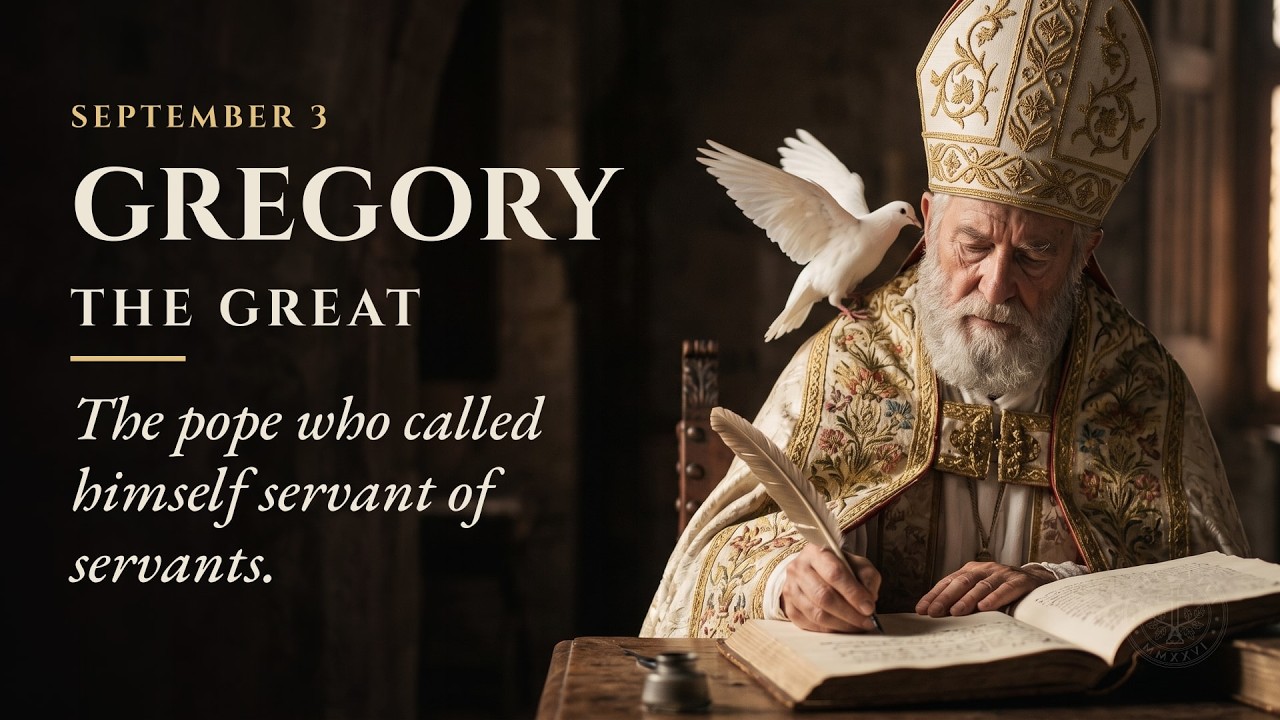
From those years of ink and grain, Rome kept other scenes as well. It would be remembered afterward that each day he seated twelve poor at his table and served them with his own hands; and the pious memory added that one afternoon there was a thirteenth guest whom the others did not see: a pilgrim come from heaven. The marble slab of that table is still preserved on the Caelian Hill. It is recorded instead, in his own letter, that the empress Constantina asked him for the head of Saint Paul for a new church. He replied that in Rome the bodies of the apostles are not touched, and sent her instead a brandeum: a cloth that had rested upon the tomb. As time went on, the account grew: before those who scorned those cloths, Gregory would have cut one, and from the linen blood flowed. The art of the centuries that followed would also imagine him writing with a white dove perched on his shoulder, the Spirit dictating at his ear. The deacon Peter, according to that same memory, watched it amazed from behind a curtain. And a legend still later dared more: that his tears, moved by the justice of the pagan emperor Trajan, sufficed for his soul to receive mercy. Dante would take it up seven centuries later.
Behind all of that was a body breaking apart. The gout deformed his hands, fevers returned without warning, the stomach punished since the fasts of the Caelian Hill barely tolerated food. Every sack of grain, every truce, every page came from a man who many days could not keep himself upright. And while Rome ate from his table, his gaze was already reaching further: beyond the sea, toward those fair-haired boys he had never forgotten, toward a sowing whose harvest he knew he would not see.
The Mission to the Ends of the Earth: The Angles and the Fruit Unseen
In the year 596 he went back up to the Caelian Hill. This time he was not seeking silence: he had come to ask for the only thing left to give. From the monastery of Saint Andrew—his house, his brothers, the happiest years of his life—he chose about forty monks, with the prior Augustine at their head. He sent them to the kingdom of Kent, on the island of Britannia: for a Roman, the very edge of the world. They were going toward a tongue no one knew and toward shores they had never seen. He would never know them either.
He saw them off and stayed behind. It is easy to pass over that detail, and it is the one that weighs most. Whoever has once watched his own depart toward something uncertain—a son, a brother, a friend whom perhaps he would never hold again—knows what the near side of a farewell costs.
The journey soon went wrong. In Gaul, on the road north, the monks began to hear stories about the Angles: a fierce people, pagan, whose tongue no one understood. Fear took hold, and Augustine turned back toward Rome to ask, in the name of them all, for leave to return. Gregory could have rebuked him. He did not. In July of 596 he handed him a letter that holds instead of strikes: the order to continue the journey, with God's help, and the express prohibition to turn back. And he sent Augustine back to the road, at the head of his brothers, with his own fear transformed into the authority to hold up theirs.
In the year 597 they came ashore on the isle of Thanet, off the coast of Kent. They advanced in procession, singing litanies, a silver cross at the front and a painted image of Christ the Lord: thus the Gospel entered that land, on foot and singing. King Ethelbert received them in the open air, distrustful of roofs and of spells, heard them, and granted them a house and freedom to preach in his city of Canterbury. That same year the king asked for baptism: the first king of those peoples to confess Jesus Christ. In Rome, a sick man read the news and wrote letters of gratitude to the king, to Queen Bertha, to his monks: the seed seen from afar, already green, in a field he would never set foot on.
And he went on teaching from a distance, with a patience that still astonishes. With knuckles already deformed by gout, he dictated to the abbot Mellitus, who was on his way to Britannia with reinforcements, an instruction that is worth a whole treatise: "Do not destroy the temples of the idols of those people, but only the idols that are in them; let them be sprinkled with holy water, altars built, and relics placed." Let the old feasts be transformed, little by little, into Christian feasts; because the summit is not reached in a leap, but step by step. The shepherd who had learned to speak differently to each listener was now applying the same medicine to an entire people.
The pen reached as well to another kingdom: to Theodelinda, the Catholic queen of the Lombards—the same people who had besieged Rome—congratulating her on the Catholic baptism of her son Adaloald, and he sent her relics. Where armies had not been able to go, letters were arriving.
Two peoples were drawing near to Christ by his hand, and he would not see the harvest of either. He sowed just the same. But each letter came now from a body that was fading: fidelity would be measured, from then on, in sickness.
The Last Service: Fidelity in Sickness
From the year 600 onward, the good days could be counted on one's fingers. Gout had twisted his knuckles until his hands were deformed; fevers came and went like tides; his stomach, punished since the fasts of the Caelian Hill, rejected almost all food. He himself left it written, without seeking pity: there were days when he could not rise from his bed, and he waited for death as the only remedy left to him. Of his friends he asked one thing alone: that they pray for him.
And yet the sickbed became an office. Beside the bed a notary waited with his wax tablet, and the letters kept leaving Rome, one after another. To a bishop who doubted; to an administrator who had to account for every sack of grain; to the monks who held the mission in the north. Of his fourteen years as pope there survive more than eight hundred fifty letters. The last ones were born in that room, dictated between fever and fever, with a voice that was failing.
Whoever has worked while sick understands those letters. Whoever has cared for others without strength left to care for himself knows what that room is made of. It was not health that held him, because he had none. It was Christ, the one he called in his writings the inner physician. And that physician tended now, in silence, to the shepherd who was fading.
He never recovered the cloister. He had missed it in writing for fourteen years. And yet, in that bare room—a bed, a woolen blanket, a tablet—his life came to resemble the cell of Saint Andrew once more. The silence he could not choose came, at last, to find him.
Gregory died on the 12th of March in the year 604, at about sixty-four years old, fourteen of them in the seat of Peter. They clothed him in pontifical vestments: the alb of linen, the dalmatic, the chasuble, the white pallium with its dark crosses. They carried him to the Basilica of Saint Peter, the old basilica of five naves where they had consecrated him. They buried him beneath the portico, a few steps from the tomb of the apostle.
There was no process, no tribunal, no centuries of waiting. The people of Rome acclaimed him a saint right there, with the simple certainty of those who know whom they are burying. He was the man who had fed them in hunger, defended them in war, and walked beside them, on foot, in the midst of the plague.
Over the tomb they carved an epitaph in verse. It had been decades since Rome had named consuls; that magistracy, the highest of her old glory, had died out with almost everything else. And the stone gave to a sick monk the title that the city no longer gave to anyone: consul of God. Not consul of Rome; of God. A city that had lost everything found, for the shepherd who had held it up, a word from her past still equal to the honor.
What remains when the body surrenders and the mission stays alive? There remained the letters, copied and kept for the ages. There remained the grain counted for the poor, and a newborn Church singing litanies beneath the gray sky of Canterbury. There remained, at the close of each letter, a signature that had turned authority into service. And there remained something lighter than the stone of the portico: a memory that was only beginning to take root. It would travel much farther than that March in Rome could yet see.
Memory and Legacy: The Doctor Still Speaking
The first journey of that memory ended at the world's edge. A century after his death, around the year 704, an anonymous monk of the monastery of Whitby, in Northumbria, took up his pen and wrote the oldest life of Gregory that survives. Rome did not write it: Britannia did. The people who had received the forty monks returned their faith in the form of written gratitude. And a few decades later, another monk of that island, Bede, the great chronicler of the Angles, searched for documents and copied the epitaph from the portico. He gave it then a name no decree had given: our apostle. Our, he said; because from Gregory they had received Christ.
Italy took longer to write, but it wrote. In the eighth century, at Monte Cassino, Paul the Deacon was the first to set down that dove which art would never let go, and which would accompany every image of Gregory writing from then on. It is devout memory, not chronicle; but it said something true through the language of imagery: that those pages had not been born of talent alone. And around the year 873, another biographer, John the Deacon, described the ancient portrait that still stood in the monastery on the Caelian Hill: the high forehead, the aquiline nose, the sparse, faded-blond beard, the bald crown. Thanks to that page we know, even now, what face to seek.
In those same centuries, his name began to sing. The Franks and the Romans wove together a whole repertory of melodies for the liturgy, and they placed it entire under Gregory's authority: Gregorian chant, it was called, and that is what it is called still. That he intervened in the ordering of the Roman liturgy is certain; that he composed or notated melodies, no one can prove. The chant bears his name as a son bears the surname of a father he never knew: by inheritance, not by birth certificate. And yet the surname says something fitting, because all that music breathes what he taught: sobriety, prayer, the word of God made voice.
With the centuries, the story kept growing. Medieval devotion imagined a Mass in which Christ himself, as the Man of Sorrows, appeared over Gregory's altar to overcome the doubt of a witness. It is the Mass of Saint Gregory, painted on retables and engraved throughout Europe from the fourteenth century on. It is late legend, not history; but it measures, better than any document, how much weight that name already carried. And in 1298, Pope Boniface VIII set the formal seal: Gregory was proclaimed a Doctor of the Latin Church, alongside Ambrose, Augustine, and Jerome. Four teachers for all the West; one of them, the monk who had not wanted to teach from a throne.
Why do we still speak his name fourteen centuries later? Perhaps because he has not stopped serving. No pope has abandoned that signature: servant of the servants of God. The Pastoral Rule still forms pastors; his homilies are still prayed in the Divine Office. Each 3rd of September, the anniversary of that consecration he did not want, choirs sing at his feast. And in March of 2012, at San Gregorio al Celio, on the same stone from which the monks had departed, the Bishop of Rome and the Archbishop of Canterbury prayed Vespers together: Rome and the island of the Angles, standing, before the house where it all began.
His body rests beneath that altar now. And over all the layers of art, legend, and music, the oldest line remains intact: the one on the epitaph beneath the March rain. Consul of God. The voice that dictated from a sickbed still speaks, from the Rome in ruins to the world of today.
Reflection: The Cloister Recovered in Charity
There remains a face. The one in the ancient portrait of the Caelian: the high forehead, the eyes sunken and attentive, the pen paused mid-sentence. A man who fled from power and ended up bearing it whole upon his shoulders. His life answered that question without giving a speech. He wept for the cloister lost in every letter, and while he wept he distributed grain, he bought peace with empty hands, he wrote for the pastors and he gave to his most beloved brothers a people he would never see. What he loved was silence. What was needed was a city. He chose the city, and he discovered, almost without seeking it, that in the hungry one fed there also dwelt Christ: that charity was not the ruin of his contemplation, but its highest form.
We too know that crossing. It comes without warning: the call in the small hours that unmakes our plans, the father grown ill who needs our hours, the beloved work we must lay down because someone needs us more. What do we do when that call in the small hours asks us to leave what we love most in order to sustain what matters most?
Gregory did not set down the burden. Fourteen years on his feet, the last of them already ill, until the last letter dictated from the sickbed.
And in the end it turned out he had lost nothing. The silence he sought within four walls he found in the bread given out, in the word written, in the title he made his own and that popes have signed for fourteen centuries since. The monk who lost his cloister found it, entire, in charity.
Saint Gregory the Great, Doctor of the Church, father of pastors and servant of the servants of God, pray for us.