A lamp burns on a wooden table. Two men have been talking for hours. One doubts; the other will not let go. Outside, the sky begins to lighten. From this night, something will be born that neither of them can yet imagine.
Where It All Begins: Caleruega and Childhood
Long before that lamp, there is a bare hill south of the Duero, in the Kingdom of Castile, among oak groves and vineyards of the upper Duero. It is called Caleruega: low stone and adobe houses, a square tower that watches over the plain, a sky so vast the dry wind sweeps it bare almost every day. It is a land of labor and of passage. The Christian kingdoms of Hispania push slowly south, and villages like this one live from what the soil gives: dark rye bread, wool, winters of frost. Here, in a stone house beside the tower, everything begins.
In that house live Felix de Guzmán and Juana de Aza, minor nobility of Castile: richer in name than in gold, people of hard earth and simple faith. It is believed that around 1170 a son is born to them, and they name him Dominic. It is a turbulent time for Christendom: cities grow, the first great schools are born, and in many regions there spreads an unease about how to live the Gospel with truth. No one in Caleruega can know it yet, but that newborn will carry the answer in his hands.
Generations later, the friars who inherited his memory would tell two scenes from those first days. That Juana, before the birth, dreamed she carried in her womb a dog with a torch burning in its mouth, and that the torch set the whole world on fire. And that on the day of baptism, the godmother saw a star shine above the child's forehead. These are pious legends, born from the love of those who came after; the Church has accompanied them without demanding them as facts. But whoever told them first wanted to say something very simple: from that house came a fire, and a light.
The first thing the child knew of Jesus Christ had the face of his mother. Juana shared bread with the poor of the village and walked to the monastery of Silos to pray. The neighbors would remember her for that concrete charity, without speeches: the open door, the shared table. Dominic grew watching those hands. In a land where almost everything was scarce, he learned early that what little one has is broken and shared, and that giving does not impoverish. That lesson, learned beside the hearth, would never leave him.
He was about eight years old when the family entrusted him to an uncle of his, an archpriest — a priest in charge of several churches — in Gumiel de Izán. It was a day's journey away. Thus the Order would remember it: there he spent his childhood among psalms and letters, learning Latin, learning to read Scripture, learning the order of the hours that marked the Church's prayer. From those years came the habit of listening more than speaking. Nothing in that hill swept by the wind, nothing in that village schoolroom, announced that this boy would change the course of the entire Church.
Those years with the archpriest gave him what the village could not: a love of learning. And learning demanded more. Around fourteen years old, the boy took the road to Palencia, where the most vital schools of Castile were at work. He left behind the tower, his mother's home, the smell of oak. He was seeking knowledge. He would find, first, the hunger of others.
The Price of Learning: Palencia and Compassion
Palencia received him with noise: narrow streets of mud and wood beside the cathedral, bells, carts, voices of students come from half of Castile. There, schools were already at work, schools that hinted at what would soon become universities. In their lecture halls lined with long benches, with manuscripts chained to lecterns so no one could carry them away, the boy from Caleruega spent some ten years. First the arts — grammar, logic, the craft of thinking in order — and later, as it was always remembered in the Order, theology: the study of God and of Scripture.
He lived with little and studied with everything. Those who knew him would remember a serious, austere young man, more drawn to manuscript than to the loud life of students. His only wealth was books: manuscripts copied by hand on cured skin, very costly, which he had been annotating in the margins with his own hand over years. A poor student might spend a whole lifetime gathering a library like that. Each page held hours of his; to sell it was to sell memory.
And then came the famine. He was around twenty when the harvests failed and hunger fell upon the region. The fields emptied their villages into the city: entire families begging in the squares, children with skin drawn tight to bone, old people who sank down beside the cathedral walls. The young man passed among them each morning on his way to class. He saw them. And one day he could not pass by anymore.
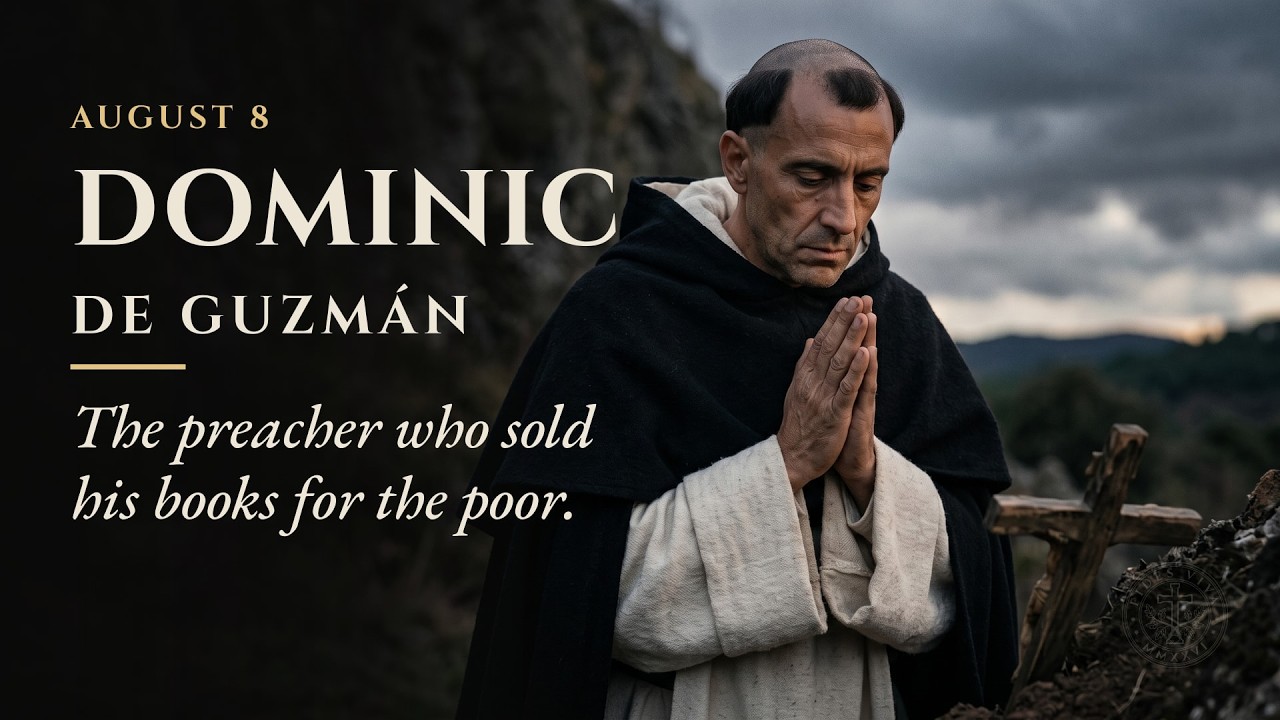
He sold his books. All of them. The manuscripts he had annotated in his own hand, the furniture in his room, what he had. With the money he gave food to the hungry, and when someone asked him why a student would part with his treasure, he answered with a phrase his brothers would repeat for centuries: "I do not wish to study from dead skins while men are dying of hunger."
It was not a sudden impulse. It was a deliberate choice, made by someone who knew exactly what those pages were worth and what those lives were worth more. From his mother's hands he had learned that bread is broken and shared; now he discovered that knowledge, too, must be broken and shared, that studying Christ on parchment means nothing if you do not recognize him in the one who hungers. Study did not cease to matter to him: it mattered in a different way. From then on, and forever, it would be a means, never a possession.
The gesture did not go unnoticed. In a city of ambitious students, a young man who gave away everything for people he did not know was a rare story, the kind that travels by word of mouth and reaches far. The gesture stayed in the memory of those who saw it, and with it stayed the question. He still commanded no one and decided nothing but his own affairs. But anyone could wonder what such a man would do on the day he had more than books to give.
The answer would begin in a stone choir, under a rule and a silence.
A Choir for Silence: Osma and the Regular Life
That choir stood in El Burgo de Osma, some days' journey east of Palencia, where the Ucero River descends from the mountains. He was around twenty-six when he entered the cathedral chapter — the community of priests who served the temple day and night. They were not loose clergy, each with his own house and income. They were canons regular, men who lived together as one family, with nothing of their own, under the Rule of Saint Augustine. It was an ancient rule, asking three simple things: one heart, goods held in common, prayer in common. Upon entering he received the tonsure, the shaven crown of the clergy, and a white choir habit.
A man who would shape his life stood at the head of that community: Diego de Acebes, the prior, later bishop of Osma. A Castilian with a broad face and firm will, one of those who reform whatever they touch. He had wanted a fervent chapter of true prayer and real discipline, and he sought men to match. The student who had given up his books for the hungry of Palencia was exactly that. Diego called him; he said yes.
The years at Osma kept the rhythm of the bells. Psalms at dawn, work, reading, psalms at midday, psalms at dusk. A life ordered like a furrow, made of repetition and silence. And at night, when the others slept, the church was not entirely empty. An oil lamp burned before the altar, and before the lamp, a man knelt. Those who came upon him unnoticed would tell afterward what they heard in that darkness: a groan, and a question repeated to Christ again and again — "Lord, what will become of sinners?" He wept at night for people he did not know, for those far from God and unaware of it.
The community recognized quickly what it had. They made him sacristan, keeper of the church and its lamps, and later subprior, the second of the house. He spent nearly ten years there. He could have spent forty: the choir, the rule, the golden stone, a tranquil old age among psalms. Nothing in that life asked to be abandoned.
But in 1203 a diplomatic mission called Diego, now bishop, to northern Europe. And Diego, who had to choose a traveling companion, chose his subprior. The shortest way north crossed the Pyrenees and entered Languedoc, the lands of the county of Toulouse. Neither of them knew what awaited them in those lands: a faith different from their own, spread through villages and cities, and a Church that almost no one listened to anymore.
The Sleepless Night: Toulouse and the Encounter
On the far side of the mountains, the world changed color. Languedoc was a rich land: vineyards ordered to the horizon, cities of merchants, towers of red brick along the banks of the Garonne. But beneath that prosperity ran another faith. People spoke of the "Good Men": they were Cathars, who taught that this material world was the work of a dark power, and that to be saved was to shed it. Their most austere preachers, the "Perfect," lived what they said: on foot, in worn tunics, in constant fasting. They were listened to. The Catholic clergy were seen riding past on horseback, well dressed, collecting rents — and in many villages no one listened to them anymore.
The Castilian party entered Toulouse as evening fell and sought lodging. The owner was a man of strong arms and easy manner, accustomed to travelers. And that same night, Dominic discovered that the man who gave him shelter, bread, and fire belonged to the faith of the Good Men. He could have kept silent. He was a guest passing through; the next day the road led north, and the bishop had a royal errand waiting. Instead of going up to sleep, he pulled a bench to the table and began to ask.
No one wrote down the words that crossed between them that night; what remained is the fact, and the fact is enough. They talked hour after hour, while the lamp consumed its oil. The innkeeper defended what he held, and he had reasons that stung: he had seen up close a clergy that was rich, distant, indifferent. Dominic did not deny them. He listened to the end, without interrupting, and answered slowly. He would speak to him of Christ, of a God who had made all things good, of a Church greater than its own sins. Without raising his voice. Without giving anything up for lost. When the other closed himself off, he did not push: he waited, and began again from another angle.
Outside the brick city slept. Inside, two tired men held, each in his own way, what mattered most. The jug emptied and no one refilled it. The eyes burned, the voice wore thin. Neither rose from the table. Neither gave the conversation up as finished.
And dawn came. Gray light entered through the window when the lamp had nothing left to burn. By that hour, the innkeeper had returned to the faith of the Church. No one forced him, no one humiliated him. He was not defeated: he was waited for. Twelve hours of patience accomplished what years of sermons had not.
Dominic left that house with something more precious than a victory: a certainty. Faith is not imposed; it is proposed. And to propose it takes time, closeness, the same table, the same bread. It takes someone willing to lose an entire night for a single man — and not to call it loss. That morning he understood something else too: work like this could not be done in passing, between two stages of a journey. It needed whole lives given to it.
The mission continued north, and he fulfilled his part. But the question traveled with him all the way: if one night had been enough for one man, what would it take for an entire land? The answer was going to cost him the comfortable life he still had. Because to speak as he had spoken that night, every night, he would have to live differently: without a horse, without money, without anything that would contradict the word. Barefoot, if need be. And toward that he was already walking, without knowing it yet.
Barefoot on the Road: The Radical Choice
Three years later, the road brought him back to the south. It was 1206, and in Languedoc the Church's official mission was sinking. The pope had sent Cistercian legates to recover that land, and the legates had arrived as the great always do: with retinue, with horses, with servants. No one listened to them. In Montpellier, disheartened, they crossed paths with the two Castilians, and Bishop Diego told them something no prelate had dared to say: the problem was not the message, it was the messenger. Against adversaries who lived poor, the word would only be credible from poverty. He proposed to dismiss the apparatus: to go out on foot, without money, begging bread from door to door. And so it would not be mere advice — he did it first: he sent his own retinue back to Osma and kept only what he wore.
Dominic stayed with him. And that day something ended and something began. The immaculate canon in his white surplice gave way to a wanderer in a coarse, faded, patched tunic, cinched with a cord. Everything he owned fit in the leather satchel at his side: the Gospel of Matthew and the letters of Paul. Nothing more. His feet, bare on the red earth of the Lauragais, cracked day after day until they hardened. His face and hands darkened in the sun; only his brow, in the shadow of his hood or his felt hat, kept its former paleness.
They began by speaking, village by village. In Montréal, in Fanjeaux, they accepted public disputations with Cathar preachers: entire days of argument before judges chosen by both sides, with the people listening. They came not to condemn anyone: they came to propose, Scripture in hand, that this world was a good work of a good God. Jesus Christ had come to save it, not to despise it. And from that preaching sprang, that same year, the first stone of all that would follow. At the foot of the hill of Fanjeaux, in a place called Prouilhe, Dominic gathered a group of women who had returned to the faith of the Church. Many had been raised as girls in Cathar houses and had nowhere else to go. He gave them a house, a life in common, a task: to sustain with their prayer what the preachers did on the roads. It was December 1206. No one knew it yet, but the first house of an Order that did not yet exist had just come into being.
The memory of the friars preserved one scene from those disputations, and they told it for generations. In Fanjeaux, the judges could not decide, and someone proposed a test: cast the writings of both sides into the fire, and let God show the truth. The Cathar books burned. Dominic's notebook leapt from the flames. They threw it back in, and it leapt again. Three times they tried, and three times it came out unscathed, as if the truth written in it had nothing to fear from fire.
At the end of 1207 came the blow. Diego had returned to Osma to set his diocese in order, and there he died, on the thirtieth of December. The teacher, the friend, the man who had called him to the chapter and dragged him to the roads, would not return. The legates gradually left the mission. The companions scattered. And Dominic, at thirty-seven, was left alone in a foreign land, holding a work that belonged to no one else anymore.
Shortly after, the land itself caught fire. In 1208 a papal legate, Peter of Castelnau, was murdered, and Innocent III called a crusade against Languedoc. At the head of the armies came a merciless baron, Simon de Montfort, and for years the war laid waste to villages, burned crops, besieged cities. Dominic took no part in any of it. From his dealings with Montfort, people would remember later a gesture of courtesy — a baptism, a wedding in the family — but he never walked with the armies. His answer to disagreement remained what it had been on that night in Toulouse: to arrive on foot, after the iron had passed, armed with nothing but the word. Where others rode past with naked swords, he entered barefoot, with a book.
So the years passed, from 1209 to 1215. He walked from village to village, listened, disputed, reconciled those who wanted to return. He fasted so much that the sinews stood out under his skin. And by night he sought out an empty church. Those who followed him told afterward what some caught sight of by chance: in the darkness, believing himself alone before a lamp, he could be heard groaning in the dark, the same plea as always for those who were far from faith. From that hidden weeping came, each morning, the patience of his days.
He had given up the horse, the money, the house, the friend. What remained to him were his two books, a staff, and a question that grew with each day's journey: one life was not enough for that land. Many were needed. And in Toulouse, without fanfare, a few men were beginning to want to walk with him.
A New Way of Living: Foundation and Rules
The first to give shape to that desire was the bishop of Toulouse, a Provençal named Fulk who had been a famous troubadour before he became a monk. He knew the power of words, and he recognized in that barefoot Castilian the preacher his diocese needed. In 1215 he entrusted him officially with preaching throughout his territory, and a neighbor of the city, Peter Seila, did something more: he gave his own house. For the first time in nine years, Dominic and his companions had a common roof. They were barely a handful. They prayed together, studied together, went out to preach and came back. They still had no name; they already had a way of living.
That same autumn, Fulk traveled to Rome, and he took Dominic with him. Innocent III, the most powerful pope of his century, had called a great council in the Lateran Basilica. Hundreds of bishops from all Christendom filled the wooden tiers, white mitres beneath golden mosaics. Among such purple, a preacher in a worn tunic came to ask for something unheard of: that a community dedicated only to preaching be approved. And the council, precisely, had just closed a door: to curb the confusion of so many new movements, it forbade creating new religious rules. Whoever wanted to found a community would have to do so within a form already in existence.
The piety of later generations would tell of a dream from those days: Innocent would have seen the Lateran Basilica tilt, about to collapse, and a small man in a poor habit holding it up with his shoulders. Upon waking, he would have recognized in Dominic that man. No one saw it happen that way, but it captures what Rome sensed in him.
What he did upon returning, we know for certain. In Toulouse he gathered his brothers and they decided together, as a community, the rule that would govern them. Dominic invented nothing: he chose the Rule of Saint Augustine, the same one he had lived by for almost ten years in the choir of Osma. He obeyed the council's norm, and within that ancient form he planted something new. His own constitutions placed study at the heart of common life, and allowed dispensing from any observance that would hinder preaching. Everything was ordered to a single end: to know Jesus Christ so as to be able to announce him, and to announce him in time.
Innocent died in the summer of 1216 without having signed anything. His successor was Honorius III, an elderly and conciliatory Roman, and that winter the answer came at last. On the twenty-second of December, 1216, a papal bull confirmed the community of Toulouse [sobreimpreso: "Religiosam vitam, 22 de diciembre de 1216"]. And weeks later, in January, another document called them for the first time by the name they would never leave behind: Order of Preachers. Ten years of roads fit into those three words.
By then the wanderer had changed clothes for the last time. A tunic and scapular of undyed white wool, and over it, when he went out, a black cape with hood: the habit the world would learn to recognize. He was forty-six years old, he had a house, a name, the blessing of Rome. Any founder would have taken a breath and put down roots. He looked at the small group of his brothers and began to think the opposite.
Founding Is Scattering: The Sending of the Brothers
What he was thinking, he said in Prouilhe in August of 1217, and it made no sense to anyone. The Order was months old and had sixteen men; some were very young, several had not finished their studies. Those who supported the mission begged him for prudence: consolidate the house, form them slowly, grow first and send later. He listened to all of them, as he always did. And on the fifteenth of August, the feast of the Assumption of the Virgin Mary, he gathered his friars and announced that they were separating.
His reason fit into a farmer's image, the kind you learn by watching fields: "Grain heaped together rots; scattered, it bears fruit." That was all the argument. A handful of wheat kept in the granary ends up lost; cast into the earth, it multiplies. Seven brothers would go to Paris; four, to Spain; others, to Rome and to Bologna; a few would stay, holding Toulouse and Prouilhe. Even his own brother by blood, Manés, was included in the division. The father who had taken ten years to gather a family unmade it in a morning, by conviction and not by defeat.
And it is worth seeing clearly what that meant. They left on foot, two by two, with no money, begging bread, toward cities where no one knew them and where their habit said nothing yet. They carried no guarantee at all: they carried the Gospels in their satchel and the name of Jesus Christ on their lips, which was all they had come to give. The destinations were not by chance either. Paris and Bologna were the two great universities of Europe, the places where the age did its thinking. He who had sold his books for the poor now wanted preachers who would study, men able to give reason for their hope before the most demanding minds of his time.
The morning the last group disappeared over the horizon, he was left almost alone. It could have been the end of a naive hope; it was the beginning of a multiplication. By the next year, the brothers in Paris had settled beside the university, in a house that took the name of Saint-Jacques and that in time would become a seedbed of theologians. In Bologna another community took root, among the law students. And he himself did not stay still: during 1218 and 1219 he walked half of Europe on foot—Rome, Toulouse, Paris, and his native Castile, where houses were born in Segovia and Madrid. He visited the scattered ones, encouraged them, corrected them, set out again. Thousands of kilometers in leather sandals, while the Order sprouted behind every farewell.
The scattered grain bore fruit. But the gesture of letting go opened a question that no founder before him had answered in this way: what holds together a family spread across half a continent? Without a father present in each house, without rents to secure the future, the Order needed another way to stay united: not that of a man who commands, but that of brothers who deliberate. To that he gave his last strength. He had four years of life left, and he was going to spend them learning—and teaching—how to govern by serving.
Governing by Serving: Chapters and Miracles
One of the stations on those journeys was Rome, where the Order had a house and where he also gathered a community of nuns at San Sisto. From those days the friars and the nuns kept an astonished memory, which was told from generation to generation. One afternoon there was nothing to eat in the convent: the alms-seekers had returned with empty hands. Dominic sent the brothers to sit at the table as if the food existed, and to give thanks. While they prayed, two young strangers entered the refectory with loaves, gave each friar his share, and disappeared without anyone seeing them leave. For men who had wagered their whole lives on Providence, that bread needed no explanation.
The same memory held another, darker day. Outside San Sisto, a young man named Napoleon, nephew of a cardinal, fell from his horse and lay dead on the stones. Dominic had the body brought to a room, knelt beside it and prayed at length; afterward he returned him alive to his family. A young woman of seventeen who was there, received by him at San Sisto, spent the rest of her long life telling what she had witnessed.
And from those same years comes another scene that Dominicans and Franciscans have treasured with affection, though the earliest writings do not record it. In Rome, Dominic is said to have met with Francis of Assisi, the poor man in his brown habit, and the two founders embraced. Two different paths, one same intuition: that the Gospel of Jesus Christ is preached first by the way one lives.
But his true work in those years was not the prodigies. It was a way of governing. In 1220 he called together the first General Chapter of the Order in Bologna: friars who had come from all the houses, gathered to decide together. There he had the chapter approve what he had lived for years: the renunciation of stable rents and property. The Order would possess nothing; it would live on alms, as each of his men lived, with no wealth but study and the word. During the sessions he claimed no seat of honor: he sat on the ground, among the rest.
The next year, at the second chapter, he went further still. He established that superiors would be chosen by the friars themselves, and major decisions made in chapters where each house had a voice. A family without an owner, governed by the deliberation of the brothers: something unheard of in the Europe of lords. And then, before all of them, he offered his own resignation as Master of the Order. The friars did not accept it. He had returned the power before anyone asked him to; authority, in his hands, was a service that could be set down, like everything else.
He was fifty-one years old and his body worn by fifteen years of walking. The fevers came back more often each time. What remained to be seen was how a man who never held anything back for himself would die. Only a few weeks were left to find out.
The Last Poverty: Death in Bologna
The summer of 1221 still carried him to Venice, to preach alongside Cardinal Ugolino. He returned to Bologna in late July, on foot under the heavy heat of the plain, and arrived burning with fever—his skin ashen and his lips already dry. Twenty years of walking, fasting, and nights without sleep were now catching up with him all at once. Even so, that night he went on speaking with the brothers of the things of God, as he had always done, until the fever overcame him. By dawn he could not rise.
The heat of August pressed down on the city and the fever would not break. He knew he was dying, and he asked to be taken to Saint Nicholas of the Vineyards, to die among his own, in the house of his brothers.
There it became clear what twenty years of a life given away had left in his hands: nothing. He had no place of his own in which to die: they took him in to another friar's room. He had no bed: they lent him a pallet of boards that belonged to someone else. And because the habit he wore was worn thin by the road, they put on him the white habit of a young brother, borrowed as well. The founder of an Order already spread across half of Europe was dying on what was borrowed, dressed in what was borrowed. It was not an accident. It was the last page of a choice made long ago, in an inn in Toulouse and on the roads of Languedoc.
He gathered the brothers around the bed and left them his whole inheritance in a single sentence: "Keep charity, guard humility, possess voluntary poverty." A whole life spent announcing Jesus Christ fit into those words. There was no more testament because there were no more goods: what he left them was, exactly, what he had lived before them.
The friars wept. They were men hardened to the elements and to hunger, and they wept like sons. Through the fever, he looked at them and consoled them with a strange promise, spoken with complete calm: "Do not weep: I will be more useful to you after my death than in life." He was going, and his first thought was the comfort of those who remained.
When he felt the hour drawing near, he asked them to begin the Subvenite, the prayer with which the Church sends off those who depart. Come to his aid, saints of God; go forth to meet him, angels of the Lord. A score of voices, hushed, in the narrow room, while the afternoon faded. And as the words rose, he ceased to breathe. It is August 6, 1221. He is fifty-one years old.
Then came silence, and the light of August on the floor of the cell. He left no house, no book, no bed, no coin: poverty in him had not been a discourse, and at the end, quite literally, there was nothing of his own to give away. And yet he left what no inheritance can buy: hundreds of brothers scattered through Paris, Bologna, Rome, Segovia, Madrid, and Toulouse, in the same habit and the same task. That afternoon no one knew what would remain of a life like that. It began to be seen in the years that followed, and it has not stopped being seen since.
The Grain That Bears Fruit: Legacy and Contemplation
Twelve years after that afternoon, his brothers opened the tomb to move the body to a more fitting sepulcher. Those who were present always remembered the fragrance that rose from the wood as they opened it. That same year the process began: in Bologna and in Toulouse, friars and lay people who had known him declared under oath what they had seen and heard. And on July 3, 1234, Pope Gregory IX inscribed Dominic de Guzmán among the saints of the Church.
The grain, meanwhile, went on bearing fruit. From that Order born to announce Jesus Christ through study and the word came Thomas Aquinas, who taught the faith to be reasoned through, and Catherine of Siena, who spoke without fear to the powerful. From it came also Martin de Porres, who served the poor of Lima. His body has rested since then in Bologna, beneath a white marble ark where sculptors carved his story: his miracles and the sending of the brothers. And eight centuries later, his sons continue to study, to teach, and to preach in more than a hundred countries of the world.
Two centuries later, the piety of the faithful would also come to say that the Virgin herself gave him the Rosary in Prouilhe, as a weapon for his preaching. The scene does not appear in the memories of his first brothers; but it holds a truth that they did know: all his word was born from prayer, and to pray for those who did not believe was always his first work.
At the beginning there was a lamp on a table, and a man who did not rise from it. That question—whether a life can be changed by a conversation that is not abandoned—Dominic answered with his whole life: one night for a single innkeeper, and from that table an Order that still walks emerged.
We too know that table: the conversation with someone who thinks differently, the one we are tempted to abandon before dawn. His answer is already given. Ours remains open, tonight.
The lamp of that inn has not gone out.
Saint Dominic de Guzmán, preacher of the truth and father of preachers, pray for us.