Hook + C1
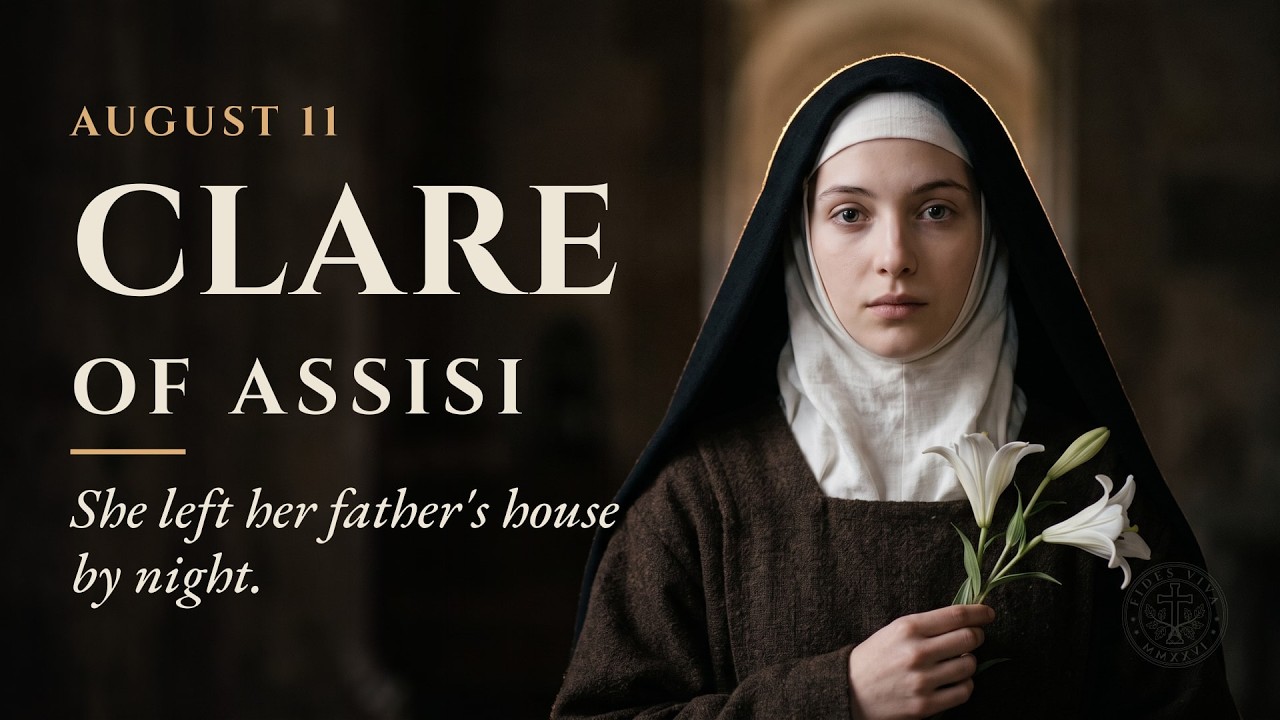
It is night and the house is asleep. A young woman of eighteen comes down the stairs without a sound. She leaves behind the great gate, the one for visitors and suitors, and pushes open a side door. She carries a dark mantle and a palm blessed that same morning. At the end of the road, friars are waiting with candles.
And a pair of scissors.
It was Palm Sunday of 1212, and the girl who had just slipped out was the heiress of one of the most powerful families in Assisi.
Inside the chapel someone lifts the scissors. What is heard then does not sound like a ceremony: it sounds like metal against hair. When it is over, there are golden braids on the floor, and nobody bends down to pick them up.
A few days later her family came for her. There were pleas first, and threats after. She answered without raising her voice, because the cut hair had already said everything. The men went home without her.
And that was only the beginning. That girl was about to ask Rome for something no monastery ever asked for. Not lands. Not revenues. The right to have nothing. A tiny, scandalous request that would cost her forty years of fighting. A pope offered to release her from her promise. She said no.
Her name was Clare. Clare of Assisi.
To understand what pushes an heiress out through that door, we have to go back to the city where she was born, when a family name served as a shield and as a target.
Central Italy, at the turning point between two centuries. Assisi climbs the slope of Mount Subasio in steep streets of rose-colored stone, bristling with towers: each tower is a noble family watching all the others. Below, in the piazzas, merchants count new coins and dream of new power; above, knights guard shields, lineages, and old grievances. The entire city—the entire age—is learning to measure people by what they possess.
In that world, beside the Cathedral of San Rufino, in one of the noble houses in the upper part of the city, a girl is born around the year 1193. Her father, Favarone di Offreduccio, is a knight of the great families of Assisi. Her mother, Ortolana, is a woman of deep faith: she has made pilgrimage to Rome, to Santiago de Compostela, and even to the land where Jesus walked. She has returned with her gaze transformed. The daughter is given a name that sounds like a promise: Chiara. Clare. Bright.
That light knows darkness soon enough. In 1198 the people of Assisi rise against the nobility: they tear down the fortress of the Rocca and assault the houses of the great families. The Offreduccio family must flee to Perugia, the rival city, with what fits in a few chests. The girl grows up there, among armed men and conversations in low voices, learning too early that a name can be both shelter and a target. When they finally return, Assisi is still at war with Perugia. The peace of her childhood is barely a truce between bells of alarm.
And yet, inside that house of stone, something different grows in silence. The women who would grow old at her side decades later still spoke of it with wonder: the girl kept count of her prayers on a knotted cord she carried hidden, the way other girls hide a treasure. She spoke with Jesus without anyone telling her to. And she set aside food from her own table—the white bread of the lords—to have it brought, in a bowl, to the poor of the city. From her mother she had learned to give alms. No one had taught her to do without what was hers; that came from within her alone.
Her future, though, had been written by others. A daughter of the Offreduccio family existed to seal alliances: a generous dowry, a convenient marriage, sons to carry on the line. In the house there were looms and cloth dyed green and red, embroidered belts, fine linen veils; everything spoke of what she would become. But the girl looked elsewhere. That could not be explained by any privilege of birth. No one in the house could explain it then.
Meanwhile, down the street, in that same city, a young man older than she was about to make her understand. He was the son of a merchant, and he sold the fine cloth that families like Clare's bought. No one beyond Assisi yet knew his name. Soon there would be no one who did not speak it: Francis.
The Secret Meeting and the Decision
A few years later, the merchant's son was the scandal of Assisi. He had stripped himself of everything—even his clothes—before the bishop and half the city, to give them back to his father; now he wore a tunic of rough cloth, rebuilt ruined churches with his own hands, and called lepers his brothers. Some thought him mad. Others were beginning to follow him. And when he spoke of God, even those who mocked him fell silent for a moment.
Among those who heard him was a girl of seventeen from the upper part of the city. What Francis preached was not a new doctrine: it was the Gospel as it had always been, spoken as though it had just happened—that the Son of God had chosen to be born with nothing and to die with nothing, that the poor Christ was the hidden treasure worth selling everything to find. The girl who had hidden bread in a bowl heard, for the first time spoken aloud, her own secret.
She wanted to speak with him. But an heiress of the Offreduccio could not cross the city to meet with the son of a merchant who slept among stones. So she would slip away in secret, accompanied by her friend Bona di Guelfuccio, while Friar Philip, one of Francis's friars, would guide the meetings. In those conversations in hushed tones, under the arch of a wall or among the olive trees of the outlying fields, Francis offered her no safety. He spoke to her of leaving the world for love of Jesus Christ, of a life without a dowry, without walls of her own, without anything to defend. She listened with her heart racing ahead of her reason. And she, who had suitors waiting and a name that weighed like armor, would return home each time with fewer doubts and more vertigo.
Palm Sunday came in 1212. The Cathedral of San Rufino, just steps from her house, filled with the whole city dressed for the feast. One by one, the ladies of Assisi approached the altar to receive the blessed palm. Only one remained in her place, still, eyes lowered, as though already taking leave of it all. Then Bishop Guido did something no one expected: he descended the steps of the altar, crossed the nave, and placed the palm in Clare's hand. No one asked why. Perhaps he alone, in all the cathedral, knew what that palm was sealing.
That very night, when the house fell silent, she did not leave by the main gate, where the family's honor stood guard. She left by the small door, wrapped in a dark mantle, with the palm still warm from the incense. She descended the steep streets without a torch, crossed the city walls, and followed the dirt path that led down toward the plain, between black olive trees under the stars. Eighteen years of lineage, of fine cloth and a written future lay sleeping behind her.
She did not know what waited for her on the other side of that night. She knew whom she was going to find. And below, among the holm oaks of the plain, a response was already trembling: small lights kindled beside a tiny chapel, candles of friars keeping vigil.
The Cutting of Hair and the New Life
The low door opened and received her in a glow of burning wax. Inside, the Porziuncola was barely four walls of rough stone and an altar; the friars formed a semicircle with candles in their hands, and the forest held its silence around them. No one spoke grand words. Before the altar, the young woman took off her mantle, and the feast-day dress shone for an instant in the light of the candles. For the last time.
Then Francis took the scissors. In the silence of the chapel, the smallest and most final sound of that night was heard: metal cutting through hair. The golden braids, undone, fell onto the stone, strand by strand, still golden in the light of the candles. No one gathered them in that moment. They lay there, on the floor, the way an entire life is left behind.
Then they clothed her in a tunic of rough undyed cloth, a cord knotted at her waist, and a dark veil over her shorn head. There was no dowry, no order, no monastery waiting for her. That night she ceased to belong to a lineage and began to belong to the poor Christ, and that belonging was, for now, her only home.
But a woman could not live among friars, and Francis had no place for her yet. That same night they brought her to the Benedictine monastery of Saint Paul of the Abbesses, near Bastia, in the plain. There, within days, it caught up with her—what she had left sleeping in Assisi: the men of her house, determined to bring her back.
First they pleaded. Then they threatened. They spoke to her of dishonor, of the family name, of the marriage that awaited her. She resisted without returning a single harsh word, firm as they had never seen her; the shaved head beneath the veil said what no longer needed saying. The men returned to Assisi empty-handed, and she moved soon after to a quieter refuge: Sant'Angelo di Panzo, a hermitage of nuns on the slope of Mount Subasio, among oak groves.
Sixteen days after the flight, someone called at the door of Panzo. It was Catherine, her younger sister, fifteen years old. She had made the same journey, alone, to ask for the same life. And this time the family did not come to plead.
San Damiano kept the memory of that morning forever. The armed relatives, with Uncle Monaldo at their head, burst into the hermitage to tear the girl away and drag her off. They seized her, pulling her down the slope; and suddenly that slight body became heavy as the mountain stone, impossible to move for so many men together. Monaldo raised his arm to strike, and his arm went rigid, seized by pain. They released the girl and departed. Her sister picked her up from the ground, embraced her, and no one ever came to claim her again.
Francis cut her hair too and gave her a new name: Agnes, like the gentle lamb that no one could drag away.
A home was still needed. Francis had it ready all along without knowing it: San Damiano, the small ruined church that he himself had rebuilt stone by stone in the early days of his conversion, on the slope among the olive groves, on the outskirts of Assisi. There the two sisters settled. Bare cells, a low-beamed dormitory, straw mattresses, a walled garden and, below, the Spoleto Valley opening like a promise. Neither of them would ever own anything again. And neither of them ever looked back.
They were not alone for long. Other women from Assisi began to knock at that door: noble and simple, young and widowed, drawn by a life that offered nothing and gave everything. With the years, even Ortolana, the mother, now a widow, would cross that threshold to live under the obedience of her own daughter. The community of the Poor Clares was being born, without proclamation, in silence.
Around her twenty-first year she had to accept, by pure obedience, what she had never asked for: the title of abbess. She bore it in her own way, more as a mother than as a ruler, serving before commanding. And an early memory of the Order records that by then she had obtained from Pope Innocent III, by word of mouth, something no monastery had ever asked for: the right to own nothing, not even in common.
Because everyone petitioned Rome for protection, lands, secure revenues. She asked for the opposite. And that petition, so small and so scandalous, would cost her forty years of struggle. The community grew; the fight for the meaning of poverty was only beginning.
The Struggle for Poverty and Faithful Friendship
Rome did not take long to notice that house. In 1219, Cardinal Hugolino of Segni, protector of the new monasteries of poor women, drew up for them a rule in the Benedictine manner: prudent, ordered, designed to endure centuries. Clare accepted it out of obedience. But the text was silent on the one thing that mattered to her above all: the right to own nothing. For the lawyers of the curia, a monastery without revenues was an imprudence that needed correcting. For her, a monastery with revenues was something else—not what she had promised to the poor Christ. She did not break with anyone or raise her voice: she kept her conviction as one keeps a coal beneath ash, neither extinguishing it nor showing it, and waited as long as necessary.
In the summer of 1225, that coal gave warmth to another. Francis arrived at San Damiano sick, worn down, nearly blind: his eyes, raw with sores, could bear the light of day no longer. Thirteen years had passed since the night of the scissors, and now it was he who needed shelter. The sisters prepared a small reed hut for him beside the monastery, and Clare tended him as one tends a father and a friend: with silence, with cloths of water, with food he scarcely touched. And there, in the darkness of those eyes that could no longer see, was born the most luminous song of his century: the Canticle of the Creatures. Brother Sun, Sister Moon, Sister Water, humble and precious and chaste. The man who could not look upon the world blessed it entire from Clare's garden. The enclosure that seemed barren had given soil to song.
A year later, on the fourth of October, 1226, Francis died at the Porziuncola, on bare earth, as he had lived. And the procession bearing his body toward Assisi turned aside from the road and climbed to San Damiano. The grille of the monastery, the one that separated the sisters from the world, opened wide. And through it passed, on a bier, the friend. The Poor Clares saw him for the last time; they kissed his hands marked with the wounds, they wept without outcry, as one weeps in a poor house. Clare stood at the front, holding her daughters and held by no one. She was about thirty-two years old. She had twenty-seven years left to live, all of them without him. From that day forward, keeping poverty intact was no longer only a conviction: it was a fidelity.
The greatest trial came dressed in purple. Cardinal Hugolino was now Pope Gregory IX, and he still thought the same: a house of women without revenues could not sustain itself. He wanted to solve it with a father's generosity: he offered her secure possessions. And seeing her resistance, he offered something more: to dispense her from her vow himself, to free her by his own authority. Clare's answer was engraved forever: "I do not wish in any way to be dispensed from the following of Christ." Before that firmness, the pope yielded. On the seventeenth of September, 1228, he granted San Damiano the Privilege of Poverty: a papal document, with his leaden seal, that granted no lands, no revenues, no protection. It granted the right to own nothing.
And daily life began to show that this folly could stand. Years later, the sisters who grew old at her side would tell it again and again: the morning when there was only one loaf for fifty, and the mother ordered it broken and blessed, and they all ate until full; the empty flask of oil that appeared filled; the sisters who fell sick, and even children from outside, healed when she traced the sign of the cross on their foreheads. And they remembered too what was not a miracle and said the same thing: the abbess on her knees at night, washing the feet of the sisters who returned from begging. She governed thus, from below, with a basin.
But her own body was beginning to exact its price. Since 1224 sickness had not released her; each year thinner, paler, more time on the straw mat than on her feet. And meanwhile, beyond the olive groves, the emperor and Rome declared war on each other, and armies began to move toward the Spoleto Valley.
Siege, Illness, and the Miracle of Silence
And yet her voice had never reached so far as in those years. In 1234, a messenger brought news to the grille from Bohemia. Agnes, daughter of the king of Bohemia, sought in marriage by the emperor himself, had said no. She had built with her dowry a hospital for the poor, had founded beside it a monastery of Poor Clares, and had entered herself, a princess, to live with nothing. Now she sought counsel, and she sought it in Assisi.
Clare wrote to her. Four letters over nearly twenty years, the most intimate thing that flowed from her pen. She taught her to gaze upon the poor Christ as one gazes into a mirror: "Place your mind before the mirror of eternity, place your soul in the brilliance of glory, place your heart in the figure of the divine substance, and transform your entire being, through contemplation, into the image of the Godhead itself." In the last letter she would call her the half of her soul. A woman who barely left her straw mat wrote with ink and parchment across more than a thousand miles to guide a princess. Her cell had no walls inward.
But the war that circled the valley came to her door at last. The emperor Frederick II and Rome were locked in open war, and among the imperial armies served Saracen mercenaries, feared throughout Italy. In September of 1240, a company fell upon San Damiano. They leapt the wall, entered the cloister. The shouts reached the cell where the mother, sick now for sixteen years, could barely move.
Those who were there never forgot it, and they always told it the same way. Clare asked to be carried to the door, before the invaders. She had the small silver and ivory box brought, the one where the Blessed Sacrament was kept: there was no other treasure in all that house. Held up by her daughters, she prostrated herself before Christ present in that small portion of consecrated bread, and prayed for the sisters whom he had entrusted to her. The armed men hesitated. They drew back. They vaulted the wall again and vanished among the olive groves, without anyone pursuing them. Not a sword drawn, not a drop of blood. A dying woman on her knees had been enough.
A year later, another army, that of Vitale d'Aversa, laid siege to Assisi itself. Behind those walls on the hillside, the community fasted and prayed for the city that had seen them born. The siege lifted without Assisi falling, and the whole city attributed it to the prayer of the poor women of San Damiano. It never forgot that debt.
The next blow came not from an army, but from Rome. In 1247, the new pope, Innocent IV, a great jurist, imposed upon the monasteries of Poor Clares a rule written by him, which permitted holding goods in common. It was, once again, prudence against the promise. Clare was fifty-three years old, half of them spent in sickness, and had no intention of yielding. Her answer was the boldest of her entire life: if no rule said what she had promised to Christ, she would write it herself. No woman had ever seen her own rule approved by the Church. From her straw mat, word by word, she composed her own form of life: absolute poverty, without possessions even in common, work of the hands, silence, tenderness among sisters. Everything learned from Francis, set down at last in writing so that no one could erase it.
Christmas Eve came in 1252, the last she would see. The sisters went down to the choir for the office of Christmas; she had no strength even for that. Alone in the dark cell, she grieved before the Lord that she must miss the feast of his birth. The monastery kept the memory of that night forever: from her bed, Clare saw and heard the Mass that the Friars Minor celebrated in the Basilica of Saint Francis, on the other side of Assisi. The chants, the lights, the altar. As if distance had folded itself through love for a sick woman. The woman who had not left those walls for forty years had seen the distant without moving from her bed.
After that night, the sound of the world began to fade, like footsteps moving away. What remains when the body fails and everything seems about to be lost? In that cell there remained three things: a straw mat, a parchment without a seal, and a hope that no longer depended on the body. The Rule was still unapproved. And Clare's time was running out.
The Rule and the Final Threshold
The summer of 1253 came to San Damiano with the white light of August and news that no one expected: the pope was coming to see her. Innocent IV, the same jurist who six years before had imposed on her a rule not her own, climbed the olive-covered slope to the poorest monastery in Italy. The most powerful man in Christendom knelt beside the straw mat of a woman who owned nothing. She asked him the only thing left to ask in this world: that he approve her form of life, the one she had written word by word from her bed. And the pope, before that gaunt face that had not yielded for forty years, ceased to resist.
On August 9th, the bull was sealed. Solet annuere: the Church is accustomed to grant what is asked of her with rectitude. A parchment with a lead seal hanging from silk cords, and within it, entire, the Rule of Clare. For the first time in the history of the Church, a form of life written by a woman received the approval of Rome. When the document reached her hands, she could barely speak. The sisters remembered afterward that she kissed it, and never let it go: she held it pressed against her chest like a mother holding a newborn child. Forty years of waiting fit into that piece of sheepskin.
Now she could go. Yet she lingered two more days, and filled them with farewells. Around her straw mat gathered her daughters, and also some elders in brown robes. They were the first companions of Francis, the ones who had held the candles at the Porziuncola the night everything began. The circle was closing. She blessed her sisters, those present and those living far away, in Prague, in Florence, in so many houses she would never see: "Always love God, and your own souls, and all your sisters."
Those who kept vigil beside the bed treasured as a sacred thing what they heard in those final hours, and so they told it always. At one moment, they saw her move her lips, speaking very low, as to someone very near. The sisters understood then that she was speaking to her own soul, and that she was bidding it farewell. She was telling it: "Go in safety, my soul, for you have a good escort for the journey." No fear. After a lifetime of letting go, death was only the last small door to pass through in the night. On the other side awaited not darkness, but Christ, the poor Bridegroom she had followed since she was eighteen. And still they heard from her one more thanksgiving, the simplest possible: "Blessed are you, Lord, who have created me."
On August 11th, 1253, with the light of August coming low through the single window, Clare of Assisi gave up her soul. Without visible agony, without a cry. The sisters, kneeling in silence, saw how the face that illness had sharpened for twenty-nine years fell into a peace that none of them could describe without tears.
There remained a poor house, a handful of women with their hearts broken, and a parchment safe forever. The foundress had gone; the form of life would not. And what Assisi did with her in the hours that followed was no longer a mourning: it was the beginning of another story of light.
Concealment and Light: The Legacy of Clare
That same autumn, an envoy of the pope climbed the olive-covered slope. Bartholomew of Spoleto came with notaries and parchment, and sat beside the grille to listen. One by one, the sisters of San Damiano told what they had witnessed over forty years: the bread that fed fifty, the pyx held high before the assailants, the abbess on her knees washing their feet. Sister Philippa spoke more than any other. Twenty declarations, taken down word for word: the memory of a poor house, written down so it would never be lost.
There was no need to wait. On August 15th, 1255, barely two years after her death, Pope Alexander IV canonized her in Anagni. The bull played with her name from the very first line: Clare, clear by her life, clearer still after her death. The girl who had hidden bread in a bowl was now a saint of the universal Church.
And then the woman who had lived hidden went into hiding once more. In 1260 her remains left the Church of San Giorgio for the new Basilica of Saint Clare, built in the rose stone of Mount Subasio. They buried her so deep beneath the high altar that no one could reach her. Six centuries of silence. Meanwhile, her image took shape on the walls: the panel of 1283 with eight scenes from her life, the fresco by Simone Martini in the basilica of her friend Francis. Everyone painted her the same: undyed grey-brown habit, white coif, black veil, the oval face serene.
Until 1850, with the permission of Pius IX, picks opened the sepulcher. The flesh and the robes had turned to dust; the skeleton lay intact. What was hidden came back into the light. Years later, among her relics appeared a parchment in which some wished to recognize the original of that bull which, the story goes, she held pressed against her chest when she died. Today her reliquary body rests in the crypt, in a case of crystal and Subasio stone, beneath a golden half-light where kneeling worshippers are always present.
To the modern world too her name came. In 1958, Pius XII remembered the sick woman of whom the sisters told—that one Christmas Eve she saw and heard, from her bed, the Mass celebrated far away—and declared her patroness of television: the woman of silence, guardian of the screens. And in 1989, John Paul II canonized Agnes of Prague, the princess of her letters. Seven centuries later, the Church confirmed that friendship which had crossed Europe from a cell with nothing.
A life hidden, twice buried, and yet never extinguished. The Poor Clares pray today on five continents, and the lamp she lit in San Damiano still burns. There remains one last question, the first of all.
What We Do Not Possess
The question with which everything began remains open: what draws someone to give up everything when they have everything? Clare answered without words. Her answer was to slip out at night through a small door. And to wait forty years, sick for half of them, for a parchment to grant her the right to own nothing. Her empty hands held the whole of Christ; that was all her wealth.
We too live with our hands full: the closet that no longer closes, the screen we cannot set down even at the table, the purchase that consoles an afternoon and weighs on us the next day. How much of what we grip has been closing our hands?
She kept hers open to the end. In San Damiano, the light of August still enters each year through the same small window, over the bare stone where there was never anything to steal. Eight centuries later, her form of life still stands.
Saint Clare of Assisi, mother and lawgiver of the Poor Clares, mirror of poverty, patroness of television, pray for us.