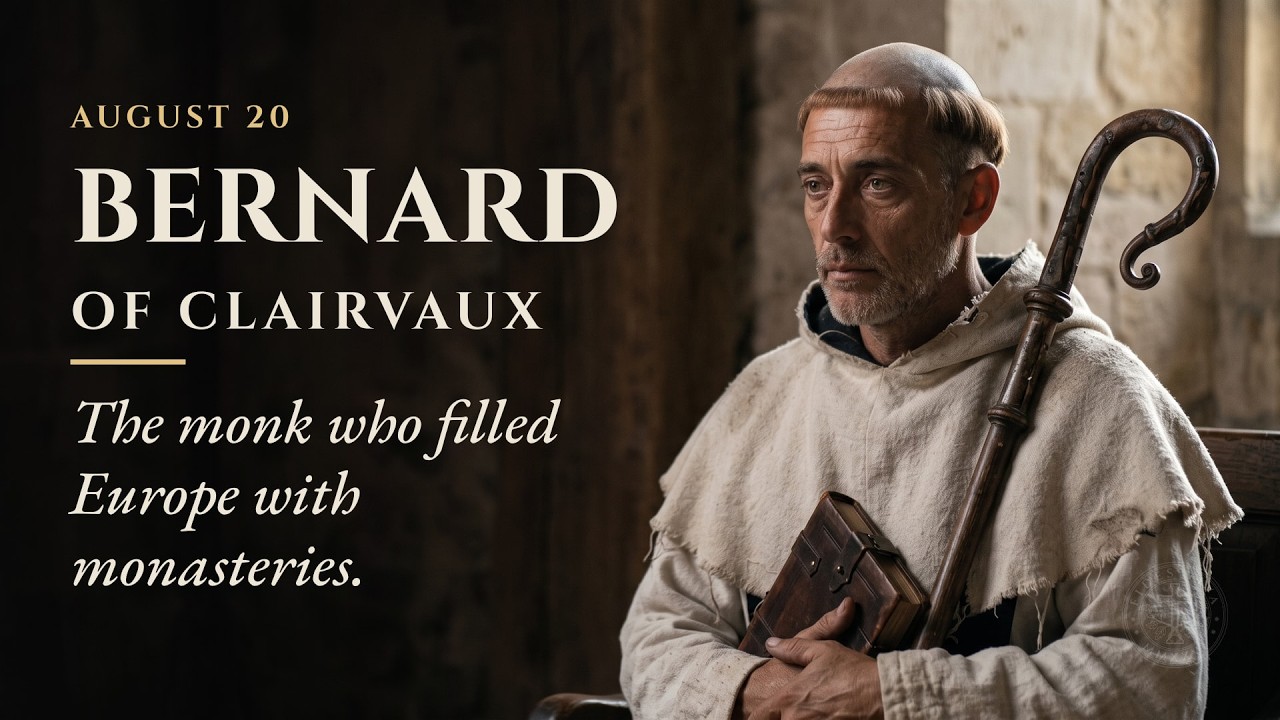
It was night in a hidden valley among forests. A man dressed in white wool wrote by candlelight in a cell of bare stone. He was so thin that the hand over the parchment seemed made of bone. Then he stopped. He set down the quill.
Outside, at the monastery door, a messenger waited. He carried the seal of a king.
He was not the first. They came from Rome, from Paris, from the cities of the Empire, all seeking the same thing: his word. It was the twelfth century, and this sick monk, abbot of a poor monastery in a valley of Champagne, was the most listened-to man in Christendom. Popes asked his counsel. Kings opened their doors to him. Councils waited for his voice.
And he, when he entered the cloister, had asked for one thing alone: to disappear. Silence. It was the only thing the world never granted him.
He settled a schism that split the Church in two. He preached a crusade before a king and an emperor. He stood between an armed crowd and the homes of the Jews of the Rhine. And he wrote of the love of God as no one had written since the early Fathers of the Church.
His name was Bernard. Bernard of Clairvaux.
But before the cell, before the letters and the kings, there was a hill in Burgundy, a castle, and a child whom no one imagined would become a monk.
The Dream and the Promise: Born for Another Destiny
The eleventh century was drawing to a close. It was a world of vineyards and forests, of stone fortresses and bells that marked time before clocks existed, where power was measured in swords. The Church was waging a long struggle for its freedom from the princes, and in the great monasteries gold burned in splendid liturgy. But beneath that splendor a different thirst was growing: for a faith more bare, more poor, more like the Gospel itself.
So Cistercian memory tells it: in the castle of Fontaine-lès-Dijon, on a hill that overlooked the plain, a woman heavy with child dreamed of a small white dog, reddish on the back, that barked without ceasing. The dream troubled her, until the family came to understand it as a promise: the son she was carrying would be a guardian, and his bark would defend the house of the Lord. She kept those words in her heart.
Around 1090 that child was born, and they named him Bernard. He was the third of seven children of Tescelin the Red, a knight of the Duke of Burgundy, and of Aleth de Montbard, and he grew up within walls built for war, walls that smelled of leather and hearth smoke.
The house was one of arms, but its soul was hers. Aleth dressed as a noblewoman and lived almost as a nun. She carried bread to the poor with her own hands, and raised her seven children in the faith before anything else. From her the boy received his first piety. That woman of quiet voice was his first school, and the deepest one.
Around the age of ten they sent him to Châtillon-sur-Seine, to the school of the canons of Saint-Vorles. Cold halls of golden stone, narrow light, wax tablets and stylus. There he learned grammar, rhetoric, and dialectic, and learned them with an ease that foretold a brilliant career in letters. The pale boy, tall, with blue eyes and a fixed gaze, loved words: their music, their weight, their edge. Those who saw him imagined for him a bright future: letters, the court, perhaps his father's arms. Any destiny but a cloister.
And then, around 1107, Aleth died. Her son was about seventeen. The woman who had been the silent center of the household faded, and with her faded the world as the young man knew it. The studies were still there, the roads still open, the future still promised. But inside something else had opened: a wound. And in the depths of that wound, a question he could not yet name.
For six years he carried it with him. From Châtillon to Fontaine, among books and roads, among brothers made for his father's arms, the grief worked in silence, as water works stone. Little by little, that question began to have a direction. No one in the house suspected where. And no one suspected, above all, that when that young man at last gave his answer, he would not give it alone.
The Renunciation That Draws Others: Thirty Doors Close
The answer came in 1113. And it did not come alone.
Among all the monasteries of Burgundy, the young man had chosen the most unlikely: Cîteaux, a recent foundation lost among marshes and forests, where a handful of monks were attempting to live the Rule of Saint Benedict without compromise. No gold on the altar, no rents, no splendor: work, fasting, silence. Life there was so harsh that vocations barely came, and the entire reform was dying for lack of hands. Precisely for that reason he chose it: he wanted a place where nothing stood between the soul and God.
Any other would have departed in secret, before dawn, before the family could stop him. He did the opposite: he spoke. He spoke with his brothers, with his uncles, with his friends, one by one, with that word of his that already burned. One by one he persuaded them, until that word of his made desirable what to anyone else would have seemed a loss beyond remedy. Gerard, the soldier of the family, resisted with force; he too ended by yielding. When the group at last set out on the road, they numbered thirty: brothers, kinsmen, companions from his studies and from arms. Thirty doors of Burgundian nobility closed at once.
At the gate of the monastery the horses were left behind, the swords, the fine fabrics. The noble cloaks gave way to the tunic of raw white wool, undyed: the wool of the poor. In time came also the tonsure: the shaved crown and the narrow ring of hair that marked the monastic tonsure. Stephen Harding, the English abbot who ruled the house, saw thirty novices enter a monastery that was dying. The reform that was fading had just received its future.
In the novitiate, the newly arrived man repeated a question to himself as one sharpens a blade: "Bernard, why have you come?" He would ask it all his life, in the cell and on the roads. It was his way of not forgetting that he had come to seek God, and God alone.
Two years sufficed. On June 25, 1115, Stephen Harding sent him with twelve monks to found a new house in a valley of Champagne that was called the Absenta Valley: a narrow place, dark, with wooded slopes and unyielding soil. They renamed it with a name that was almost a profession of faith: Clairvaux. Clear valley. The abbot of that settlement of huts was about twenty-five years old.
The beginnings were of a poverty that frightens. They raised huts of wood and earth, cleared the hillside with their hands, sowed late and harvested little. There were winters when bread grew so scarce that they cooked beech leaves to deceive hunger. And yet they sang. Seven times a day they left the spade and returned to praise, because that was why they had come: so that no hour of the day would pass without God. In that want there was a joy that no one ever quite knew how to explain.
The young abbot demanded much, and of no one more than himself. He fasted beyond what reason allowed, slept barely, treated his body as an adversary. That excess ruined his stomach forever: from then on he would live sick, almost skeletal, sustained by an energy that did not come from the flesh. Until William of Champeaux, the bishop of the region, intervened with a father's authority: he imposed on him what he would never have granted himself—a whole year of rest, a cell apart, a diet. Bernard obeyed. And in that obedience he learned the lesson he would later teach to half of Europe: penance is not the goal. The goal is love.
His monks would later recall that one day his sister Humbeline came to the valley, married to a nobleman and dressed in fine fabrics and jewels, with a retinue that filled the road with color. Her brother rebuked her with a harshness that wounded her. But the wound worked inward, as it had worked in him: she returned home transformed, changed her life, and ended by taking the black habit of the Benedictines at Jully. The Church venerates her today as a blessed. The pull of that man did not stop at the cloister door: it reached even those who came only to visit.
One man had set thirty alight; the thirty were now kindling whole regions, and vocations came to the valley as water comes to an open channel. Among the creaking of snow and the chanting of matins in Latin, in that hidden corner of Champagne, a voice was ripening. Very soon it would be sought from far beyond the valley.
From the Cell to the World: The Voice That Did Not Wish to Be Heard
The first to knock at the door were the bishops. In 1128, a council gathered at Troyes was examining something that had not existed before: knights who had sworn to protect pilgrims in the Holy Land and wanted to live as monks without laying down the sword. No one knew what to do with them. The abbot of Clairvaux was summoned, listened, and helped give shape to the rule of that new militia which history would call the Temple. For them he wrote afterward a treatise, In Praise of the New Knighthood, where he warned them that the first battle, the decisive one, is fought within the human heart itself.
That journey seemed a parenthesis. It was an announcement. Two years later, in 1130, Pope Honorius II died, and in Rome two rival elections proclaimed two popes at once: Innocent II and Anacletus II. All of Christendom split into two obediences. Kings, cities, and monasteries had to choose a side, and to choose wrongly could cost kingdoms and souls. Innocent, driven out of Rome, crossed the Alps seeking support. And in the midst of that confusion, the gaze of everyone began to turn toward the same point: a hidden valley of Champagne.
The King of France called a council at Étampes to decide which pope the kingdom would follow. And something unheard-of occurred: bishops and lords agreed to entrust the discernment to a monk without a see, without purple, and without an army. The gaunt abbot of Clairvaux studied the facts, prayed, and spoke for Innocent II. When he spoke, the kingdom followed him. From that day onward, without seeking it and without wanting it, he began to be the arbiter of Christendom.
Eight years of roads followed. On the back of a mule, in a cloak of rough wool covered with dust, he traveled through France, Italy, and the lands of the Empire, defending the cause of unity city by city, court by court. He spoke before kings and won their allegiance. He spoke before the emperor, and the Empire too bowed. He entered Pisa, Milan, Rome, and multitudes came out to the roads to see the white monk pass. In the halls where the fate of Europe was decided, among cardinal purples and royal ermine, his tunic of raw wool was the only white in the scene. He had no armies or treasures. He had a word that burned, and a life that backed it entirely. In 1138 the schism faded at last. The Church had one shepherd again, and half of Europe knew whom it owed for it.
From then on no one left him in peace. Bishops tangled in disputes wrote to him, abbots with doubts, princes with quarrels, and even the popes asked his counsel—that abbot who had wished to be nothing. From his desk there issued over the course of his life more than five hundred letters, dictated between one office and another, on the way to a council or returning from a court. A man who had entered the cloister to disappear had become impossible to avoid: all of Christendom passed, sooner or later, through the clear valley.
No one saw the price. The sick stomach that barely tolerated food, the fevers in strange beds, the nights without choir and without cloister. Each mile carried him further from the one thing he had asked of life. On the mule, on the way to another city and another dispute, the old question from the novitiate reached him again: why have you come? And the answer was no longer simple. He went because the Church of Jesus Christ was torn, and he did not know how to love Christ without grieving for His torn garment. He went by obedience, never by choice. But each time the world called him, the silence slipped a little more through his fingers.
And yet he always returned. He returned to the valley as one returns to breath. In 1135, in the chapter house of Clairvaux, he began to comment before his monks on the most ardent book of all Scripture: the Song of Songs, that poem of love between bride and Bridegroom. Verse by verse, day after day, he showed that that nuptial song speaks of the soul and of Christ: of a thirst that only God satisfies, of a love that seeks and is sought. He would dictate them for eighteen years, eighty-six sermons, and death would find him with the work unfinished. From those pages was born the best of his doctrine, and it was not born from a lecture hall: it was born from prayer, from the choir before dawn, from bare stone.
Well into the series he left written the sentence that portrays him entire: "I love because I love, I love in order to love." Love needs no reasons outside itself; it is not a means to gain something else. Whoever heard it in the chapter house did not listen to a theory: he listened to a man who spoke of what he lived. That is why his word tasted of honey: it was fruit of the cloister, not of the schools.
Thus his life was divided into two halves that would never stop contending for him: the cell and the road, the Bridegroom and the courts. Each public victory brought him more letters, more petitions, more roads. The echo of his word grew across all of Christendom; and in exact measure with that echo, the silence kept shrinking.
The Love and the Wound: Tears in the Choir
In 1138, in the midst of those years of homilies and roads, death entered the valley. It took Gerard. Among the brothers, he had been one of those who most resisted the call of 1113: a knight made for the sword and the open air, who took time to yield. And for years now, he was the man without whom Clairvaux could not function. As cellarer he held the keys of the abbey: the granaries, the building works, the accounts, the daily bread of the whole community. The abbot could pray, preach, and depart for councils because Gerard sustained everything else. He was his hands.
In the days of mourning, the abbot did not weep. He kept the office and the rule with the community, his face dry, and more than one might have thought he felt nothing. He felt too much. Days later, commenting on the Song of Songs before his monks, he began the homily with the verse that came next. And halfway through the sentence, his voice broke.
He wept before them all. The master who had taught half of Europe the science of divine love wept over a human love, without hiding it and without asking forgiveness for it. And instead of composing himself and continuing with the verse, he made his grief itself the matter of the homily. He confessed how much he had loved his brother, how much it hurt him that the house was without him. He told them all that tears do not deny faith, and that weeping for one whom you have loved is not betrayal of the love of God. That homily, the twenty-sixth, is the most defenseless page of all his work: the doctrine of love without measure, written this time not in ink, but in a wound. Whoever heard him that day understood something that no lecture hall teaches: true love is not learned in the books that explain it, but in the losses that prove it.
Another wound, very different, awaited him outside the valley. In the schools of Paris there shone then the most brilliant and contentious intellect of his generation: Peter Abelard, master of dialectic, able to dismantle and reassemble any argument before crowded lecture halls. His method applied reason to the deepest mysteries: the Trinity, grace, redemption. For many it was a dawn. For others, a danger: faith turned into a matter for the schools. William of Saint-Thierry, the abbot's closest friend, read those works with alarm and wrote to Clairvaux: there must be an answer. Two ways of approaching the mystery of Jesus Christ collided: the one that examines it to understand it, and the one that kneels before it to love it.
Around 1140, a council gathered at Sens brought the two men together. The abbot arrived with a list of propositions drawn from Abelard's books, prepared beforehand; the bishops examined them and condemned them. Abelard, seeing the case decided before he could speak, refused debate and appealed to Rome. At Sens, the firmness of the abbot bordered on harshness. The man who had wept for his brother did not flinch at striking down an adversary, convinced he was defending something greater than them both.
The end of that dispute was written by neither of them. On the road to Rome, Abelard fell ill and found refuge in the great abbey of Cluny, under the care of its abbot, Peter the Venerable. There, subdued and at peace, he died in 1142, reconciled with the Church. The old lion of the lecture halls fell asleep like any other monk, and the controversy that had shaken Christendom closed not with a sentence, but with mercy.
Three years later, in 1145, word came to the valley that left the abbot between wonder and trembling. In Rome they had just elected a pope. And the one elected was Bernardo Paganelli: a monk of Clairvaux, formed under his rule, whom he himself had sent to Italy in 1140 as abbot of Tre Fontane. He took the name Eugene III. For the first time in history, a son of Cîteaux sat in the chair of Peter. The white habit had reached the highest throne of the Church.
He wrote to him at once, with a freedom that no one else in Christendom could allow himself: that of a father before his son and of a subject before his lord, in the same ink. But beneath the joy lay a new weight. If the pope himself was his own son, who would protect him from the world's calls? The answer did not take long to arrive. The heart that had loved without measure was about to be called to the most public and most bitter trial of his life.
Summit and Abyss: The Crusade, the Defense, and the Failure
The trial came from very far away. In 1144, at the opposite end of the known world, Edessa had fallen: a Christian city in the East, one of the first territories that the previous generation of crusaders had won, and the first to be lost. The news crossed Europe like a shudder. Pope Eugene III called for a new expedition to aid the Holy Land, and when it came time to choose the voice that should kindle it, he did not hesitate. He entrusted the preaching to the man who had formed him in the silence of a valley. The abbot, already old, already ill, obeyed. All his life he had taught that obedience does not choose its tasks.
On March 31, 1146, on the hill of Vézelay, beneath the basilica of Saint Mary Magdalene, a multitude awaited him that overflowed the entire slope. The church had grown too small; they had to raise a platform on the open hillside, in the cold March wind. There was the King of France, Louis VII, with his court. And there was he: fifty-six years old, his hair white, a body that barely held itself upright. But when he spoke, his voice filled the entire slope. He preached the cross of Christ, the aid to the brothers of the East, the forgiveness offered to whoever would take the road. The crowd surged toward the platform asking for crosses. The cloth crosses prepared ran out within moments, and they had to tear his own habit to go on cutting more. The king too took a cross there.
It was not the end of the road, but the beginning. At Christmas of that same year, in the imperial cathedral of Speyer, built of red sandstone and filled with a court wrapped in furs, the white monk stood before Emperor Conrad III. The German resisted. Bernard pressed on, with that word of his that left no honorable way out of lukewarmness, and the emperor ended by taking the cross. The two greatest thrones of the West were already marching toward the East, moved by the voice of a monk who weighed less than his own habit.
But while he preached, another monk preached also, and he preached blood. His name was Radulf, and he traveled the cities of the Rhine inciting the crowds with a terrible logic: before crossing the sea to fight far away, kill the Jews who lived nearby. In the Rhineland the attacks began. When word of this reached Bernard, his answer came at once and without a single shade of hesitation. He wrote harsh letters to those cities, and in one of them he left the phrase that memory preserves: "The Jews must not be persecuted, must not be killed." A crusade preached in the name of Christ could not be stained with that blood. And as letters were not enough, the old sick man mounted his mule and traveled to Mainz. He confronted Radulf face to face, stripped him of authority before them all, and forced him back to his monastery. The violence died. The Jewish memory of the Rhine kept with gratitude the name of the white monk who had stood in the way.
Along those same roads of the Rhine ran another letter, very different. In the convents of the Rhineland it was remembered that an abbess named Hildegard, of the monastery of Bingen, had written to him in those days asking for counsel: visions came to visit her and she did not know whether she should keep silent about them or write them down. The abbot answered by encouraging her, and his word carried weight when Pope Eugene approved the writings of that woman. Two spiritual worlds recognized each other in a few lines: the valley of silence and the voice of fire of the Rhine.
In 1147 the armies departed. And everything went wrong. In the plains of Anatolia, hunger, disorder, and ambushes unmade the German expedition. What remained of the Christian forces arrived in the Holy Land, decimated, and in 1148 the siege of Damascus ended in retreat. Nothing had been gained. Europe had given its sons, its gold, and its prayers, and received in return columns of defeated survivors. The disaster demanded a culprit, and all of Christendom looked in the same direction: toward the valley. Toward the man whose irresistible voice had promised that God blessed the road. The man whom all listened to became, almost overnight, the man whom all pointed at.
He could have defended himself. He had a pen feared throughout Christendom and arguments in abundance: he had not led the armies, had not chosen the routes, had not ordered the siege. He wrote none of that. He was composing then, for his son Eugene III, a book on the office of being pope, "De consideratione", and in its second book he faced the disaster head-on, without evasion and without excuse. He accepted that the blow fall upon him. And before the question that all Europe asked—why God had permitted it—he answered with a single phrase, bare as his walls: "The judgments of God are a deep abyss." That was as far as a man could speak. He chose to remain without defense rather than without faith.
In the midst of those dark years, God sent him a comfort in the shape of a farewell. On November 2, 1148, the archbishop Malachy of Armagh, reformer of the Church of Ireland and one of his most beloved friends, fell ill at Clairvaux, where he had made a stop on his way from Rome. He died right there, in the valley, tended by Bernard until his last breath. The abbot celebrated his funeral, and afterward did the only thing he knew how to do with love: he wrote it. He composed the life of his friend so that his memory would not be lost. Two saints shared that cell: one died in peace, and the other kept his name for the ages.
Summit and abyss had already passed through his life, and both had left him equally poor and lighter. The old man had few years left and a body that was fading. He did not ask for reprieve. After so many roads he had not chosen, only one meeting remained—the one that no messenger could interrupt: the roads, at last, had come to an end.
The Silence at Last: Death and Legacy
It came slowly, through the summer of 1153. The body, punished for forty years by fasting and roads, no longer held food; his legs swelled; his face was almost that of a dead man, but the blue eyes remained clear. And the word kept working. Until the end he was dictating his sermons on the Song of Songs, the work of all his maturity: he had reached his eighty-sixth sermon when death took the pen from his hand. The commentary remained unfinished, stopped in the middle of the song of love. Perhaps it could not have ended any other way: he had taught that love for God has no measure, and a work on that love could have no final page.
On August 20, 1153, in the infirmary of Clairvaux, on a straw mattress, with a wooden crucifix between his hands, he died surrounded by his monks. He was sixty-three years old. There was no pomp, because the rule he himself had embraced forbade it: only the circle of white habits, the candles, the murmur of psalms. The man whom kings, popes, and multitudes had fought over for decades faded away in a quiet corner of Champagne, in the valley he had built with his own hands. The silence he had pursued all his life received him at last, without conditions.
The valley wept for its father, and all of Christendom wept with the valley. But death did not stop that voice; it freed it. His letters, his treatises, his sermons kept running from cloister to cloister, copied without rest, and the foundations born from Clairvaux kept multiplying across all of Europe. The Church did not take long to speak aloud what the monks already knew. Barely twenty-one years after his death, on January 18, 1174, Pope Alexander III inscribed him among the saints.
With time, the piety of the centuries added images to his memory—more tender than exact. It was told that, praying before an image of the Virgin, he received from her breast a few drops of milk: the sign that his wisdom came not from books, but from Mary. And it was told also that, while praying before the Crucifix, Christ freed one arm from the cross to hold him close. The great painters of Spain carried those two scenes to canvas, and they still hang in the museums. History does not confirm them; but they say, in their own way, something that is true: that all his learning was born from that embrace and from that sweetness.
The official word would come later, and with a name of honey. In 1830, Pope Pius VIII proclaimed him a Doctor of the Church: a teacher of the faith for all times. The title they gave him says everything: the Mellifluous Doctor, the one whose word flows like honey. For this reason his image has carried, for centuries now, a beehive at his feet: sweetness as the fruit of hidden labor, made in the darkness of the cell just as honey is made in the darkness of the hive.
To his house, however, time showed no mercy. Thus the memory of the Cistercians recalls it: during the French Revolution, the abbey of Clairvaux was suppressed and dismantled; the monks scattered and the walls passed to other uses. The relics of the saint were saved and are venerated today in the cathedral of Troyes, not far from his valley. And in that same city there survived another treasure: the manuscripts of the scriptorium of Clairvaux, copied from the days of Bernard, preserved until now and opened today to readers of the whole world.
Eight centuries after his death, in 1953, Pope Pius XII devoted an entire encyclical to him, sealing that name of honey. And in 2009, Benedict XVI called him "the last of the Fathers," because in the full twelfth century he gave voice again, in its own words, to the great theology of the earliest centuries. A monk who wished to disappear is still read, quoted, and prayed to nearly nine hundred years later. The reason is simple and bewildering at once: his word does not age because it did not speak of his time, but of the love of Jesus Christ, which knows no age. The empires that claimed him fell; the thrones he arbitrated are dust. What he wrote in the cell remains.
The voice faded in a valley of Champagne one August morning. What that voice asked has not gone quiet yet.
Reflection: Love Without Measure and the Question That Remains
There remains the question that opened this life: what happens when what a man desires most is precisely what is denied to him. He wanted a cell and received roads; he wanted silence and was asked for his voice. And his answer was not a theory: it was obedience to every call without letting go of his desire. It was returning to the valley after each court and council, and loving in both places with the same fire. He left it written in a single phrase, the one most truly his own: "The reason for loving God is God himself; the measure is to love him without measure." He lived divided between the cloister and the world, but he never lived divided in love.
We too know that distance between the life we choose and the one we are given: the work that comes undone from one day to the next, the diagnosis that reorders all our plans. There is the call that pulls us from the corner where we had finally found peace. What do we do with the love that does not fit in our plans?
He chose to spend it entirely, wherever it was placed.
Nearly nine centuries later, his word still kindles a fire in whoever reads it. The plans the world imposed on him have passed; the love with which he carried them has not passed and will not pass.
Saint Bernard of Clairvaux, abbot and Mellifluous Doctor, father of Cîteaux, master of love without measure, pray for us.