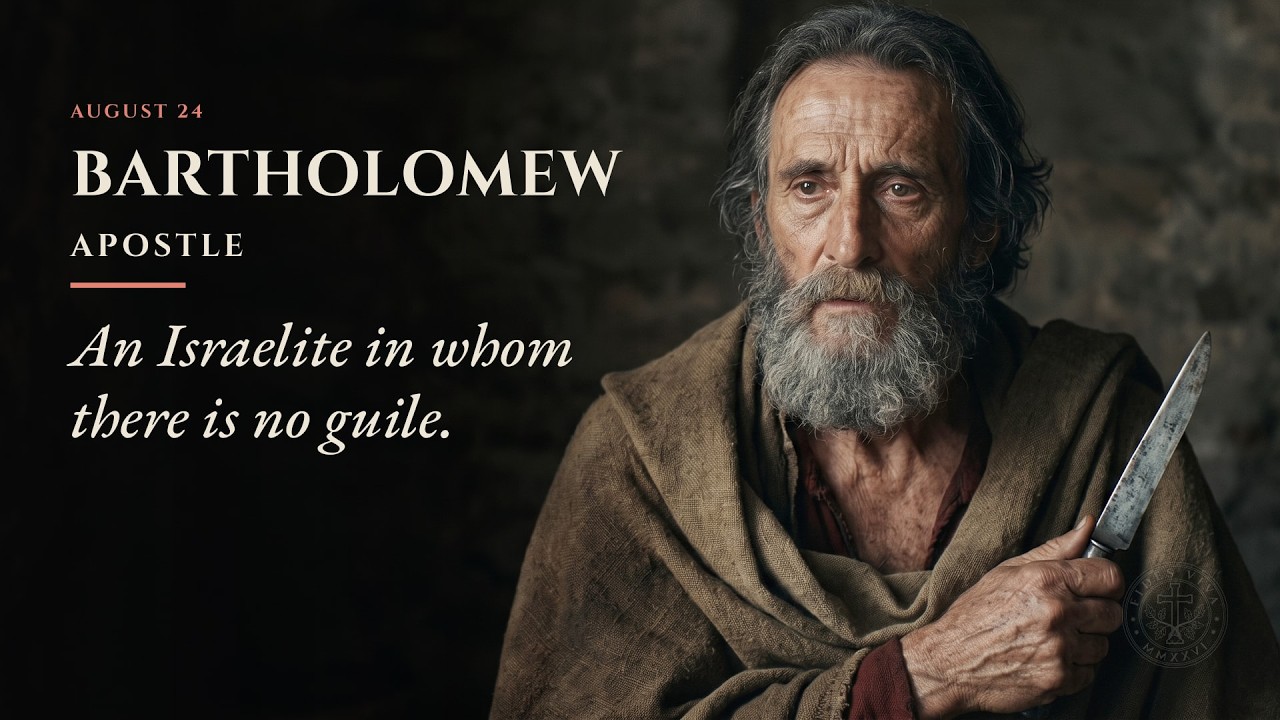
A man sits in the shadow of a fig tree, a small scroll of parchment resting on his knees. He is a man of Scripture and silence, made for waiting in the shade. Along the path comes a friend, breathless: they have found him—the one Moses and the prophets wrote about. And he comes from Nazareth.
The man does not pretend. He speaks aloud what he thinks:
"Can anything good come from Nazareth?"
The question hangs trembling in the still air of the afternoon. It is the first century; Rome rules, and Nazareth is a village so small that Scripture never names it. The objection is reasonable. Anyone would have agreed with it.
And yet that same afternoon, the skeptic will reverse his objection—not because anyone argues him out of it, but because of something he cannot yet suspect.
Of the Twelve apostles, he left the fewest words. One scene, barely. No letters. No speeches. And yet at the far end of the known world, there is an entire Church that calls itself apostolic because it traces its faith to him and to another of the Twelve.
The Gospels call him Nathanael; the Church, since ancient times, has recognized him in the one the lists of the Twelve name Bartholomew: bar-Tolmai, son of Tolmai.
Before that afternoon there was a shade: a fig tree in a village Scripture does know. Cana of Galilee.
Beneath the Fig Tree: The Question Without Disguise
Dawn breaks over Galilee. Along the dust roads pass caravans and soldiers; at the roadside post, the tax collectors of Herod Antipas—tetrarch by grant of Rome—weigh the grain and count the nets. It is a land that endures: the poor, observant, stubborn Jewish villages of the north bear the contempt of the elites in Jerusalem. And by the river runs a new rumor: a man baptizing in the wilderness, announcing that something is about to arrive.
Scattered among those hills, between vineyards, cisterns cut into bedrock, and gray-trunked fig trees, huddles a handful of houses of basalt and adobe: Cana of Galilee. There, in the opening years of the century, the oldest memory places his birth: a child of a devout family. Memory holds two names for him: Nathanael, "God's gift," and his father's name: bar-Tolmai, son of Tolmai. He grows among low walls and village fields, schooled in the Law and the Prophets, and becomes a man lean-limbed, with large hands and a fixed gaze.
Frank to the point of harshness, unable to fake it, he doubts to verify, not to evade. And he has a place of his own: the fig tree. In Israel, to sit beneath the fig tree is the very image of one who meditates on Scripture and prays alone. In that dappled shade he spends his deepest hours, a scroll of parchment across his knees, waiting for a Messiah who delays.
Around the year twenty-seven—a little before, a little after: village years go unrecorded. His friend Philip goes down to the Jordan, where John baptizes, and returns with his heart ablaze. He seeks him out and blurts the news: we have found him—the one Moses and the prophets wrote about; it is Jesus, son of Joseph. From Nazareth. The answer comes plain and direct: "Can anything good come from Nazareth?" It is not idle mockery: Nazareth does not appear once in Scripture; from a place like that no one expects the Messiah. Philip does not argue. He simply opens a door: "Come and see."
And he goes. That gesture alone reveals him: the skeptic sets out to verify. They descend together toward the bank of the Jordan, to Bethany, on the far side. Jesus sees him coming from a distance and speaks first, before them all: "Here is a true Israelite. There is no duplicity in him." Praise before the first word. Disconcerted, the man from Cana asks how he knows him. Then comes the sentence that undoes him: "Before Philip called you, when you were under the fig tree, I saw you."
No one had seen him there. That shade was his corner without witnesses, and it turns out a witness had been there. His whole defense collapses at once. From his mouth comes the earliest confession in the fourth Gospel: "Rabbi, you are the Son of God; you are the King of Israel." Everything he objected to just hours before surrenders in a single phrase.
Jesus does not stop at the praise. He promises him more: "You will see heaven opened and the angels of God ascending and descending on the Son of Man." It echoes Jacob's dream: a ladder set between heaven and earth. To the man in whom there is no deceit, he does not promise power or honor. He promises to see. What he will see, and at what cost, he cannot yet suspect. He leaves the fig tree, leaves Cana, and sets out to follow the man from Nazareth. Precisely from Nazareth.
The Invisible Apostle: Walking Without Leaving a Trace
Around the year twenty-eight, in Galilee, Jesus chooses from among his followers twelve men. Matthew, Mark, and Luke preserve the lists, and in all three the same small detail repeats: Bartholomew appears always immediately after Philip. The friend who said "come and see" and the one who went to see remain together forever, name beside name, like two who walk shoulder to shoulder.
And that is almost all Scripture ever says about him.
Through the years of ministry he takes no leading role. He does not question aloud, as Peter does; he does not call down fire from heaven, as the sons of Zebedee do. He walks. He listens. He is present. His tunic grows worn and is mended at the shoulder, his feet fill with calluses, the wind off the lake tosses his hair, and no evangelist pauses to record it. The man who confessed him Son of God has become nearly invisible, and it seems not to trouble him. Once truly seen, there is no need to be looked at again.
He surfaces once more, and it is worth all the rest. After the cross, after the empty tomb, seven disciples go out to fish on the Sea of Tiberias. John names them, and there he is, with name and town: "Nathanael, of Cana of Galilee." They work the net all night and catch nothing, and at dawn a voice from the shore tells them to cast the net to the right. The boat can barely bear the weight. Beside a fire kindled on the stones, the Risen One waits for them with bread. No one dares ask him who he is: they know he is the Lord. And the man from the fig tree, wet and silent, is watching the promise fulfilled: greater things.
Not long after, he is in Jerusalem, in the upper room of the house, with the Eleven and with Mary, the mother of Jesus. The Acts of the Apostles names him among those who persevere in prayer, waiting for the Holy Spirit. It is his last appearance in the sacred page: a man gone still, hands folded, waiting.
After Pentecost, his name vanishes from Scripture. Not a journey recorded, not a letter, not a line. The silence that wraps this apostle resembles the silence in which almost any life unfolds: work no one registers, fidelity no one applauds. But a name can disappear from the pages without disappearing from the world. Far from Galilee, very far away, someone was going to remember where he had passed.
To the Ends of the World: Memory Takes the Relay
From here the written record falls silent, and the ancient Churches of the East take up the story, guarding his trace as one guards a family treasure. That memory sets him on the road toward where the map ends. While Peter and Paul walk toward the heart of the Empire, Bartholomew turns the other way: toward the sunrise, toward lands where Rome no longer rules and where no one has heard the name of Jesus.
The decades from the thirties to the fifties are spent this way. Arabia, with its caravans and its handful of wells; Mesopotamia, between the two ancient rivers of the world; Persia, the endless plateau of the Parthians. Whole years fit into a single sentence because no one wrote them down: in each place, all that remained was the memory of a Galilean who had passed through, announcing the risen Christ. He sleeps where they receive him. He learns words in tongues not his own. He grows old on the road: his temples turn gray, his beard fills with white strands, his skin cracks from sun and dust.
A man of whom only a confession was ever written—one sentence, a single phrase—crosses half the world to hold it. He carries no escort, no letters of introduction, no certainty of return. He carries a bundle wrapped in leather, tied at his chest with a cord: the Gospel of Matthew, written in Hebrew characters. And somewhere in those lands he leaves it, as one plants a tree one will never see grow.
That book had a destiny of its own. More than a century later, a Christian teacher from Alexandria named Pantaenus traveled to "India"—that vast name the ancients gave to Arabia, to Ethiopia, to the lands of Medes and Parthians. There he found a Gospel of Matthew in Hebrew characters, kept safe by those who already knew Jesus Christ. The memory of the one who had left it there lived on: Bartholomew. It is the oldest echo of his mission. A man disappears from the pages, and more than a century later a book of his still speaks at the ends of the world.
Toward the year sixty-five, already an old man, he turns north. Greater Armenia: a high plateau of volcanic stone beneath snow-crowned peaks, fortresses of dark stone, a kingdom disputed between Rome and Parthia, with temples to idols in every valley. The Armenian memory receives him alongside another of the Twelve, Jude Thaddeus, and both are venerated as the first to kindle faith in that people. Because of them, centuries later, that Church will call itself apostolic.
His hair is white and his back still straight. He has crossed the entire known world to reach this place. And here, in these cold valleys, the highest word of his life awaits him: the one spoken without speaking.
The Court and the Idol: The Trial Before the Powerful
In those valleys stood Albanopolis, the city where the apostle's road would come to an end. What happened there no chronicler set down: it is kept in an ancient account, the Passion of Bartholomew, copied for centuries by hands that loved it—more storyteller than notary. And it deserves to be told as it was always told, in all its color.
There reigned in the city a man called Polymius, and the king carried a wound in his house: a daughter tormented by a spirit. She suffered, they said, the torment of a spirit no one could calm. In the great temple stood Astaroth, the idol that kingdom consulted, and for the king's daughter there had been no answer. Then word came to the king of a stranger who spoke in the name of a God without temple or statue, and who healed. He sent for him.
An old man entered the throne room, more than sixty years old, in a dusty red tunic and a threadbare pale cloak, a book pressed to his chest. Around him, embroidered silks, tiaras with ribbons, guards in scale armor. The contrast was absolute, and he did nothing to soften it. He asked to see the girl, invoked over her the name of Jesus Christ, and the spirit released her. The king's daughter stood at peace, free, looking at her own as one wakes.
The idol remained. Bartholomew went to the temple and, before its priests, commanded it to be silent forever: Astaroth was no god, but a deception Christ had bound in chains. From that day the oracle was mute. And in a kingdom accustomed to buying answers with sacrifice, that silence spoke louder than any oracle bought with sacrifice.
The king asked for baptism. With him descended to the waters his wife, his whole house, and twelve cities of his realm. The man who once asked whether anything good could come from Nazareth now saw a king of the East lay down his crown to receive Jesus.
But a converted king leaves an empty temple, and an empty temple ruins those who lived by it. The priests stripped of their livelihood did not go to argue with the apostle: they went to find Astyages, the king's brother. They spoke to him of gods offended, of thrones that fall when altars fall, of a kingdom slipping from their hands because of an old foreign man. Astyages listened in silence. He feared the ruin of worship and feared losing what held his power. And he made a choice.
He had him seized. There was no trial worthy of the name: there was an order, ropes, and guards. Before Astyages, the old man took back nothing he had said; he had confessed Christ before a king and would not deny him before the king's brother. He was as unable to pretend as that day long ago by the Jordan. The sentence came from the executioners: flayed alive and then beheaded.
They led him out, toward the place of execution. He walked upright among the spears, his wrists bound, without a word. No one in Albanopolis yet knew how far a witness goes when all the power turns against him. They were about to see.
The Total Surrender: Martyrdom in Armenia
It must have been around the year seventy, or thereabouts. At dawn they brought him outside the walls, to a bare stretch of dark volcanic stone where wooden posts already waited. The executioner carried a curved-blade knife, the same one skinners use on livestock. That was Astyages' order: let him die slowly, and let everyone see him die.
They took from him the pale cloak and the red tunic, the two garments that had traveled with him from so far away, and left him with only a linen cloth at his waist. They bound his wrists with rope of esparto grass. He was nearing sixty-five: a body worn down by roads, his hair and beard white, his back still straight. All his life he had been a man incapable of hiding. Now they would not even leave him his skin.
The knife began its work, and the skin was stripped away in strips from the shoulder. There is no need to say more of the pain. What the memory of those lands wanted to keep was not the wound, but the face. There was no gesture of rage. There was no curse, no plea. The eyes stayed open, fixed, as they had always been: the gaze of a man who looks straight on and does not know how to hide.
He trembled from exhaustion, and still he stood. Many years before, Jesus had promised him he would see greater things: heaven opened, the angels of God ascending and descending on the Son of Man. It may be that on that stretch of Armenian ground, as they tore away the last covering, he was seeing at last what was promised. His serenity did not look like resistance. It looked like the serenity of someone already gazing at something else.
Then came the sword. One stroke. And silence.
That morning was not lost. The memory of the Churches of the East kept it and passed it from mouth to mouth, until the years faded and what remained was essential: an old man who chose to give his skin rather than deny the name of Jesus.
The apostle of few words had spoken his last, and it was not a speech: it was his whole body. Other witnesses would leave letters, sermons, celebrated answers before their judges. He left the only thing left to give: the very wrapping of himself, delivered to Jesus Christ without holding back, just as that first afternoon when he had surrendered with a single sentence. He had never known how to believe halfway. He did not know how to die halfway either.
The Armenian memory held that those close to him gathered what remained of their teacher and kept it as one keeps what is most beloved. Over that place on the high plateau, centuries later, a monastery of reddish stone would rise, a destination for pilgrims for generations to come. Because the body of Bartholomew, which in life had crossed half the world, had not yet finished traveling.
Relics Disputed, Living Memory
And it kept traveling for centuries. On the island of Lipari, off the coast of Sicily, fishermen told how the ark with his remains had arrived by sea, floating. They said the people came down to the shore to receive it as one receives a father. There he was venerated for generations, until the threat of Saracen raids forced them to move him to safety: around the year 838, the relics crossed to the mainland and found refuge in Benevento, in southern Italy.
A century and a half later, an emperor enters the story. Otto III, an emperor still very young, with dark blond hair and intense piety, wanted to have the apostle at the heart of Christendom. Around the year 998 he founded a basilica for him in Rome, on Tiber Island, that island shaped like a ship anchored in the middle of the river. There, Rome says, his body rests beneath the high altar, inside a sarcophagus of red porphyry, with a bronze tablet that reads simply: body of Saint Bartholomew the apostle.
But Benevento never accepted having lost him entirely: to this day it maintains that the true body still rests in its basilica. In the eleventh century, an arm of the apostle traveled even farther, given as a gift to the cathedral of Canterbury, in England. Two cities claim the same bones, and a fragment is venerated on the far side of Europe.
Looked at closely, that dispute is not a quarrel: it is a declaration of love. No one litigates for a thousand years over the remains of a man who means nothing to anyone. The peoples wanted Bartholomew near precisely because he left almost no words: a body given whole speaks more than many books, and to have him beneath one's own altar was to have at hand that way of believing, frank and without reserve. On Tiber Island, the basilica still stands, and the question remains open: how does the memory of such a witness become present today.
The Skin and the Art: A Testimony Without Words
One answer came from art, and it came without turning away the gaze. Between 1536 and 1541, Michelangelo painted the Last Judgment in the Sistine Chapel, and there, among the saints who surround Christ, he placed Bartholomew: an old man with a white beard and a powerful body holding the curved knife in one hand and, in the other, his own skin, empty, hanging like a mantle. And in the distorted face of that skin, the painter hid his own portrait. As if to say that before this witness, he too felt seen from within.
Twenty-one years later, in 1562, Marco d'Agrate carved one of the most overwhelming images of the apostle for the Duomo of Milan. A man standing, carved in white marble, with every muscle and every nerve laid bare, and the skin cast over his shoulders like a stole. In his hand, the Gospel. On the base, the sculptor signed with pride: It was not Praxiteles who made me, but Marco d'Agrate.
What strikes the eye is that Christian art never wished to hide the wound. It could have clothed him, crowned him, erased every trace of the knife. It chose the opposite: to show the man standing, serene, carrying, himself, what had been torn from him. Because the skin is no longer the mark of a defeat, but the measure of a surrender: someone loved Jesus Christ so much he did not spare even the wrapping of his own body. Marble turned the horror into dignity. And that dignity, now fixed in marble, keeps saying the same thing every time someone stops to look at it.
A Saint for Those Who Question: Legacy and Living Presence
That house stands in the middle of the Tiber, in the basilica of Tiber Island. Since the Holy Year 2000 it has been the Sanctuary of the New Martyrs. In its side chapels are kept memories of Christians from five continents who died, in the twentieth century and the twenty-first, for confessing Jesus Christ. A missal, a letter, a worn rosary. Humble objects of people history never recorded, kept a few steps from the red porphyry sarcophagus. The apostle who gave even his skin now receives, under his own roof, those who gave their lives yesterday morning. No one had to explain the kinship. It is understood the moment one walks in.
In Milan, the Veneranda Fabbrica del Duomo restored the statue of Marco d'Agrate and in 2025 returned it to public view. Each day, people from everywhere pass before it; many know nothing of the man from Cana, and still they stop. There is something in that serene face that keeps asking the same question it asked in life: whether what one believes is truly professed.
And each August twenty-fourth, when summer begins to yield, his name travels in procession through dozens of towns. In San Bartolomé de Tirajana, in the San Bartolos of Mexico, Colombia, Peru, the image comes out with its red mantle, the knife in hand and the demon chained at its feet. All of it unfolds amid dances, novenas, and fairs. All of Armenia venerates him as the father of its faith; the Spanish-speaking world celebrates him as a neighbor. Simple people who pray to an apostle of whom barely a single sentence remained, and who need nothing more: it is enough for them to know he was sincere and he was faithful.
Twenty centuries on, the question he asked beneath a fig tree still finds its answer in each of those faces.
The Place Where We Are Seen: A Final Contemplation
That doubt spoken aloud found no answer in an argument, but in a gaze. Something good did come from Nazareth: the one who knew him before he asked. And the skeptic of Cana spent the rest of his life answering that moment: he crossed deserts and plateaus, left a Gospel in nameless lands, and gave, at the end, all that a man can give for Jesus Christ. His honest doubt did not close the door. It was the door.
And the fig tree remains. Each life has one: a hidden place where, without witnesses, you are who you truly are. The sincerity lived there weighs more, before God, than the correctness of the answers. We too are seen in that place. In the darkened kitchen when bad news arrives; in the hospital corridor; in the question we ask in a low voice without expecting anyone to hear. What will we answer the day we feel that gaze upon what we truly are?
He answered with the shortest and most total phrase he ever left: "You are the Son of God." And he held it for four decades without writing a book, without leaving speeches, until he had not even skin left to stand between himself and his testimony.
Lives without chronicle are not lost. Of this man barely two sentences were written, and upon them rest the faith of a nation, a basilica in the middle of a river, and the memory of today's martyrs. What is not written down is not lost: it is sown. Beneath a fig tree in Galilee, someone saw him first; and he answered with his whole life.
Saint Bartholomew, apostle and martyr, pillar of the Church, father of the faith of Armenia, pray for us.