There are places no one looks at: a stone by the water, a chapel crumbling into the fog. And yet heaven stops there. What makes the humblest thing turn holy?
The Humble Root
It all began long before the crowns and the crowds. It began in Galilee, in the first century, under Roman rule. Villages of stone and dust. Tax collectors on the roads, tribute that bent the backs of farmers, and a small nation who had waited, for generations, for an ancient promise to be fulfilled. In one of those villages, in Nazareth, a Jewish girl named Mary had just said yes to God.
She carried Jesus within her when she set out for the hill country of Judea, to the home of her cousin Elizabeth. Days of walking on stone paths, a muted blue mantle covering her head, dust on her sandals. And crossing the threshold, Elizabeth's greeting met her: "Blessed are you among women." Then the young woman answered with a song still prayed today in every language on earth: "My soul magnifies the Lord... for he has looked upon the humility of his servant."
A servant. That is how the Lord's mother named herself, at the highest hour of her joy. She claimed no thrones, no titles; she simply recognized that God had set his eyes on what was smallest. Every shrine, every title the peoples of the earth have given her, every road walked by pilgrims is born from that same gaze: the gaze of a God who chooses the humble to touch the earth.
Many centuries later, on a wooded plain in central Italy, at the foot of Mount Subasio, stood a tiny chapel among holm oaks and low oaks. Four walls of rough stone, a roof of tile, an altar. It would fit whole in the yard of any house. They called it the Porciúncula: the little portion, the smallest piece of land. Above, on the hillside, the town of Assisi showed its rose-colored walls. This was the Italy of warring communes, of towers raised out of pride, of merchants and soldiers moving up and down the roads. Below, on the plain, the valley fog wrapped those forgotten walls every dawn, as if it meant to hide them from view.
Yet it carried a name far too large for its size: Saint Mary of the Angels. Franciscan memory holds that the place took its name because in that corner of the woods, angel songs could sometimes be heard. Voices not of this world, a thin music threading through the trees at dusk or in the depth of night. No one wrote down what they heard. The music passed from mouth to mouth among the simple people of the valley, until it became a name, until it settled into the stone.
And the chapel, meanwhile, was falling apart. Loose stones in the grass, the roof sagging, the altar covered in dust. No major road passed that way; no pilgrim sought it out. But some presences are never in a hurry. In that silence, something —Someone— was waiting. A mother had chosen her house in the place no one looked at, and she waited for someone able to see her.
Up in the rose-colored town on the hill, the son of a cloth merchant was coming of age: a young man who dreamed of knightly glory and feasts until dawn. He did not yet know that his whole life would be decided down below, on the plain, in the fog.
The Little Portion Chosen
The decision came from where he least expected it. One day, praying before the crucifix in the half-ruined church of San Damiano, the young man felt that Christ himself was asking him to repair his house. He understood it his own way, with the simplicity of someone who looks for no hidden meaning: if the house was broken, it had to be raised again. He left behind his father's cloth, his dreams of knighthood, his name, his inheritance. And he set to work carrying stones.
So he went down to the plain, toward the little portion hidden among the holm oaks. He found it as it was: the roof sagging, the walls broken open, the altar buried in dust. And he loved it for exactly that. For months he worked alone, unseen, in the fog of dawn and the birdsong: mixing the lime, setting each stone back in place, straightening what had fallen. The hands of the merchant's son, made for counting coins, covered in cracks and dirt. No one applauded. No one watched. And in that humble, quiet labor, Francis of Assisi was happier than he had ever been.
It was there, in 1209, that everything finally caught fire. One morning, during Mass in that newly repaired chapel, he heard the gospel where Jesus sends his disciples out on the road: no gold, no bag, no second tunic, no sandals. And he understood that those words were meant for him. Not an idea, not a plan: a way of life. He took off his sandals, traded his belt for a length of rope, and went out to proclaim the peace of Christ with nothing but what he wore.
He did not stay alone for long. Other men from Assisi, one after another, came down to the plain looking for him, and stayed. Barefoot, dressed in sackcloth, they slept under the trees. Around the chapel of Saint Mary of the Angels the Order of Friars Minor was born: the friars of the poor little portion of land. Of all the churches Francis had repaired, this was the one he never wanted to leave. The cradle of his fraternity had an owner, and she was the Mother of the Lord.
Franciscan memory has kept it this way: on a Palm Sunday night in 1211, a young noblewoman of Assisi, Clare, left her family's house and crossed the darkened plain to the chapel. She arrived in the rich gown of a young lady, embroidered for another destiny. And before the altar of Saint Mary of the Angels she traded it for a rough habit, forever. That night the women's branch of the Franciscan family was born. The small door had opened for her too.
A chapel small enough to fit in a courtyard was already welcoming everyone who sought something larger than the world. The merchant's son, his companions, a nobleman's daughter: each had left much behind, and in the little portion found everything. The greater gift was still to come. Because that small door, opened one night for Clare, would one day open for anyone who came with a repentant heart.
The Door of Forgiveness
According to the tradition of the Friars Minor, in 1216 Francis walked to Perugia, where Pope Honorius III was residing at the time. He was not going to ask for land, revenues, or protection for his Order. He was going to ask for a gift for others: that anyone who entered the chapel of Saint Mary of the Angels repentant and confessed would receive full forgiveness of their sins. All of it. No money, no journey, no conditions.
The request was enormous. In those days, a pardon like that was earned on the great pilgrim roads of Christendom: Jerusalem, Rome, Santiago. Months of travel, dangers, costs only some could afford. And that barefoot friar was asking for it for a chapel the size of a barn, hidden among the oak trees, within reach of any peasant in the valley. Honorius III, a cautious man of law, listened. And granted it. The feast was fixed to a day on the calendar that would outlast the centuries: August 2. A day the faithful still keep, eight centuries later.
From then on, every summer, the people of the valley came down to the plain. Peasants, mothers with their children, old men who could barely walk. They stepped into the cool shadow of the chapel, knelt before the Virgin on the altarpiece, and walked out with a clean soul. They had paid nothing. They had earned nothing. That was, exactly, the heart of the gift: the forgiveness of Jesus Christ offered before any merit, like water that rises from the ground without anyone asking for it. Francis had asked for it with that same simplicity: mercy is not sold. It is given. And what is truly given is given in a small place, so no one is afraid to walk in.
Ten years later, the man who had asked for that pardon returned to the little portion to die. He was gravely ill, worn down by years on the road. In his hands, his feet, and his side he bore the wounds of Christ, which had marked him two years before. He asked to be taken there, to the chapel where everything had begun. He asked to be laid on the bare ground, poor to the end. And in early October of 1226, surrounded by his brothers, beside the chapel of the Virgin, he died in peace. He had been born to a new life in that chapel; in that chapel he chose to give it back. The Mother's house was also the door of his passing into eternal life.
In 1277, as the last who had known him were dying, an elderly friar, Benedict of Arezzo, put the memory of the pardon into writing before a notary. It had been kept by Brother Masseo, a companion of Francis. What until then had passed from friar to friar was now set down in ink, so time could not erase it.
And the centuries did with the chapel what faith does with what it loves: they protected it without changing it. Between 1569 and 1679, a great Renaissance basilica rose over it, its dome visible from across the plain. It carried the same humble name: Saint Mary of the Angels. But the immense structure did not come to replace the small one: it came to shelter it. Even today, whoever passes through the basilica's monumental doors finds, at its center, beneath the vault, the little chapel of rough stone. Tile roof, plain altarpiece, unchanged since the days of Francis. There, the great serves the small. Like a marble reliquary built around a single grain of wheat.
Can a place so small hold a promise so great? The Friars Minor believed it could. And when their brothers set sail for lands Francis had never seen, they carried what took no room in the hold: the name of Saint Mary of the Angels and the date of the pardon. The title crossed the ocean. And on the far side of the sea, not knowing it, a green valley between volcanoes awaited it.
The Stone and the Spring
That valley bore the name of an ancient city: Cartago, founded in 1563, capital of one of the poorest provinces in the Spanish empire. No silver mines, no palaces: low houses of adobe and tile, dirt streets, a sky heavy with clouds, fine rain falling from the volcanoes. But even within that poverty there were degrees. In the center lived the Spaniards; to the east, outside the city's boundaries, in a district called La Puebla de los Pardos — the settlement of the mixed-race poor — lived the others: mulattoes, mestizos, people of dark skin, kept on the margins by the laws of the time. Huts of cane and mud, plantain groves, a stream running clear over stones and ferns. There, where the city ended, everything was about to begin.
So the faith of the people of Cartago tells it: it was August 2, 1635, and the girl's name was Juana Pereira. A young woman of mixed race, parda or mulatta, some fifteen or eighteen years old. That afternoon she went down to the stream to gather firewood, as she had so many afternoons before. No one was waiting for her. No one was watching. She was gathering branches when she saw it: on a stone, beside the spring, a tiny figure. She picked it up in her hand. It was an image of dark stone, about three inches tall — small enough to fit whole in her palm — a veiled woman with a child on her left arm. The Virgin and her Son, Jesus, carved from a single block, the features plain, almost rough, the surface damp with earth and moss. A dark-skinned Virgin. Dark like her.
She carried it home and kept it, the way one keeps a small treasure. The next day she went back to the stream for more wood, and there was the figure again, on the same stone. Bewildered, she ran to her hut: the place where she had put it away stood empty. She put the image away again; again it returned to the stone. Then the girl did what simple people did with what they could not explain: she brought it to the priest. The parish priest, they say, locked it away under lock and key. And so the devotion of the simple has kept it: from there too it vanished, and that time as well it was found on the rock by the spring, serene, waiting. No one needed further signs. That small Lady wanted no borrowed altar. She had chosen her place: a stone at the edge of a stream, in the district of those who counted for no one. And she had chosen her people.
On that stone, around 1639, the first chapel rose: walls of mud and cane, a tile roof, a plain altar where the tiny carving reigned without a crown. The pardos of the valley felt her their own from the first day. She was dark like them; she had let herself be found by one of them; she had chosen to live in their district, not in the city of the gentry. They called her the Virgin of the Pardos, and in time, with the tenderness that only trust can give, La Negrita — "the little dark one." Beside the stone the spring kept flowing, and the sick began drinking its water, asking for health. They received everything twice over: the Mother and the water, neither one earned, neither one bought. In 1782, the whole city — even the city of the gentry — declared her patroness of Cartago. The last had received first; now they opened the door to everyone else.
An image that returns, and returns again, to the place where no one expects to be chosen. That silent insistence was the only sermon the valley ever needed. And the seed kept growing: what had been born in a marginal district was on its way to becoming the heart of an entire people.
A People Beneath Her Mantle
In 1824, Costa Rica was a young state, barely born out of three centuries of Spanish rule, still searching for its face. And when that small country wanted to say who it was, it looked toward Cartago, toward the tiny carving from the stream. That year, Our Lady of the Angels was declared patroness of Costa Rica. The devotion of one marginal district became the name of an entire nation. In time, August 2 would become a national holiday. It was the day the valley's memory keeps as the day of the finding, the same day as the Porciúncula's pardon across the sea. Rarely does history draw so clean a circle: the Lady who had chosen the last was now the Mother of all.
Generations passed. Grandmothers taught their grandchildren to cross themselves before La Negrita, the sick kept drinking the water from the spring, and over the stone of the finding the temple kept growing along with the people. Everything seemed solid, rooted, permanent.
Until the night of May 4, 1910.
That day the earth shook beneath Cartago with a violence the city would never forget. Walls buckling, roof tiles falling like rain, dust and screams in the darkness. When dawn came, the whole city lay in ruins. So did the Virgin's temple: its walls collapsed, its roof caved in, centuries of devotion reduced to rubble in seconds. Among the wreckage, the people searched for what they loved most. And they found it. The small image emerged from the rubble without a scratch. And beneath everything, silent as the first day, the stone of the finding stood in its place, untouched.
What had been built came down. What God had placed there remained.
The people of Cartago then did what they had learned from their Mother: return to the same place. The shrine was not moved to safer ground, nor to some more distinguished site. It would be rebuilt right there, on the same stone, around the same spring. Starting in 1912, under the direction of the Catalan architect Luis Llach Llagostera, a new temple began to rise. It was unlike anything the country had known: a Byzantine-style basilica of gray stone, its towers crowned with domes. Arches and columns painted with flowers, ceilings of painted wood, slowly gave shape to the interior. Year after year the scaffolding climbed higher: men hoisting stone after stone under the sun, while the faithful kept coming to pray amid the dust and noise of the work. The city that had lost everything was rebuilding, stone by stone, the one thing it refused to lose.
Then came the day of the highest recognition. On April 25, 1926, with the authorization of Pope Pius XI, the image received its canonical coronation. Before a crowd of lace veils and hats gathered from across the country, the three-inch carving was crowned with gold — the same one Juana had picked up from the moss with wet hands. The Mother who holds Jesus on her left arm, the one who had waited on a rock for a poor girl to find her, now received the crown of a queen. Nothing smaller; nothing greater. And in July 1935, that same Pius XI raised the shrine to the rank of minor basilica. Rome set its seal on a faith that had not been born in Rome, but in a stream in the district of the pardos.
A stone no one moved. An image no one could keep away from its place. A temple fallen and raised again on the same ground. That is how a faith holds through ruin and generations: not in the strength of walls, but in the faithfulness of a presence. And in the faithfulness of a people who learned from her to always return to the same place. That return, over the years, would become a road. Every August, an entire country would set out toward the stone and the water.
The Pilgrims' Road
And so it happened. Today, when the calendar reaches July 23, all of Costa Rica begins to lean toward Cartago. The novena begins: nine days in which every diocese in the country arrives in pilgrimage with its rosary, and the city readies itself like someone expecting a guest. The image herself comes out to meet her people in the *Pasada*, the traditional procession that carries her from the Cartago cathedral to the basilica, amid singing and bells. On the eve of the feast, the Rosary of Light sets the night ablaze with thousands of candles. Bead by bead, the voices repeat the name of Jesus on the lips of his Mother.
But the heart of it all is the road. Every year, above all on the night before August 2, close to two million people set out on foot toward the basilica. Two million: a good part of a country walking in the same direction. They come from San José and from much farther away; some have been walking for days from distant provinces. The route drops from the hill of Ochomogo down into the valley, and by dawn it is a river of people: flashlights, plastic ponchos against the fine drizzle. Children asleep on their parents' shoulders, the elderly leaning on their children, water stations and first-aid tents along the edge of the road. Many walk barefoot. Others cover the last stretch to the altar on their knees, held up by a relative gripping their elbows.
This is no improvised march. Every year, weeks in advance, medical teams and five hundred twenty-five officers of the Public Force cover the route from Ochomogo to the shrine. On June 5, technicians from the Ministry of Health test the water from the spring and the fountains, so the gift stays safe as well.
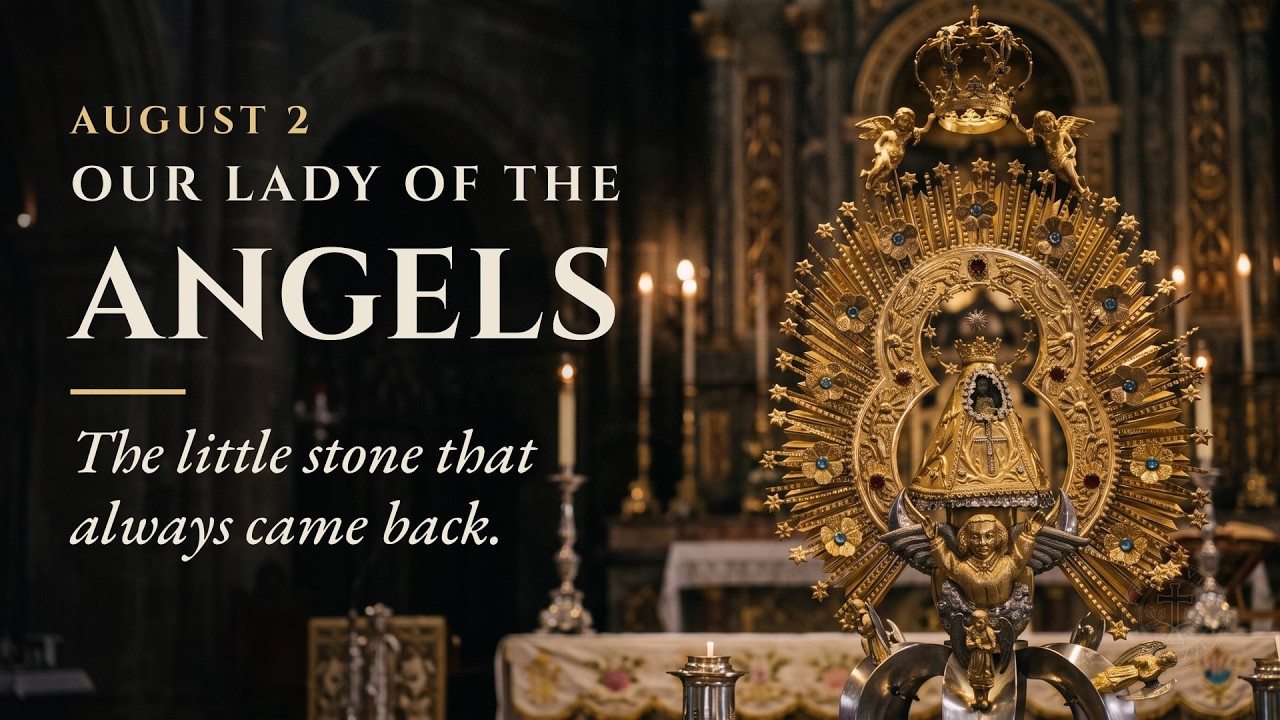
And at the end of the road, the goal. Inside the basilica, high on the main altar, the tiny carving shines atop its golden frame, surrounded by flowers, lights, and candles. From below, the dark face is barely visible amid the glow of the metal; but every one of those who arrive knows exactly who they are looking at. They speak to her softly, the way one speaks to a mother. They present their children to her. They give thanks. They ask. Along the walls of the crypt, beside the stone of the finding, the ex-votos pile up: small pieces of silver and brass shaped like legs, eyes, hearts, houses. Each one holds the memory of a favor received, a health recovered, a promise kept.
Outside, by the wall of the fountain, the oldest scene of all repeats itself without tiring. The water from the spring — the same water that ran beside the stone in the days of that finding — flows from bronze spouts, and hands reach out toward it. A mother fills a bottle for a sick child. A man wets the forehead of his aging father. Someone drinks slowly, eyes closed. They ask for health of body and soul, and give thanks in advance, because they have learned from the Lady that grace arrives before merit does.
And the current does not stop. In July 2026, under the pontificate of Leo XIV, the season's first pilgrims were already crossing the doors of the basilica, days before the feast, like the first drops of the flood to come. Almost four centuries after Juana's stream, the road is still full.
One might wonder what so many tired feet are looking for, what those who walk all night find at the end of it. Perhaps the answer lies not in anyone's words, but in what has already been seen from a chapel lost in the fog of Umbria.
A Presence That Remains
The answer had been in plain sight for centuries. A chapel falling apart among the oak trees, which a young man raised with his own hands. A hard stone at the edge of a stream, in the neighborhood of those who counted for no one. Heaven did not choose those places despite their smallness: it chose them precisely for that, with no noise to drown out its voice, no merit to confuse the gift with a payment.
Mary had sung it from the beginning, on the hills of Judea: "My soul magnifies the Lord... for he has looked upon the humility of his servant." Everything else was that song coming true slowly, across the centuries: the carving that, as the faith of the people has kept it, returned twice to the same stone, like someone repeating a choice; the temple brought down and the rock left whole underneath. Some presences insist on staying. And they always stay low, within reach of those who have nothing else.
Francis walked into a ruined chapel, and out of it came a family scattered across the world. Juana opened her hand beside the water, and a whole people found a mother. That is what humble things do when heaven dwells in them: they do not make themselves larger, they make larger those who touch them.
Through all of it, she never spoke a single word. She did not need to. Her way of speaking was to remain: near the barefoot friars of the plain, near a girl gathering firewood, near a people walking at night through the rain. And always with the Child on her left arm, because a mother does not point to herself: she brings Jesus level with the eyes of the poor.
We keep places like that too, even when they do not look it. A kitchen table where someone prays alone before the house wakes. Corners no one would look at twice, the way no one looked twice at that stream. Perhaps the sacred does not wait for us to build something great; it waits, simply, for a door left open.
The question from the fog and the stream has not aged: what makes the humblest thing turn holy. Every pilgrim carries it back home, like water in a bottle. And the answer, now as then, belongs to whoever receives it.
As long as a whole country keeps setting out each August, as long as the water keeps springing beside the stone of the finding, Our Lady of the Angels will go on where she has always been: in the smallest of things. Her arms full of her Son, she waits without hurry for those who arrive weary.
Our Lady of the Angels, Queen and Lady of the Angels, patroness of Costa Rica, mother of the humble, pray for us.