Hook
A man drives a pickaxe into the ground of a temple. Behind him, others have spent weeks filling baskets with earth and broken stone, carrying them up into the light. The marble is gone. Beneath the marble was fill. Beneath the fill, more fill.
The most powerful man on earth has ordered this ground opened. He is not looking for gold. He is looking for a tomb.
The city above no longer carries the name it once had. Over this place, generations ago, a shrine to other gods was raised, and with each layer of rubble the memory of what lay beneath faded away. No one alive has seen it.
Several meters beneath the pickaxe man's sandals lie two pine beams, unplaned and rough. Darkened by moisture, with red earth packed into the grain, with nail holes where the wood split outward. They would fit on a cart.
It is not marble. It is not gold. It is an instrument of execution.
And yet that beam will be raised before multitudes. Two empires will fight for it with armies. They will break it into splinters and scatter it across the entire world. Today it has a name: the True Cross.
Rome drove it into the ground to bury a man in shame. How does the most humiliated thing on earth become the most venerated?
The Wood and Shame
Judea, toward the year thirty. On a bare hill outside the walls of Jerusalem, a pine post stands driven into the ground. It measures about three meters. It was not planted for this morning: it has been used before and will be used again. Rome does not carve a new cross for each condemned man; it leaves the post fixed and forces each man to bring his own crossbeam.
The province lives under the emperor Tiberius, with a Roman prefect and a garrison that speaks Latin in a city that prays in Aramaic. Here the cross is the most infamous penalty in all the empire: almost never for a citizen, and reserved for slaves, bandits, and rebels. It does not serve to punish a man. It serves to make sure no one wants to speak his name again.
The crossbeam was made in the garrison workshop: regional pine, cut with an axe, unplaned, its edges full of gray splinters. It weighs between thirty and fifty kilos. In the post, a notch waits to receive it. This is not carpentry. This is barracks work, built to last, not to be admired.
The condemned man has been scourged first. His name is Jesus of Nazareth. He carries the crossbeam on his shoulders to the hill, and there they lay him on the wood. The nails are forged iron. They pass through his hands and feet, and the pine splits around them. Centuries later, in a tomb in Jerusalem, the heel bone of a man would be found with the nail still inside it. That is how real it was.
Then they raise it. The crossbeam enters the notch, and the man hangs from the post, visible to anyone passing by. Above, in a slot in the wood, they fit a small walnut tablet. It is written in Hebrew, in Greek, and in Latin, so that everyone who passes can read it. It states the condemned man's name and the charge: Jesus of Nazareth, King of the Jews. That morning, just one sentence.
The sun of Judea climbs and beats down hard. The hours pass. The soldiers wait, because the cross is designed to make death take time. Before evening falls, the man on the wood is dead.
Years later, Paul of Tarsus would state it plainly: "We preach Christ crucified: a stumbling block to Jews and folly to Gentiles." A crucified man. For any man of that time, the word was not a symbol. It was a smell, a post on a hill, a body that families did not want to name.
When they take the body down, the two beams remain. To Rome they are unclean: the instruments of execution do not return to the workshop, they are set aside and buried. What was passed down afterward, from mouth to mouth, was this: the beams from that morning were dismantled and buried near the same place, among disturbed earth and rubble. No one speaks of the walnut tablet again.
No one marks the spot. A pine beam stained with dried blood, ochre now under dust, is not something to preserve. It is something to flee from. Can what everyone wants to forget have a future?
The earth weighs on the beams. And it will weigh for a very long time.
Three Centuries Under Earth
Forty years later, the city burns. It is the year seventy. The legions of Rome have surrounded Jerusalem for months, and when they finally break through, the temple on the mount collapses in smoke and screams. The walls fall stone by stone. What does not burn crumbles. And the rubble of an entire city seeks the low places: it fills ditches, buries courtyards, erases roads.
The hill outside the walls receives its share. Over the ditch where the beams lie, rubble piles up—stone, ash, broken tiles. Year by year grass grows over it. Those who knew that morning pass away, one by one. Their children already know a different city.
Sixty-five years pass, and another revolt brings another punishment. The emperor Hadrian decides that Jerusalem will cease to exist. In the year 135 he founds it anew with a different name, Aelia Capitolina: a Roman city, with streets laid out to a line and gods brought from Rome. Over the hill of execution, and over the tombs cut into the rock beside it, he raises a pagan shrine. The engineers level the ground their own way: they dump meters of earth and stone until the rock vanishes. Over the fill goes a platform. Over the platform, a temple. Around it, a marble courtyard with walls and cisterns.
The beams stay beneath it all. Each layer presses down on the one before. Moisture blackens the pine, red earth works into the grain, pressure rounds the edges. Above, a citizen of Aelia climbs the steps, burns incense before a statue, and leaves. No one knows what lies under those paving stones.
And so a century passes. Then another. The city bears a different name, holds different festivals, worships a different god of marble at the exact spot. Whoever comes to pray in Jerusalem finds a Roman city that is not even called Jerusalem. Beneath the temple courtyard, in complete darkness, two pine beams have become indistinguishable from any other buried wood. No one searches for them because no one remembers they are there. What was infamy has turned into nothing: neither shame nor glory. Only earth, and earth on top of earth.
Silence does not hurt. It is simply forgotten. And that is worse.
Two thousand kilometers away, the cross reappears before the wood does. Autumn of the year 312. A general named Constantine marches on Rome to dispute the empire with another emperor, with fewer soldiers than his rival. He himself would tell, years later, what he saw on the way: a sign of light in the sky and a promise of victory beneath that sign. He orders a monogram painted on his soldiers' shields: the first two letters of the name of Christ in Greek, crossed one over the other. On October 28 he wins at the Milvian Bridge, over the Tiber, and enters Rome. From that day forward, the sign of the condemned is embroidered on the emperor's standard.
It is a drawing. Gold and purple over the troops. While the sign marches through Rome, the object still lies in Aelia Capitolina, buried beneath a temple of other gods, and no one in the court imagines that wood still exists.
Thirteen years pass. In 325, Constantine convenes bishops from across the empire at Nicaea, and among them is Macarius, bishop of Jerusalem. Shortly after, the emperor makes an unusual decision: he orders the pagan shrine at Aelia demolished and the ground excavated down to the rock of the tomb of the Lord Jesus. He writes to Macarius. He entrusts him with the basilica that must rise there and asks that it lack nothing in splendor: marble, columns, a coffered ceiling, all paid for by the imperial treasury.
Then the pickaxes come down. First the temple falls, stone by stone, and the courtyard's paving stones are loaded onto carts. Then the platform. And beneath it, what no one expected so deep: fill. Meters of fill. The workers descend basket by basket through the earth that Hadrian ordered dumped nearly two centuries before, searching for a rock that no living man has seen.
Word travels through the court that the emperor has ordered the sepulcher of Christ sought beneath the temple of Roman gods, and Jerusalem waits each day for the voice that will announce the rock. What if, under all that stone, there is something more? What if the beams from that morning are still there below, a few strokes of the pickaxe away from light?
The Discovery and the Miracle
Toward the year 326, a woman of nearly eighty descends from a litter at the edge of the excavation. She wears a dark tunic and a long veil, nothing in her dress announcing who she is. Her name is Helena, and she has crossed half an empire to see with her own eyes the places where Jesus lived and died. Along the way she has founded churches, distributed money among the poor, sat at table with consecrated virgins in the cities she passed through. Now she stands at the rim of the pit, dust from the quarry on the hem of her garment, and looks down.
Whoever wrote down the chronicle of the works and the rock that was found, in the emperor's own lifetime, never gave a single line to any beam. The scene traveled from mouth to mouth for seventy years before anyone fixed it in ink. So the memory of Jerusalem told it afterward.
One day the baskets bring up something that is not earth. A worker shouts. More men come down. From the bottom of the fill, struck by picks, come beams black with moisture, their grain packed with red earth, their edges rounded by three centuries of weight. They lay them on linen cloths. They count them. There are three crosses, taken apart, of unequal length. And separate from them, a small tablet, with letters the crust barely lets you read.
Three. The city knew that morning there were three condemned. But the earth has made them identical: the same wood, the same color, the same nail holes with the fiber burst outward. None of them carries a name. The tablet has come loose from its post, and no one can say which one it belonged to. Which of the three?
Here the piety of the centuries added one more scene. Macarius, the bishop, has a woman brought from the city—gravely ill. They hold the first beam close to her: nothing. The second: nothing. At the touch of the third, she rises up. Other voices said it was a dead man, being carried to burial, who came back to life as that wood passed by. The story changes from mouth to mouth; the gesture does not: the cross known as Christ's is not the one that looks most noble, but the one that gives life.
What happens in that moment reverses the meaning of the wood. Rome had ordered those beams buried because to touch them was to be defiled. They were the business of slaves, of executioners, of the lowest death the law knew. And now an Augusta, the mother of the most powerful man on earth, bends over one of them, still filthy with mortar, and venerates it. No one polishes it. No one washes it clean. What Roman law had declared impure, faith calls holy, because the Lord Jesus died upon it. The object has not changed in substance. It has changed in name.
What is to be done with something like this? No one in the city yet knows how to keep a relic like this, or who should be its keeper. Helena decides. One piece of the wood travels toward the imperial palace, for her son. Another piece, with the tablet, a nail, and some thorns, will travel with her to Rome, to her own house, which one day will become a church. And the rest—the larger part—is sealed in a silver casing and given to Macarius, the bishop of the city. The wood that lay three centuries beneath the earth now sleeps in silver, on the same hill, while above it the walls of the basilica Constantine has ordered built rise.
It has come back to the light. Now the city must see it.
The Cross Raised: Feast and Veneration
On September 13th, the year 335, Jerusalem smells of incense before dawn. Bishops and clergy have arrived, summoned for the occasion, and with them crowds that fill the new courtyard opened onto the main street. That day two churches are consecrated at once, both built on the same hill. One, with five naves and a wooden ceiling carved with care, covers Golgotha: they call it the Martyrium, the witness. The other, round, shelters beneath its vault the rock of the empty tomb: the Anastasis, the Resurrection. Between the two, open to the sky, the bare stone shows where the post was driven.
Ten years before, on this same ground, stood a pagan temple and heaps of rubble. Now there are marble columns, oil lamps, gold in the ceilings, and singing that lasts the whole day long. The emperor wanted nothing in the world to surpass this work in splendor. And the work is finished.
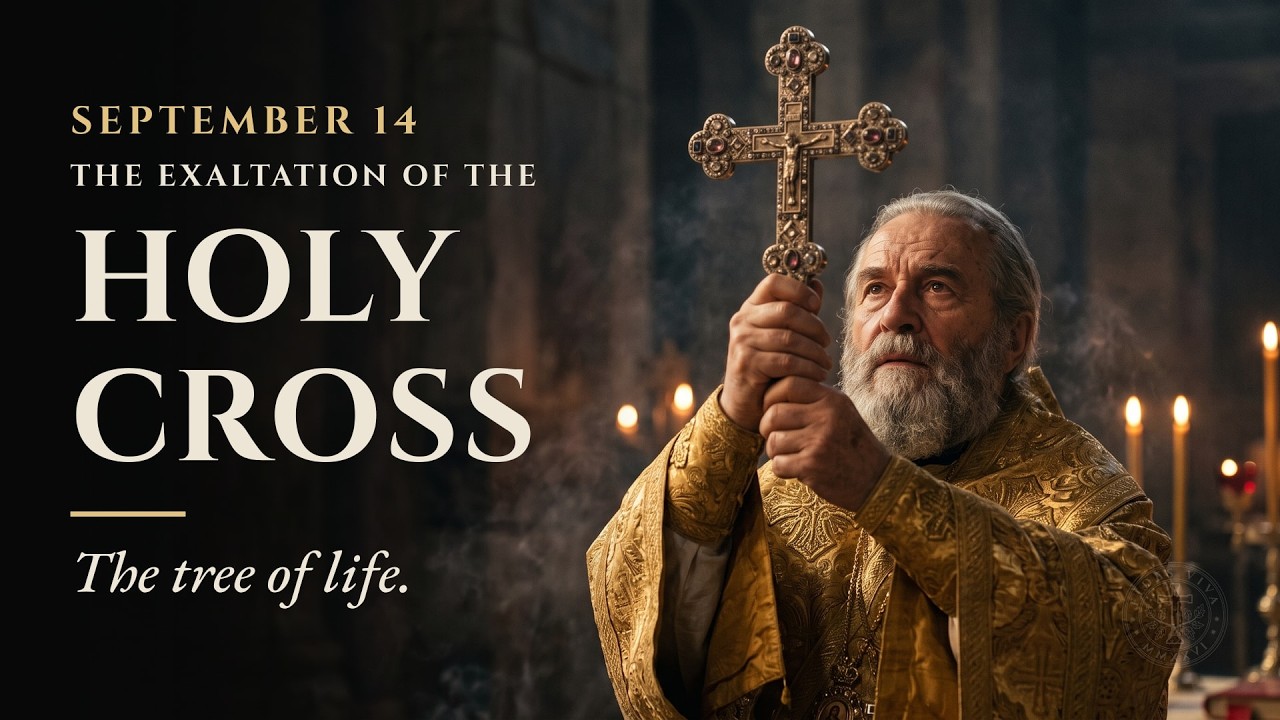
The next day, the 14th of September, the bishop of Jerusalem opens the silver casing. It is the first time. He lifts the wood on which Christ died and shows it to the people gathered at Golgotha. To show, to lift, to hold high: that is to exalt. This is where the feast takes its name, and where it takes its date. It does not remember a martyrdom or a death. It remembers the day an entire city could, at last, look.
Memory takes root quickly. By the year 351, the bishop of the city is named Cyril, and he writes to the Emperor Constantius, son of Constantine. Splinters of the holy wood have already been distributed across almost the whole world: small pieces cut with a saw travel to other churches, which receive them as if they were receiving the entire hill. On May 7th of that same year, in mid-morning, a cross of light appeared above Jerusalem, stretched from Golgotha to the Mount of Olives, and the whole city saw it.
Half a century after the dedication, a woman from Gallaecia, in the northwest of Hispania, arrives in Jerusalem with a walking staff, a mail pouch, and sandals with thick soles. She has been traveling for years. She has seen Sinai and the Jordan, and by night she writes to her sisters in community, the ones who stayed at home, to tell them everything they will never be able to see. Her name is Egeria. Thanks to her ink, that morning was not lost.
It is Good Friday, very early. Behind the rock of Calvary they place the bishop's chair, and the bishop sits. "A table is set before him, covered with a cloth; the deacons stand around the table; a gilded silver reliquary is brought in, in which the holy wood of the cross rests." They open it, take the wood from its casket, and lay it on the linen, in sight of all. The bishop, seated, grips the ends of the beam with both hands. And the people begin to pass.
One by one. Catechumens and the faithful, men and women, bend over the table, touch the cross first with their foreheads and then with their eyes, kiss it, and leave by another door. No one extends a hand. Egeria notes the reason: at some moment, someone in that line bit the wood and carried off a splinter between their teeth. From then on the strongest deacons stand around the table and watch each forehead that bows.
The wood polishes itself, year after year, at the places where thousands of foreheads and lips wear it smooth; it grows darker and smoother just where it is loved most. Guards must be posted, not against an enemy, but against the people themselves who love too much what they touch.
The same pilgrim describes the other great feast of the hill, the one in September, which fills the courtyard and the two churches with pilgrims. "The day of the Encaenia is called that on which the holy church that stands at Golgotha, which they call the Martyrium, was consecrated to God." Encaenia: the feast of dedication, of renewal. In Jerusalem they remember at once the consecration of the basilicas and the day the cross appeared, because for them it is one and the same thing.
So in less than fifty years the impure object has become a rite. It has a date. It has a reliquary. It has a line of people who know exactly how to draw near. A woman from the other end of the world can come and see it and write it down for other women who will never see it. Can a piece of wood unite peoples who do not know each other and generations who will not meet? In Jerusalem, each September, the answer is a hymn that fills the courtyard until nightfall.
And the hymns do not stay in the city. They leave by the same gates as the splinters, and wherever a splinter arrives, someone arrives who wants to sing to it.
Loss, Captivity, and Restoration
In the year 569, a small casket crosses Gaul toward Poitiers. It comes from Constantinople, sent by the Emperor Justin II, and inside it carries a splinter of the same grayish-brown pine wood that Egeria saw laid on the linen. Waiting for it is a queen who left the throne to become a nun: Radegund, founder of a monastery that from that day forward is called Holy Cross, the first in the West dedicated to it. To receive the relic, a poet from Italy, a friend of the house, named Venantius Fortunatus, composes two new hymns.
"Vexilla regis prodeunt, fulget crucis mysterium": the banners of the King advance, the mystery of the cross shines forth. The nuns sing it when the casket enters the church. It is still sung today, every Holy Week. An instrument of execution now has hymns of its own, written for a splinter, on the other side of the world.
Forty-five years later, Jerusalem burns again.
It is the year 614. Persia and the empire of Constantinople have been at war for more than a decade, and the armies of the King of Kings, Chosroes II, advance through Syria and Palestine. The general Shahrbaraz lays siege to the city. When he enters, everything is swift and brutal. Churches set ablaze. Thousands dead in the streets. Columns of captives filing out through the gates. The churches of the city burn, and with them the courtyard where each September the multitude sang. And from Golgotha they carry away what nearly three centuries of pilgrims had come to touch.
The silver casket closes, sealed with wax and lead, wrapped in cloth. With it, toward Persia, goes the patriarch of the city, Zacharias, an old man with a white beard, deported with his people among the columns of captives. Both are bound for Ctesiphon, the Persian capital on the banks of the Tigris.
The convoy moves away through the Syrian desert with silk, gold, lamps torn from churches, and people in chains. Among all that plunder, the sealed casket is hardly noticed. No one opens it. In Ctesiphon they keep it as a trophy, proof that the God of the Romans could not defend his city. For more than fifteen years it will remain there, closed.
For Jerusalem, and for the whole Christian empire, it is as if the memory itself had been torn away. Over the burned hill there settles a new silence, the silence of a house emptied in a single afternoon, where eyes still search for the places where things were.
The emperor who reigns then in Constantinople is named Heraclius. He is the son of the governor of Carthage, of Armenian blood. But instead of waiting behind walls, he leads his own campaigns: he goes at the head of his army, seeking the enemy in their own land. In the year 627, beside the ruins of Nineveh, he defeats the Persians in open battle. A year later, Chosroes II is overthrown by his own men and dies. The empire that had reached the walls of Constantinople crumbles in months.
From those ruins rises the same general who had taken Jerusalem, Shahrbaraz. Now he needs Constantinople to reach the throne, and he negotiates. Among the conditions, one weighs more than provinces: the casket.
And the casket returns. It comes back with the same seals of wax and lead with which it left Golgotha. In all those years no one opened it, no one profaned it. For those who received it, that alone said everything: what was stolen was not defeated. Heraclius brings it back and restores it to Jerusalem in 630, though some historians place the event a year before. The date that remained fixed in the memory of the city was March 21st.
And here, at the gates of the city, tradition preserved a scene that the West has not stopped painting ever since.
The emperor arrives clothed in all that makes him emperor: the purple cloak, the pearl diadem, the imperial sandals. He takes the wood in his arms and means to enter thus, in victory, by the same gate through which Jesus Christ had gone out, carrying that weight toward his execution. And he cannot. His feet will not move forward. He stops.
He removes the diadem. He lets the purple fall. He takes off his sandals. And in a simple tunic, with his feet on the stones, he carries the beam to Golgotha, while the people who survived the fire watch him pass. There they open the casket before all, and the grayish-brown wood, with its dark grain, returns to its gilded silver reliquary.
He carries it now as He carried it then: with nothing over him.
But the restoration lasts only as long as an empire lasts. Jerusalem has fallen twice in six hundred years, and the wood that returns today in procession may depart again in a cart. What remains of a sign when the relic that holds it is lost, or returns for only an instant? The answer is already leaving through the gates of the city, in splinters, in hymns, in the gesture of hands that will never set foot on Golgotha.
Fragments and Memory: The Sign That Does Not Perish
In Constantinople, beneath the dome of Hagia Sophia, a patriarch rises to a high place with a cross in his hands. He lifts it toward the east. Then toward the south, toward the west, toward the north. At each turn, the multitude repeats the same brief prayer, hundreds of times, until the words stop being words and become breath. It is September 14th, and since the beginning of the seventh century the imperial city has celebrated thus what Jerusalem had begun to celebrate three hundred years before: to raise the sign so that all may see it. To exalt, in its literal sense, is to lift it high.
Rome does not wait long to follow. Between the years 687 and 701, Pope Sergius I has a fragment of the wood brought from the Vatican basilica to the Lateran, and there, on the day of the Exaltation, all the Christian people of the city kiss it. What had been a local rite of a hill in Judea is now a feast of the whole Church. And the wood continues to break apart: splinters cut with a saw travel in silver and gold cases toward cathedrals, monasteries, and villages that have never seen Golgotha.
Five and a half centuries later, Jerusalem falls again.
It is the year 1187. The army of Saladin has defeated the Crusaders by the Horns of Hattin, and that same year the city surrenders. The larger fragment—the one Helena left to the bishop, the one Egeria touched with her forehead, the one Heraclius carried barefoot—vanishes. There is no procession of return. There is no sealed chest that comes back fifteen years later. And it never reappears.
And yet, the feast of September 14th continued to be celebrated, year after year, without the relic.
What remained were the splinters, scattered across half the world. In Rome, on the site of the ancient palace where Elena once lived, the basilica of Santa Croce in Gerusalemme rises. Today you reach its chapel of relics by a sloping corridor that climbs slowly, like a small ascent to Calvary. At the end, behind glass, the pieces rest: three fragments of the wood in a reliquary of gold and gems, crafted by the goldsmith Giuseppe Valadier in 1803. Beside them, a tablet of walnut with letters in Hebrew, Greek, and Latin, a piece of nail, thorns. In Cantabria, among the green mountains of the Picos de Europa, the monastery of Santo Toribio de Liébana guards what is held to be the largest fragment in the West. Two arms of dark wood, set in a cross of gilded silver, form a piece just over half a meter high. In Poitiers the relic that gave birth to those hymns is still preserved.
And memory comes down to the street. Every May, in villages across Spain and all of Spanish America, wooden crosses are covered with flowers and carried in procession. With them the fields and houses are blessed. And every morning, in any place in the world, a hand that may never have seen a reliquary traces over the forehead, the chest, and the shoulders the same shape that Rome nailed to a post to erase a man.
There are questions that faith does not avoid. In 1870, a French architect took the trouble to measure every known fragment of the True Cross, one by one, and add them up. The sum gave a small part of the volume of a Roman cross; the rest was lost along the way, or never left Jerusalem. And in 2002 the walnut tablet in Rome passed through a laboratory: radiocarbon analysis placed its wood between the tenth and twelfth centuries. Some see in the tablet a medieval copy of a lost original; others, simply a medieval tablet. Science has not closed the question, and the faith of those who climb the ramp does not wait for it before kneeling. What Jesus Christ carried was a real beam, on a real day, on a hill that is still there. On that, no laboratory has ever had anything to say.
It is enough to stop for a moment before one of these cases to feel the disproportion. A splinter the size of a finger. And around it, vaults twenty meters high, gold, marble, centuries of architecture raised to hold something that would fit in a fist. The scale is inverted: what is venerated is not the wood, but what happened upon it.
The whole beam was lost more than eight hundred years ago. The feast goes on. The gesture goes on. Millions of hands, even now, upon waking, will draw a cross over their own body without any relic asking it of them. There remains a question over those hands: what have they found in the instrument of an execution, that they trace it upon themselves as one puts on a coat before stepping out into the cold?
The Paradox That Saves
Every September 14th, in many churches around the world, a priest lifts a cross above the heads of those who have come. It is no longer a rough-hewn beam. It is a cross of gold, or silver, or polished wood without a single mark. And as he raises it, the choir sings the words that open the Mass of the day: "We should glory in the cross of our Lord Jesus Christ, in whom is our salvation, life, and resurrection."
Glory in the cross. To any man of the first century, that sounded like glorying in the executioner's rope. The first generation of Christians already said it: "We preach Christ crucified: a stumbling block to Jews and foolishness to Gentiles." That is how it all began.
How can what is most humiliated come to be what is most venerated? The wood answered in its own way, without saying a word. It let itself be buried three centuries and, according to what Jerusalem kept afterward, came back to light beneath a laborer's pickaxe. It crossed the desert as spoils, sealed, and so its return was passed on: on the shoulders of an emperor who had to strip away his crown to carry it. And even shattered into splinters, with its greater part lost, it remains the first thing a Christian hand draws upon waking.
But the answer at the heart of it is not in the wood. It is in who hung from it. Jesus Christ did not trade the cross for a throne. He made the cross the throne. And a few paces from the post, the tomb that Constantine would later order excavated to the rock lay, on the third day, empty.
The cross does not explain suffering. It does not beautify it either, nor hide it. Rome did not stop being Rome, the nails stayed iron, the blood went on drying ochre under the sun of Judea. What Easter changes is not the weight of the wood, but what the wood announces: that the final act was not death. That is why the sign could outlive the relic. You can lose a splinter, a chest, an entire city. You cannot lose a gesture that fits in any body and needs to touch nothing to happen.
We too carry beams we did not choose. The diagnosis that arrives in a hospital corridor, the job that ends in a three-line email, the empty chair at Sunday dinner. What do we do with what today seems only weight, only defeat?
He did not avoid it. Long before Golgotha, he had said to his own: "If any man would come after me, let him deny himself and take up his cross daily and follow me." Every day. Not someone else's cross, not a cross of gold. His own. And he was the first to carry it to the end.
The cross raised now hangs in the air of the church, and the assembly looks at it as the people of Jerusalem looked at the wood that the bishop held with both hands. For centuries, the Latin liturgy has offered it a greeting of three words.
Ave, crux, spes unica: "Hail, cross, our only hope." Only. Not one among several, not the most beautiful on a list. The only one that stood when the empires that nailed it fell, buried it, stole it, and gave it back.
The scaffold of slaves is now the sign of the free. What humiliated is what saves.
Holy Cross of Christ, tree of life, sign of hope, throne of our King, pray for us.