Outside the walls of Jerusalem, men come down toward the Kidron with a body on a bier and torches burning. They lay it in a grave cut into the rock, cover it with flowers, and seal the entrance with the stone.
Three days later they open it again. And inside there is no one.
Only the cloths remain, folded and empty, and a smell of flowers filling the whole chamber. The same men who had buried the mother of Jesus stare at the place where her body should be, and that emptiness tells them more than any vision: they had seen a tomb like this before, on the other side of the city, years earlier.
There is one fact that weighs more than any account. That Church hunted for the remains of its martyrs, defended them, raised altars over them. Of Mary it never claimed anything: not a bone, not a relic. No city ever said it had her. In an age that fought over relics, that silence says something.
For almost twenty centuries people prayed before that empty grave without anyone defining it. Until on the first of November 1950, in front of nearly a million people, a pope proclaimed it a truth of faith.
To understand what was kept in that opened tomb with no one inside, we have to go back to the day it all began, on a hill outside the walls.
Silence After Calvary
Jerusalem, under Roman rule. Foreign soldiers keep watch on the walls; in the Temple courts, priests keep a wary eye on the followers of a crucified Galilean. It is a city of limestone and dust, of markets that cry out and crosses planted along the roads, where a newborn faith learns to pray in whispers.
It had all begun on a sunless afternoon, on a hill beyond the walls. Jesus of Nazareth was dying on a Roman cross. At the foot of the wood, in the dust, stood his mother: a small woman, near fifty years old, her veil drawn tight against her face. She did not cry out. She stood there with that serene sorrow that does not complain. Beside her, the only disciple who had not fled. Then the crucified one lowered his gaze toward them both and said to the disciple: "Behold, your mother." Five words like a will. And from that hour, the disciple took her into his own home.
In the days that followed that Passover, she appears again, once, with her name: Mary, the mother of Jesus, persevering in prayer with the apostles in the upper room of a house on Mount Zion. Around her, fishermen marked by fear and by hope; at the center of the silence, she. No one wrote down what she said: the book of the Acts of the Apostles names her and moves on, the way one points to a lamp burning and continues walking. And when the Spirit descended with a rush of wind and tongues of fire, she who in Nazareth had been overshadowed by his shadow now received it with the whole Church.
After that, Scripture falls silent. No evangelist tells of her years that followed; no chronicle of the first century records her end. That silence is part of her portrait. The memory of Jerusalem kept it as one keeps a treasure: it says that she went on living on Mount Zion, among the newborn community, with no office, no title, no written history. A lamp of oil, a water jar, some needlework in her lap. In the gatherings she sat at the edge of the group, listening, her hair now very gray beneath her veil. She kept and pondered all things in her heart, as she had always done. Those were uncertain years: the community prayed with doors half-closed, and more than one of the brothers knew prison for the name of Jesus. Those who had seen the Lord die and those who had seen him rise found in her something they did not know how to name. It was the quiet certainty of one who had believed everything from the beginning. She remained. Still, faithful, almost invisible.
There is something unsettling about that portrait. The mother of the Lord is also the most hidden of the early Church. Her greatness left no documents, no letters, no speeches: only that quiet presence that held everyone together.
How does a life so hidden that even Scripture does not tell it come to an end? For generations, Christians asked themselves the same question. And when they set out to find the answer, they did not find one memory, but two. Two cities, separated by the sea, each claimed to have received her final days.
Two Cities, One Memory
The first was Jerusalem, the city of the cross and the Upper Room. The second lay far away, across the sea: Ephesus, on the coast of the province of Asia, one of the great cities of the Greek world. There, the Christians of that shore remembered, John had lived—the disciple who had received her as his mother. And the question arose of itself: if he had journeyed to that coast, would he have left her behind?
It was not a thought without foundation. The community in Jerusalem had endured hard years: arrests, threats, brothers scattered along the roads with nothing but what they carried. A refuge far from the city, in the care of the beloved disciple, was entirely plausible. So it was remembered there for centuries: that John brought her with him. And that she spent part of her final years in a small house of gray stone, on a slope of pines and cypresses, looking out from above the plain of the Aegean.
It is easy to imagine her there. An elderly woman now, with silver at her temples beneath a light linen veil, spinning by a low doorway, with short steps and hands tired from so much labor. The light of Asia is whiter than the light of Judea; the wind carries the scent of resin and salt, so different from the dry dust of Galilee. She still speaks little, as she had throughout her life. She welcomes those who climb the slope asking after her Son, breaks bread with them, and in her words the young believers hear Christ with a mother's voice. Even today, on that hill above the ruins of Ephesus, a small stone house receives streams of pilgrims in silence.
Yet that memory is the younger of the two. It grew late, sustained more by devotion than by the recollections of the first generations, and the Church has guarded it with affection without ever giving it the weight of the other. Because the other, the more ancient, points insistently to Jerusalem: to Mount Zion, to the house of the community, to a garden of olives at the foot of the walls.
Where did the mother of Jesus close her eyes for the last time? No chronicle settles it, and perhaps that double memory speaks something true: two entire worlds, the Jewish and the Greek, felt her as their own and wished to keep her. But when believers searched for the place of her rest, the most ancient voice answered without hesitation from Jerusalem. There, the earliest memories said, there was no agony, but a sleep. And toward that sleep the gaze now turns.
The Sleep Without Agony: The Dormition
In a house on Mount Zion, the same stone that had listened to so many years of prayer held also her farewell. So the believers of the first centuries told it, from father to son, with the tenderness of those who repeat something sacred: one day, the Mother of Jesus knew that her hour had come near. There was no fear in that knowledge. The accounts of the earliest centuries tell that a messenger from heaven announced it to her and placed in her hands a palm branch—the sign of those who reach the goal. She received it as she had received all things since Nazareth: with a quiet yes, asking no questions.
And then the apostles began to arrive. They came from the roads of the world, where the Gospel had scattered them, and the ancient accounts describe them gathered once more around her, as in the days of the Upper Room. Peter, with broad shoulders and hair already white. John, the son entrusted to her at the cross, who did not leave the bedside. One by one they entered the small room, in silence, as one enters a holy place.
It was not an agony. It was a vigil. The woman who had waited nine months for the Word made flesh now waited for the final encounter, with her hands crossed on her chest and her eyes at peace. She spoke little, as always. She blessed them. And the men who had weathered storms, known prisons, and faced martyrdom bowed their heads before that small elderly woman who took her leave without a complaint, without a tremor.
In the hour of her passage, the door of heaven opened downward. Jesus himself descended, attended by countless angels, to receive the soul of his mother. He who had been carried in her arms came now to carry her. He who had learned from her to take his first steps came now to sustain her last step. The icons of the East would paint this for centuries to come: Christ standing beside the bed, holding Mary's soul in his arms—small and luminous as a child wrapped in white swaddling clothes. Bethlehem, reversed. The Nativity, returned.
For this reason the East never wished to call that death. It called it the Dormition: a falling asleep. The face did not know anguish; the body did not know decay. Death, which from the beginning of the world had entered houses like a thief, entered that room and found itself disarmed. There was nothing there to steal: all had already been given.
And that memory did not remain a family whisper. From the third century onward, Christian communities set it down in writing in the accounts of the Virgin's passing, copied and translated from one language to another throughout the East. They are late texts, yes, and the Church never counted them among the Scriptures. But they stand as a trace: beneath their pages beats what those first generations believed they had received from the apostles themselves.
The body now lay upon the bed. The body that had given flesh to the Son of God, the hands that clothed him, the arms that carried him sleeping. What does the earth do with a body that was the cradle of hope? The answer began that same night, when the apostles—as Jerusalem's memory recalls—lifted it upon their shoulders and, with torches lit, sought the olive-lined path.
The Empty Tomb and the Sign of Thomas
The city fell away behind them, street by street, until the paving stones became a path and the path became a slope. The Church of Jerusalem always remembered that descent thus: the apostles moving down toward the Kidron with the body on a bier, the torches opening a river of light between the twisted olives, the psalmody rising slowly in the darkness. They were the psalms she herself had prayed all her life, now given back over her sleeping body. And they did not sound like weeping. They sounded like a song for the road. The oldest grief in the world—burying the mother—was becoming, step by step, the first procession in honor of the Mother of the Lord. Ahead lay Gethsemane, the garden where her Son had sweated blood; now the earth of that agony was about to receive a rest in peace.
At the foot of the Mount of Olives a tomb awaited them, hewn into the rock: a small chamber with its burial bench, like those Jerusalem carved in those days for its dead. There they laid the body wrapped in white linen, bound with strips of cloth, the face serene and still uncovered. They lit lamps though the night was dark, and left them burning, because no one wished to leave her in darkness. They covered the bench with flowers. And they sealed the entrance with stone—that gesture every child knows: leaving a mother in the earth, not knowing how to walk away.
One was missing. Thomas, who arrived late. The same man who years before had asked to touch the wounds of the Risen One came now from his missionary journeys, dust from travel on his feet and on his cloak. He found the tomb already sealed. A legend cherished by Christian devotion tells what happened next: he asked to see the body one last time so he could bid her farewell. The others could not refuse him. On the third day they rolled back the stone.
Inside there was no one. Upon the stone bench lay the linen wrappings, empty, and a fragrance of flowers that filled the entire stone chamber. The men who three days before had buried the mother stood looking at the hollow where her body should have been, and that hollow spoke to them louder than any apparition. Because they knew a tomb like this. On the other side of the city, many years before, another sepulcher had been left with the wrappings and without the body, and from that emptiness their faith had been born. The certainty came to them unbidden, like an ancient joy returning: Jesus Christ had not left to decay the woman who had given him her flesh. He had taken her with him. Whole.
And the devotion of the West wished to give Thomas, once again, a sign suited to his nature. Centuries later it was told that, as he lifted his eyes, the apostle saw the Virgin already in glory, and that she loosened the cincture that circled her tunic—a simple woolen sash—and let it fall into his hands: a piece of cloth for faith that needs to touch what it believes.
Why did an empty tomb become the heart of that memory? Perhaps because it spoke, without words, what no relic could say. The ancient Church guarded with reverence the bones of its martyrs; it sought them, defended them, built altars above them. Of Mary, by contrast, it never claimed a bone, a fragment, a handful of ash. No city ever boasted of possessing her body, and in a world that disputed over relics, that silence carries weight. What Jerusalem kept was something else: a hollow place. A stone bench where a body rested and is no longer there. Absence made sanctuary.
And that hollow place can still be pointed to on a map. In the early fifth century, an Armenian pilgrim descended into the Valley of Josaphat and visited the tomb of the Virgin; around the year 431, an ancient pilgrim's guide, the Jerusalem Breviary, described there a basilica dedicated to Saint Mary, raised upon her sepulcher. And many centuries later the stone spoke again. In 1972, after a flood, excavations beneath the present church revealed that this burial place was part of a first-century funerary complex, with three chambers carved entirely from the rock. Archaeology cannot prove a mystery. But it confirmed, layer by layer, that memory was pointing to a true place.
Since then, pilgrims have not ceased to descend those stairs. Generation after generation, hands from every people have polished the marble that covers the burial bench, beneath lamps of oil that never go out. And around that emptiness something larger than a shrine began to grow: a feast, a song, a faith that would soon embrace the whole of East and West alike.
From Memory to Song: The Feast of the Assumption
In the year 431, the other city of memory returned to the center of the world. In Ephesus, where tradition placed Mary's final years beside John, bishops gathered from across the empire to answer a question that divided Christendom: if Mary's Son is true God, can this woman be called Mother of God? The council answered with a single Greek word, Theotokos: she who gave birth to God. And that word was like opening a floodgate. Throughout the empire, basilicas began to rise dedicated to the Mother of the Lord, and her name entered fully into the public prayer of the Church.
Rome answered almost at once. Between the years 432 and 440, the mosaics of the triumphal arch of Saint Mary Major showed her enthroned, dressed like an empress, against a background of gold. In that same basilica, for centuries to come, an ancient icon would be venerated—the Virgin with the Child—which legend attributes, with more love than history, to the brush of Saint Luke. (on-screen: "Salus Populi Romani, Saint Mary Major Basilica")
And then the empty tomb of Gethsemane entered the history of empires. Around the year 452, the Emperor Marcian and the Empress Pulcheria were raising in Constantinople a great Marian shrine. They wished for it the highest relic imaginable: the body of the Mother of God. A memory that Jerusalem repeated for centuries, and which a preacher would gather much later, preserves the scene: the most powerful sovereigns on earth asked the bishop Juvenal of Jerusalem to send that body to the capital.
The old bishop's answer was simple and immense. There was no body. The sepulcher, opened before the apostles, had preserved only the shroud. And that was what Juvenal sent to Constantinople, according to that memory: a linen cloth, deposited with imperial honors in the church of the Blachernae. The empire asked for a relic and received testimony to an emptiness. No other answer could have said so much.
From that shared memory a feast was born. In Jerusalem, the commemoration of the Mother of God grew fixed to a single day—the fifteenth of August—and between the sixth and eighth centuries that date spread like a quiet tide. The East celebrated it as the Koimesis, the Dormition; the West received it into its most ancient liturgical books and came to call it the Assumption. Two names for a single certainty, sung each summer beneath the same sky.
The great preachers of the East made it into song: Modestus of Jerusalem, Sophronius, Germanus of Constantinople, Andrew of Crete. And above all, a monk who had come from Damascus, John of Damascus, who in the eighth century preached the feast in Gethsemane itself, standing upon the very sepulcher. There, where anyone could touch the stone, he recalled the ancient procession: that body, he said, was "placed upon the glorious shoulders of the apostles." He was not speaking of a distant place. He was speaking of the ground beneath his feet, and the assembly knew it.
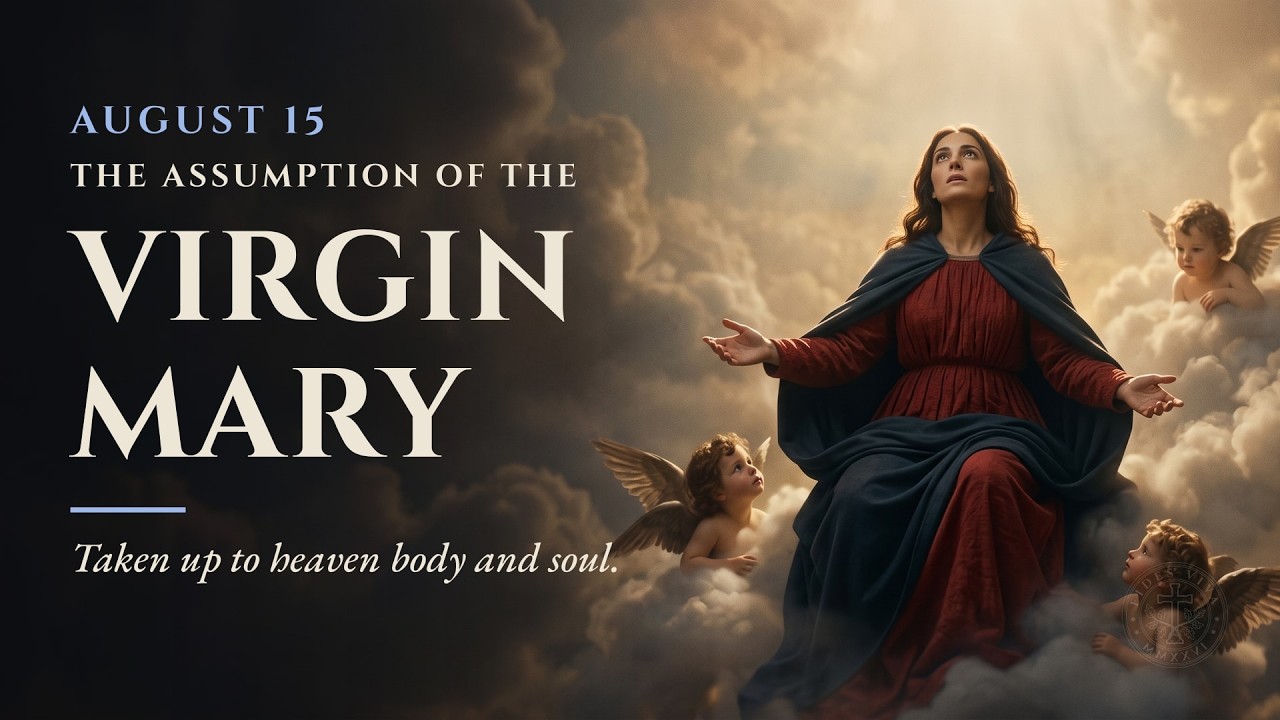
What was sung was painted. The East fixed its image in the icon of the Dormition: the horizontal bed, the apostles bent in two groups, and standing in the center, Christ holding the soul of his mother like a child wrapped in white swaddling clothes. The West looked upward: the Virgin elevated among angels, her blue mantle billowed by a wind not of this world. Titian painted her thus in Venice, burning in red and gold above the astonished apostles; Correggio made her ascend in a spiral through the entire dome of the cathedral of Parma; Rubens placed at her feet the empty tomb covered with flowers.
Devotion wished, moreover, to touch. From the twelfth century onward, the city of Prato guards the green woolen sash with golden threads that its tradition says was given to Thomas, and displays it to the people from the exterior pulpit of the cathedral five times each year; one of them on the fifteenth of August. And from the fifteenth century, in Elche, the feast became sacred theater. Each August, in the packed basilica, a golden pomegranate descends open from the dome with a child dressed as an angel singing within, and below hundreds of faces lift all at once, like a single wonder.
In 1750, Saint Alphonsus Liguori gathered fifteen centuries of doctrine and tenderness in The Glories of Mary, a book that would cross the ocean with the Spanish- and Portuguese-speaking peoples. And in 1910, upon the same Mount Zion where it all began, the Abbey of the Dormition was consecrated, with an image of Mary asleep in its crypt: memory returned home, stone upon stone.
Fifteen centuries of feast, of mosaics, of processions and song. Faith was alive everywhere; but no one had yet pronounced it, aloud and for all time, as a certainty for the whole Church. That hour would come in the twentieth century, over a world freshly emerged from its darkest war.
The Hour of Proclamation: The Dogma of 1950
Europe counted its dead. Entire cities were fields of rubble, and millions of families held the name of someone who had not returned: fallen on a front, vanished in a camp, buried in haste and without a stone. Never in living memory had the human body been treated with such contempt. And it was precisely then, over that landscape of ruins, that the Church chose to speak of the destiny of flesh.
On May 1st, 1946, Pope Pius XII sent a letter to every bishop in the world. It announced nothing: it asked. He wanted to know whether the Assumption of Mary could be defined as a truth of faith, and—this was decisive—whether the bishops and their people desired it. This was not Rome imposing a novelty from Rome, but listening to what the People of God had been singing every fifteenth of August for fifteen centuries.
The answers came from every continent, and they were nearly unanimous: yes. The faith was already there; only the word was lacking. And the word was spoken in the Holy Year of 1950, when Rome filled with pilgrims who crossed a Europe still marked by war.
On November 1st, 1950, dawn broke cold over St. Peter's Square. From earliest light, the crowd filled the plaza until it overflowed: nearly a million people, a multitude that spilled beyond the colonnade. On the outer atrium of the basilica, a platform was raised; around the Pope were arrayed thirty-six cardinals and five hundred fifty-five patriarchs, archbishops, and bishops, who had come from every corner of the earth. Below, a sea of dark coats, hats, and scarves under the low light of November.
When the Pope approached the microphones, silence fell over the plaza like something physical. A million people quiet at once. Then, with slow and solemn voice, Pius XII pronounced the formula that the Church had awaited since the days of Gethsemane: Mary, "having completed the course of her earthly life, was assumed body and soul into heavenly glory." An immense ovation rose over the plaza, and the newsreel cameras captured that moment for the whole world.
Every word had been weighed. The formula does not say whether Mary died or not: "having completed the course of her earthly life" leaves that question where the first centuries left it, open and at peace. And the Pope himself linked that day to another, nearly a century earlier, nearly a century before, when it was defined that Mary was conceived without sin. "These two dogmas are closely bound together," he wrote: she who was preserved from sin from the beginning could not be handed over to corruption at the end. The yes of Nazareth was sealed from one end to the other.
Five years after the furnaces and the mass graves, the Church proclaimed that a human body—the body of a woman, an old woman from a village without rank or record—is already in the glory of God. It was not an abstract idea: it was, at last, an answer. To the century that had turned bodies into numbers, faith showed a crowned body, alive forever beside the risen Christ.
The word was spoken, and spoken for all time. What remained was to understand what that certainty meant for every generation that would come after: not a distant privilege, but a promise made to all.
The Promise for All: Living Hope
Fourteen years later, the entire Church gathered in council gave that word its broadest horizon. In 1964, the Second Vatican Council devoted the final chapter of its great constitution on the Church to Mary. It looked at her in a new way: not as an isolated exception, but as the first of a caravan. The Mother of Jesus, already glorified in body and soul, goes before the People of God who still walk, as "a sign of certain hope and comfort." What she is now, all who belong to her Son will be one day. The Assumption ceased to be only the feast of a single woman: it became the anticipated portrait of redeemed humanity.
And that hope did not remain in documents. Every August fifteenth it returns to the streets. In Asunción, Paraguay, the city itself bears this mystery's name. In the cathedrals of Seville and Guadalajara, in Bogotá and Santa Fe, in countless parishes across the Americas dedicated to Our Lady of the Assumption. In the towns of Brazil that venerate Nossa Senhora da Assunção, the noon of August smells of flowers and the tang of firecracker smoke. Flower-laden platforms advance beneath arches of palm, brass bands open the way, carpets of petals scatter beneath the image's passage, and children look upward, toward the Virgin who ascends. Fifteen centuries of faith made into a feast of the people, year after year, generation after generation.
The chain remains alive until today. On August fifteenth, 2025, in Liberty Square in Castel Gandolfo, Pope Leo XIV prayed the Angelus of the solemnity and read again before the faithful that text from the Council: the woman already glorified, a sign of certain hope and comfort for the people who walk. Hours before, he had celebrated the Eucharist in the local parish, with more than two thousand people gathered from dawn; and for the August that follows, the same gathering was already announced. The papal summer in the Roman hills, with the Assumption as its highest day, takes up a tradition of centuries.
From Gethsemane to an Italian square in the height of summer, the same certainty crosses the centuries without wearing thin. But the feasts end, the bands fall silent, the flowers on the platforms wither as the afternoon falls. And then the promise returns to its deepest place: not the squares, but the heart of each one; not the multitudes, but each particular body we love and that one day we will have to entrust to the earth.
An Empty Tomb: Hope in Everyday Life
Someone, at some point, has stood before a grave. A winter dawn, lilies still fresh, a name carved in stone that we know by heart. There the words run out quickly, and what remains is the only thing that truly matters: what became of the person we said goodbye to, and whether the earth has the final word. In the distance, the city wakes: buses, shutters rising, the ordinary noise. Life goes on, and the question stays there, still, waiting. In Jerusalem there is a tomb you descend to by stairs, and for sixteen centuries pilgrims have visited it precisely because it holds nothing.
A question hung in the air: why did the life of a hidden woman, without records or monuments, become the hope of the human body for millions. Her whole life is the answer. She said yes in Nazareth when no one knew her name, and she kept saying it in a whitewashed house where no one wrote down her days. She held fast to the fidelity of ordinary hours: bread, lamplight, prayer with the others. And that hidden yes, sustained to the end, received a fullness that no power of this world could give: the body that had carried Jesus Christ did not know the corruption of the grave.
There is in this a quieter comfort. Almost nothing remained of her greatness: after the Resurrection, Scripture names her only once, praying with the apostles. How many lives resemble hers—mothers and fathers who held a house together without anyone recording it, the sick who offered whole years in silence, the daily faithfulnesses that never made the news. The Assumption speaks for them too: what is hidden is not lost, and what is small, when it is given in love, weighs in heaven more than empires.
We too carry the same question, though we do not speak it aloud. It returns in the hallway of a hospital, in the call that comes at dawn, in the first anniversary of an absence. What do we do with the promise that the bodies we have held are not destined for dust?
Mary did not answer it with speeches. She answered it by living: she believed, she waited, she remained at her Son's side all the way to the foot of the cross, and she trusted when nothing was left to see. That is why the ancient accounts remember her sepulcher full of flowers, and why, twenty centuries later, half the world still lifts its eyes each August fifteenth. She was the first; she will not be the last. The promise stands open for all who love, who bury, and who hope. Her empty tomb still declares, in the silence of Gethsemane, that love has more future than death.
Holy Mary, Mother of God, Virgin assumed into heaven, hope of the faithful, pray for us.