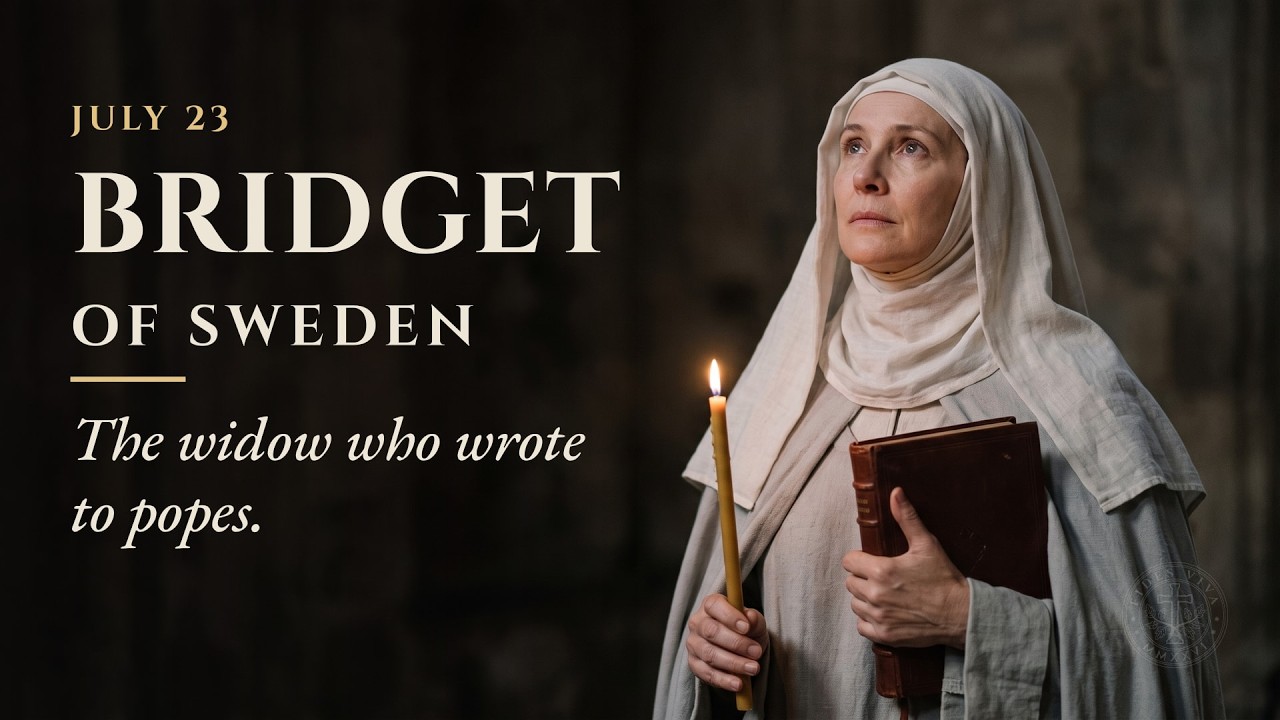
Beneath the portico of a half-ruined church, an old woman in a threadbare cloak holds out her hand. No one would guess she was born among the kinsmen of kings, or that popes receive the letters she sends. What changes a life so completely?
The Girl Who Could Not Forget
The beginning lies far from that portico: at the northern edge of Christendom, where the fourteenth century smelled of birch resin and wood smoke. Sweden was then a young kingdom, newly settled in the faith. Its stone churches rose among forests of birch and granite, under winters half a year long and summer nights that scarcely darkened. Far to the south, the Church was entering one of its most turbulent centuries: Rome would soon be left without its shepherd. The north, meanwhile, prayed by the fire, with the fervor of those who have just received the faith and are only beginning to live it.
On an estate at Finsta, in the Swedish region of Uppland, a girl named Birgitta was born around the year thirteen hundred and three — daughter of the judge Birger Persson. Her family was among the most powerful in the realm, tied by blood to the royal house: people of law and land, accustomed to giving orders and being heard. Beside their house stood the church her own father had ordered built: faith and power grew up together under one sky. In time, all of Christendom would know her by the name we give her in our own tongue: Bridget.
She grew up amid the crackle of firewood and the smell of bread, with the snow packed against the windows for months on end. She was a girl of fair, rosy skin, with golden-blond hair in two braids and grey-blue eyes that looked straight ahead. Alert and strong-willed, she had that early seriousness of children who listen more than they speak.
The oldest memories preserved of her tell how, very young, she saw the Virgin one night, offering her a crown. The child bowed her head to receive it. And they tell of something more. Around the age of ten she heard a sermon on the Passion of Jesus Christ: the scourging, the thorns, the nails. That night, in a dream, she found herself before Christ crucified, covered in wounds, the blood still fresh. And she heard him speak.
"See the state I am in, my daughter."
She asked who had done this to him, and the answer lodged in her forever: he was wounded by those who scorned him, those who forgot his love.
She woke with the wounded face burned into her memory. Other children lose their dreams at first light; she could not forget it, nor did she want to. That compassion came to live in her like a glowing ember: the certainty that someone was suffering out of love, and that almost no one took it to heart. Her whole life — and it was a long life, full of roads — would be that girl's answer to the man of the wounds.
But the world does not wait for girls to finish understanding their dreams. In that Sweden, the daughters of great houses were pieces on the board of alliances, and her father was already thinking of his daughter's future. What would a girl do with that ember when her fate was already written by others? For her childhood ended soon. Around the age of thirteen, Bridget's life was no longer hers to decide.
A Holiness Made at Home
The chosen man was named Ulf Gudmarsson. He was a young nobleman, only a few years older than she was, son of a family of judges like her own, destined to govern the province of Närke. Around the age of thirteen, Bridget married him, as the daughters of great houses married then: by her father's decision, before God and before men, with all the solemnity of the north. A girl and a young man stood facing each other, promising a life that neither of them could yet imagine.
And yet that arranged marriage became one of the most fruitful love stories of its century. Ulf and Bridget shared twenty-eight years on the estate of Ulvåsa, among the lakes and meadows of Östergötland. There eight children were born — four sons and four daughters — and among them a girl named Catherine, who in time would follow her mother's path all the way to the altars. The house was large and its mistress young; she managed larders, servants, and harvests with the keys at her belt and the book of hours within reach. She prayed as she administered; she raised her children in the faith as she watched over the accounts. None of it seemed to her too ordinary for the soul: for her, the home was the first temple.
And she did not walk alone. Husband and wife grew together in the faith, in time embracing the rule of the Franciscan tertiaries — lay people who, without leaving their state in life, bound themselves to prayer, plain living, and care for the poor. Beneath the great lady's silks lay a hidden Franciscan cord. With Ulf she founded a small hospital beside the estate, and she did not merely pay for it: she went herself, washed the wounds, fed the sick with her own hands. The servants saw their mistress kneeling before a beggar covered in sores. Perhaps they did not understand that she was serving Christ — the man of the wounds from her childhood — in each of those broken bodies.
Her fame as a wise and upright woman crossed the realm. In thirteen hundred and thirty-five, King Magnus Eriksson, a kinsman of hers, called her to the court at Stockholm. The task was delicate: to be teacher to his young wife, Blanche of Namur, a princess from Walloon lands who knew neither the language nor the customs of the north. The lady of Ulvåsa settled in among continental silks and northern furs, teaching an adolescent queen how to be Swedish. And as she taught, she watched. She saw the luxury up close, the frivolity, justice bent by favor; she saw how wide a gulf could open between the crown and the Gospel. She still kept silent. But something in her was beginning to take note, like one who saves up words for a day that has not yet come.
Seen from the outside, her life looked complete: a faithful marriage, eight children, a prosperous house, the king's favor, charity practiced without noise. Many would have rested in that fullness. But the faith she and Ulf shared asked for one step more, and the two of them felt it at once — the desire to set out, like so many Christians of their time, toward a distant shrine at the far end of Europe.
Husband and wife set out together on the longest journey they had ever made. Only one of them would return alive.
The Ring upon the Tomb
Around thirteen forty-one, Ulf and Bridget took to the road toward Santiago de Compostela, at the western edge of Christendom. There the faith of the age venerated the tomb of the Apostle James. Months of marching across Europe: mountain passes, swollen rivers, hostels crowded with pilgrims of every tongue. The great lady of the north walked in a brown traveling smock, a wide-brimmed hat over her veil. She carried the pilgrim's staff in her hand; her skin was weathered by sun and wind. Beside her walked the governor of Närke, now just one more pilgrim among thousands.
At last they came before the Romanesque cathedral, beneath the carved stone of the Portico of Glory. There, husband and wife knelt together, with nearly thirty years of shared life behind them. They had shared the bed, the children, the accounts, and the poor; now they shared the same offering. It was the summit of their marriage, and also its farewell, though they did not yet know it.
On the way home, Ulf fell ill. The road back toward the north grew slow and full of dread; she nursed him at every stage, as she had nursed so many sick in her hospital. But this time the wounded body was that of the man of her life. They reached Sweden and sought refuge in the Cistercian monastery of Alvastra, near Mount Omberg and the waters of Lake Vättern. Within those walls of gray stone, in thirteen forty-four, Ulf Gudmarsson gave up his soul to God. Twenty-eight years of marriage ended in a monastic cell, with the monks' chant sounding in the background.
What the widow did then left a mark that Sweden did not forget. She went to her husband's tomb, drew off her wedding ring, and laid it upon the stone. It was no rejection of the love she had lived: it was her offering. Everything that ring had meant — the faithfulness, the children, the home — she now placed into the hands of God, to belong to him alone. She divided her goods among her children and the poor, and traded her silks for a rough gray tunic of penance. She covered her face with the white veil of widows and stayed on to live beside the monastery, in prayer and fasting.
And in that silence, the voice returned. She herself would tell of it afterward, and the Church would receive her inner experience with reverence. In prayer, Christ spoke to her as he had not spoken since she was a child. "You shall be my bride and my channel, and you shall hear and see spiritual things." Bride and channel. The widow of Alvastra was betrothed anew, this time to the Lord Jesus; and through her, and through her, as through a channel, words would pass that were not her own.. So began the Heavenly Revelations. Bridget received them in Swedish, caught up in prayer, and dictated them. The monastery's prior, Peter of Alvastra, a learned and sober monk, rendered them into Latin, the language of the Church, so they could be read across all Christendom.
That voice would not fall silent. And it brought more than consolation: it brought commissions, warnings, messages for kings and prelates that no one dared to speak aloud. It soon became clear that what the widow heard in the silence of Alvastra was not meant to stay in Alvastra. It had to be carried far, to the ailing heart of Christendom: it had to be carried to Rome.
The Voice That Unsettled Popes
Before she set out, the voice entrusted her with a work. In prayer, Christ showed her a new order, consecrated to the Most Holy Saviour: a double monastery, with sixty nuns and a community of priests and brothers who called the apostles to mind. All of it under the authority of an abbess. A house of praise at the far northern edge of the world. King Magnus Eriksson, who had honored her so highly at court, gave over his palace at Vadstena for the foundation, on the shore of Lake Vättern. The walls were promised; the essential thing was still missing: no order could be born without the pope's approval. And the pope was not in Rome.
For decades the successors of Peter had dwelt in Avignon, under the shadow of the kings of France, while the city of the apostles sank into neglect. Yet toward Rome everything still pointed. In thirteen forty-nine, with the great Jubilee of the coming year on the horizon, the widow of Alvastra set out for Rome to seek approval of her rule. She was about forty-six. As she crossed the border of her kingdom she could not have known it, but she would never set foot alive on her own soil again.
The Rome she found bore no likeness to the glory the pilgrims sang of. It was a depopulated, ruined city, its basilicas half-abandoned and its streets overgrown with weeds; the chroniclers of the age went so far as to tell of she-wolves prowling near the Lateran. With no pope, the heart of Christendom scarcely beat. In the midst of that desolation, the Swede settled in a house that soon became a home for pilgrims from the north, a school of prayer, a refuge for the poor. And in thirteen fifty came the sweetest consolation of those years: her daughter Catherine, widowed very young, crossed Europe to join her. She came for a visit; she stayed for good. From then on mother and daughter would share the same poverty, the same prayer, the same destiny.
For it was poverty in earnest. The lady of Ulvåsa, the kinswoman of kings, the teacher of a queen, spent all she had on the poor and the pilgrims until nothing was left. And then she did the unthinkable: she held out her hand. Beneath the porticoes of the churches, among the beggars of Rome, an old woman from the north asked for alms with the same upright bearing she had once carried through the halls of Stockholm. No one forced her to it. She had chosen to resemble Christ in his poverty even in this, even in the humiliation of depending on the mercy of others.
But the hand that begged was the same hand that wrote. For more than twenty years, out of that Roman house went letters that made chancelleries tremble: to the kings of France and England, locked in an endless war, pleading for peace in the name of God. To the popes of Avignon she directed, again and again, one demand that never wore thin: return to Rome, return to the tomb of Peter. She did not speak in her own name. She passed on what she heard in prayer, like one delivering a message that is not her own; and the Church, in time, would receive with reverence the authenticity of that inner experience. Between one letter and the next, she made her pilgrim way through Italy — Assisi, Gargano, Naples — wearing out the roads as others wear out their lives.
And one day the powerful listened to her. Urban V returned to Rome in thirteen sixty-seven, and for a few years the city had a pope again. Before him the Swedish widow came forward: black mantle, white veil, the straight back of one who asks nothing for herself. In thirteen seventy, Urban approved the rule of the Most Holy Saviour: Vadstena had its foundation at last. But the pope, weary, was looking back again toward Avignon, and she warned him, with all the gravity of her soul, not to return. He did not listen. The papal court went back to southern France, and Rome was left a widow once more.
More than twenty years of insisting, and the fruit did not come. Another would have called that wait a failure. She called it faithfulness, and went on writing. And when it seemed she had already given everything, at nearly seventy, the old woman lifted her eyes from her letters and looked toward the sea. The longest journey of her life still lay ahead of her, toward the land where everything had begun.
The Light of Bethlehem
On the fourteenth of March, thirteen seventy-two, a ship sailed from the port of Naples bound for the East. It carried pilgrims, merchants, and an old woman of nearly seventy: bent, frail, her hair silver-white beneath the veil, her staff in her hand. At her side, as always, Catherine. To cross the sea to the Holy Land was then a wager against the storms, against the pirates, against old age itself. And the sea took its share: near the coast the ship ran aground and partly broke apart, and the pilgrims barely escaped with their lives. She did not turn back. It was not fear that carried her; it was desire, and the desire weighed heavier than the sea.
When at last she set foot in the Holy Land, the pilgrim slowly walked the road she had dreamed of all her life. In Jerusalem she walked the places of the Passion: the golden stone beneath the sun, Calvary, the empty Sepulchre. Sixty years before, a Swedish child had woken weeping over the wounds of a crucified man who spoke to her in dreams. Now, old and bent, she touched with her own hands the walls where those wounds had truly been opened. The circle of her life was beginning to close.
And in August she came to Bethlehem. She went down into the grotto of the Nativity, beneath the old basilica: a chamber of rock, narrow, lit by oil lamps. There she knelt. What she lived through then she herself dictated soon after, and it was set down in the seventh book of her Heavenly Revelations.
The darkness of the grotto opened into light. She saw the Virgin kneeling, in prayer, and on the ground, naked and shining, the newborn Child: Jesus, with a brightness no lamp could give. His Mother did not hold him in her arms; she adored him on her knees, her hands joined, like the first believer before her God made flesh. And the old woman, kneeling in her turn, watched the birth of the Lord as though it were happening before her eyes.
After a lifetime spent gazing at the wounds, she was granted to look upon the beginning: the same body, still unhurt, shining upon the stone. It was the deepest consolation of her seventy years. The face worn down by the journey was bathed in that brightness, serene as it had never been.
That image did not stay in the grotto. Only a few years later, painters across Italy began to show the Nativity in a new way — the Mother on her knees, the Child naked and radiant on the ground. From workshop to workshop, the scene crossed Europe and entered altarpieces, miniatures, frescoes. The vision that consoled an old woman in a cave of Judea left a deep mark on the way the West has pictured Christmas Eve ever since.
With that light in her eyes she set out for home. The way back was as hard as the way out, and the pilgrim reached Rome worn thin, ill, aged all at once. She carried that brightness of Bethlehem with her; she carried too, untouched, all that she still hoped for. Vadstena was still unfinished. The pope was still in Avignon. And to the old woman who had seen the glory of the manger there remained the most silent trial of all: to die without seeing the fruit.
The Hope She Never Saw
In Rome her poor house was waiting, always open to the pilgrims of the north, and a task that allowed no rest. Ill, worn out by the journey, she dictated her last letters to the pope in Avignon. Her confessors' pens ran across the paper. In a voice worn to a whisper she repeated what she had been saying for more than twenty years: that the shepherd should return to the tomb of Peter. Then she sealed the letters and waited, as she had always waited.
The end came with the Roman summer. On the twenty-third of July, thirteen seventy-three, at daybreak, the light entered the cell where she lay. She was about seventy years old. Catherine kept watch at her side, as she had done for more than two decades; around her, her confessors prayed in low voices. She held a crucifix between her hands: the image of the wounded Christ that had been with her since that childhood dream in Finsta. So died the woman who had been born a princess: in a borrowed house, far from her own land, poor among the poor.
She died without seeing almost anything she had asked for come to pass. Vadstena stood only half-built; the pope, in Avignon; her order barely begun. In the eyes of the world, that life ended as an unfulfilled wait. But what she had sown began to grow almost at once.
One of her confessors gathered the notebooks and set the Heavenly Revelations in order to hand them to the Church. And before anyone spoke of canonization, the painters had already gone ahead. In Italy the first panels appeared with the Virgin kneeling before the Child shining upon the ground, just as the old woman had seen him in Bethlehem. Her voice went on speaking in ink and in color.
The following year, her children set out with the body on the long road back to the north: months of travel across a Europe that had watched her pass as a pilgrim. On the fourth of July, thirteen seventy-four, her remains were laid to rest in Vadstena, beside Lake Vättern, in the monastery she had dreamed of and that was still being built. The widow who died far away was coming home. And her work, instead of dying with her, was putting down roots on that shore.
The greatest thing was still to come. In thirteen seventy-seven, four years after that Roman daybreak, Pope Gregory XI left Avignon and entered Rome. The successor of Peter was returning to his see, this time to stay. No bells were rung for the Swedish widow; but few voices had asked for that return with as much constancy as hers. The hope for which she pressed on for decades came true when she could no longer see it. Perhaps that is why the Christian people still call on her as patroness of lost causes.
What she never saw grow did not cease to bear fruit: it went on growing for centuries, down to our own day. The road that began beside a tomb in Alvastra opened out into a church beside a Swedish lake. And it was not going to stop there.
Patroness of a Continent
Eighteen years were enough. On the seventh of October, thirteen ninety-one, Pope Boniface IX raised her to the altars: she was the only woman canonized in the whole of the fourteenth century. The Church recognized in the widow of the north what ordinary believers had known all along: that God had spoken through her. In Vadstena, the monastery she had dreamed of rose at last beside the lake. For generations it was the spiritual heart of Scandinavia: a beacon of books, of liturgy, and of charity lit at the edge of the world. Catherine, her daughter, guided the community's first steps; today the Church venerates her, too, as a saint.
Six centuries later, history held in store for her a title wider than her homeland. On the first of October, nineteen ninety-nine, Saint John Paul II proclaimed her co-patroness of Europe, alongside Catherine of Siena and Teresa Benedicta of the Cross, Edith Stein. Three women were called to uphold a continent in spirit; among them was the Swede who crossed it on foot, from Compostela to Jerusalem, stitching north and south with her steps.
Today her remains rest in the church of Vadstena, the "Blue Church," so called for the grey-blue stone that faces the Vättern. And there something happens that she would have understood well: before her reliquary, Catholics and Lutherans pray side by side, brothers parted for centuries who meet around the same mother. The voice that pleaded without rest for the unity of the Church has become, in her own land, a sign of reconciliation.
She was a bridge, too, between the ways of following Christ. Wife and mystic, mother and founder, lady of the court and beggar of the portico: she did not have to stop being the one to become the other. In every state of life she found a way to love Christ — that is the inheritance she left to those who stay in the world, and those who leave it all behind.
That is why her life has not stayed in the books. It goes on asking a question of everyone who hears it, centuries later: the same one she answered without words, with her feet, with her hands, with her waiting. From the girl of Finsta to the patroness of a continent, that question has crossed the centuries unchanged. And it is still awaiting an answer.
The Truth Spoken in Love
An open hand beneath the portico of a church in ruins. That is where it all began: an old woman begging for bread in a strange city, no one guessing her name. Now that hand can be understood. It was not the hand of just any poor woman: it belonged to a woman who had received too much to keep it for herself. Nobility, love, children, a voice: all of it was given to her, and all of it she kept giving back. The stripping away was not her ruin. It was her freedom.
What moves a great lady, who had everything, to choose to beg and to speak without fear to the powerful of her time? She never explained it. She lived it. She loved a man for twenty-eight years, and she lost him. She raised eight children and left a ring upon a stone. She spoke the truth to kings and popes, not out of ambition, but out of faithfulness to Christ, who had called her by name. She waited, whole decades, for a fruit she never saw. The girl who could not forget a wounded face spent her whole life answering him. That was her whole answer: deeds, one after another, to the end.
We too live lives that seem already written: a home to hold together, work that will not wait, a grief we carry in silence. We keep, perhaps, something safe that we are afraid to let go. And on any ordinary morning, between the keys and the bread, there is room for the same call she once received. The fruit, perhaps, will be seen by others. She sowed all the same.
For the greatest work of a life can come into flower when the one who sowed it is no longer there to see it.
Saint Bridget of Sweden, faithful mother and wife, prophetic voice before the powerful, foundress of the Most Holy Saviour, co-patroness of Europe, pray for us.